
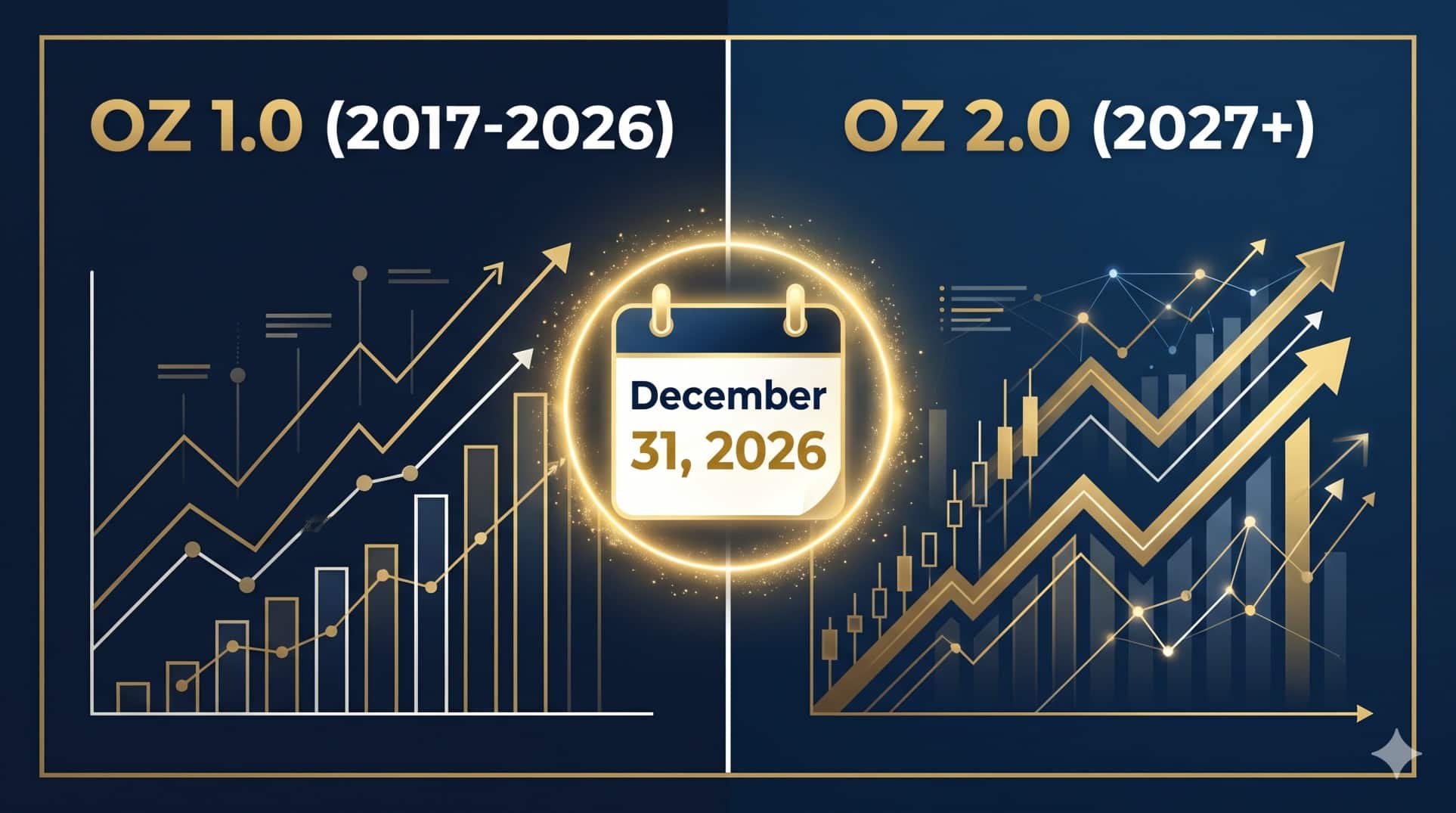
⚡ Executive Summary: 2026 Opportunity Zone Updates
- The Hard Deadline: All capital gains deferred under the original 2017 program must be recognized on December 31, 2026, and reported on your 2026 tax return.
- The FMV Loophole: If your QOF investment has lost value, securing a Fair Market Value (FMV) appraisal before year-end can legally reduce the amount of deferred gain you must recognize.
- OZ 2.0 is Here: The One Big Beautiful Bill Act (OBBBA) made the program permanent, introducing a rolling 5-year deferral and a massive 30% basis step-up for rural zones starting in 2027.
- 10-Year Rule Remains: The most powerful benefit—tax-free appreciation after a 10-year hold—remains fully intact for both legacy and new investments.
Table of Contents
- The December 31, 2026 Deadline: The End of OZ 1.0 Deferrals
- How the FMV Appraisal Strategy Can Lower Your 2026 Tax Bill
- Enter OZ 2.0: The OBBBA and the Future of Opportunity Zones
- Standard vs. Rural Zones: The New 30% Step-Up Explained
- IRS Notice 2026-40: Transition Rules for Active Projects
- Step-by-Step: Preparing Your QOF Investment for the 2026 Tax Year
- State Tax Conformity: The Hidden Trap for QOZ Investors
- Are the Tax Benefits Still Worth It for New Money?
- Frequently Asked Questions About Qualified Opportunity Zones in 2026
The December 31, 2026 Deadline: The End of OZ 1.0 Deferrals
If you deferred capital gains into a Qualified Opportunity Fund (QOF) anytime between 2018 and 2026, the bill is finally coming due. Under the original Tax Cuts and Jobs Act (TCJA) of 2017, the deferral period for all legacy investments ends on December 31, 2026.
This means you must recognize those deferred capital gains 2026 on your federal tax return, which you will file in April 2027. You cannot re-defer this specific gain by rolling it into another fund. The IRS requires you to pay the tax based on the capital gains rates in effect for the 2026 tax year, not the year you originally realized the gain.
Many investors are caught off guard by this “phantom income” event. You owe the tax regardless of whether you have sold your QOF investment or received any cash distributions from the fund to cover the liability. If your money is tied up in an illiquid real estate development, you must source the cash to pay the IRS from your outside assets.
However, the tax code provides a specific calculation for exactly how much gain you must recognize. You do not automatically pay tax on the entire original amount if you met certain holding periods or if the asset depreciated.
How the FMV Appraisal Strategy Can Lower Your 2026 Tax Bill
One of the most critical Opportunity Zone expiration rules involves a built-in safety net for underperforming investments. IRC Section 1400Z-2 caps the amount of gain you must recognize at the lesser of two numbers:
- Your remaining deferred gain.
- The Fair Market Value (FMV) of your QOF interest on December 31, 2026, minus your basis in the fund.
If your QOF investment lost value due to market conditions, high interest rates, or project delays, you can use the FMV limitation to permanently erase a portion of your deferred gain. To claim this, you need a qualified, independent appraisal of your specific fund interest before the end of the year.
Scenario 1: The FMV Limitation in Action
Marcus sold his tech startup in 2019 and realized a $2,000,000 capital gain. He immediately invested the full amount into a QOF to defer the tax. Because he held the investment for five years prior to 2026, he received a 10% basis step-up. His basis is now $200,000, and his remaining deferred gain is $1,800,000.
By December 31, 2026, the commercial real estate market has softened. An independent appraisal values Marcus’s QOF interest at only $1,500,000.
The Math:
- Remaining Deferred Gain: $1,800,000
- FMV ($1,500,000) minus Basis ($200,000) = $1,300,000
Marcus must recognize the lesser of the two amounts. He only reports $1,300,000 of capital gain on his 2026 tax return. The remaining $500,000 of his original gain is permanently excluded from federal taxation.
Without a formal appraisal, the IRS will assume the FMV exceeds your deferred gain, forcing you to pay tax on the maximum amount. Given the volume of investors facing this deadline, appraisal firms are heavily booked. Securing an appraiser early in the fourth quarter of 2026 is a non-negotiable step for any serious QOF investment strategy.
Enter OZ 2.0: The OBBBA and the Future of Opportunity Zones
For years, the industry wondered what would happen to Opportunity Zones after 2026. The original legislation was temporary, and the window to achieve the maximum tax benefits closed years ago. That changed entirely with the passage of the One Big Beautiful Bill Act (OBBBA).
The OBBBA makes the opportunity zone program a permanent fixture of the US tax code. Often referred to as “OZ 2.0,” this new framework applies to investments made on or after January 1, 2027. It redesigns the incentive structure to fix the flaws of the original program while offering massive new benefits for patient capital.
Under OZ 2.0, the rigid December 31, 2026 deadline is replaced with a rolling five-year deferral. If you realize a capital gain in 2027 and invest it into a new QOF, you defer the tax until 2032. If you invest in 2029, you defer until 2034. This rolling structure makes the program a permanent, tax-efficient tool for wealth management, rather than a one-time legislative loophole.
Read more about long-term capital gains tax strategies for high-net-worth individuals.Furthermore, the OBBBA mandates that governors redesignate all Qualified Opportunity Zones every 10 years. The first redesignation process kicked off on July 1, 2026. The new maps tighten the eligibility requirements, ensuring that capital flows into genuinely distressed communities rather than gentrifying neighborhoods that no longer need the economic stimulus.
Standard vs. Rural Zones: The New 30% Step-Up Explained
The most aggressive change in the OBBBA is the introduction of tiered basis step-ups. Under the original rules, investors could get up to a 15% step-up if they invested early enough. OZ 2.0 brings the step-up back, but it heavily favors rural development.
If you invest in a standard, urban Qualified Opportunity Zone under the new rules and hold the asset for five years, you receive a 10% step-up in basis. This effectively eliminates 10% of your original deferred gain.
But if you invest in a designated “Qualified Rural Zone,” that step-up triples to 30% after a five-year hold. The federal government is using the tax code to force capital out of saturated coastal cities and into America’s agricultural and rural manufacturing hubs.
Scenario 2: The 30% Rural Step-Up
Elena sells a portfolio of stocks in March 2027, realizing a $1,000,000 capital gain. She immediately rolls the gain into a QOF that is building affordable housing in a designated Qualified Rural Zone in Ohio.
The Timeline:
- 2027: Elena defers the $1,000,000 gain.
- 2032 (Year 5): Elena receives a 30% basis step-up ($300,000). Her rolling 5-year deferral ends. She pays tax on only $700,000 of her original gain.
- 2037 (Year 10): Elena sells her QOF interest for $2,500,000. Because she held the investment for 10 years, the $1,500,000 in appreciation is 100% tax-free.
This dual-benefit structure makes taking a fresh look at opportunity zone benefits mandatory for anyone generating significant capital gains in 2027 and beyond.
IRS Notice 2026-40: Transition Rules for Active Projects
Because the original zone designations expire at the end of 2026, developers and fund managers faced massive uncertainty regarding active, half-finished projects. If a zone loses its QOZ status on January 1, 2027, does the fund lose its tax benefits?
The Treasury Department resolved this by issuing IRS Notice 2026-40 in June 2026. The notice provides critical transition relief for active projects caught between the old and new maps.
If a Qualified Opportunity Fund or a Qualified Opportunity Zone Business (QOZB) has an active working capital safe harbor plan in place before December 31, 2026, the project retains its QOZ status through completion, even if the underlying census tract is not redesignated by the state governor. The notice also allows for ordinary course replacement property acquisitions within those legacy zones.
However, Notice 2026-40 explicitly states that investors cannot take the deferred capital gains 2026 triggered by the December 31 inclusion event and re-defer them into a new OZ 2.0 fund. The original gain must be recognized and taxed. Only new gains realized in 2026 or later are eligible for the OZ 2.0 rolling deferral.
Step-by-Step: Preparing Your QOF Investment for the 2026 Tax Year
Taxpayers in this situation generally need to execute a precise sequence of actions before the ball drops on New Year’s Eve. Failing to prepare for the inclusion event will result in underpayment penalties and missed tax savings.
Step 1: Audit Your Legacy QOF Holdings
Gather the K-1s and original deferral documentation for every QOF investment you made since 2018. Calculate your exact deferred gain and your current basis. If you held the investment past the 5-year or 7-year marks prior to 2026, ensure your basis reflects those automatic step-ups.
Step 2: Commission a Fair Market Value Appraisal
If you suspect your QOF interest is worth less than your deferred gain, hire an independent valuation firm immediately. The appraisal must specifically value your partnership interest or stock in the fund, not just a pro-rata share of the fund’s underlying real estate. This document will serve as your defense if the IRS audits your 2026 return.
Step 3: Model Your 2026 Tax Liability
Work with your CPA to project your 2026 marginal tax bracket. The deferred gain will be taxed at the capital gains rates applicable in 2026, which includes the Net Investment Income Tax (NIIT) if your income exceeds the threshold. Do not assume you will pay the exact rate that existed in the year you originally sold the asset.
Step 4: Secure Liquidity
You will need cash to pay the IRS by April 15, 2027. If your QOF is not issuing a cash distribution to cover the tax liability, you must liquidate other portfolio assets, arrange a line of credit, or harvest tax losses in your standard brokerage accounts to offset the incoming gain.
State Tax Conformity: The Hidden Trap for QOZ Investors
Federal tax laws are only half the battle. When evaluating Qualified Opportunity Zones in 2026, you must strictly separate federal rules from state rules. Not all states conform to IRC Section 1400Z-2.
States like California, New York, and Pennsylvania have historically decoupled from federal Opportunity Zone legislation. If you live in a non-conforming state, you likely already paid state-level capital gains tax on the original sale back in the year it occurred. Consequently, you will not owe state tax on the federal inclusion event in 2026.
Conversely, if you live in a conforming state, your state tax bill will come due at the exact same time as your federal bill. You must ensure your liquidity planning accounts for both the IRS and your state department of revenue.
Scenario 3: The State Conformity Trap
James lives in California. In 2021, he sold a business for a $500,000 capital gain and invested it in a QOF. Because California does not conform to federal QOZ rules, James had to pay California state income tax on that $500,000 on his 2021 state tax return.
On December 31, 2026, James faces the federal inclusion event. He will owe federal capital gains tax on the $500,000 (minus any basis step-ups). However, he will owe zero California state tax on this event, because he already paid it five years ago.
Are the Tax Benefits Still Worth It for New Money?
With the transition to OZ 2.0, many investors are asking if QOZ tax benefits are still a viable wealth-building strategy. The answer is a resounding yes, provided the underlying real estate or business fundamentals are sound.
The original program faced criticism because capital often flowed into gentrifying areas that were already positioned for development. The OBBBA’s tighter census tract requirements mean new investments will require more rigorous due diligence. You are investing in genuinely distressed or rural areas, which carries higher execution risk.
However, the tax incentives compensate for that risk. The rolling five-year deferral provides immediate time-value-of-money benefits. The 30% basis step-up for rural zones is one of the most generous tax reductions currently available in the federal code. Most importantly, the crown jewel of the program—the ability to exit the investment after 10 years and pay absolutely zero federal capital gains tax on the appreciation—remains fully intact.
If you have a long-term investment horizon and are willing to lock up capital for a decade, a QOF investment remains a premier tax-efficient tool.
Frequently Asked Questions About Qualified Opportunity Zones in 2026
What exactly happens to my QOF investment on December 31, 2026?
December 31, 2026, is the mandatory inclusion date for all capital gains deferred under the original TCJA program. You must calculate your remaining deferred gain and report it as taxable income on your 2026 federal tax return, paying the tax out of pocket if the fund does not distribute cash.
Can I defer my 2026 inclusion event gain into a new QOF?
No. IRS Notice 2026-40 explicitly prohibits taxpayers from taking the deferred gain triggered by the December 31, 2026 deadline and rolling it into a new OZ 2.0 fund. That specific historical gain must be recognized and taxed.
What is the One Big Beautiful Bill Act (OBBBA)?
The OBBBA is the legislation that made the Opportunity Zone program a permanent part of the tax code. It created “OZ 2.0,” which features a rolling five-year deferral, new basis step-ups, and a requirement to redesignate eligible census tracts every 10 years.
How do rural opportunity zones work under OZ 2.0?
To incentivize investment outside of major cities, the OBBBA offers a 30% basis step-up for investments made in designated Qualified Rural Zones, provided the investor holds the asset for at least five years. This is triple the 10% step-up offered for standard urban zones.
Do I have to sell my QOF interest to pay the 2026 tax?
No, you do not have to sell your investment. In fact, selling before the 10-year mark would forfeit your right to tax-free appreciation. You must simply find outside liquidity to pay the tax bill generated by the mandatory inclusion event.
What happens if my QOF lost value by 2026?
If your investment depreciated, you can utilize the Fair Market Value (FMV) limitation. By securing a qualified appraisal before year-end, you only pay tax on the lesser of your deferred gain or the current FMV of your interest (minus your basis). This can permanently erase a portion of your tax liability.
Are opportunity zones permanent now?
Yes. Thanks to the OBBBA, the tax incentive is now permanent. However, the specific geographic zones are not. State governors must evaluate and redesignate eligible low-income census tracts every 10 years, ensuring the program targets areas that actually need economic development.
How does IRS Notice 2026-40 affect my active real estate project?
Notice 2026-40 provides a safe harbor for active projects located in zones that might lose their QOZ designation in 2027. As long as your fund has a compliant working capital plan in place before December 31, 2026, the project retains its tax-advantaged status through completion.
Do all states follow federal opportunity zone rules?
No. State conformity varies wildly. States like California and New York do not conform to federal QOZ rules, meaning they tax the capital gain in the year it was originally realized. Always consult a local tax professional to understand your specific state obligations.
Is the 10-year tax-free appreciation benefit going away?
No. The most powerful benefit of the program—the ability to exclude 100% of post-investment appreciation from federal capital gains tax after a 10-year hold—remains fully intact for both legacy OZ 1.0 investments and new OZ 2.0 investments.
Disclaimer: This content provides general information for educational purposes only. Tax laws are complex and change often. It is not professional tax, legal, or financial advice. Always consult a qualified tax professional for personalized guidance regarding your specific situation. Ourtaxpartner.com is not responsible for any actions taken based on the information provided herein.
