
While several states spent 2026 expanding their indirect tax bases, two landmark statutory exemptions took effect on January 1, 2026 that hand millions of dollars in immediate cash-flow savings back to businesses: the Missouri broadband equipment sales tax exemption and the Hawaii healthcare GET exemption. For broadband telecom operators building out fiber and wireless networks in Missouri, and for physicians, dentists, pharmacies, and clinics treating government-insured patients in Hawaii, these laws permanently eliminate up to 12.238% in Missouri capital expenditure taxes and 4.5% in Hawaii gross receipts taxes.
Tax exemptions do not claim themselves automatically. If your accounts payable department in Missouri continues paying vendor sales tax on network routers and fiber optic cabling, or if your medical billing team in Hawaii forgets to attach Schedule GE with the new three-digit exemption code to your monthly returns, you are voluntarily donating working capital to the state treasury.
Here is the exact statutory breakdown, invoice math, and line-by-line filing playbook to lock in your 2026–2027 savings in both jurisdictions—plus how to claw back any taxes you already overpaid earlier in 2026.
⚡ Executive Summary: Key 2026–2027 Tax Compliance Rules at a Glance
- Missouri Broadband Machinery Exemption (Effective January 1, 2026): Enacted under Missouri House Bill 594 and codified at RSMo Section 144.812, broadband communications service providers are 100% exempt from Missouri’s 4.225% state rate and all local city/county/district sales and use taxes (averaging 8.44% combined, up to 12.238%) on machinery, equipment, and infrastructure used in whole or in part to provide broadband services.
- Missouri Exemption Certificate & Refund Mechanics: Telecom and cable providers claim the upfront exemption by issuing Missouri Form 149 (Sales and Use Tax Exemption Certificate, Rev. 08-2026) to hardware vendors or by entering into a Direct Pay Agreement with the Missouri Department of Revenue (DOR). Taxes paid in error during 2026 can be recovered using Form 472P (Purchaser’s Claim for Refund) or amended Form 53-C returns.
- Hawaii Healthcare GET Exemption (Effective January 1, 2026): Enacted under Act 47, Session Laws of Hawaii 2024 (Senate Bill 1035) and codified at HRS Section 237-24.3(12), eligible healthcare providers are exempt from the 4.0% state General Excise Tax (GET) and the 0.5% county surcharge (4.5% total) on amounts received for healthcare-related goods and services covered under Medicare, Medicaid, or TRICARE.
- Hawaii Copay Inclusion & Schedule GE Reporting: Per Hawaii Department of Taxation Tax Information Release (TIR) No. 2025-02, the exemption covers both direct program reimbursements and patient out-of-pocket payments (deductibles, copayments, and coinsurance) for covered services. Providers must still report gross receipts in Column A of Form G-45 and Form G-49, deduct them in Column B, and attach Schedule GE citing Exemption/Deduction (ED) Code 160 by the 20th day of the following month.
Table of Contents
- ⚡ Executive Summary: Key 2026–2027 Tax Compliance Rules at a Glance
- How the Missouri Broadband Equipment Sales Tax Exemption Works in 2026–2027
- Claiming Missouri Broadband Tax Relief on Form 149 & Recovering Overpayments
- Inside the Hawaii Healthcare GET Exemption for Medicare, Medicaid & TRICARE
- Qualifying Hawaii Providers, Patient Copays & Non-Exempt Revenue Traps
- 2026–2027 Business Scenarios: Calculating Your Exact Tax Savings
- Step-by-Step Guide to Filing Missouri Form 149 & Hawaii Form G-45 / Schedule GE
- Frequently Asked Questions About Missouri & Hawaii’s 2026 Tax Exemptions
- Capturing Your Full 2026–2027 Tax Savings & Refund Opportunities
How the Missouri Broadband Equipment Sales Tax Exemption Works in 2026–2027
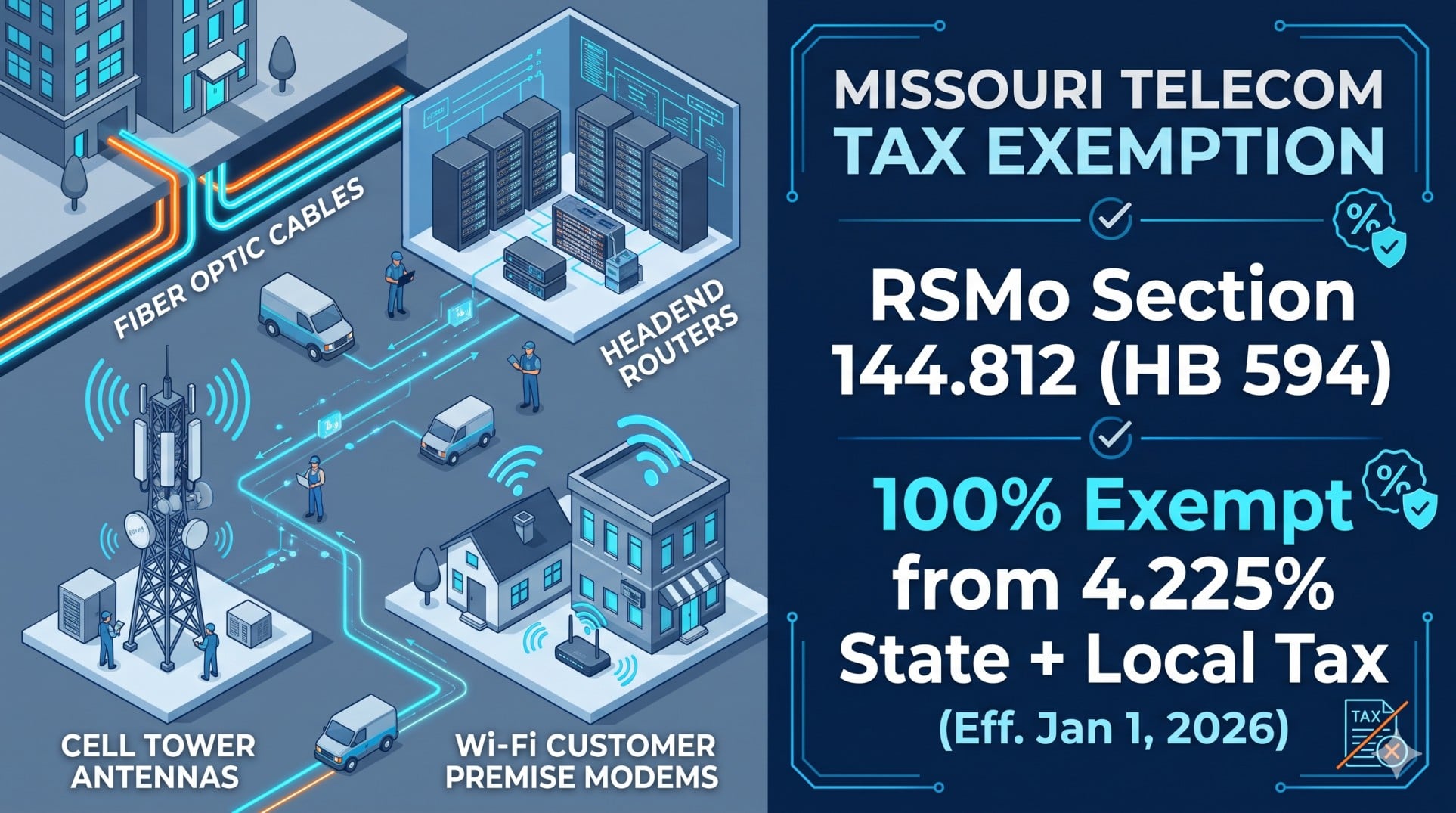
Effective January 1, 2026, the Missouri broadband equipment sales tax exemption under RSMo Section 144.812 (enacted by House Bill 594) eliminates 100% of state (4.225%) and local sales and use taxes on machinery, equipment, and infrastructure used in whole or in part to provide broadband communications service.
Before 2026, Missouri telecom and internet service providers (ISPs) faced a frustrating statutory gap. While Missouri had long exempted traditional manufacturing machinery under RSMo Section 144.030.2(5), broadband network operators frequently faced local sales and use taxes—and audit disputes—over whether outside plant fiber, customer premise modems, and wireless towers qualified as exempt production equipment. Worse yet, prior statutory proposals only offered a partial state-level exemption while leaving local city, county, and special district taxes intact.
When Governor Mike Kehoe signed House Bill 594 into law on July 10, 2025, the General Assembly solved both problems starting January 1, 2026. Codified at RSMo Section 144.812, the new statute exempts qualifying broadband purchases from both the 4.225% Missouri state base rate and every single one of Missouri’s 2,500+ local taxing jurisdictions (where combined rates average 8.44% statewide and reach as high as 12.238% in municipalities like Saint Ann or over 9.50% to 11.679% across St. Louis and Kansas City commercial districts).
Who Qualifies as a “Broadband Communications Service Provider”?
Under RSMo Section 144.812.1, the legal incidence of the exemption applies to purchases made by a “broadband communications service provider”—defined broadly as any person or entity engaged in the provision of broadband communications service. And the statute defines “broadband communications service” to encompass three distinct revenue streams (or any combination thereof):
- Internet Access Service: As defined under federal law in 47 U.S.C. Section 151 (including fiber-to-the-premises, coaxial cable internet, fixed wireless, and satellite internet access).
- Telecommunications Service: Wireline, wireless, cellular, and interconnected VoIP voice and data transmission services.
- Video Programming Service: Cable television, IPTV, and multichannel video distribution delivered over broadband networks.
What Hardware and Software Qualifies Under RSMo Section 144.812?
One of the biggest financial wins in the Missouri broadband equipment sales tax exemption is the phrase “used in whole or in part to provide broadband communications service.” Unlike strict manufacturing exemptions that require machinery to be used “exclusively” or “directly” in fabrication, RSMo Section 144.812 covers dual-use equipment and end-to-end network architecture—from the central office headend all the way inside the subscriber’s living room:
- Outside Plant & Distribution Infrastructure: Fiber optic cables, coaxial cables, copper wires, conduits, innerduct, utility poles, antennas, towers, repeaters, amplifiers, multiplexers, duplexers, transmitters, receivers, and insulating or protective enclosures and cases.
- Central Office, Headend & Hub Hardware: Switches, core routers, cable modem termination system (CMTS) components, optical line terminals (OLTs), rectifiers, circuit cards, channel cards, storage devices, equipment frames, and server cabinets.
- Customer Premise Equipment (CPE): Optical network terminals (ONTs), cable modems, Wi-Fi routers, mesh extenders, and subscriber set-top gateways furnished by the provider.
- Power, Testing & Enabling Systems: Primary power equipment, uninterruptible power supplies (UPS), backup generators and batteries for network nodes, diagnostic testing analyzers, network operating software, and successor technologies used to monitor, test, maintain, enable, or facilitate qualifying broadband infrastructure.
Telecom companies expanding across state lines should also pair this hardware exemption with our multi-state telecommunications and SaaS sales tax compliance guide to ensure their customer billing engines match 2026–2027 state sourcing rules.
Claiming Missouri Broadband Tax Relief on Form 149 & Recovering Overpayments
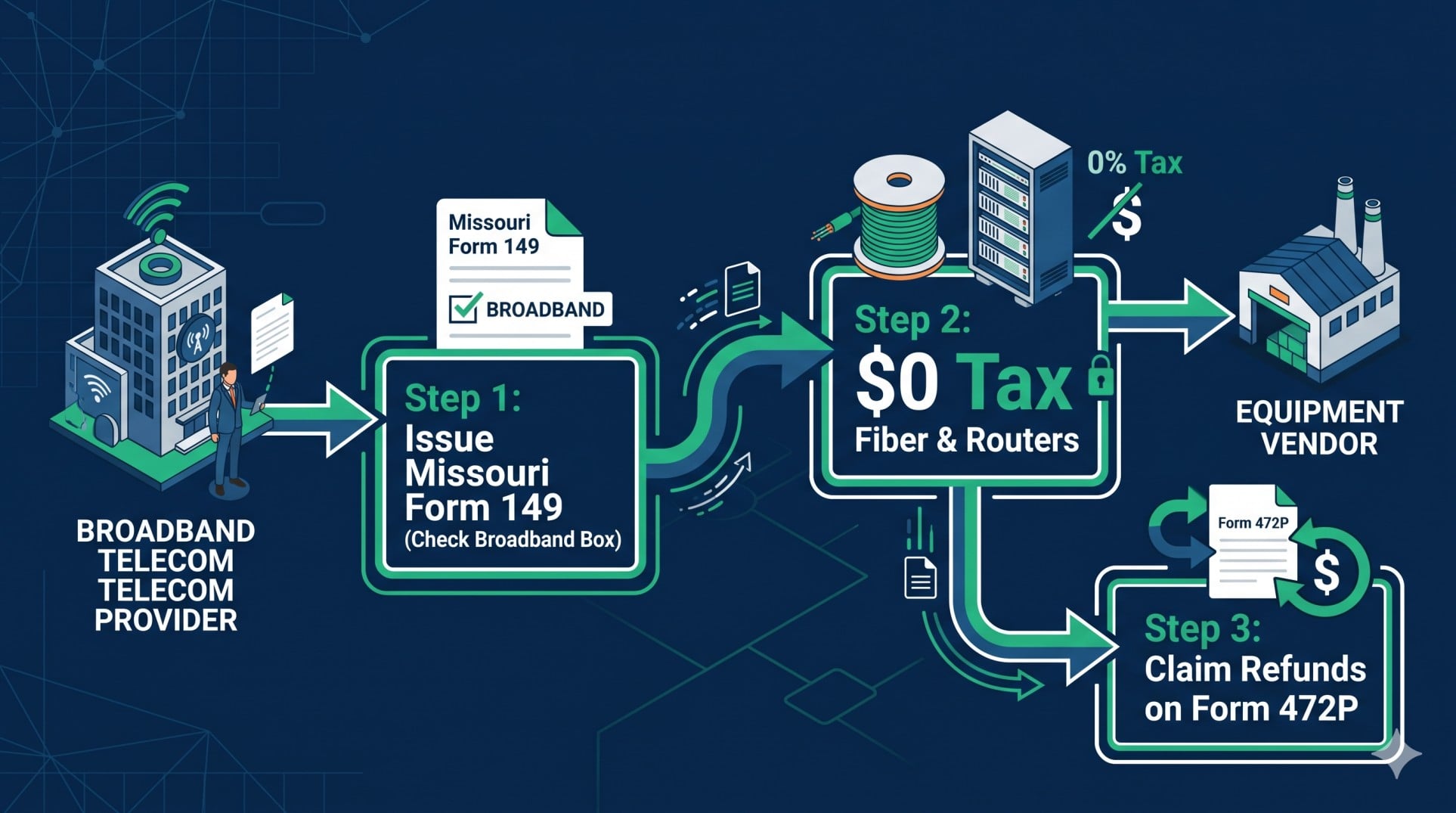
To buy qualifying network hardware tax-free at checkout, broadband providers must issue a completed Missouri Form 149 (Sales and Use Tax Exemption Certificate, Revised 08-2026) to their equipment suppliers, or apply for a Direct Pay Agreement with the Missouri Department of Revenue.
Under RSMo Section 144.812.3, the exemption is not self-executing on vendor invoices. A hardware manufacturer or telecom supply distributor (such as Cisco, Corning, CommScope, or Graybar) is legally required to charge Missouri sales or vendor’s use tax unless the buyer furnishes a written exemption certificate. In August 2026, the Missouri Department of Revenue released an updated edition of Form 149 (Rev. 08-2026) that includes a dedicated checkbox on Page 1 specifically titled: “Machinery, Equipment, or Other Infrastructure Used in Whole or in Part to Provide Broadband Communications Services (Section 144.812, RSMo).”
Supply-Chain Tier Trap: Telecom Provider vs. Third-Party Construction Contractor
Here is a critical compliance distinction that trips up rural electric cooperatives and regional fiber builders during construction projects: Who is actually buying the fiber and conduit?
Under Missouri sales tax law (RSMo Section 144.062 and 12 CSR 10-112.010), construction contractors installing real property improvements are generally treated as the end consumers of materials they purchase to fulfill a lump-sum construction contract. However, RSMo Section 144.812 specifically grants the exemption to sales, purchases, or use of machinery and equipment by a broadband communications service provider.
Pro-Tip: Structuring Third-Party Fiber Trenching & Tower Contracts
If your broadband company hires an outside engineering, procurement, and construction (EPC) contractor to bury fiber conduit, make sure your procurement team either purchases the fiber, conduit, vaults, and electronics directly using your company’s Missouri Form 149 broadband machinery certificate, or structures the contract as an agency purchasing arrangement where the contractor buys qualifying RSMo 144.812 equipment strictly as a disclosed purchasing agent for the broadband provider. Do not let contractors bury 8.5% Missouri sales tax inside lump-sum material markups!
How to Claw Back Overpaid 2026 Missouri Sales & Use Tax (Form 472P)
What if your accounts payable team paid Missouri sales tax—or self-assessed Missouri Consumer’s Use Tax on Form 53-C—on routers, fiber, or modems purchased between January 1, 2026 and today? You don’t have to write that money off. Under RSMo Section 144.190, Missouri provides a 10-year statute of limitations for claiming refunds of overpaid sales and use tax (or credits against future returns), and purchasers can file directly with the Department of Revenue under Section 144.190.4(2):
- If You Self-Assessed Consumer’s Use Tax on Form 53-C: Prepare an amended Form 53-C (Consumer’s Use Tax Return) for each 2026 monthly or quarterly period where you accrued tax on qualifying broadband hardware, and submit it alongside Form 472P (Purchaser’s Claim Under Section 144.190.4(2) for Sales or Use Tax Refund).
- If You Paid Sales or Vendor’s Use Tax to an Equipment Supplier: Send the supplier a completed Form 149 claiming the RSMo 144.812 exemption, and request either a direct credit memo from the vendor or ask the vendor to sign Missouri Form 5433 (Assignment of Rights From the Seller to Purchaser for Refund). If the vendor is unresponsive or refuses to sign Form 5433, Missouri law allows you to execute a notarized Form 5440 (Statement Confirming Purchaser’s Efforts to Obtain an Assignment of Rights) and claim the cash refund directly from the Missouri DOR on Form 472P. (Note: For refunds of $100,000 or more, attach Form 5378 to receive your payout via ACH transfer.)
| Compliance Feature | Missouri Broadband Equipment Exemption | Hawaii Healthcare GET Exemption |
|---|---|---|
| Enabling Legislation & Statute | Missouri House Bill 594 (2025); codified at RSMo Section 144.812 | Hawaii Act 47, SLH 2024 (SB 1035); codified at HRS Section 237-24.3(12) & TIR No. 2025-02 |
| Statutory Effective Date | January 1, 2026 (permanent ongoing exemption for 2026–2027+) | January 1, 2026 (applies to gross income received on or after Jan 1, 2026) |
| Tax Rates Eliminated | 4.225% State + 0.50% to 8.013% Local Sales/Use Tax (Combined 4.725%–12.238%; 8.44% avg.) | 4.0% State General Excise Tax + 0.5% County Surcharge (4.5% total across all 4 counties) |
| Eligible Taxpayers | Broadband communications service providers (ISPs, telecom carriers, cable/video operators) | Hospitals, infirmaries, medical clinics, healthcare facilities, pharmacies, MDs/DOs (Ch. 453), Dentists (Ch. 448), APRNs (Ch. 457), Pharmacists (Ch. 461) |
| Qualifying Transactions / Receipts | Purchases/leases of machinery, equipment, CPE, fiber, towers, power & testing gear used in whole or part for broadband | Gross receipts from healthcare-related goods & services covered under Medicare, Medicaid, or TRICARE (including patient copays, deductibles & coinsurance) |
| Required Forms & Exemption Codes | Form 149 (Rev. 08-2026) given to vendor; or Direct Pay Permit; Refunds via Form 472P & Form 5433/5440 | Form G-45 (Periodic) & Form G-49 (Annual) Column B deduction + Schedule GE using ED Code 160 |
| Online Portal & Filing Deadline | MyTax Missouri; Returns due last day of following month (monthly) or last day of month after quarter | Hawaii Tax Online; Form G-45 due 20th day of following month; Form G-49 due 20th day of 4th month after year-end |
Inside the Hawaii Healthcare GET Exemption for Medicare, Medicaid & TRICARE
Effective January 1, 2026, the Hawaii healthcare GET exemption under Act 47 (HRS Section 237-24.3(12)) exempts qualifying hospitals, clinics, pharmacies, doctors, dentists, and advanced practice nurses from paying Hawaii’s 4.0% state General Excise Tax and 0.5% county surcharge on healthcare goods and services reimbursed under Medicare, Medicaid, or TRICARE.
Why is this law such a massive financial breakthrough for Hawaii medical practices? Unlike the 45 states that impose a retail sales tax on the consumer, Hawaii imposes a broad-based General Excise Tax (GET) directly on the business for the privilege of doing business in the state. In retail commerce, businesses are permitted to visibly pass the GET on to the customer (typically charging 4.712% in Honolulu, Maui, Hawaii, and Kauai counties to cover the 4.0% state tax plus the 0.5% county surcharge on a tax-on-tax basis).
Private medical and dental practices treating government-insured patients were trapped in a painful federal catch-22. Under federal Medicare, Medicaid (Med-QUEST), and TRICARE balance-billing prohibitions, healthcare providers are strictly forbidden from passing state gross receipts taxes on to beneficiaries above the fixed federal fee schedule. Worse yet, while nonprofit hospitals in Hawaii already enjoyed a GET exemption under HRS Section 237-23, private physician groups, dental clinics, and retail pharmacies had to pay the 4.0% to 4.5% GET straight out of their net operating margins. The Hawaii Legislature estimated that this disparity drained $74 million per year from local medical providers.

How HRS Section 237-24.3(12) & TIR No. 2025-02 Level the Playing Field
Signed by Governor Josh Green, M.D. (himself a former rural emergency room physician) as Act 47, Session Laws of Hawaii 2024 (Senate Bill 1035), and detailed in Hawaii Department of Taxation Tax Information Release No. 2025-02 (issued August 1, 2025), the new Medicare Medicaid TRICARE GET exemption eliminates the tax on all qualifying government healthcare revenue starting January 1, 2026.
Because all four Hawaii counties—City and County of Honolulu (Oahu, District 1), Maui County (District 2), Hawaii County (Big Island, District 3), and Kauai County (District 4)—impose the maximum 0.5% county surcharge throughout 2026 and 2027, claiming the Hawaii healthcare GET exemption immediately adds $45,000 in pure bottom-line profit for every $1,000,000 in Medicare, Medicaid, and TRICARE collections.
Healthcare groups operating multi-entity management structures or ambulatory surgery centers can pair this guidance with our Hawaii General Excise Tax (GET) registration and periodic filing services to ensure intercompany fees and clinical receipts are segregated properly.
Qualifying Hawaii Providers, Patient Copays & Non-Exempt Revenue Traps
Under Hawaii Tax Information Release No. 2025-02, only nine statutorily enumerated categories of healthcare facilities and licensed practitioners qualify for the Medicare Medicaid TRICARE GET exemption, and the exemption extends to patient deductibles, copayments, and coinsurance paid for covered services.
Do not assume that every business touching the healthcare sector qualifies, or that only government EFT deposits are exempt. Here are the exact statutory boundaries established by the Hawaii Department of Taxation:
The 9 Eligible Healthcare Provider Categories Under HRS 237-24.3(12)
To claim the exemption on Form G-45 and Schedule GE, the taxpayer receiving the gross income must be one of the following nine entities or licensed professionals:
- Hospitals (including for-profit hospitals and specialty surgical hospitals).
- Infirmaries.
- Medical Clinics (including multi-specialty group practices, urgent care centers, and outpatient clinics).
- Health Care Facilities (such as skilled nursing facilities, ambulatory surgery centers, and dialysis centers).
- Pharmacies (retail, clinical, and specialty pharmacies dispensing covered prescriptions).
- Physicians and Osteopathic Physicians (MDs and DOs) licensed under Chapter 453, HRS.
- Dentists (DDS and DMD) licensed under Chapter 448, HRS.
- Advanced Practice Registered Nurses (APRNs) licensed under Chapter 457, HRS.
- Pharmacists licensed under Chapter 461, HRS.
Crucial Win: Patient Copayments, Deductibles & Coinsurance Are Exempt!
One of the most valuable clarifications in TIR No. 2025-02 involves patient cost-sharing. When a Medicare Part B, Medicare Advantage, Medicaid (Med-QUEST), or TRICARE patient visits your clinic or pharmacy, the reimbursement is often split between the government program (or its contracted managed-care plan) and the patient’s out-of-pocket share.
The Hawaii Department of Taxation explicitly confirmed that the Medicare Medicaid TRICARE GET exemption applies to both:
- Amounts received directly from Medicare (including Medicare Part A, Part B, Part C / Medicare Advantage, and Part D plans), Medicaid (including Hawaii Med-QUEST managed care health plans), or TRICARE (administered by TriWest Healthcare Alliance in the West Region); AND
- Amounts received directly from the patient—or a secondary supplemental insurer—for deductibles, copayments, and coinsurance, provided the underlying healthcare-related good or service is covered under the Medicare, Medicaid, or TRICARE program.
Compliance Warning: What Remains Taxable at 4.5% in 2026–2027?
The exemption under HRS Section 237-24.3(12) does not cover commercial health insurance (such as HMSA, Kaiser commercial plans, UHA, or HMAA commercial policies), workers’ compensation claims, motor vehicle personal injury protection (PIP) claims, or cash-pay/self-pay cosmetic and elective procedures not covered by Medicare, Medicaid, or TRICARE. For-profit clinics must continue remitting the 4.0% state GET plus 0.5% county surcharge on all commercial insurance and non-covered self-pay receipts.
Cash vs. Accrual Transition Rule for Late-2025 Dates of Service
Because Act 47 applies to gross income or gross proceeds received on or after January 1, 2026, how you handle claims from late 2025 depends on your tax accounting method under HRS Section 237-3. If your medical practice files GET returns on the cash basis (which most physician and dental practices use), payments received in January or February 2026 for Medicare/Medicaid patient visits that occurred in November or December 2025 qualify as 2026 gross receipts. Conversely, if your hospital or clinic reports on the accrual basis, eligibility is tied to when the revenue is accrued on your books on or after January 1, 2026.
| Industry & Transaction Type | State & Governing Authority | 2026–2027 Taxability Status | Required Documentation / Return Coding |
|---|---|---|---|
| Fiber Optic Cable, Conduit, Poles & Vaults (purchased by an ISP/Telecom) | Missouri (RSMo 144.812) | 100% Exempt (State & Local) | Issue Missouri Form 149 (Rev. 08-2026) checking the Broadband Communications Services box. |
| Central Office Routers, Switches, CMTS & OLTs (used in whole or part for broadband) | Missouri (RSMo 144.812) | 100% Exempt (State & Local) | Issue Form 149 to vendor or self-exempt under Missouri DOR Direct Pay Agreement. |
| Customer Premise Modems, ONTs & Wi-Fi Gateways (purchased by broadband provider) | Missouri (RSMo 144.812) | 100% Exempt (State & Local) | Exempt under RSMo 144.812 even when placed at subscriber residences/businesses. |
| ISP Corporate Office Furniture, Breakroom Supplies & Passenger Vehicles | Missouri (RSMo 144.020) | Taxable (4.225% + Local) | Administrative tangibles not used to provide or enable broadband remain fully taxable. |
| Medicare Part A, B, C (Advantage) & Part D Reimbursements to MD/DO/DDS/Pharmacy | Hawaii (HRS 237-24.3(12)) | 100% Exempt (0% GET / 0% County) | Report in Col. A & Col. B on Form G-45/G-49; attach Schedule GE with ED Code 160. |
| Medicaid (Med-QUEST) & TRICARE Reimbursements to Qualifying Clinic/Hospital | Hawaii (HRS 237-24.3(12)) | 100% Exempt (0% GET / 0% County) | Report in Col. A & Col. B on Form G-45/G-49; attach Schedule GE with ED Code 160. |
| Patient Copays, Deductibles & Coinsurance on Covered Medicare/Medicaid/TRICARE Care | Hawaii (TIR No. 2025-02) | 100% Exempt (0% GET / 0% County) | Included in ED Code 160 deduction on Schedule GE when underlying service is covered. |
| Commercial Health Insurance (HMSA, UHA, HMAA) & Cosmetic Self-Pay Receipts | Hawaii (HRS 237-13(6)) | Taxable at 4.5% (4.0% State + 0.5% Co.) | Report in Col. A on Line 15 (Service Business/Retailing) of Form G-45 with no Col. B deduction. |
2026–2027 Business Scenarios: Calculating Your Exact Tax Savings
To quantify how much cash your organization can retain in 2026 and 2027, you must apply the exact state and local tax rates to your capital expenditure budgets in Missouri or your payer-mix revenue schedules in Hawaii.
Let’s walk through four detailed mathematical scenarios showing how these two exemptions work in practice.
Scenario 1: Missouri Regional Fiber ISP Network Expansion
The Setup: Ozark FiberNet, a regional broadband communications service provider headquartered in Springfield, Missouri (Greene County), launches a 2026 fiber-to-the-home (FTTH) network expansion across Springfield and surrounding rural municipalities. During Q2 2026, Ozark FiberNet purchases $2,400,000 in network infrastructure to be delivered to its Springfield staging warehouse (where the combined 2026 sales and use tax rate is 8.10%—comprising the 4.225% state base rate, 1.75% Greene County tax, and 2.125% City of Springfield tax).
The Equipment Purchase Breakdown:
- Single-mode fiber optic cabling, HDPE conduit, and splice closures: $1,100,000
- Central office optical line terminals (OLTs), core switches, and DC rectifiers/backup batteries: $750,000
- Subscriber optical network terminals (ONTs) and Wi-Fi 7 routers (CPE): $450,000
- Optical time-domain reflectometers (OTDR diagnostic testing gear) and network management software: $100,000
- Total Q2 2026 Broadband CapEx: $2,400,000
Step-by-Step 2026 Tax Savings Math:
- Pre-2026 Tax Burden: Prior to January 1, 2026, paying the 8.10% combined Springfield/Greene County rate on $2,400,000 of broadband distribution and CPE hardware would have cost Ozark FiberNet $194,400.00 in non-recoverable sales/use tax.
- 2026–2027 Exemption Application: Every item on Ozark FiberNet’s purchase order—outside plant fiber, central office OLTs, backup power, customer premise Wi-Fi routers, and diagnostic OTDR testers—is explicitly listed as qualifying machinery and equipment under RSMo Section 144.812.1(3).
- Execution: Ozark FiberNet issues a completed Missouri Form 149 (Rev. 08-2026) checking the “Broadband Communications Services (Section 144.812, RSMo)” box to its vendors.
- Total Q2 2026 Cash Saved: $194,400.00 ($0.00 tax due).
Scenario 2: Missouri Telecom Clawback Refund on Overpaid Q1 2026 Use Tax
The Setup: Gateway Wireless LLC, a fixed-wireless and fiber broadband provider operating in St. Louis County (where its warehouse sits in a special taxing district with a combined sales rate of 9.613% and a combined consumer use tax rate of 6.60%), purchased $500,000 worth of antennas, multiplexers, and tower transceivers from an out-of-state vendor in January and February 2026. Unaware that House Bill 594 had taken effect on January 1, 2026, Gateway Wireless’s controller self-assessed 6.60% Missouri Consumer’s Use Tax on its Q1 2026 Form 53-C, remitting $33,000.00 to the Missouri Department of Revenue.
Step-by-Step Refund Recovery Math:
- Because Gateway Wireless self-assessed the tax directly to the state on Form 53-C, it does not need to obtain an Assignment of Rights (Form 5433) from the out-of-state vendor.
- Gateway Wireless prepares an amended Q1 2026 Form 53-C reducing taxable purchases by $500,000, attaches a completed Form 472P (Purchaser’s Claim for Refund), a copy of its self-issued Form 149 citing RSMo Section 144.812, and copies of the vendor invoices.
- Net Cash Refund Recovered from Missouri DOR: $33,000.00.
Scenario 3: Honolulu Multi-Provider Medical Clinic Filing Form G-45 & Schedule GE
The Setup: Pacific Ohana Medical Group, a for-profit primary care and cardiology clinic in Honolulu (Oahu, Tax District 1) employing six physicians licensed under Chapter 453, HRS, and three APRNs licensed under Chapter 457, HRS, closes its books for October 2026. The clinic reports on the cash basis and files monthly Form G-45 returns.
October 2026 Gross Receipts Breakdown:
- Direct Medicare Part B and Medicare Advantage plan reimbursements: $165,000
- Medicare patient 20% coinsurance and annual deductible payments collected at the front desk: $35,000
- Hawaii Med-QUEST (Medicaid) managed-care plan reimbursements: $90,000
- TRICARE reimbursements + active-duty family copayments: $30,000
- Commercial insurance reimbursements (HMSA, UHA, HMAA) + commercial patient copays: $180,000
- Total October 2026 Gross Income: $500,000
Step-by-Step October 2026 Form G-45 & Schedule GE Calculation (Due November 20, 2026):
- Calculate Total Exempt Government Program Receipts: Under HRS Section 237-24.3(12) and TIR No. 2025-02, the clinic combines Medicare reimbursements ($165,000), Medicare patient coinsurance/deductibles ($35,000), Medicaid reimbursements ($90,000), and TRICARE receipts/copays ($30,000) = $320,000.00 exempt under Hawaii Schedule GE ED Code 160.
- Form G-45 Part II (4.0% State GET – Line 15 Service Business):
- Column A (Gross Income): $500,000.00
- Column B (Exemptions/Deductions): $320,000.00
- Column C (Taxable Income): $180,000.00 (Commercial receipts only)
- State GET Due (4.0% × $180,000): $7,200.00
- Form G-45 Part IV (0.5% Oahu County Surcharge – Line 19):
- Column A: $500,000.00 | Column B: $320,000.00 | Column C: $180,000.00
- County Surcharge Due (0.5% × $180,000): $900.00
- Total October 2026 Tax Due: $8,100.00 (instead of the $22,500.00 the clinic would have owed prior to 2026).
- Monthly Cash Saved: $14,400.00 per month—or $172,800.00 per year in permanent tax savings!
Scenario 4: Hilo Pediatric Dental Practice & Retail Pharmacy on Hawaii Island
The Setup: Mauna Kea Dental & Pharmacy operates a dental clinic (licensed under Chapter 448, HRS) and an adjacent community pharmacy (licensed under Chapter 461, HRS) in Hilo (Hawaii County, Tax District 3, where the combined GET + Hawaii County Surcharge is 4.5%). In 2026, 45% of its dental patients are covered by Med-QUEST (Medicaid) and 55% of its pharmacy prescriptions are reimbursed through Medicare Part D and Medicaid.
Across calendar year 2026, the practice collects $1,400,000 in Medicaid dental reimbursements and Medicare Part D / Medicaid prescription reimbursements (including $85,000 in Medicare Part D patient prescription copays). By reporting the $1,400,000 in Column B of its monthly Form G-45 and annual Form G-49 reconciliation return using Hawaii Schedule GE ED Code 160 (District 3), the Hilo practice saves $63,000.00 ($1,400,000 × 4.5%) in 2026 alone.
If your accounting team needs assistance reconciling monthly periodic returns against annual reconciliations or filing refund claims, explore our state sales, use, and excise tax refund recovery services to make sure no savings are left behind.
Step-by-Step Guide to Filing Missouri Form 149 & Hawaii Form G-45 / Schedule GE
To pass a state Department of Revenue audit while claiming these exemptions, you must execute the exact state certificates, schedule codes, and electronic portal submissions required by the Missouri Department of Revenue and the Hawaii Department of Taxation.
Part A: Missouri Telecom Step-by-Step Compliance (Form 149 & MyTax Missouri)
- Download the Current Revision of Form 149 (Rev. 08-2026): Do not use outdated pre-2026 versions of Form 149 that lack the specific statutory checkbox. Obtain the August 2026 revision of Missouri Form 149 (Sales and Use Tax Exemption Certificate) from the Missouri DOR portal.
- Complete Section 1 (Purchaser Information): Enter your broadband company’s legal name, DBA, mailing address, Missouri Tax I.D. Number (8-digit number issued by DOR), Federal Employer Identification Number (FEIN), and describe your business activity as “Broadband Communications Service Provider.”
- Select the RSMo Section 144.812 Checkbox: Under the Exemption Reason section, check the box labeled: “Machinery, Equipment, or Other Infrastructure Used in Whole or in Part to Provide Broadband Communications Services (Section 144.812, RSMo).” Sign and date the certificate under penalties of perjury.
- Deliver Form 149 to Vendors & Update ERP Use Tax Rules: Send the signed Missouri Form 149 broadband machinery certificate to every fiber, hardware, tower, and CPE vendor. Simultaneously, update your internal ERP tax engine (such as Avalara, Vertex, or SAP) so your AP system stops auto-accruing Missouri Consumer’s Use Tax on Form 53-C for qualifying broadband capital and maintenance cost centers.
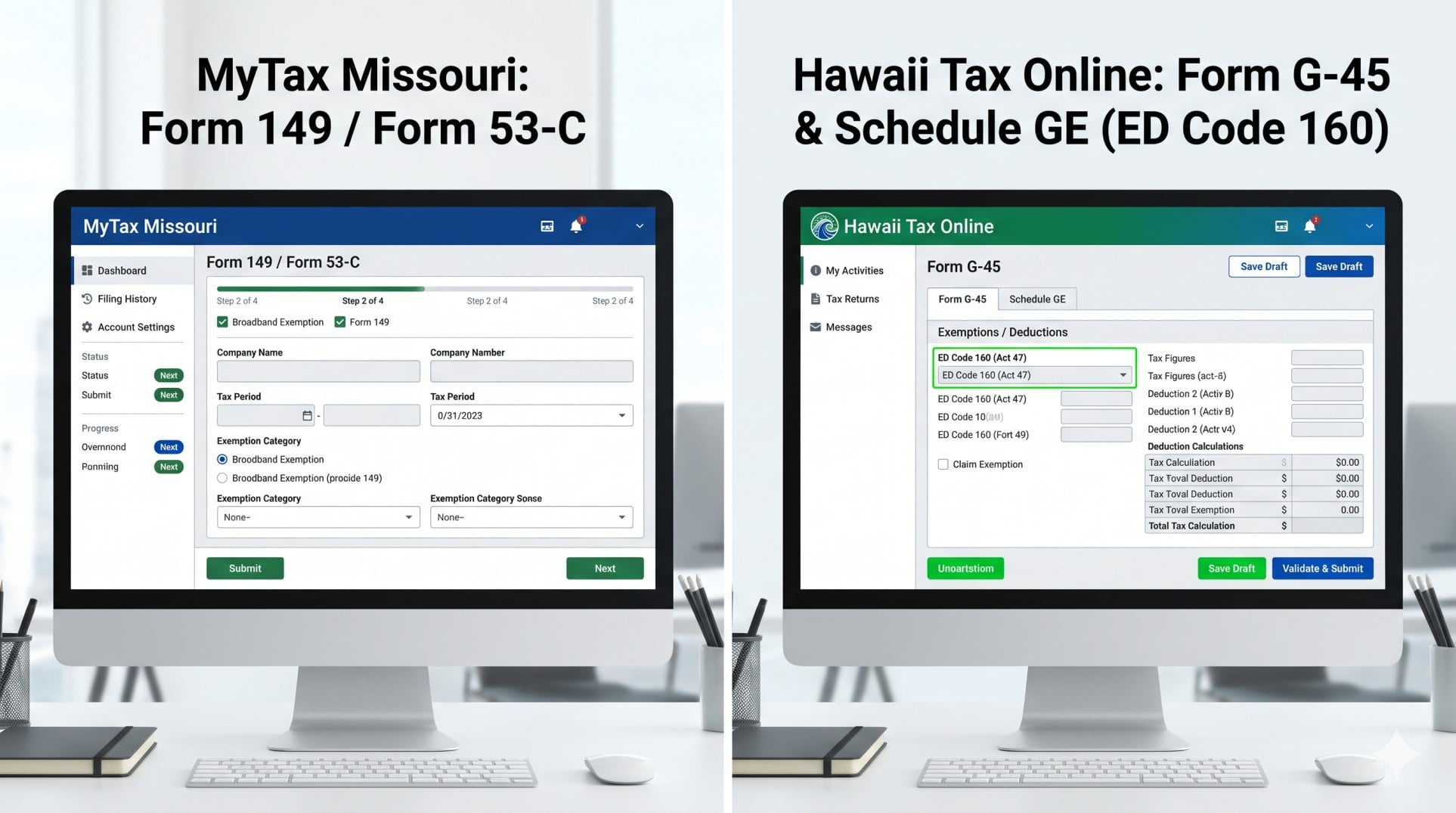
- File Ongoing Returns via MyTax Missouri: Report any remaining non-exempt administrative purchases on Form 53-C (or retail sales of non-exempt items on Form 53-1) through the MyTax Missouri portal. Monthly returns are due on the last day of the following month; quarterly returns (for filers with $500 or less in monthly tax) are due by April 30, July 31, October 31, and January 31. Remember that timely filers on Form 53-1 receive a 2.0% timely payment allowance!
Part B: Hawaii Healthcare Step-by-Step Compliance (Form G-45, G-49 & Schedule GE)
- Segregate Payer Receipts in Your Practice Management / EHR System: Configure your medical, dental, or pharmacy billing software (such as Epic, Athenahealth, Dentrix, or PioneerRx) to generate monthly cash-receipts reports broken down by payer class: (a) Medicare / Medicare Advantage + patient cost-sharing, (b) Medicaid / Med-QUEST + patient cost-sharing, (c) TRICARE + patient cost-sharing, and (d) taxable commercial insurance and self-pay receipts.
- Log Into Hawaii Tax Online (HTO) for Periodic Filing (Form G-45): By the 20th day of the month following the close of your filing period (monthly for taxpayers paying more than $4,000 in annual GET; quarterly by April 20, July 20, October 20, and January 20 for $4,000 or less; semiannually by July 20 and January 20 for $2,000 or less), open your Form G-45 periodic return on Hawaii Tax Online.
- Report Gross Income in Column A and Exempt Receipts in Column B: Never omit exempt Medicare, Medicaid, or TRICARE receipts from Column A! Under Hawaii law, you must include 100% of your total gross receipts (both commercial and government-insured) in Column A (Gross Income) on the appropriate activity line (typically Line 15, Service Business and Calling, or Line 14, Retailing for pharmacies) and in Part IV (County Surcharge, Lines 19–22). Then, enter the exact dollar total of your qualifying Medicare, Medicaid, and TRICARE receipts (including patient copays/deductibles) in Column B (Exemptions/Deductions).
- Complete and Attach Schedule GE Using ED Code 160: If you claim an amount in Column B without attaching Schedule GE (General Excise/Use Tax Schedule of Exemptions and Deductions), the Hawaii Department of Taxation will automatically disallow the exemption and issue a proposed tax assessment. On Schedule GE, enter:
- Activity Code: Enter the line number from Form G-45 (e.g., “15” for Services or “14” for Retailing; plus a separate line for your County Surcharge line: “19” for Oahu, “20” for Maui, “21” for Hawaii, or “22” for Kauai).
- ED Code: Enter 160 (the official code for “Medicare, Medicaid, or TRICARE programs — HRS §237-24.3(12)”).
- District: Enter “1” for Oahu, “2” for Maui, “3” for Hawaii, or “4” for Kauai.
- Amount: Enter the exact dollar amount claimed in Column B.
- Reconcile Annually on Form G-49: File your annual reconciliation return on Form G-49 (with an annual Schedule GE attached) by the 20th day of the fourth month following the close of your tax year (April 20, 2027 for calendar-year 2026 taxpayers). If you accidentally paid GET on Medicare, Medicaid, or TRICARE receipts on earlier 2026 Form G-45 periodic returns, you can claim the overpayment credit/refund directly on your 2026 Form G-49 reconciliation or by filing an amended Form G-45 on Hawaii Tax Online!
Have questions about how these rules interact with your overall state tax footprint? Reach out through our SALT advisory and multi-state tax compliance consultation page for a custom review of your 2026–2027 filings.
Frequently Asked Questions About Missouri & Hawaii’s 2026 Tax Exemptions
1. When did the Missouri broadband equipment sales tax exemption take effect?
The Missouri broadband equipment sales tax exemption took effect on January 1, 2026. Enacted by Missouri House Bill 594 and codified under RSMo Section 144.812, it permanently exempts qualifying broadband machinery and equipment from both the 4.225% state tax and all local sales and use taxes.
2. Does the Missouri broadband exemption cover customer premise Wi-Fi routers and modems?
Yes, RSMo Section 144.812.1(3) explicitly includes customer premise equipment (CPE), modems, optical network terminals (ONTs), cable modem termination system components, and Wi-Fi equipment purchased by a broadband communications service provider, alongside central office switches and outside plant fiber.
3. How do I claim the Missouri broadband exemption with my equipment suppliers?
You claim the exemption by completing Missouri Form 149 (Sales and Use Tax Exemption Certificate, Rev. 08-2026), checking the box for “Broadband Communications Services (Section 144.812, RSMo),” and providing the signed certificate to your vendor. You do not need to mail Form 149 to the Missouri Department of Revenue.
4. Can a Missouri broadband provider get a refund for sales tax paid in error during 2026?
Yes, if you paid Missouri sales or use tax on qualifying broadband equipment on or after January 1, 2026, you can recover the overpayment by filing Missouri Form 472P (Purchaser’s Claim for Refund). Include vendor invoices, a signed Form 149, and either a seller’s Assignment of Rights (Form 5433) or a notarized effort statement (Form 5440).
5. What is the effective date of the Hawaii healthcare GET exemption for Medicare, Medicaid, and TRICARE?
The Hawaii healthcare GET exemption under Act 47 (HRS Section 237-24.3(12)) took effect on January 1, 2026. It applies to all qualifying gross receipts received on or after January 1, 2026, eliminating the 4.0% state GET and the 0.5% county surcharge.
6. Are patient copayments, deductibles, and coinsurance exempt from Hawaii GET in 2026?
Yes, according to Hawaii Department of Taxation Tax Information Release No. 2025-02, amounts received directly from patients for deductibles, copayments, and coinsurance are 100% exempt from GET, provided the underlying healthcare good or service is covered under Medicare, Medicaid, or TRICARE.
7. Which healthcare providers qualify for the Hawaii Medicare, Medicaid, and TRICARE GET exemption?
Under HRS Section 237-24.3(12), nine categories qualify: hospitals, infirmaries, medical clinics, health care facilities, pharmacies, physicians and osteopathic physicians (Chapter 453, HRS), dentists (Chapter 448, HRS), advanced practice registered nurses (Chapter 457, HRS), and pharmacists (Chapter 461, HRS).
8. What ED Code is required on Hawaii Schedule GE for Medicare, Medicaid, and TRICARE receipts?
Taxpayers must use Hawaii Schedule GE ED Code 160 when claiming the deduction for Medicare, Medicaid, or TRICARE receipts under HRS Section 237-24.3(12). You must list ED Code 160 for both the state GET activity line (such as Line 15 or Line 14) and the applicable County Surcharge line (Lines 19–22).
9. Do Hawaii medical providers still need to report exempt Medicare and Medicaid income on Form G-45?
Yes, you must report 100% of your total gross receipts (including exempt Medicare, Medicaid, and TRICARE revenue) in Column A of Form G-45 and Form G-49, and then deduct the exempt portion in Column B supported by Schedule GE. Failing to report the receipts in Column A and Schedule GE is a common audit error.
10. Are Medicare Advantage (Part C) and Hawaii Med-QUEST managed care plans included in the GET exemption?
Yes, reimbursements for covered healthcare goods and services purchased under Medicare Part C (Medicare Advantage), Medicare Part D prescription plans, and Hawaii Med-QUEST (Medicaid) managed-care plans qualify for the Medicare Medicaid TRICARE GET exemption under HRS Section 237-24.3(12) and TIR No. 2025-02.
Capturing Your Full 2026–2027 Tax Savings & Refund Opportunities
Both the Missouri broadband equipment sales tax exemption under RSMo Section 144.812 and the Hawaii healthcare GET exemption under HRS Section 237-24.3(12) represent rare, high-value opportunities to immediately boost your bottom line in 2026 and 2027. For a Missouri broadband ISP investing millions into fiber and wireless infrastructure, properly issuing Form 149 saves 8.44% to 12.238% on every hardware purchase. For a Hawaii medical clinic, dental practice, or pharmacy, coding Schedule GE with ED Code 160 permanently eliminates the 4.5% gross receipts tax on every dollar of Medicare, Medicaid, and TRICARE revenue.
If your business overpaid Missouri sales or use tax on broadband infrastructure earlier in 2026, or if your Hawaii healthcare practice needs to amend 2026 Form G-45 returns and reconcile Form G-49 to recover overpaid GET, our indirect tax specialists are ready to help. Contact the SALT & Excise Tax team at Ourtaxpartner.com today to audit your 2026 invoices, file your refund claims, and put your monthly compliance on autopilot.
Disclaimer: This content provides general information for educational purposes only and reflects state, local, and federal sales, use, and excise tax laws applicable to the 2026–2027 compliance periods. State and local tax rates, nexus thresholds, and excise regulations change frequently across jurisdictions. This article does not constitute professional tax, legal, or accounting advice. Always consult a certified public accountant (CPA), enrolled agent (EA), or qualified SALT advisor at Ourtaxpartner.com regarding your specific business compliance obligations. Ourtaxpartner.com is not responsible for any actions taken based on the information provided herein.
