
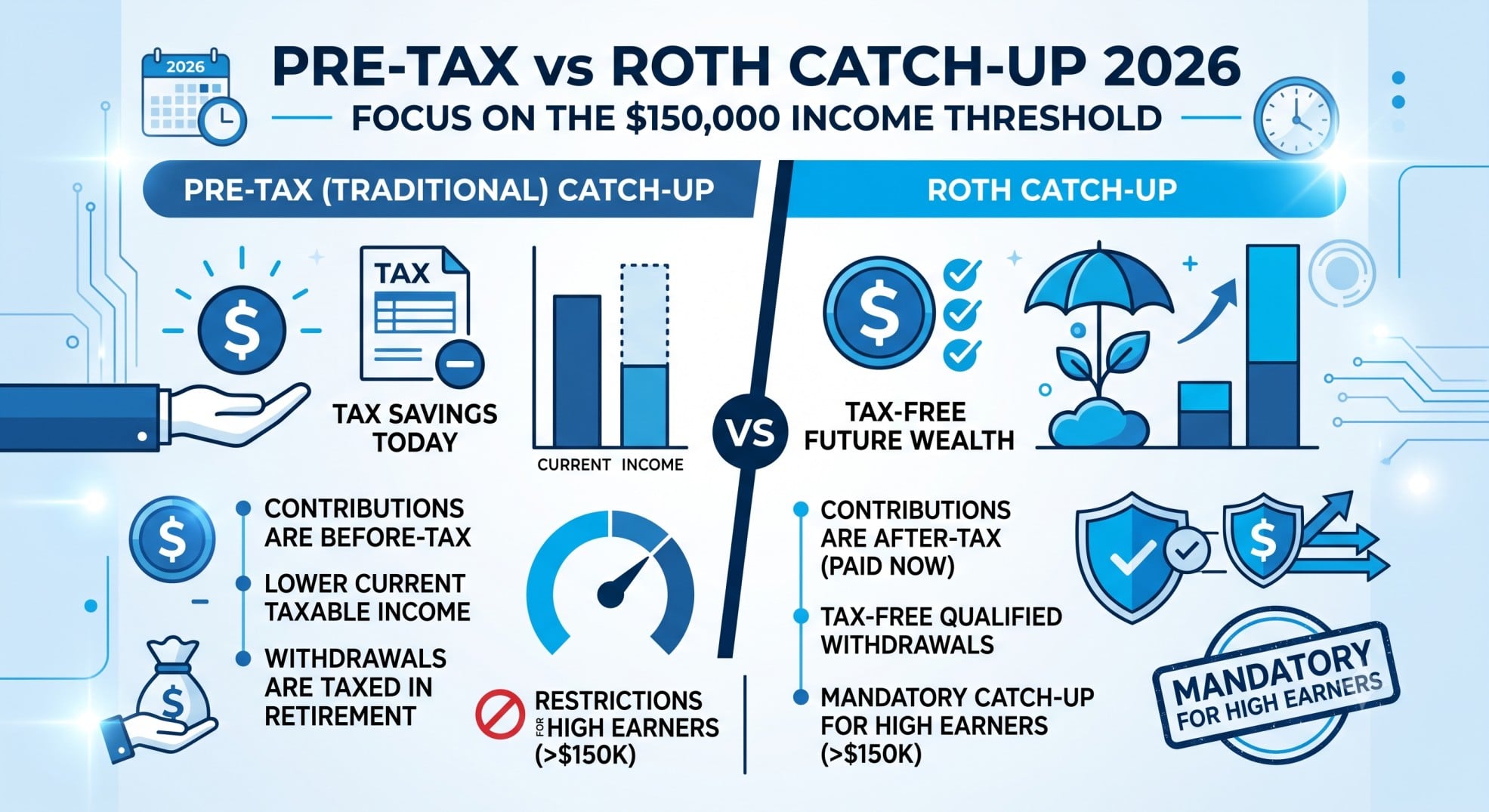
⚡ Executive Summary: 2026 Roth Catch-Up Mandate
- Beginning January 1, 2026, workers aged 50 and older who earned more than $150,000 in FICA wages in 2025 must make all catch-up contributions on a Roth basis.
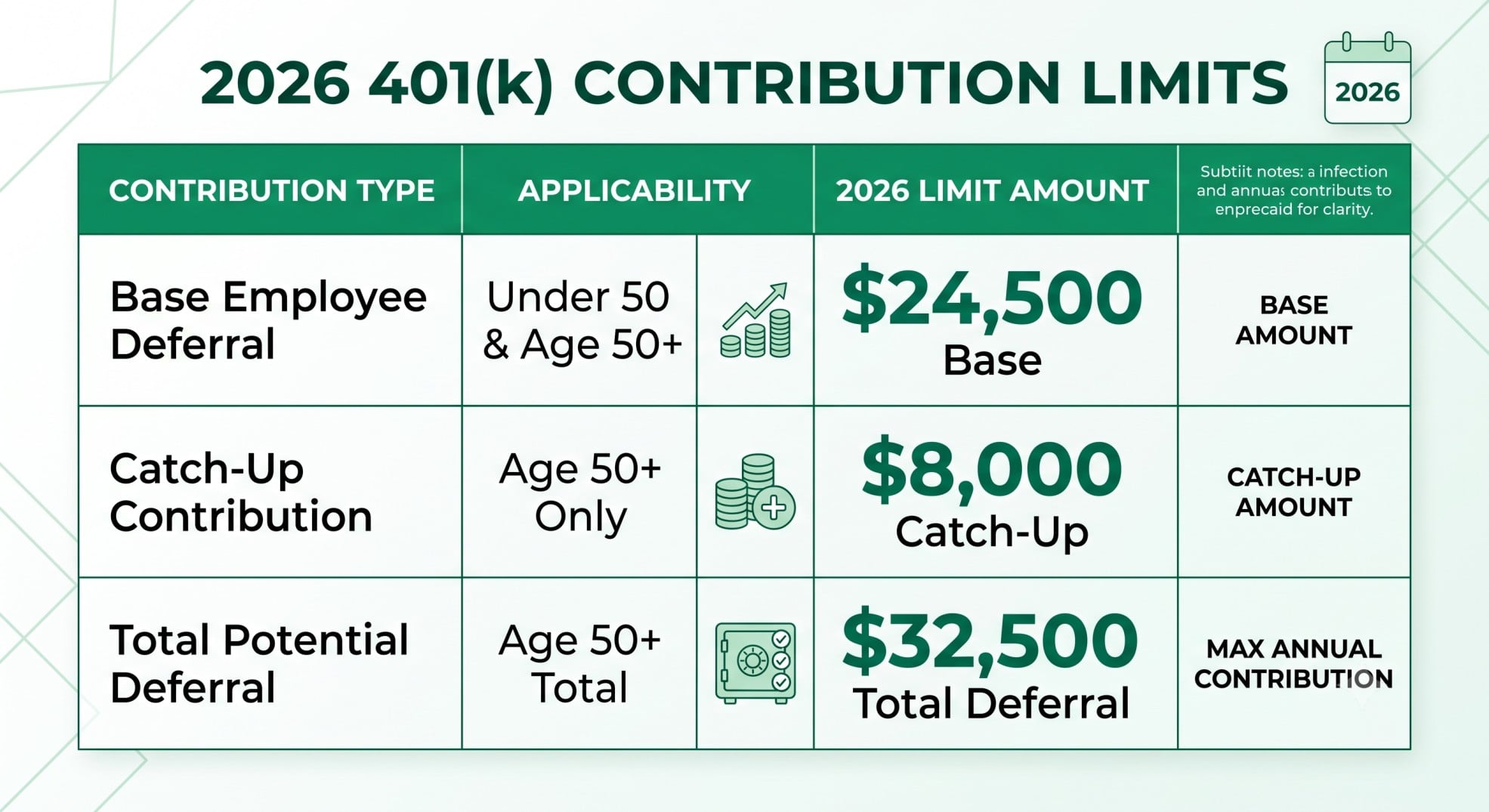
- The standard 401(k) limit for 2026 is $24,500, with an $8,000 catch-up for ages 50-59, and a super catch-up of $11,250 for ages 60-63.
- If your employer’s retirement plan does not offer a Roth option, you will be entirely locked out of making any age-based catch-up contributions.
- Self-employed individuals with Solo 401(k)s are generally exempt because they do not receive W-2 FICA wages.
High earners face a strict new reality for their retirement planning. Beginning January 1, 2026, the IRS is changing exactly how you fund your golden years. If your income exceeds a specific statutory threshold, you lose the ability to defer taxes on your extra retirement contributions. Congress designed this provision to accelerate tax revenue, targeting your paycheck directly.
You need to understand the mechanics of this shift before the new year begins. The mandatory Roth catch-up for 2026 forces high-income taxpayers to reevaluate their entire deferral strategy. Missing the nuances of this rule could result in rejected contributions, unexpected tax bills, or losing your catch-up privileges entirely.
We are going to break down exactly how this legislation works. You will learn how to calculate your exposure, how to navigate the employer lockout trap, and how specific business structures can bypass the mandate completely.
Table of Contents
- Understanding the Mandatory Roth Catch-Up for 2026
- The $150,000 Catch-Up Rule: FICA Wages vs. MAGI Confusion
- The Lockout Trap: Losing Your Catch-Up Entirely
- The Self-Employed Exemption: Solo 401(k)s and K-1 Income
- Step-by-Step: Calculating Your 401k Catch-Up Roth Requirement for 2026
- Transition Rules: 2026 Good-Faith vs. 2027 Strict Compliance
- Frequently Asked Questions About the Mandatory Roth Catch-Up for 2026
Understanding the Mandatory Roth Catch-Up for 2026
The rules governing retirement contributions are shifting dramatically. Under the original SECURE 2.0 Act, Congress mandated that higher-income employees must pay taxes upfront on their catch-up contributions. After a two-year administrative delay, this rule officially takes effect on January 1, 2026.
Here is the core mechanic. If you are 50 or older, you are allowed to contribute extra money to your 401(k) above the standard limit. Historically, you could choose whether to make these extra contributions on a pre-tax or Roth basis. The mandatory Roth catch-up for 2026 removes that choice for anyone who earned more than $150,000 in FICA wages from their employer in the prior calendar year.
Your 2026 status is determined entirely by your 2025 earnings. If your 2025 wages cross the threshold, every single dollar of your catch-up contribution in 2026 must go into a Roth account. You pay taxes on that money now, but it grows tax-free and can be withdrawn tax-free in retirement.
The numbers for 2026 require careful payroll planning. The standard limit is $24,500. If you are between the ages of 50 and 59, you get an $8,000 catch-up, bringing your combined total to $32,500. If you fall into the special SECURE 2.0 bracket for ages 60 to 63, you get a super catch-up of $11,250, lifting your absolute cap to $35,750.
Your base $24,500 contribution is completely unaffected by this legislation. You can still defer taxes on that primary amount regardless of how much money you make. The restriction applies strictly to the $8,000 or $11,250 catch-up portion.
David is 52 years old and works as a Vice President of Sales. In 2025, his W-2 Box 3 showed $180,000 in wages. Because his prior-year wages exceed the threshold, David is subject to the mandatory Roth catch-up for 2026. He can still contribute his base $24,500 on a pre-tax basis. But if he wants to contribute the additional $8,000, those funds must go into a Roth account.
The $150,000 Catch-Up Rule: FICA Wages vs. MAGI Confusion
Taxpayers frequently misunderstand how the IRS measures income for this specific provision. The $150,000 catch-up rule is not based on your overall wealth, your household income, or your tax bracket. It is based exclusively on a very narrow definition of compensation.
The statute explicitly ties the threshold to wages under Internal Revenue Code Section 3121(a). In plain English, this means FICA wages. When you look at your W-2, this is the number reported in Box 3 (Social Security wages) and Box 5 (Medicare wages). It is the exact amount of your compensation subject to payroll taxes.
This creates a massive planning opportunity because FICA wages are vastly different from Modified Adjusted Gross Income (MAGI). Your MAGI includes everything. It captures your spouse’s salary, capital gains from stock sales, rental property income, and dividends. FICA wages ignore all of that outside income.
You could theoretically have a MAGI of $800,000 due to a massive real estate sale, but if your W-2 salary from your day job is only $140,000, you are completely exempt from the mandate. You can still make your catch-up contributions on a pre-tax basis.
Another critical nuance involves job changes. The IRS applies the $150,000 catch-up rule on an employer-by-employer basis. If you switch jobs mid-year, your wages do not combine for the purposes of this test.
Marcus is 55 and switched jobs mid-year in 2025. He earned $90,000 at Company A and $100,000 at Company B. His total W-2 income is $190,000. However, the IRS applies the test per employer. Since neither W-2 Box 3 exceeds $150,000 individually, Marcus is completely exempt. He can make his entire $8,000 catch-up on a pre-tax basis in 2026.
Understanding how to read your W-2 box codes is essential for predicting your tax liabilities before the calendar year turns over.
The Lockout Trap: Losing Your Catch-Up Entirely
One of the most severe consequences of this legislation has nothing to do with the taxpayer’s choices. It depends entirely on the employer’s plan design. This is known in the industry as the lockout trap.
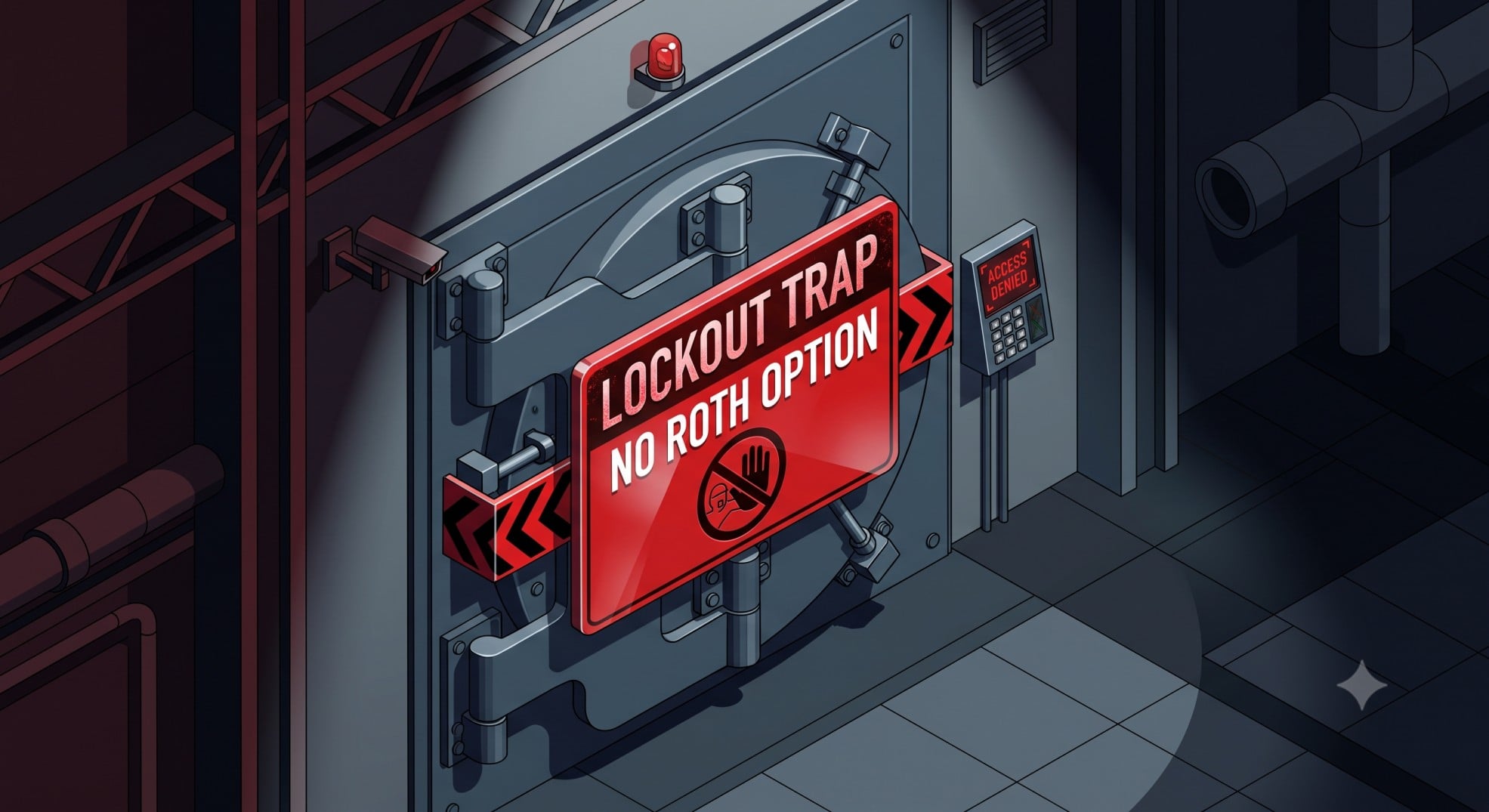
If your employer’s 401(k) plan only offers traditional, pre-tax deferrals and does not have a Roth option built into the plan document, high earners face a hard stop. The law states that if you are over the wage threshold, your catch-up must be Roth. If the plan cannot accept Roth money, you cannot make the contribution at all.
You lose the ability to save that extra $8,000 or $11,250 entirely. You are capped at the base $24,500 limit until your company’s HR department amends the plan to allow Roth deferrals.
This issue is compounded by the IRS “universal availability” requirement. If an employer amends their plan to allow Roth catch-ups for high earners, they must legally offer Roth catch-ups to every single eligible participant in the plan. Small businesses with outdated plan documents are scrambling to update their systems to avoid penalizing their top executives.
Do not assume your payroll provider will automatically fix this for you. You must proactively verify your plan’s capabilities.
Sarah is 61 years old and works for a mid-sized engineering firm. Her 2025 W-2 Box 3 wages were $160,000. She wants to take advantage of the $11,250 super catch-up allowed for her age bracket. Unfortunately, her employer’s 401(k) plan only offers traditional pre-tax deferrals. Because she is over the threshold and the plan lacks a Roth option, Sarah is locked out. She can only contribute the $24,500 base limit in 2026.
The Self-Employed Exemption: Solo 401(k)s and K-1 Income
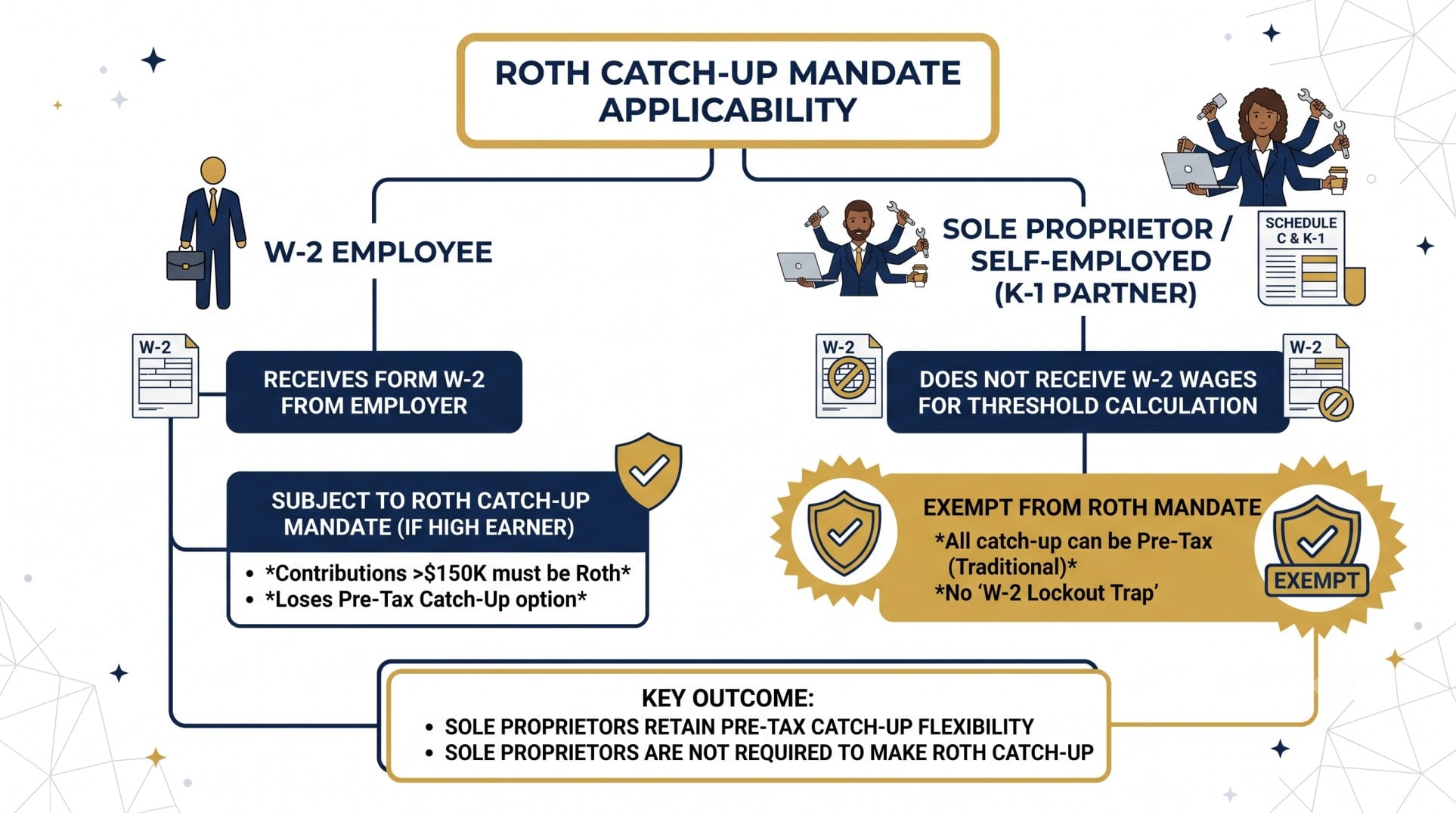
Business owners operate under a different set of rules. The SECURE 2.0 Roth catch-up for high earners was drafted with very specific statutory language that inadvertently—or perhaps intentionally—carved out a massive exemption for the self-employed.
Because the law specifically targets “wages” as defined under IRC Section 3121(a), it only applies to income subject to FICA taxes. Sole proprietors, independent contractors, and partners in a partnership do not receive W-2 FICA wages from their own businesses. Instead, they earn self-employment income subject to SECA (Self-Employment Contributions Act) taxes, which are reported on a Schedule K-1 or Schedule C.
If you fund a Solo 401(k) using purely self-employment income, you do not have FICA wages. Therefore, you are completely exempt from the mandate. You can earn $500,000 in net profit as a sole proprietor and still make your entire catch-up contribution on a pre-tax basis.
S-Corporation owners must tread carefully here. Unlike sole proprietors, S-Corp owners are required by law to pay themselves a reasonable W-2 salary. That salary is subject to FICA taxes. If an S-Corp owner sets their W-2 salary at $160,000, they trigger the mandate. If they set their W-2 salary at $140,000 and take the rest of their profits as shareholder distributions, they stay under the threshold and bypass the rule.
Elena is a 58-year-old freelance consultant operating as a sole proprietor. Her net Schedule C income in 2025 was $250,000. She funds a Solo 401(k). Because sole proprietors do not receive W-2 FICA wages, Elena bypasses the SECURE 2.0 Roth catch-up for high earners entirely. She can make her full $8,000 catch-up as a pre-tax contribution.
Proper tax planning for high-income earners requires aligning your corporate structure with these new retirement mandates.
Step-by-Step: Calculating Your 401k Catch-Up Roth Requirement for 2026
Figuring out exactly how to handle your payroll elections requires a systematic approach. Do not wait until your first paycheck in January to adjust your deferrals. Follow these exact steps to ensure compliance and maximize your tax advantages.
Step 1: Verify Your Age Eligibility
You must be 50 years old or older by December 31, 2026, to make any catch-up contributions. If you turn 50 on the very last day of the year, the IRS grants you full catch-up privileges for the entire calendar year.
Step 2: Locate Your 2025 W-2
The mandate operates on a one-year lookback. Pull your final pay stub or W-2 from 2025. Look specifically at Box 3. If that number is $150,000 or less, you are clear. You can choose between pre-tax or Roth. If it is $150,000.01 or higher, you are subject to the mandate.
Step 3: Check for Multiple Employers
If you worked two jobs in 2025, evaluate each W-2 independently. Do not add them together. If neither individual W-2 crossed the $150,000 mark, you are exempt, regardless of your total combined income.
Step 4: Confirm Plan Documents with HR
Email your benefits administrator immediately. Ask them a direct question: “Does our 401(k) plan currently accept Roth deferrals?” If the answer is no, you must pressure them to update the plan, or you will fall victim to the lockout trap.
Step 5: Stack Your Contribution Limits
Calculate your total capacity. Set your payroll system to defer your first $24,500 on a pre-tax basis to maximize your immediate tax deduction. Then, direct your payroll system to route the next $8,000 (or $11,250 if you are 60 to 63) into the Roth bucket to satisfy the 401k catch-up Roth requirement for 2026.
| Age Bracket (by Dec 31, 2026) | Base Limit | Catch-Up Limit | Total Potential Contribution | Tax Treatment for High Earners |
|---|---|---|---|---|
| Under 50 | $24,500 | $0 | $24,500 | Pre-tax or Roth |
| 50 to 59 | $24,500 | $8,000 | $32,500 | Catch-up MUST be Roth |
| 60 to 63 | $24,500 | $11,250 | $35,750 | Catch-up MUST be Roth |
| 64 and older | $24,500 | $8,000 | $32,500 | Catch-up MUST be Roth |
Transition Rules: 2026 Good-Faith vs. 2027 Strict Compliance
Implementing this law has been a logistical nightmare for payroll providers. Recognizing the administrative burden, the IRS issued Notice 2023-62, which delayed the original 2024 effective date by two full years. This delay gave recordkeepers time to rewrite their software.
For the 2026 tax year, the IRS is operating under a “reasonable good-faith interpretation” standard. This means that if an employer makes a genuine, documented effort to identify high earners and recharacterize their catch-up contributions as Roth, the IRS will generally not penalize minor administrative errors.
Starting in 2027, the grace period ends. The final regulations issued by the Treasury Department must be strictly followed. Any failure to properly categorize FICA wages for a catch-up contribution will result in plan disqualification risks and immediate tax penalties for the employee.
If you are an employer, you must use 2026 to iron out the bugs in your payroll system. If you are an employee, you must monitor your pay stubs closely. Setting up a Solo 401(k) or adjusting your W-2 salary now is the best defense against future compliance headaches.
Frequently Asked Questions About the Mandatory Roth Catch-Up for 2026
What is the mandatory Roth catch-up for 2026?
Starting in 2026, taxpayers aged 50 and older who earned over $150,000 in FICA wages during the prior year must make all 401(k) catch-up contributions on an after-tax Roth basis. You can no longer use pre-tax dollars for these specific contributions.
Does the $150,000 catch-up rule apply to my joint household income?
No, the threshold applies strictly to your individual FICA wages from a single employer. Your spouse’s income, investment returns, and other non-wage earnings do not factor into this specific calculation.
What happens if my employer does not offer a Roth 401(k)?
You will face the lockout trap. If your plan lacks a Roth option, you cannot make any age-based catch-up contributions at all until the plan is amended to accept them.
Are super catch-up contributions for ages 60 to 63 affected?
Yes. The new 401k catch-up Roth requirement for 2026 applies to both the standard $8,000 catch-up and the $11,250 super catch-up. If you exceed the wage threshold, the entire amount must be Roth.
Does the SECURE 2.0 Roth catch-up for high earners apply to IRAs?
This rule only applies to employer-sponsored retirement plans like 401(k)s, 403(b)s, and 457(b)s. Traditional IRAs and Roth IRAs operate under entirely separate contribution and income limits.
How do I find my FICA wages for a catch-up contribution determination?
Look at Box 3 (Social Security wages) and Box 5 (Medicare wages) on your W-2 from the prior year. The IRS uses these specific boxes, not your overall gross salary or Adjusted Gross Income.
Are self-employed individuals subject to this rule?
Generally, no. Sole proprietors and partners who receive K-1 income do not earn W-2 FICA wages from their business. Therefore, they are exempt and can continue making pre-tax catch-up contributions to a Solo 401(k).
Can I still make my standard $24,500 contribution on a pre-tax basis?
Absolutely. The mandatory Roth rule only applies to the catch-up portion of your savings. Your base limit of $24,500 can remain entirely pre-tax regardless of how much money you make.
What if my income drops below $150,000 in 2026?
The rule looks backward. Your 2026 eligibility is based entirely on your 2025 W-2. If your income drops in 2026, you will be exempt from the rule in 2027, but you must still comply in 2026.
Is the $150,000 limit adjusted for inflation?
Yes. The statute indexes the threshold for inflation in $5,000 increments. While the baseline is $150,000 for the 2025 lookback year, this figure will increase in future tax years.
The mandatory Roth catch-up for 2026 represents a fundamental shift in how high earners must approach their retirement savings. By understanding the exact mechanics of the wage threshold, the lockout trap, and the self-employed exemptions, you can protect your wealth and keep your financial plan on track.
Disclaimer: This content provides general information for educational purposes only. Tax laws are complex and change often. It is not professional tax, legal, or financial advice. Always consult a qualified tax professional for personalized guidance regarding your specific situation. Ourtaxpartner.com is not responsible for any actions taken based on the information provided herein.
