
Date: 2/10/2026
Red Alert: The ‘On-Ramp’ Ends & Automated Seizures Begin
The safety net for student loan borrowers has officially vanished. The 12-month “on-ramp” period, which shielded millions from credit damage and aggressive collections, expired on September 30, 2024. This was immediately followed by the end of the “Fresh Start” program on October 2, 2024. For those who haven’t made a payment since then, the clock is ticking toward the 270-day default threshold, which many will hit in mid-2025.
The 2026 Refund Twist
While the Department of Education resumed involuntary collections in May 2025, a major policy shift occurred on January 16, 2026. The Trump Administration announced an indefinite pause on the Treasury Offset Program (TOP) and wage garnishments. This move was intended to provide breathing room during the implementation of the Working Families Tax Cuts Act. While this pause explains how to stop 2025 federal tax refund seizure for student loans for the current filing season, it is not a permanent cancellation. Your debt continues to accrue interest, and the government has already issued “Notice of Intent” letters to millions of households.
The Rise of Automated IRS Collections
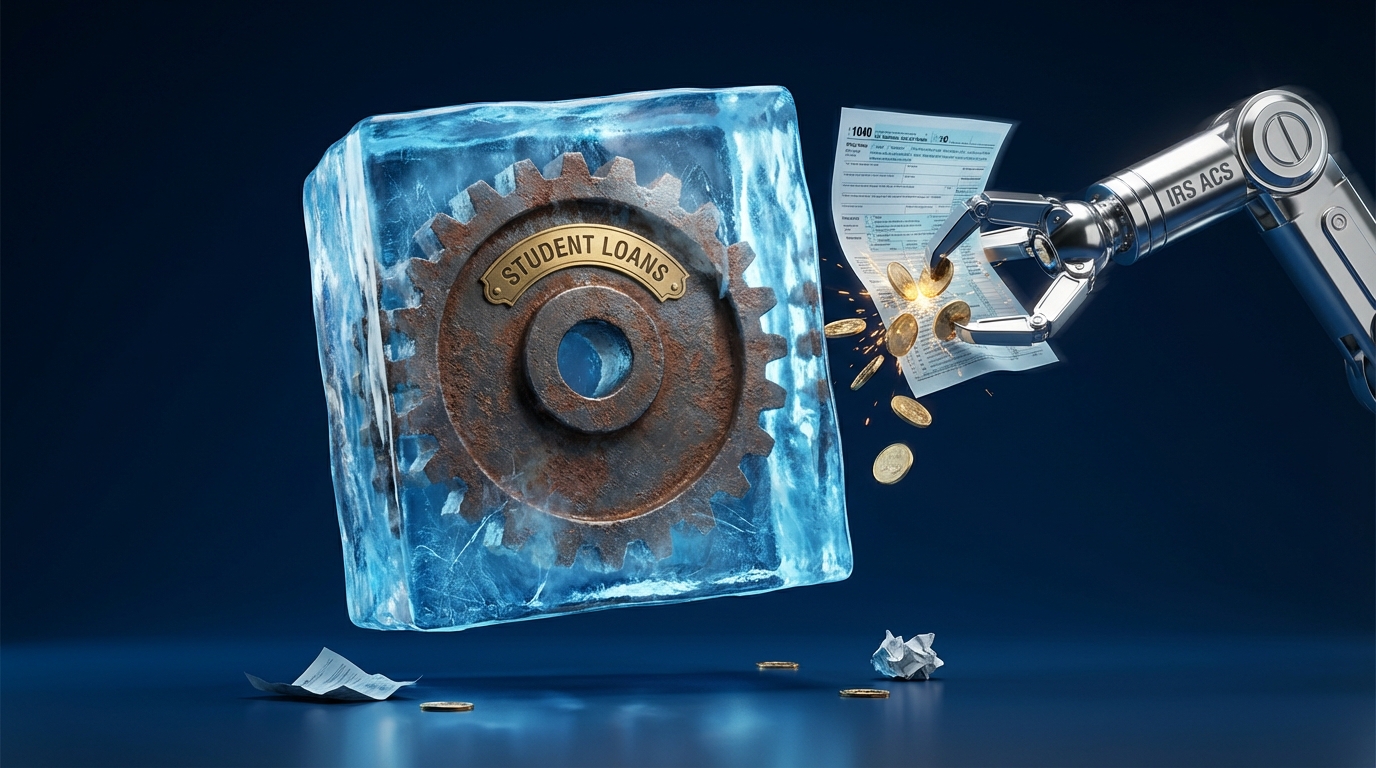
Even with the student loan pause, the IRS has shifted toward a high-tech, “hands-off” enforcement model. Due to a 27% reduction in workforce and the mandates of Executive Order 14247, the agency has phased out paper refund checks as of September 30, 2025. The IRS now relies heavily on the Automated Collection System (ACS) to flag accounts. This automation ensures that other debts, such as child support and state taxes, are seized instantly. If you are struggling with unpaid levies, you should investigate internal revenue service debt relief programs for 2025 back taxes to avoid automated triggers.
New Thresholds for Small Businesses
The IRS is also using new data streams to identify “unreported income” from side hustles and small businesses. The 2025 threshold for Form 1099-K is now set at $20,000 and 200 transactions. If your digital payments exceed this, the IRS will automatically cross-reference your return. Business owners facing unexpected liabilities should seek out the best tax resolution services for small business owners in 2025. Proactive management is the only way to stop 2025 wage garnishment and federal tax refund offsets before the automated system locks your accounts.
Strategic Debt Resolution
If you find yourself in default, waiting for the “indefinite pause” to end is a risky strategy. You may need to hire a tax relief attorney for 2025 federal debt settlement to negotiate a permanent solution. For those with significant liabilities, the most effective path is often learning how to qualify for an offer in compromise for 2025 tax debt. This program allows you to settle your debt for less than the full amount, providing a true “fresh start” that automation cannot offer.
| Collection Action | Status (2025-2026) | Trigger Point |
|---|---|---|
| Student Loan Refund Offset | Indefinitely Paused | 270 Days Delinquent |
| Wage Garnishment (AWG) | Indefinitely Paused | 15% of Disposable Pay |
| Back Tax Seizures | Active & Automated | Unpaid Assessment |
| 1099-K Automated Audit | Active | $20,000 Threshold |
The ‘OBBB’ Act: New Deductions (Tips/Overtime) vs. Offset Risks
The One Big Beautiful Bill (OBBB) Act of 2025 represents a massive shift for service workers and hourly employees. By introducing “above-the-line” deductions for tips and overtime, the law aims to put more cash directly into your pocket. However, there is a significant catch. The same law that grants these tax breaks also strengthens the government’s ability to take that money back if you owe federal debts.
New Deductions: Tips and Overtime
If you work in a service role, the “No Tax on Tips” deduction allows you to deduct up to $25,000 in qualified tips. To qualify, your job must fall under one of the 70 Treasury Tipped Occupation Codes (TTOC), which include roles like bartenders (101), wait staff (102), and digital content creators (209). Keep in mind that mandatory service charges or “auto-gratuities” do not count; the tips must be voluntary and received in a customary tipped role.
For those working extra hours, the “No Tax on Overtime” deduction offers a similar boost. You can deduct the “extra half” of your FLSA time-and-a-half pay, up to $12,500 for individuals. For example, if your base pay is $20 per hour and your overtime rate is $30, you can deduct the $10 premium for every qualified hour worked. Note that these benefits begin to disappear once your income hits $150,000 for individuals or $300,000 for joint filers.
| Deduction Type | Maximum Amount | Key Requirement |
|---|---|---|
| No Tax on Tips | $25,000 | Must be a TTOC-qualified role. |
| No Tax on Overtime | $12,500 ($25,000 Joint) | Only the “extra half” of FLSA pay. |
The Offset Risk: Protecting Your Refund
While these deductions can lead to much larger refunds, the Department of Education resumed the Treasury Offset Program (TOP) on May 5, 2025. If you have defaulted federal student loans, the government can now seize 100% of your refund to cover the debt. Learning how to stop 2025 federal tax refund seizure for student loans is now a priority for millions of workers who were counting on that OBBB boost to pay bills.
Beyond student loans, the IRS continues to offset refunds for unpaid federal taxes and child support. If you are struggling with old tax bills, you should explore internal revenue service debt relief programs for 2025 back taxes before you file your next return. For those with complex income streams, the best tax resolution services for small business owners in 2025 can help navigate the new Schedule 1-A reporting requirements and avoid math errors that delay your money.
If you receive a “Notice of Intent to Offset,” you have a narrow 60-day window to act. You may need to hire a tax relief attorney for 2025 federal debt settlement to negotiate a stay or a formal payment plan. Understanding how to qualify for an offer in compromise for 2025 tax debt could even help you settle for less than you owe. Taking these proactive steps is the most effective way to stop 2025 wage garnishment and federal tax refund offsets and ensure your OBBB savings stay in your pocket.
The ‘Perfect Storm’: Shutdowns & The 27% Staffing Cut
The IRS is currently navigating a workforce crisis that directly impacts your ability to receive a timely refund. Between 2025 and 2026, the agency’s total headcount plummeted from 102,000 to just 74,000 employees. This 27% reduction, driven by mass layoffs of probationary staff and the DRP 2.0 buyout program, has left the agency’s Taxpayer Services and Compliance departments severely understaffed. If you are struggling with unpaid balances, you may need to look into internal revenue service debt relief programs for 2025 back taxes before the agency’s remaining staff falls further behind on processing requests.
The Impact of the 2026 Refund Freeze
The staffing shortage reached a breaking point during the partial government shutdown that began on February 1, 2026. Under “essential” federal rules, the IRS only processes electronically filed returns that are error-free and fully automated. Any return that requires human intervention—such as those flagged for a Treasury Offset—is essentially frozen. Because the staff members who handle manual validations are often furloughed, taxpayers expecting a refund may face indefinite delays until the government fully reopens. This creates a massive bottleneck for anyone trying to resolve a debt issue.
| Metric | 2024 / Early 2025 | Late 2025 / 2026 |
|---|---|---|
| IRS Staffing Levels | ~102,000 employees | ~74,000 (27% Reduction) |
| Student Loan Offsets | Suspended (On-Ramp) | Active (Resumed May 5, 2025) |
| Tax Code Complexity | Standard Updates | 100+ Changes (OBBBA Act) |
| Manual Review Wait | 3–6 Weeks | 12+ Weeks (Estimated) |
Resumption of Student Loan Seizures
For the first time since 2020, the federal government is actively seizing tax refunds to cover defaulted student debt. The pandemic-era “on-ramp” protection officially ended on May 5, 2025, allowing the Department of Education to refer borrowers to the Treasury Offset Program (TOP). Many taxpayers are searching for how to stop 2025 federal tax refund seizure for student loans, only to find that the Bureau of the Fiscal Service can legally take 100% of a refund. This includes sensitive credits like the Child Tax Credit (CTC) and the Earned Income Tax Credit (EITC).
To protect your household income, it may be necessary to hire a tax relief attorney for 2025 federal debt settlement. These professionals can help you navigate the complex “One Big Beautiful Bill” (OBBBA) regulations that introduced over 100 changes to the tax code in late 2025. With the IRS operating in a “high-error environment” due to lack of training and staff, even a small mistake on your return can trigger a manual review that lasts three months or longer.
Proactive Resolution Strategies
If you are a business owner or a high-earner, the stakes are even higher. Finding the best tax resolution services for small business owners in 2025 is essential to ensure your filings are perfect the first time. You should also investigate how to qualify for an offer in compromise for 2025 tax debt if the new OBBBA rules have left you with a liability you cannot afford. Taking these steps early is the most effective way to stop 2025 wage garnishment and federal tax refund offsets before the automated systems take control of your assets.
Strategic Defense: Navigating RAP & The ‘Injured Spouse’ Loophole
The 2025 tax season introduces a complex environment for married couples balancing student debt and joint filings. Under the new Repayment Assistance Plan (RAP), high-earning households are finding a strategic advantage through the Married Filing Separately (MFS) loophole. By filing separately, you can exclude your spouse’s income from your payment calculation, potentially dropping your monthly bill to as low as $10. This is especially powerful for medical or dental professionals who can use the 100% interest subsidy to freeze their loan balance while investing their savings elsewhere. However, remember that the tax-free status of student loan forgiveness expires on December 31, 2025, meaning any debt wiped out after that date could trigger a massive tax bill.
The Injured Spouse Shield
If you are worried about how to stop 2025 federal tax refund seizure for student loans because of your spouse’s past-due debts, Form 8379 is your primary defense. When you sign a joint return, the Treasury views the refund as one lump sum. Filing as an “Injured Spouse” tells the IRS to pause and split the money before it leaves the building. To stop 2025 wage garnishment and federal tax refund offsets effectively, you must choose between the proactive “Shield” or the reactive “Clawback” method.
| Method | Action | Processing Time |
|---|---|---|
| Shield (Proactive) | Attach Form 8379 to your original 1040 electronic return. | 8 Weeks |
| Clawback (Reactive) | File Form 8379 after the refund has already been seized. | 11–14 Weeks |
Navigating Offsets and Debt Relief
Timing is everything for your 2025 finances. While the Department of Education resumed involuntary collections on May 5, 2025, a subsequent administrative pause on January 16, 2026, created a narrow window of risk for many filers. If you owe back taxes, you should explore internal revenue service debt relief programs for 2025 back taxes. For those with liabilities under $50,000, the “Fresh Start” program allows for streamlined installment agreements that avoid public tax liens. If your debt is significantly higher, learning how to qualify for an offer in compromise for 2025 tax debt could allow you to settle for a fraction of the total balance.
Small business owners often face unique challenges when personal and professional liabilities overlap and trigger offsets. Seeking out the best tax resolution services for small business owners in 2025 can help protect your company’s cash flow from aggressive federal collection tactics. If your situation involves complex litigation or high-dollar seizures, it is often necessary to hire a tax relief attorney for 2025 federal debt settlement to negotiate directly with the Treasury. Before you file, call the TOP Hotline at 800-304-3107 to verify if a “Certified Offset” is pending against your Social Security number.
The Community Property Trap
Be aware that your geography can weaken your defense. In community property states like Texas, California, and Washington, the IRS generally considers all income earned during the marriage to be owned 50/50. In these regions, the “Injured Spouse” defense is less effective because the government can still legally seize half of the joint refund, even if the debt belongs entirely to one person. Always ensure both spouses sign Form 8379 if you are filing it separately from your return to avoid further processing delays.
FAQ: Shutdown Delays, Private Lenders & The OBBB
The 2026 filing season is facing unprecedented hurdles that could delay your 2025 tax refund. A 43-day government shutdown in late 2025, followed by another lapse in funding on January 31, 2026, has left the IRS with 27% fewer staff members than last year. This staffing shortage has pushed the processing backlog to over 2 million returns. If you want to avoid “indefinite delays,” you should file electronically and choose direct deposit. These returns fall under the “Automated Exception” rule and continue to process during shutdowns, while paper returns and those requiring manual review will sit untouched until the government fully reopens.
Private Lenders vs. Federal Offsets
Many taxpayers worry that private student loan companies can snatch their tax refunds. Fortunately, private lenders cannot use the Treasury Offset Program (TOP) to seize your federal money. To access your assets, a private lender must first sue you and obtain a court-ordered judgment for a bank levy or wage garnishment. However, the rules are different for federal debt. Federal student loan offsets officially resumed on May 5, 2025. If your federal loan is in default—meaning you have not made a payment in at least 270 days—the government can take your entire refund to cover the balance.
If you are worried about your check disappearing, you should research how to stop 2025 federal tax refund seizure for student loans by looking into loan rehabilitation or consolidation before the IRS processes your return. For those struggling with unpaid taxes, the IRS will seize your refund even if you have an active installment agreement. You may need to explore internal revenue service debt relief programs for 2025 back taxes to find a more sustainable solution. Small business owners, who often face complex tax liabilities, should consult the best tax resolution services for small business owners in 2025 to protect their operating capital from sudden seizures.
If your debt is overwhelming, you might hire a tax relief attorney for 2025 federal debt settlement to negotiate on your behalf. These professionals can help you determine how to qualify for an offer in compromise for 2025 tax debt, which allows you to settle for less than you owe. Taking these steps early is the most effective way to stop 2025 wage garnishment and federal tax refund offsets before the Treasury acts. Remember, once a refund is seized, it is rarely returned, so proactive defense is your best strategy.
The OBBB Act: New Rules for 2025
The One Big Beautiful Bill (OBBB) Act, signed in July 2025, fundamentally changed how we handle student debt and taxes. One major win for workers is the permanent extension of tax-free employer student loan repayments of up to $5,250 per year. However, the bill also introduced the Repayment Assistance Plan (RAP), which extends the timeline for loan forgiveness to 30 years for new borrowers. Additionally, the OBBB eliminates Grad PLUS loans starting July 1, 2026, and sunsets economic hardship deferments for new loans issued after July 2027. On the tax side, the bill increased the 2025 standard deduction by $1,000 for single filers and $2,000 for joint filers.
2025 Refund Risk Summary
| Debt Type | Can Seize 2025 Refund? | Rule / Trigger |
|---|---|---|
| Federal Student Loans | YES | If in default (270+ days delinquent). |
| Back Taxes (IRS) | YES | Automatic, even if on a payment plan. |
| Private Student Loans | NO | Requires a court-ordered judgment. |
| State Tax Debt | YES | Through the Treasury Offset Program (TOP). |
| Child Support | YES | High priority; seized before other debts. |
About the Author
ARUN KP
With over 15 years of extensive experience in the accounting and taxation industry, Arun KP specializes in cross-border India-US taxation. As an Entrepreneur and AI Content Generator, he leverages cutting-edge technology to simplify complex financial landscapes for individuals and businesses.
Entrepreneur | AI Content Generator | India-US Tax Professional | Accountant
Disclaimer: This article is for informational purposes only and does not constitute professional tax advice.
