
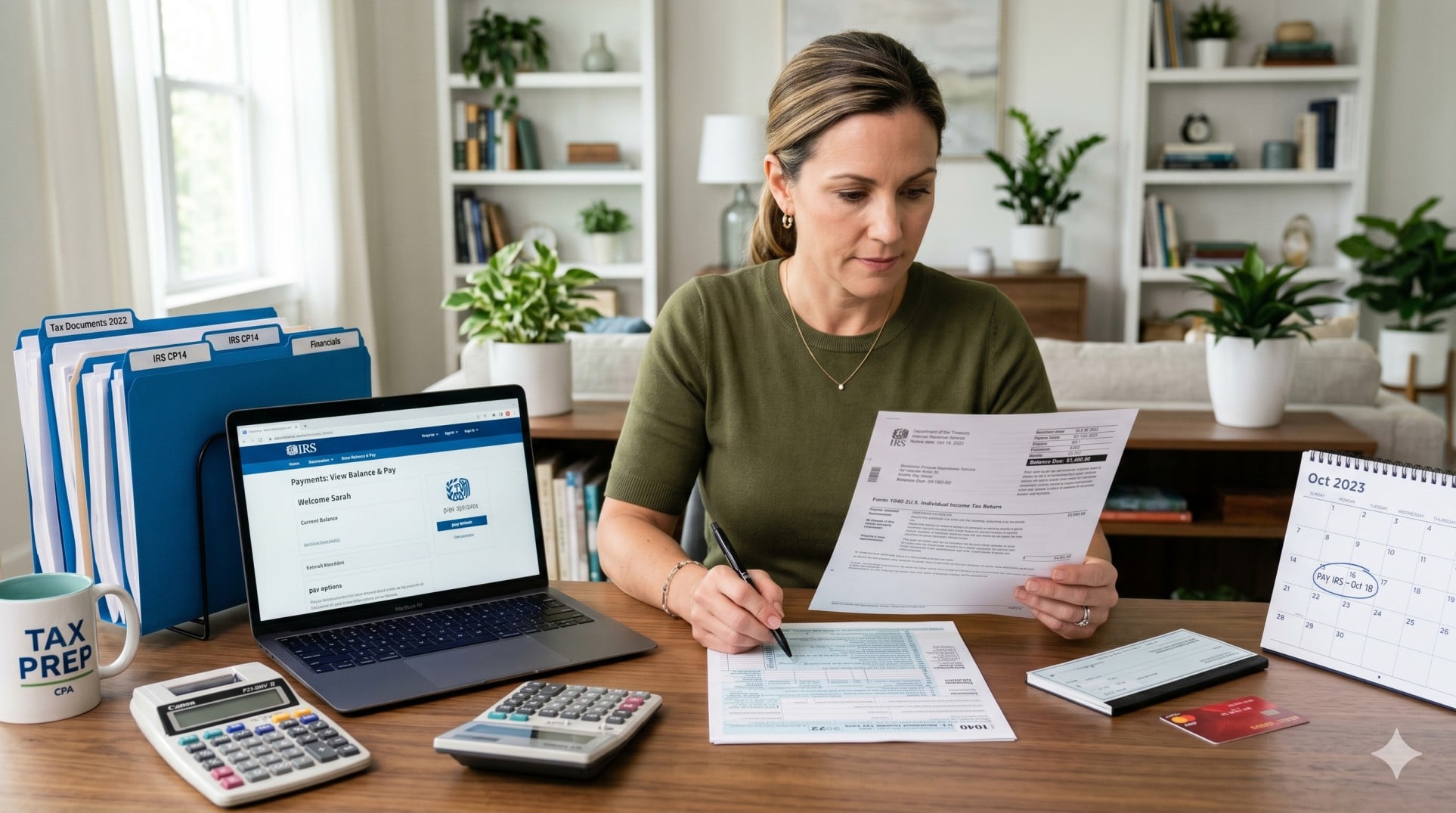
If you received an IRS CP14 notice after filing your 2025 federal return in the 2026 filing season, this guide explains what the notice means, what to do next, and how to handle payment, penalty, and interest issues in plain English. The focus is federal individual income tax only, with a short note on when state notices are different.
Quick takeaways
- A CP14 notice is the IRS’s first and most common balance-due notice. It says you owe tax, interest, and possibly penalties, and it asks for payment within 21 days.
- For the 2025 tax year, most calendar-year individual returns were due April 15, 2026. An extension to file would not have extended the time to pay.
- If you agree with the notice, pay the amount due by the date shown on the notice. If you can’t pay in full, the IRS says to make a payment plan or pay what you can now.
- If you disagree, call the IRS number on the notice and have your records ready, such as canceled checks, amended-return documents, or proof of payment.
- If you already paid in full, compare the notice with your records and your IRS online account before you pay again. The IRS has said some CP14 notices can appear before a payment fully posts or when a payment needs extra handling.
Who this applies to
This article is for individual taxpayers who received a federal CP14 balance due notice after filing a 2025 Form 1040 or Form 1040-SR return, including W-2 employees, retirees, and freelancers. If the notice came from a state tax department, the IRS says that is a separate agency and you should contact that office directly.
Introduction
If you opened your mail and found an IRS CP14 notice, the key thing to know is that the IRS is saying your account shows a balance due. For a 2025 return, the relevant filing year is 2026, and the original filing and payment deadline for most calendar-year filers was April 15, 2026. If you needed more time to file, Form 4868 had to be filed by that original due date, and it did not extend the time to pay.
The safest next step is usually to read the notice, compare it with your tax return and payment records, and then either pay, set up a payment plan, or dispute the notice if it is wrong. The IRS specifically tells taxpayers not to wait to respond to a notice and says notices explain what action is needed.
What a CP14 notice means
The IRS and the Taxpayer Advocate Service describe CP14 as the notice that tells you there is a balance due, states the amount, and requests payment. The Taxpayer Advocate Service says it is the first and most common balance-due notice, and the notice generally asks for payment within 21 days. The IRS’s own CP14 page says to read the notice carefully, pay by the due date, make a payment plan if you cannot pay in full, or contact the IRS if you disagree.
In plain English, a CP14 notice usually means one of three things:
- You filed the return and still owe money.
- You filed late and the IRS has already assessed tax, penalties, or interest.
- You already paid, but the payment has not fully posted or needs extra handling.
A CP14 does not automatically mean the IRS made a mistake. It also does not mean you should ignore it. If you do nothing, the IRS warns that it may continue collection actions and add more penalties and interest.
What to do first
The fastest response depends on your situation
| If this is true | Do this now | Why it matters |
|---|---|---|
| You agree with the amount due | Pay the amount by the due date on the notice. | Paying on time stops additional interest from adding up after that date. |
| You can’t pay in full | Pay what you can now and set up a payment plan. | The IRS says payment plans are an option, and acting quickly can reduce future charges. |
| You disagree with the balance | Call the IRS number on the notice and have proof ready. | The IRS says to contact it if you disagree and to have supporting documents available. |
| You already paid | Compare the notice with your records and IRS online account before taking action. | The IRS has acknowledged that some notices can arrive before a payment fully posts or while a payment needs further handling. |
If you agree with the notice
If the balance is correct, pay it by the due date on the notice. The IRS says you can view the notice in your online account, make payments there, and get email alerts for new notices. It also offers payment options such as Direct Pay, an IRS Online Account, debit or credit card through a payment processor, and payment by bank withdrawal when e-filing.
If you mail a check or money order, follow the notice instructions and use the address listed on the notice. The IRS says to mail payment to the address on the notice or the correct balance-due payment address if the notice does not give a specific mailing address.
If you disagree with the notice
If you think the IRS balance is wrong, call the number on the top right corner of the notice and have your paperwork ready. The IRS specifically mentions items like canceled checks or an amended return. If the notice came from another agency, such as a state tax department, the IRS says to contact that office instead.
If you already paid
Do not assume the CP14 is correct just because it arrived. Compare the notice with your bank records, canceled check, payment confirmation, and IRS online account. The IRS has said CP14 notices can be sent before a payment fully posts or when the payment needs additional handling. If your records show full payment, keep those records handy before you call or send another payment.
If you can’t pay in full
If you can’t pay the balance by the CP14 due date, the IRS says to pay what you can now and look at a payment plan. For individuals, the IRS currently allows qualified taxpayers to apply online for a short-term payment plan if they owe less than $100,000 in combined tax, penalties, and interest, or a long-term payment plan if they owe $50,000 or less in combined tax, penalties, and interest and have filed all required returns. If you are a sole proprietor or independent contractor, the IRS says to apply for a payment plan as an individual.
The IRS also says that in cases of financial hardship it may temporarily delay collection until your situation improves. That is fact-specific, so do not assume it will be granted automatically. If you need that kind of help, the IRS says to use the payment-plan and tax-debt-help options on its site or call the number on your notice.
If you qualify for a payment plan, be careful to keep up with future filing and payment obligations. The IRS says missing future payments or filing requirements can cause problems with the agreement.
Penalty and interest basics
A CP14 notice may include not just tax, but also penalty and interest. For individuals, IRS interest on unpaid tax generally accrues from the return due date and compounds daily. The IRS says the interest rate for taxpayers other than corporations is the federal short-term rate plus 3 percentage points.
If you filed your 2025 return on time but did not pay in full, the main charge is usually the failure-to-pay penalty, which the IRS says is generally 0.5% of the unpaid tax per month or partial month, up to 25%. If you have an approved payment plan after filing on time, the failure-to-pay penalty is reduced to 0.25% per month during the plan.
If you also filed the return late, the late filing penalty can apply too. The IRS says the failure-to-file penalty is generally 5% of the unpaid tax per month or partial month, up to 25%. If both the late-filing and late-payment penalties apply in the same month, the IRS says the combined charge is generally 5% for that month, because the late-filing penalty is reduced by the late-payment penalty. For returns due after December 31, 2025, the minimum late-filing penalty is $525 if the return is more than 60 days late.
If you can show reasonable cause, the IRS may remove or reduce some penalties. The IRS says reasonable cause is decided case by case and may cover facts like a fire, natural disaster, serious illness, inability to get records, or system issues that blocked a timely electronic filing or payment. It also says lack of funds by itself is not usually enough.
Common mistakes to avoid
- Ignoring the notice. The IRS says not to wait to respond to a notice and warns that unpaid balances can lead to more notices, penalties, and interest.
- Paying the wrong amount or paying twice. If you already paid, verify the account first so you do not duplicate payment while the IRS is still processing the first one.
- Mailing payment to the wrong address. The IRS says to use the address on the notice or the correct balance-due address in its payment instructions.
- Assuming a filing extension means you also had more time to pay. The IRS is clear that an extension to file is not an extension to pay.
- Waiting because you can’t pay in full. The IRS says to pay what you can and make arrangements for the rest.
Practical examples
Example 1: W-2 worker who owes a small balance
Simplified illustration: Priya filed her 2025 return on time and got a CP14 showing $1,200 still due. She can pay the full amount by the notice deadline. In that case, she avoids adding more interest after the notice due date, although any amounts already assessed on the account still remain due.
Example 2: Late filer who also owes tax
Simplified illustration: Marcus filed his 2025 return 2 months late and still owes $2,000. If both the late-filing and late-payment penalties apply, the IRS says the combined monthly charge is generally 5% of the unpaid tax for each month or partial month the return was late. That means a rough penalty cost of about $200 over two months, before interest and any minimum penalty rules.
Example 3: Freelancer who can’t pay the whole bill
Simplified illustration: Elena is a freelancer who owes $6,000 after filing her 2025 return. She can pay $1,500 now but not the rest. The IRS says she should pay what she can now and apply for a payment plan. If her plan is approved and she filed on time, the late-payment penalty may drop to 0.25% per month during the agreement, but interest still continues until the balance is paid off.
Example 4: Notice arrives after payment already went out
Simplified illustration: Jordan paid the full amount by check with the return, then got a CP14 a few weeks later. The IRS has said this can happen when a payment is still pending or needs extra handling. Jordan should compare the notice with the bank record and IRS account before sending another payment.
CP14 response checklist
- Read the notice and note the due date. The IRS says the notice explains how much you owe and how to pay it.
- Compare the notice with your return, bank records, and payment confirmation. The IRS says some notices can arrive before a payment fully posts.
- If you agree, pay by the notice due date using an IRS payment method.
- If you can’t pay in full, pay what you can and apply for a payment plan.
- If you disagree, call the IRS number on the notice and keep your proof ready.
- Keep copies of the notice, proof of payment, and any letters you send or receive. This helps if you later need to request penalty relief.
FAQ
What exactly is an IRS CP14 notice?
It is the IRS’s first and most common balance due notice. It says you owe money, shows the amount, and requests payment within 21 days.
Do I need to respond if I already paid?
If your records show full payment, compare the notice with your proof of payment and your IRS online account before doing anything else. The IRS has said CP14 notices can appear while a payment is still pending or being handled.
What if I can’t pay the full amount?
The IRS says to pay what you can now and consider a payment plan. Qualified individuals may apply online for short-term or long-term payment options, depending on how much they owe.
Will interest keep growing after a CP14?
Yes, if the balance is unpaid after the notice due date. The IRS says interest accrues on unpaid tax and compounds daily, and the rate for individuals is generally the federal short-term rate plus 3 percentage points.
Can the IRS remove penalties?
Sometimes. The IRS may remove or reduce some penalties if you show reasonable cause and good faith, but it looks at the facts and circumstances of your situation.
What if the notice is from my state instead of the IRS?
Then it is not a federal CP14 issue. The IRS says if the notice is from another agency, such as a state tax department, you should contact that office directly.
Bottom line
A CP14 notice is a serious but fixable balance-due notice. For a 2025 return in the 2026 filing season, the key move is to verify the balance, pay by the notice due date if you agree, and act quickly if you need a payment plan or think the notice is wrong. The longer you wait, the more likely penalty and interest charges will grow.
What to do next
- Pull out the CP14 notice and your 2025 tax return records.
- Confirm whether the balance is correct or whether you already paid it.
- If you owe, pay by the notice deadline or apply for a payment plan.
- If you disagree, call the IRS number on the notice and gather proof before you call.
- If you got a state notice too, handle that separately with your state tax agency.
Source note: Sources consulted: IRS forms, instructions, publications, official IRS pages and news updates, and related IRS guida

I received a notice to pay by June 29. I established a shot term payment plan with a due date of Oct. 12, 2026. I confirmed this is still active on my online account. My concern is the notice did not acknowledge this and that I will be penalized for failing to respond to the letter.
CM Gaede