
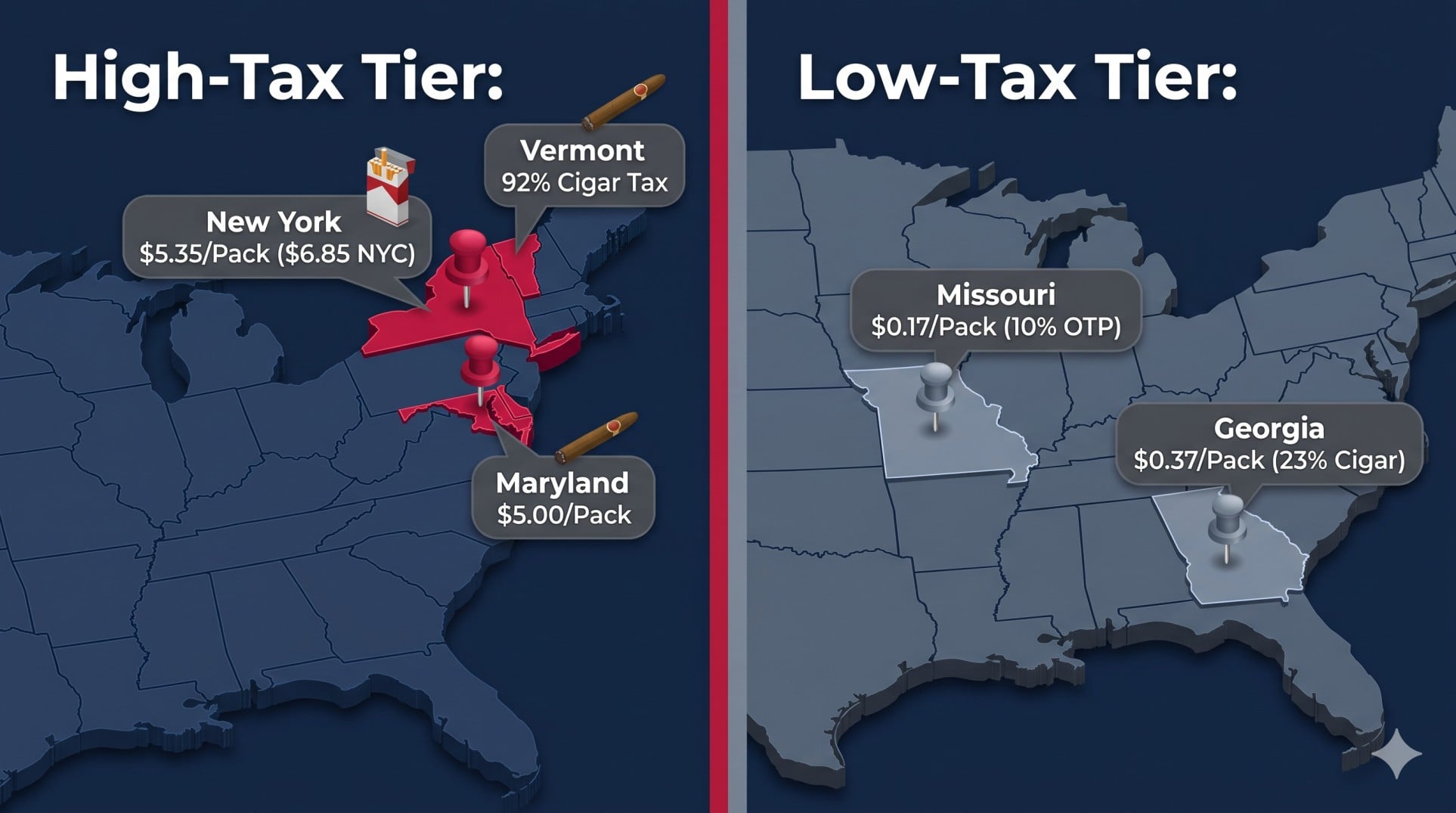
Nowhere in the United States tax code is the financial gulf between neighboring and regional states wider than in tobacco excise taxation. In 2026–2027, mastering interstate cigarette stamping and cigar tax compliance means operating across a thirty-fold rate disparity: while Missouri taxes cigarettes at $0.17 per pack (and Georgia at $0.37 per pack), New York levies $5.35 per pack ($6.85 inside New York City), Maryland charges $5.00 per pack, and Vermont taxes Other Tobacco Products and cigars at up to 92% of wholesale price.
That extreme price spread—where a single 600-carton master pallet of cigarettes carries $2,040 in state tax in Missouri versus $64,200 in New York State (or $82,200 in NYC)—has turned interstate highways like I-95, I-81, I-87, and I-70 into high-priority enforcement corridors. State Department of Revenue (DOR) criminal investigators, Maryland Field Enforcement Division agents, and federal Bureau of Alcohol, Tobacco, Firearms and Explosives (ATF) task forces actively target multi-state wholesalers, sub-jobbers, and retail chains moving inventory across borders.
Even legitimate, tax-paying distributors can accidentally trigger contraband seizures, $600-per-carton civil fines, and federal felony indictments if they transport unstamped or wrong-state-stamped cartons without proper nonresident stamping agent credentials and bills of lading. Here is the definitive 2026–2027 compliance and audit-defense guide for distributors and retailers operating across high-tax and low-tax states.
⚡ Executive Summary: Key 2026–2027 Tax Compliance Rules at a Glance
- The High-Tax vs. Low-Tax Cigarette Spread (2026–2027): On top of the $1.01 per pack federal TTB tax, state cigarette excise taxes for a pack of 20 range from $0.17 in Missouri (lowest in the U.S.) and $0.37 in Georgia (2nd lowest) to $3.08 in Vermont, $5.00 in Maryland, and $5.35 in New York (highest in the U.S., reaching $6.85/pack in New York City with the $1.50 city tax, plus mandatory NYS Prepaid Sales Tax on Form ST-133).
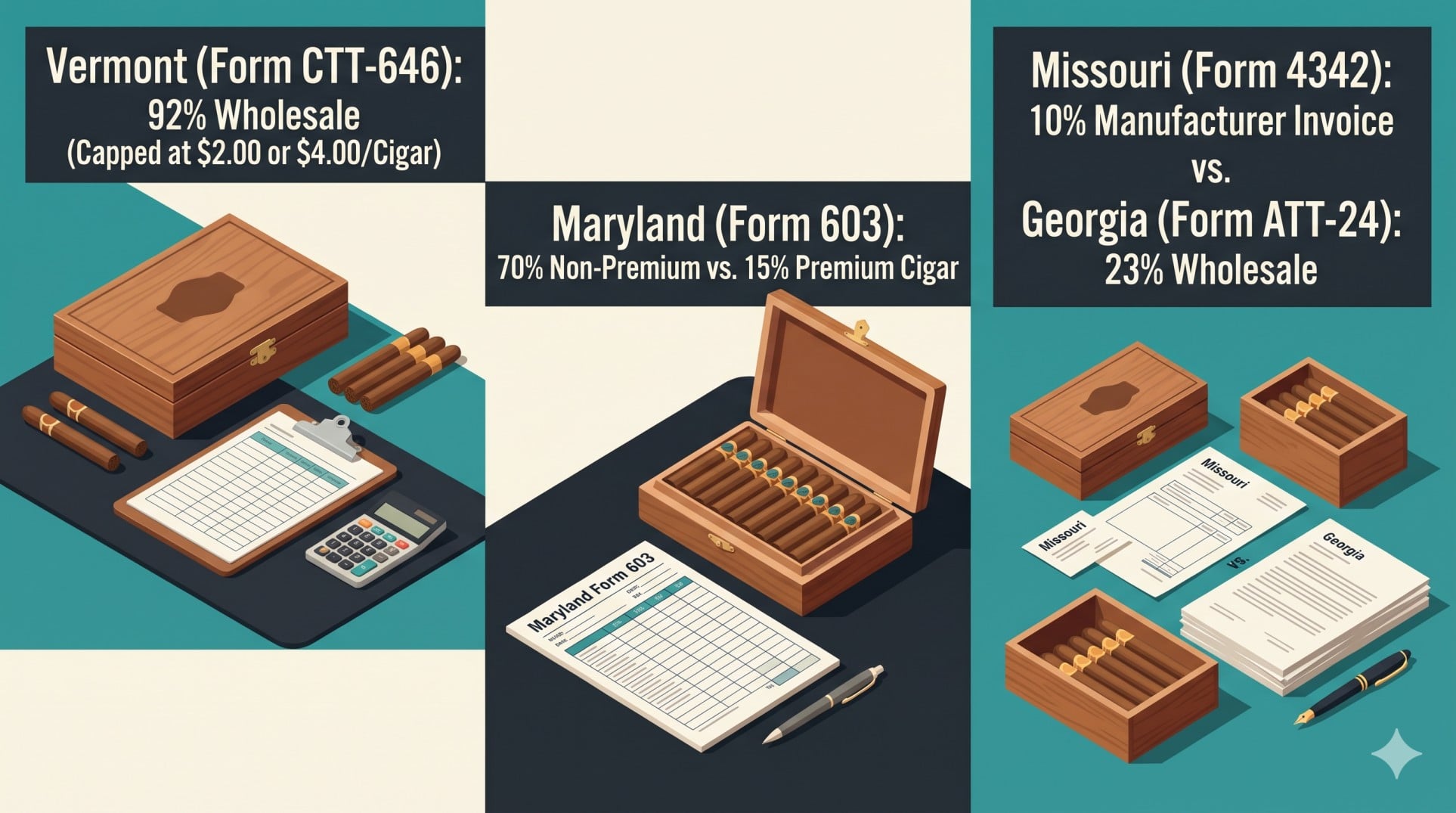
- The Cigar & OTP Valuation Divide: Vermont taxes non-cigar OTP and e-cigarettes at 92% of wholesale price and large cigars under a three-tier cap (92% up to $2.17 wholesale; flat $2.00/cigar for $2.18–$9.99 wholesale; flat $4.00/cigar for $10.00+ wholesale on Form CTT-646). Contrast that with Maryland (70% non-premium cigars, 15% premium cigars, 60% OTP on Form 603), New York (75% wholesale on cigars and, effective September 1, 2026, nicotine pouches on Form MT-203), Georgia (23% of wholesale cost on large cigars and 10% on loose/smokeless OTP on Form ATT-24), and Missouri (10% of manufacturer’s invoice price before discounts on Form 4342 / Form 4387).
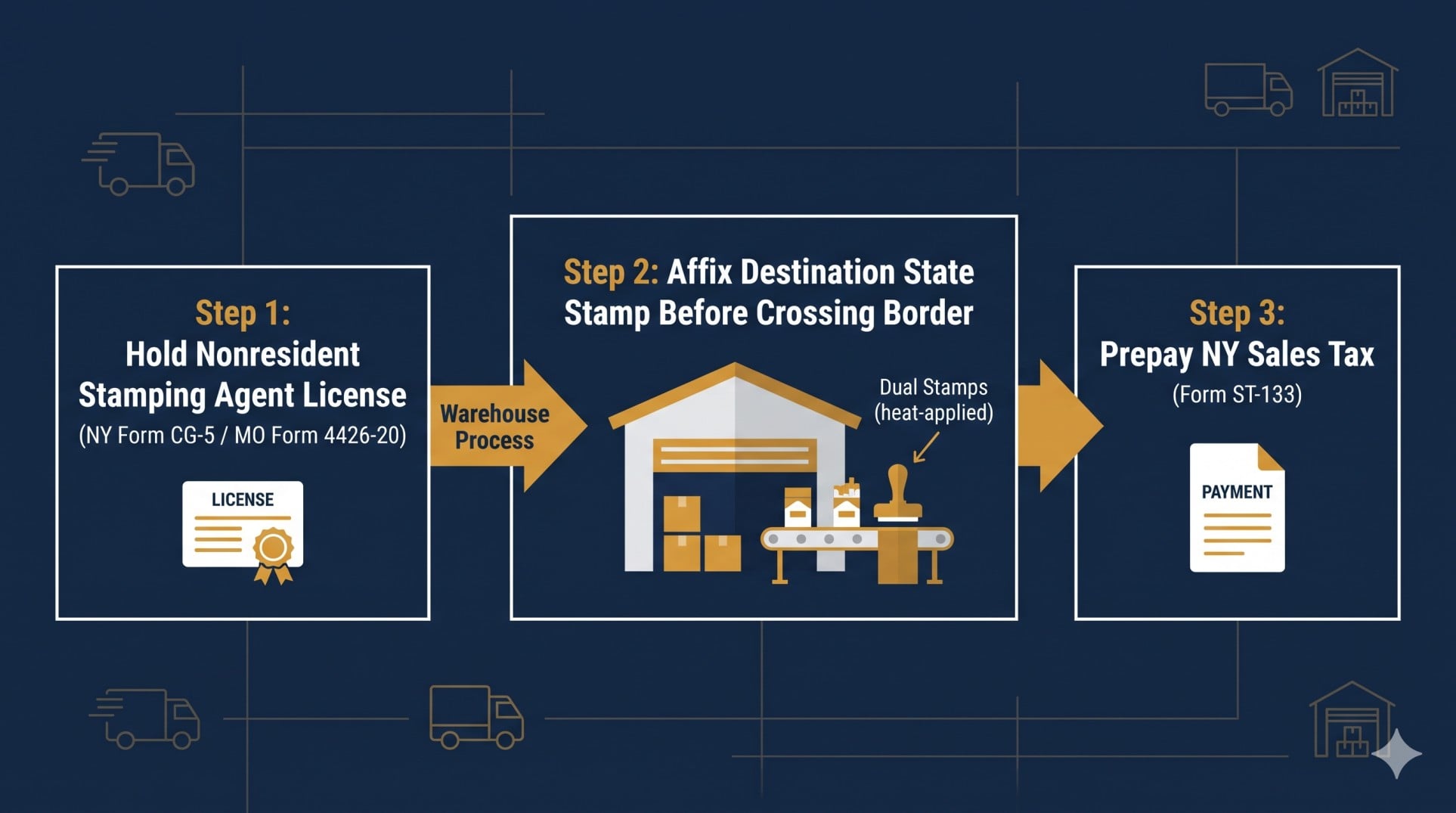
- Interstate Stamping & Nonresident Agent Mandates: A low-tax state stamp (such as a Missouri $0.17 decal or Georgia $0.37 stamp) is legally treated as unstamped contraband in any other state. Before shipping cigarettes into another state, an out-of-state wholesaler must hold a Nonresident Stamping Agent License (e.g., filing NY Form CG-5 or MO Form 4426-20) and affix the destination state’s tax stamp prior to crossing the border.
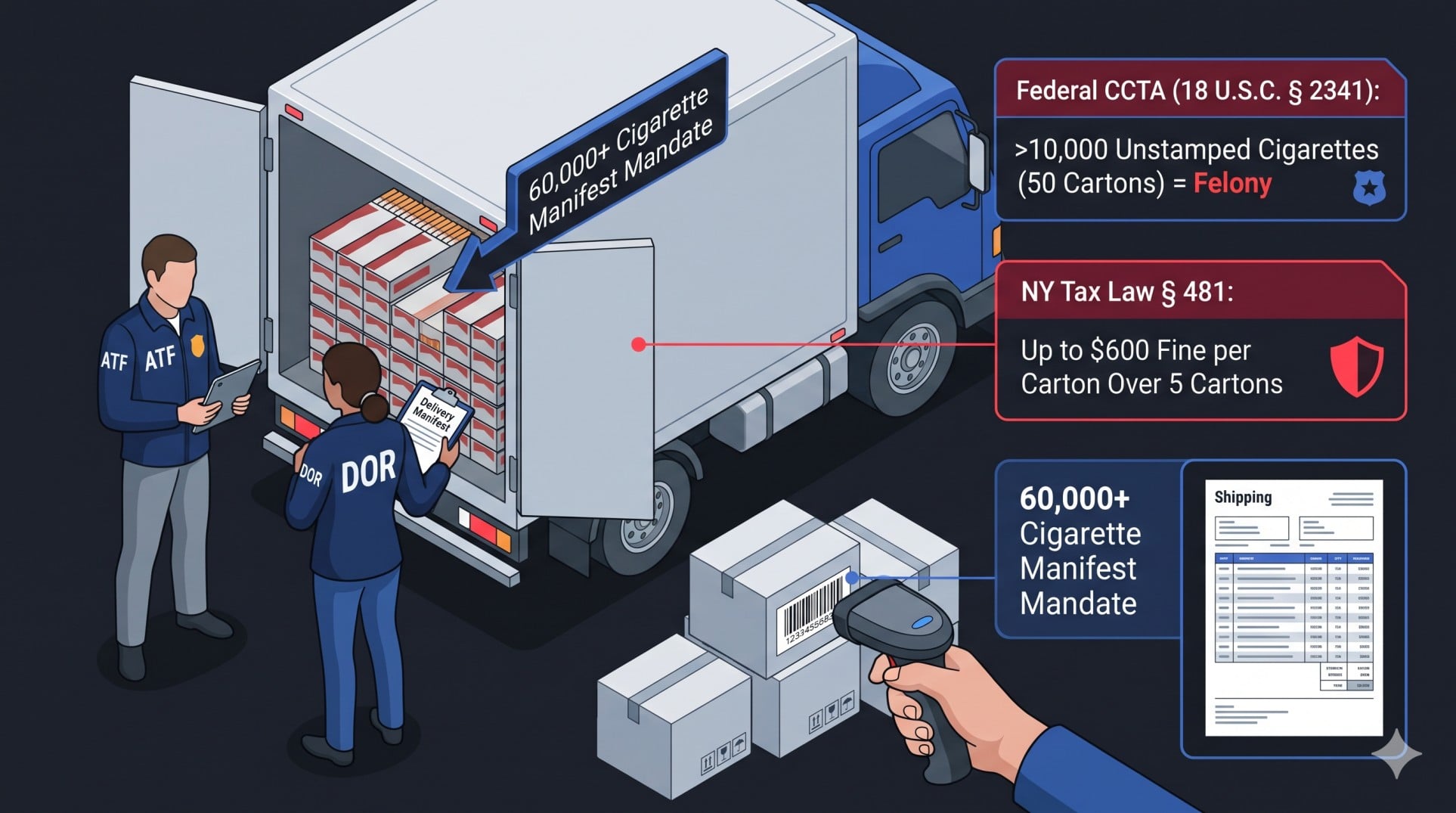
- Federal CCTA (50-Carton Felony) & State Contraband Penalties: Under the federal Contraband Cigarette Trafficking Act (18 U.S.C. § 2341) and ATF’s June 8, 2026 Final Rule (27 CFR Part 646), possessing or transporting more than 10,000 unstamped cigarettes (just 50 cartons) or 500 cans of smokeless tobacco is a federal felony carrying up to 5 years in prison. In New York, possessing over 5 cartons (1,000 cigarettes) without valid NY stamps triggers civil fines up to $600 per carton under Tax Law § 481(1)(b)(i) and felony charges at 50 cartons (Class E) and 150 cartons (Class D) under Tax Law § 1814.
Table of Contents
- ⚡ Executive Summary: Key 2026–2027 Tax Compliance Rules at a Glance
- The 2026–2027 Border Arbitrage Map: Why NY, MD & VT Clash With MO & GA
- Interstate Cigarette Stamping Rules: Resident vs. Nonresident Agents
- Cigar & OTP Border Traps: Vermont’s 92% Rate vs. Missouri & Georgia
- 2026–2027 Business Scenarios: Cross-Border Stamping, Refunds & Seizure Math
- Surviving DOR Inspections & Federal CCTA Contraband Enforcement
- Step-by-Step Interstate Compliance, Manifest & Filing Guide (NY, MD, VT, MO, GA)
- Frequently Asked Questions About Interstate Cigarette & Cigar Tax Compliance
- Protecting Your Multi-State Distribution Business From Contraband Audits
The 2026–2027 Border Arbitrage Map: Why NY, MD & VT Clash With MO & GA
In 2026–2027, the gap between the New York $5.35 and Maryland $5.00 cigarette tax rates on the East Coast and the Missouri $0.17 and Georgia $0.37 cigarette tax rates in the Midwest and South creates an excise arbitrage spread of $4.63 to $6.68 per pack—driving aggressive cross-border enforcement by state revenue departments.
Why have these five states become the focal point of interstate tobacco compliance audits? Because they sit at opposite extremes of U.S. fiscal policy. Since September 1, 2023, New York has held the #1 highest state cigarette excise tax in the nation at $5.35 per pack of 20 (with New York City adding an extra $1.50 per pack local excise tax for a combined $6.85 per pack, plus a statutory minimum retail price floor of $13.00+ and average retail prices hitting $14.83 to $16.50+ per pack). Right down the I-95 corridor, Maryland holds the second-highest state rate in the country at $5.00 per pack of 20 (enacted in June 2024 under the FY 2025 Budget Reconciliation and Financing Act, rising from $3.75/pack), while Vermont anchors New England with a $3.08 per pack cigarette tax and a blistering 92% wholesale tax on Other Tobacco Products (OTP).
Now compare those Northeast and Mid-Atlantic figures to the nation’s two lowest cigarette tax states: Missouri ($0.17 per pack of 20, unchanged since 1993 because Missouri voters have repeatedly rejected ballot increases) and Georgia ($0.37 per pack of 20), where average retail pack prices hover near $8.01 to $8.79.
How Border Disparities Impact Lawful Multi-State Distributors
You do not have to be an illicit bootlegger to get caught in the crossfire of these border wars. Legitimate regional wholesale distributors operating warehouses in border hubs—such as St. Louis or Joplin, Missouri (bordering eight states, including high-tax Illinois at $2.98/pack plus Chicago/Cook County taxes of $4.18/pack), Valdosta or Augusta, Georgia, Hagerstown, Maryland, Plattsburgh, New York, or Brattleboro, Vermont—routinely service retail convenience stores, cigar lounges, and military commissaries across two to five state lines on the same daily delivery route.
When a single delivery truck carries cartons stamped for multiple states—or carries unstamped cigars and OTP boxes across a border without itemized destination manifests—a routine highway weigh-station stop or warehouse floor inspection can halt your entire operation. Distributors tracking broader multi-state tobacco rate changes should also review our 2026 cigarette excise tax hikes and floor stock tax guide for a breakdown of recent stamp transitions.
| State & Tax Tier | 2026–2027 Cigarette Excise Tax (Pack of 20) | 2026–2027 Cigar Excise Tax Rate & Cap | 2026–2027 Other Tobacco (OTP) & Vape Tax | Stamping Discount / Timely Allowance | Primary Cigarette & OTP Tax Forms & Due Dates |
|---|---|---|---|---|---|
| New York (#1 Highest Cigarette Tax) |
$5.35 / pack State $6.85 / pack in NYC (+ $0.2675/stick > 20; + Prepaid Sales Tax) |
75% of wholesale price (No per-cigar cap) Little cigars: $5.35/pack of 20 |
75% of wholesale on OTP & Pouches (eff. Sept 1, 2026); $2.00/oz Snuff; 20% Retail Vape Tax |
Stamping agent commission via Form CG-4 (approx. 1.60% on initial threshold / 1.36% above) | Form CG-6 (Resident) / Form CG-5 (Nonresident) & Form MT-203 (OTP) Due: 20th of month |
| Maryland (#2 Highest State Cigarette Tax) |
$5.00 / pack ($0.25 per cigarette for packs > 20) |
70% of wholesale (Non-Premium Cigars); 15% of wholesale (Premium Cigars) |
60% of wholesale on OTP; 30% of wholesale Pipe; 20% Retail ESD Vape (> 5 mL) / 60% Retail (≤ 5 mL) |
0.82% of gross value on Maryland tax stamps; 0.6% timely credit on OTP | MD Cigarette Tax Return & Form 603 (OTP Return) Due: 21st of month |
| Vermont (High Cigar & OTP Tax Tier) |
$3.08 / pack ($0.154 per cigarette) |
92% of wholesale (≤ $2.17); $2.00/cigar ($2.18–$9.99); $4.00/cigar ($10.00+); Little cigars: $0.154/stick |
92% of wholesale on OTP & E-Cigarettes; $2.57/oz Snuff / Smokeless ($3.08 min < 1.2 oz) |
2.3% of face value on cigarette stamp purchases | Form CTT-646 (Cigarettes & Tobacco Products Return via myVTax) Due: 15th of month |
| Georgia (#2 Lowest Cigarette Tax) |
$0.37 / pack ($0.465 per pack of 25) |
23% of wholesale cost price (Large Cigars > 3 lbs/1,000); 2.5 mills ($0.0025)/stick (Little Cigars ≤ 3 lbs/1,000) |
10% of wholesale cost on Loose/Smokeless; $0.05/mL Closed Vape; 7% wholesale Open/Single-Use Vape |
Stamping discount (2% to 8% tiered by volume under O.C.G.A. § 48-11-3) | Form ATT-24 (Distributor OTP) & Cigarette Return via GTC Due: 10th of month (Retailer Form ATT-67 w/in 24 hrs) |
| Missouri (#1 Lowest Cigarette Tax) |
$0.17 / pack (8.5 mills/stick) ($0.2125 per pack of 25; + County taxes $0.05 in St. Louis/Jackson Co.) |
10% of manufacturer’s invoice price (before discounts or deals; no per-cigar cap) | 10% of manufacturer’s invoice price on all non-cigarette leaf OTP; $0.00 State Vape & Synthetic Pouch Tax |
3.0% allowance on Cigarette Decals (Form 4405); 2.0% timely discount on OTP (Form 4342 / 4387) |
Form 4426-20 (Out-of-State Cig.) & Form 4342 / 4387 (OTP) Due: 15th of month (Cigarette report due 20th) |
Interstate Cigarette Stamping Rules: Resident vs. Nonresident Agents
To achieve 100% interstate cigarette stamping and cigar tax compliance, a wholesale distributor located in one state cannot ship cigarettes into another state unless it first obtains a Nonresident Stamping Agent License from the destination state’s Department of Revenue and physically affixes the destination state’s tax stamp before the truck crosses the border.
Never assume that paying your home state’s cigarette tax allows you to sell to an out-of-state convenience store, or that an out-of-state retailer can self-assess cigarette tax on a monthly return the way they might with OTP. In all five states—New York, Maryland, Vermont, Missouri, and Georgia—cigarette excise taxes are collected exclusively through physical heat-applied (or meter-applied) tax stamps affixed to the bottom of each 20-pack or 25-pack prior to first sale or delivery inside the destination state.
How Resident vs. Nonresident Stamping Agent Credentials Work
When a regional distributor operates a central warehouse—say, in New Jersey or Pennsylvania servicing New York and Maryland, or in Missouri servicing Illinois, Kansas, and Kentucky—the warehouse must segregate its stamping lines by state and file separate resident and nonresident monthly reconciliations:
- New York State & NYC Dual Stamping (Form CG-6 vs. Form CG-5): Under New York Tax Law Article 20, only a licensed NYS Cigarette Agent (Application Form CG-100-A, accompanied by a credit bond, performance bond, and annual Form CG-213 Stamping Agent Certification of Compliance filed on or before September 1, 2026 for the September 1, 2026–August 31, 2027 period) may purchase and affix New York stamps. In-state stamping agents file monthly Form CG-6 (Resident Agent Cigarette Tax Report), while out-of-state stamping wholesalers approved by Albany to stamp packs at an out-of-state warehouse for delivery into New York file Form CG-5 (Nonresident Agent Cigarette Tax Report) by the 20th day of the following month. Furthermore, if any packs are destined for the five boroughs of New York City, the agent must be dually licensed by the NYC Department of Finance to affix the joint NYS/NYC cyan/monogrammed stamp ($6.85 total: $5.35 state + $1.50 city) rather than the state-only $5.35 stamp!
- New York’s Mandatory Prepaid Sales Tax on Cigarettes (Form ST-133): Unlike most states, New York requires cigarette stamping agents to prepay Prepaid Sales Tax on Cigarettes at the time stamps are purchased/affixed and pass that prepaid sales tax down the wholesale chain accompanied by Form ST-133 (Certificate of Prepayment of Sales Tax on Cigarettes). Under NYS Tax Law § 1103 and § 1111(j), the prepaid sales tax rate is 8% of the statutory base retail price adjusted every September 1 (verify current Publication 508 base retail adjustments for the September 1, 2026–August 31, 2027 period).
- Maryland Nonresident Wholesalers & The 30-Carton Trap: In Maryland, out-of-state wholesalers must hold a Maryland Wholesaler Cigarette License issued by the Comptroller of Maryland (Alcohol, Tobacco, and Cannabis Commission / Field Enforcement Division) and purchase $5.00 Maryland stamps (receiving a 0.82% stamping discount). Transporting unstamped cigarettes into Maryland—or packs bearing a Virginia ($0.60), Delaware ($2.10), or Pennsylvania ($2.60) stamp—without a valid Maryland unstamped transport permit is a crime under Maryland Tax-General Article § 13-1015.
- Missouri Out-of-State Cigarette Wholesalers (Form 4426-20 & Form 4405): Even when shipping into the lowest-tax state in the nation ($0.17/pack), an Illinois, Kansas, or Arkansas distributor cannot ship unstamped cartons to a Missouri gas station. The out-of-state wholesaler must hold an Annual Wholesaler’s Cigarette License from the Missouri Department of Revenue, purchase Missouri cigarette tax decals on Form 4405 (Cigarette Decal Purchase Order Form) (deducting the 3.0% statutory stamping allowance under RSMo § 149.021), and file Form 4426-20 (Out of State Missouri Cigarette Wholesaler Monthly Cigarette Tax Report — 20s only) (or Form 4426-25 for 25-packs) by the 20th day of the following month. (Also watch out for Missouri’s two county-level cigarette taxes: St. Louis County and Jackson County / Kansas City each levy an extra $0.05 per pack county tax!)
Claiming Tax Refunds or Credits When Stamped Cartons Are Exported or Returned
What if your warehouse already affixed a state’s tax stamp to a case of cigarettes, and that case is subsequently returned to the manufacturer as damaged/unsellable or sold and shipped to a licensed customer in another state? You do not have to eat the stamp cost. In New York, resident agents report out-of-state transfers of unstamped stock on Schedule C (Form CG-6.2) and claim stamp refunds/credits for unsellable or exported stamped goods accompanied by manufacturer affidavits. In Missouri, wholesalers and retailers exporting OTP outside Missouri deduct those interstate sales on Schedule C (Form 4390) or Schedule A (Form 4795) attached to their monthly return.
Cigar & OTP Border Traps: Vermont’s 92% Rate vs. Missouri & Georgia
While cigarettes carry visible tax stamps, cigars and Other Tobacco Products (OTP) do not—creating an invoice-level border audit trap between the Vermont 92% wholesale cigar tax cap ($2.00 or $4.00 maximum per cigar) and low-tax OTP states like Missouri (10% of manufacturer’s invoice price) and Georgia (23% of wholesale cost on large cigars).
Because boxes of Arturo Fuente, Padrón, Macanudo, or Swisher Sweets cigars look identical whether they sit in a humidor in Atlanta, St. Louis, Baltimore, or Burlington, state DOR auditors enforce cigar and OTP taxes by auditing bills of lading, federal PACT Act/interstate reports, and bank wire records.
1. How the Vermont 92% Wholesale Cigar Tax Cap Works (32 V.S.A. § 7771 & Form CTT-646)
Vermont levies one of the highest baseline OTP tax rates in America at 92% of the wholesale price (which also applies to e-cigarettes, vaping liquids, and pipe tobacco on Form CTT-646 via myVTax, due the 15th of each month). However, to prevent a 92% ad valorem tax from adding $12.00+ in excise tax to a single hand-rolled premium cigar, Vermont statute establishes a strict four-tier cigar tax matrix based on weight and single-cigar wholesale price:
- Tier 1 — Little Cigars (Weighing ≤ 3 lbs. per 1,000 cigars): Taxed at the exact same rate as cigarettes—$0.154 (15.4 cents) per cigar, which equals $3.08 per pack of 20.
- Tier 2 — Standard Large Cigars (Wholesale Price ≤ $2.17 per Cigar): Taxed at 92% of the wholesale price. (Notice why $2.17 is the exact statutory breakpoint: $2.17 × 92% = $1.9964, right under $2.00!)
- Tier 3 — Mid-Tier Premium Cigars (Wholesale Price > $2.17 and < $10.00 per Cigar): Taxed at a flat per-unit cap of $2.00 per cigar (regardless of whether the wholesale cost is $2.50 or $9.99).
- Tier 4 — Ultra-Premium Cigars (Wholesale Price ≥ $10.00 per Cigar): Taxed at a flat per-unit cap of $4.00 per cigar—the highest per-cigar statutory cap in the United States!
2. Maryland’s 70% vs. 15% Premium Cigar Split & New York’s Uncapped 75% Rate
Now compare Vermont’s four-tier cigar system against its regional neighbors:
- Maryland (Form 603 — Due the 21st): Under Maryland Tax-General Article § 12-105, Maryland splits large cigars into two sharply different tax brackets: Non-premium cigars (machine-made cigars, tipped cigars, and filtered/flavored mass-market cigars) are taxed at a punishing 70% of the wholesale price with no dollar cap. Conversely, qualifying handmade “Premium Cigars” are taxed at just 15% of the wholesale price! Meanwhile, general OTP (chewing tobacco, snuff, and oral nicotine pouches) is taxed at 60% of the wholesale price (hiked from 53% in July 2024), and pipe tobacco is taxed at 30% of the wholesale price. Misclassifying a machine-made cigarillo as a 15% “premium cigar” on Maryland Form 603 results in an immediate 55% tax underpayment assessment!
- New York (Form MT-203 — Due the 20th): New York taxes all large cigars—both machine-made and hand-rolled premium—at a flat, uncapped 75% of the wholesale price (while little cigars are taxed like cigarettes at $5.35 per pack of 20). On a $12.00 wholesale ($24.00 retail) Padrón cigar, New York’s uncapped 75% tax adds $9.00 per stick (compared to $4.00 in Vermont, $1.80 in Maryland, $2.76 in Georgia, and $1.20 in Missouri!). And remember: effective September 1, 2026 under NYS Important Notice N-26-2, New York also extended that 75% wholesale tax on Form MT-203 to all tobacco-free alternative nicotine products (nicotine pouches)!
3. Missouri’s 10% “Manufacturer’s Invoice” Rule vs. Georgia’s 23% “Wholesale Cost” Rule
Even in low-tax Missouri and Georgia, multi-state distributors get tripped up by the statutory definition of the tax base:
- Missouri (10% of Manufacturer’s Invoice Price Before Discounts — Form 4342 / Form 4387): Under RSMo § 149.160 and § 149.180, Missouri taxes all non-cigarette tobacco products (large cigars, little cigars, chewing tobacco, snuff, roll-your-own, cigarette papers, tubes, and blunt wraps) at just 10% of the manufacturer’s invoice price before discounts or deals, minus a 2.0% timely remittance deduction when filed by the 15th of the following month. Here is the audit trap: if a Missouri retailer or sub-jobber buys cigars from a secondary out-of-state wholesaler (not the manufacturer), the 10% tax is still based on the original manufacturer’s gross invoice price before promotional buydowns—and free samples or promotional goods are 100% taxable! Furthermore, out-of-state wholesalers selling OTP into Missouri must file Missouri Form 4342 every month (even “No Sales” zero returns!), while Missouri retailers buying untaxed OTP from unlicensed out-of-state suppliers must file Form 4341 and Form 4343 by the 15th.
- Georgia (23% Large Cigars / 10% Smokeless — Form ATT-24 & The 24-Hour Retailer Rule): Under O.C.G.A. § 48-11-2, Georgia taxes large cigars (weighing more than 3 lbs. per 1,000) at 23% of the wholesale cost price, little cigars (3 lbs. or less per 1,000) at 2.5 mills ($0.0025) per cigar ($0.05 per pack of 20), and loose/smokeless tobacco at 10% of the wholesale cost price (plus $0.05/mL on closed vapes and 7% wholesale on open/disposable vapes). Licensed distributors file Georgia Form ATT-24 electronically via the Georgia Tax Center (GTC) by the 10th day of the following month. Watch out for Georgia’s hair-trigger retail rule: if a Georgia tobacco retailer receives any cigars or OTP on which the Georgia tax was not paid by a licensed wholesaler, the retailer is legally required to file Form ATT-67 within 24 hours of receiving the products!
For a complete analysis of how states tax synthetic and tobacco-derived pouches alongside cigars, check out our 2026–2027 nicotine pouch excise tax compliance guide for 20+ states.
2026–2027 Business Scenarios: Cross-Border Stamping, Refunds & Seizure Math
To illustrate the exact dollar stakes of border tax differentials and interstate compliance errors in 2026–2027, let’s walk through four detailed mathematical scenarios involving cigarettes and premium cigars across New York, Maryland, Vermont, Missouri, and Georgia.
Scenario 1: The 100-Case Cigarette Pallet — Missouri & Georgia vs. Maryland & NYC
The Setup: Suppose a national logistics carrier is moving a standard 100-case pallet of combustible cigarettes (where 1 case = 60 cartons = 600 packs of 20; so 100 cases = 6,000 cartons / 60,000 packs of 20 / 1,200,000 cigarettes). Let’s calculate the exact 2026–2027 excise stamp outlay (and stamping discounts) required to legally stamp that exact same 60,000-pack pallet across our focus states:
- In Missouri ($0.17/Pack on Form 4405):
- Gross State Stamp Value: 60,000 packs × $0.17 = $10,200.00.
- Less Missouri 3.0% Wholesaler Decal Allowance: -$306.00.
- Net Missouri Stamp Cash Outlay: $9,894.00 (plus $3,000 if delivered inside St. Louis County or Jackson County at $0.05/pack).
- In Georgia ($0.37/Pack on GTC):
- Gross State Stamp Value: 60,000 packs × $0.37 = $22,200.00 (before Georgia’s tiered 2%–8% stamping discount).
- In Vermont ($3.08/Pack on Form CTT-646):
- Gross State Stamp Value: 60,000 packs × $3.08 = $184,800.00.
- Less Vermont 2.3% Stamp Discount: -$4,250.40.
- Net Vermont Stamp Cash Outlay: $180,549.60.
- In Maryland ($5.00/Pack):
- Gross State Stamp Value: 60,000 packs × $5.00 = $300,000.00.
- Less Maryland 0.82% Stamp Discount: -$2,460.00.
- Net Maryland Stamp Cash Outlay: $297,540.00.
- In New York State / New York City ($5.35 State / $6.85 NYC Joint Stamp on Form CG-6):
- Gross State-Only Stamp Value (Upstate/Long Island): 60,000 packs × $5.35 = $321,000.00.
- Gross Joint NYS/NYC Stamp Value (Five Boroughs): 60,000 packs × $6.85 = $411,000.00 (plus mandatory NYS Prepaid Sales Tax certified on Form ST-133 of roughly $50,000+ on the 60,000 packs!).
- The Arbitrage Reality: Moving that single 100-case pallet from Missouri into New York City represents a $400,000+ excise tax differential on one truckload!
Scenario 2: Multi-State Cigar Distributor Shipping 3 Cigar Tiers Into VT, MD, NY, GA & MO
The Setup: Atlantic Coast Cigar Wholesalers distributes three distinct boxes of 20 cigars (100 boxes of each = 2,000 cigars per SKU) into Vermont, Maryland, New York, Georgia, and Missouri in October 2026:
- SKU #1 (Machine-Made Tipped Cigarillos — Non-Premium Large Cigar): Wholesale price = $1.50 per cigar ($3,000.00 total for 2,000 cigars).
- SKU #2 (Handmade Toro Premium Cigar): Wholesale / Manufacturer’s Invoice price = $6.00 per cigar ($12,000.00 total for 2,000 cigars).
- SKU #3 (Reserve Churchill Ultra-Premium Cigar): Wholesale / Manufacturer’s Invoice price = $14.00 per cigar ($28,000.00 total for 2,000 cigars).
Step-by-Step 2026 Cigar Excise Tax Calculation Across All 5 States (For All 6,000 Cigars / $43,000.00 Total Wholesale Value):
- Vermont (Form CTT-646 — 92% Rate With $2.00 and $4.00 Tiered Caps):
- SKU #1 ($1.50 wholesale ≤ $2.17): Taxed at 92% of $3,000.00 = $2,760.00 ($1.38/cigar).
- SKU #2 ($6.00 wholesale — between $2.18 and $9.99): Capped at a flat $2.00 per cigar × 2,000 cigars = $4,000.00 (instead of $11,040 at 92%!).
- SKU #3 ($14.00 wholesale — $10.00 or more): Capped at a flat $4.00 per cigar × 2,000 cigars = $8,000.00 (instead of $25,760 at 92%!).
- Total Vermont Cigar Excise Tax Due: $2,760 + $4,000 + $8,000 = $14,760.00.
- Maryland (Form 603 — 70% Non-Premium vs. 15% Premium Cigar Split):
- SKU #1 (Non-Premium Machine-Made — $3,000 wholesale): Taxed at 70% = $2,100.00.
- SKU #2 & SKU #3 (Qualifying Handmade Premium Cigars — $12,000 + $28,000 = $40,000 wholesale): Taxed at 15% = $6,000.00.
- Total Maryland Gross Cigar Tax: $2,100 + $6,000 = $8,100.00 (less Maryland’s 0.6% timely filing credit of -$48.60 = $8,051.40 net).
- New York (Form MT-203 — Uncapped 75% Wholesale Tax):
- Because New York has zero per-cigar cap and no reduced premium cigar rate, all $43,000.00 is taxed at 75% = $32,250.00 (including a massive $10.50 excise tax per stick on SKU #3!).
- Georgia (Form ATT-24 — 23% of Wholesale Cost Price):
- All three SKUs are large cigars (> 3 lbs/1,000) taxed at 23% of $43,000.00 = $9,890.00.
- Missouri (Form 4342 — 10% of Manufacturer’s Invoice Price Less 2% Discount):
- Gross Tax: $43,000.00 × 10% = $4,300.00.
- Less Missouri 2.0% Timely Remittance Deduction (Line 5 of Form 4342): -$86.00.
- Net Missouri OTP Tax Due: $4,214.00 (nearly 8 times lower than New York’s tax on the exact same shipment!).
Scenario 3: The I-81 Highway Inspection — Wrong-State Stamps Trigger NY & Federal CCTA Penalties
The Setup: An independent sub-jobber based in Pennsylvania loads a cargo van with 120 cartons (1,200 packs / 24,000 cigarettes) bearing valid Georgia $0.37 tax stamps and Missouri $0.17 tax decals purchased from cash-and-carry outlets, intending to deliver them to three bodegas in Binghamton and Syracuse, New York. New York State Department of Taxation and Finance Criminal Investigations Division (CID) investigators inspect the van and the bodegas.
Step-by-Step Civil & Criminal Penalty Math:
- Zero Credit for Georgia or Missouri Stamps: Under New York Tax Law § 471 and § 481, cigarettes bearing another state’s tax stamp are legally defined as unstamped/unlawfully stamped contraband cigarettes in New York. All 120 cartons are immediately seized and forfeited, along with the cargo van under Tax Law § 1846!
- New York Civil Contraband Penalty (Tax Law § 481(1)(b)(i)(A)): The Commissioner of Taxation and Finance is authorized to impose a civil penalty of up to $600.00 for each 200 cigarettes (1 carton) or fraction thereof in excess of 1,000 cigarettes (5 cartons). On 120 cartons: 120 cartons − 5 carton threshold = 115 excess cartons × $600.00/carton = $69,000.00 in civil contraband fines—on top of the $6,420.00 in unpaid NYS excise tax ($5.35 × 1,200 packs)!
- New York Felony Prosecution (Tax Law § 1814): Because 24,000 cigarettes exceeds the 10,000-cigarette (50-carton) threshold under NYS Tax Law § 1814(a)(1) and § 1814(c)(1), the driver and store owner face a Class E Felony (and had the load reached 30,000 cigarettes / 150 cartons, it jumps to a Class D Felony under § 1814(c)(2)).
- Federal CCTA Felony (18 U.S.C. § 2341 & § 2342): Because 24,000 cigarettes exceeds the federal Contraband Cigarette Trafficking Act (CCTA) threshold of 10,000 unstamped cigarettes (50 cartons), the sub-jobber also faces federal felony charges carrying up to 5 years in federal prison!
Scenario 4: Missouri Retailer Buying Untaxed Cigars From an Out-of-State Distributor
The Setup: Show-Me Cigar & Smoke in Columbia, Missouri orders $15,000.00 (manufacturer’s gross invoice price before a $1,500 promotional discount, so net invoice is $13,500) of premium cigars from an unlicensed wholesaler in Florida that does not collect Missouri’s 10% OTP tax. Show-Me Cigar’s bookkeeper forgets to file Missouri Form 4341 by the 15th of the following month and files it 30 days late.
Step-by-Step Missouri Late Filing Math:
- Taxable Base (Before Discounts!): Under RSMo § 149.160 and Form 4341 Line 1 instructions, the 10% tax applies to the manufacturer’s invoice price before discounts or deals ($15,000.00, not $13,500.00) = $1,500.00 gross OTP tax.
- Forfeiture of 2% Timely Discount: Because the return was postmarked after the 15th, Show-Me Cigar forfeits the 2% ($30.00) timely remittance deduction on Line 5.
- Mandatory 25% Late Penalty (Form 4341 Line 7): Under Missouri OTP rules, any return remitted after the 15th due date is hit with an immediate 25% statutory penalty on Line 7 ($1,500.00 × 25% = $375.00) plus daily statutory interest!
If your distribution company or retail store is facing a state contraband assessment or needs to clean up unfiled out-of-state OTP returns, contact our excise tax audit defense and voluntary disclosure specialists immediately.
Surviving DOR Inspections & Federal CCTA Contraband Enforcement
Under Contraband Cigarette Trafficking Act (CCTA) enforcement rules (18 U.S.C. § 2341 et seq. and ATF’s June 8, 2026 Final Rule amending 27 CFR Part 646), possessing, shipping, or distributing more than 10,000 unstamped cigarettes (50 cartons) or more than 500 single-unit consumer cans of smokeless tobacco without evidence of applicable state/local tax payment is a federal felony.
In May 2026 (effective June 8, 2026), the Bureau of Alcohol, Tobacco, Firearms and Explosives (ATF) published its final rule in the Federal Register formally codifying the USA PATRIOT Improvement Act’s strict 10,000-cigarette threshold, smokeless tobacco provisions, and 60,000-cigarette recordkeeping mandates in 27 CFR Part 646. Here is what every multi-state distributor and retail chain owner must know to survive a joint ATF and State DOR inspection in 2026–2027.
1. The 50-Carton Federal CCTA Trigger & The 60,000-Cigarette Manifest Rule
- The 10,000-Cigarette (50-Carton) Felony Line: Under 18 U.S.C. § 2341(2), “contraband cigarettes” means any quantity in excess of 10,000 cigarettes (50 cartons of 200 cigarettes) that bear no evidence of the payment of applicable state or local cigarette taxes in the state or locality where such cigarettes are found, unless possessed by a statutorily exempt person (such as a licensed manufacturer, common carrier under a proper bill of lading, or a stamping agent specifically licensed by that state).
- The 500-Can Smokeless Tobacco Contraband Trigger: Under 18 U.S.C. § 2341(7) and 27 CFR Part 646, trafficking in more than 500 single-unit consumer-sized cans or packages of smokeless tobacco (just 100 five-can rolls!) across state lines to evade state OTP excise taxes is equally a federal CCTA violation.
- Mandatory ATF Recordkeeping Over 60,000 Cigarettes (300 Cartons): Under 18 U.S.C. § 2343(a) and 27 CFR § 646.146, any person who distributes more than 60,000 cigarettes (300 cartons / 5 cases) in a single transaction must maintain complete commercial records—including the full name, address, destination, vehicle license number, driver’s license number, and declaration of the specific purpose of the purchase—open to physical inspection by ATF officers during normal business hours.
2. State-Level Contraband Inspection Triggers in NY, MD, VT, MO & GA
State revenue inspectors do not need to wait for a 50-carton load to seize your inventory or arrest a driver:
- New York State (2-Carton Presumption & 6,000-Carton Schedule F): Under NYS Tax Law § 481(2)(a), possession of more than 400 cigarettes (just 2 cartons!) in unstamped or out-of-state-stamped packages by anyone other than a licensed NYS agent or distributor is presumptive legal evidence that the cigarettes are subject to tax and penalties. Furthermore, stamping agents must report any customer purchasing more than 6,000 cartons per month on a dedicated Schedule F (Form CG-5.5/6.5)!
- Maryland (30-Carton Criminal Escalation & Per-Pack Transport Fines): Under Maryland Tax-General Article § 13-1014 and § 13-1015, willfully possessing or selling 30 cartons or less of unstamped/out-of-state-stamped cigarettes is a misdemeanor ($500 fine / 3 months jail); exceeding 30 cartons escalates the penalty to $1,000 and 1 year imprisonment, while willfully transporting unstamped cigarettes on Maryland highways is a felony carrying an additional fine of up to $50 per carton plus seizure of both the cigarettes and the delivery vehicle!
- Georgia ($250 Late Penalty + $25/Day Non-Filing Fine): Under O.C.G.A. § 48-11-14, failing to file your monthly Georgia tobacco tax report on the Georgia Tax Center by the 10th triggers an automatic $250.00 late penalty plus $25.00 for every single day the report remains unfiled, while possessing unstamped cigarettes or untaxed cigars triggers civil penalties up to 500% of retail value or $1,000 and criminal prosecution.
Audit Survival Rule: Never Commingle Unstamped Stock in Delivery Vans
Even if your central warehouse is a licensed stamping agent in three states, never put unstamped cartons onto a local route-delivery van! Under state excise laws, unstamped cigarettes may only be held inside your bonded, state-approved stamping warehouse facility or transported via common carrier/bonded truck accompanied by an official bill of lading directly to another licensed stamping agent, a federal military installation, or an out-of-state facility. Every carton on a retail route truck must already bear the exact stamp of the state and city where the retail store sits.
Multi-state distributors who also ship e-cigarettes or vapes alongside cigars must ensure their SKU catalogs comply with state PMTA registries; see our 2026–2027 guide to FDA vape directory laws and state excise tax compliance to prevent dual contraband seizures.
Step-by-Step Interstate Compliance, Manifest & Filing Guide (NY, MD, VT, MO, GA)
To operate across high-tax and low-tax state borders in 2026–2027 with zero contraband or audit exposure, implement this four-step operational and tax-filing protocol across your distribution network.
Step 1: Secure Resident & Nonresident Licenses and Wholesale Exemption Certificates
- New York: File Form CG-100-A (Application for License as a Cigarette Agent or Agent/Wholesaler) and Form MT-202 (Distributor of Tobacco Products License). On or before September 1 of each year (including the September 1, 2026–August 31, 2027 cycle), furnish Form CG-213 (Cigarette Stamping Agent Certification of Compliance with Tax Law Article 20) to both your cigarette manufacturers and the NYS Tax Department.
- Missouri Wholesaler-to-Wholesaler Exemption (Form 4357): In Missouri, if your licensed OTP wholesale house sells cigars or smokeless tobacco tax-free to another Missouri-licensed OTP wholesaler (reported on Schedule E of Form 4342 / 4387), you must collect and retain a signed Missouri Form 4357 (Other Tobacco Products Tax Exemption Certificate) from the buying wholesaler. If a Missouri DOR auditor asks for Form 4357 and you don’t have it on file, the deduction on Schedule E is disallowed and you owe the 10% tax plus a 25% penalty!
- Georgia & Maryland Permits: Register all wholesale and manufacturer representatives on the Georgia Tax Center (GTC), and maintain active Cigarette Wholesaler and OTP Wholesaler licenses with the Maryland Alcohol, Tobacco, and Cannabis Commission (ATCC) and the Comptroller of Maryland.
Step 2: Equip Every Interstate Truck With a 7-Point Statutory Bill of Lading
Whenever your company trucks or third-party carriers transport cigarettes, cigars, or smokeless tobacco across state lines, require the driver to carry a physical and digital Bill of Lading / Delivery Manifest in the cab containing seven mandatory data points:
- Date of shipment and unique sequential invoice/manifest number.
- Full legal name, physical warehouse address, and state tobacco license numbers of the shipper/consignor.
- Full legal name, physical delivery address, and verified destination-state tobacco license number of the consignee/purchaser (or military post exchange / federal instrumentality purchase order number).
- Exact quantity of cigarettes broken down by brand family (for MSA/NPM tracking), pack size (20s vs. 25s), and exact state tax stamp affixed (e.g., “NYS $5.35 Stamp,” “NYS/NYC Joint $6.85 Stamp,” “MD $5.00 Stamp,” “MO $0.17 Decal”).
- For cigars and OTP: exact quantity, manufacturer’s gross invoice price, wholesale selling price, single-cigar wholesale price (for Vermont’s $2.17 / $10.00 tier verification), premium vs. non-premium status (for Maryland’s 15% vs. 70% split), and net weight in ounces.
- For New York cigarette deliveries: an attached Form ST-133 (Certificate of Prepayment of Sales Tax on Cigarettes) passing through the prepaid sales tax.
- Vehicle license plate number and driver’s commercial license identification (satisfying 27 CFR § 646.146 for shipments exceeding 60,000 cigarettes).
Step 3: Reconcile Physical Stamp Vaults & MSA Brand Schedules Monthly
In every stamping state, your monthly tax return is not just a financial return—it is a physical inventory reconciliation of every single tax stamp roll and unstamped carton that entered or left your warehouse:
- In New York, reconcile opening and closing unaffixed stamps and stamped packs on Form CG-6 (Resident Agent) or Form CG-5 (Nonresident Agent) alongside Schedule A (Form CG-5.1 / CG-6.1), Schedule B (Form CG-5/6-ATT — Packages Stamped During the Month), Schedule C (Form CG-6.2 — Out-of-State Transfers), and annual/periodic MSA brand certifications on Form CG-30 / CG-30.1.
- In Missouri, reconcile out-of-state cigarette decals on Form 4426-20 / 4426-25, and attach OTP Schedule A (Form 4388 — New Inventory), Schedule B (Form 4389 — Customer Returns), and Schedule C (Form 4390 — Export Sales) to your monthly OTP report.
Step 4: Hit Every Monthly Statutory Filing Deadline across All 5 States
Program these exact monthly due dates into your 2026–2027 compliance calendar (remembering that “No Activity / Zero Sales” returns are mandatory every month for active license holders in states like Missouri and Georgia):
- 10th of the Month (Georgia): File Georgia Form ATT-24 (Distributor OTP Return) and Georgia Cigarette Tax Returns electronically via the Georgia Tax Center (GTC). (Remember: Georgia retailers receiving untaxed OTP must file Form ATT-67 within 24 hours of receipt!)
- 15th of the Month (Vermont & Missouri OTP): File Vermont Form CTT-646 electronically via myVTax. File Missouri Form 4342 (Out-of-State Wholesalers Selling OTP into Missouri), Form 4387 (In-State Wholesalers), or Form 4341 / 4343 (First-Sale Retailers) with the Missouri Department of Revenue to lock in your 2.0% timely remittance deduction and avoid the 25% late penalty.
- 20th of the Month (New York & Missouri Cigarettes): File New York Form CG-6, Form CG-5, Form CG-89 (Wholesale Dealer Informational Return), and Form MT-203 (Distributor of Tobacco Products Tax Return, including cigars and alternative nicotine pouches at 75%) via NYS Online Services. File Missouri Form 4426-20 / 4426-25 (Cigarette Tax Report).
- 21st of the Month (Maryland): File the Maryland Cigarette Tax Return and Maryland Form 603 (Other Tobacco Products Tax Return) with the Comptroller of Maryland.
Need a dedicated team to manage your multi-state stamping reconciliations, PACT Act manifests, and monthly OTP filings? Visit our outsourced multi-state tobacco, cigar, and cigarette excise tax compliance hub to put your filings in expert hands.
Frequently Asked Questions About Interstate Cigarette & Cigar Tax Compliance
1. Which states have the highest and lowest cigarette excise taxes in 2026–2027?
New York levies the highest state cigarette excise tax in the United States at $5.35 per pack of 20 (reaching $6.85 per pack inside New York City), followed among states by Maryland at $5.00 per pack. Missouri levies the lowest state cigarette tax in the nation at $0.17 per pack, followed by Georgia at $0.37 per pack.
2. Can a distributor legally ship Missouri-stamped ($0.17) or Georgia-stamped ($0.37) cigarettes to a retailer in New York or Maryland?
No, a cigarette tax stamp from Missouri or Georgia has zero legal validity in any other state. Under New York and Maryland law, packs bearing another state’s stamp are classified as unstamped contraband cigarettes. Distributors must hold a Nonresident Stamping Agent License and affix the destination state’s stamp before crossing the border.
3. How does the Vermont 92% wholesale cigar tax cap work in 2026–2027?
Under the Vermont 92% wholesale cigar tax cap (reported on Form CTT-646), large cigars with a wholesale price of $2.17 or less are taxed at 92% of the wholesale price; cigars with a wholesale price over $2.17 and under $10.00 are taxed at a flat $2.00 per cigar; and cigars priced at $10.00 or more wholesale are taxed at a flat $4.00 per cigar.
4. How does Maryland tax premium cigars versus non-premium cigars in 2026?
On Maryland Form 603, Maryland taxes non-premium (machine-made/mass-market) cigars at 70% of the wholesale price, whereas qualifying handmade premium cigars are taxed at just 15% of the wholesale price. General Other Tobacco Products (OTP) in Maryland are taxed at 60% of the wholesale price, and pipe tobacco at 30%.
5. What is the federal Contraband Cigarette Trafficking Act (CCTA) felony threshold?
Under Contraband Cigarette Trafficking Act (CCTA) enforcement rules (18 U.S.C. § 2341 and ATF’s June 8, 2026 Final Rule in 27 CFR Part 646), knowingly shipping, transporting, receiving, possessing, or distributing more than 10,000 unstamped cigarettes (just 50 cartons) or more than 500 cans of smokeless tobacco is a federal felony punishable by up to 5 years in prison.
6. What are the civil and criminal penalties for possessing unstamped cigarettes in New York?
Under New York Tax Law § 481(1)(b)(i)(A), the Commissioner may assess a civil fine of up to $600.00 per carton (200 cigarettes) in excess of 5 cartons (1,000 cigarettes), plus vehicle and inventory forfeiture. Under Tax Law § 1814, possessing or transporting 10,000+ unstamped cigarettes (50 cartons) for sale is a Class E felony, and 30,000+ (150 cartons) is a Class D felony.
7. How are cigars and Other Tobacco Products taxed in Missouri and Georgia?
In Missouri, all non-cigarette tobacco products (including cigars, snuff, and chew) are taxed at 10% of the manufacturer’s invoice price before discounts or deals on Form 4342 / Form 4387 (with a 2% timely payment discount). In Georgia, large cigars are taxed at 23% of the wholesale cost price and loose/smokeless tobacco at 10% on Form ATT-24.
8. What is Georgia Form ATT-67 and why does it have a 24-hour deadline?
Under Georgia Department of Revenue regulations, if a Georgia tobacco retailer receives any cigars or Other Tobacco Products on which the Georgia excise tax has not already been paid by a licensed wholesaler or distributor, the retailer is required to file Form ATT-67 within 24 hours of receiving the untaxed products and remit the tax via the Georgia Tax Center.
9. What is New York Form ST-133 for cigarette wholesalers and retailers?
In addition to the $5.35/pack state excise tax ($6.85 in NYC), New York requires cigarette stamping agents to prepay Prepaid Sales Tax on Cigarettes and issue Form ST-133 (Certificate of Prepayment of Sales Tax on Cigarettes) to wholesale and retail buyers, who then take a credit for the prepaid tax on their retail sales tax returns.
10. What certificate must a Missouri OTP wholesaler collect when selling tax-free to another Missouri wholesaler?
When a licensed Missouri OTP wholesaler sells cigars or smokeless tobacco to another Missouri-licensed OTP wholesaler and deducts that sale on Schedule E of Form 4342 or Form 4387, the seller must collect and retain a signed Missouri Form 4357 (Other Tobacco Products Tax Exemption Certificate) from the buyer to substantiate the exemption during an audit.
Protecting Your Multi-State Distribution Business From Contraband Audits
Operating across high-tax and low-tax state lines in 2026–2027 requires military-grade precision in interstate cigarette stamping and cigar tax compliance. When a single delivery route spans the gap between the Missouri $0.17 and Georgia $0.37 cigarette tax rates and the New York $5.35 and Maryland $5.00 cigarette tax tiers—or crosses from Missouri’s 10% cigar tax into the Vermont 92% wholesale cigar tax cap and New York’s uncapped 75% rate—state DOR auditors and federal ATF agents treat every paperwork error as potential contraband trafficking.
Don’t let an unverified bill of lading, a missing nonresident stamping agent schedule, or a miscalculated cigar tier expose your business to vehicle seizures, $600-per-carton civil fines, or federal CCTA scrutiny. Contact the SALT & Excise Tax specialists at Ourtaxpartner.com today to audit your interstate stamping workflows, secure your nonresident distributor licenses, and manage your monthly multi-state cigarette and OTP tax returns with 100% accuracy.
Disclaimer: This content provides general information for educational purposes only and reflects state, local, and federal sales, use, and excise tax laws applicable to the 2026–2027 compliance periods. State and local tax rates, nexus thresholds, and excise regulations change frequently across jurisdictions. This article does not constitute professional tax, legal, or accounting advice. Always consult a certified public accountant (CPA), enrolled agent (EA), or qualified SALT advisor at Ourtaxpartner.com regarding your specific business compliance obligations. Ourtaxpartner.com is not responsible for any actions taken based on the information provided herein.
