
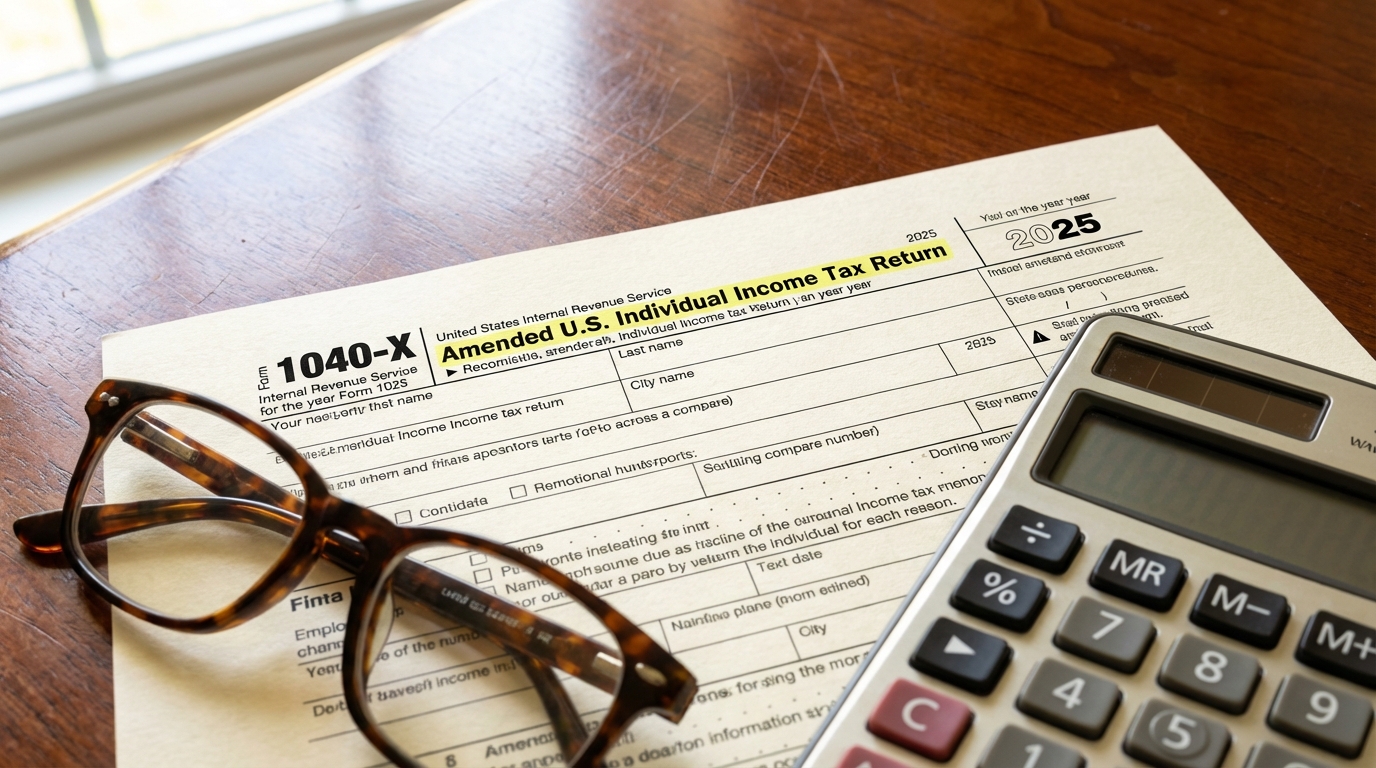
In the complex landscape of US taxation, accuracy is paramount, but errors are inevitable. Whether due to a late-arriving W-2, an overlooked deduction, or a retroactive change in tax legislation like the One, Big, Beautiful Bill Act (OBBB) of 2025, taxpayers often find themselves needing to correct a previously filed return. The mechanism for this correction is Form 1040-X, Amended U.S. Individual Income Tax Return.
As we navigate the closing of the 2025 tax year, understanding the regulatory framework surrounding amended returns is critical for compliance and financial optimization. This guide provides an exhaustive analysis of how to file an amended tax return, the specific statutes governing refunds and liabilities, and the tactical steps required to navigate the IRS correction process effectively.
Key Takeaways
- Statute of Limitations: To claim a refund, you generally must file Form 1040-X within three years of the original filing date or two years from the date the tax was paid, whichever is later (IRC § 6511).
- E-Filing Availability: The IRS allows electronic filing of Form 1040-X for the current tax year (2025) and up to two prior tax periods. Older returns must be filed on paper.
- Legislative Changes: The One, Big, Beautiful Bill Act (Public Law 119-21), signed July 4, 2025, introduced new deductions for seniors, overtime pay, and tips. Taxpayers who failed to utilize these on their 2025 filings (if filed early) may need to amend.
- Processing Time: Amended returns can take up to 16 weeks or longer to process. Status can be tracked via the “Where’s My Amended Return” tool.
- Penalty Prevention: Amending to pay additional tax by the April 15 deadline stops the accrual of failure-to-pay penalties and interest.
The Regulatory Framework of Form 1040-X
Form 1040-X serves as the procedural vehicle for taxpayers to correct errors on Forms 1040, 1040-SR, and 1040-NR. It is not merely a request; it is a sworn statement of correction that replaces specific lines of the original return.
When to File an Amended Tax Return
The IRS stipulates specific conditions under which an amendment is necessary. You should file Form 1040-X if you need to correct:
- Filing Status: Changing from Single to Married Filing Jointly (or vice versa, within specific legal constraints).
- Income: Reporting income from a forgotten W-2, 1099-NEC, or 1099-DIV.
- Deductions and Credits: Claiming missed opportunities, such as the new 2025 Deduction for Overtime Compensation or the Additional Deduction for Seniors.
- Dependents: Adding or removing a dependent claimed in error.
When NOT to File
The IRS automated systems are designed to handle minor discrepancies. Do not file Form 1040-X for:
- Math Errors: The IRS computer system automatically corrects calculation errors during processing.
- Missing Forms: If you forgot to attach a W-2 or schedule, the IRS will send a request for the missing document. Do not amend unless your total tax liability changes.
- Penalty Abatement Only: If you are requesting a refund of penalties and interest only, Form 1040-X is generally not the correct vehicle. (Note: Form 843 is typically used for penalty abatement requests).
Critical Deadlines and the Statute of Limitations
Understanding the timing rules codified in Internal Revenue Code (IRC) § 6511 is essential to ensure your claim for a refund is not time-barred.
| Scenario | Filing Deadline for Refund | Regulatory Basis |
|---|---|---|
| General Refund Claim | 3 years from the date the original return was filed, or 2 years from the date the tax was paid (whichever is later). | IRC § 6511(a) |
| Early Filers | If filed before April 15, the clock starts on April 15. | IRC § 6513(a) |
| Foreign Tax Credit | 10 years from the due date of the return. | IRC § 6511(d)(3) |
| Bad Debt / Worthless Securities | 7 years from the due date of the return. | IRC § 6511(d)(1) |
Note on 2025 Deadlines: For a 2025 calendar year return filed by April 15, 2026, the deadline to amend for a refund is generally April 15, 2029.
Step-by-Step: How to File an Amended Return
1. Electronic Filing (Recommended)
For tax year 2025 and the two immediate prior years (2024 and 2023), the IRS accepts electronically filed amended returns. This method is faster and minimizes mathematical errors. Tax software will generate the Form 1040-X based on your inputs.
2. Paper Filing Mechanics
If you are amending a return from 2022 or earlier, or if you prefer paper filing, you must mail the physical form.
Protocol for Paper Filing:
- Separate Envelopes: If amending multiple years (e.g., 2023 and 2024), mail each Form 1040-X in a separate envelope to avoid processing confusion.
- Attachments: Attach any new or corrected forms (W-2, 1099) that support the changes. Do not attach the original return.
- Explanation: Part III of Form 1040-X requires a clear, concise explanation of the changes. Cite specific reasons (e.g., “Receipt of corrected Form 1099-B showing higher cost basis”).
Detailed Scenarios: Navigating Complex Amendments
Below are six common scenarios requiring amendments, analyzed through the lens of 2025 tax law and the OBBB Act.
Scenario 1: The “One, Big, Beautiful Bill” Retroactive Deduction
Context: The OBBB Act (P.L. 119-21) introduced a new deduction for overtime compensation effective for tax years 2025-2028.
Situation: A taxpayer filed their 2025 return early in 2026 but failed to claim the deduction for $5,000 of overtime pay.
Action: The taxpayer must file Form 1040-X. In the “Income and Deductions” section, they will adjust their Adjusted Gross Income (AGI) downward by the deductible amount.
Result: Since the deduction reduces taxable income, the taxpayer is likely owed a refund. The explanation should cite “Claiming qualified overtime deduction pursuant to P.L. 119-21.”
Scenario 2: Correcting Filing Status (Marriage Penalty Fix)
Situation: A couple married in November 2025 but erroneously filed as “Single” for that tax year.
Action: They must file an amended return to change their status to “Married Filing Jointly” (MFJ). This is often beneficial due to the 2025 MFJ standard deduction of $31,500 compared to $15,750 for Single filers.
Constraint: Once a joint return is filed, it generally cannot be amended to separate returns after the filing deadline has passed.
Scenario 3: The Forgotten 1099-NEC
Situation: A freelancer omitted a $2,000 payment from a client. The IRS has not yet sent a CP2000 notice.
Action: File Form 1040-X immediately to report the additional income.
Financial Implication: This will increase tax liability. The taxpayer should pay the additional tax immediately to minimize the 0.5% per month failure-to-pay penalty and the 7% underpayment interest (rate as of early 2025).
Scenario 4: Foreign Tax Credit Adjustment
Situation: A taxpayer accrued foreign taxes in 2022 but failed to claim the Foreign Tax Credit.
Action: Unlike the standard 3-year rule, the taxpayer has 10 years to amend for foreign tax credits (IRC § 6511(d)(3)). They can file Form 1040-X for the 2022 tax year to claim this credit retroactively.
Scenario 5: Dependent Disallowance
Situation: A divorced parent claimed a child as a dependent, but the divorce decree grants the exemption to the ex-spouse for 2025.
Action: The taxpayer must amend to remove the dependent. This will likely increase taxable income and reduce credits (like the Child Tax Credit).
Warning: If the IRS audits this before an amendment is filed, the taxpayer could face a 20% accuracy-related penalty under IRC § 6662.
Scenario 6: Claiming the New Senior Deduction
Situation: A 66-year-old taxpayer missed the new OBBB deduction of $6,000 for seniors on their 2025 return.
Action: File Form 1040-X.
Income Limit Check: Ensure Modified AGI is under the phase-out threshold ($75,000 for singles, $150,000 for joint filers) before amending. If income exceeds these caps, the amendment may yield zero benefit.
2025 Tax Parameters for Reference
When amending a 2025 return, ensure you use the correct standard deduction and bracket figures verified for this tax year.
| Filing Status | 2025 Standard Deduction | Top Tax Bracket Threshold (37%) |
|---|---|---|
| Single | $15,750 | Over $626,350 |
| Married Filing Jointly | $31,500 | Over $751,600 |
| Head of Household | $23,625 | Over $626,350 (35% bracket ends) |
Note: The Additional Standard Deduction for the aged or blind in 2025 is $1,600 ($2,000 for unmarried taxpayers).
Common Pitfalls & Mistakes
1. Forgetting State Returns
Federal changes often impact state tax liability. If you file a federal amended return, you likely need to file an amended state return as well. Failure to do so can result in state-level penalties and interest.
2. Amending Too Soon
If you are expecting a refund from your original return, wait until you receive it before filing Form 1040-X. Filing an amendment while the original is still processing can trigger system flags that delay both refunds.
3. Missing the “Explanation of Changes”
Part III of Form 1040-X is mandatory. A vague explanation like “Fixed error” can delay processing. Be specific: “Amending to include Form W-2 from Employer XYZ, EIN 12-3456789, not received at time of original filing.”
4. Ignoring Carrybacks
If your amendment involves a Net Operating Loss (NOL) or general business credit carryback, ensure you are using the correct carryback period rules applicable to 2025.
FAQ: IRS Amended Return Inquiries
Where’s My Amended Return?
You can track the status of your amended return using the IRS online tool “Where’s My Amended Return?” or by calling the IRS. The tool generally becomes available three weeks after you mail your return. Processing can take up to 16 weeks, though delays are possible depending on IRS backlog volumes.
Can I get my amended refund via Direct Deposit?
Yes. For tax year 2021 and later (including 2025), if you file Form 1040-X electronically, you can request a direct deposit for your refund. Paper-filed amended returns will still result in a paper check.
What are the penalties if I owe more tax?
If your amendment results in additional tax owed, you may be subject to:
- Failure-to-Pay Penalty: 0.5% of the unpaid taxes for each month the tax remains unpaid, capped at 25%.
- Interest: The annual interest rate for underpayments in early 2025 is 7%, compounded daily.
Filing voluntarily before the IRS catches the error typically avoids the harsher 20% accuracy-related penalty or 75% civil fraud penalty.
Does the OBBB Act affect prior years?
The One, Big, Beautiful Bill Act primarily impacts tax years 2025 through 2028. It made the 2017 tax cuts permanent but did not generally create retroactive refunds for years prior to 2025, except where specific provisions (like certain disaster relief) might apply.
Conclusion
Filing an amended return with Form 1040-X is a powerful remedy for tax filing errors, but it requires precision and adherence to strict statutory deadlines. Whether you are correcting a simple W-2 omission or leveraging new opportunities from the OBBB Act of 2025, the key is to act definitively. Ensure your documentation is complete, your explanation is clear, and your filing is timely. By following these guidelines, you mitigate the risk of audits and ensure you pay no more tax than is legally required.
Disclaimer: The information provided in this article is for educational and informational purposes only and does not constitute professional financial or tax advice. Tax laws are subject to change. We recommend consulting with a qualified tax professional regarding your specific situation.
