
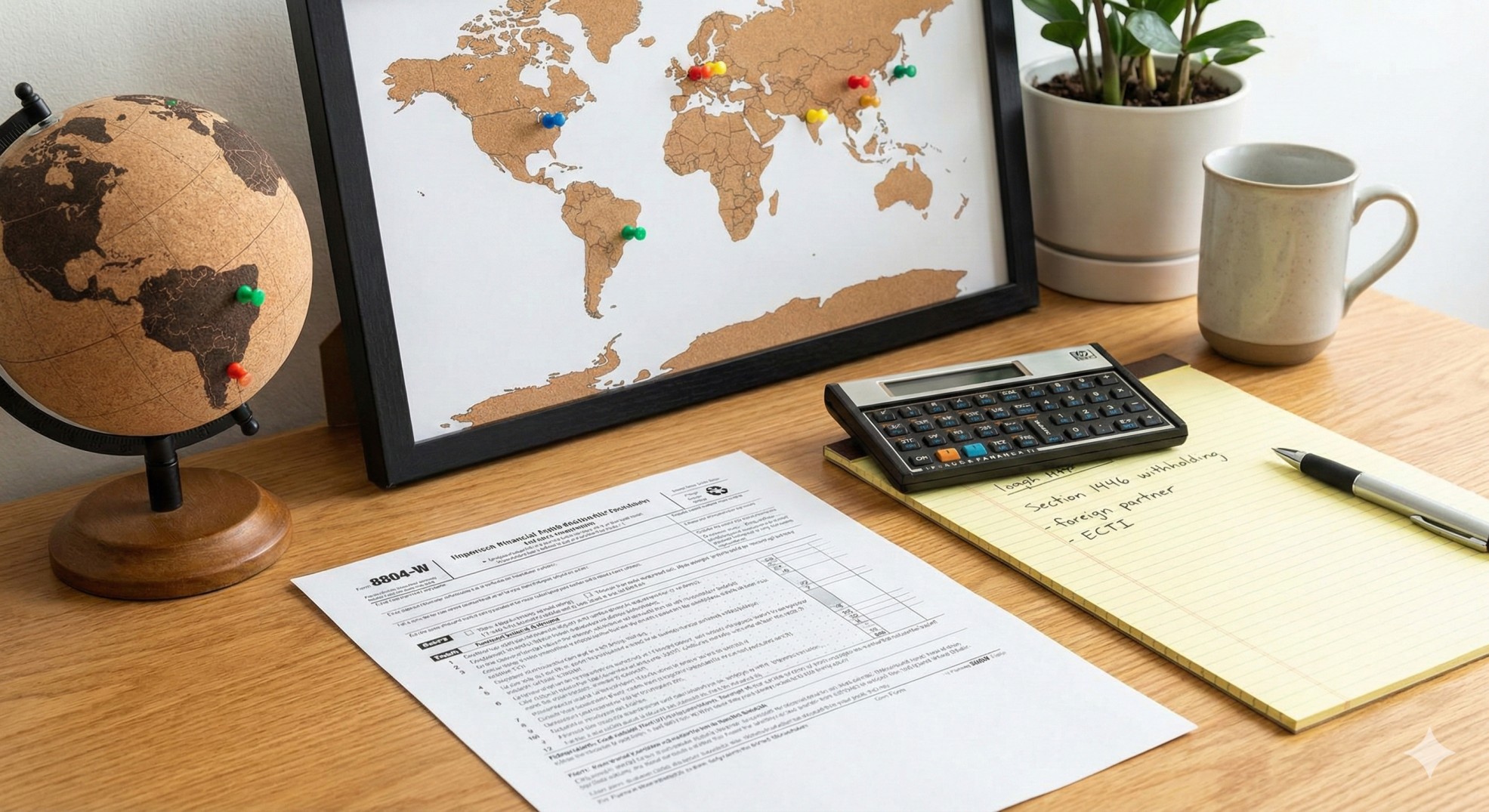
In my 15 years of practice, I have found that international tax compliance is often the most daunting area for domestic partnerships. Specifically, managing Form 8804-W Partnership Tax Payments requires a high level of technical precision. This form is not merely a filing requirement; it is a complex worksheet used to determine the installment payments of Section 1446 withholding tax. When a partnership earns income effectively connected with a U.S. trade or business, it must ensure that the IRS receives its share of tax throughout the year, rather than waiting for the annual return. Failure to navigate these waters correctly can lead to significant underpayment interest and penalties.
Purpose of Form 8804-W Partnership Tax Payments
The primary purpose of Form 8804-W Partnership Tax Payments is to serve as a worksheet for partnerships to calculate their required installment payments of tax under Section 1446. This tax is specifically levied on the Effectively Connected Income (ECI) that is allocable to foreign partners. Because the U.S. tax system operates on a “pay-as-you-go” basis, the IRS requires partnerships to act as withholding agents. Consequently, the partnership must estimate the total ECI for the year and remit payments in four installments. This ensures that the tax liability of foreign persons, who may have limited assets within the U.S. jurisdiction, is collected at the source.
Who Must File
Any partnership (domestic or foreign) that has ECI allocable to a foreign partner must utilize this worksheet to determine its Installment Tax Payments. A “foreign partner” includes nonresident alien individuals, foreign corporations, foreign partnerships, and foreign estates or trusts. In addition, the requirement is triggered regardless of whether the partnership actually distributes cash to the partners. If the income is “allocable” under the partnership agreement and constitutes ECI, the withholding requirement exists. Furthermore, even if a partnership believes it will owe no tax due to losses, I always advise my clients to complete the worksheet to document their position and avoid “failure to withhold” inquiries.
Objective and Merit of the Form
The objective of this form is rooted in Section 1446 Withholding of the Internal Revenue Code. The legislative intent is to prevent tax avoidance by foreign investors who might otherwise receive their share of U.S. profits and fail to file a U.S. tax return. By requiring the partnership to pay installments, the IRS secures the revenue upfront. The merit of the form lies in its “Safe Harbor” provisions. Much like individual estimated taxes, the form allows partnerships to base their payments on either 90% of the current year’s tax or 100% of the prior year’s tax (provided the prior year was a full 12-month period and showed a tax liability). This provides a level of certainty for the partnership’s cash flow management.
Describing Different Sections
The Form 8804-W Partnership Tax Payments worksheet is divided into several technical parts that require meticulous data entry:
- Part I (Annualized Income Installment Method): This is often the most complex section. It allows the partnership to annualize its income based on actual results for specific months of the year. This is particularly beneficial for seasonal businesses.
- Part II (Installment Payments): This section calculates the required payment for each of the four due dates. It factors in the applicable tax rates—currently the highest rate under Section 1 (for non-corporate partners) and Section 11 (for corporate partners).
- Part III (Adjusted Seasonal Installment Method): Partnerships with highly seasonal income patterns can use this section to further refine their payment requirements, potentially reducing the cash outlay in slower months.
- Schedule A: This is used to track the Foreign Partner Tax attributes, such as specific allocations and the application of different tax rates based on the partner’s entity type.
Conditions, Situations, and Major Provisions
Several complex situations can complicate Section 1446 Withholding. For instance, if a partnership has a “tiered” structure—where one partnership is a partner in another—the lower-tier partnership must look through to the ultimate beneficial owners to determine the correct withholding. Additionally, under certain conditions, a foreign partner may provide a certificate (Form 8804-C) to the partnership to reduce the withholding based on the partner’s anticipated losses from other U.S. sources. However, in my 15 years of practice, I have found that the IRS scrutinizes these certificates heavily. Consequently, partnerships should exercise extreme caution before relying on them to reduce Installment Tax Payments.
How To Complete Form
Completing the worksheet requires a professional workflow that begins with an accurate mid-year closing of the books. First, identify all Effectively Connected Income (ECI) and exclude any income that is not effectively connected (such as FDAP income, which is handled under Sections 1441 or 1442). Second, categorize partners by their tax status (corporate vs. individual) to apply the correct withholding rates. Third, determine if the partnership qualifies for the “Prior Year Safe Harbor.” Finally, calculate the installment for the period, subtract any overpayments from previous periods, and remit the balance via the Electronic Federal Tax Payment System (EFTPS).
When To File & Procedure
It is important to note that Form 8804-W is a *worksheet* and is not actually filed with the IRS. Instead, it is kept in the partnership’s permanent records to justify the amount of tax remitted. The Installment Tax Payments themselves are due on the 15th day of the 4th, 6th, 9th, and 12th months of the partnership’s tax year. For a calendar-year partnership, these dates are April 15, June 15, September 15, and December 15. The actual reporting of these payments occurs at the end of the year on Form 8804 and Form 8805.
Extension of Time To File & Procedure
Because Form 8804-W is a worksheet for internal use, there is no “extension” for the form itself. However, the underlying obligation to make Installment Tax Payments cannot be extended. If the partnership fails to make a payment by the due date, interest and penalties begin to accrue immediately. While the final annual return (Form 8804) can be extended using Form 7004, this does not provide relief for late installment payments. In my experience, the IRS is very aggressive in assessing underpayment interest under Section 6655 for partnerships that miss these quarterly windows.
Where To File
As previously mentioned, you do not file the 8804-W worksheet. However, the payments calculated on the worksheet must be made electronically. The IRS effectively mandates the use of EFTPS for these payments. When making the payment, you must specifically select “Form 8804” as the tax type to ensure the credit is applied to the partnership’s withholding account. Paper checks are highly discouraged and can lead to processing delays that trigger erroneous penalty notices.
Amending of the Form (Applicability)
If you discover an error in a previous installment calculation, you do not “amend” the 8804-W. Instead, you adjust the current period’s installment to “catch up” or “credit back” the difference. The worksheet is designed to be cumulative; Part II, Line 10, for example, asks for the total of previous installments. This self-correcting mechanism ensures that by the end of the fourth installment, the partnership has remitted the correct total Foreign Partner Tax for the year.
Penalties of Non-Filing
The penalties for failing to manage Form 8804-W Partnership Tax Payments are primarily found in Section 6655, which deals with the underpayment of estimated tax. The IRS calculates this penalty as an interest charge on the amount of the underpayment for the period it remains unpaid. Furthermore, if a partnership fails to withhold the tax entirely, the partnership itself becomes liable for the tax under Section 1461. This means the IRS can collect the tax from the partnership’s own assets, plus interest and potentially a 100% penalty if the failure is deemed willful.
CPA’s Professional Insights
In my practice, I often tell clients that the biggest “audit red flag” is a discrepancy between the ECI reported on Schedule K and the total income used for Section 1446 Withholding. The IRS uses automated matching to ensure these numbers align. Additionally, practitioners should be very careful with “Publicly Traded Partnerships” (PTPs), as they follow different rules under Section 1446. Another tip: always maintain updated W-8BEN or W-8BEN-E forms for every foreign partner. Without a valid W-8, you are required to withhold at the highest possible rate, and you lose the ability to use certain treaty benefits or lower rates for specific types of income.
Conclusion
Managing Form 8804-W Partnership Tax Payments is a critical component of a partnership’s fiduciary duty to the IRS. By accurately calculating Effectively Connected Income (ECI) and adhering to the installment schedule, a partnership protects itself from costly penalties and ensures its foreign partners remain in compliance with U.S. law. While the technical requirements of Section 1446 Withholding are high, a disciplined approach to quarterly calculations will mitigate risk and streamline the year-end reporting process.
Frequently Asked Questions (FAQ)
1. What happens if the partnership has a net loss for the year?
If the partnership reasonably estimates that it will have no ECI for the year, the required installment payment is zero. However, you should still complete the 8804-W worksheet to document how you arrived at that conclusion in case of a future audit.
2. Can we use the “Prior Year Safe Harbor” if the partnership was not in existence last year?
No. To use the 100% of prior year tax safe harbor, the partnership must have filed a Form 8804 for a full 12-month period in the preceding year and that return must have shown a tax liability.
3. Does the partnership have to withhold if the foreign partner is a “Flow-Through” entity?
Yes. If the partner is a foreign partnership or trust, the domestic partnership must withhold on the ECI allocable to that entity, unless the foreign entity provides specific documentation (like a W-8IMY) that allows for “look-through” treatment.
4. Are capital gains included in the ECI for Form 8804-W?
Yes, if the capital gains are effectively connected with the U.S. trade or business. However, the worksheet allows you to apply the specific capital gains tax rates (e.g., 20% for individuals) rather than the higher ordinary income rates.
5. What is the difference between Form 8804 and Form 8804-W?
Form 8804 is the annual return filed with the IRS to report the total tax liability for the year. Form 8804-W is the internal worksheet used during the year to calculate the quarterly installment payments that are credited against that final liability.
