
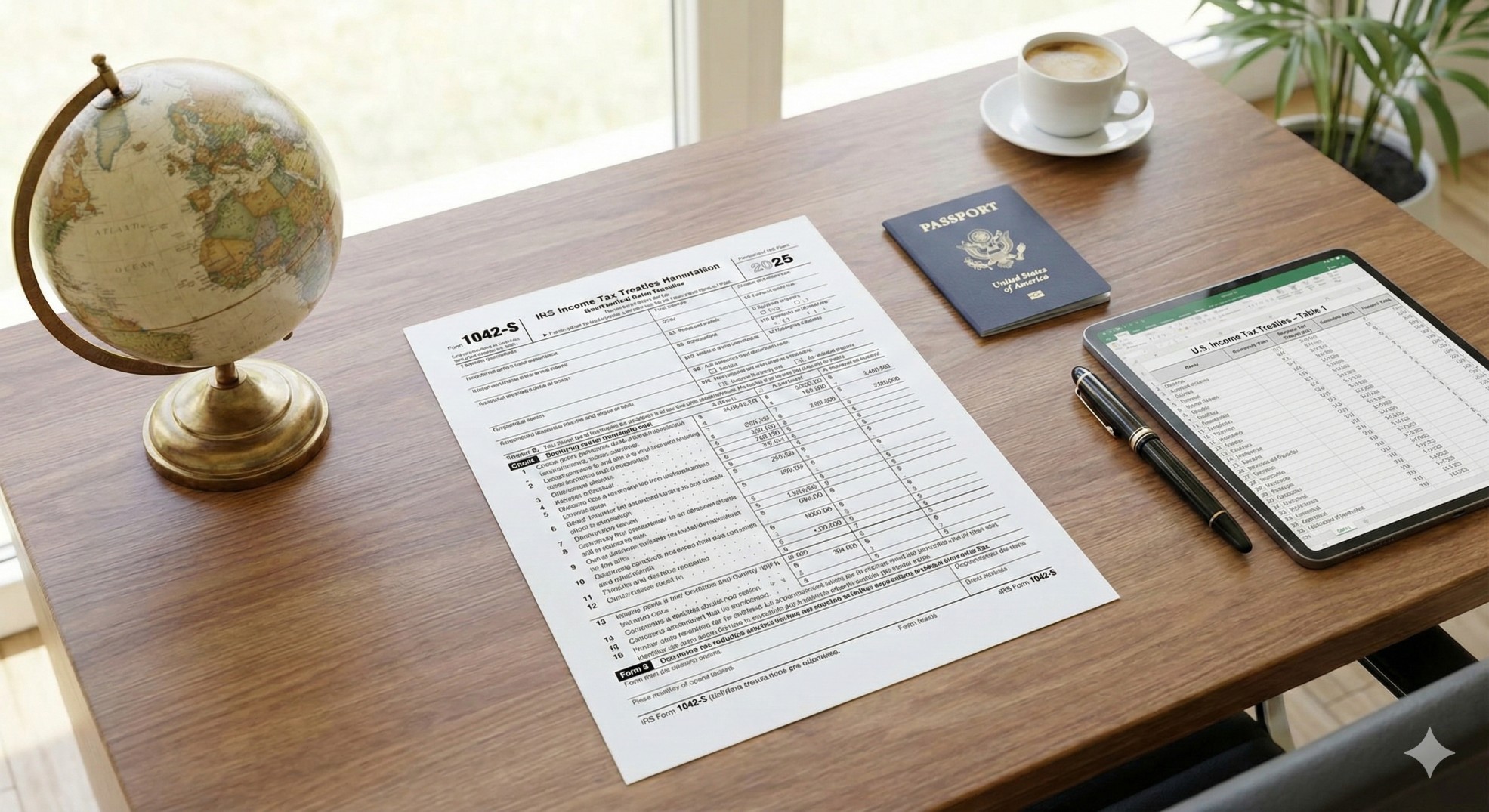
In my 15 years of practice as a CPA, I have found that international tax compliance is the area where domestic businesses are most likely to stumble. At the center of this complexity is Form 1042-S Withholding Reporting. This form is the primary mechanism the IRS uses to track payments made to non-resident aliens (NRAs) and foreign entities. Unlike domestic 1099 reporting, the stakes here are significantly higher because the payer is often personally liable for the tax that should have been withheld. Consequently, a deep understanding of the technical requirements is not just a matter of administrative diligence; it is a vital safeguard against massive corporate liability.
Purpose of Form 1042-S Withholding Reporting
The primary purpose of Form 1042-S Withholding Reporting is to report U.S. Source Income paid to foreign persons that is subject to withholding. This includes a wide array of payments such as dividends, interest, royalties, rents, and compensation for personal services. Furthermore, the form serves to document the amount of tax actually withheld and any claims for tax treaty benefits. By filing this form, the withholding agent provides the IRS with the data necessary to verify that the correct NRA Withholding Tax was applied at the source. In addition, it allows the foreign recipient to claim a credit or refund on their own U.S. tax return if they were over-withheld.
Who Must File
Any person or entity acting as a “withholding agent” that makes a payment of U.S. Source Income to a foreign person must file Form 1042-S. This requirement applies regardless of whether any tax was actually withheld. For instance, if a payment is exempt under a tax treaty, you must still file the form to report the exemption. Withholding agents include individuals, corporations, partnerships, trusts, and even government agencies. Furthermore, if you are a “Qualified Intermediary” (QI) or a “Withholding Foreign Partnership” (WP), your reporting obligations are even more stringent. In my experience, many small businesses overlook this requirement when they hire a foreign freelancer or pay a foreign software vendor, leading to significant exposure during an IRS audit.
Objective and Merit of the Form
The objective of Form 1042-S is rooted in two distinct chapters of the Internal Revenue Code. First, Chapter 3 Withholding (Sections 1441-1464) focuses on the withholding of tax on non-resident aliens and foreign corporations. Second, Chapter 4 FATCA Compliance (Sections 1471-1474) focuses on identifying U.S. persons who may be hiding assets in foreign accounts. The merit of the form lies in its dual-purpose reporting structure. It ensures that the U.S. government collects tax on income generated within its borders while simultaneously enforcing global transparency. Consequently, the form is a cornerstone of the IRS’s efforts to combat international tax evasion and ensure that NRA Withholding Tax is properly remitted.
Describing Different Sections
The Form 1042-S Withholding Reporting document is technically dense and requires specific codes for every entry:
- Box 1 (Income Code): A two-digit code identifying the type of income (e.g., 06 for Dividends, 12 for Royalties).
- Box 2 (Gross Income): The total amount paid before any withholding.
- Box 3a & 4a (Exemption Codes): Codes that explain why a lower rate of withholding was applied (e.g., Code 04 for Treaty Exemptions).
- Box 3b & 4b (Tax Rate): The actual percentage of tax withheld, which is typically 30% unless a treaty applies.
- Box 13 (Recipient Information): Detailed data on the foreign person, including their country code and Taxpayer Identification Number (TIN).
- Box 12 (Withholding Agent Information): The identifying data of the entity that made the payment and is responsible for the Chapter 3 Withholding.
Conditions, Situations, and Major Provisions
One of the most complex situations in Form 1042-S Withholding Reporting involves the “Limitation on Benefits” (LOB) article found in most modern tax treaties. To claim a reduced rate of NRA Withholding Tax, a foreign entity must not only be a resident of a treaty country but must also meet specific LOB tests to prove they aren’t just a “conduit” for a third-party country. Furthermore, Chapter 4 FATCA Compliance requires withholding agents to determine the “FATCA Status” of the recipient (e.g., Participating FFI, NFFE). If a recipient fails to provide a valid Form W-8 with the necessary FATCA documentation, the agent is generally required to withhold a flat 30% regardless of any treaty that might otherwise apply to Chapter 3 Withholding.
How To Complete Form
To complete the form with professional accuracy, I recommend a rigorous four-step workflow. First, obtain a valid Form W-8 (W-8BEN, W-8BEN-E, etc.) from the recipient *before* making any payment. Second, validate the recipient’s TIN and treaty claim against the IRS’s current treaty tables. Third, determine if the income is “Fixed, Determinable, Annual, or Periodical” (FDAP) income, which is the primary trigger for withholding. Finally, reconcile the total amounts reported on all 1042-S forms with the total tax remitted on the annual Form 1042. In my 15 years of practice, I have found that failing to reconcile these forms is the fastest way to trigger an IRS notice.
When To File & Procedure
The deadline for filing Form 1042-S Withholding Reporting is March 15th of the year following the payment. This deadline applies to both the filing with the IRS and the furnishing of the form to the recipient. Unlike 1099s, there is no “automatic” extension for furnishing the form to the recipient. The procedure for filing with the IRS is almost exclusively electronic. Consequently, withholding agents must use the IRS FIRE (Filing Information Returns Electronically) system. In addition, you must also file the “summary” Form 1042 by the same March 15th deadline to report the total tax liability for the year.
Extension of Time To File & Procedure
If a withholding agent cannot meet the March 15th deadline, they can request a 30-day extension by filing Form 8809, Application for Extension of Time To File Information Returns. This extension is generally automatic if filed by the due date. However, it is important to note that this only extends the time to file with the IRS; it does *not* extend the time to pay the tax. Furthermore, if you need an extension to furnish the form to the recipient, you must send a letter to the IRS explaining the “good cause” for the delay. In my practice, I view these extensions as a safety net, but I always aim for the March 15th deadline to avoid complications with foreign recipients’ own tax filings.
Where To File
For electronic filings, the “where” is the IRS FIRE system. Starting with the 2023 tax year, the IRS has mandated that almost all withholding agents file electronically if they file 10 or more information returns in aggregate. For the very few who still qualify for paper filing, the forms must be mailed to the Internal Revenue Service Center in Ogden, Utah. However, I strongly advise all clients to use the electronic method, as it provides an immediate acknowledgment of receipt and significantly reduces the risk of the IRS losing the documents in transit.
Amending of the Form (Applicability)
If you discover an error after filing, you must file a “Corrected” Form 1042-S. The procedure involves checking the “Corrected” box at the top of the form and providing the updated information. It is vital to note that if you change the amount of tax withheld, you must also file an amended Form 1042 (the annual return) to ensure the totals match. The statute of limitations for the IRS to assess NRA Withholding Tax is generally three years from the date the return was filed, so timely corrections are essential to mitigate potential interest and penalties.
Penalties of Non-Filing
The penalties for failing to adhere to Form 1042-S Withholding Reporting requirements are severe. Under IRC Sections 6721 and 6722, the penalties are as follows:
- $330 per form for failure to file or failure to furnish a correct form (up to a maximum of over $3.9 million per year).
- Intentional Disregard: If the IRS determines the failure was willful, the penalty increases to $660 per form or 10% of the total amount required to be reported, with no maximum cap.
- Withholding Liability: Most importantly, the withholding agent is personally liable for the 30% tax (plus interest) if they failed to withhold and cannot prove the recipient paid the tax.
In my 15 years of practice, I have seen the “Withholding Liability” penalty bankrupt small firms that failed to properly document their foreign payments.
CPA’s Professional Insights
One of the most common “audit red flags” I see is a withholding agent applying a treaty rate of 0% for a recipient who did not provide a U.S. or foreign TIN on their Form W-8. Under the regulations, a TIN is generally required to claim treaty benefits on most types of income. Furthermore, the IRS is currently using data analytics to match 1042-S filings against the “Foreign Account Tax Compliance Act” (FATCA) data received from foreign banks. If your Chapter 4 FATCA Compliance codes don’t align with what the foreign bank is reporting, an inquiry is inevitable. My advice: always perform a “pre-filing audit” of your W-8 collection process in December to catch missing data before the March deadline.
Conclusion
Form 1042-S Withholding Reporting is a high-stakes compliance requirement that demands technical precision. By understanding the interplay between Chapter 3 Withholding and Chapter 4 FATCA Compliance, withholding agents can effectively manage their U.S. Source Income payments. Do not treat this as a routine administrative task; the personal liability for NRA Withholding Tax makes it one of the most significant risks in the tax code. Proactive documentation, valid W-8 collection, and timely electronic filing are the only ways to ensure your business remains on the right side of the IRS.
Frequently Asked Questions (FAQ)
1. Do I need to file a 1042-S if the income is exempt under a treaty?
Yes. Even if the withholding rate is 0%, you must file Form 1042-S to report the gross income and the specific exemption code that justifies the 0% rate.
2. What is the difference between Form 1042 and Form 1042-S?
Form 1042 is the annual *tax return* used to report the total tax liability and payments. Form 1042-S is the *information statement* issued to each individual recipient to report their specific income and withholding.
3. Can I use a 1099-NEC instead of a 1042-S for a foreign freelancer?
No. If the freelancer is a non-resident alien and the work was performed in the U.S., you must use Form 1042-S. Using the wrong form is a common error that triggers penalties for both forms.
4. What happens if I don’t have a W-8 from the foreign recipient?
In the absence of a valid W-8, you are generally required to withhold at the full 30% rate. You cannot apply treaty benefits or exemptions without the proper documentation on file at the time of payment.
5. How do I report payments to a foreign “disregarded entity”?
You generally report the payment to the owner of the disregarded entity. You must obtain a Form W-8 from the owner (the “beneficial owner”) to determine the correct withholding rate and reporting requirements.
