
Weighing the Foreign Tax Credit vs. FEIE is the single highest-stakes tax calculation for the roughly nine million Americans living and working outside the United States. Because the United States enforces citizenship-based taxation under Internal Revenue Code (IRC) Section 61, your worldwide income remains subject to federal reporting regardless of where your employer or bank account is located. For Tax Year 2026 (returns filed in 2027), the IRS raised the maximum Foreign Earned Income Exclusion (FEIE) to $132,900 per qualifying taxpayer under IRS Revenue Procedure 2025-32, while the One Big Beautiful Bill Act (OBBBA) permanently locked in individual tax brackets and the $1,700 refundable Additional Child Tax Credit.
Most expats pick one mechanism during their first year abroad and blindly copy that election onto future returns. That habit costs overseas families and business owners thousands of dollars in missed refunds, forfeited retirement contribution room, and unnecessary double taxation. Understanding how the Foreign Earned Income Exclusion 2026 cap interacts with dollar-for-dollar credits on IRS Form 1116 allows you to legally reduce your US federal tax bill to zero—and in some cases, generate a direct cash refund from the US Treasury.
⚡ Executive Summary: Key 2026 Tax Rules at a Glance
- 2026 FEIE Cap & Deadlines: Per IRS Revenue Procedure 2025-32, qualifying expats can exclude up to $132,900 of foreign earned income ($265,800 for married couples where both spouses qualify separately), plus up to $18,606 in standard foreign housing expenses. Tax Year 2026 expat returns are due automatically on June 15, 2027, though any tax owed must still be paid by April 15, 2027.
- Post-OBBBA Refundable Credit Impact: The One Big Beautiful Bill Act permanently fixed the Child Tax Credit at $2,200 per child with up to $1,700 refundable via the Additional Child Tax Credit (ACTC). Claiming the FEIE on IRS Form 2555 completely disqualifies you from claiming the refundable ACTC, making the Foreign Tax Credit superior for expat parents in high-tax nations.
- Core IRS Forms Required: The FEIE is an above-the-line income subtraction computed on IRS Form 2555 and carried to Schedule 1 (Form 1040), Line 8d. The Foreign Tax Credit is a nonrefundable dollar-for-dollar tax offset calculated on IRS Form 1116 and reported on Schedule 3 (Form 1040), Line 1.
- The 5-Year Revocation Lockout: Once you revoke a previously elected FEIE to claim the Foreign Tax Credit on all your earned income, IRC Section 911(e)(2) bars you from re-electing the FEIE for five tax years (through Tax Year 2031) without applying for a costly private letter ruling from the IRS.
Table of Contents
- ⚡ Executive Summary: Key 2026 Tax Rules at a Glance
- How the Foreign Earned Income Exclusion 2026 Works (Form 2555)
- How the Foreign Tax Credit Works in 2026 (Form 1116)
- 2025 vs. 2026 Thresholds and Side-by-Side Comparison
- Strategic Comparison: Foreign Tax Credit vs. FEIE by Country Tax Rate
- The Hidden Traps: Child Tax Credits, IRAs, and the 5-Year Revocation Rule
- Combining Both: How the Stacking Rule and Proration Work in 2026
- 4 Real-World 2026 Expat Tax Scenarios (With Step-by-Step Math)
- Self-Employment, Business Entities, and State Tax Traps Abroad
- Step-by-Step Guide: How to Calculate and File Form 2555 and Form 1116 in 2027
- Frequently Asked Questions About Foreign Tax Credit vs. FEIE
- Final Verdict: Making the Right Election for Your 2026 Return
How the Foreign Earned Income Exclusion 2026 Works (Form 2555)
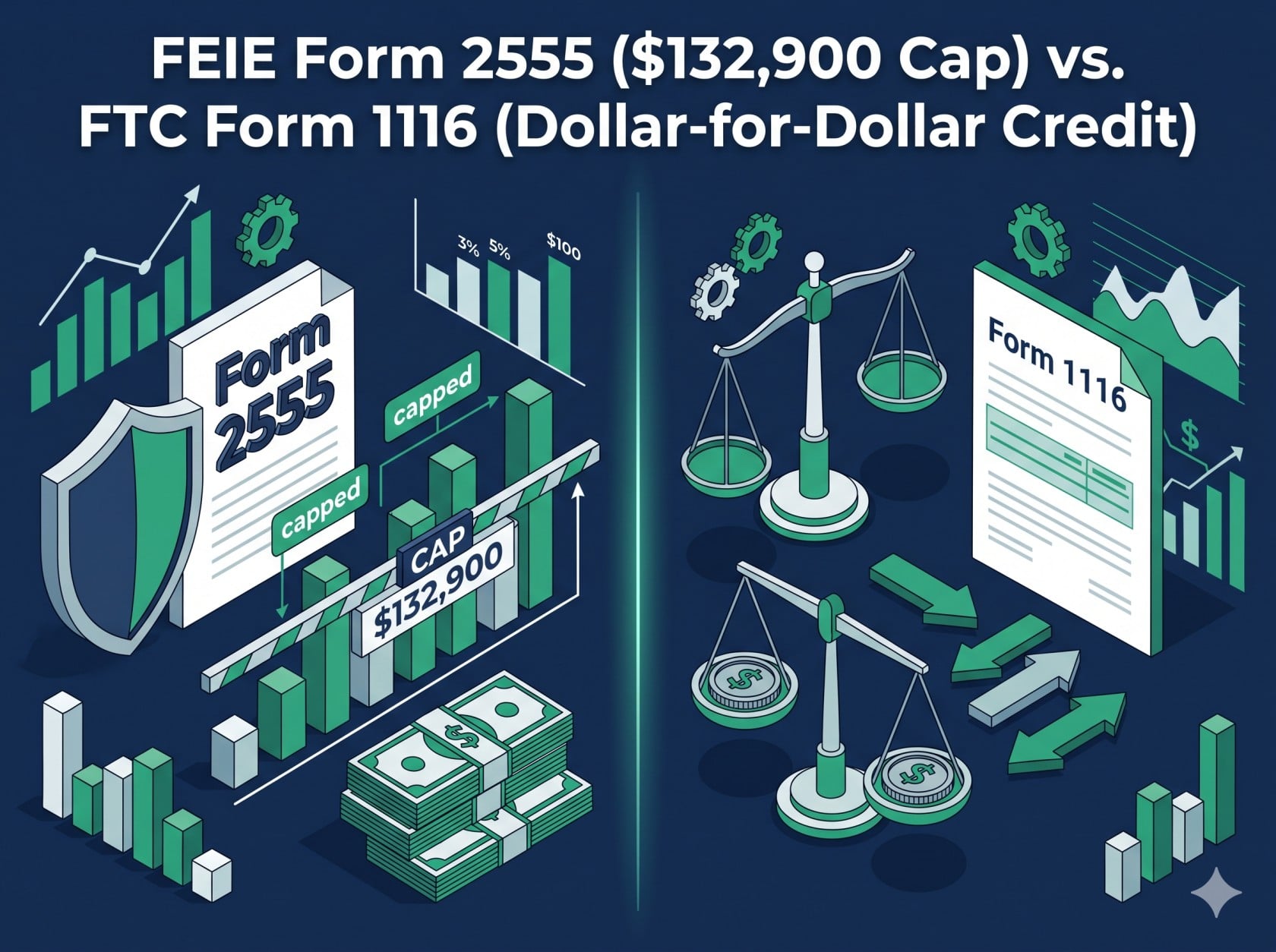
The Foreign Earned Income Exclusion 2026 allows qualifying US citizens and resident aliens to remove up to $132,900 of active foreign wages or self-employment income directly from their gross income via IRS Form 2555 before calculating federal income tax. Because it functions as an above-the-line exclusion on Schedule 1, taxpayers can still claim the full 2026 standard deduction ($16,100 for Single filers or $32,200 for Married Filing Jointly) against any remaining unexcluded income.
Under IRC Section 911, the FEIE applies strictly to “earned income” generated from personal services performed outside the United States. Passive income streams—including capital gains, corporate dividends, interest, rental property profits, and pension distributions—never qualify for the exclusion. Furthermore, payments received Directly from the US government or its agencies (such as military pay or federal civil service wages) are statutorily barred from exclusion on IRS Form 2555.
Passing the Tax Home Test and Residency Requirements
You don’t qualify for the FEIE simply by boarding an international flight or receiving wire transfers from a foreign company. Under IRS Publication 54, you must first establish a “tax home” in a foreign country—meaning your principal place of business or employment is located abroad for an indefinite period—and your “abode” (your primary domestic and economic home base) cannot remain inside the United States.
Once your foreign tax home is established, you must satisfy one of two statutory tests:
- The Physical Presence Test (PPT): Available to both US citizens and green card holders, this purely mathematical test requires you to be physically present inside one or more foreign countries for at least 330 full 24-hour days during any consecutive 12-month period. Days spent in transit over international waters or partial days arriving in or departing from the US do not count toward the 330-day minimum.
- The Bona Fide Residence Test (BFR): Available to US citizens (and resident aliens from countries with non-discrimination tax treaty clauses), this test requires you to reside in a foreign country for an uninterrupted period that includes an entire calendar tax year (January 1 through December 31, 2026). The IRS evaluates your local visa status, foreign housing lease, local tax filings, and community ties to verify genuine residency.
2026 Foreign Housing Exclusion and Deduction Mechanics
Expats claiming the FEIE can stack an additional tax break on Part VI of IRS Form 2555 for reasonable foreign housing expenses such as rent, utilities (excluding telephone and television), and property insurance. If you are a W-2 employee paid with employer-provided funds, this is called the Foreign Housing Exclusion; if you are self-employed, you claim the Foreign Housing Deduction on Schedule 1, Line 24j.
The IRS requires you to subtract a mandatory “base housing amount” before excluding housing costs. Set at 16% of the annual FEIE maximum, the 2026 base housing floor is $21,264 (or $58.26 per qualifying day). Standard qualifying housing expenses are capped at 30% of the FEIE limit, which equals $39,870 for 2026. Subtracting the $21,264 base from the $39,870 standard cap yields a maximum standard housing exclusion of $18,606. However, if you live in a high-cost metropolitan area like London, Hong Kong, Geneva, Singapore, or Madrid, IRS Notice 2026-25 authorizes much higher city-specific housing caps that can shield an extra $30,000 to $80,000 of income.
How the Foreign Tax Credit Works in 2026 (Form 1116)
The Foreign Tax Credit (FTC), governed by IRC Section 901 and claimed on IRS Form 1116, provides a direct dollar-for-dollar reduction of your US federal income tax liability for income taxes legally owed and paid (or accrued) to a foreign national or local government. Unlike an exclusion that lowers taxable income, a credit directly erases the final tax bill calculated on Form 1040.
Qualifying for the Foreign Tax Credit requires zero overseas residency tests. You don’t need 330 days abroad or a foreign tax home; you simply need foreign-source income and a qualifying foreign income tax liability. Under Treasury Regulation Section 1.901-2, only compulsory foreign levies based on net income qualify for the credit. Value-added taxes (VAT), goods and services taxes (GST), property taxes, wealth taxes, and foreign social security contributions (such as UK National Insurance or French CSG/CRDS when covered by a Totalization Agreement) cannot be credited on IRS Form 1116.
The 4 Foreign Income Baskets and the Limitation Formula
To prevent taxpayers from using high tax rates on foreign wages to wipe out US taxes owed on low-taxed passive investments, the IRS forces you to separate your income onto distinct copies of IRS Form 1116 based on specific statutory “baskets”:
- General Category Income: Includes active wages, salaries, bonuses, and active self-employment business income.
- Passive Category Income: Includes dividends, interest, annuities, rents, royalties, and capital gains from the sale of passive assets.
- Foreign Branch Income: Applies to business profits attributable to a qualified business unit (QBU) operating as a foreign branch in a foreign country (excluding passive income).
- Section 951A Category Income (GILTI): Applies to Global Intangible Low-Taxed Income inclusions required for US shareholders of Controlled Foreign Corporations (CFCs).
For each separate basket, your maximum allowable credit for 2026 cannot exceed the proportion of your US federal tax liability attributable to that foreign income. The IRS enforces this via the Form 1116 limitation formula:
Maximum 2026 FTC Limit = Total US Tax Before Credits × (Foreign-Source Taxable Income in Basket ÷ Total Worldwide Taxable Income)
If your foreign tax paid exceeds this limitation—which happens whenever your foreign effective tax rate is higher than your US effective tax rate—the excess isn’t lost. Under IRC Section 904(c), unused foreign tax credits can be carried back 1 year (to Tax Year 2025 via an amended Form 1040-X) and carried forward up to 10 years within the exact same income basket. Note that individual taxpayers with $300 or less ($600 for Married Filing Jointly) of creditable foreign taxes strictly from passive investment income reported on a qualified payee statement (like Form 1099-DIV) can bypass IRS Form 1116 entirely, though doing so forfeits any carryback or carryover rights.
2025 vs. 2026 Thresholds and Side-by-Side Comparison
Evaluating US expat taxes 2026 requires looking at the newly indexed thresholds released in IRS Revenue Procedure 2025-32 alongside the permanent tax code provisions enacted under the One Big Beautiful Bill Act. Every dollar figure below applies to income earned between January 1, 2026, and December 31, 2026, for returns filed in 2027.
| Expat Tax Provision / Metric | Tax Year 2025 (Filed in 2026) | Tax Year 2026 (Filed in 2027) | Statutory Authority / IRS Form |
|---|---|---|---|
| Maximum FEIE (Per Qualifying Person) | $130,000 | $132,900 ($364.11/day) | IRC Sec. 911(b)(2)(D); Form 2555 |
| Maximum FEIE (Married Couple, Both Qualify) | $260,000 | $265,800 | Two separate Forms 2555 required |
| Foreign Housing Base Amount (Floor) | $20,800 ($56.99/day) | $21,264 ($58.26/day) | 16% of FEIE limit; Form 2555 Part VI |
| Standard Foreign Housing Expense Cap | $39,000 | $39,870 | 30% of FEIE limit; IRS Notice 2026-25 |
| Maximum Standard Housing Exclusion | $18,200 | $18,606 (Higher in select cities) | Standard Cap minus Base Amount |
| Standard Deduction (Single / MFJ / HoH) | $15,750 / $31,500 / $23,625 | $16,100 / $32,200 / $24,150 | Rev. Proc. 2025-32; Form 1040 |
| Child Tax Credit / Refundable ACTC Cap | $2,200 / $1,700 refundable | $2,200 / $1,700 refundable | OBBBA Sec. 70104; Schedule 8812 |
| Passive FTC Exemption (No Form 1116 Needed) | $300 Single / $600 MFJ | $300 Single / $600 MFJ | IRC Sec. 904(j); Schedule 3 Line 1 |
| Social Security Wage Base (12.4% OASDI Cap) | $176,100 | $184,500 | Schedule SE (FEIE does not reduce SE tax) |
While Table 1 highlights the annual inflation adjustments, choosing between the two frameworks requires comparing their structural rules across eligibility, income types, and downstream tax consequences.
| Feature / Tax Rule | Foreign Earned Income Exclusion (FEIE) | Foreign Tax Credit (FTC) |
|---|---|---|
| Primary IRS Form | IRS Form 2555 (flows to Schedule 1, Line 8d) | IRS Form 1116 (flows to Schedule 3, Line 1) |
| Eligible Income Types | Active earned income only (wages, salaries, self-employment) | All foreign-source income (wages, self-employment, dividends, rent, capital gains, pensions) |
| 2026 Dollar Limit | Capped at $132,900 per person (+ housing exclusion) | No dollar cap; limited to US tax attributable to foreign income |
| Residency / Presence Test | Strict: Foreign Tax Home + 330 Full Days (PPT) or Full Calendar Year (BFR) | None: Only requires foreign-source income and foreign income tax paid or accrued |
| Foreign Taxes Required? | No. Ideal for 0% tax jurisdictions (e.g., UAE, Cayman Islands) | Yes. Must be a legal, compulsory foreign income tax liability |
| Refundable Child Tax Credit (ACTC) | Disqualified. Claiming Form 2555 blocks the $1,700 per child refund | Allowed. Preserves full eligibility for the $1,700 per child refund |
| IRA / Roth IRA Contributions | Excluded income does not count as eligible compensation for IRA contributions | Unexcluded wages count fully toward the 2026 $7,500 IRA limit (subject to MAGI phase-outs) |
| Unused Benefit Carryover | None. Unused exclusion below $132,900 vanishes at year-end | Excess credits carry back 1 year and carry forward 10 years |
| Revocation / Lockout Rule | Revoking locking you out of re-electing FEIE for 5 full tax years | Annual election; can switch between deduction and credit freely each year |
Strategic Comparison: Foreign Tax Credit vs. FEIE by Country Tax Rate
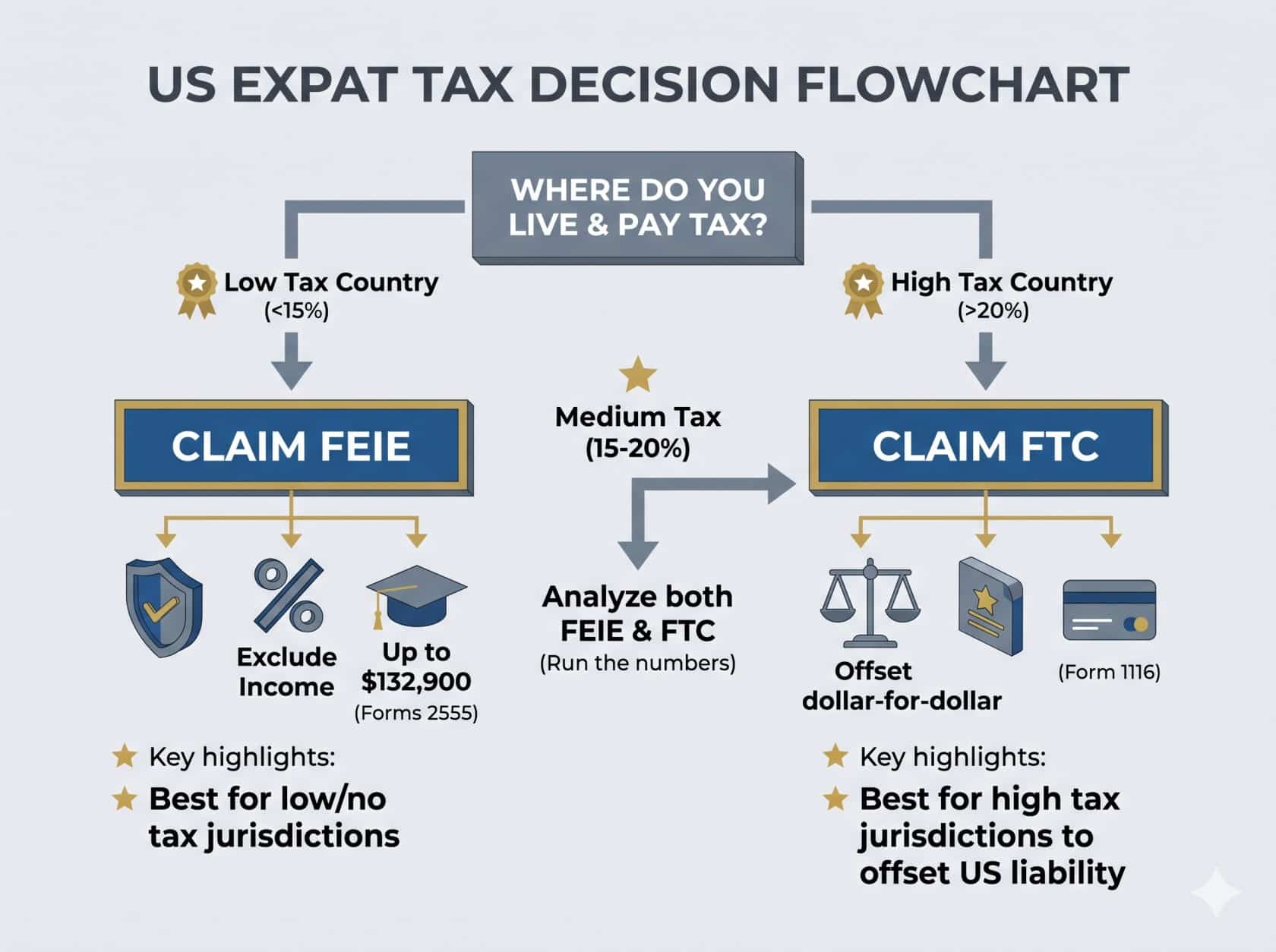
When comparing the Foreign Tax Credit vs. FEIE, the single biggest deciding factor is the effective income tax rate of your host country compared to your effective US tax rate. Expats living in low-tax or zero-tax countries almost always save more money with the FEIE, while Americans residing in high-tax nations usually achieve superior long-term tax results using the Foreign Tax Credit.
When the FEIE Wins: Low-Tax, Zero-Tax, and Territorial Regimes
If you pay less income tax to your host country than you would owe to the IRS under 2026 federal income tax brackets and standard deduction rules, the Foreign Tax Credit alone won’t wipe out your US tax bill. For example, if your US effective tax rate on $120,000 is 14.3% ($17,183 tax), and you live in Singapore where your local effective tax rate is roughly 6.5% ($7,800 tax), claiming only the FTC leaves you owing the 7.8% difference ($9,383) directly to the IRS.
In contrast, electing the Foreign Earned Income Exclusion 2026 on IRS Form 2555 erases up to $132,900 of earned income regardless of whether you paid a single dime of foreign tax. The FEIE is the undisputed winner for:
- Zero-Tax Jurisdictions: United Arab Emirates (Dubai/Abu Dhabi), Saudi Arabia, Qatar, Bahrain, the Bahamas, Bermuda, and the Cayman Islands.
- Low-Flat-Tax & Territorial Countries: Singapore, Hong Kong, Bulgaria (10% flat tax), Paraguay, Panama, and Costa Rica (when earning offshore income exempt from local territorial taxation).
- Perpetual Travelers / Digital Nomads: Remote workers who spend 330+ days hopping across multiple countries on tourist or digital nomad visas without triggering tax residency in any single foreign nation.
When the Foreign Tax Credit Wins: High-Tax Jurisdictions
If you live and work in Western Europe, Canada, Australia, Japan, New Zealand, or high-tax Latin American nations, your local effective income tax rate almost certainly exceeds your US effective tax rate at every income tier. In countries like the United Kingdom, Germany, France, Denmark, or the Netherlands, marginal income tax rates climb past 40% to 50% much faster than the US 24% or 32% brackets.
When your foreign tax paid exceeds your tentative US tax bill, IRS Form 1116 reduces your US federal income tax to exactly $0. Better yet, every dollar of foreign tax paid above your US liability generates excess Foreign Tax Credit carryovers that remain on your return for up to 10 years. If you later take a sabbatical, receive a poorly taxed bonus, or move to a lower-tax country while still earning foreign-source general category income, you can deploy those banked credits to shield future income from the IRS.
The Hidden Traps: Child Tax Credits, IRAs, and the 5-Year Revocation Rule
Choosing between the Foreign Tax Credit vs. FEIE goes far beyond comparing top-line tax liabilities on Form 1040 Line 16. Claiming IRS Form 2555 triggers strict statutory disqualifications across other sections of the Internal Revenue Code that can quietly cost your household thousands of dollars every year.
Trap 1: The $1,700 Refundable Additional Child Tax Credit (Schedule 8812)
Under the One Big Beautiful Bill Act (Section 70104), Congress permanently set the Child Tax Credit (CTC) at $2,200 per qualifying child under age 17, with up to $1,700 per child refundable via the Additional Child Tax Credit (ACTC) on Schedule 8812. Both the claiming parent (or at least one spouse on a joint return) and each qualifying child must hold a valid, work-eligible Social Security Number issued before the due date of the 2026 return.
Here is the statutory trap that catches expat parents off guard: under IRC Section 24(h)(4) and the instructions for Schedule 8812, any taxpayer who files IRS Form 2555 to claim the FEIE or Foreign Housing Exclusion is 100% barred from claiming the refundable Additional Child Tax Credit. If you exclude all your income using Form 2555, your tax liability drops to zero, rendering the $2,200 nonrefundable portion useless and legally blocking the $1,700 cash refund.
Conversely, if you live in a country where you pay foreign income taxes and use IRS Form 1116 (without filing Form 2555), your foreign tax credits reduce your US tax liability to $0 first. Because your foreign wages remain included in your Earned Income on Form 1040, you remain eligible to calculate the ACTC (15% of earned income above $2,500, capped at $1,700 per child). For an expat family with three qualifying children in the UK or Canada, choosing the FTC over the FEIE results in a $5,100 annual check wired directly from the IRS.
Trap 2: Traditional and Roth IRA Contribution Eligibility
For Tax Year 2026, eligible taxpayers can contribute up to $7,500 ($8,600 if age 50 or older) to a Traditional or Roth IRA. However, IRC Section 219 stipulates that you can only contribute up to the amount of your “taxable compensation” included in gross income.
When you exclude 100% of your foreign salary using the Foreign Earned Income Exclusion 2026 on Form 2555, you have $0 of unexcluded compensation on your tax return. Contributing to an IRA in that scenario triggers a punitive 6% excess contribution penalty under IRC Section 4973 for every single year the disallowed funds remain in the account. Furthermore, for Roth IRA eligibility, your Modified Adjusted Gross Income (MAGI) adds back any Form 2555 excluded income—meaning the FEIE simultaneously strips away your eligible compensation if you earn under $132,900 while keeping your MAGI high enough to trigger the 2026 Roth phase-out thresholds ($153,000 to $168,000 for Single filers; $242,000 to $252,000 for Married Filing Jointly). Using the Foreign Tax Credit keeps your wages unexcluded, preserving your legal right to fund an IRA if your MAGI sits below the phase-out ceiling.
Trap 3: The 5-Year FEIE Revocation Lockout Rule
Once you claim the FEIE on a valid tax return, that election remains in effect for all subsequent tax years unless you revoke it. You can revoke the FEIE for 2026 simply by attaching a signed statement to your return or by claiming the Foreign Tax Credit directly against foreign earned income that would otherwise have been excluded.
CPA Audit Warning: Under IRC Section 911(e)(2), once you revoke the Foreign Earned Income Exclusion, you cannot claim the FEIE again until the sixth taxable year following the tax year for which the revocation was first effective—unless you apply for an IRS Private Letter Ruling and pay an IRS user fee exceeding $3,000. If you revoke the FEIE on your 2026 tax return, you are locked out of Form 2555 for 2027, 2028, 2029, 2030, and 2031. Never switch from the FEIE to the FTC if you plan to relocate to a low-tax country like Dubai or Singapore within the next five years.
Combining Both: How the Stacking Rule and Proration Work in 2026
High-earning expats whose foreign compensation exceeds $132,900 in 2026 don’t have to choose exclusively between the two mechanisms—they can combine IRS Form 2555 and IRS Form 1116 on the exact same tax return, provided they follow the IRS “no double-dipping” allocation rules and the IRC Section 911 stacking rule.
The IRC Section 911(f) Stacking Rule Explained
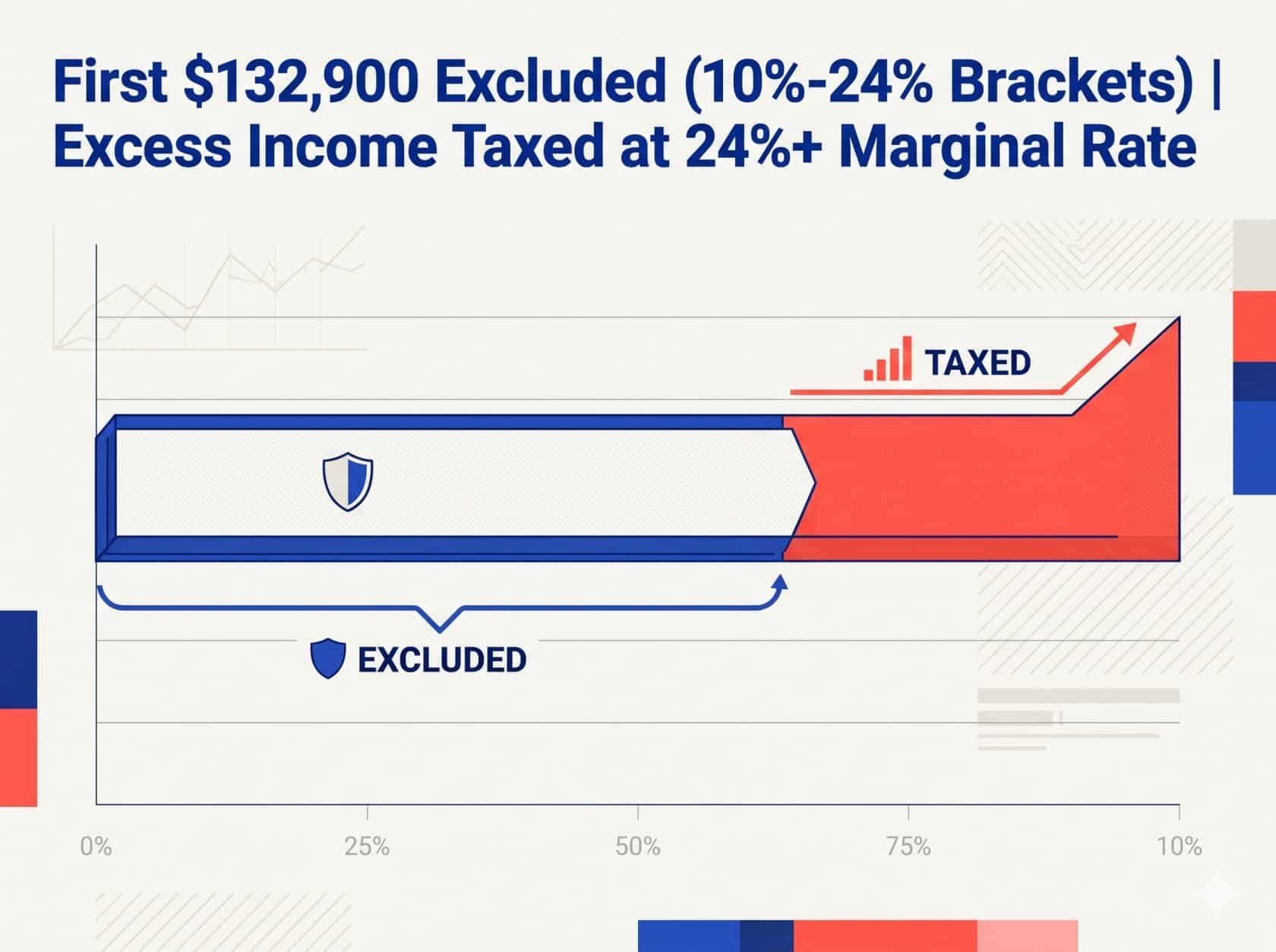
A common misconception among expats is that if you earn $180,000 abroad and exclude $132,900 on Form 2555,plus deduct the $16,100 Single standard deduction, your remaining $31,000 of taxable income will be taxed at the lowest 10% and 12% brackets. The IRS blocks this via the Foreign Earned Income Tax Worksheet in the Form 1040 instructions.
Under the stacking rule, your excluded foreign earned income sits at the very bottom of your income stack, filling up the 10%, 12%, and 22% brackets first. Specifically, the worksheet forces you to:
- Calculate the tentative tax on your total unreduced taxable income (including the excluded $132,900).
- Calculate the tentative tax on the excluded $132,900 alone (less any nondeductible expenses allocated to it).
- Subtract the second figure from the first figure to determine your actual Form 1040 Line 16 tax liability.
Because the 2026 24% bracket for Single filers starts at $105,700 of taxable income, excluding the first $132,900 means your very first dollar of unexcluded taxable income is taxed immediately at a 24% marginal rate (or higher).
Scaling Back Foreign Taxes Under IRC Section 911(d)(6)
If you earn $200,000 in a foreign country, pay $50,000 in foreign income tax, and exclude $132,900 via Form 2555, you cannot claim all $50,000 of foreign tax on IRS Form 1116. Under IRC Section 911(d)(6), you are prohibited from claiming a Foreign Tax Credit for foreign taxes paid on income that was already excluded from US taxation.
You must reduce your creditable foreign taxes on Form 1116 Line 12 by multiplying your total foreign taxes paid on earned income by a disallowed fraction: the numerator is your excluded foreign earned income (plus housing exclusion) minus definitely related deductible expenses, and the denominator is your total foreign earned income minus total definitely related deductible expenses. In our $200,000 salary example with zero deductible expenses, 66.45% ($132,900 ÷ $200,000) of your foreign taxes—or $33,225—must be scaled back and permanently forfeited, leaving only $16,775 available as a credit on Form 1116 against the remaining $67,100 of unexcluded wages.
4 Real-World 2026 Expat Tax Scenarios (With Step-by-Step Math)
To illustrate how the Foreign Tax Credit vs. FEIE plays out in practice for US expat taxes 2026, examine these four mathematical case studies using verified 2026 brackets and inflation numbers from IRS Revenue Procedure 2025-32.
Scenario 1: Single Digital Nomad in Dubai, UAE (0% Foreign Tax)
- Taxpayer Profile: Chloe, Single filer, W-2 remote software engineer living in Dubai for all 365 days of 2026.
- 2026 Income & Foreign Tax: $125,000 foreign wages; $0 UAE income tax paid.
- Option A (Foreign Tax Credit Only): Because Chloe paid $0 in foreign income taxes, her Form 1116 credit is $0. After subtracting the 2026 Single standard deduction of $16,100, her US taxable income is $108,900. Using 2026 Single tax brackets (10% up to $12,400; 12% up to $50,400; 22% up to $105,700; 24% above $105,700), she owes $18,734 in federal income tax.
- Option B (FEIE via Form 2555): Chloe passes the Physical Presence Test (365 days abroad) and excludes all $125,000 under the $132,900 cap. Her AGI and taxable income drop to $0, resulting in a $0 US tax bill.
- Winner: FEIE saves Chloe $18,734 in 2026.
Scenario 2: Married Expat Parents in London, UK (High Tax + 2 Kids)
- Taxpayer Profile: Marcus and Elena, Married Filing Jointly, living in London for all of 2026 with two qualifying children (ages 6 and 9, both with valid SSNs).
- 2026 Income & Foreign Tax: Marcus earns $115,000 USD equivalent in UK wages; Elena has $0 income. Marcus pays $32,000 USD equivalent in UK PAYE income tax (excluding UK National Insurance).
- Option A (FEIE via Form 2555): Marcus excludes his entire $115,000 salary under the $132,900 limit. Their US income tax is $0. However, because they filed Form 2555, Schedule 8812 bars them from claiming the refundable Additional Child Tax Credit. Net US tax result: $0 owed, $0 refund
