
⚡ Executive Summary: 2026 Digital Nomad & Section 911 Tax Rules
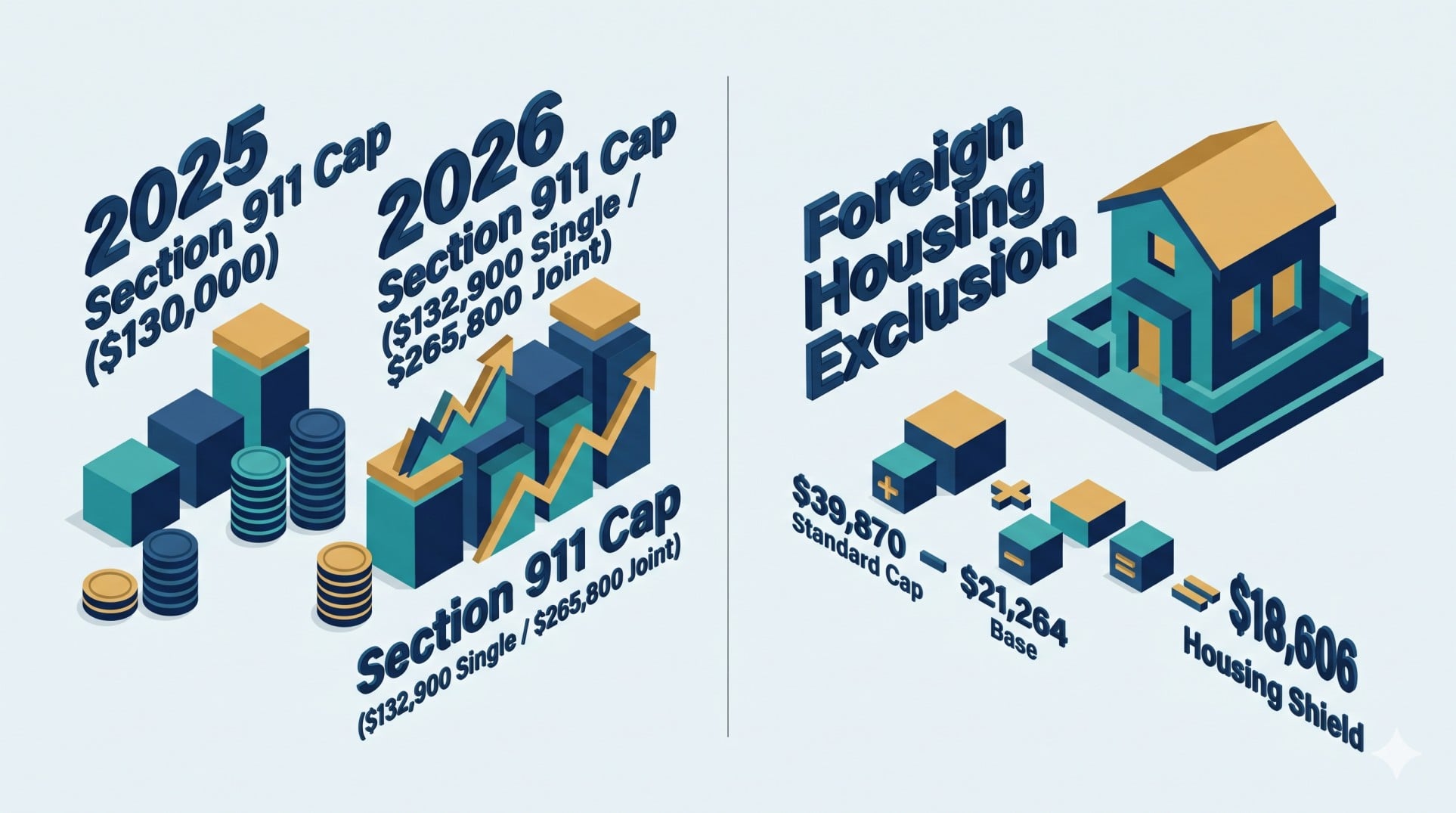
- 2026 Maximum Exclusion Cap: Under IRS Revenue Procedure 2025-32, qualifying taxpayers can exclude up to $132,900 of foreign earned income in 2026 (up from $130,000 in 2025), or up to $265,800 for married couples filing jointly when both spouses qualify and earn income abroad.
- 2026 Foreign Housing Shield: Pursuant to IRS Notice 2026-25, the 2026 base housing floor is $21,264 (16% of the maximum exclusion) and the standard housing expense limit is $39,870 (30%), creating a standard housing exclusion of up to $18,606 (with much higher caps in designated high-cost cities).
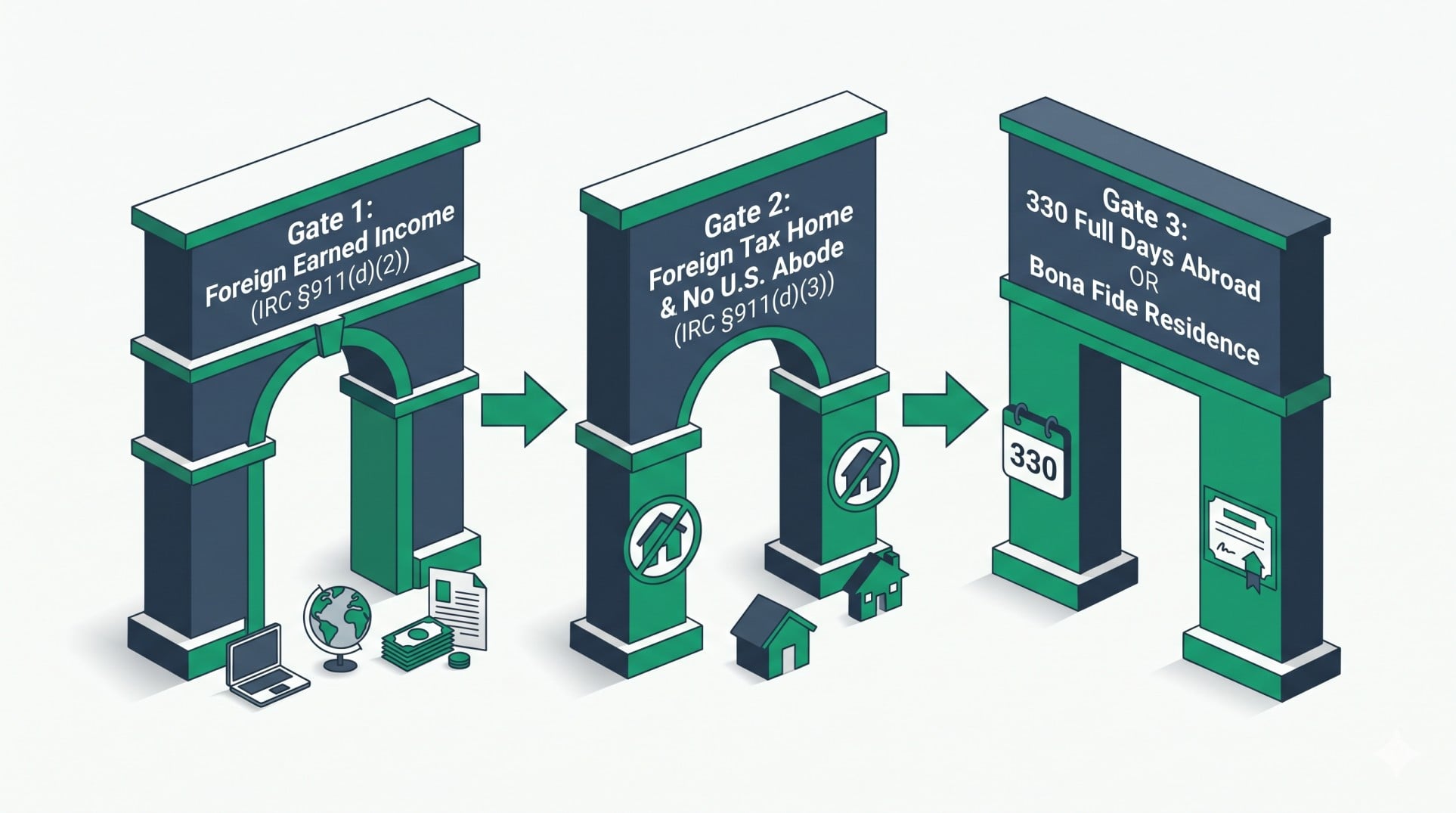
- The 3-Gate Eligibility Test: Claiming Form 2555 requires having qualifying foreign earned income, establishing a tax home in a foreign country without maintaining an abode in the United States, and passing either the 330-day Physical Presence Test or the full-year Bona Fide Residence Test.
- Self-Employment Tax Warning: Excluding income on Form 2555 eliminates federal income tax but does not reduce the 15.3% Self-Employment Tax (12.4% Social Security up to the $184,500 2026 wage base plus 2.9% Medicare) unless you use a Totalization Agreement or foreign corporate structure.
Working from Lisbon, Chiang Mai, or Medellín does not stop the Internal Revenue Service from taxing your paycheck. Because the United States enforces citizenship-based taxation under Internal Revenue Code (IRC) Section 1 and Section 61, U.S. citizens and green card holders must report and pay federal tax on their worldwide income regardless of where they live. Claiming the Foreign Earned Income Exclusion under IRC Section 911—commonly abbreviated as the FEIE—is the primary statutory mechanism to legally zero out federal income tax on up to $132,900 of active earnings in 2026.
Many digital nomads assume that simply staying outside the United States for 330 days automatically entitles them to a tax-free return. Every figure and compliance rule in this digital nomad tax guide for 2026 reflects IRS Revenue Procedure 2025-32, IRS Notice 2026-25, and U.S. Tax Court precedent so you can structure your travel calendar, housing expenses, and business entities without triggering an audit disallowance.
Table of Contents
- What Is the Foreign Earned Income Exclusion in 2026?
- How to Qualify for the Foreign Earned Income Exclusion: The 3 Mandatory Gates
- How Country-Hopping Nomads Pass the Foreign Tax Home and U.S. Abode Test
- 330-Day Physical Presence Test vs. Bona Fide Residence Test
- 2026 Foreign Housing Exclusion and Deduction Rules (IRS Notice 2026-25)
- How the IRC Section 911(f) Stacking Rule Taxes Unexcluded Income
- The 15.3% Self-Employment Tax Trap and 3 Legal Workarounds
- 4 Real-World Hypothetical Scenarios With Step-by-Step 2026 Tax Math
- Step-by-Step Guide: How to File Form 2555 and Form 2350 for 2026
- Section 911 Exclusion vs. Foreign Tax Credit (Form 1116): Which Wins in 2026?
- Federal vs. State Rules: Sticky Domicile States and California Non-Conformity
- Frequently Asked Questions About Digital Nomad Taxes
What Is the Foreign Earned Income Exclusion in 2026?
The Foreign Earned Income Exclusion is a federal tax election under IRC Section 911(a) that allows qualifying U.S. citizens and resident aliens living and working outside the United States to exclude up to $132,900 of foreign earned income from federal gross income for the 2026 tax year.
Having the FEIE explained accurately starts with recognizing that it is neither an automatic deduction nor a blanket exemption from filing a tax return. You must still report 100% of your worldwide compensation on Form 1040 and affirmatively elect the exclusion by attaching Form 2555 (Foreign Earned Income). If you fail to file a return and the IRS audits you before you make a valid election under Treasury Regulation Section 1.911-7(a), you can lose the entire exclusion for that tax year.
Pursuant to IRS Revenue Procedure 2025-32 (Section 3.39) and IRS Notice 2026-25, the inflation-adjusted Section 911 thresholds for tax year 2026 (for returns filed in 2027) compare to 2025 as follows:
| Section 911 Provision | 2025 Tax Year | 2026 Tax Year | Statutory & IRS Authority |
|---|---|---|---|
| Maximum Earned Income Exclusion (Per Qualifying Person) | $130,000 | $132,900 | IRC Section 911(b)(2)(D)(i); Rev. Proc. 2025-32, Section 3.39 |
| Combined Exclusion for Married Couple (Both Qualifying) | $260,000 | $265,800 | IRC Section 911(a) applied separately to each spouse on two Forms 2555 |
| Daily Prorated Exclusion Rate (Non-Leap Year) | $356.16 / day | $364.11 / day | IRC Section 911(b)(2)(A) ($132,900 divided by 365 days) |
| Base Housing Floor Amount (16% of Max Exclusion) | $20,800 ($56.99/day) | $21,264 ($58.26/day) | IRC Section 911(c)(1)(B); IRS Notice 2026-25 |
| Standard Housing Expense Limit (30% of Max Exclusion) | $39,000 ($106.85/day) | $39,870 ($109.23/day) | IRC Section 911(c)(2)(A); IRS Notice 2026-25 |
| Maximum Standard Housing Exclusion / Deduction | $18,200 | $18,606 | 30% standard cap ($39,870) minus 16% base floor ($21,264) |
| Standard Deduction (Single / Married Filing Jointly) | $15,750 / $31,500 | $16,100 / $32,200 | IRC Section 63(c)(2); Rev. Proc. 2025-32, Section 4.14 |
Because the standard deduction stacks on top of your Form 2555 exclusion, a single remote worker with no housing exclusion in 2026 can earn up to $149,000 ($132,900 exclusion plus $16,100 standard deduction) and owe $0 in federal income tax. A married couple where both spouses qualify and each earns at least $132,900 abroad can shelter up to $298,000 ($265,800 combined exclusions plus the $32,200 joint standard deduction) completely free of federal income tax.
How to Qualify for the Foreign Earned Income Exclusion: The 3 Mandatory Gates
Under IRC Section 911(d)(1), qualifying for the Section 911 exclusion requires passing three cumulative gates: you must earn active compensation for personal services performed in a foreign country, maintain your tax home in a foreign country without having a U.S. abode, and satisfy either the Physical Presence Test or the Bona Fide Residence Test.
Missing even one of these three statutory elements invalidates your Form 2555 claim:
- Gate 1: Qualifying Foreign Earned Income (IRC Section 911(b)(1) & Section 911(d)(2)). The income must be “earned income” (wages, salaries, bonuses, commissions, professional fees, or net self-employment earnings) received for personal services actually performed while you are physically located in a foreign country. Critically, the source of foreign earned income is determined by where your body is located when you perform the work—not where your employer, client, or bank account is located. You can work remotely for a New York corporation, get paid in U.S. dollars into a Chase checking account in Manhattan, and still have 100% foreign-source earned income as long as you performed the coding, consulting, or management while physically sitting in Spain or Thailand.
- Gate 2: A Tax Home in a Foreign Country and No U.S. Abode (IRC Section 911(d)(3)). Your regular or principal place of business—or, if you have no regular place of business, your regular place of abode in a real and substantial sense—must be in a foreign country or countries throughout your qualifying period. Simultaneously, you must not have an “abode” in the United States during that period.
- Gate 3: The Residency or Presence Requirement (IRC Section 911(d)(1)(A)-(B)). A U.S. citizen may qualify under either the Bona Fide Residence Test (uninterrupted residence in a foreign country or countries that includes an entire calendar tax year, January 1 through December 31) or the Physical Presence Test (at least 330 full 24-hour days physically present in a foreign country or countries during any consecutive 12-month period). A U.S. green card holder (resident alien) can always use the 330-day Physical Presence Test, and can use the Bona Fide Residence Test if they are a citizen or national of a country with a U.S. income tax treaty containing a non-discrimination clause under Revenue Ruling 91-58.
What Income Does NOT Qualify for Form 2555?
Several common income streams are strictly disqualified from the Section 911 exclusion and remain fully taxable on Form 1040:
- Unearned & Passive Income: Dividends, interest, capital gains from stocks or crypto, rental real estate income, royalties, annuities, and pension distributions.
- U.S. Government Compensation (IRC Section 911(b)(1)(B)(ii)): Wages or fees paid by the United States government or any U.S. federal agency or instrumentality (whether working as a federal civilian employee, military member, or direct employee of a U.S. agency). Independent third-party contractors working for a private company that holds a U.S. government contract may still qualify if they are not employees of the U.S. government.
- Work Performed During U.S. Return Trips: If you spend 20 days visiting family in Chicago during 2026 and work remotely during 10 of those U.S. days, the pro-rata share of your salary earned during those 10 U.S. workdays is U.S.-source income and must be carved out on Form 2555, Part IV.
- Capital as a Material Income-Producing Factor (IRC Section 911(d)(2)(B)): If you run an e-commerce, manufacturing, or inventory-heavy business where capital (inventory, equipment, or factories) is a material income-producing factor alongside your personal labor, IRS rules cap the portion of net business profits treated as “earned income” at a reasonable allowance for your personal compensation, not to exceed 30% of your share of the net profits! (To avoid the 30% cap on capital-intensive businesses, many entrepreneurs pay themselves a W-2 salary through a corporate structure or separate service contracts from inventory sales).
- Delayed Payments Received After the Next Tax Year (IRC Section 911(b)(1)(B)(iv)): Amounts received after the close of the taxable year *following* the taxable year in which the services were performed (such as multi-year deferred bonuses) cannot be excluded.
How Country-Hopping Nomads Pass the Foreign Tax Home and U.S. Abode Test
Under IRC Section 911(d)(3), an individual shall not be treated as having a tax home in a foreign country for any period during which their abode is in the United States. Itinerant nomads who move between multiple foreign countries can still establish a foreign tax home where they physically work, provided they sever their U.S. residential, economic, and familial ties.
This is the exact statutory trap where unrepresented remote workers lose in U.S. Tax Court. In cases such as Harrington v. Commissioner, 93 T.C. 297 (1989), and Evans v. Commissioner, T.C. Memo. 2015-12, the Tax Court emphasized that “tax home” (your principal place of employment/work) and “abode” (your domestic home, where you maintain your strongest economic, familial, and personal ties) are two separate legal concepts.
How does that apply if you are a perpetual traveler staying in Airbnbs in 8 different countries during 2026 without a 12-month apartment lease anywhere? Under IRS Revenue Ruling 73-529 and IRS Publication 54, if you have no fixed regular place of business and no permanent abode anywhere in the world, your tax home is located wherever you physically work—meaning a country-hopping nomad’s tax home moves with them from foreign country to foreign country. However, that rule only works if the IRS cannot point to an existing **U.S. abode** waiting for you back in the States.
How to Prove You Have No U.S. Abode in an IRS Audit
- Never Keep an Unrented U.S. Residence Available for Your Use: If you own a house or hold an apartment lease in Austin or Miami that sits empty (or is occupied by your spouse or dependent children) while you travel abroad for 330 days, the IRS will rule that your abode remained in the United States, disqualifying 100% of your Form 2555 exclusion. If you own U.S. real estate, lease it out to an unrelated third-party tenant on a long-term, arm’s-length lease!
- Watch the Temporary 1-Year Assignment Rule: If your foreign stay is expected to last (and actually lasts) for 1 year or less at a single location while you maintain a U.S. residence, the IRS treats your absence as temporary, keeping your tax home in the U.S.
- Note the Combat Zone Exception (IRC Section 911(d)(3)): Prior to 2018, contractors working in overseas combat zones were frequently denied the exclusion if their families lived in a U.S. house. Congress amended IRC Section 911(d)(3) so that citizens or residents serving in an area designated by Executive Order as a combat zone under IRC Section 112 in support of the U.S. Armed Forces are exempt from the U.S.-abode restriction—a special exception that does not apply to regular civilian remote workers in non-combat countries.
- Build Foreign Ground Ties: Keep copies of foreign coworking memberships, local gym memberships, digital nomad visas, foreign mobile phone plans, local transit passes, and Airbnb/lease receipts across every country on your itinerary.
330-Day Physical Presence Test vs. Bona Fide Residence Test
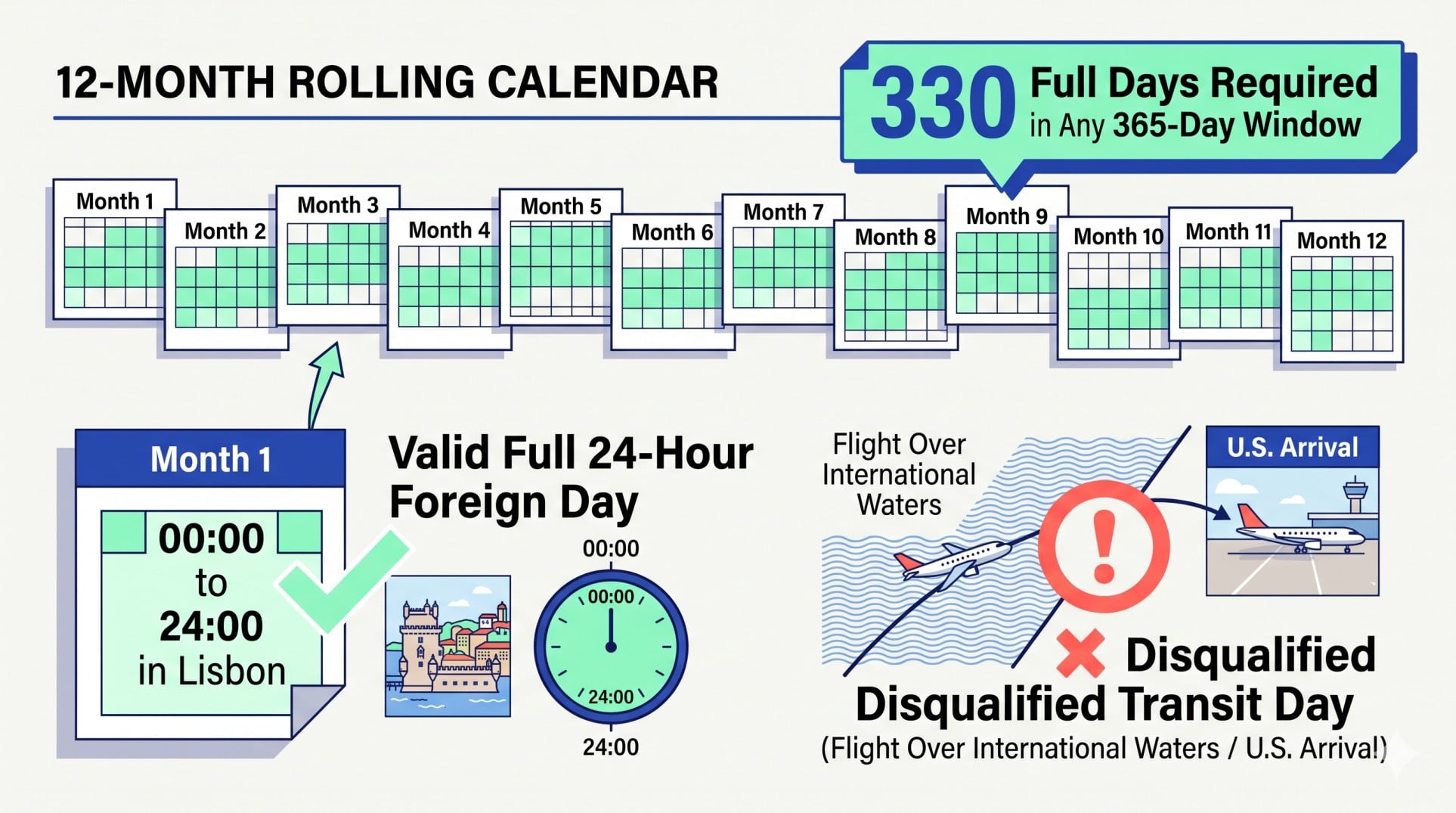
The Physical Presence Test under IRC Section 911(d)(1)(B) is a purely mechanical count requiring at least 330 full 24-hour days physically inside one or more foreign countries during any 12-consecutive-month period. The Bona Fide Residence Test under IRC Section 911(d)(1)(A) requires establishing genuine residency in a foreign country for an uninterrupted period that includes a full calendar year (January 1 to December 31).
Most country-hopping workers rely on the **Physical Presence Test** because it does not require obtaining a permanent resident visa, paying local income taxes to a single host government, or staying in one country. However, the 330-day rule is unforgiving—missing the threshold by a single hour due to a delayed flight or medical emergency reduces your exclusion to **$0** (the only statutory waiver of the time requirement under IRC Section 911(d)(4) applies when you are forced to flee a foreign country due to war, civil unrest, or adverse conditions officially listed by the Treasury Secretary in an annual Revenue Procedure).
Critical Day-Counting Traps Under the 330-Day Physical Presence Test
- The Midnight-to-Midnight Full Day Rule (Treas. Reg. Section 1.911-2(d)(2)): A “full day” is a continuous 24-hour period beginning at midnight (00:00) and ending at the following midnight (24:00). If you fly out of New York (JFK) on May 1 and land in London Heathrow at 6:30 AM on May 2, May 2 is not a full day in a foreign country. Your first full qualifying day is May 3.
- The International Waters and Airspace Trap (Treas. Reg. Section 1.911-2(h)): A “foreign country” includes only the territory and territorial waters (generally within 12 nautical miles of the coast) and airspace under the sovereignty of a foreign government. It does not include Antarctica, U.S. possessions/territories (such as Puerto Rico, Guam, the U.S. Virgin Islands, or American Samoa), or international waters/airspace!
- Transit Between Two Foreign Countries: If you leave one foreign country (e.g., Japan) to travel directly to another foreign country (e.g., Australia), you do not lose a qualifying day while passing over international waters, provided the travel over international waters takes **less than 24 hours**. If you take a transatlantic repositioning cruise that spends 4 days in international waters between Spain and Brazil, those 4 days are **disqualified**.
- Transit Between the U.S. and a Foreign Country: Any time spent over international waters while traveling *from* or *to* the United States (or during a flight that has a layover inside a U.S. airport like Miami when flying from Colombia to Europe) breaks your foreign presence day! Never book a flight between Latin America and Europe or Asia that connects through a U.S. airport if your 330-day count is tight.
| Comparison Factor | Physical Presence Test (IRC §911(d)(1)(B)) | Bona Fide Residence Test (IRC §911(d)(1)(A)) |
|---|---|---|
| Core Statutory Standard | At least 330 full 24-hour days in foreign countries during any 12 consecutive months. | Bona fide resident of a foreign country or countries for an uninterrupted period that includes an entire tax year (Jan 1 – Dec 31). |
| Ideal Digital Nomad Profile | Itinerant travelers hopping between multiple countries on tourist or nomad visas. | Settled expats/nomads holding a long-term residence visa, local lease, and tax registration in a host country. |
| Maximum U.S. Visit Days Allowed | Roughly 35 days (including travel/arrival/departure days) per 12-month window. | Flexible (typically up to 2–3 months of temporary U.S. trips per year, provided clear intent to return to the foreign residence). |
| Partial-Year Qualification in Year 1? | Yes, via any rolling 12-month window overlapping two calendar years (prorated by qualifying days). | Yes, only after you subsequently complete a full Jan 1 – Dec 31 calendar year as a bona fide resident. |
| Statement to Foreign Authorities Trap (IRC §911(d)(5)) | Does not apply. | If you submit a statement to the host country authorities claiming you are not a resident of that country and are held exempt from its income tax as a nonresident, you are automatically barred from Bona Fide Residence in that country. |
2026 Foreign Housing Exclusion and Deduction Rules (IRS Notice 2026-25)
In addition to the $132,900 earned income cap, IRC Section 911(c) and IRS Notice 2026-25 allow qualifying taxpayers to exclude or deduct reasonable foreign housing expenses that exceed a 2026 base housing floor of $21,264, up to a standard cap of $39,870 (or higher in IRS-designated high-cost cities).
Whether you claim the **Foreign Housing Exclusion** (Part VI of Form 2555) or the **Foreign Housing Deduction** (Part IX of Form 2555) depends entirely on whether your income comes from an employer (W-2 wages) or self-employment (1099 / Schedule C):
- W-2 Employees Claim the Foreign Housing Exclusion: Housing expenses are considered “employer-provided amounts” even if your employer does not pay a separate housing stipend—because your regular W-2 salary paid by your employer counts as an employer-provided amount under IRC Section 911(c)(3)(D)!
- Self-Employed Freelancers Claim the Foreign Housing Deduction: If your foreign earned income comes from self-employment on Schedule C, you cannot claim the housing *exclusion*, but you can claim the **Foreign Housing Deduction** on **Form 2555, Line 50**, which flows to **Schedule 1 (Form 1040), Line 24j** as an above-the-line adjustment to gross income (limited to your net foreign earned income exceeding your Form 2555 Line 45 earned income exclusion). Note that if you earn **less** than $132,900 in total foreign earned income, claiming the housing exclusion or deduction provides zero additional tax benefit because your base $132,900 exclusion already wipes out 100% of your foreign earned income!
What Counts (and Doesn’t Count) as a Qualifying Housing Expense in 2026?
- Qualifying Foreign Housing Costs: Rent (including medium- and long-term apartments or Airbnbs while inside your qualifying foreign tax home), fair rental value of housing provided in kind by an employer, utilities (electricity, gas, water), real and personal property insurance, non-refundable lease fees, furniture rental, and residential parking.
- Disqualified Housing Costs (IRC Section 911(c)(2)(A)): Mortgage principal or interest, property taxes, the cost of buying furniture or renovations, domestic labor (maids, housekeepers, gardeners), pay television/streaming subscriptions, **internet and telephone charges**, and any housing expenses categorized as “lavish or extravagant under the circumstances.”
If you live in a major global hub, always check the location table in **IRS Notice 2026-25** (released April 7, 2026). Instead of the standard **$39,870** cap on housing expenses, high-cost locations such as Hong Kong, London, Tokyo, Geneva, Singapore, Zurich, Paris, and Toronto allow dramatically higher annual housing expense ceilings—letting high-income earners shield tens of thousands of extra dollars above the **$132,900** base limit. For more details on deducting business workspace expenses when operating abroad, see our guide on home office and remote business deductions.
How the IRC Section 911(f) Stacking Rule Taxes Unexcluded Income
Under IRC Section 911(f), any unexcluded income above the $132,900 cap (or any passive investment income and U.S.-source income) is not taxed starting at the bottom 10% and 12% brackets. Instead, it is “stacked” on top of your excluded foreign income and taxed at the higher marginal brackets that would have applied without the exclusion.
Before Congress enacted IRC Section 911(f) in the Tax Increase Prevention and Reconciliation Act of 2005, an expat earning $180,000 who excluded the maximum Section 911 limit had their remaining taxable income taxed starting at the 10% bracket. Today, the **Foreign Earned Income Tax Worksheet** in the Form 1040 instructions closes that loophole completely.
Here is how the 4-step **Foreign Earned Income Tax Worksheet** mechanics work for 2026:
- Step 1: Calculate your Form 1040 Taxable Income (Line 15) *after* subtracting your Form 2555 exclusion and your 2026 standard deduction ($16,100 Single / $32,200 Married Filing Jointly).
- Step 2: Add your net excluded foreign earned income (your Form 2555 exclusion minus any disallowed allocable deductions from Line 44) back to your Form 1040 Taxable Income to find your “Hypothetical Combined Taxable Income.”
- Step 3: Compute the 2026 federal tax on that Hypothetical Combined Taxable Income using the 2026 tax tables, and separately compute the 2026 federal tax on your net excluded foreign earned income alone.
- Step 4: Subtract the tax on the excluded amount from the tax on the combined amount. The result is your actual 2026 federal tax liability on Form 1040, Line 16!
Why the Stacking Rule Matters for Capital Gains: Because IRC Section 911(f) stacks your capital gains and qualified dividends on top of your $132,900 excluded income, you cannot use the 0% long-term capital gains bracket (which ends at $49,450 for single filers and $98,900 for joint filers in 2026) if you excluded $132,900 on Form 2555.
Your long-term capital gains will be pushed directly into the 15% (or 20%) capital gains rate tier!
The 15.3% Self-Employment Tax Trap and 3 Legal Workarounds
The Section 911 exclusion only shelters foreign earned income from regular federal income tax under Chapter 1 of the Internal Revenue Code; it provides zero exemption from the 15.3% Self-Employment Tax (Social Security and Medicare) imposed under IRC Section 1401 (Chapter 2) on Schedule SE.
This catches thousands of independent 1099 freelancers and sole proprietors off guard every April. If a freelance software developer earns $130,000 in net Schedule C profit while living abroad for 340 days in 2026, Form 2555 reduces their federal income tax to **$0**. However, under Treasury Regulation Section 1.1402(a)-11, they must still calculate Self-Employment Tax on **100%** of their net Schedule C profit without regard to the Form 2555 exclusion!
For tax year 2026, the Social Security Administration raised the Social Security taxable wage base to $184,500 (up from $176,100 in 2025). That means a self-employed nomad pays **12.4%** Social Security tax on the first **$184,500** of net self-employment earnings (92.35% of Schedule C net profit) plus **2.9%** Medicare tax on all net earnings (plus the **0.9%** Additional Medicare Tax on net earnings above $200,000 single / $250,000 joint). On **$130,000** of net Schedule C profit, that equals **$18,368** in Self-Employment Tax!
3 Proven Tax Saving Strategies to Reduce or Eliminate the 15.3% SE Tax
Experienced international CPAs deploy three distinct tax saving strategies to legally mitigate this payroll tax hit:
- Strategy 1: U.S. Bilateral Social Security Totalization Agreements. The United States has active Social Security Totalization Agreements with **30+ countries** (including the United Kingdom, Germany, Spain, Portugal, France, Italy, the Netherlands, Canada, Australia, Japan, South Korea, Chile, Brazil, and Uruguay). If you reside and work in a Totalization treaty country, become subject to that host country’s social security system, and obtain a **Certificate of Coverage** from the foreign agency, your net earnings are **100% exempt** from the 15.3% U.S. Self-Employment Tax! Attach a copy of the Certificate of Coverage (or write “Exempt, see attached statement” on Schedule 2, Line 4) to your Form 1040. Note that non-treaty nomad hubs like Mexico, Thailand, Indonesia (Bali), Costa Rica, and Colombia do *not* have active Totalization Agreements in force with the U.S.
- Strategy 2: Domestic LLC Taxed as an S-Corporation (Form 1120-S). If you earn **$120,000 to $300,000+** in net freelance profit and travel through countries without a Totalization Agreement, electing S-Corporation status on **Form 2553** allows you to split your profit between a “reasonable W-2 salary” (e.g., **$65,000**, which is subject to 15.3% FICA tax and excluded from federal income tax on Form 2555) and S-Corp shareholder distributions (e.g., **$85,000**, which are exempt from the 15.3% FICA/SE tax!). Be aware that S-Corp distributions are unearned pass-through income and *cannot* be excluded under Form 2555—meaning you will pay regular federal income tax on the distribution portion wh
