
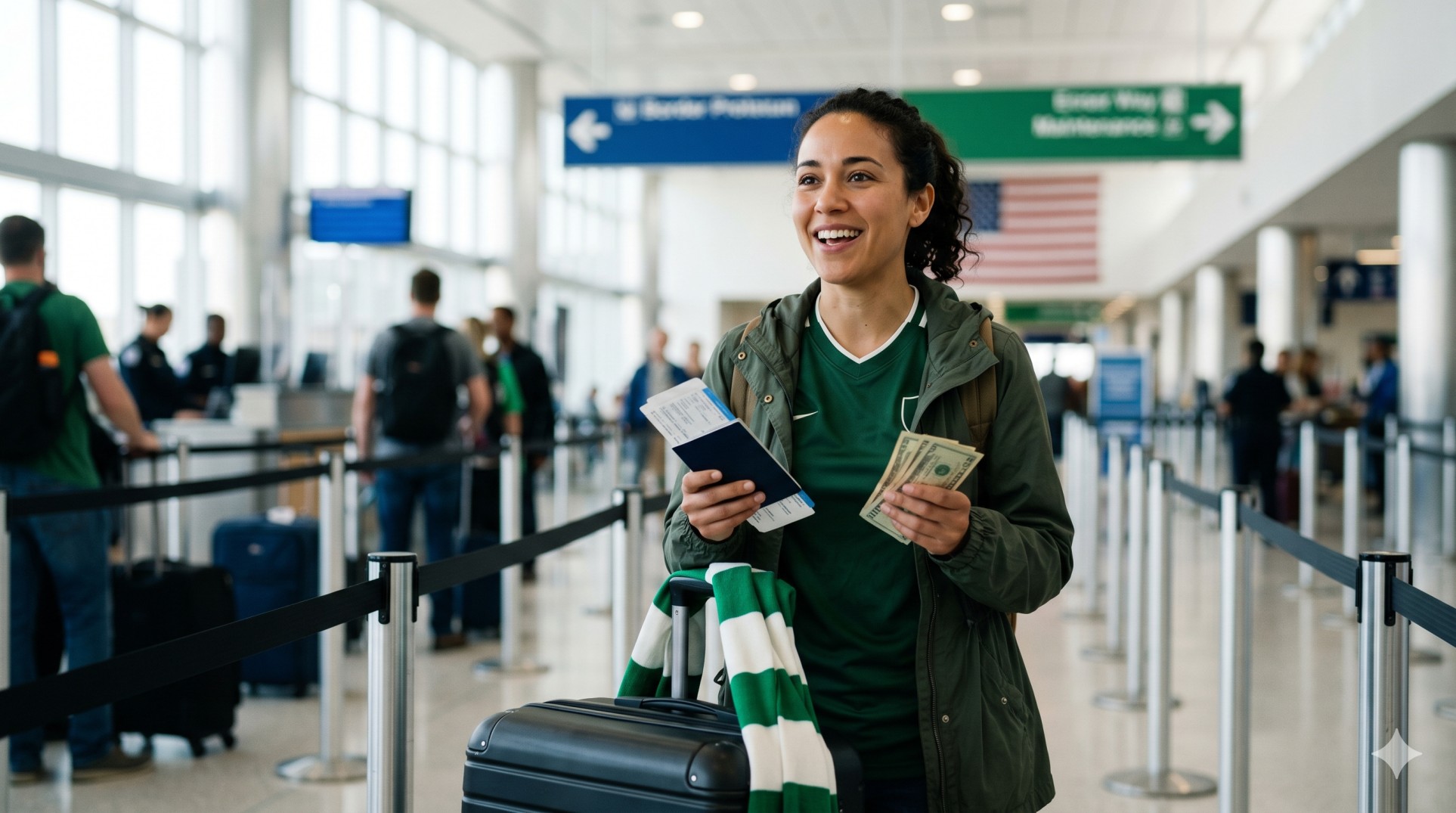
The 2026 FIFA World Cup will be an unforgettable experience. Millions of fans will travel to North America for the tournament. Furthermore, many visitors will bring large amounts of spending money. However, you must understand the strict rules for declaring cash at US customs.
Otherwise, your dream vacation could quickly become a massive financial nightmare. Therefore, you must prepare your documents before your plane lands. In this comprehensive guide, we will explain exactly what you must declare. Specifically, we will cover cash limits and commercial merchandise rules.
Thus, you can clear customs smoothly and enjoy the thrilling games. Let us explore how to protect your money and your visa status.
The $10,000 Rule: What You Need to Know
Many international tourists prefer using cash for their daily expenses. You might plan to buy expensive match tickets in Dallas. In addition, you might want to pay for luxury hotels in cash. However, the US government strictly monitors money crossing its borders.
Therefore, you must follow specific financial reporting laws. If you carry more than $10,000 USD, you must declare it officially. Consequently, hiding your money is a terrible and dangerous idea. Let us explore how this important rule actually works.
Understanding FinCEN Form 105
The primary document you need is FinCEN Form 105. This form officially reports your cash to the US government. Furthermore, it is completely free to file this required paperwork. The government simply wants to track large international financial movements.
Therefore, filing this form does not mean you pay a tax. You are merely providing required information to federal customs officers. Consequently, you should never fear filling out this simple document. Thus, honesty is always your absolute best policy at the border.
How Customs Calculates Your Total Cash
You might think the rule only applies to US dollars. However, customs officers count every single type of currency you carry. For example, they will combine your Euros, Pesos, and US dollars. If the total combined value exceeds $10,000 USD, you must report it.
In addition, traveler’s checks and money orders count as physical cash. Therefore, you must calculate your total financial instruments very carefully. Consequently, a simple math error can cause massive legal problems. Thus, count your money twice before you board your flight.
Bringing Merchandise to Sell at the World Cup
Some passionate fans plan to fund their trip by selling merchandise. You might bring rare football jerseys to sell in Miami. Furthermore, you might carry handmade scarves to trade with other fans. However, US customs has very strict rules about commercial goods.
Therefore, you cannot simply pack a suitcase full of retail inventory. You must declare these commercial items when you arrive at the airport. Let us review the specific rules for bringing goods to sell.
Personal Use vs. Commercial Goods
Customs officers easily spot the difference between personal and commercial items. If you pack five personal shirts, that is perfectly fine. However, if you pack fifty identical jerseys, officers will ask questions. Therefore, you must declare these items as commercial goods immediately.
Furthermore, bringing goods to sell requires the correct US visa. A standard tourist visa does not allow you to run a business. Consequently, you risk immediate deportation if you lie about your intentions.
Paying Customs Duties and Taxes
When you declare commercial merchandise, you might owe customs duties. The US government taxes foreign goods entering the country for resale. Therefore, you must pay these specific fees before leaving the airport. In addition, the exact tax rate depends on the specific items.
For instance, clothing might have a different tax rate than electronics. Consequently, you should research these import duties before you travel. Thus, you can budget for these extra expenses accurately.
The Severe Penalties for Hiding Cash
Some travelers try to hide their money to avoid the paperwork. They might split cash between different bags or jacket pockets. However, customs officers use advanced technology and highly trained dogs. Therefore, they will likely find your hidden currency very quickly.
If they catch you lying, the consequences are incredibly severe. Furthermore, ignorance of the law will not save you from punishment. Let us look at the specific penalties you might face.
Civil Fines and Cash Seizure
If you fail to declare your cash, officers can seize it. Specifically, they can confiscate every single dollar you are carrying. Furthermore, getting your money back is a long and expensive legal process. You will likely have to hire a specialized US customs lawyer.
In addition, the government can issue massive civil fines against you. Therefore, a simple mistake can cost you your entire vacation budget. Consequently, filing the free form is always the smarter financial choice.
Criminal Charges and Visa Cancellations
The penalties go far beyond just losing your physical money. Lying to a federal customs officer is a serious federal crime. Therefore, you could face criminal cash smuggling charges. Furthermore, officers will likely cancel your tourist visa immediately.
As a result, you will be deported back to your home country. Consequently, you will miss the entire World Cup tournament. Thus, you must always answer customs questions completely truthfully.
Step-by-Step: How to Declare Your Money
Declaring your cash is actually a very simple and straightforward process. You just need to follow the correct steps when you arrive. Therefore, you should prepare your information before your plane lands. Furthermore, being organized will make your customs experience much faster.
Let us walk through the exact process you must follow at the airport. Proper preparation eliminates all the stress of border crossings.
Filling Out the Customs Declaration Form
During your flight, flight attendants will hand you a blue customs form. You must check “Yes” on the question about carrying currency. Specifically, this is the question asking if you have over $10,000. Therefore, you officially notify the officers of your cash.
In addition, you must declare any commercial merchandise on this same form. Consequently, this blue paper is your first step toward legal compliance. Thus, keep a pen handy in your carry-on bag.
Submitting FinCEN Form 105
After checking “Yes,” you must complete FinCEN Form 105. You can actually fill out this form online before you travel. Therefore, you can save valuable time at the busy airport terminal. However, you can also request a paper copy from the customs officer.
Furthermore, you must hand this completed form directly to the agent. Consequently, they will review your money and process your legal entry. Thus, you can legally enter the United States with your cash.
Case Study Scenarios
Real numbers make these complex customs rules much easier to understand. Therefore, let us look at three different traveler scenarios. These examples will show exactly how the declaration rules work in practice.
Furthermore, they highlight the extreme importance of proper travel planning. By studying these cases, you can avoid making expensive mistakes.
Scenario 1: The Group of Friends in Miami
Four friends travel together from Brazil to Miami for the matches. They bring $24,000 USD total to share for hotels and tickets. However, one person carries all the money in his personal backpack. Because he physically holds more than $10,000, he must declare it.
- Total Cash: $24,000 USD.
- Requirement: He must file FinCEN Form 105.
- Result: He declares the cash, files the form, and enters safely.
Therefore, the person physically carrying the money holds the legal responsibility. Consequently, he protects the entire group by following the rules.
Scenario 2: The Merchandise Seller in Los Angeles
David flies into Los Angeles with 200 expensive football scarves. He plans to sell them outside the stadium for a large profit. However, he does not declare them on his customs form.
- Goods Value: $5,000 USD.
- Action: Customs officers search his bags and find the commercial inventory.
- Result: Officers seize the scarves and cancel his tourist visa.
Because he lied about commercial goods, he faces immediate deportation. Consequently, his business plan completely fails and he misses the tournament.
Scenario 3: The Family in New York/New Jersey
A family of three arrives at the airport in New York/New Jersey. The father carries $6,000, the mother carries $5,000, and the son carries $1,000. They submit a joint family customs declaration form to the officer.
- Combined Family Cash: $12,000 USD.
- Requirement: Families filing a joint declaration must combine their cash totals.
- Result: They must file FinCEN Form 105 because their total exceeds $10,000.
Therefore, families cannot split money to avoid the reporting requirement. Consequently, they must declare the combined total to stay legal.
Traveling Between Host Cities and Countries
The 2026 World Cup spans across the entire North American continent. You might travel frequently between the US, Canada, and Mexico. Therefore, you will cross international borders multiple times during your trip. Furthermore, each border crossing requires a brand new customs declaration.
Let us review how this international travel impacts your cash reporting. You must stay vigilant throughout your entire vacation.
Crossing Borders to Canada and Mexico
If you leave the US for a match in Toronto, rules apply. Specifically, you must declare cash when leaving the United States. Yes, the $10,000 rule applies to both arriving and departing travelers. Therefore, you must file FinCEN Form 105 when you exit.
In addition, Canada and Mexico have their own cash declaration laws. Consequently, you must research the rules for all three host countries. Thus, you avoid having your money seized by foreign governments.
Domestic Flights Within the US
Fortunately, domestic travel is much easier for international fans. If you fly from Dallas to Atlanta, you stay inside the US. Therefore, you do not pass through international customs again. Furthermore, you do not need to declare your cash on domestic flights.
However, airport security might still ask questions if they see large stacks of money. Consequently, you should always keep your stamped FinCEN Form 105 handy. Thus, you can easily prove you brought the money into the country legally.
Smart Alternatives to Carrying Large Amounts of Cash
Carrying thousands of dollars in cash is inherently dangerous. You could easily lose your wallet in a crowded stadium. Furthermore, pickpockets often target excited tourists at major sporting events. Therefore, you should consider safer financial alternatives for your trip.
Let us explore some modern ways to manage your World Cup budget. These methods will save you time and reduce your stress.
Using Travel Credit Cards
Travel credit cards are the safest way to spend money abroad. Most major US hotels, restaurants, and stadiums accept credit cards easily. Furthermore, many premium cards offer zero foreign transaction fees. Therefore, you get excellent exchange rates without carrying heavy cash.
In addition, credit cards offer fraud protection if your card is stolen. Consequently, you should rely on plastic for your major expenses. Thus, you only need a small amount of cash for minor purchases.
Setting Up International Bank Transfers
If you need to pay for a long-term rental, use bank transfers. You can wire money directly to your US property manager. Therefore, you avoid carrying massive amounts of cash through the airport. Furthermore, modern financial services offer cheap and fast international transfers.
Consequently, you can manage your money securely from your smartphone. Thus, you eliminate the need for FinCEN Form 105 entirely. This makes your customs experience incredibly fast and simple.
Frequently Asked Questions (FAQ)
Is it illegal to bring more than $10,000 into the US?
No, it is completely legal to bring any amount of money. There is absolutely no limit on how much cash you can carry. However, the law strictly requires you to report amounts over $10,000. Therefore, the crime is not having the money; the crime is hiding it from customs.
Do families traveling together get a $10,000 limit per person?
No, families filing a joint customs declaration share a single $10,000 limit. If your combined family total exceeds $10,000, you must declare it. Therefore, you cannot give $9,000 to your spouse to avoid the paperwork. Consequently, customs officers will penalize you for splitting funds illegally.
Does foreign currency count toward the $10,000 limit?
Yes, all foreign currency counts toward the total limit. You must calculate the US dollar equivalent of your Euros, Pounds, or Reais. Furthermore, traveler’s checks, money orders, and gold coins also count. Therefore, you must add all your financial instruments together before arriving.
What happens if I sell merchandise on a tourist visa?
Selling merchandise on a B1/B2 tourist visa or ESTA is strictly prohibited. These visas do not allow you to engage in local employment or retail business. Therefore, if customs officers discover your commercial inventory, they will deny your entry. Consequently, you will be sent home and your visa will be revoked.
Conclusion and Next Steps
The 2026 World Cup will be a thrilling adventure for international fans. You will experience amazing matches and vibrant host cities. However, you must respect US customs laws regarding cash and merchandise. By declaring cash at US customs, you protect yourself from severe penalties.
Furthermore, filing FinCEN Form 105 ensures your money remains safe and legal. Therefore, take the time to count your currency before you travel. In addition, consider using credit cards to minimize your physical cash. Thus, you can focus entirely on the beautiful game instead of legal troubles.
Did you find this customs guide helpful? Please share this article with your fellow traveling fans! In addition, bookmark this page for your 2026 trip planning. Finally, explore our other helpful World Cup tax and travel guides on our blog to stay informed.
Disclaimer: This article is strictly for educational and informational purposes. This website does not provide tax or legal services. Therefore, readers should consult a certified CPA or tax professional for their specific situations.
