
Date: 2/12/2026
Key Takeaways: The ‘Post-IRA’ Cliff is Here
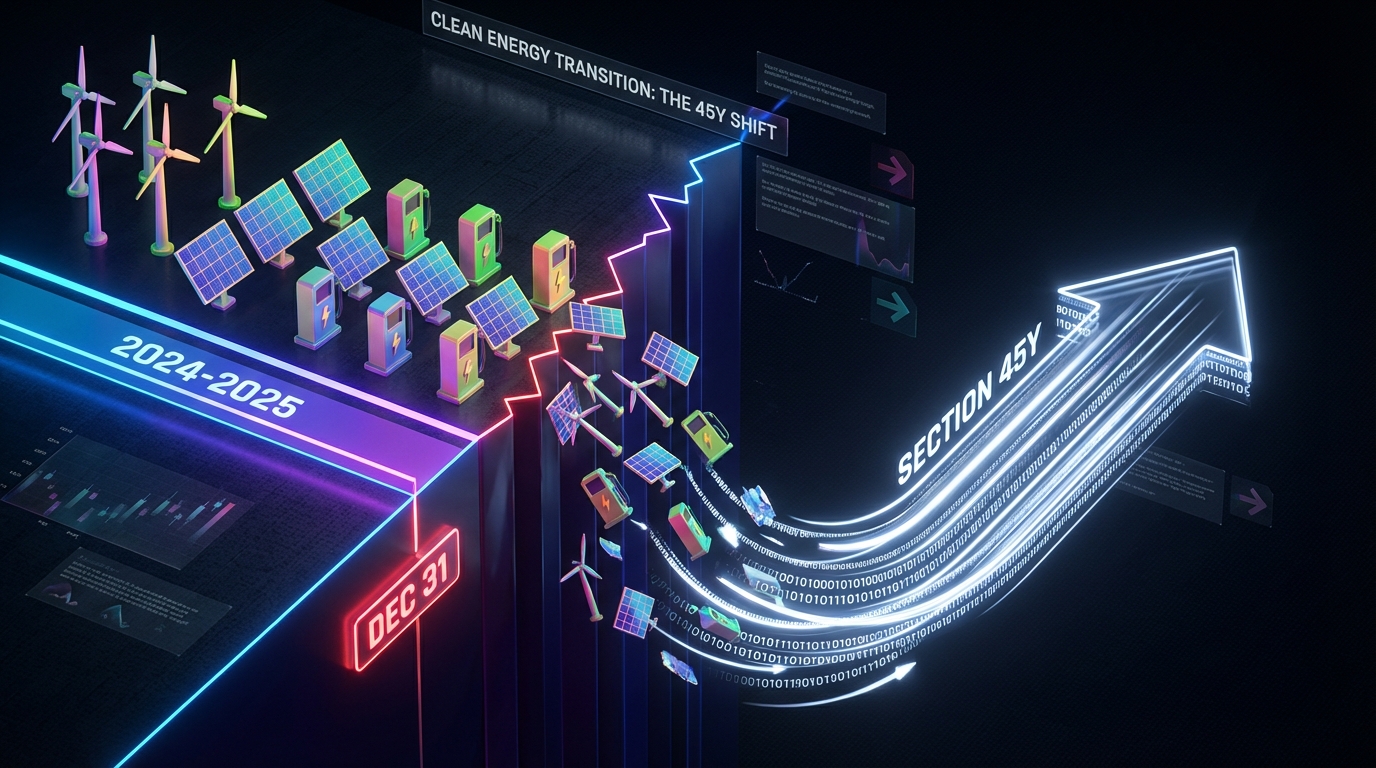
The tax environment for green energy changed significantly with the passage of the One Big Beautiful Bill Act (OBBBA) in July 2025. We have entered the “Post-IRA” era, which is defined by a massive shift in how the IRS rewards clean energy production and investment. For taxpayers, the most important thing to understand is the “cliff.” Many popular credits are scheduled to vanish entirely at the end of 2025, making this a critical year for your financial planning.
The Shift to Technology-Neutral Credits
Starting January 1, 2025, the IRS no longer cares whether you are using wind, solar, or geothermal power to generate electricity. The old technology-specific credits have been replaced by Section 45Y (Clean Electricity Production Credit) and Section 48E (Clean Electricity Investment Credit). These new rules focus entirely on greenhouse gas emissions rather than the specific equipment used.
To qualify, a project must have a greenhouse gas emissions rate of zero or net-negative. This opens the door for new technologies that were previously excluded, provided they meet the cleanliness standard. However, the amount you can claim depends heavily on whether you meet strict labor requirements regarding prevailing wages and apprenticeships. If you do not meet these labor standards, your credit amount drops significantly.
| Credit Type | Base Rate (No Labor Compliance) | Full Rate (With Labor Compliance) |
| 45Y (Production Credit) | 0.3 cents per kWh | 1.5 cents per kWh |
| 48E (Investment Credit) | 6% of project cost | 30% of project cost |
The 2025 Consumer Credit Cliff
If you have been waiting to upgrade your home, your window of opportunity is closing fast. Under the OBBBA, several major consumer tax breaks will be repealed after December 31, 2025. This is not a slow phase-out; it is a total expiration. For example, the 2025 solar tax credit eligibility requirements now dictate that a system must be fully installed and operational by the end of the year to qualify for the 30% credit. If the system is not running by New Year’s Eve, the credit drops to 0%.
The same urgency applies to the maximum credit for energy efficient home improvements under Section 25C. This credit covers heat pumps, insulation, and energy-efficient windows. If you spend money on these upgrades after December 31, 2025, you will receive no federal tax credit. If you are wondering how to claim residential clean energy credit benefits, the process remains the same on your tax return, but the project must be finished before the 2026 calendar year begins.
Drivers and business owners also face inflation reduction act electric vehicle tax credit limits and repeals. The Commercial Clean Vehicle Credit (45W) and the credit for charging stations (30C) are both set to end on December 31, 2025. This marks the end of the immediate tax credits for purchasing clean vehicles and installing infrastructure.
Higher Hurdles for Domestic Content
The government is getting much stricter about where your equipment comes from. For projects starting in 2025, the “adjusted percentage” for domestic manufactured products has climbed to 45%. This will continue to rise every year until it hits 55% in 2027. If you do not meet these domestic content thresholds, your financial return on the project will suffer.
This is especially true for non-profits and tribal governments using “Direct Pay.” In 2024, failing the domestic content test meant you only received 90% of your credit. In 2025, that payment drops to 85%. By 2026, if you do not meet the domestic content requirements, your direct payment amount drops to 0%. This makes sourcing American-made parts a financial necessity for tax-exempt entities.
Accelerated Deadlines and Foreign Restrictions
Wind and solar projects now have a specific expiration date. To stay eligible for the 45Y or 48E credits, these facilities must be placed in service before January 1, 2028. Furthermore, you must have started construction by July 5, 2026, to qualify under the “safe harbor” rules. This creates a very tight timeline for large-scale energy developments that often take years to permit and build.
Security is also a major focus of the new guidance. As of July 4, 2025, you cannot claim any credit if your facility uses components from a “Prohibited Foreign Entity” (PFE). This includes companies tied to China, Russia, North Korea, and Iran. Additionally, you are no longer allowed to transfer these credits to any “Specified Foreign Entity” under Section 6418. These rules are designed to keep federal tax dollars within the domestic supply chain and out of the hands of foreign adversaries.
The transition to the 45Z Clean Fuel Production Credit also brings new rules. While this credit lasts through 2029, all feedstock must be grown or produced in the U.S., Canada, or Mexico starting in 2026. Because these rules are changing so rapidly and the “cliffs” are so steep, you should seek professional consultation for clean energy tax incentives to ensure your projects remain compliant and your tax savings are maximized.
The Meat: Technical Rules & The 2025 Filing Deadline
Understanding the tax code involves staying informed about current regulations and filing deadlines. Taxpayers who invested in green technology may be eligible for credits that reduce tax liability. These credits are typically non-refundable, meaning they can reduce the amount owed but do not result in a refund check for any amount exceeding the total tax liability. Missing filing windows could mean delaying potential tax benefits or facing penalties if a balance is owed.
Residential Solar and Energy Requirements
The Residential Clean Energy Credit applies to qualified clean energy property installed in a residence. Eligibility requires the equipment to be used in a home located in the United States, including both existing homes and those under construction. This incentive covers various technologies, such as solar electric panels, solar water heaters, wind turbines, and fuel cells. The credit amount is calculated as a percentage of the total installation cost.
Annual limits apply to energy-efficient home improvements under Section 25C. These limits are categorized based on the type of upgrade performed, allowing taxpayers to potentially spread improvements over several years to maximize benefits.
| Improvement Category | Credit Limit Type |
|---|---|
| General Weatherization (Doors, Windows, Insulation) | Annual capped amount for general upgrades |
| Heat Pumps, Water Heaters, and Biomass Stoves | Specific annual limit for high-efficiency equipment |
Electric Vehicle Credit Thresholds
Clean vehicle credits are subject to specific eligibility requirements based on the vehicle type and the taxpayer’s income levels. To qualify, the vehicle’s manufacturer’s suggested retail price must fall within established limits. Additionally, the taxpayer’s modified adjusted gross income must not exceed specific thresholds. Final assembly requirements also influence whether a vehicle qualifies for the full or partial credit amount.
| Vehicle Type | Eligibility Requirements |
|---|---|
| Vans, SUVs, and Pickups | MSRP Limit and Income Thresholds |
| Sedans and Other Vehicles | MSRP Limit and Income Thresholds |
| Used Clean Vehicles | Sale Price Limit and Income Thresholds |
Commercial Incentives and Technical Filing
Commercial developers and building owners may utilize deductions for buildings that reduce energy costs through improvements to the building envelope, HVAC, or lighting systems. The deduction amount is determined by the level of energy reduction achieved and compliance with specific labor and apprenticeship requirements. This provision helps offset the costs of modernizing infrastructure to improve efficiency.
To claim residential credits, taxpayers must complete the appropriate IRS forms and attach them to their annual return. This process requires categorizing costs for hardware and labor. Maintaining receipts and manufacturer certification statements is necessary to verify that products meet the efficiency standards required by the IRS for the applicable tax year.
Consulting with a tax professional can help clarify complex rules and ensure proper filing. Professionals assist in determining if unused credit portions can be carried forward to future years and help avoid claiming the same expenses for multiple incentives unless permitted. Proper planning ensures that green energy investments provide the intended financial benefits for the taxpayer.
The Data: Calculating Your Losses (2025 vs. 2026)
The 2025 tax year represents a final “golden window” for taxpayers looking to subsidize their green energy transitions. Under the mandates of the One Big Beautiful Bill Act (OBBBA), the financial landscape shifts dramatically on January 1, 2026. For many households, waiting just one extra year to install solar panels or upgrade a furnace could result in a literal five-figure increase in their net costs.
To help you navigate this transition, we have broken down the specific “losses” you will face if you delay your projects. These figures aren’t just theoretical; they are based on the hard expiration dates set by the IRS and the OBBBA. Understanding these deadlines is the first step in protecting your household budget from the upcoming 2026 credit cliff.
The $3,200 Home Efficiency Cliff (Section 25C)
If you are planning to weatherize your home, 2025 is the year to act. Currently, the maximum credit for energy efficient home improvements allows you to claim up to $3,200 annually. This includes a $2,000 credit for high-efficiency heat pumps or biomass stoves and another $1,200 for smaller upgrades like windows, doors, and insulation. For example, if you replace your drafty windows and install a new heat pump in 2025, the IRS effectively pays for $3,200 of the bill.
Starting in 2026, this credit is eliminated entirely. According to IRS Notice 2025-42, any equipment must be “placed in service”—meaning installed and operational—by December 31, 2025. Simply buying the equipment and leaving it in your garage will not qualify you for the tax break. If your contractor finishes the job on New Year’s Day 2026, that $3,200 benefit vanishes.
Uncapped Solar Losses (Section 25D)
The loss of the Residential Clean Energy Credit is perhaps the most significant blow to homeowners. In 2025, you can still claim a 30% uncapped credit for solar panels, battery storage, and geothermal systems. For a standard $25,000 solar installation, this puts $7,500 back in your pocket. Because the credit is uncapped, the more you spend on qualifying systems, the more you save on your tax bill.
To understand how to claim residential clean energy credit benefits before they expire, you must meet the 2025 solar tax credit eligibility requirements. This year, the IRS has introduced a strict “PIN” requirement. You cannot claim the credit unless your manufacturer provides a Qualified Manufacturer Identification Number (QMID) for your specific hardware. In 2026, Section 25D expires completely under OBBBA § 139, meaning a solar array installed in 2026 costs the full retail price with zero federal support.
The Early End for Electric Vehicles (30D & 25E)
The inflation reduction act electric vehicle tax credit limits are facing an accelerated timeline. While many expected these credits to last through the decade, the OBBBA has moved the finish line to September 30, 2025. If you acquire a qualifying new EV before this date, you can receive up to $7,500. If you buy a used EV for under $25,000, you can still claim 30% of the sale price, capped at $4,000.
There is a small “loophole” for those facing delivery delays. You must complete a binding purchase agreement and provide a down payment before the September 30 cutoff. As long as you obtain a “time of sale” report from your dealer, you can take delivery later in the year. However, vehicles acquired on October 1, 2025, or later will receive no federal credit, representing a 100% loss of this incentive.
Commercial and Infrastructure Reductions
Business owners also face a tightening window. The commercial energy efficiency tax deduction 179D, which currently offers up to $5.81 per square foot for energy-efficient building designs, is scheduled for termination. Projects must begin construction before June 30, 2026, to remain eligible. Similarly, the 30% credit for home EV chargers (Section 30C) expires on that same date. If you plan to install a home charging station, doing so in early 2026 is your last chance to grab that $1,000 credit.
2025 vs. 2026 Comparison Table
| Credit Type | 2025 Max Benefit | 2026 Max Benefit | Total Potential Loss |
|---|---|---|---|
| Home Improvements (25C) | $3,200 | $0 | $3,200 |
| Solar/Battery (25D) | 30% (Uncapped) | $0 | $7,500+ (Avg.) |
| New EV (30D) | $7,500 | $0 | $7,500 |
| Used EV (25E) | $4,000 | $0 | $4,000 |
| EV Charger (30C) | $1,000 | $0 (after June 30) | $1,000 |
| Max Potential Loss | — | — | $23,200+ |
Given the complexity of the “placed in service” rules and the new manufacturer PIN requirements, a professional consultation for clean energy tax incentives is highly recommended. A tax professional can help you verify that your equipment is on the IRS-approved list and ensure your installation timeline aligns with the OBBBA deadlines. Moving quickly in 2025 could be the difference between a massive tax refund and paying full price for your home upgrades.
Strategic Action Plan: Audit-Proofing & Mobilization
The IRS has shifted its strategy for 2025, moving away from “good faith” reporting toward a “strict substantiation” model. If you want to satisfy the 2025 solar tax credit eligibility requirements, you must build a defense-ready paper trail before you even file your return. This means maintaining a contemporaneous digital and physical folder for at least three years, or until the property is sold if the credit affects your cost basis.
1. Critical Documentation: The “Audit-Proof” Folder
For those looking at how to claim residential clean energy credit benefits, the most significant change is the Qualified Manufacturer ID (QMID). For any Section 25C home improvement claim in 2025, you must record a specific 4-character alphanumeric PIN provided by the manufacturer. If you omit this PIN on Form 5695, the IRS systems are programmed to flag the claim for an automatic rejection. You should request this PIN at the point of sale to avoid delays later.
You also need to document the exact “Placed in Service” date, as the credit is claimed in the year the system becomes operational, not necessarily when you paid for it. For solar or wind projects, keep the “Permission to Operate” (PTO) letter from your utility company as proof. For electric vehicles, ensure you have a copy of the “Seller Report” (Form 15400) that the dealer is required to submit to the IRS at the time of sale.
To secure the maximum credit for energy efficient home improvements, such as the $150 credit for home energy audits, your documentation must be precise. You must have a written report from a Qualified Home Energy Auditor who is certified by a DOE-approved program like RESNET or BPI. This report must clearly list the auditor’s name and their professional certification number to withstand an audit.
2. Mobilization Deadlines (The “OBBBA” Compression)
The One Big Beautiful Bill Act (OBBBA), signed in July 2025, significantly accelerated the expiration of several popular incentives. You must align your project timelines with these “Hard Stop” dates to ensure you do not lose out on thousands of dollars in incentives. For example, missing the September deadline for an EV purchase is a permanent loss of credit that cannot be recovered.
| Credit Type | Section | 2025 Deadline / Status |
|---|---|---|
| Clean Vehicle Credit | 30D / 25E | TERMINATED for vehicles acquired after Sept 30, 2025. |
| Commercial Clean Vehicle | 45W | TERMINATED for vehicles acquired after Sept 30, 2025. |
| Residential Clean Energy | 25D | EXPIRES Dec 31, 2025. 30% rate drops to 0% in 2026. |
| Home Improvement Credit | 25C | EXPIRES Dec 31, 2025. |
| Refueling Property | 30C | Terminated for property placed in service after June 30, 2026. |
It is vital to understand the inflation reduction act electric vehicle tax credit limits as they stand under this new timeline. If your vehicle is not delivered and in your possession by the September 30 cutoff, you will likely be ineligible for the $7,500 new vehicle credit or the $4,000 used vehicle credit, regardless of when you signed the contract.
3. Strategic Action for Commercial & Utility Projects
Commercial property owners should evaluate the commercial energy efficiency tax deduction 179D alongside the new technology-neutral credits. For developers using Sections 45Y and 48E, audit-proofing requires “Day Zero” compliance with labor standards. To receive the full 30% credit instead of the base 6%, you must document that all laborers were paid Prevailing Wages and that Apprenticeship hours met the 15% threshold for 2025.
Failure to track these hours on a daily basis creates a massive financial risk. In an audit, the IRS can strip away roughly 80% of the credit value if your records are incomplete. Furthermore, if you are utilizing the “Direct Pay” option under Section 6417, projects starting in 2025 only receive 85% of the payment if domestic content requirements are not met. This payment drops to 0% for any projects that begin construction in 2026.
If you are participating in the “Transferability” market by buying tax credits, remember that the audit risk stays with you, the buyer. You must perform rigorous due diligence on the seller’s documentation. This includes verifying the “Placed in Service” dates and the “Cost Basis” calculations to ensure the credit you are purchasing is ironclad and won’t be recaptured by the IRS later.
4. Immediate Mobilization Checklist
- Verify Manufacturer Status: Before you buy a heat pump, water heater, or windows, check the IRS/DOE Qualified Manufacturer List. Ensure they have registered their QMID/PINs for the 2025 tax year.
- Finalize EV Deliveries: If you are planning a fleet or personal EV purchase, the vehicle must be in your physical possession by September 30, 2025. A “pre-order” or “deposit” does not count as an acquisition for tax purposes.
- Secure Construction Proof: For large-scale projects, document the “5% Safe Harbor” by spending 5% of the total project cost before year-end. This helps grandfather your project into the 2025 rules if construction carries over into 2026.
- Pre-Filing Registration: If you plan to use Direct Pay or Transferability, you must complete the IRS Energy Credits Online (ECO) registration. You need a registration number before you can legally file your 2025 tax return.
- Seek Expert Review: Because the OBBBA has compressed these timelines, obtaining a professional consultation for clean energy tax incentives is highly recommended to ensure your specific project meets the accelerated deadlines.
FAQ: The Long-Tail Questions Clients Are Asking
The landscape of green tax incentives shifted significantly following the signing of the One Big Beautiful Bill Act (OBBBA) on July 4, 2025. For high-net-worth individuals and owners of multiple properties, the rules have become more nuanced. Understanding the **2025 solar tax credit eligibility requirements** is the first step in maximizing your returns before the upcoming sunsets. This guide answers the most pressing questions regarding how these new regulations affect your portfolio and your primary residence.
Can I claim credits for my vacation home?
The answer depends entirely on which credit you are pursuing. For the Section 25D Residential Clean Energy Credit—which covers solar panels, wind turbines, and geothermal heat pumps—you can claim the credit for any home you use as a residence. This includes your secondary vacation home or mountain cabin, provided you do not rent the property out to others. If you use the home personally, it qualifies.
However, the rules for the Section 25C Energy Efficient Home Improvement Credit are much tighter. While you can claim heat pumps and water heaters for a second home, “building envelope” upgrades like insulation, windows, and doors are strictly reserved for your principal residence. Furthermore, fuel cell property is also restricted to your main home. If you are a landlord, you cannot claim these residential credits for tenant-occupied properties, as these are personal tax credits rather than business deductions.
Does my battery storage need to be connected to solar?
One of the most common questions regarding how to claim residential clean energy credit involves battery storage. Since 2023, the law has decoupled battery storage from solar production. As long as the battery has a capacity of at least 3 kilowatt-hours (kWh), it qualifies for the 30% credit even if it is charged exclusively from the utility grid. This is a major win for homeowners looking to protect against blackouts without installing full solar arrays.
If you already have an existing solar system and decide to add a battery in 2025, the battery is treated as a standalone “expenditure made” for that tax year. You can claim the 30% credit on the battery cost regardless of when your solar panels were originally installed. This allows for modular upgrades to your home energy system while still capturing significant tax savings.
Which labor costs are actually tax-deductible?
Taxpayers often assume all installation costs are covered, but the OBBBA maintains a strict divide between different types of upgrades. When calculating your maximum credit for energy efficient home improvements, you must separate material costs from labor based on the specific equipment installed. The following table breaks down where labor is included in the 30% calculation:
| Project Type | Labor Included? | Credit Section |
|---|---|---|
| Solar, Geothermal, Wind, Battery | Yes (100% of professional labor) | Section 25D |
| Heat Pumps, Central Air, Water Heaters | Yes (Installation & assembly) | Section 25C |
| Insulation, Air Sealing, Windows, Doors | No (Materials only) | Section 25C |
What is the new “PIN” requirement for 2025?
Starting January 1, 2025, the IRS has introduced a new layer of verification to prevent fraudulent claims. For most Section 25C upgrades, you must provide a Product Identification Number (PIN) on your tax return. Because many manufacturers struggled to implement the full 17-digit PIN system in time, the IRS is allowing a temporary 4-character “QM Code” (Qualified Manufacturer Code) for the 2025 tax year only.
Before you sign a contract, verify that your contractor can provide the QM Code or PIN on your final invoice. If the manufacturer is not registered as a “Qualified Manufacturer” with the IRS, your credit will be denied automatically. This makes the choice of equipment just as important as the choice of installer.
How do electrical panel upgrades work?
If your home’s electrical system cannot handle a new heat pump or EV charger, you may need an “enabling property” upgrade. This refers to panelboards or branch circuits with a capacity of at least 200 amps. You can claim a credit for these upgrades if they are required to support other 25C improvements. However, this specific credit is capped at $600 annually within the broader $1,200 efficiency limit. If you upgrade the panel in late 2024 but wait until 2025 for the heat pump, you can typically treat both as installed in 2025 to simplify your filing.
When do these credits actually expire?
The OBBBA established firm sunset dates that every high-net-worth investor should mark on their calendar. Missing these dates by even a day could result in the total loss of the incentive. For those managing commercial portfolios, the commercial energy efficiency tax deduction 179D requires construction to begin by June 30, 2026, to remain eligible under current high-rate rules. Residential and vehicle deadlines are even tighter:
- Electric Vehicles: The inflation reduction act electric vehicle tax credit limits apply to any vehicle acquired after September 30, 2025. “Acquired” means you have a binding contract and have made a payment or deposit.
- Residential Credits: Both 25C and 25D credits are scheduled to terminate for any property placed in service after December 31, 2025.
- Foreign Entities: You cannot claim credits for equipment containing components from a “Foreign Entity of Concern” (FEOC), such as certain manufacturers in China, for projects starting after July 4, 2025.
Can I sell my credits to someone else?
While Section 6418 allows businesses to transfer or sell credits to third parties, individuals face significant hurdles. If you purchase a tax credit as an individual, you are generally bound by passive activity loss rules. This means you can usually only use those purchased credits to offset tax liability from passive income, such as rental properties, rather than your W-2 wages or stock market gains. Given these complexities, seeking professional consultation for clean energy tax incentives is highly recommended for anyone considering credit transfers or large-scale multi-property upgrades in 2025.
About the Author
ARUN KP
With over 15 years of extensive experience in the accounting and taxation industry, Arun KP specializes in cross-border India-US taxation. As an Entrepreneur and AI Content Generator, he leverages cutting-edge technology to simplify complex financial landscapes for individuals and businesses.
Entrepreneur | AI Content Generator | India-US Tax Professional | Accountant
Disclaimer: This article is for informational purposes only and does not constitute professional tax advice.
