
⚡ Executive Summary: Charitable Deduction 2026 Changes
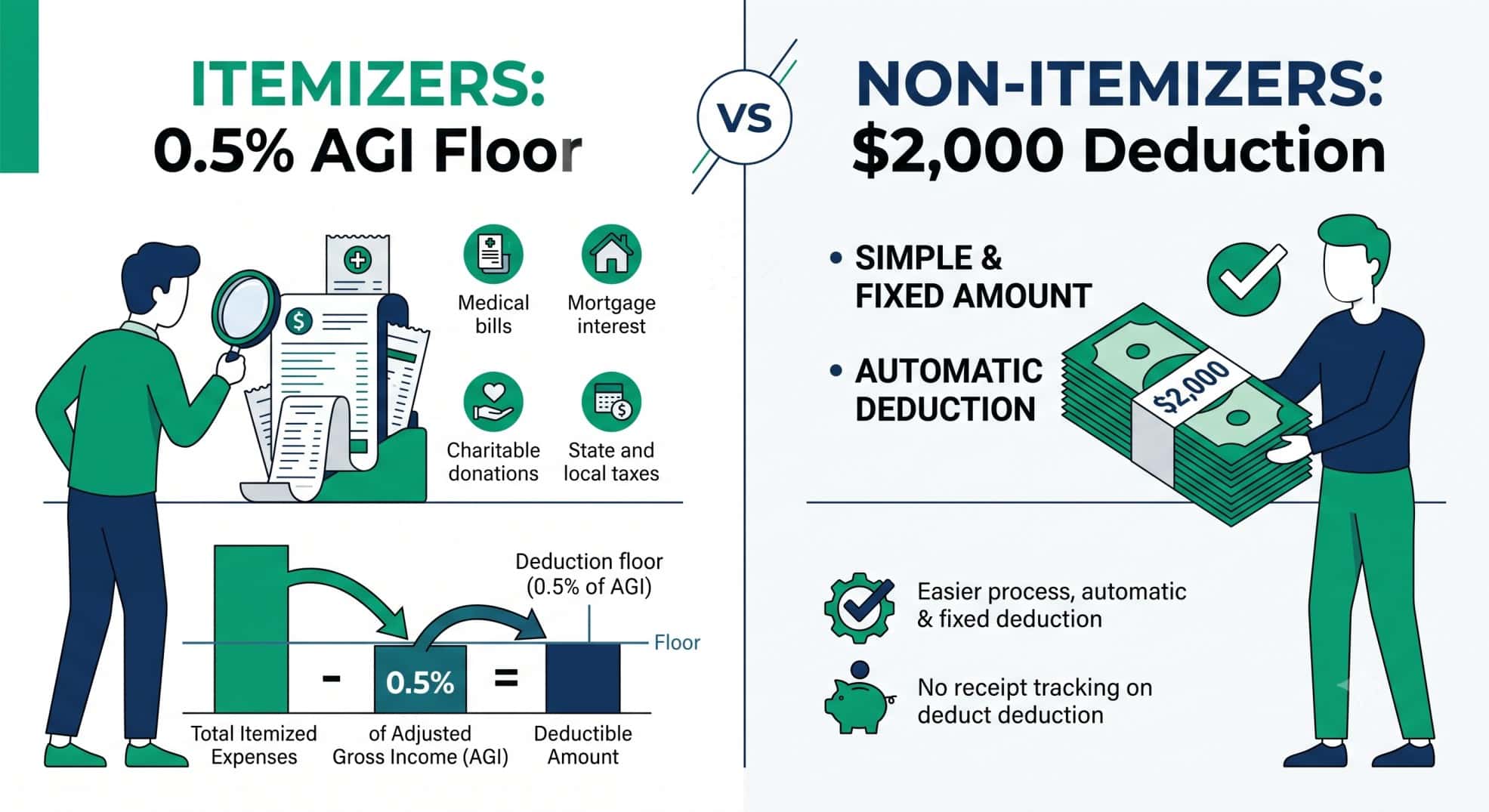
- Under the newly enacted tax legislation, itemizers face a strict 0.5% Adjusted Gross Income (AGI) floor, meaning only donations exceeding this threshold provide a tax benefit.
- Taxpayers taking the standard deduction can now claim a specific above-the-line deduction of $2,000 for joint filers and $1,000 for single filers for cash gifts to public charities.
- High earners in the 37% bracket face a new limitation where the tax benefit of their itemized charitable deductions is capped at 35%.
- The statutory mileage rate for driving in service of a qualified charity remains permanently fixed at 14 cents per mile.
Table of Contents
- Understanding the Charitable Deduction 2026 Changes
- How the 0.5% AGI Floor Charity Rule Works
- Claiming a Charitable Deduction Without Itemizing 2026
- The Donor Advised Fund 2026 Strategy and Bunching
- Qualified Charitable Distributions (QCDs) for Seniors
- The 37% Bracket Haircut on Itemized Deductions
- Charitable Mileage Rate: The 14-Cent Statutory Limit
- Step-by-Step Guide: Maximizing Your Giving in 2026
- Frequently Asked Questions About the $2,000 Charity Deduction
The rules governing how you write off your philanthropy have fundamentally shifted. The charitable deduction 2026 changes, enacted under recent sweeping tax legislation, introduce a dual system that alters the math for both high-net-worth donors and everyday taxpayers. Congress has implemented a new floor for those who itemize, while simultaneously carving out a specific, permanent benefit for those who take the standard deduction.
You can no longer assume that every dollar you drop into a collection plate or transfer to a nonprofit will lower your tax bill. The introduction of an Adjusted Gross Income (AGI) floor means the first portion of your giving might yield zero tax relief. Conversely, taxpayers who previously received no benefit for small donations now have a dedicated write-off.
Adapting to these rules requires proactive planning. Waiting until December to write checks will likely result in lost tax savings. You must calculate your projected income early in the year and structure your giving to clear the new legislative hurdles.
Understanding the Charitable Deduction 2026 Changes
The tax code has historically allowed taxpayers to deduct contributions made to qualified 501(c)(3) organizations on Schedule A. This system heavily favored taxpayers with enough total deductions (mortgage interest, state taxes, medical expenses) to exceed the standard deduction.
The charitable deduction 2026 changes rewrite this dynamic. Lawmakers sought to balance revenue generation with incentives for charitable giving. The result is a compromise: a restriction on itemizers and a new allowance for non-itemizers.
If you itemize, your total charitable contributions must now exceed a percentage of your income before they count. If you do not itemize, you get a flat, capped deduction regardless of your other expenses. This bifurcated system forces every taxpayer to run a break-even analysis before deciding how and when to donate.
Read more about choosing between the standard deduction and itemized deductions.
How the 0.5% AGI Floor Charity Rule Works
The most significant hurdle for high-income earners is the new 0.5% AGI floor charity limitation. Under this rule, you can only deduct the portion of your charitable contributions that exceeds one-half of one percent of your Adjusted Gross Income.
Your AGI is calculated on page one of your Form 1040. It includes your wages, business income, capital gains, and dividends, minus specific above-the-line deductions. To find your floor, you simply multiply your final AGI by 0.005. This floor applies to your total charitable giving for the year, including both cash and non-cash donations.
| Adjusted Gross Income (AGI) | 0.5% AGI Floor | First Dollar Deductible |
|---|---|---|
| $100,000 | $500 | $501 |
| $250,000 | $1,250 | $1,251 |
| $500,000 | $2,500 | $2,501 |
| $1,000,000 | $5,000 | $5,001 |
Any donations made below that floor are effectively ignored by the IRS for tax purposes. Let’s look at how this impacts a typical itemizing household.
Scenario 1: The Impact of the Floor
Robert and Elena file jointly and have an AGI of $300,000. They have enough mortgage interest and state taxes to itemize on Schedule A.
Their 0.5% AGI floor charity limit is $1,500 ($300,000 x 0.005).
They donate $5,000 to their local food bank during the year. Because of the new rule, they must subtract the $1,500 floor from their total contribution.
Only $3,500 of their donation is actually deductible on Schedule A. The first $1,500 provided zero tax benefit.

This floor resets every single year. If you make consistent, moderate donations annually, you will lose the tax benefit of that bottom tier of giving year after year. Beating this math requires a change in timing.
Claiming a Charitable Deduction Without Itemizing 2026
While itemizers face a new restriction, the majority of Americans who take the standard deduction receive a new benefit. You can now claim a charitable deduction without itemizing 2026.
Congress established a permanent above-the-line style deduction for cash contributions made to qualified charities. This means you can take your full standard deduction and then subtract an additional amount for your charitable giving directly from your taxable income.
The limits for this specific deduction are strictly capped based on your filing status and are not indexed for inflation:
- Married Filing Jointly: You can claim a maximum $2,000 charity deduction.
- Single / Head of Household: You can claim a maximum $1,000 charity deduction.
This deduction applies only to cash, check, or credit card donations made directly to public charities. You cannot use this provision to deduct the value of donated clothing, household goods, or stock. Furthermore, contributions to Donor Advised Funds (DAFs) and private non-operating foundations are explicitly excluded from this non-itemizer benefit.
Scenario 2: The Non-Itemizer Benefit
Marcus is a single filer who rents his apartment. He takes the standard deduction because he has very few deductible expenses.
Throughout 2026, he donates $1,500 in cash to an animal rescue. Because he does not itemize, he utilizes the new provision.
He claims his full standard deduction, plus he claims the maximum $1,000 charity deduction allowed for single filers. The remaining $500 of his donation yields no tax benefit, but he successfully lowered his taxable income by $1,000 without needing to fill out Schedule A.
This provision simplifies tax filing for millions while still rewarding philanthropic behavior up to the statutory cap.
The Donor Advised Fund 2026 Strategy and Bunching
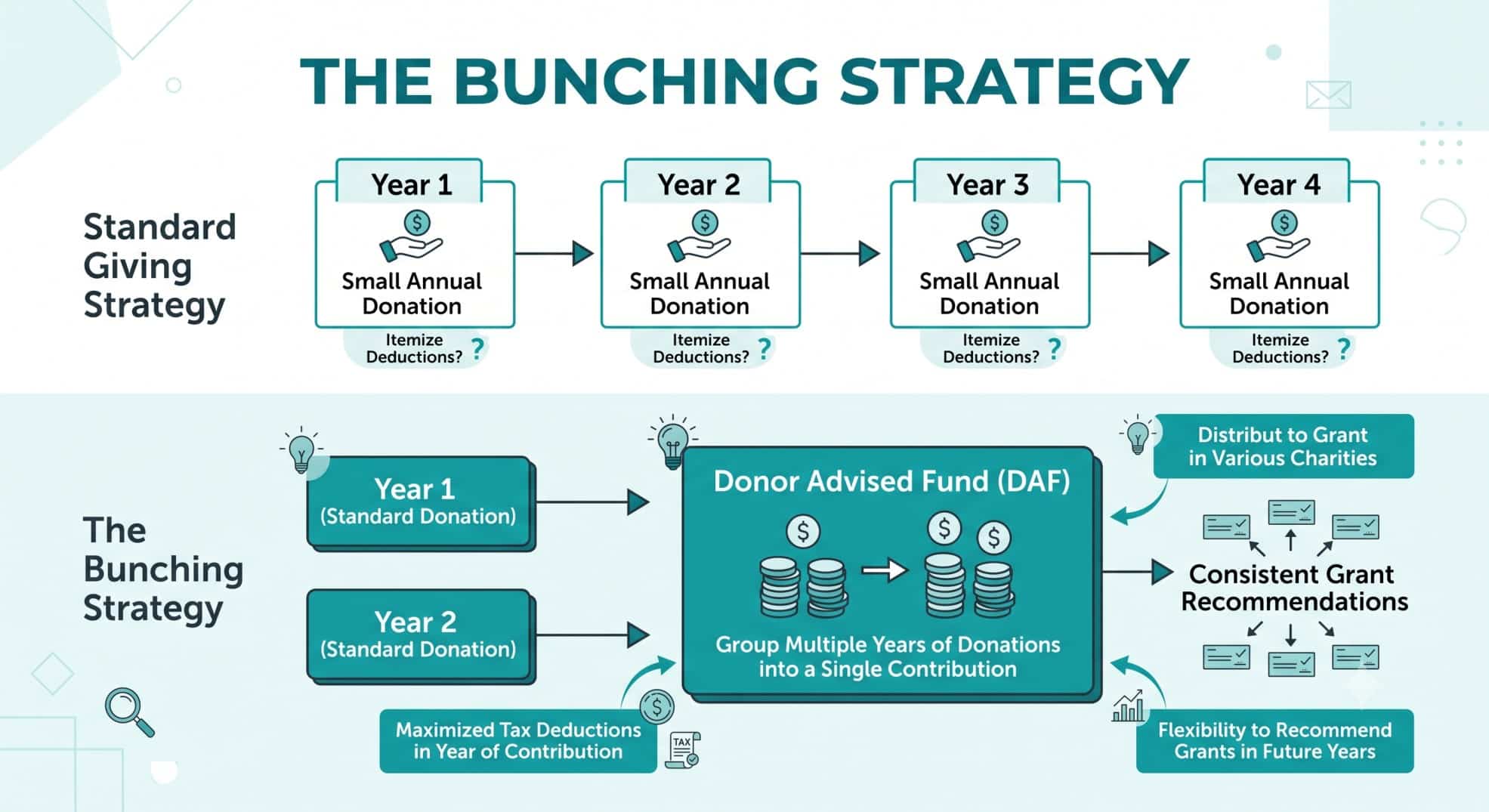
If you are an itemizer, the most effective way to defeat the 0.5% AGI floor is through “bunching.” Instead of making smaller donations every year and losing the floor amount repeatedly, you consolidate several years of giving into a single tax year.
The premier vehicle for executing this is a Donor Advised Fund (DAF). A DAF is a specialized financial account created for the sole purpose of supporting charitable organizations. When you contribute cash or appreciated assets to a DAF, you receive an immediate tax deduction for the full amount in that specific tax year (subject to the floor). You can then invest the funds and grant the money out to your chosen charities slowly over time.
The donor advised fund 2026 strategy relies on spiking your deductions in year one to overwhelm the AGI floor, and then taking the standard deduction in subsequent years.
Scenario 3: Beating the Floor with a DAF
Sarah has an AGI of $200,000. Her 0.5% floor is $1,000. She normally gives $10,000 a year to her university.
The Old Way (Annual Giving): If she gives $10,000 in 2026, she deducts $9,000 (losing the $1,000 floor). If she gives $10,000 in 2027, she deducts $9,000 (losing another $1,000). Over two years, she deducts $18,000 and loses $2,000 to the floor.
The DAF Strategy (Bunching): In 2026, Sarah contributes $20,000 to a DAF. Her floor is still $1,000. She deducts $19,000 on her 2026 tax return. She loses the floor only once.
In 2027, she makes zero new charitable contributions from her personal accounts (she takes the standard deduction). Instead, she advises the DAF to send $10,000 to her university. The charity still gets their annual funding, but Sarah preserved an extra $1,000 in tax deductions by bunching.
This strategy is particularly powerful if you experience a high-income year, such as selling a business or receiving a large bonus. You can fund the DAF heavily in the high-tax year, clear the floor easily, and secure the deduction when your marginal rate is highest.
Learn more about setting up and managing a Donor Advised Fund.
Qualified Charitable Distributions (QCDs) for Seniors
Taxpayers aged 70½ or older have a unique tool that bypasses the charitable deduction 2026 changes entirely: the Qualified Charitable Distribution (QCD).
A QCD allows you to transfer funds directly from your Traditional IRA to a qualified charity. The beauty of a QCD is that the distribution never touches your Form 1040. It is completely excluded from your Adjusted Gross Income.
Because the money is never recognized as income, you do not need to worry about the 0.5% AGI floor charity rule. Furthermore, because it lowers your AGI, it actually makes it easier to clear the AGI floors for other itemized deductions, such as medical expenses.
Scenario 4: The Power of the QCD
David, age 75, has an AGI of $100,000 (which includes his Required Minimum Distributions). He wants to give $5,000 to his church.
If he withdraws the cash and writes a check, his AGI remains $100,000. His 0.5% floor is $500. He can only deduct $4,500, and he must itemize to get it.
Instead, David uses a QCD to send $5,000 directly from his IRA to the church. His AGI drops to $95,000. He pays no taxes on the $5,000 withdrawal. He doesn’t have to worry about the floor, and he can still take his full standard deduction.
QCDs can also satisfy your Required Minimum Distributions (RMDs) for the year, making them the most tax-efficient giving method for seniors.
Explore our complete guide to Required Minimum Distributions and QCD strategies for seniors.
The 37% Bracket Haircut on Itemized Deductions
High-income earners must navigate an additional layer of complexity. The charitable deduction 2026 changes include an interaction with the top marginal tax brackets, often referred to as a deduction haircut.
If your income pushes you into the top 37% tax bracket, the tax savings generated by your itemized deductions are now capped. Historically, deductions offset income at your highest marginal rate. If you were in the 37% bracket, a $10,000 deduction saved you $3,700 in federal taxes.
Under the new limitation rules for high earners, the tax benefit of itemized charitable deductions is capped at 35% for those in the 37% marginal tax bracket (sometimes referred to as the 2/37ths limit). This means that even after you clear the 0.5% AGI floor, the remaining deductible amount yields a slightly smaller tax refund than it would have in previous years.
This haircut makes the donor advised fund 2026 strategy even more critical. If your deductions are being devalued at the top bracket, you must maximize the raw volume of your deductions by bunching them efficiently to offset the lower percentage yield.
Understand how the itemized deduction limits impact high-net-worth tax planning.
Charitable Mileage Rate: The 14-Cent Statutory Limit
When you drive your personal vehicle in service of a qualified 501(c)(3) organization, you can deduct the mileage. However, unlike the business or medical mileage rates, which the IRS adjusts annually based on inflation and gas prices, the charitable mileage rate is fixed by statute.
Internal Revenue Code Section 170(i) permanently sets the charitable mileage rate at 14 cents per mile. It does not matter if gas costs $2 or $5 a gallon; the rate remains 14 cents.
If you are an itemizer, you calculate your total charitable miles driven for the year, multiply by $0.14, and add that figure to your total cash and non-cash contributions. Remember, this total pool of contributions is still subject to the 0.5% AGI floor.
You can also deduct parking fees and tolls associated with your volunteer driving. You cannot deduct general repair or maintenance costs for your vehicle.
Step-by-Step Guide: Maximizing Your Giving in 2026
To ensure you do not leave tax savings on the table, follow this systematic approach to your 2026 philanthropy.
- Project Your 2026 AGI Early: In the first quarter of the year, estimate your total income. Multiply this number by 0.005 to establish your exact charitable floor.
- Assess Your Filing Status: Determine if your total itemized deductions (mortgage interest, state and local taxes, plus charity above the floor) will exceed your standard deduction.
- Choose Your Track:
- If you will take the standard deduction, plan to utilize the $2,000 charity deduction (MFJ) or $1,000 (Single) by making direct cash contributions to public charities (avoiding DAFs for these specific dollars).
- If you will itemize, evaluate if your planned giving easily clears the floor.
- Execute a Bunching Strategy: If your giving is trapped below the floor, halt your monthly donations. Open a Donor Advised Fund and front-load 2 to 3 years’ worth of contributions into the current tax year.
- Leverage QCDs if Eligible: If you are over 70½, stop writing checks from your checking account. Direct your IRA custodian to send funds straight to the charity to bypass the floor entirely.
- Document Everything: The IRS requires a bank record or written communication from the charity for any monetary contribution. For single donations over $250, you must have a contemporaneous written acknowledgment from the organization before you file your return.
Frequently Asked Questions About the $2,000 Charity Deduction and More
What are the main charitable deduction 2026 changes?
The primary changes are the introduction of a 0.5% AGI floor for taxpayers who itemize their deductions, and the creation of a specific $1,000 (Single) or $2,000 (Joint) above-the-line deduction for taxpayers who take the standard deduction.
How does the 0.5% AGI floor charity rule work?
If you itemize, you must calculate 0.5% of your Adjusted Gross Income. You can only deduct the portion of your total charitable contributions that exceeds this dollar amount. The first dollars donated up to the floor provide no tax benefit.
Can I claim a charitable deduction without itemizing 2026?
Yes. If you take the standard deduction, you can claim a specific deduction for cash contributions made to qualified charities. You do not need to fill out Schedule A to claim this benefit.
Who qualifies for the $2,000 charity deduction?
Married couples filing jointly who take the standard deduction can deduct up to $2,000 in cash contributions. Single filers and heads of household are capped at a $1,000 deduction.
Can I use a Donor Advised Fund for the non-itemizer deduction?
No. Contributions to Donor Advised Funds (DAFs) and private foundations are explicitly excluded from the $1,000/$2,000 non-itemizer deduction. You must give directly to a public charity to claim it.
What is the best donor advised fund 2026 strategy?
The best strategy is “bunching.” You contribute multiple years’ worth of donations into a DAF in a single tax year. This allows you to easily exceed the 0.5% AGI floor once, rather than losing the floor amount every single year through smaller annual donations.
Do Qualified Charitable Distributions (QCDs) count toward the 0.5% floor?
No. QCDs are excluded from your Adjusted Gross Income entirely. Because they never enter your AGI, they are not subject to the floor, making them highly efficient for seniors.
What is the mileage rate for charity in 2026?
The charitable mileage rate is 14 cents per mile. This rate is fixed by statute in the Internal Revenue Code and does not adjust annually for inflation or gas prices.
How does the 37% bracket haircut work?
For high-income earners in the top 37% tax bracket, the tax savings generated by itemized charitable deductions are capped at 35%. This means your deduction offsets your income at a slightly lower rate than your actual top marginal bracket.
Disclaimer: This content provides general information for educational purposes only. Tax laws are complex and change often. It is not professional tax, legal, or financial advice. Always consult a qualified tax professional for personalized guidance regarding your specific situation. Ourtaxpartner.com is not responsible for any actions taken based on the information provided herein.
