
⚡ Executive Summary: Premium Tax Credit 2026 Changes
- The enhanced premium tax credit expired on January 1, 2026, triggering an estimated 114% average premium increase for exchange enrollees.
- The strict 400% Federal Poverty Level (FPL) subsidy cliff has returned, meaning households earning even $1 over the limit lose all federal assistance.
- Taxpayers face severe Form 8962 repayment risks if their final 2026 Modified Adjusted Gross Income (MAGI) exceeds the 400% threshold.
- The House passed a three-year extension of the enhanced subsidies, but the bill remains pending in the Senate, requiring taxpayers to plan based on current law.
Table of Contents
- The Expiration of the Enhanced Subsidies
- The Return of the ACA Subsidy Cliff 2026
- Form 8962 Repayment Shock: What Happens If You Go Over?
- Income Estimation Strategies to Avoid the Cliff
- The Self-Employed Health Insurance Deduction Interaction
- Legislative Watch: Will the Senate Extend the Subsidies?
- Step-by-Step Guide: Managing Your 2026 Premium Tax Credit
- Frequently Asked Questions About the ACA Subsidy Cliff 2026
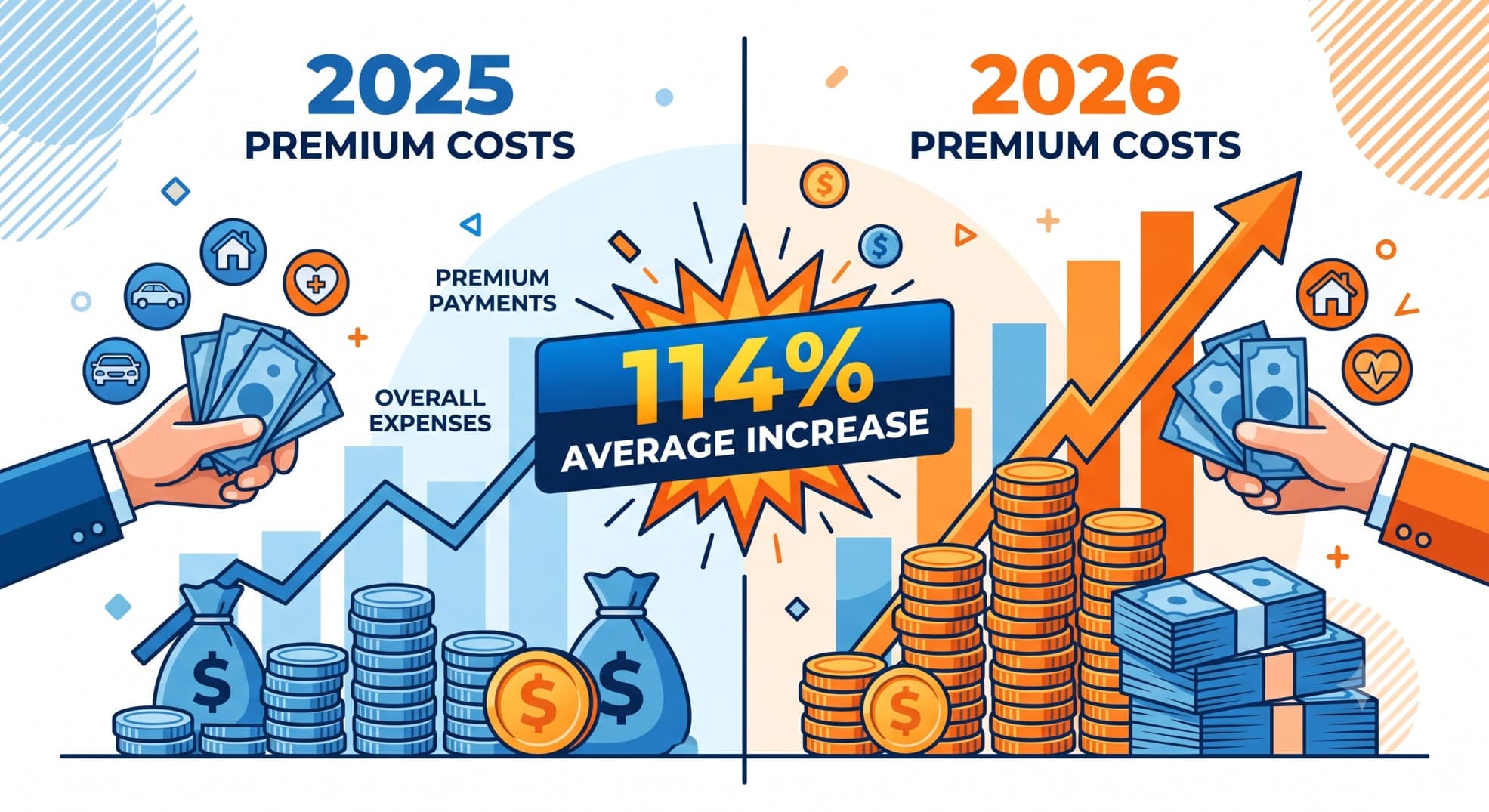
The financial mechanics of the Affordable Care Act shifted dramatically on January 1, 2026. Temporary provisions that capped healthcare premiums at 8.5% of household income are gone. Because the enhanced premium tax credit expired, millions of enrolled taxpayers are facing a harsh reality: steeply rising monthly premiums and the return of a strict income cutoff.
Understanding the premium tax credit 2026 changes requires aggressive tax planning, not just budgeting for higher monthly bills. If your Modified Adjusted Gross Income (MAGI) crosses a specific threshold by even a single dollar, you lose all federal assistance. This triggers a cascading effect on your tax return, often resulting in a five-figure tax liability when you file.
The Expiration of the Enhanced Subsidies
The American Rescue Plan and the Inflation Reduction Act temporarily removed the income cap for ACA subsidies. Those provisions sunset at the end of 2025. For the past few years, anyone buying health insurance on the ACA exchange was guaranteed that their benchmark silver plan premiums would not exceed 8.5% of their household income. High earners still received partial subsidies to offset the cost of older age bands or expensive regional markets.
That safety net no longer exists. We are now back to the original ACA rules established in 2010. The immediate impact is a severe spike in out-of-pocket costs for middle- and upper-middle-class families.
KFF estimates an average premium payment increase of 114% for those enrolled in ACA exchange plans. In real dollars, that translates to an estimated $1,016 a year in additional premium costs for the average enrollee. Older Americans and those living in high-cost areas will see increases far exceeding that average, as their premiums are no longer artificially capped as a percentage of their income.
Read more about adjusting your household budget for rising healthcare costs.
The Return of the ACA Subsidy Cliff 2026
The ACA subsidy cliff 2026 is a strict income limit set at 400% of the Federal Poverty Level (FPL). Earn one dollar over this limit, and your subsidy drops to zero. There is no phase-out, no partial credit, and no grace period.
To calculate your specific health insurance subsidy income limit 2026, you must look at the 2025 HHS Poverty Guidelines. The ACA always uses the prior year’s poverty guidelines to determine eligibility for the current enrollment year. The table below outlines the exact thresholds you must stay under to retain your subsidy.
| Household Size | 2025 Federal Poverty Level (FPL) | 400% Subsidy Cliff for 2026 |
|---|---|---|
| 1 | $15,650 | $62,600 |
| 2 | $21,150 | $84,600 |
| 3 | $26,650 | $106,600 |
| 4 | $32,150 | $128,600 |
Let’s look at the math in action to understand the severity of this cliff.
Scenario 1: The 400% Cliff Impact
David and Susan are a 60-year-old married couple living in a high-cost state. Their benchmark silver plan costs $2,000 per month, or $24,000 annually.
Their projected 2026 MAGI is $85,023, which puts them at 402% of the FPL. They are just over the limit for a family of two.
If the enhanced subsidies were still in place, their premium costs would be capped at 8.5% of their income. They would pay $7,227 for the year, and the government would cover the remaining $16,773.
Because the cliff has returned, they get zero federal help. They must pay the full $24,000 out of pocket. That $24,000 represents 28.2% of their annual income—about a quarter of everything they earn—instead of the 8.5% they paid last year.
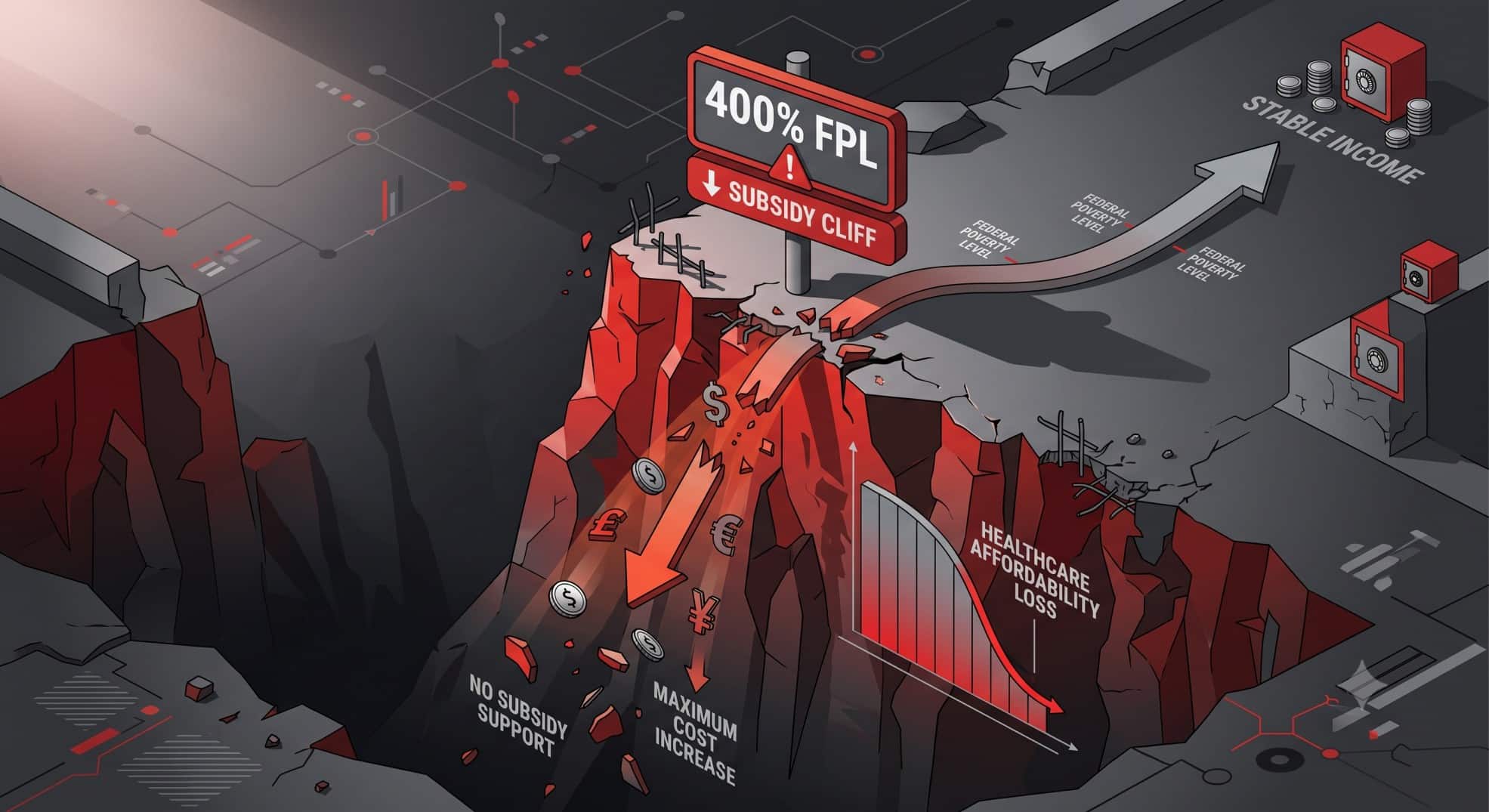
This binary system forces taxpayers to monitor their income with extreme precision. A small, unexpected financial event in December can destroy a year’s worth of healthcare budgeting.
Form 8962 Repayment Shock: What Happens If You Go Over?
If you receive Advance Premium Tax Credits (APTC) during the year based on an income estimate, but your final MAGI exceeds the 400% cliff, you must repay every dollar of that subsidy on your tax return.
When you apply for coverage on Healthcare.gov, you estimate your income for the upcoming year. The exchange pays the subsidy directly to your insurance company every month. When you file your taxes the following spring, you use Form 8962 to reconcile the subsidy you received against the subsidy you actually deserved based on your final MAGI.
If your income falls below 400% of the FPL, the IRS caps the amount of APTC you have to repay if you underestimated your income. But if your final MAGI lands at 401% of the FPL, that repayment cap disappears entirely. This is the Form 8962 repayment 2026 shock.
Scenario 2: The Surprise Capital Gain
Mark and Linda, both 62, estimated their 2026 MAGI at $80,000. This kept them safely below the $84,600 cliff for a family of two. Based on this estimate, the exchange sent $21,200 in APTC to their insurance company throughout the year.
In November, Mark decides to sell a mutual fund to pay for a home repair, triggering a $5,000 long-term capital gain. Their final 2026 MAGI hits $85,000.
They crossed the cliff by $400. When their CPA files their return, the Form 8962 calculation shows they are entirely ineligible for the subsidy. They must write a check to the IRS for the full $21,200.
A $400 mistake cost them over $21,000. This asymmetric risk requires proactive tax planning before December 31.
Learn more about managing capital gains taxes to protect your deductions.
Income Estimation Strategies to Avoid the Cliff
You can control your MAGI through strategic deductions and timing of income. If you are nearing the cliff, you must pull levers to reduce your taxable income before the year ends.
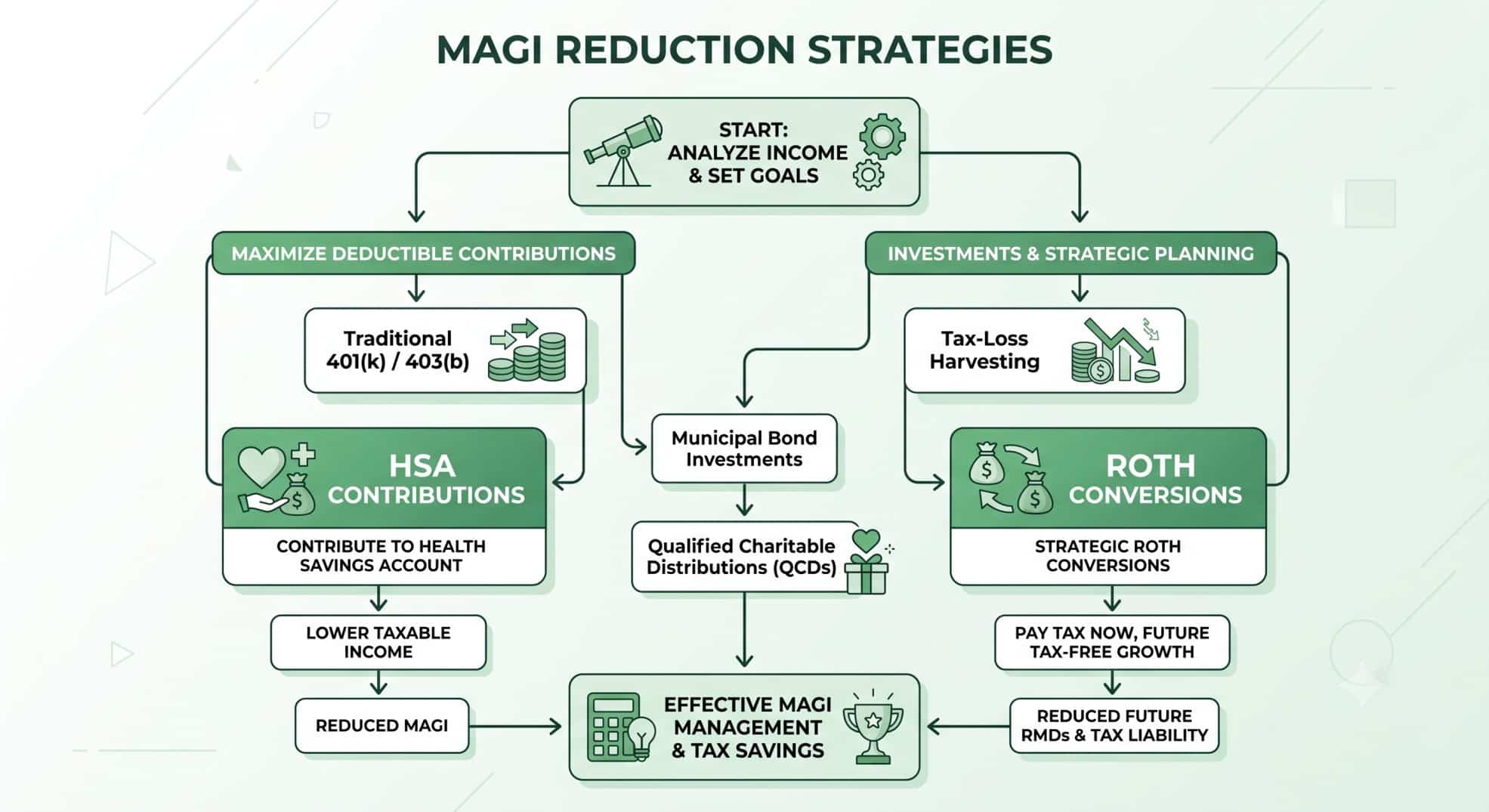
The most effective way to manage the premium tax credit 2026 changes is to understand exactly what goes into your MAGI. For ACA purposes, MAGI is your Adjusted Gross Income (AGI) plus non-taxable Social Security benefits, tax-exempt interest, and excluded foreign income. If you project your income will land dangerously close to the health insurance subsidy income limit 2026, execute these strategies:
- Max Out Pre-Tax Accounts: Contributions to a Traditional 401(k), 403(b), or Traditional IRA directly reduce your AGI. If you are $3,000 over the cliff in December, contributing $3,500 to an IRA can pull you back to safety and save your entire subsidy.
- Fund a Health Savings Account (HSA): If you have a High Deductible Health Plan (HDHP), HSA contributions are an above-the-line deduction. This lowers your MAGI dollar-for-dollar.
- Delay Capital Gains: Do not sell appreciated stock or property if the gain will push you over the cliff. Wait until January 2027 to execute the trade.
- Avoid Roth Conversions: Converting Traditional IRA funds to a Roth IRA generates taxable income. If you are anywhere near the ACA subsidy cliff 2026, halt all Roth conversions immediately. The tax cost of the conversion plus the lost ACA subsidy creates an effective marginal tax rate that can exceed 100%.
The Self-Employed Health Insurance Deduction Interaction
Self-employed individuals can deduct their health insurance premiums to lower their MAGI, but this creates a complex circular calculation when trying to qualify for the ACA subsidy.
The self-employed health insurance deduction is an above-the-line deduction. It lowers your MAGI, which helps you stay under the cliff. But the deduction is limited to the out-of-pocket premiums you actually pay. If you lose your subsidy, your out-of-pocket premiums increase. This larger expense increases your self-employed deduction, which lowers your MAGI. That lower MAGI might suddenly qualify you for the subsidy again. But if you get the subsidy, your out-of-pocket premiums drop, shrinking your deduction, raising your MAGI, and pushing you back over the cliff.
Scenario 3: The Circular Math
Sarah is a 50-year-old freelance consultant. Her net Schedule C income is $70,000. The 400% FPL limit for a single person is $62,600. Her annual premiums are $10,000.
If she takes the full $10,000 deduction, her MAGI drops to $60,000. She is under the cliff and qualifies for a $4,000 subsidy.
But if she gets a $4,000 subsidy, she only paid $6,000 out of pocket. She can only deduct $6,000. Her MAGI becomes $64,000 ($70,000 – $6,000). Now she is over the cliff and loses the subsidy.
To break this loop, the IRS provides alternative calculation methods in Publication 974. Tax software handles this iterative math, but you must be aware of the interaction when projecting your estimated quarterly taxes.
Explore more tax deductions for self-employed professionals.
Legislative Watch: Will the Senate Extend the Subsidies?
The House of Representatives passed a three-year extension of the enhanced subsidies, but the bill is currently stalled in the Senate.
The expiration of these benefits is a highly politicized issue. Lawmakers are aware of the premium shock hitting their constituents. The House passed a measure to retroactively extend the removal of the 400% cliff for another three years. However, the issue is currently in the Senate’s hands. As of this writing, no final vote has occurred.
You cannot plan your finances based on pending legislation. You must operate under current law. Because the enhanced premium tax credit expired, you must assume the cliff is real and plan your MAGI accordingly. If the Senate passes the extension retroactively in 2027, you will simply receive a larger refund or a lower tax bill when you file. If you already filed and paid a repayment penalty, you would need to file an amended return (Form 1040-X) to reclaim your money. But if they fail to act, and you ignored the cliff, you will face the full financial penalty.
Step-by-Step Guide: Managing Your 2026 Premium Tax Credit
Protecting yourself from the premium tax credit 2026 changes requires proactive quarterly monitoring and precise year-end execution. Follow these steps to secure your subsidy and avoid a tax-time disaster:
- Identify Your Target FPL: Look up the 2025 HHS Poverty Guidelines for your household size. Multiply that number by four to find your exact health insurance subsidy income limit 2026.
- Project Your MAGI: Calculate your expected W-2 wages, net business income, interest, dividends, and capital gains. Subtract above-the-line deductions like student loan interest and retirement contributions.
- Update Healthcare.gov: If your projected MAGI is near the cliff, log into your exchange account and update your income. Consider taking less than 100% of your APTC in advance. Taking 80% leaves a buffer that can absorb minor income fluctuations.
- Run a Q3 Audit: In October, review your year-to-date income. If you are trending higher than expected, you have two months to react.
- Consult a Tax Professional in November: Do not wait until tax season to discuss your ACA subsidies. By April, the tax year is closed, and your options to reduce MAGI are severely limited. A November tax projection allows you to make strategic moves while the calendar year is still open.
- Execute December Reductions: If you are within $5,000 of the cliff in December, aggressively fund pre-tax accounts. A last-minute contribution to a Traditional IRA or HSA is the most reliable way to dodge a Form 8962 repayment 2026.
Scenario 4: The Mid-Year Marriage Penalty
John and Emily are both single and earn $45,000 each. The 400% FPL limit for a single individual is $62,600. Because they are both well below the limit, they each receive substantial APTC to lower their monthly premiums.
In August 2026, they get married. For tax purposes, your marital status on December 31 dictates your filing status for the entire year. They must now file as Married Filing Jointly.
Their combined MAGI is $90,000. The 400% FPL limit for a family of two is $84,600. By getting married, their combined income pushed them over the cliff.
Not only do they lose the subsidy for the remainder of the year, but they must also repay the APTC they received during the months they were single. The IRS provides an alternative calculation for the year of marriage to mitigate some of this damage, but the financial shock remains severe.
Frequently Asked Questions About the ACA Subsidy Cliff 2026
What are the primary premium tax credit 2026 changes?
The most significant change is the expiration of the enhanced subsidies that capped premiums at 8.5% of income. We have returned to the original ACA rules, which include a strict income limit at 400% of the Federal Poverty Level.
How does the ACA subsidy cliff 2026 work?
The cliff is a hard income cutoff. If your Modified Adjusted Gross Income (MAGI) is at or below 400% of the FPL, you qualify for a subsidy. If your MAGI is even one dollar over that limit, you lose 100% of the federal assistance and must pay full price for your health insurance.
What happens if my income is $1 over the health insurance subsidy income limit 2026?
You lose all eligibility for the premium tax credit. If you received advance payments during the year, you must repay the entire amount on your tax return, regardless of how small the overage was.
How can I avoid a severe Form 8962 repayment 2026?
You must keep your final MAGI below the 400% FPL threshold. You can do this by contributing to pre-tax retirement accounts (like a Traditional IRA or 401k), funding a Health Savings Account (HSA), or delaying the sale of assets that would trigger capital gains.
Did the enhanced premium tax credit expired permanently?
Under current law, yes. The provisions from the American Rescue Plan and Inflation Reduction Act sunset on January 1, 2026. While the House has passed a three-year extension, it has not yet passed the Senate or been signed into law.
Does a Roth conversion affect my ACA subsidy?
Yes, significantly. A Roth conversion takes pre-tax money and converts it to after-tax money, which adds directly to your MAGI for the year. If that additional income pushes you over the 400% cliff, you will lose your entire health insurance subsidy.
How does the self-employed health insurance deduction work with the subsidy cliff?
It creates a circular calculation. The deduction lowers your MAGI, helping you qualify for the subsidy. But the subsidy lowers your out-of-pocket premium, which reduces your deduction, potentially raising your MAGI back over the cliff. You must use the alternative calculation methods in IRS Publication 974 to resolve this.
Will Congress fix the ACA subsidy cliff for 2026?
It is possible but not guaranteed. The House passed a bill to extend the enhanced subsidies, but the Senate has not voted on it. Taxpayers must plan their finances based on the current law, which includes the strict 400% cliff.
What is the 2025 FPL for a family of four?
The 2025 Federal Poverty Level for a family of four in the contiguous United States is $32,150. This means the 400% cliff for a family of four in 2026 is $128,600.
Disclaimer: This content provides general information for educational purposes only. Tax laws are complex and change often. It is not professional tax, legal, or financial advice. Always consult a qualified tax professional for personalized guidance regarding your specific situation. Ourtaxpartner.com is not responsible for any actions taken based on the information provided herein.
