
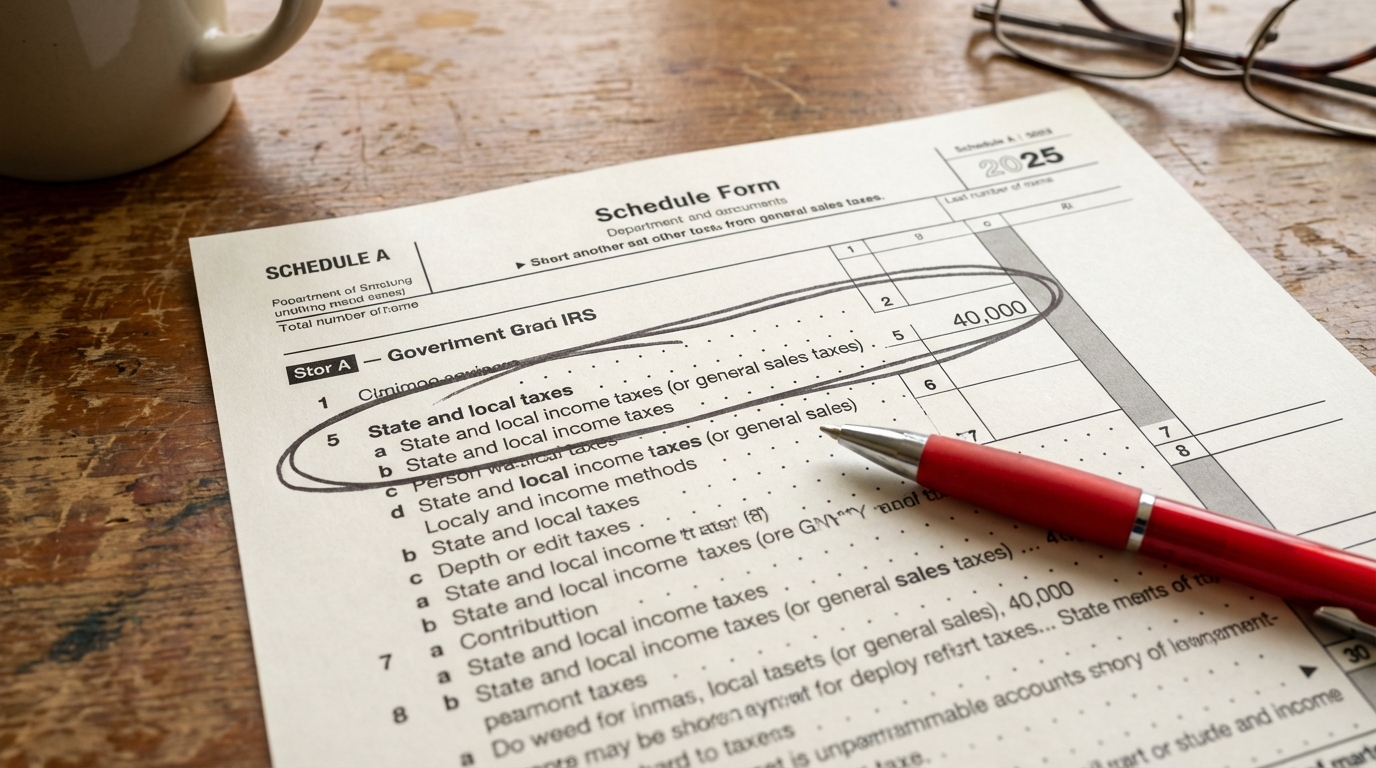
For Tax Year 2025, the rules for deducting sales tax have undergone their most significant overhaul in nearly a decade. With the enactment of the One Big Beautiful Bill Act (OBBBA), the previous limitations that frustrated many taxpayers have been lifted, opening new tax-saving opportunities for millions of Americans.
If you made a major purchase this year—such as a vehicle, boat, or home renovation—or if you live in a state with no income tax, understanding these changes is critical. This guide details exactly how to claim the sales tax deduction, the new limits for 2025, and how to determine if itemizing is the right strategy for you.
Key Takeaways for Tax Year 2025
- SALT Cap Quadrupled: Under Public Law 119-21 (OBBBA), the State and Local Tax (SALT) deduction limit has increased from $10,000 to $40,000 ($20,000 for Married Filing Separately).
- The “Either/Or” Rule Remains: You must choose between deducting state and local income tax OR state and local sales tax. You cannot claim both.
- Major Purchase Boost: You can use the IRS optional tax tables for your daily spending and add the actual sales tax paid on specific major items like cars, boats, and aircraft.
- Itemizing is Required: To claim this deduction, your total itemized deductions must exceed the new 2025 Standard Deduction ($15,750 for Singles, $31,500 for Married Filing Jointly).
The New 2025 Landscape: OBBBA and the $40,000 Cap
For years, the Tax Cuts and Jobs Act (TCJA) limited the amount of state and local taxes (SALT) you could deduct to a flat $10,000. This “SALT cap” disproportionately affected taxpayers in high-tax states or those making significant purchases.
Effective for Tax Year 2025 (returns filed in early 2026), the One Big Beautiful Bill Act has raised this cap to $40,000 per return ($20,000 if married filing separately). This change significantly alters the math for itemizing. If you purchased a vehicle or renovated your home in 2025, you are far less likely to hit the ceiling than in previous years, allowing you to write off a much larger portion of the sales tax you paid.
| Filing Status | 2024 SALT Cap (Old) | 2025 SALT Cap (New) |
|---|---|---|
| Single / Head of Household | $10,000 | $40,000 |
| Married Filing Jointly | $10,000 | $40,000 |
| Married Filing Separately | $5,000 | $20,000 |
Income Tax vs. Sales Tax: Making the Choice
The IRS does not allow you to “double dip.” You must make a strategic choice on Schedule A (Form 1040):
- Option A: Deduct state and local income taxes paid (withheld from your paycheck or paid as estimated taxes).
- Option B: Deduct state and local general sales taxes paid.
Who Should Choose the Sales Tax Deduction?
The sales tax deduction is generally the clear winner for two types of taxpayers:
- Residents of No-Income-Tax States: If you live in Alaska, Florida, Nevada, South Dakota, Tennessee, Texas, Washington, or Wyoming, you pay little to no state income tax. Therefore, deducting sales tax is your only option to maximize the SALT deduction.
- Big Spenders in 2025: Even if you pay state income tax, a year with extraordinary spending (e.g., buying a $60,000 truck and a $20,000 wedding ring) might result in sales tax totals that exceed your income tax withholding.
How to Calculate Your Sales Tax Deduction
You do not need to save every receipt from every coffee or grocery run to claim this deduction. The IRS offers two methods for calculation.
Method 1: The Actual Expense Method
You can deduct the exact amount of sales tax you paid during the year. To use this method, you must have receipts or reliable records (like credit card statements showing tax separated) for every single taxable purchase made in 2025. This is administratively difficult for most taxpayers and is rarely recommended unless your spending habits are highly irregular.
Method 2: The Table + Major Purchase Method (Recommended)
Most taxpayers use the IRS Sales Tax Deduction Calculator or the Optional State Sales Tax Tables found in the Schedule A instructions. This method allows you to combine two figures:
Total Deduction = (IRS Table Amount based on Income/Family Size) + (Actual Tax on Major Purchases)
What Qualifies as a “Major Purchase”?
You can add the actual sales tax paid on the following specific items to your table amount. Note that furniture and appliances generally do not count unless they are part of a substantial home renovation.
- Motor Vehicles: Cars, SUVs, trucks, vans, and motorcycles.
- Recreational Vehicles: Motor homes, RVs, and off-road vehicles.
- Watercraft & Aircraft: Boats and airplanes.
- Homes: Mobile homes, prefabricated homes, or materials for a substantial addition/renovation to a home.
- Leased Vehicles: Sales tax paid on the lease payments.
Real-World Scenarios: The 2025 Rules in Action
To understand how the new $40,000 cap and higher standard deduction ($31,500 for married couples) impact your return, consider these examples.
Scenario A: The Texas Resident (No Income Tax)
Profile: Mark and Sarah are married, living in Texas (no state income tax). They earn $180,000 combined.
2025 Activity: They purchased a new SUV for $55,000 (paying $3,437 in sales tax) and renovated their kitchen for $40,000 (paying $3,300 in sales tax on materials).
Calculation:
- IRS Table Amount (based on income/family size): ~$1,400
- Major Purchase Add-on (SUV): +$3,437
- Major Purchase Add-on (Renovation): +$3,300
- Property Taxes Paid: $9,000
Result: Under the old laws, they would have been capped at $10,000. Under OBBBA, they deduct the full $17,137. However, they must compare this to their Standard Deduction of $31,500. Unless they have significant mortgage interest or charitable donations to bridge the gap, they might still take the Standard Deduction.
Scenario B: The “Major Purchase” Swing
Profile: David is single, living in California (high income tax). He earns $150,000.
2025 Activity: He buys a luxury electric vehicle for $90,000, paying roughly $9,000 in sales tax.
Comparison:
- Income Tax Paid: $11,000 (via withholding).
- Sales Tax Potential: $1,100 (Table amount) + $9,000 (EV Tax) = $10,100.
Common Pitfalls & Mistakes
⚠️ Warning: Do Not “Double Dip”
The most common audit trigger regarding sales tax is attempting to deduct both income tax and sales tax. The IRS automated matching system will flag this error immediately. You must check Box 5a (Income Tax) OR Box 5b (Sales Tax) on Schedule A—never both.
1. Forgetting Local Taxes: The IRS tables often only list the state sales tax portion. You must manually check the box or add the calculation for your local (city/county) sales tax rate, which can significantly increase your deduction.
2. Misidentifying “Major Purchases”: Taxpayers often try to add sales tax from expensive electronics, jewelry, or furniture to the table amount. Unless you use the “Actual Expenses” method (saving all receipts), you cannot add these items. Only the specific categories listed by the IRS (vehicles, boats, aircraft, homes) can be added to the table rate.
3. Ignoring the Standard Deduction Threshold: Before spending hours calculating sales tax, ensure your total itemized deductions can beat the 2025 Standard Deduction.
| Filing Status | 2025 Standard Deduction | When to Itemize? |
|---|---|---|
| Single | $15,750 | If SALT + Mortgage Interest + Charity > $15,750 |
| Married Filing Jointly | $31,500 | If SALT + Mortgage Interest + Charity > $31,500 |
| Head of Household | $23,625 | If SALT + Mortgage Interest + Charity > $23,625 |
Frequently Asked Questions (FAQ)
Can I deduct sales tax on a car purchase if I don’t itemize?
No. The sales tax deduction is an itemized deduction claimed on Schedule A. If you take the Standard Deduction ($15,750 for singles in 2025), you cannot claim any additional deduction for sales tax, regardless of how large the purchase was.
Does the $40,000 SALT cap apply to single filers?
Yes. Under the One Big Beautiful Bill Act, the $40,000 limit applies to Single, Head of Household, and Married Filing Jointly filers. The only lower limit is for Married Filing Separately, which is capped at $20,000.
Can I deduct VAT or foreign sales tax paid on vacation?
No. The deduction applies strictly to state and local general sales taxes paid within the United States. Value Added Tax (VAT) paid in foreign countries is not deductible as sales tax.
Where can I find the IRS Sales Tax Deduction Calculator?
The IRS provides an official “Sales Tax Deduction Calculator” on their website. For the 2025 tax year, you will need your Adjusted Gross Income (AGI) and the total sales tax paid on specified major purchases to get an accurate figure.
Conclusion
The 2025 tax year brings welcome relief to taxpayers who have felt constrained by the SALT cap in recent years. With the limit raised to $40,000 under the OBBBA, the sales tax deduction is more valuable than ever, particularly for those in states without income tax or those who have purchased new vehicles or boats this year.
However, the higher Standard Deduction means the bar to itemize is also higher. Review your total expenses carefully—combining your mortgage interest, charitable contributions, and newly expanded SALT deduction—to ensure you don’t leave money on the table when you file in 2026.
Disclaimer: The information provided in this article is for educational and informational purposes only and does not constitute professional financial or tax advice. Tax laws are subject to change. We recommend consulting with a qualified tax professional regarding your specific situation.
