
Date: 2/8/2026
The “Front-Loaded” Trap: Why Federal Logic Will Cost You 8%
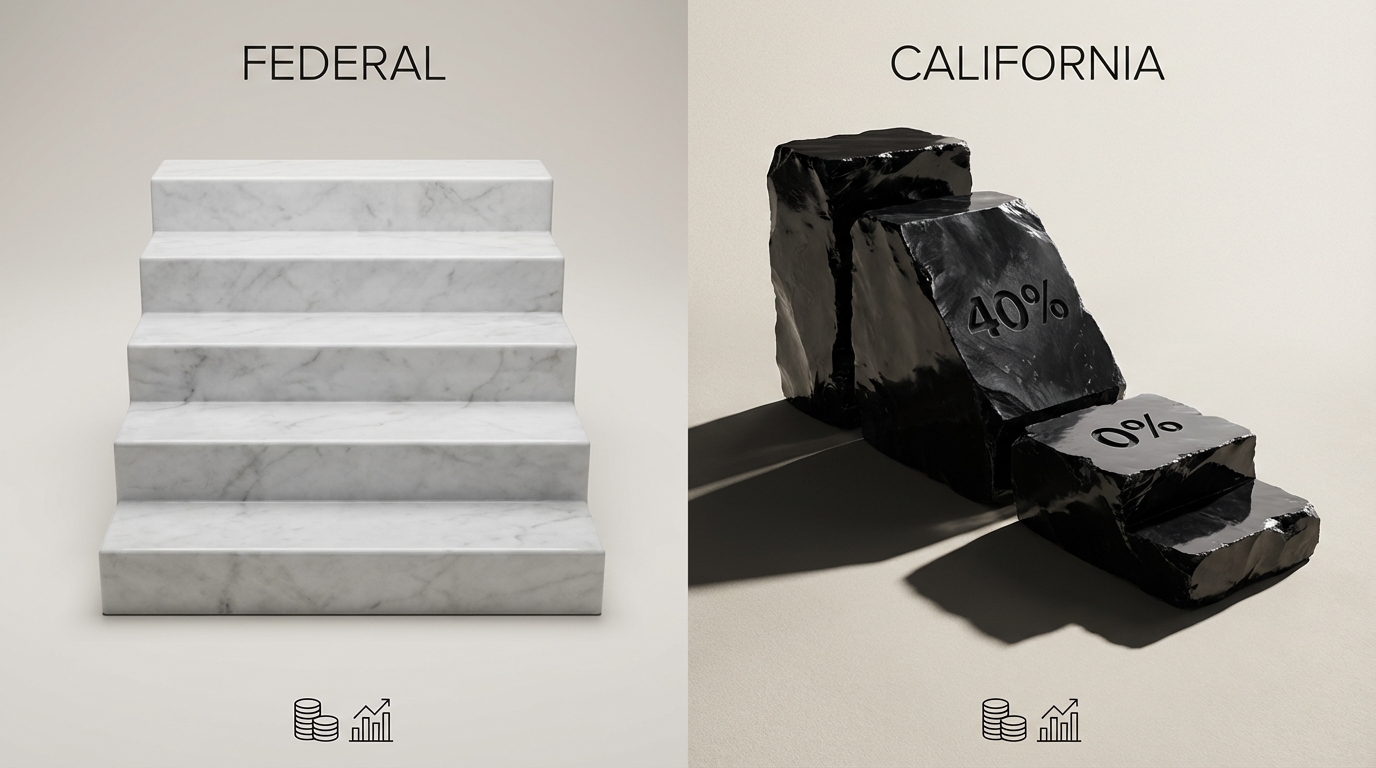
The “trap” exists because of a fundamental mismatch between the IRS and the California Franchise Tax Board (FTB). If you assume California follows the standard federal 25% quarterly split, you are walking into an expensive mistake. By June 15, federal logic says you should have paid 50% of your tax. However, California law demands 70% of your total annual liability by that same date.
This 20% gap isn’t just a rounding error; it triggers an immediate underpayment penalty. The FTB interest rate for early 2025 is a staggering 8%, compounded daily. Even though the third quarter requires a 0% payment, the damage is often already done by mid-summer. You might think you are “catching up” in September, but the penalty clock started ticking the moment you missed the 40% requirement in June.
The Comparison: IRS vs. California Percentages
| Installment | Due Date | Federal (IRS) | California (FTB) |
|---|---|---|---|
| 1st Payment | April 15, 2025 | 25% | 30% |
| 2nd Payment | June 16, 2025* | 25% | 40% |
| 3rd Payment | Sept 15, 2025 | 25% | 0% |
| 4th Payment | Jan 15, 2026 | 25% | 30% |
*June 15, 2025, falls on a Sunday; the deadline moves to the next business day.
High Earners and the Safe Harbor Cliff
For high earners, the rules get even stricter. If your Adjusted Gross Income (AGI) exceeds $150,000, you must pay 110% of your prior year’s tax to meet the “safe harbor” and avoid penalties. If your income hits $1 million or more, the safety net disappears entirely. You are required to pay 90% of your current year’s actual tax liability, making precise calculations essential for compliance.
Managing these lopsided percentages often requires **California 540-ES underpayment penalty mitigation services** to ensure you aren’t overpaying or triggering interest. Business owners should also be aware of the mandatory e-pay rules. If any single payment exceeds $20,000, or your total liability is over $80,000, you must pay electronically. Failure to do so results in a 1% noncompliance penalty on top of other costs.
Strategic Compliance and Professional Oversight
Navigating these aggressive schedules is why many taxpayers seek high net worth California state tax planning. Working with a certified public accountant for California quarterly payments can help you avoid the “September Illusion” where you feel ahead but are actually accruing debt. Whether you need California state tax compliance services for business owners or simply expert assistance for California 540-ES filing, getting the math right in June is the only way to keep that 8% in your own pocket. Professional help with California estimated tax vouchers ensures that your payments are credited correctly and on time to avoid unnecessary FTB scrutiny.
2025 Deadlines & The LA County “Palisades Fire” Exception
California handles estimated taxes differently than the federal government. While the IRS prefers four equal installments, the California Franchise Tax Board (FTB) uses a front-loaded “30-40-0-30” schedule. This means you pay 30% in April and 40% in June, leaving you with nothing due in September if you have met those requirements. If you find these percentages confusing, California 540-ES underpayment penalty mitigation services can help you navigate the math to avoid surprise charges at year-end.
The Palisades Fire Extension for Los Angeles County
For taxpayers in Los Angeles County, the “Palisades Fire” and severe winds that began on January 7, 2025, triggered significant disaster relief. The IRS and FTB granted an automatic extension for any tax filing or payment deadline falling between January 7, 2025, and October 15, 2025. This relief is vital for high net worth California state tax planning, as it allows residents to keep capital liquid for several additional months. However, note that the final Q4 payment for the 2025 tax year remains due on January 15, 2026, as it falls outside the disaster window.
The table below outlines how the standard deadlines shifted for affected LA County residents. If you are unsure which dates apply to your specific situation, seeking professional help with California estimated tax vouchers is a smart move to ensure compliance.
| Installment Period | Original Due Date | LA County Disaster Deadline | Percentage Due |
|---|---|---|---|
| 2024 Q4 (Final) | Jan 15, 2025 | Oct 15, 2025 | Varies (2024 Rules) |
| 2025 Q1 | April 15, 2025 | Oct 15, 2025 | 30% |
| 2025 Q2 | June 16, 2025 | Oct 15, 2025 | 40% |
| 2025 Q3 | Sept 15, 2025 | Oct 15, 2025 | 0% |
| 2025 Q4 | Jan 15, 2026 | Jan 15, 2026 | 30% |
Mandatory E-Pay and Compliance Rules
California enforces a strict mandatory e-pay rule that many taxpayers overlook. You must make all future payments electronically if you make an estimate or extension payment exceeding $20,000 or file a return with a total tax liability over $80,000. If you meet these thresholds but send a paper check, the FTB will assess a 1% noncompliance penalty. Working with a certified public accountant for California quarterly payments ensures your electronic transfers are set up correctly to avoid these unnecessary costs.
To qualify for the “Safe Harbor” and avoid underpayment penalties, you generally must pay the lesser of 90% of your current year tax or 100% of your prior year tax. For those with a 2024 adjusted gross income over $150,000, the prior year safe harbor requirement increases to 110%. Utilizing California state tax compliance services for business owners can help you track these thresholds throughout the year. If you are filing a paper return under the disaster rules, remember to write “LA County Fires” at the top in blue or black ink. For complex filings, expert assistance for California 540-ES filing is recommended to ensure all disaster-related exceptions are properly claimed.
The “Mandatory e-Pay” Trigger: Don’t Mail That Check
In California, writing a physical check to the Franchise Tax Board (FTB) might seem like a safe, traditional way to handle your obligations. However, doing so could trigger a permanent electronic payment mandate that lasts a lifetime. If you cross specific financial thresholds, the state requires you to ditch paper vouchers forever. Failing to follow these rules results in a 1% non-compliance penalty on every payment you make by mail thereafter. For many taxpayers, utilizing California 540-ES underpayment penalty mitigation services is the most effective way to navigate these rigid requirements without losing money to avoidable fees.
The Two Triggers for Mandatory E-Pay
The FTB monitors two specific thresholds that force you into the “Mandatory e-Pay” program. Once you meet either of these marks, you are legally required to submit all future payments—including extensions and estimated taxes—electronically, regardless of the amount or the tax year. This rule applies to the individual, not just the specific tax year in question.
| Trigger Type | Threshold Amount | The Consequence |
|---|---|---|
| Single Payment | Over $20,000 | All future payments must be electronic. |
| Total Tax Liability | Over $80,000 | All future payments must be electronic. |
The “First One is Free” rule is a common point of confusion for those involved in high net worth California state tax planning. The specific payment that actually pushes you over the $20,000 or $80,000 threshold does not have to be electronic. However, every single payment made after that transaction must be digital. High-earners often trigger this mandate by “stacking” payments; for instance, if you send one check for $21,000 to cover two quarters at once, you have permanently triggered the mandate for the rest of your life in California.
The Cost of Non-Compliance
If you are under the mandate and send a paper check anyway, the FTB will assess a penalty of 1% of the amount paid. On a $50,000 tax payment, that is a $500 mistake just for using a stamp. To ensure you stay on the right side of the law, seeking expert assistance for California 540-ES filing can prevent these costly clerical errors. While fiduciaries, estates, and trusts are currently exempt from this rule, most business owners and high-income individuals are strictly bound by it.
Approved Electronic Payment Methods
To avoid the 1% penalty, you must use one of the FTB’s approved digital channels. Working with a certified public accountant for California quarterly payments can help you set up these systems correctly the first time. The primary methods include:
- Web Pay: A free service that allows direct transfers from your bank account.
- Electronic Funds Withdrawal (EFW): This is typically scheduled through your tax software during filing.
- Credit Card: While convenient, these are subject to a service fee, usually between 2.3% and 2.5%.
Managing these thresholds requires proactive California state tax compliance services for business owners. If you are unsure if you have already triggered the mandate, or if you need professional help with California estimated tax vouchers, consult with a specialist before your next deadline. Staying digital isn’t just a convenience—it’s a requirement to protect your bottom line.
High-Net-Worth Alerts: PTE Credits & The Behavioral Health Tax
Starting January 1, 2025, California is rebranding its 1% surcharge on high earners. What was once known as the Mental Health Services Act is now officially the Behavioral Health Services Act (BHSA). If your taxable income exceeds $1 million, you are subject to this 1% tax. While the name has changed, the calculation remains the same: you take your taxable income from Form 540, subtract $1 million, and multiply the remaining subtotal by 1%.
The PTE Credit Limitation Trap
A common mistake for business owners is assuming their Pass-Through Entity (PTE) credits will cover this specific bill. It will not. Under California law (RTC Section 17043(c)(1)), the PTE elective tax credit cannot be used to reduce the 1% Behavioral Health Services Tax. This means that even if you have millions in credit carryovers, you still owe the 1% surcharge in cash. Utilizing **California 540-ES underpayment penalty mitigation services** can help you avoid expensive surprises when you file your return.
For those managing complex portfolios, high net worth California state tax planning is vital to navigate these nuances. You will likely need professional help with California estimated tax vouchers to ensure the 1% tax is paid separately from your other liabilities. Missing these specific payments can lead to penalties, even if your total PTE credits technically exceed your total state tax liability. The state treats the BHSA tax as a distinct obligation that requires its own funding through quarterly installments.
SB 132: PTE Extensions and New Penalties
The rules for the PTE elective tax are also shifting. Senate Bill 132 recently extended the 9.3% elective tax through the 2030 tax year, providing much-needed certainty for business owners. However, starting in 2026, the state is introducing a new “relief” system for late payments that comes with a high price tag. If you miss the June 15 prepayment, you can still make the election, but you will face a 12.5% penalty on the underpaid amount.
For example, if an entity underpays the June 15, 2026, installment by $20,000, the owners will see their personal PTE credits reduced by $2,500. This is a direct hit to your bottom line. Working with a certified public accountant for California quarterly payments ensures your entity meets the “greater of $1,000 or 50% of the prior year tax” threshold to avoid these credit reductions.
Credit Ordering and TMT Rules
When it comes to claiming credits, the order in which you apply them matters for your long-term savings. You must claim the Other State Tax Credit (OSTC) before your PTE credits. Since the OSTC does not carry over to future years, using it first protects your tax benefits from expiring. PTE credits, by contrast, have a five-year carryover window. Additionally, the PTE credit is a powerful tool because it can reduce your regular tax below the Tentative Minimum Tax (TMT), which is a major benefit for those who frequently trigger the Alternative Minimum Tax.
2026 Billionaire Tax Watch
Finally, taxpayers should monitor the proposed “2026 Billionaire Tax Act.” This ballot initiative, if passed in November 2026, would impose a one-time 5% emergency tax on the net worth of residents exceeding $1 billion. While it is not yet law, California state tax compliance services for business owners can help you prepare for potential wealth-based levies. For now, focus on the 2025 deadlines to stay compliant. Expert assistance for California 540-ES filing can ensure your payment schedule follows the state’s unique 30/40/0/30 split.
2025 Estimated Tax Deadlines (Form 540-ES)
| Installment | Due Date | Required Amount |
|---|---|---|
| 1st Payment | April 15, 2025 | 30% of annual payment |
| 2nd Payment | June 16, 2025 | 40% of annual payment |
| 3rd Payment | Sept 15, 2025 | 0% (No payment required) |
| 4th Payment | Jan 15, 2026 | 30% of annual payment |
FAQ: Penalties, Dormant LLCs, and Safe Harbors
Navigating California’s tax system requires more than just knowing what you owe; it requires knowing when to pay to avoid the Franchise Tax Board (FTB) taking an extra cut. To protect your wallet from the Form 5805 underpayment penalty, you should look into California 540-ES underpayment penalty mitigation services. These services help you meet “Safe Harbor” targets, which are specific thresholds that legally exempt you from penalties even if you end up owing more on tax day.
Safe Harbor Thresholds for 2025
California’s safe harbor rules differ depending on your income level. If your Adjusted Gross Income (AGI) is $1 million or more, the rules become significantly stricter, as you lose the ability to base your payments on the prior year’s tax liability.
| Taxpayer Category | Requirement to Avoid Penalty |
|---|---|
| Standard (AGI under $150,000) | Pay 90% of 2025 tax or 100% of 2024 tax. |
| High-Income (AGI over $150,000) | Pay 90% of 2025 tax or 110% of 2024 tax. |
| $1 Million+ Earners | Must pay 90% of 2025 tax (Prior year rule is not available). |
Understanding Penalties and Interest Rates
If you miss these marks, the costs add up quickly. For the period between July 1, 2025, and June 30, 2026, the FTB has set the underpayment interest rate at 7%. This is on top of the late payment penalty, which starts at 5% of the unpaid balance and grows by 0.5% every month. For those with complex portfolios, high net worth California state tax planning is essential to ensure these percentages do not erode your investment returns.
If you have a clean record for the last three years, you might qualify for a one-time penalty abatement. This allows you to wipe away a failure-to-pay penalty once. However, it is much safer to use professional help with California estimated tax vouchers to ensure your math is correct from the start. Remember, if you are required to pay electronically and choose to send a check, the FTB will levy a 1% noncompliance penalty.
The $800 Minimum Tax for LLCs
Many business owners mistakenly believe that if their LLC isn’t making money, they don’t owe the state anything. In California, the $800 annual minimum franchise tax is a “pay-to-play” fee. Even if your LLC is dormant or losing money, you must pay this fee every year until you formally cancel the entity with the Secretary of State. The temporary first-year waiver has expired, meaning LLCs formed in 2025 and 2026 owe the $800 tax for their first year.
Utilizing California state tax compliance services for business owners can help you track these deadlines and filing requirements. If your LLC was active for 15 days or less during the year and conducted no business, you might escape the tax, but this is a narrow window that requires precise timing and expert assistance for California 540-ES filing.
The California 30-40-0-30 Payment Schedule
California does not follow the federal 25% quarterly split. Instead, the state front-loads payments to collect 70% of the tax by June. Working with a certified public accountant for California quarterly payments ensures you follow this unique schedule:
- 1st Installment (April 15): 30% of required annual payment
- 2nd Installment (June 15): 40% of required annual payment
- 3rd Installment (Sept 15): 0% (No payment due if first two were met)
- 4th Installment (Jan 15): 30% of required annual payment
About the Author
ARUN KP
With over 15 years of extensive experience in the accounting and taxation industry, Arun KP specializes in cross-border India-US taxation. As an Entrepreneur and AI Content Generator, he leverages cutting-edge technology to simplify complex financial landscapes for individuals and businesses.
Entrepreneur | AI Content Generator | India-US Tax Professional | Accountant
Disclaimer: This article is for informational purposes only and does not constitute professional tax advice.
