
⚡ Executive Summary: The Augusta Rule in 2026
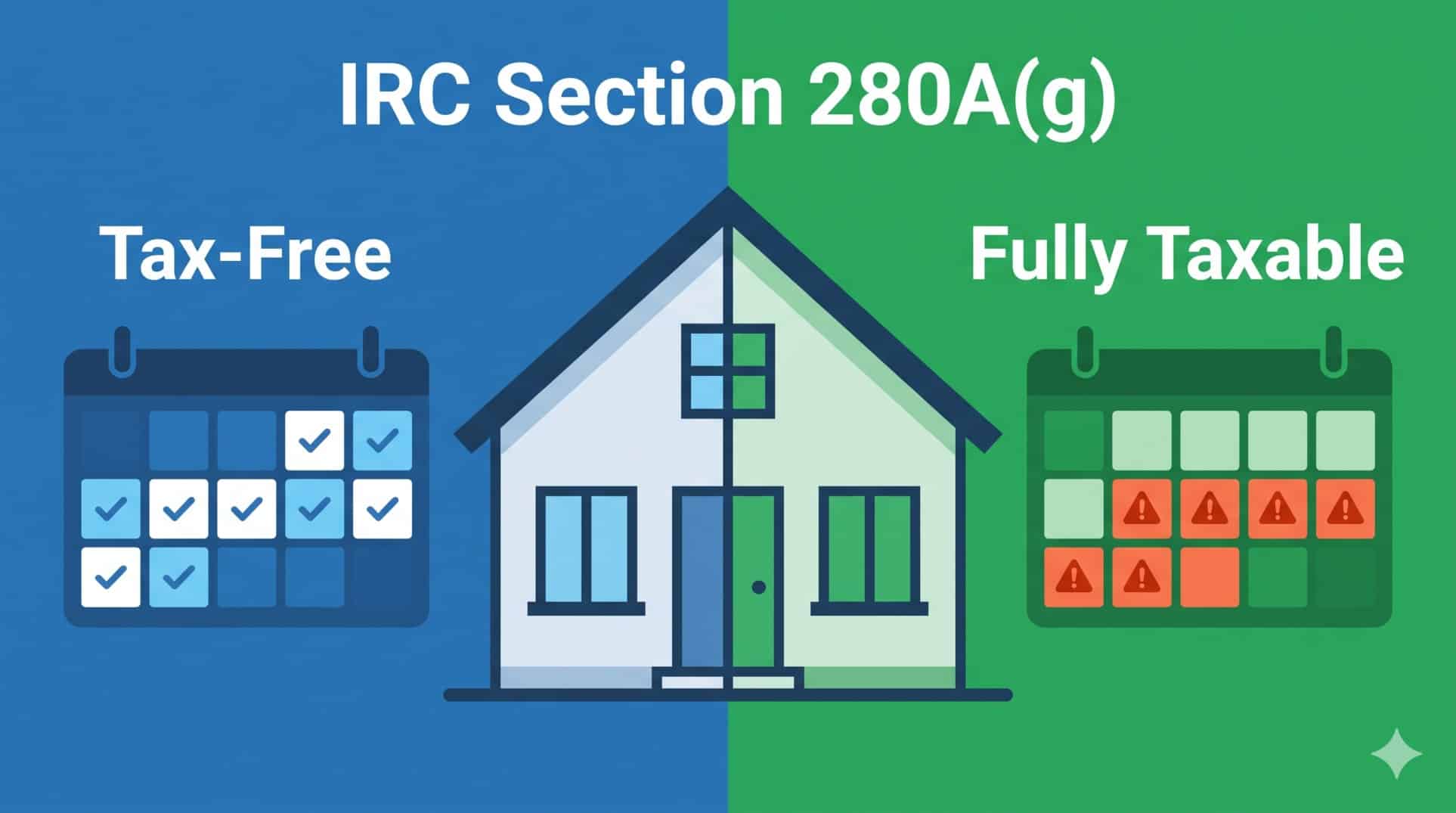
- Internal Revenue Code Section 280A(g) allows homeowners to rent their personal residence for up to 14 days per calendar year and pay zero federal income tax on the proceeds.
- S-Corp and C-Corp owners can rent their homes to their own businesses for legitimate meetings, creating a dual tax benefit: a corporate deduction and tax-free personal income.
- Sole proprietors and single-member LLCs do not qualify for the corporate rental strategy because they are not recognized by the IRS as separate legal entities.
- Exceeding the limit by even one day makes the entire year’s rental income fully taxable. Strict documentation and fair market value pricing are mandatory to survive an audit.
Taxes on rental income can severely cut into your net profits. But there is a specific provision in the tax code that allows you to generate completely tax-free income from your personal residence. Often discussed among real estate investors and corporate shareholders, the Augusta Rule is one of the most powerful tax strategies available today. If you operate Short-Term Rentals or run a small business, you need to master this provision.
The mechanics are rigid. The IRS does not allow you to simply write a check to yourself and call it a tax deduction. You must follow strict corporate formalities, document fair market value, and adhere to absolute statutory deadlines. In this comprehensive guide, we explain how to rent a primary home tax-free for up to 14 days without triggering an IRS audit. We will break down the exact documentation required, analyze recent tax court rulings, and explore other Short-Term Rental Tax Loopholes for 2026.
Table of Contents
- What is the Augusta Rule?
- How Business Owners Use the Augusta Rule
- Entity Types: Who Qualifies and Who Fails?
- Step-by-Step: How to Rent a Primary Home Tax-Free
- Calculating Fair Market Value (FMV) and Avoiding Audit Traps
- Recent Tax Court Rulings: The Sinopoli and Jadhav Cases
- 1099 Reporting Mechanics: How to File
- Other Short-Term Rental Tax Loopholes for 2026
- Frequently Asked Questions About the Augusta Rule
What is the Augusta Rule?
Originating in the 1970s, residents of Augusta, Georgia, wanted to lease their homes to attendees of the Masters golf tournament without facing a massive tax burden for a few days of income. Congress responded by creating Internal Revenue Code (IRC) Section 280A(g).
This statute dictates that if you use a dwelling unit as a personal residence and rent it out for fewer than 15 days in a calendar year, the rental income is entirely excluded from your gross income. You do not report it on Schedule E, and you pay zero federal income tax on it. You also do not deduct any expenses related to the rental, such as cleaning fees or utilities, because the income itself is invisible to the IRS.
The rule is absolute. If you rent the property for 15 days, every single dollar earned from day one becomes taxable. You must keep the rental period to up to 14 days. There is no prorating and no grace period. A single extra day converts a tax-free windfall into ordinary taxable income.
How Business Owners Use the Augusta Rule
While originally designed for homeowners living near major event venues, savvy business owners have adapted this rule into a recurring corporate tax strategy. If you own a formal business entity, your company can rent your personal home for legitimate business purposes. Common uses include monthly board meetings, annual strategic planning retreats, or team-building events.
The business deducts the rental cost as an ordinary and necessary business expense under IRC Section 162. Meanwhile, you, the homeowner, receive the payment tax-free under Section 280A(g). This effectively moves cash out of your business and into your personal pocket without triggering income tax, dividend taxes, or self-employment tax.
To execute this properly, the business must have a genuine need for an off-site meeting space. You cannot rent your home to your business to do the exact same daily administrative work you normally do in your home office. The event must be distinct, documented, and necessary for corporate governance or strategy.
Sarah owns a marketing agency structured as an S-Corp. She hosts a monthly board meeting with her co-founder at her personal residence. She researches local hotel conference rooms and finds they charge $600 per day. Sarah drafts a rental agreement between her S-Corp and herself. The business pays her $600 for 12 days out of the year, totaling $7,200. The S-Corp deducts the $7,200 as a business expense. Sarah receives the $7,200 tax-free. Assuming a 24% marginal tax bracket, she saves $1,728 in federal taxes.
Entity Types: Who Qualifies and Who Fails?
Not every business owner can use this strategy. The IRS requires the business paying the rent to be a distinct, separate taxpaying entity from the homeowner. You cannot rent property to yourself.
- S-Corporations: Qualify. The S-Corp is a separate entity that files an 1120-S tax return.
- C-Corporations: Qualify. The C-Corp is a separate entity that files an 1120 tax return.
- Partnerships / Multi-Member LLCs: Qualify. They file a 1065 tax return and are treated as separate entities from the individual partners.
- Sole Proprietorships / Single-Member LLCs: Do NOT qualify. The IRS views a single-member LLC as a “disregarded entity.” Because you and the business are considered the exact same taxpayer, you cannot pay yourself rent.
If you operate as a single-member LLC and want to utilize this strategy, you must elect to be taxed as an S-Corp. You can read more about entity structuring in a guide to S-Corp tax elections to see if the transition makes financial sense for your revenue level.
David runs a freelance design business as a single-member LLC. He hears about the strategy online and writes a $5,000 check from his LLC to his personal account for “home rental.” Because the IRS considers a single-member LLC a disregarded entity, David is essentially paying himself. Upon audit, the IRS disallows the $5,000 business deduction, adds the income back to his Schedule C, and assesses penalties and interest.
Step-by-Step: How to Rent a Primary Home Tax-Free
To successfully rent a primary home tax-free, you must treat the transaction with extreme corporate formality. Handshake agreements and retroactive bookkeeping will fail under audit.
Step 1: Establish a Legitimate Business Purpose
Identify exactly why the business needs an off-site meeting space. Valid reasons include annual shareholder meetings, quarterly strategic planning, or employee training sessions. Document the agenda before the meeting occurs.
Step 2: Research Fair Market Value (FMV)
Find three comparable commercial venues in your local area. Call local hotels, co-working spaces, or country clubs and ask for a daily quote for a conference room that fits your headcount. Save these quotes as PDFs or printed emails in your corporate records.
Step 3: Draft a Formal Rental Agreement
Create a short-term lease agreement between your business entity (the tenant) and yourself (the landlord). Specify the dates, the daily rate, and the specific areas of the home being rented. Both parties must sign it.
Step 4: Execute the Meeting and Take Minutes
Hold the meeting on the scheduled dates. Take formal corporate minutes detailing what was discussed, who attended, and the decisions made. File these minutes in your corporate binder.
Step 5: Pay via a Traceable Method
The business must pay the homeowner via check or bank transfer. The payment must match the invoice and the rental agreement exactly. Do not pay in cash, and do not simply make a journal entry without moving actual funds.
Calculating Fair Market Value (FMV) and Avoiding Audit Traps
You cannot charge your business $10,000 a day for your living room. The rent must match what a comparable commercial space would charge for a similar meeting. The IRS heavily scrutinizes the daily rate.
When calculating FMV, you must compare apples to apples. If your board meeting consists of two people, you cannot use a 500-person hotel ballroom as your comparable quote. You must find quotes for small, 4-to-6 person executive boardrooms. If a local co-working space charges $400 a day for a boardroom, your home rental rate should be $400 a day.
Recent Tax Court Rulings: The Sinopoli and Jadhav Cases
The IRS has recently cracked down on business owners abusing this provision. Two recent Tax Court cases highlight exactly what to do and what to avoid.
In Sinopoli v. Commissioner (2023), the taxpayers claimed massive deductions for renting their homes to their S-Corp. They failed to provide adequate documentation of the meetings and used highly inflated rental rates. The Tax Court disallowed the majority of the deductions but did allow a rate of $500 per meeting for the days they could actually prove a meeting took place.
In Jadhav v. Commissioner (2023), the outcome was worse. The taxpayers charged their business between $2,000 and $2,500 per day without any independent comparable quotes to justify the rate. They also lacked written rental agreements and corporate minutes. The Tax Court disallowed every single dollar of the deduction and slapped the taxpayers with a 20% accuracy-related penalty.
The lesson for 2026 is clear: Pigs get fat, hogs get slaughtered. Keep your daily rates realistic, gather your comparable quotes before the meeting, and document everything.
1099 Reporting Mechanics: How to File
When your business pays rent to an individual (even if that individual is you), standard IRS reporting rules apply. If the total rent paid during the year is $600 or more, the business must issue a Form 1099-MISC to the homeowner, reporting the total amount in Box 1 (Rents).
This creates a point of confusion. If the income is tax-free, won’t a 1099 trigger an IRS audit? Proper tax preparation solves this. You must report the 1099-MISC income on Schedule E of your personal tax return. Then, on the very same Schedule E, you enter an offsetting deduction for the exact same amount, labeled “IRC Section 280A(g) Exclusion.”
This zeroes out the income. The IRS computer matches the 1099 to your return, sees the statutory exclusion, and clears the return without a manual audit. Failing to report the 1099 and back it out is a guaranteed way to trigger an automated CP2000 notice from the IRS.
If you need assistance managing corporate reporting requirements, reviewing a small business tax compliance checklist can keep your entity in good standing.
Other Short-Term Rental Tax Loopholes for 2026
If you operate dedicated Short-Term Rentals as a primary investment strategy, you might be looking for tax benefits beyond the 14-day limit. One of the most prominent Short-Term Rental Tax Loopholes for 2026 involves the Section 469 material participation rules.
Under standard IRS rules, rental real estate is considered a “passive activity.” This means you cannot use losses from a rental property (such as large depreciation deductions) to offset your active W-2 income or business income. However, the IRS provides an exception for properties where the average guest stay is seven days or less.
If the average stay is seven days or less, the IRS does not classify the property as a “rental activity” under Section 469. It is treated more like a hotel business. If you materially participate in the management of the property—such as handling bookings, coordinating cleaners, and managing repairs for more than 100 hours a year (and more than anyone else)—the activity becomes “active.”
This allows high-income earners to buy a property, accelerate the depreciation through a cost segregation study, and use those massive paper losses to offset their W-2 income, potentially saving tens of thousands in taxes.
Marcus rents his beachfront primary residence on weekends throughout the summer to vacationers. He tracks his days poorly and ends up renting the home for 15 days total, earning $10,000. Because he hit day 15, the statutory exemption vanishes entirely. The entire $10,000 must be reported as taxable rental income on Schedule E, and he must now calculate and deduct prorated expenses.
Frequently Asked Questions About the Augusta Rule
What is the Augusta Rule?
It is a provision under IRC Section 280A(g) that allows homeowners to rent their personal residence for up to 14 days per calendar year and pay zero federal income tax on the rental income. It is commonly used by business owners to rent their homes to their own corporations for meetings.
Can I use this strategy if I have a single-member LLC?
No. Single-member LLCs and sole proprietorships are considered disregarded entities by the IRS. You cannot rent a home to yourself. The business paying the rent must be a separate legal entity, such as an S-Corp, C-Corp, or multi-member LLC.
Do I have to issue a 1099 for the rent?
Yes. If your business pays $600 or more in rent to an individual during the calendar year, it must issue a Form 1099-MISC. The homeowner reports the income on Schedule E and immediately deducts it using the Section 280A(g) exclusion to render it tax-free.
Does the 14-day limit apply per property or per taxpayer?
The limit applies per dwelling unit. If you own a primary residence and a separate vacation home, you can potentially rent each property for up to 14 days tax-free, provided you meet the personal use requirements for each dwelling.
Can I use this strategy for my vacation home?
Yes, provided the vacation home qualifies as a personal residence. To qualify, you must use the home for personal purposes for more than 14 days a year, or 10% of the total days it is rented to others at fair market value, whichever is greater.
What happens if I rent my home for exactly 15 days?
The tax exemption is completely voided. Every dollar of rental income earned from day one through day 15 becomes fully taxable and must be reported on your federal tax return. The 14-day limit is a hard statutory cap.
How do I prove fair market rent to the IRS?
You must obtain written quotes from comparable commercial venues in your local area. If you are hosting a board meeting for four people, get daily rate quotes from local hotels or co-working spaces for a 4-person conference room. Keep these quotes in your corporate records.
Are state taxes deferred under this rule?
Federal taxes are completely excluded, but state tax treatment varies. Most states conform to the federal tax code and honor Section 280A(g), but you must verify your specific state’s tax laws with a local CPA to ensure you do not owe state-level income tax.
Can I deduct expenses if I use this rule?
No. Because the rental income is entirely excluded from your gross income, the IRS does not allow you to deduct any expenses associated with the rental, such as cleaning fees, utilities, or depreciation. You cannot double-dip the tax benefits.
Mastering the Augusta Rule allows you to keep your capital working for you. By respecting the timelines, avoiding audit traps, and ensuring you rent a primary home tax-free for up to 14 days, you can scale your wealth efficiently and legally.
Disclaimer: This content provides general information for educational purposes only. Tax laws are complex and change often. It is not professional tax, legal, or financial advice. Always consult a qualified tax professional for personalized guidance regarding your specific situation. Ourtaxpartner.com is not responsible for any actions taken based on the information provided herein.
