
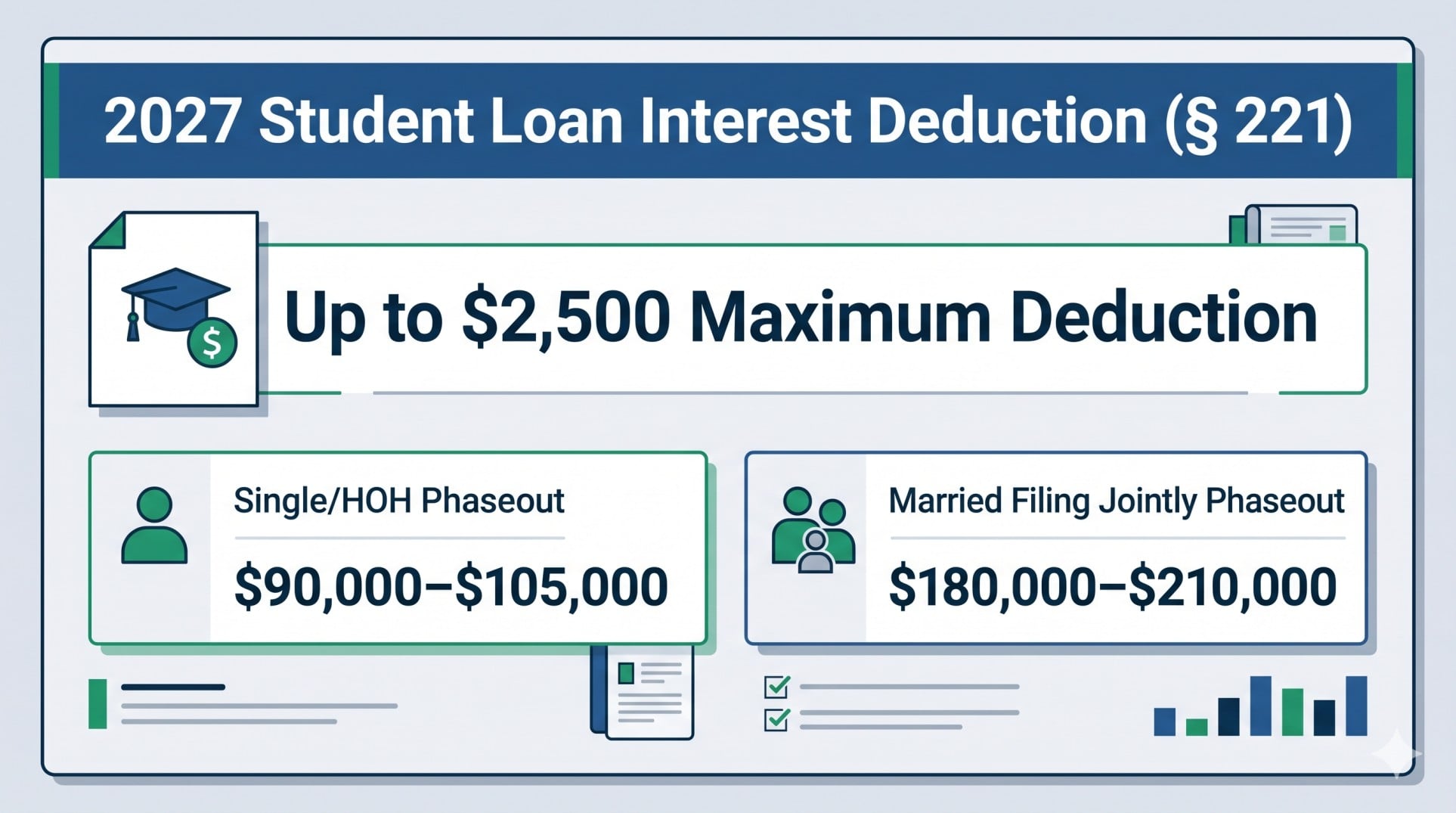
According to Section 3.31 of IRS Revenue Procedure 2026-35, the official student loan interest deduction 2027 allows eligible borrowers to deduct up to $2,500 of qualified education loan interest paid during the year under Internal Revenue Code Section 221. For Tax Year 2027, the deduction phases out for Modified Adjusted Gross Income (MAGI) between $90,000 and $105,000 for Single, Head of Household, and Qualifying Surviving Spouse filers, and between $180,000 and $210,000 for Married Filing Jointly couples.
Because this tax break is an “above-the-line” adjustment to income on Schedule 1 (Form 1040), you can claim the full $2,500 deduction even if you take the 2027 standard deduction instead of itemizing. These updated 2027 student loan interest deduction income limits apply to interest paid between January 1, 2027, and December 31, 2027, which you’ll report on the federal return you file in early 2028.
⚡ Quick Numbers: 2027 Student Loan Interest Deduction at a Glance
- 2027 Maximum Deduction Cap (IRC Sec. 221(b)(1)): Up to $2,500 per tax return (not per borrower or per loan) as an above-the-line adjustment to income.
- 2027 Single, HOH & QSS MAGI Phaseout Range: Begins phasing out above $90,000 and is completely eliminated at $105,000 (a $15,000 phaseout window, up $5,000 from 2026).
- 2027 Married Filing Jointly MAGI Phaseout Range: Begins phasing out above $180,000 and is completely eliminated at $210,000 (a $30,000 phaseout window, up $5,000 from 2026); Married Filing Separately filers do not qualify.
- Key IRS Forms & Filing Deadline: Verify interest paid on Form 1098-E and report the deduction on Schedule 1 (Form 1040), Line 21 by Monday, April 17, 2028.
Table of Contents
- Exact Student Loan Interest Deduction 2027 Numbers and Income Limits
- 2026 vs. 2027 Student Loan Interest Deduction Comparison: What Changed?
- How the 2027 Student Loan Interest Deduction Works & Who Qualifies
- How to Claim the $2,500 Student Loan Deduction on Your 2027 Tax Return
- Frequently Asked Questions
Exact Student Loan Interest Deduction 2027 Numbers and Income Limits
Under Section 3.31 of IRS Revenue Procedure 2026-35 and IRC Section 221(b)(2)(B), the student loan interest deduction 2027 caps at $2,500 and phases out between $90,000 and $105,000 of MAGI for Single filers, or between $180,000 and $210,000 for Married Filing Jointly filers.
| 2027 Filing Status | Maximum 2027 Deduction | MAGI Limit for Full $2,500 Deduction | 2027 Partial Deduction Phaseout Range | Ineligible MAGI Ceiling ($0 Deduction) |
|---|---|---|---|---|
| Single | $2,500 | $90,000 or less | $90,001 to $104,999 | $105,000 or more |
| Head of Household (HOH) | $2,500 | $90,000 or less | $90,001 to $104,999 | $105,000 or more |
| Qualifying Surviving Spouse (QSS) | $2,500 | $90,000 or less | $90,001 to $104,999 | $105,000 or more |
| Married Filing Jointly (MFJ) | $2,500 | $180,000 or less | $180,001 to $209,999 | $210,000 or more |
| Married Filing Separately (MFS) | $0 (Disallowed) | Not Eligible | Not Eligible | Not Eligible (IRC § 221(e)(2)) |
Keep in mind that the $2,500 cap applies per tax return, not per spouse or per student. If you and your spouse file Married Filing Jointly and each paid $2,500 in student loan interest during 2027 ($5,000 total), your combined deduction on your joint return is still capped at $2,500.
Notice also that Married Filing Separately taxpayers are strictly barred from claiming the 2027 student loan interest deduction under IRC Section 221(e)(2)—even if they only file separately to lower their income-driven student loan monthly payment under a federal repayment plan. You must weigh the monthly loan payment savings of filing separately against losing up to $2,500 in deductible interest and other joint tax benefits.
2026 vs. 2027 Student Loan Interest Deduction Comparison: What Changed?
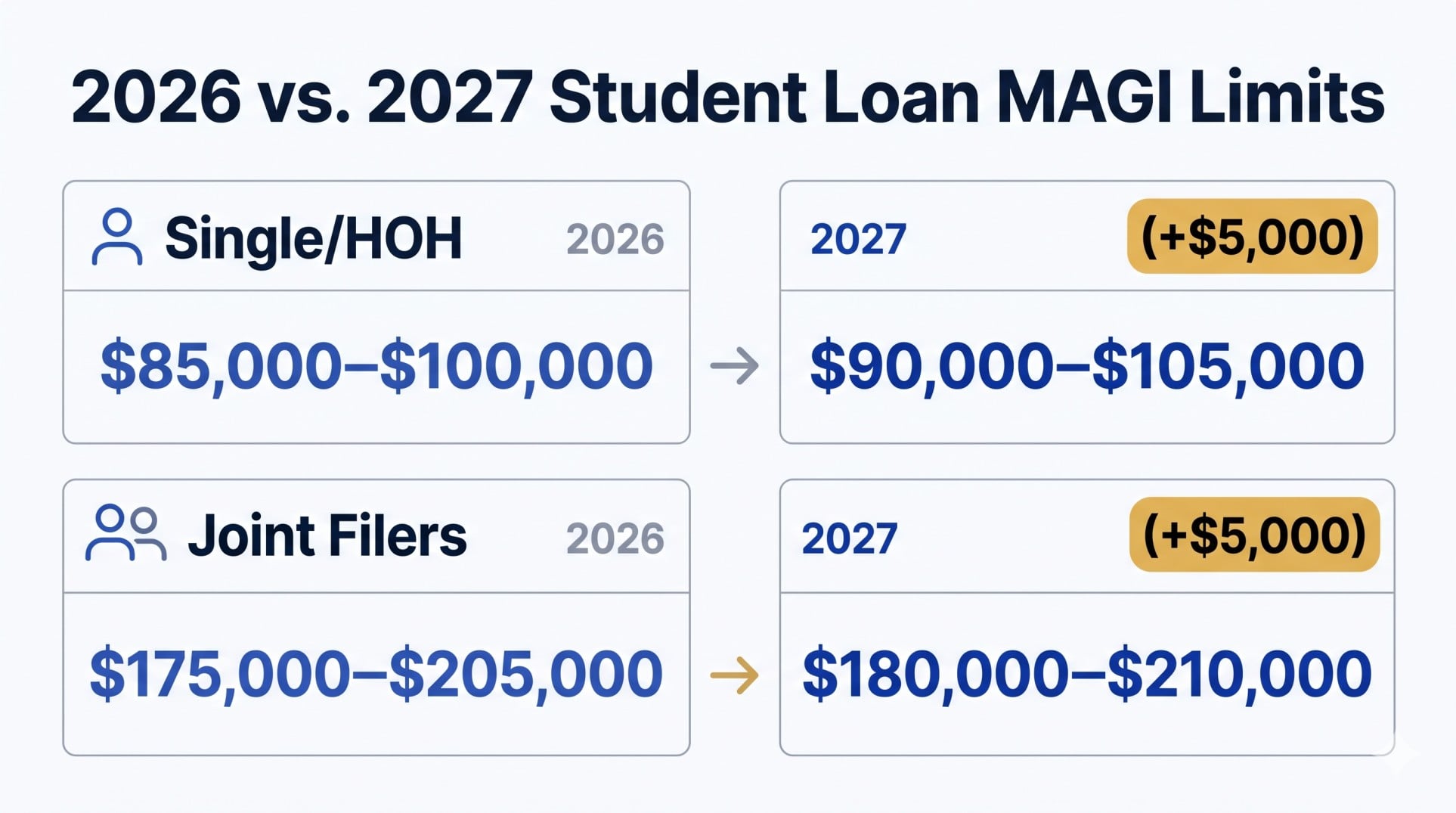
Compared to 2026, the IRS increased the 2027 student loan interest deduction income limits by $5,000 across both the starting and ending MAGI phaseout thresholds for Single, Head of Household, and Married Filing Jointly taxpayers, while the statutory $2,500 maximum deduction remains unchanged.
| Student Loan & Related Education Tax Item | 2026 Official IRS Limit | 2027 Official Limit (Rev. Proc. 2026-35) | Year-Over-Year Change ($ Increase) |
|---|---|---|---|
| Maximum Student Loan Interest Deduction (§ 221(b)(1)) | $2,500 | $2,500 | $0 (Fixed Statutory Cap) |
| Single / HOH / QSS — Phaseout Start MAGI | $85,000 | $90,000 | +$5,000 |
| Single / HOH / QSS — Complete Phaseout MAGI ($0) | $100,000 | $105,000 | +$5,000 |
| Married Filing Jointly — Phaseout Start MAGI | $175,000 | $180,000 | +$5,000 |
| Married Filing Jointly — Complete Phaseout MAGI ($0) | $205,000 | $210,000 | +$5,000 |
| Employer Student Loan Repayment Exclusion (§ 127) | $5,250 | $5,420 | +$170 |
| Savings Bond Education Interest Exclusion — Single/HOH (§ 135) | $101,800–$116,800 | $105,100–$120,100 | +$3,300 |
| Savings Bond Education Interest Exclusion — MFJ (§ 135) | $152,650–$182,650 | $157,600–$187,600 | +$4,950 |
Why do the MAGI phaseout limits jump in exact $5,000 steps? Under IRC Section 221(f)(1), the IRS only adjusts the phaseout starting points when cumulative inflation pushes the calculation across the next $5,000 multiple. Because the statutory phaseout width is fixed at $15,000 for Single/HOH filers and $30,000 for Married Filing Jointly filers, a $5,000 bump to the starting floor automatically raises the upper ceiling by $5,000 as well.
Look at the sixth row in the comparison table above for another major 2027 update from Section 3.22 of IRS Revenue Procedure 2026-35: under the One, Big, Beautiful Bill Act (Public Law 119-21), the tax-free limit for employer-provided educational assistance—which includes employer student loan repayment benefits under IRC Section 127—is now indexed for inflation and rises from $5,250 in 2026 to $5,420 in 2027.
No Double-Dipping With Employer Student Loan Assistance (§ 127): If your employer pays up to $5,420 toward your student loans tax-free in 2027 under an IRC Section 127 educational assistance program, you cannot deduct the interest portion covered by your employer’s payment on Schedule 1. However, any additional student loan interest you pay out of your own pocket during 2027 still qualifies for the $2,500 student loan interest deduction 2027!
How the 2027 Student Loan Interest Deduction Works & Who Qualifies
To claim the student loan interest deduction 2027, you must be legally obligated to repay a qualified student loan, not be claimed as a dependent on someone else’s tax return, and have a 2027 MAGI below $105,000 (Single/HOH) or $210,000 (Married Filing Jointly).
| 2027 Eligibility Requirement or Rule | Qualifies for the $2,500 Deduction? | Important IRS Rule to Know (Publication 970) |
|---|---|---|
| Federal & Private Student Loans | Yes (Both qualify) | Loan must have been taken out solely to pay qualified higher education expenses |
| Who the Student Was When the Loan Was Taken | You, your spouse, or your dependent | Student must have been enrolled at least half-time in a degree/certificate program |
| Parent PLUS Loans | Yes (For the legally obligated parent) | Only the parent who signed the promissory note can deduct the interest |
| Capitalized Interest & Loan Origination Fees | Yes (Deductible as paid) | Unpaid interest added to principal and one-time loan origination fees count as interest |
| Voluntary Interest Payments (During Deferment/School) | Yes | Voluntary payments made before required repayment starts are fully deductible |
| Refinanced Student Loans | Yes (If refinanced solely for student loans) | Consolidating or refinancing into a lower rate retains eligibility; cash-out refis do not |
| Loans From Relatives or 401(k) Plans | No (Strictly disallowed) | Loans from family members or qualified employer retirement plans never qualify |
| Claimed as a Dependent on Another Return | No (Strictly disallowed) | If a parent claims you as a dependent in 2027, neither you nor your parent can deduct your loan interest |
Be careful with the “legally obligated to pay” rule when parents help recent graduates with loan payments. If a student is the sole borrower on the promissory note (with no parent co-signer) and is no longer claimed as a dependent in 2027, what happens if the parents make the student loan payments directly to the loan servicer? Under IRS regulations, the IRS treats that payment as a tax-free gift from the parents to the child, followed by the child paying the loan servicer—meaning the child can claim the 2027 student loan interest deduction on their own Form 1040, even though the parents wrote the check!
How does the student loan interest phaseout 2027 formula work if your MAGI lands in the middle of the phaseout zone? Under IRC Section 221(b)(2), you multiply your preliminary deduction (capped at $2,500) by a fraction: the numerator is your MAGI minus $90,000 (Single/HOH) or $180,000 (Married Filing Jointly), and the denominator is $15,000 (Single/HOH) or $30,000 (Married Filing Jointly). Subtract that reduction from your preliminary deduction to get your allowable deduction.
Let’s walk through two clear real-world math examples for Tax Year 2027:
Example 1: Single Borrower Claiming the Full $2,500 Deduction + Tax Savings in the 22% Bracket
Hannah is a Single physical therapist who earns $82,000 in W-2 wages in 2027 and paid $3,100 in student loan interest reported on her IRS Form 1098-E student loan deduction 2027 statement. Her preliminary deduction is capped at the $2,500 statutory maximum. Because her MAGI of $82,000 is below the $90,000 Single phaseout start, she qualifies for the entire $2,500 above-the-line adjustment on Schedule 1, dropping her Adjusted Gross Income to $79,500 before she even subtracts her $16,600 standard deduction. Since Hannah is in the 22% 2027 federal income tax bracket, that $2,500 deduction directly cuts her 2027 federal income tax bill by $550 ($2,500 times 22%).
Example 2: Married Couple Calculating a Partial Deduction in the $180,000–$210,000 Phaseout Zone
Jordan and Taylor file Married Filing Jointly in 2027 with a combined MAGI of $198,000 and paid $2,800 in qualified student loan interest during the year. Their starting deduction is capped at $2,500. Because their $198,000 MAGI falls inside the $180,000 to $210,000 student loan interest phaseout 2027 window, they calculate their reduction fraction: their excess MAGI above $180,000 is $18,000 ($198,000 minus $180,000), which they divide by the $30,000 joint phaseout range to get 0.600 (or a 60% reduction). Multiplying $2,500 by 60% reduces their deduction by $1,500, leaving Jordan and Taylor with an allowable 2027 student loan interest deduction of $1,000 ($2,500 minus $1,500) on Schedule 1.
Also separate federal IRS rules from state income tax laws. Because the student loan interest deduction 2027 reduces your federal Adjusted Gross Income (AGI) on Form 1040, Line 11, and most state income tax returns use federal AGI as their starting point, claiming this deduction on your federal return automatically lowers your state taxable income in the majority of states as well (and states like Maryland, Massachusetts, and Minnesota offer additional state-specific student loan tax credits or deductions).
How to Claim the $2,500 Student Loan Deduction on Your 2027 Tax Return
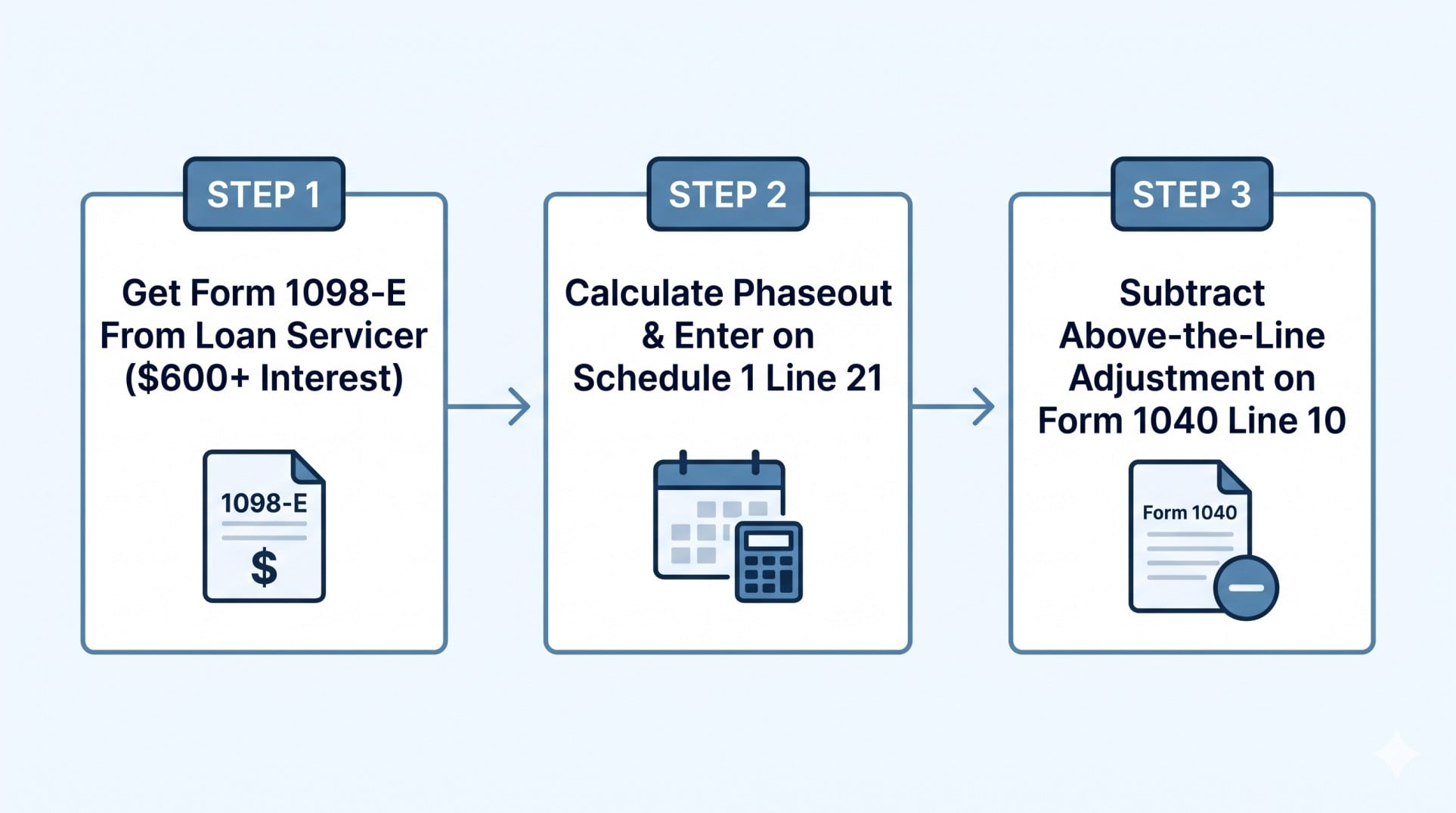
To claim the student loan interest deduction 2027, you do not need to itemize deductions on Schedule A; instead, you calculate the deduction using the Student Loan Interest Deduction Worksheet and enter it on Schedule 1 (Form 1040), Part II, Line 21.
- Collect Form 1098-E From Your Loan Servicer(s) by Early February 2028: Any federal or private loan servicer to whom you paid $600 or more in student loan interest during 2027 is required by law to send you Form 1098-E (Student Loan Interest Statement) by January 31, 2028, showing your total interest paid in Box 1. If you paid less than $600 (or have multiple servicers under $600), log into your online loan portal to download your 2027 year-end interest summary—you can still deduct interest under $600 even if you didn’t receive a physical IRS Form 1098-E student loan deduction 2027 form!
- Total Your Qualified Interest Paid (Up to $2,500 Maximum): Add up all Box 1 amounts from your Forms 1098-E plus any qualified loan origination fees or capitalized interest allocated to 2027 (excluding any amounts paid tax-free by your employer under IRC Section 127). Cap that starting total at $2,500.
- Complete the Student Loan Interest Deduction Worksheet in the Schedule 1 Instructions: Enter your total 2027 income from Form 1040, Line 9, and subtract your other Schedule 1 “above-the-line” adjustments (such as deductible 2027 traditional IRA contributions, Health Savings Account deductions, educator expenses, and half of self-employment tax) to determine your exact MAGI for the $90,000–$105,000 or $180,000–$210,000 phaseout test.
- Enter Your Allowable Deduction on Schedule 1 (Form 1040), Line 21: Put your final post-phaseout deduction (up to $2,500) on Schedule 1, Part II, Line 21 (“Student loan interest deduction”).
- Transfer Your Total Adjustments to Form 1040, Line 10, and File by April 17, 2028: Add Line 21 into your total adjustments on Schedule 1, Line 26, and carry that sum to 2027 Form 1040, Line 10, where it is subtracted directly from your total income to lower your Adjusted Gross Income on Line 11. File your return by Monday, April 17, 2028.
Frequently Asked Questions
1. What are the official 2027 student loan interest deduction income limits?
According to Section 3.31 of IRS Revenue Procedure 2026-35, the 2027 student loan interest deduction income limits begin phasing out at $90,000 of Modified Adjusted Gross Income (MAGI) and end completely at $105,000 for Single, Head of Household, and Qualifying Surviving Spouse filers. For Married Filing Jointly couples, the phaseout starts at $180,000 and ends at $210,000.
2. Do I have to itemize deductions to claim the student loan interest deduction 2027?
No, you do not need to itemize on Schedule A to claim the student loan interest deduction 2027. Because it is an “above-the-line” adjustment reported on Schedule 1 (Form 1040), Line 21, you can deduct up to $2,500 of student loan interest right on top of the $16,600 (Single) or $33,200 (Married Filing Jointly) standard deduction.
3. Can Married Filing Jointly couples deduct $5,000 if both spouses have student loans in 2027?
No, IRC Section 221(b)(1) caps the 2027 student loan interest deduction at $2,500 per tax return, not per individual borrower. Even if both spouses paid $2,500 or more on separate student loans during 2027, the maximum combined deduction on a Married Filing Jointly return is $2,500.
4. What if I paid less than $600 in student loan interest and didn’t get Form 1098-E?
You can still claim the deduction even if you paid less than $600 and did not receive an IRS Form 1098-E student loan deduction 2027 statement in the mail. Simply log into your loan servicer’s online account to check the exact dollar amount of interest you paid during 2027 and enter that amount on Schedule 1, Line 21.
5. Can I claim the student loan interest phaseout 2027 if I file Married Filing Separately?
No, taxpayers who choose the Married Filing Separately filing status are completely ineligible for the student loan interest deduction under IRC Section 221(e)(2), regardless of their income level. To qualify for the student loan interest phaseout 2027 up to $210,000, married couples must file a joint tax return.
Disclaimer: This content provides general information for educational purposes only and reflects federal tax laws applicable to Tax Year 2027 (returns filed in 2028). Tax laws are complex and subject to change. This article does not constitute professional tax, legal, or accounting advice. Always consult a certified public accountant (CPA), enrolled agent (EA), or qualified tax attorney regarding your specific financial situation. Ourtaxpartner.com is not responsible for any actions taken based on the information provided herein.
