
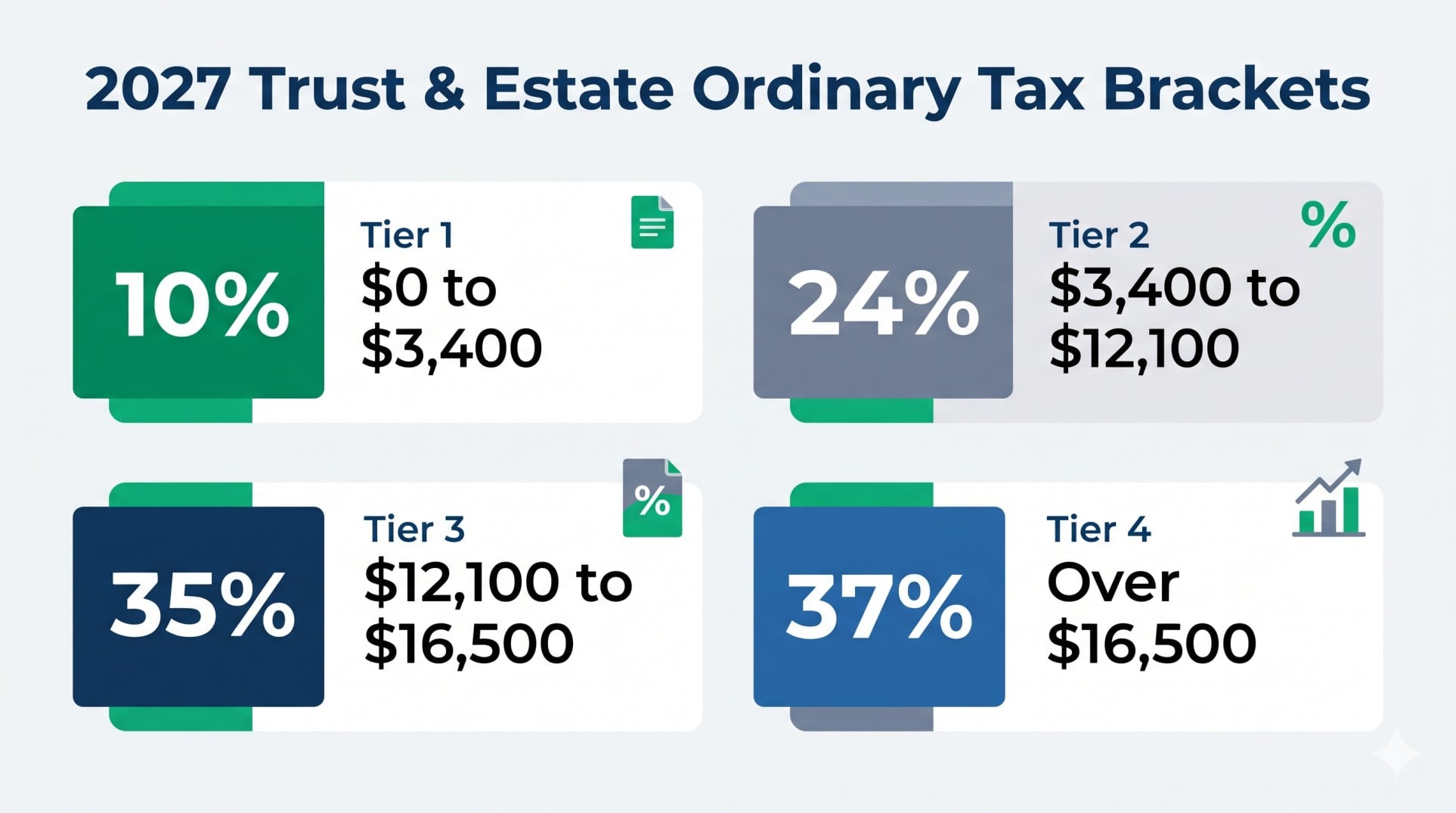
According to IRS Revenue Procedure 2026-35, the official trust tax brackets 2027 apply four compressed ordinary tax rates—10%, 24%, 35%, and 37%—to undistributed income retained inside a non-grantor trust or decedent’s estate. For Tax Year 2027, trusts and estates hit the top 37% federal income tax rate once taxable income exceeds just $16,500.
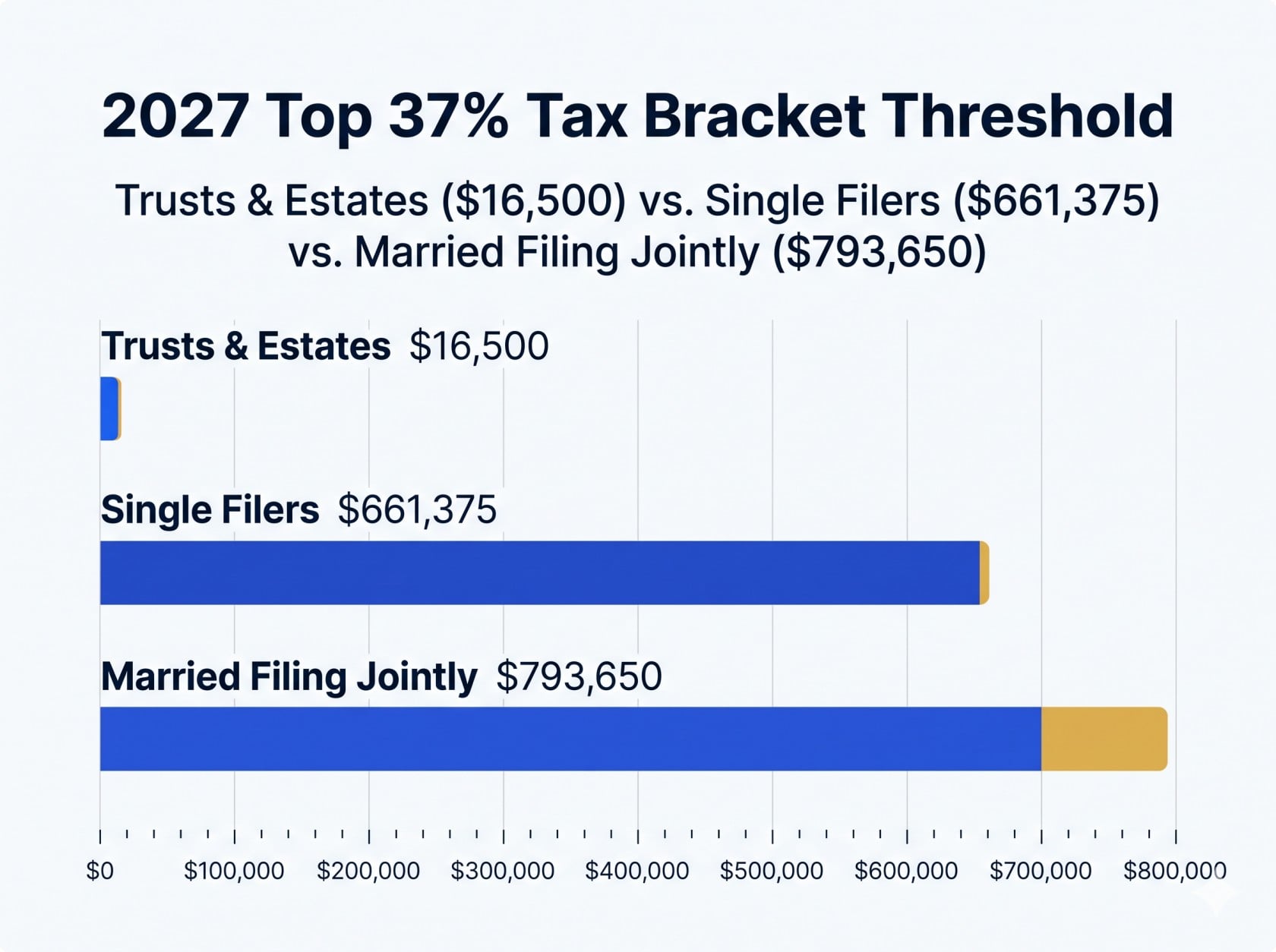
By comparison, an unmarried individual does not enter the 37% bracket in 2027 until their taxable income surpasses $661,375, and Married Filing Jointly couples don’t reach 37% until $793,650. Because of these steep estate income tax rates 2027, trustees and executors must carefully weigh whether to retain earnings inside the trust or distribute income to beneficiaries in lower individual tax brackets.
⚡ Quick Numbers: 2027 Trust and Estate Income Tax Brackets at a Glance
- 2027 Ordinary Trust & Estate Tax Brackets (IRC Sec. 1(j)(2)(E)): 10% up to $3,400; 24% from $3,401 to $12,100; 35% from $12,101 to $16,500; and 37% over $16,500.
- 2027 Long-Term Capital Gains & 3.8% NIIT Limits: 0% rate up to $3,400, 15% rate up to $16,750, and 20% rate over $16,750; the 3.8% Net Investment Income Tax kicks in above $16,500 of undistributed net investment income.
- 2027 Trust & Estate Exemption Amounts: $600 for a decedent’s estate, $300 for a simple trust, $100 for a complex trust, $5,450 for a Qualified Disability Trust, and $32,500 for the Alternative Minimum Tax (AMT) exemption.
- Key IRS Forms & Filing Deadline: Report retained fiduciary income on IRS Form 1041 and pass-through distributions on Schedule K-1 (Form 1041) by Monday, April 17, 2028 (for calendar-year filers).
Table of Contents
Exact Trust Tax Brackets 2027 and Estate Income Tax Rates
Under Section 3.01 (Table 5) and Section 3.03 of IRS Revenue Procedure 2026-35, the trust tax brackets 2027 divide ordinary taxable income into four tiers starting at 10% and reaching 37% above $16,500, while long-term capital gains are taxed at 0%, 15%, or 20%.
| 2027 Trust & Estate Taxable Income | Ordinary Income Tax Rate | Exact 2027 IRS Tax Calculation Formula (IRC § 1(j)(2)(E)) |
|---|---|---|
| $0 to $3,400 | 10% | 10% of taxable income |
| $3,401 to $12,100 | 24% | $340.00 + 24% of the excess over $3,400 |
| $12,101 to $16,500 | 35% | $2,428.00 + 35% of the excess over $12,100 |
| Over $16,500 | 37% | $3,968.00 + 37% of the excess over $16,500 |
Notice that unlike individual taxpayers—who move gradually through seven brackets (10%, 12%, 22%, 24%, 32%, 35%, and 37%)—fiduciary returns skip the 12%, 22%, and 32% tiers altogether. Once a trust or estate earns more than $3,400 in taxable ordinary income (such as bond interest, rental income, non-qualified dividends, or business profits), the marginal rate immediately jumps from 10% to 24%.
When a trust or estate realizes 2027 long-term capital gains and qualified dividends, it receives preferential tax rates under IRC Section 1(j)(5), though those thresholds are equally compressed:
| 2027 Trust & Estate Tax Provision | Internal Revenue Code Section | 2027 Taxable Income / Dollar Threshold | Applicable Tax Rate or Deduction |
|---|---|---|---|
| 0% Long-Term Capital Gains & Qualified Dividends | IRC § 1(j)(5)(B)(i) | $0 to $3,400 | 0% |
| 15% Long-Term Capital Gains & Qualified Dividends | IRC § 1(j)(5)(B)(ii) | $3,401 to $16,750 | 15% |
| 20% Long-Term Capital Gains & Qualified Dividends | IRC § 1(h)(1)(D) | Over $16,750 | 20% |
| Net Investment Income Tax (NIIT) Threshold | IRC § 1411(a)(2) | Over $16,500 (Top Bracket Start) | +3.8% Surtax on Undistributed NII |
| Alternative Minimum Tax (AMT) Exemption & Phaseout | IRC § 55(d) | $32,500 Exemption (Phases out $108,200–$173,200) | 26% up to $252,500; 28% above $252,500 |
| Qualified Business Income (QBI) Sec. 199A Threshold | IRC § 199A(e)(2) | $208,300 (Phases out up to $283,300) | Up to 20% QBI Deduction |
| Qualified Disability Trust Exemption | IRC § 642(b)(2)(C) | Up to $5,450 | $5,450 Deduction |
| Decedent’s Estate / Simple Trust / Complex Trust Exemption | IRC § 642(b) | Fixed Statutory Amounts | $600 (Estate) / $300 (Simple) / $100 (Complex) |
Because IRC Section 1411(a)(2)(B) ties the 3.8% Net Investment Income Tax (NIIT) threshold for trusts and estates directly to the dollar amount where the highest ordinary tax bracket begins, any undistributed passive investment income or capital gains above $16,500 in 2027 also triggers the 3.8% surtax. That brings the effective top federal tax rate inside a trust to 40.8% on ordinary investment income (37% plus 3.8%) and 23.8% on long-term capital gains above $16,750 (20% plus 3.8%).
2026 vs. 2027 Trust and Estate Income Tax Brackets Comparison: What Changed?
Compared to 2026, the IRS raised the 2027 trust and estate income tax brackets by roughly 3.1% across every tier, pushing the top 37% ordinary bracket threshold up by $500 (from $16,000 to $16,500) and the 20% capital gains threshold up by $500 (from $16,250 to $16,750).
| Trust & Estate Tax Item | 2026 IRS Limit (Rev. Proc. 2025-32) | 2027 IRS Limit (Rev. Proc. 2026-35) | Dollar Increase ($ Change) |
|---|---|---|---|
| 10% Ordinary Bracket Ceiling | $3,300 | $3,400 | +$100 |
| 24% Ordinary Bracket Ceiling | $11,700 | $12,100 | +$400 |
| 35% Ordinary Bracket Ceiling (37% Rate Starts Above) | $16,000 | $16,500 | +$500 |
| 3.8% NIIT Threshold for Trusts & Estates | $16,000 | $16,500 | +$500 |
| 0% Long-Term Capital Gains Ceiling | $3,300 | $3,400 | +$100 |
| 15% Long-Term Capital Gains Ceiling (20% Rate Starts Above) | $16,250 | $16,750 | +$500 |
| Trust & Estate AMT Exemption / Phaseout Start | $31,400 / $104,800 | $32,500 / $108,200 | +$1,100 / +$3,400 |
| Qualified Disability Trust Exemption (Sec. 642(b)(2)(C)) | $5,300 | $5,450 | +$150 |
| Sec. 199A QBI Deduction Phase-In Threshold | $201,750 | $208,300 | +$6,550 |
| Single Individual Top 37% Bracket Start (For Comparison) | $640,600 | $661,375 | +$20,775 |
| Married Filing Jointly Top 37% Bracket Start (For Comparison) | $768,700 | $793,650 | +$24,950 |
Look closely at the bottom two rows of the table to see why fiduciary tax planning is so critical in 2027. While a Single beneficiary doesn’t pay the 37% marginal rate until their taxable income exceeds $661,375 (and doesn’t pay the 3.8% NIIT until their Modified Adjusted Gross Income exceeds $200,000), a trust or estate hits both the 37% ordinary rate and the 3.8% NIIT at just $16,500.
To make matters worse, trusts and estates cannot claim the 2027 standard deduction of $16,600 (Single) or $33,200 (Married Filing Jointly). Under IRC Section 642(b), a complex trust is limited to a tiny $100 personal exemption, a simple trust gets $300, and a decedent’s estate receives $600 (unless the trust qualifies as a Qualified Disability Trust for a disabled beneficiary under age 65, which can deduct $5,450 in 2027 under Section 3.37 of Revenue Procedure 2026-35).
Don’t Confuse Estate Income Tax With the Federal Estate Tax: The estate income tax rates 2027 on Form 1041 apply only to income earned after death (such as dividends, interest, or rent generated by estate assets before they are distributed to heirs). The transfer of the decedent’s principal net worth at death is governed separately by the 2027 federal estate tax exemption of $15,480,000 on Form 706.
How the 2027 Trust and Estate Income Tax Works & Who Qualifies
Whether a trust pays the IRS Form 1041 tax rates 2027 depends on what type of trust it is and whether the trustee keeps the income inside the trust or distributes it to beneficiaries during the year.
- Grantor Trusts (Revocable Living Trusts & Intentionally Defective Grantor Trusts): Disregarded for separate income tax brackets under IRC Sections 671–678. All income, deductions, and credits flow directly onto the creator’s (grantor’s) personal Form 1040 and are taxed at the grantor’s individual tax brackets.
- Simple Non-Grantor Trusts: Required by the trust instrument to distribute all fiduciary accounting income annually, make no principal distributions, and make no charitable contributions. Ordinary income passes through to beneficiaries via Schedule K-1 (deductible by the trust), while capital gains allocated to principal usually stay inside the trust and face the 2027 trust capital gains tax brackets.
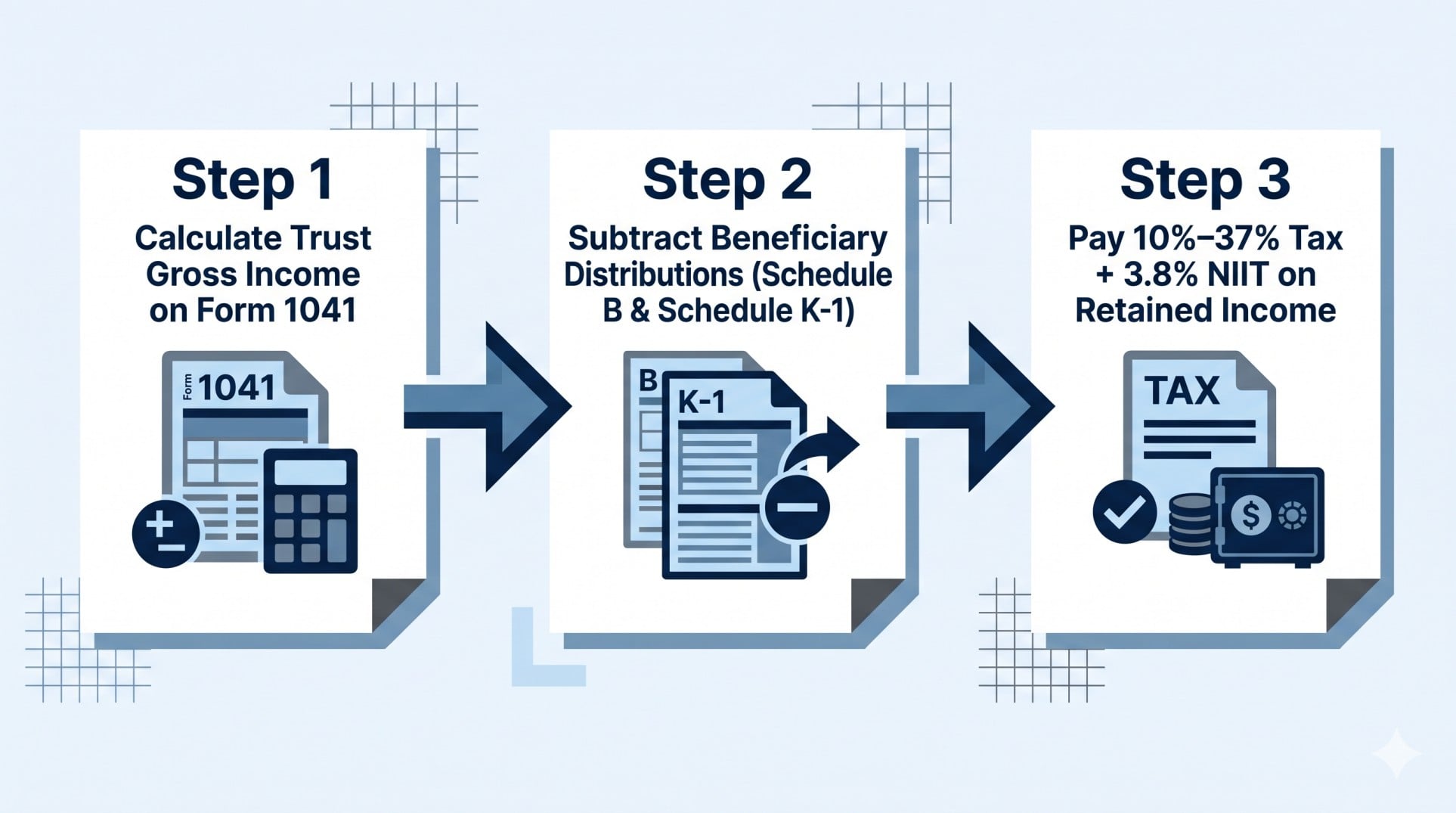
- Complex Non-Grantor Trusts & Decedent’s Estates: Permitted to accumulate income, distribute principal, or donate to charity. Any income distributed to beneficiaries up to Distributable Net Income (DNI) is deducted by the trust on Schedule B (an “above-the-line” fiduciary distribution deduction under IRC Sections 651 and 661) and taxed to the beneficiary; any undistributed income retained inside the trust or estate is taxed at the compressed trust tax brackets 2027.
In addition to the distribution deduction, non-grantor trusts and estates can claim specific fiduciary deductions under IRC Section 67(e) that reduce Adjusted Gross Income (AGI)—including trustee/executor fees, fiduciary tax preparation fees, and trust administration legal expenses—plus up to a 20% Qualified Business Income (QBI) deduction under IRC Section 199A on retained pass-through business income below the $208,300 threshold, and 2027 Alternative Minimum Tax exemption protection up to $32,500.
Let’s look at two clear real-world math examples for Tax Year 2027:
Example 1: Retaining $50,000 of Ordinary Investment Income Inside a Complex Trust vs. Distributing to a Beneficiary
The Smith Family Irrevocable Trust (a complex non-grantor trust) earns $50,100 of corporate bond interest in 2027 and has no administrative expenses. If the trustee retains all the money inside the trust, the trust subtracts its $100 complex trust exemption, leaving $50,000 in taxable income. Under the trust tax brackets 2027, the first $16,500 incurs $3,968 in tax, and the remaining $33,500 above $16,500 is taxed at 37% ($12,395), plus the 3.8% NIIT on $33,500 ($1,273)—for a total federal tax bill of $17,636. By contrast, if the trustee distributes that $50,100 to an adult beneficiary who is Single with $40,000 in W-2 wages, the trust claims a $50,100 Income Distribution Deduction and pays $0 tax. On the beneficiary’s Form 1040, after subtracting their $16,600 standard deduction, their total taxable income is $73,500—putting the distribution in the 12% and 22% individual brackets with $0 NIIT, saving the family over $8,500 in federal taxes.
Example 2: Calculating the 2027 Trust Capital Gains Tax Brackets on a Retained Stock Sale
An estate sells long-term stock during 2027 for a net long-term capital gain of $30,600, retains the proceeds in principal, and has no other income. Subtracting the $600 estate exemption leaves $30,000 of taxable long-term capital gains. Using the 2027 trust capital gains tax brackets, the first $3,400 is taxed at 0% ($0), the next $13,350 (from $3,401 to $16,750) is taxed at 15% ($2,002.50), and the remaining $13,250 above $16,750 is taxed at 20% ($2,650). In addition, the $13,500 of undistributed net investment income above the $16,500 NIIT threshold incurs the 3.8% NIIT ($513), resulting in a total federal tax of $5,165.50.
Remember that federal Form 1041 rules are separate from state fiduciary income taxes. States such as California, New York, and New Jersey tax non-grantor trusts based on the residence of the grantor, trustees, or beneficiaries, while states like Delaware, Nevada, South Dakota, Alaska, Florida, and Texas impose no state income tax on qualifying non-grantor trusts.
How to Report Trust and Estate Income on IRS Form 1041
A domestic decedent’s estate must file IRS Form 1041 for 2027 if it has gross income of $600 or more, and a domestic non-grantor trust must file if it has any taxable income for the year or gross income of $600 or more (or any non-resident alien beneficiary).
- Report Trust or Estate Income and Deductions on Form 1041 (Lines 1 through 21): Enter all interest, dividends, business income, capital gains (from Schedule D (Form 1041)), and rental income on Lines 1 through 8. Subtract fiduciary fees, attorney/accountant fees, charitable deductions (Schedule A), the Section 199A QBI deduction (Line 20), and your statutory exemption ($600 estate, $300 simple trust, $100 complex trust, or $5,450 qualified disability trust on Line 21).
- Calculate Distributable Net Income (DNI) and the Distribution Deduction on Schedule B: Complete Schedule B (Form 1041) to determine how much income was distributed (or required to be distributed) to beneficiaries. Under the 65-Day Rule (IRC Section 663(b)), trustees of complex trusts (and executors of estates) can check the box on Page 2 of Form 1041 to treat distributions made within the first 65 days of 2028 (on or before March 5, 2028, since 2028 is a leap year) as paid on December 31, 2027, shifting that income out of the 37% trust bracket.
- Issue Schedule K-1 (Form 1041) to Beneficiaries: For every dollar deducted as an Income Distribution Deduction on Form 1041, Line 18, issue a Schedule K-1 (Form 1041) to the receiving beneficiary so they can report their share of interest, dividends, or capital gains on their personal Form 1040.
- Compute Fiduciary Tax on Schedule G, Form 8960 (NIIT), and Schedule I (AMT): Calculate the tax on any remaining undistributed taxable income (Form 1041, Line 23) using Schedule G (Form 1041) and the trust tax brackets 2027. Attach Form 8960 if undistributed net investment income exceeds $16,500, and complete Schedule I (Form 1041) to check if Alternative Minimum Tax applies above the $32,500 AMT exemption.
- File Form 1041 by April 17, 2028, and Make Quarterly Estimated Payments (Form 1041-ES): Calendar-year trusts and estates must file their 2027 Form 1041 by Monday, April 17, 2028 (or file Form 7004 for an automatic 5.5-month extension to October 2, 2028). Note that while trusts must adopt a calendar year, a decedent’s estate can elect a fiscal tax year (due on the 15th day of the 4th month after the fiscal year closes), and estates are exempt from making quarterly Form 1041-ES estimated tax payments for their first two taxable years.
Frequently Asked Questions
1. What are the official trust tax brackets 2027?
According to Section 3.01 (Table 5) of IRS Revenue Procedure 2026-35, the trust tax brackets 2027 for ordinary income are 10% on taxable income up to $3,400, 24% from $3,401 to $12,100, 35% from $12,101 to $16,500, and 37% on all taxable income over $16,500. These rates apply to undistributed income reported on IRS Form 1041.
2. When do trusts and estates hit the 37% tax bracket and 3.8% NIIT in 2027?
Both the top 37% ordinary income tax rate and the 3.8% Net Investment Income Tax (NIIT) apply once a trust or estate exceeds $16,500 in taxable income in 2027 (up from $16,000 in 2026). That creates a combined 40.8% marginal tax rate on undistributed passive investment income over $16,500.
3. What are the 2027 trust capital gains tax brackets?
Under Section 3.03 of IRS Revenue Procedure 2026-35, the 2027 trust capital gains tax brackets are 0% on taxable income up to $3,400, 15% on taxable income from $3,401 to $16,750, and 20% on taxable income over $16,750. When combined with the 3.8% NIIT above $16,500, the top long-term capital gains rate for a trust is 23.8%.
4. Do revocable living trusts pay the estate income tax rates 2027?
No, a revocable living trust is treated as a “grantor trust” under IRC Sections 671–678 while the creator is alive and competent. Instead of paying the compressed estate income tax rates 2027 on Form 1041, all trust income is reported directly on the grantor’s personal Form 1040 using their individual tax brackets.
5. How can a trustee avoid the 37% IRS Form 1041 tax rates 2027?
A trustee can avoid the 37% IRS Form 1041 tax rates 2027 by distributing income to beneficiaries during 2027—or by using the IRC Section 663(b) 65-day rule to make distributions on or before March 5, 2028. The trust claims an Income Distribution Deduction on Schedule B of Form 1041, shifting the tax burden onto the beneficiary’s personal Form 1040 via Schedule K-1.
Disclaimer: This content provides general information for educational purposes only and reflects federal tax laws applicable to Tax Year 2027 (returns filed in 2028). Tax laws are complex and subject to change. This article does not constitute professional tax, legal, or accounting advice. Always consult a certified public accountant (CPA), enrolled agent (EA), or qualified tax attorney regarding your specific financial situation. Ourtaxpartner.com is not responsible for any actions taken based on the information provided herein.
