
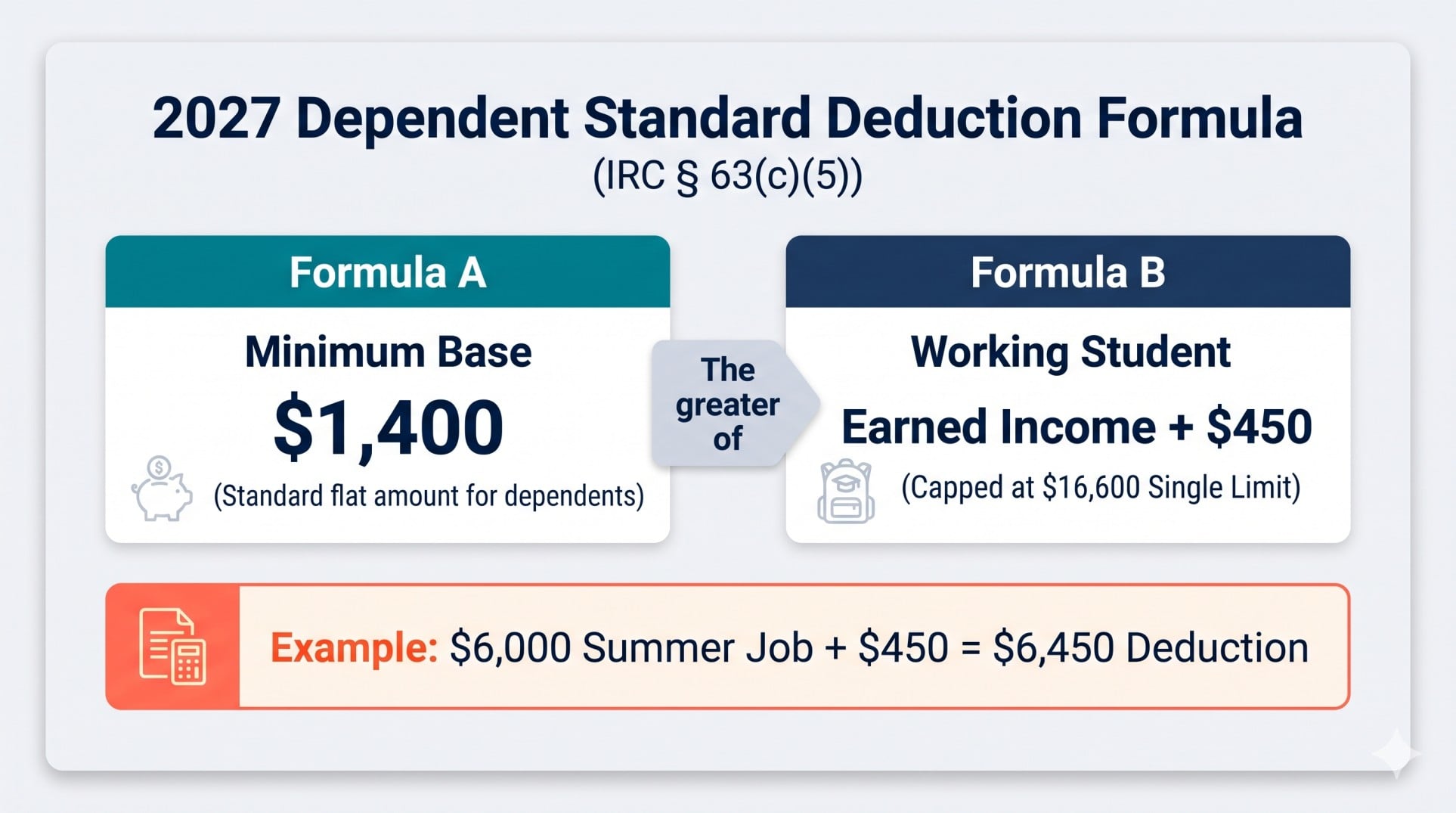
For Tax Year 2027, the official IRS dependent standard deduction for 2027 is limited to the greater of $1,400 or the dependent’s earned income plus $450, capped at the basic Single standard deduction of $16,600, according to Section 3.15(2) of IRS Revenue Procedure 2026-35. Under Section 3.02 of the same revenue procedure, the base unearned income threshold for the kiddie tax in 2027 (Internal Revenue Code Section 1(g)) is also $1,400, meaning a child’s unearned investment income over $2,800 is taxed at their parent’s marginal tax rate.
These updated thresholds govern income earned by dependent children and full-time college students between January 1, 2027, and December 31, 2027, for federal tax returns filed in April 2028. Knowing how the earned-income formula interacts with the 2027 kiddie tax threshold helps families avoid surprise tax bills on UTMA/UGMA custodial accounts, dividends, and summer jobs.
⚡ Quick Numbers: 2027 Dependent Deduction & Kiddie Tax at a Glance
- 2027 Dependent Standard Deduction (§ 63(c)(5)): Greater of $1,400 OR earned income plus $450, not to exceed the $16,600 basic Single standard deduction.
- 2027 Kiddie Tax Base Amount (§ 1(g)(4)): $1,400 tax-free unearned income, plus the next $1,400 taxed at the child’s own 10% rate, putting the Form 8615 trigger at $2,800.
- 2026 vs. 2027 Change: The minimum dependent deduction rises by $50 (from $1,350 to $1,400) and the Kiddie Tax trigger rises by $100 (from $2,700 to $2,800).
- Required IRS Forms: Reported on the child’s Form 1040 using Form 8615, or elected on the parent’s return via Form 8814 if unearned income is under $14,000.
Table of Contents
Exact 2027 Dependent Standard Deduction & Kiddie Tax Thresholds
Under IRS Revenue Procedure 2026-35, the dependent standard deduction for 2027 and the kiddie tax in 2027 work together to determine how much a child can earn from investments and wages before owing federal tax. Table 1A breaks down the deduction rules under IRC Section 63(c)(5), while Table 1B details the three unearned income tax tiers under IRC Section 1(g).
Table 1A: 2027 Dependent Standard Deduction Rules (IRC § 63(c)(5))
If a taxpayer can be claimed as a dependent on someone else’s tax return, their below-the-line standard deduction on Form 1040, Line 12 is calculated using these official 2027 limits:
| Dependent Income Scenario in 2027 | IRC Statutory Rule (Rev. Proc. 2026-35, Sec. 3.15(2)) | Exact 2027 Dollar Limit / Formula |
|---|---|---|
| Minimum Base Deduction (Unearned Income Only) | Fixed statutory floor when earned income is $950 or less | $1,400 |
| Working Dependent Formula (Earned Income > $950) | W-2 wages / net self-employment income plus fixed add-on | Earned Income + $450 |
| Maximum Single Dependent Standard Deduction Cap | Cannot exceed basic Single standard deduction (earned ≥ $16,150) | $16,600 maximum |
| Extra Addition if Dependent Is Blind or Age 65+ | Stacks on top of the dependent formula under IRC § 63(f) | +$2,100 (unmarried) / +$1,700 (married) |
Table 1B: 2027 Kiddie Tax Unearned Income Tiers (IRC § 1(g))
When a child has solely unearned income (such as stock dividends, taxable interest, capital gains distributions, or taxable scholarship grants), the unearned income limit for dependents in 2027 divides their investment earnings into three distinct brackets:
| 2027 Unearned Income Tier | 2027 Dollar Range | How the Income Is Taxed in 2027 |
|---|---|---|
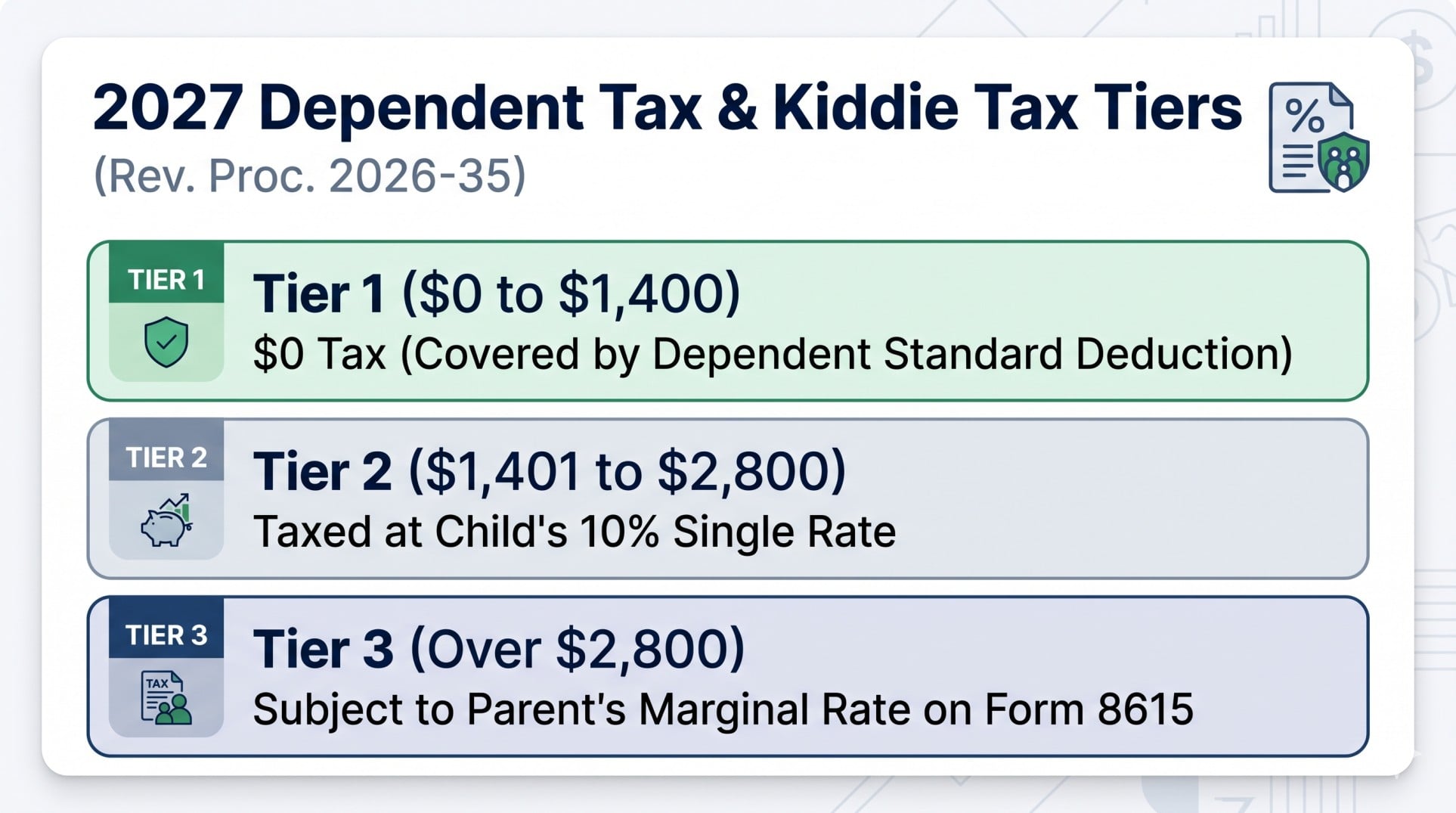
| Tier 1: Standard Deduction Shield | $0 to $1,400 | 0% Federal Tax (Completely offset by the $1,400 dependent standard deduction) |
| Tier 2: Child’s Marginal Tax Rate | $1,401 to $2,800 | Taxed at the child’s own Single rate (10% on ordinary income, or 0% on qualified dividends/long-term capital gains) |
| Tier 3: Kiddie Tax Trigger (Parent’s Rate) | Over $2,800 | Net unearned income over $2,800 is taxed at the parent’s marginal rate (up to 37% ordinary or 20% capital gains) via Form 8615 |
| Parent Election Range (Form 8814) | Over $1,400 to $13,999 | Parents may elect to report the child’s interest and dividends directly on the parent’s Form 1040 |
The $1,400 base figure in Section 3.02 of Revenue Procedure 2026-35 controls both Tier 1 and Tier 2. Because IRC Section 1(g)(4)(A)(ii) defines “net unearned income” as unearned income minus the $1,400 deduction plus another $1,400 (two times the base threshold), the parent’s 2027 federal income tax brackets only apply once unearned income tops $2,800.
2026 vs. 2027 Dependent & Kiddie Tax Comparison: What Changed?
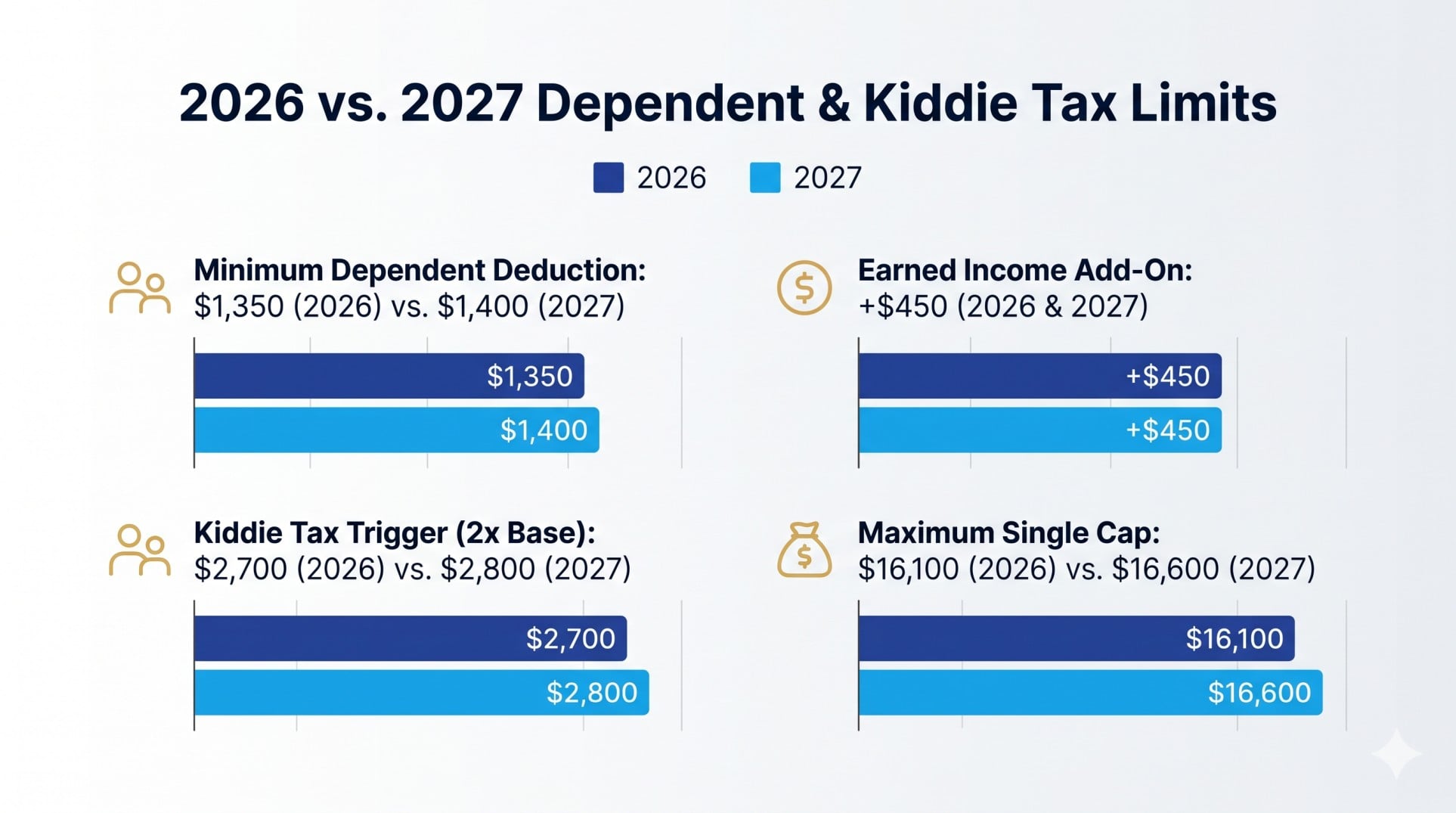
Comparing IRS Revenue Procedure 2025-32 (for Tax Year 2026) against Revenue Procedure 2026-35 (for Tax Year 2027) shows that the minimum dependent standard deduction for 2027 increased by $50 (from $1,350 to $1,400), while the earned income add-on stayed unchanged at $450. That $50 base increase automatically pushes the 2027 kiddie tax threshold on Form 8615 up by $100—from $2,700 in 2026 to $2,800 in 2027.
| Dependent & Kiddie Tax Provision | 2026 Limit (Rev. Proc. 2025-32) | 2027 Limit (Rev. Proc. 2026-35) | Year-over-Year Dollar Change |
|---|---|---|---|
| Minimum Dependent Standard Deduction (§ 63(c)(5)(A)) | $1,350 | $1,400 | +$50 |
| Dependent Earned Income Add-On (§ 63(c)(5)(B)) | Earned Income + $450 | Earned Income + $450 | $0 (Unchanged) |
| Maximum Single Dependent Deduction Cap (§ 63(c)(2)) | $16,100 | $16,600 | +$500 |
| Kiddie Tax Base Amount (§ 1(g)(4)(A)(ii)(I)) | $1,350 | $1,400 | +$50 |
| Kiddie Tax Trigger — 2x Base (§ 1(g) / Form 8615) | Over $2,700 | Over $2,800 | +$100 |
| Parent Election Maximum Gross Income (Form 8814) | Less than $13,500 | Less than $14,000 | +$500 |
| Child’s AMT Exemption Base (§ 59(j)) | Earned Income + $9,750 | Earned Income + $10,050 | +$300 |
In addition to the regular income tax changes, Section 3.09 of Revenue Procedure 2026-35 increases the Alternative Minimum Tax (AMT) exemption for a child subject to the Kiddie Tax under IRC Section 59(j) to the child’s earned income plus $10,050 for 2027 (up from earned income plus $9,750 in 2026), capped at the regular 2027 Single AMT exemption of $92,900.
How the Rules Work, Age Tests & Real-World Tax Math Examples
Understanding how the IRS separates “earned income” from “unearned income” is the key to mastering both the dependent standard deduction in 2027 and the IRS Form 8615 kiddie tax for 2027. Earned income includes W-2 wages, salaries, tips, and net self-employment earnings, whereas unearned income includes taxable interest, dividends, capital gains, custodial account distributions, rents, royalties, and taxable scholarship or fellowship grants not reported on a W-2.
Who Is Subject to the 2027 Kiddie Tax? (Age & Support Tests)
Under IRC Section 1(g)(2), a child must pay the kiddie tax in 2027 if their unearned income exceeds $2,800, they are required to file a return, at least one parent is alive at the end of 2027, they do not file a joint return, and they fall into one of three age categories on December 31, 2027:
- Under Age 18: Any child who is 17 or younger at the end of 2027.
- Age 18: A child who turns 18 in 2027 whose earned income does not exceed half (50%) of their own total support for the year.
- Full-Time College Students Ages 19 to 23: A full-time student who is at least 19 and under age 24 at the end of 2027 whose earned income does not exceed half (50%) of their own total support.
CPA Tax Planning Tip for Working Teens: Because the $450 add-on in the dependent standard deduction formula (Earned Income + $450) can offset unearned income, a working teenager who earns at least $950 at a summer job automatically shields up to $450 of investment income tax-free while shielding 100% of their W-2 wages up to $16,150. Better yet, earned income lets your child contribute up to the 2027 Roth IRA contribution limit for tax-free retirement growth.
Example 1: Dependent Child With Both W-2 Wages and Investment Income
Suppose 16-year-old Liam earns $5,000 from a part-time lifeguard job (earned income) and receives $900 in taxable bank interest (unearned income) during 2027, giving him $5,900 in total gross income.
- Step 1 (Calculate Dependent Standard Deduction): Liam compares the $1,400 minimum against his earned income of $5,000 plus $450 = $5,450. Because $5,450 is larger than $1,400 and under the $16,600 Single cap, his 2027 standard deduction is $5,450.
- Step 2 (Calculate Taxable Income & Check Kiddie Tax): Subtracting $5,450 from his $5,900 gross income leaves Liam with just $450 in taxable income. Because his $900 of unearned income is well below the $2,800 Kiddie Tax threshold, he does not file Form 8615 and pays the child’s own 10% rate on $450 (a $45 total federal tax bill).
Example 2: College Student Triggering the 2027 Kiddie Tax
Suppose 20-year-old Chloe is a full-time college student supported by her parents (who are in the 32% federal tax bracket). In 2027, Chloe has $0 earned income, $6,000 in short-term capital gains and ordinary interest from a custodial brokerage account, and no itemized deductions.
- First $1,400 (Tier 1): Offset by her $1,400 dependent standard deduction = $0.00 tax (leaving $4,600 in taxable income).
- Next $1,400 (Tier 2 — $1,401 to $2,800): Taxed at Chloe’s own 10% Single tax rate = $140.00 tax.
- Remaining $3,200 Over $2,800 (Tier 3 Net Unearned Income): Taxed at her parents’ 32% marginal tax rate on Form 8615 = $1,024.00 tax.
Adding Tier 2 and Tier 3 together, Chloe’s total 2027 federal income tax is $1,164.00. Check our guide to 2027 capital gains tax rates if your child’s custodial account generates qualified dividends or long-term capital gains instead of ordinary interest.
How to Report Dependent Income on Form 1040, Form 8615 & Form 8814
A dependent must file their own 2027 federal tax return by April 17, 2028, if their unearned income exceeds $1,400, their earned income exceeds $16,600, or their gross income exceeds the larger of $1,400 or earned income (up to $16,150) plus $450. Follow these four steps to report dependent income accurately:
- Check the Dependent Box on the Child’s Form 1040: Never report a child’s W-2 wages on a parent’s tax return. Prepare a separate Form 1040 in the child’s name, check the box under “Standard Deduction” stating “Someone can claim you as a dependent,” and enter the calculated deduction (greater of $1,400 or earned income + $450, up to $16,600) on Line 12.
- Complete IRS Form 8615 If Unearned Income Exceeds $2,800: When the IRS Form 8615 kiddie tax for 2027 applies, attach Form 8615 (Tax for Certain Children Who Have Unearned Income) to the child’s Form 1040. You will enter the parent’s taxable income from the parent’s return to calculate the tax on the child’s net unearned income over $2,800, and carry the total tax to the child’s Form 1040, Line 16.
- Consider the Parent Election on Form 8814 (Optional): Under Section 3.02(2) of Revenue Procedure 2026-35, if your child’s only 2027 income consists of interest and dividends (including capital gain distributions) totaling more than $1,400 and less than $14,000, and no estimated tax payments or backup withholding occurred under the child’s Social Security number, you can file Form 8814 (Parents’ Election To Report Child’s Interest and Dividends) with your own return so the child doesn’t have to file a separate return.
- Watch for Net Investment Income Tax (NIIT) & Credits: While the Form 8814 parent election saves paperwork, adding a child’s unearned income to a high-earning parent’s AGI can reduce education and family tax credits or expose the income to the 3.8% Net Investment Income Tax on Form 8960. Filing a separate return for the child with Form 8615 often produces a lower overall family tax bill.
Keep in mind that these filing thresholds apply strictly to federal IRS returns. State income tax filing thresholds for dependent teenagers and college students vary by state and are frequently much lower than the federal $16,600 earned income limit.
Frequently Asked Questions
1. What is the dependent standard deduction for 2027?
Under Section 3.15(2) of IRS Revenue Procedure 2026-35, the dependent standard deduction for 2027 is the greater of $1,400 or the dependent’s earned income plus $450, up to the regular Single standard deduction cap of $16,600. Blind or senior dependents also add $2,100 (unmarried) or $1,700 (married) on Form 1040.
2. What is the 2027 kiddie tax threshold?
The base 2027 kiddie tax threshold under IRC Section 1(g) is $1,400, which makes the trigger for paying the parent’s marginal tax rate $2,800. A child’s first $1,400 of unearned income is tax-free, the next $1,400 is taxed at the child’s rate, and unearned income over $2,800 requires Form 8615.
3. How much can a dependent earn in 2027 without filing a federal tax return?
In 2027, a single dependent with only W-2 wages can earn up to $16,600 without owing federal income tax or having a mandatory filing requirement. However, if the dependent has more than $1,400 in unearned investment income—or at least $400 in net self-employment income—they must file a 2027 Form 1040.
4. What changed between the 2026 and 2027 dependent standard deduction?
Comparing Revenue Procedure 2025-32 (2026) and Revenue Procedure 2026-35 (2027), the minimum dependent standard deduction increased by $50 from $1,350 to $1,400, and the maximum Single cap rose by $500 from $16,100 to $16,600. The earned income add-on remained unchanged at $450.
5. When can parents use Form 8814 instead of filing a separate return for a child in 2027?
Parents can file Form 8814 for 2027 if their child was under age 19 (or under 24 if a full-time student), had gross income consisting solely of interest and dividends between $1,400 and $13,999, and had no federal tax withheld. On Form 8814, the first $1,400 is tax-free, the next $1,400 is taxed at 10% ($140), and the excess over $2,800 is added to the parents’ income.
Disclaimer: This content provides general information for educational purposes only and reflects federal tax laws applicable to Tax Year 2027 (returns filed in 2028). Tax laws are complex and subject to change. This article does not constitute professional tax, legal, or accounting advice. Always consult a certified public accountant (CPA), enrolled agent (EA), or qualified tax attorney regarding your specific financial situation. Ourtaxpartner.com is not responsible for any actions taken based on the information provided herein.
