
Every dollar you receive from the Department of Veterans Affairs for college, vocational training, or licensing is 100% exempt from federal income tax. Under the statutory tax exclusion for veterans education benefits, payments issued through the Post-9/11 GI Bill, Montgomery GI Bill, and Veteran Readiness and Employment (VR&E) programs never count toward your gross income on Form 1040. You don’t report these funds as wages, and they won’t push you into a higher federal tax bracket when you file your 2026 return by April 15, 2027.
That baseline rule is simple, yet thousands of military families overpay the IRS or trigger automated correspondence audits every spring. Why? Because the university Bursar’s office reports your total tuition charges and VA payments on Form 1098-T, creating massive confusion when veterans try to claim the $2,500 American Opportunity Tax Credit (AOTC) or the $2,000 Lifetime Learning Credit (LLC). Understanding which VA stipends reduce your eligible college expenses—and which ones don’t—is the key to maximizing your 2026 tax refund legally.
⚡ Executive Summary: Key 2026 Tax Rules at a Glance
- 100% Tax-Free Exclusion: Under 38 U.S.C. Section 5301 and IRS Publication 970, all VA education payments—including tuition, Monthly Housing Allowance (MHA), and book stipends—are excluded from gross income for Tax Year 2026 returns due April 15, 2027.
- Post-OBBBA 2026 Credit Rules: Under Section 70606 of the One Big Beautiful Bill Act (OBBBA), claiming the AOTC (up to $2,500) or LLC (up to $2,000) in 2026 strictly requires a valid work-authorized Social Security Number (SSN) for the taxpayer and student, plus the school’s Employer Identification Number (EIN).
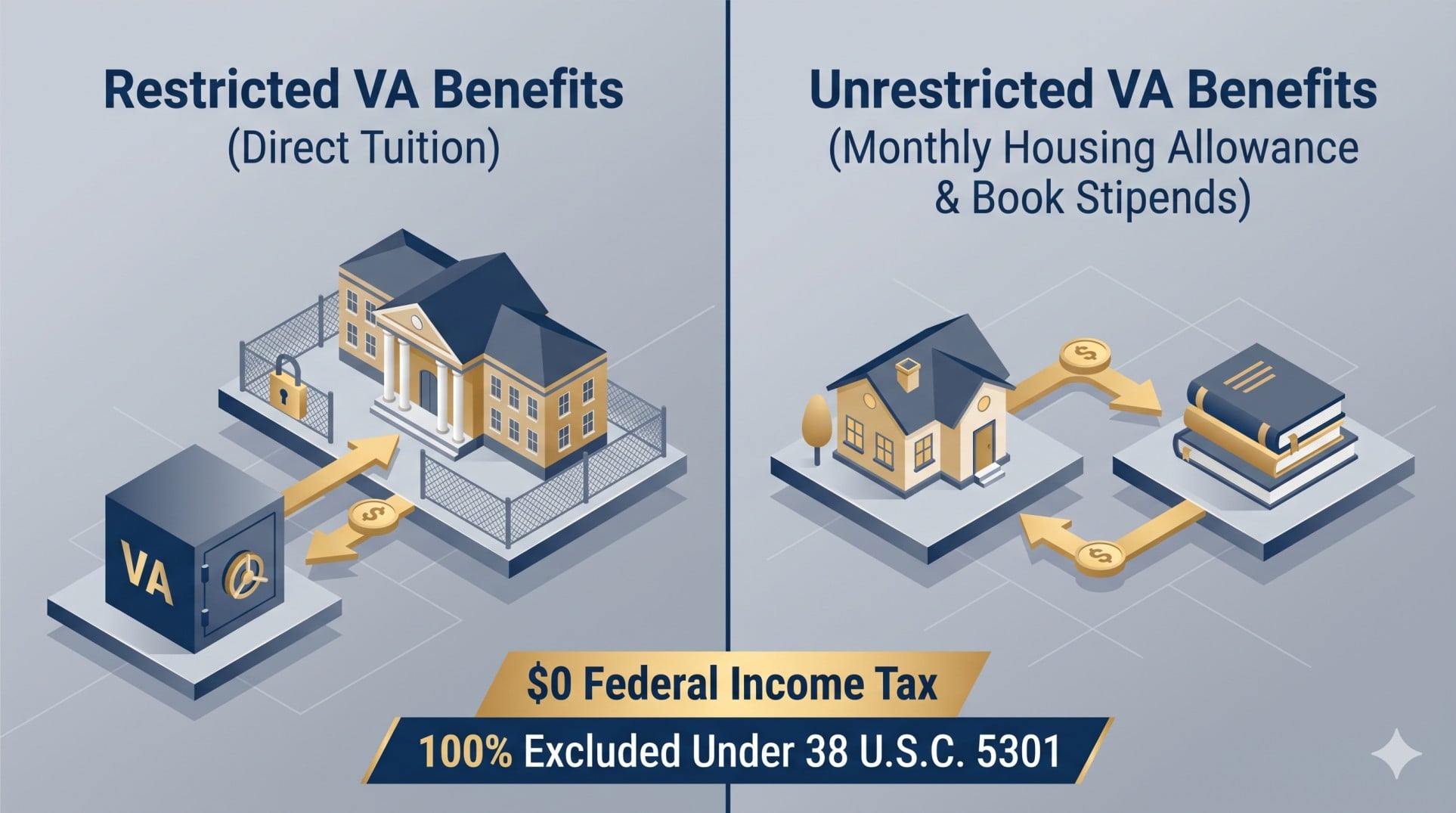
- Restricted vs. Unrestricted Stipends: Direct VA tuition payments reduce your qualified expenses on Form 8863, whereas an unrestricted VA housing allowance paid directly to you can be used to pay remaining tuition without reducing your tax credit eligibility.
- 2026 MAGI Phase-Outs: Both the AOTC and LLC phase out for single filers with Modified Adjusted Gross Income (MAGI) between $80,000 and $90,000 ($160,000 to $180,000 for Married Filing Jointly), alongside the 2026 standard deduction of $16,100 for single filers and $32,200 for joint filers per IRS Revenue Procedure 2025-32.
Table of Contents
- ⚡ Executive Summary: Key 2026 Tax Rules at a Glance
- How the Tax Exclusion for Veterans Education Benefits Works in 2026
- Which Programs Qualify for VA Education Benefits Tax-Free Treatment?
- Coordinating IRS Publication 970 Veterans Benefits With 2026 Tax Credits
- Real-World 2026 Tax Scenarios and Step-by-Step Math
- Step-by-Step Guide to Reporting GI Bill Tax Credits Form 8863 in 2027
- Frequently Asked Questions About Veterans Education Tax Rules
- Final Thoughts on Maximizing Your 2026 Education Tax Breaks
How the Tax Exclusion for Veterans Education Benefits Works in 2026
The tax exclusion for veterans education benefits operates as a complete statutory exemption from federal gross income under Title 38 of the U.S. Code, Section 5301, and Internal Revenue Code (IRC) Section 134. Payments administered by the Department of Veterans Affairs for education, training, or subsistence are never taxed, nor do they appear anywhere on Form 1040.
Unlike certain civilian scholarships or employer-provided tuition assistance under IRC Section 127—which is capped at $5,250 before becoming taxable wages—veterans benefits have no dollar ceiling. Whether the VA sends $8,000 to a community college or $65,000 to a private medical school via the Yellow Ribbon Program, your federal tax liability on that assistance is exactly $0.
Because this benefit is a statutory exclusion rather than an “above-the-line” deduction on Schedule 1 or a “below-the-line” itemized deduction on Schedule A, it leaves your Adjusted Gross Income (AGI) and Modified Adjusted Gross Income (MAGI) completely untouched. Keeping your AGI low preserves your eligibility for income-sensitive tax breaks, including the 2026 student loan interest deduction (which phases out between $85,000 and $100,000 for single filers, or $175,000 and $205,000 for joint filers) and the 2026 Earned Income Tax Credit rules for military families.
Federal vs. State Tax Conformity for VA Education Payouts
At the federal level, the IRS treats all VA education payouts as non-taxable. State Departments of Revenue across all 50 states and the District of Columbia conform to this exclusion because state income tax returns generally use federal AGI or federal taxable income as their starting point.
Since VA education stipends never enter your federal AGI on Form 1040, Line 11, they automatically bypass your state income tax calculation. However, if you use a state-sponsored 529 college savings plan alongside your GI Bill, be careful: while federal rules allow penalty-free 529 withdrawals up to the amount of tax-free military educational assistance received, a few states require state tax recapture if you withdraw 529 funds for non-qualified purposes after already deducting the contributions on a prior state return.
Which Programs Qualify for VA Education Benefits Tax-Free Treatment?
Every educational program administered by the Department of Veterans Affairs receives VA education benefits tax-free status, regardless of whether the recipient is the veteran, a current service member, a spouse, or a dependent child. If the payment originates from a VA-administered education or subsistence law, the IRS excludes it from gross income.
According to IRS Publication 970 (Tax Benefits for Education) and IRS Publication 525 (Taxable and Nontaxable Income), the following specific payouts are 100% exempt from federal income tax and self-employment tax:
- Post-9/11 GI Bill (Chapter 33): Direct tuition and fee payments sent to the school, the Monthly Housing Allowance (MHA), the annual $1,000 books and supplies stipend, rural relocation payments, and Yellow Ribbon Program matching contributions.
- Montgomery GI Bill Active Duty (MGIB-AD, Chapter 30) and Selected Reserve (MGIB-SR, Chapter 1606): Monthly flat-rate educational assistance allowances paid directly to the student’s bank account.
- Veteran Readiness and Employment (VR&E, formerly Vocational Rehabilitation, Chapter 31): Full tuition coverage, monthly subsistence allowances, laptop and equipment grants, and licensing or certification test reimbursements.
- Survivors’ and Dependents’ Educational Assistance (DEA, Chapter 35): Monthly stipends paid to eligible spouses and children of veterans who are permanently and totally disabled due to a service-connected condition, or who died on active duty.
- Edith Nourse Rogers STEM Scholarship & Marine Gunnery Sergeant John David Fry Scholarship: All tuition, housing, and book payouts received by qualifying STEM students or surviving family members.
- Transferred Post-9/11 GI Bill Benefits: When a service member transfers unused Chapter 33 months to a spouse or child, the dependent enjoys the exact same tax-free exclusion as the veteran.
CPA Audit Warning on VA Work-Study vs. Federal Work-Study: Don’t confuse the VA Work-Study Allowance Program with standard campus Federal Work-Study. Wages earned through the VA Work-Study program (administered under 38 U.S.C. Section 3485) are completely tax-free, and the VA will not issue a Form W-2. Standard campus Federal Work-Study under Title IV is fully taxable income reported on Form W-2.
Coordinating IRS Publication 970 Veterans Benefits With 2026 Tax Credits
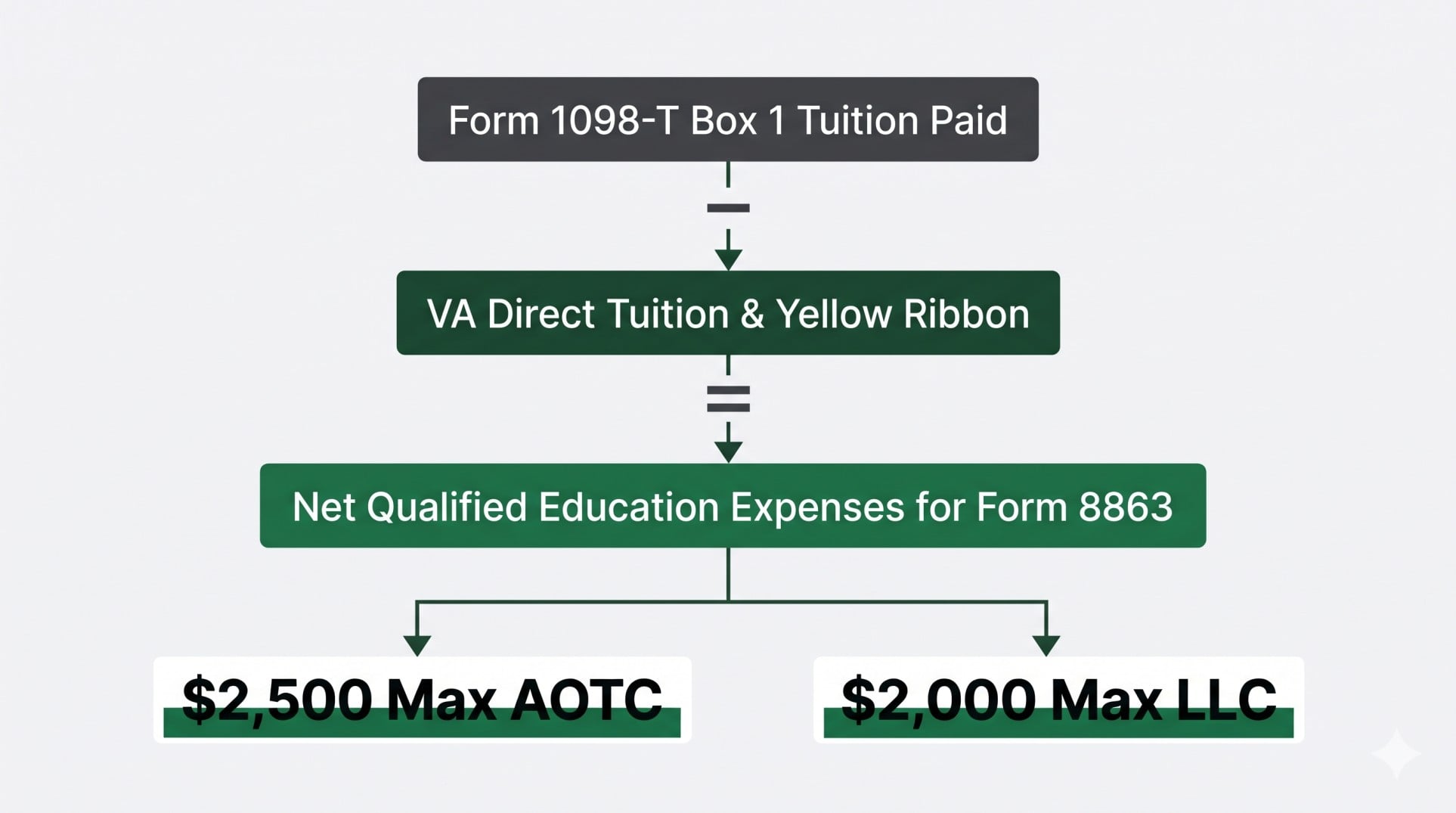
While the IRS Publication 970 veterans benefits rules guarantee you won’t pay income tax on VA payouts, those benefits can reduce the dollar amount of college tax credits you claim on your return. Under the IRS “no double benefit” rule, you cannot claim an education tax credit for tuition expenses that the VA paid with restricted funds.
To calculate your 2026 education credits accurately, you must divide your VA benefits into two legal buckets: restricted educational assistance and unrestricted educational assistance. Restricted funds are payments that the VA requires to be used exclusively for tuition, fees, or course materials—such as Post-9/11 GI Bill tuition payments sent straight to your university. You must subtract these restricted amounts from your total qualified tuition and related expenses before calculating a tax credit.
Conversely, an unrestricted VA housing allowance (like the Post-9/11 GI Bill Monthly Housing Allowance or the flat-rate Montgomery GI Bill stipend) is deposited directly into your personal bank account to spend at your discretion. Because the VA does not legally restrict how you spend housing or subsistence deposits, the IRS treats those dollars just like personal cash. If you use your unrestricted VA housing allowance or personal wages to pay out-of-pocket tuition that the VA didn’t cover, those payments qualify for the American Opportunity Tax Credit or Lifetime Learning Credit!
Tax Year 2025 vs. Tax Year 2026 Comparison Table
Before calculating your credits, review how the 2026 post-OBBBA tax landscape compares to 2025. Under the One Big Beautiful Bill Act (Public Law 119-21) and IRS Revenue Procedure 2025-32, standard deductions and student loan interest limits rose for inflation, while strict new SSN and EIN verification mandates took effect for 2026 education credits.
| Tax Provision / Threshold | Tax Year 2025 (Filed in 2026) | Tax Year 2026 (Filed in 2027) | Impact on Student Veterans |
|---|---|---|---|
| VA Education Benefits Exclusion | 100% Excluded from Gross Income | 100% Excluded from Gross Income | No change; tuition, MHA, and stipends remain 100% tax-free. |
| Standard Deduction (Single / MFJ / HoH) | $15,750 / $31,500 / $23,625 | $16,100 / $32,200 / $24,150 | Higher 2026 baseline lowers taxable civilian income alongside tax-free VA benefits. |
| American Opportunity Tax Credit (AOTC) Max | Up to $2,500 per student ($1,000 refundable) | Up to $2,500 per student ($1,000 refundable) | Requires $4,000 of net out-of-pocket qualified expenses after subtracting direct VA tuition. |
| Lifetime Learning Credit (LLC) Max | Up to $2,000 per return (Non-refundable) | Up to $2,000 per return (Non-refundable) | 20% of up to $10,000 in net unreimbursed tuition; ideal for graduate or part-time veterans. |
| AOTC & LLC MAGI Phase-Out Range | $80,000–$90,000 (Single) / $160,000–$180,000 (MFJ) | $80,000–$90,000 (Single) / $160,000–$180,000 (MFJ) | Not indexed for inflation; VA benefits are excluded from MAGI, helping veterans stay below the cap. |
| SSN & Institutional EIN Mandate (OBBBA) | ITINs permitted for certain filers; EIN required for AOTC | Valid Work SSN mandatory for claimant & student (Sec. 70606) | Starting in 2026, ITIN holders are strictly barred from claiming AOTC or LLC on Form 8863. |
| Student Loan Interest Deduction Phase-Out | $85,000–$100,000 (Single) / $170,000–$200,000 (MFJ) | $85,000–$100,000 (Single) / $175,000–$205,000 (MFJ) | Up to $2,500 above-the-line deduction on Schedule 1; MFJ phase-out threshold increased by $5,000 for 2026. |
VA Benefit Treatment Matrix for Form 8863 Credits
This second reference table breaks down exactly how each specific VA payout affects your gross income and your ability to claim GI Bill tax credits Form 8863 in 2026. If you are also balancing civilian self-employment or W-2 wages, check our guide on the 2026 federal income tax brackets and standard deduction to see how your non-military earnings are taxed.
| VA Benefit Payment Type | Taxable on Form 1040? | Restricted or Unrestricted by VA? | Reduces Qualified Expenses on Form 8863? |
|---|---|---|---|
| Post-9/11 GI Bill Direct Tuition & Fees | No (100% Tax-Free) | Restricted (Paid to School for Tuition) | Yes. Must be subtracted dollar-for-dollar from total tuition. |
| Yellow Ribbon Program Contributions | No (100% Tax-Free) | Restricted (Tuition Match) | Yes. Reduces eligible tuition expenses for AOTC and LLC. |
| Post-9/11 GI Bill Monthly Housing Allowance (MHA) | No (100% Tax-Free) | Unrestricted (Paid to Student) | No. Treated as personal cash; does not reduce eligible tuition. |
| Post-9/11 GI Bill Books & Supplies Stipend | No (100% Tax-Free) | Restricted (Designated for Course Materials) | Yes (for AOTC book claims). Reduces out-of-pocket book expenses. |
| Montgomery GI Bill (Chapter 30 / 1606) Monthly Stipend | No (100% Tax-Free) | Unrestricted (Flat Stipend to Student) | No. Tuition paid with MGIB stipends qualifies for AOTC/LLC! |
| Chapter 35 DEA Survivor & Dependent Stipend | No (100% Tax-Free) | Unrestricted (Paid to Dependent) | No. Qualified tuition paid out-of-pocket remains eligible for credits. |
Real-World 2026 Tax Scenarios and Step-by-Step Math
To see how the tax exclusion for veterans education benefits interacts with IRS Publication 970 veterans benefits adjustment rules in practice, let’s walk through three real-world 2026 calculation scenarios.
Scenario 1: Post-9/11 GI Bill at 80% Eligibility Tier (Claiming the AOTC)
Meet Caleb, a 26-year-old Navy veteran living in Virginia who served 26 months on active duty, placing him in the 80% Post-9/11 GI Bill benefit tier. In 2026, Caleb attends a state university full-time for his junior year and works part-time earning $42,000 in W-2 wages. He is a single filer taking the 2026 standard deduction of $16,100.
- 2026 University Tuition & Mandatory Fees (Form 1098-T, Box 1): $15,000
- Required Course Materials Bought Out-of-Pocket: $1,200
- VA Direct Tuition Payment to School (80% Tier): $12,000
- VA Book Stipend Paid to Caleb (80% of $1,000): $800
- VA Monthly Housing Allowance (MHA) Received in 2026: $16,200
First, Caleb excludes all $29,000 of his VA benefits ($12,000 tuition + $800 book stipend + $16,200 MHA) from his gross income. His 2026 AGI is strictly his $42,000 W-2 salary, which is well below the $80,000 AOTC MAGI phase-out threshold. After subtracting his $16,100 standard deduction, his taxable income is $25,900, resulting in a 2026 baseline federal tax liability of $2,860 (10% on the first $12,400 = $1,240, plus 12% on the remaining $13,500 = $1,620).
Next, Caleb calculates his eligible expenses for the American Opportunity Tax Credit. His total qualified expenses are $16,200 ($15,000 tuition + $1,200 required books). He must subtract his restricted VA benefits: the $12,000 direct tuition payment and the $800 book stipend (totaling $12,800). He does not subtract his $16,200 unrestricted VA housing allowance, even though he used part of that MHA deposit to pay the remaining $3,000 tuition bill!
Caleb’s net qualified education expenses equal $3,400 ($16,200 minus $12,800). On Form 8863, the AOTC gives him 100% of the first $2,000 plus 25% of the remaining $1,400 ($350), generating a total tax credit of $2,350. That credit slashes his 2026 tax bill from $2,860 down to $510.
Scenario 2: Montgomery GI Bill (Chapter 30) Graduate Student Claiming the LLC
Consider Brianna, an Army National Guard veteran in Texas pursuing a Master’s degree in cybersecurity during 2026. Instead of the Post-9/11 GI Bill, she receives flat-rate monthly stipends under the Montgomery GI Bill (Chapter 30). She is married filing jointly with her spouse; their combined 2026 W-2 income is $135,000, and they take the $32,200 joint standard deduction.
- 2026 Graduate Tuition Paid to University: $11,000
- Total Chapter 30 MGIB Stipends Deposited to Brianna’s Checking Account: $19,800
Because Chapter 30 MGIB payments are sent directly to the student without a statutory requirement that every specific dollar be remitted to the school, IRS Publication 970 classifies them as unrestricted subsistence/educational allowances. Brianna excludes the entire $19,800 from gross income. Furthermore, because the stipend is unrestricted, she does not have to reduce her $11,000 tuition payment on Form 8863!
Since Brianna already holds a bachelor’s degree, she cannot claim the AOTC, so she claims the Lifetime Learning Credit. Her joint MAGI of $135,000 sits below the $160,000 joint phase-out floor. She claims 20% of the first $10,000 of her tuition, securing the maximum $2,000 non-refundable Lifetime Learning Credit to directly offset her family’s 2026 federal income tax.
Scenario 3: 100% Post-9/11 GI Bill With Transferred Dependent Benefits
Look at Sergeant First Class Mateo and his wife Elena, who transferred 18 months of Mateo’s 100% Post-9/11 GI Bill to their 19-year-old daughter, Sofia, a college freshman in 2026. Sofia’s public university charges $10,500 in tuition and fees, and the VA pays the entire $10,500 directly to the school, plus a $1,000 book stipend and $14,000 in MHA. Sofia also spends $650 on required lab manuals and chemistry access codes.
Because the VA paid 100% of the $10,500 tuition and provided a $1,000 book stipend (which exceeds Sofia’s $650 in required course materials), Sofia’s net qualified education expenses after subtracting restricted VA assistance equal $0. Mateo and Elena enjoy $25,500 in VA education benefits tax-free support, but they cannot claim any AOTC or LLC on Form 8863 for Sofia in 2026. Attempting to claim the $10,500 listed in Box 1 of Sofia’s Form 1098-T without subtracting the VA payment in Box 5 is one of the top triggers for IRS CP2000 underreporter notices. For more strategies on managing dependent credits, review our breakdown of the 2026 Child Tax Credit and dependent rules.
Step-by-Step Guide to Reporting GI Bill Tax Credits Form 8863 in 2027
Filing your 2026 tax return properly requires leaving your tax-free VA benefits off your income lines while carefully reconciling your university tuition statement on Form 8863. Follow these five steps when preparing your return before the April 15, 2027 deadline.
- Omit All VA Payments From Form 1040 Income Lines: Do not enter your GI Bill tuition, MHA, or book stipends on Form 1040, Line 1 (wages) or Schedule 1, Line 8 (other income). Even if a third-party processor or university lists VA grants on a financial aid summary, they are legally excluded from gross income.
- Audit Your Form 1098-T (Tuition Statement): By February 1, 2027, your college will issue Form 1098-T for the 2026 calendar year. Look at Box 1 (Payments received for qualified tuition and related expenses) and Box 5 (Scholarships or grants). Most universities include direct Post-9/11 GI Bill tuition and Yellow Ribbon payments inside Box 5. However, schools frequently omit the VA book stipend or record spring 2027 VA disbursements out of sync with the calendar year. Cross-check Box 1 and Box 5 against your actual 2026 Bursar account ledger and VA award letters.
- Compute Net Adjusted Qualified Education Expenses: Use Worksheet 1-1 in IRS Publication 970 to subtract restricted VA tuition payments and restricted book stipends from your total qualified tuition, mandatory enrollment fees, and required course materials paid in 2026. Keep your unrestricted VA housing allowance completely out of this subtraction.
- Complete Form 8863 (Education Credits): If your net out-of-pocket qualified expenses are greater than zero, open Form 8863. Enter your student details and net expenses in Part III (Lines 20–31). Remember the strict 2026 OBBBA compliance rule: you must enter the educational institution’s 9-digit Employer Identification Number (EIN) on Line 22(4) for the AOTC, and both the taxpayer and student must have a valid work-authorized Social Security Number issued before the return due date.
- Transfer Credits to Form 1040 and Schedule 3: Compute the refundable portion of your AOTC (40% of the credit, up to $1,000) in Part I of Form 8863 and transfer it directly to Form 1040, Line 29. Calculate the non-refundable portion of the AOTC or the Lifetime Learning Credit in Part II of Form 8863, report it on Schedule 3 (Form 1040), Line 3, and carry it to Form 1040, Line 20.
Pro-Tip for Prior Overpayments: Did you accidentally report your GI Bill housing allowance as taxable income or forget to claim the AOTC on out-of-pocket tuition in 2023, 2024, or 2025? You can recover that cash by filing Form 1040-X (Amended U.S. Individual Income Tax Return) within three years of the original filing deadline. Also, if you have service-connected disability pay, verify how it interacts with your taxes in our guide to VA disability compensation tax rules.
Frequently Asked Questions About Veterans Education Tax Rules
1. Is the Post-9/11 GI Bill Monthly Housing Allowance (MHA) taxable in 2026?
No, the Post-9/11 GI Bill Monthly Housing Allowance is 100% tax-free and excluded from federal and state gross income. Under IRS Publication 970, you never report MHA deposits on Form 1040, and the VA does not issue a Form 1099 or W-2 for housing stipends.
2. Does the VA send a tax form like a 1099-G or W-2 for GI Bill benefits?
No, the Department of Veterans Affairs does not issue Form W-2, Form 1099-G, or Form 1099-MISC for educational assistance payments. Because the tax exclusion for veterans education benefits makes these funds completely exempt from taxation, the IRS requires zero information reporting from the VA.
3. Why are my GI Bill payments showing up in Box 5 of Form 1098-T?
Colleges are required by the IRS to report all third-party grants and scholarships administered and processed for tuition in Box 5 of Form 1098-T, which includes direct VA tuition payments under Chapter 33 and Chapter 31. Box 5 does not mean the money is taxable; it simply alerts the IRS that a portion of your Box 1 tuition was paid by a tax-free source.
4. Can I claim the American Opportunity Tax Credit if I use the GI Bill?
Yes, you can claim the American Opportunity Tax Credit as long as your total qualified tuition and required book expenses exceed the restricted tuition and book stipends paid by the VA. If you are at the 60% or 80% GI Bill tier—or if you use the Montgomery GI Bill—your out-of-pocket tuition payments qualify on Form 8863.
5. Do VA education benefits count toward Modified Adjusted Gross Income (MAGI)?
No, VA education benefits are excluded from both Adjusted Gross Income (AGI) and Modified Adjusted Gross Income (MAGI) for federal income tax purposes. They will not push you over the $80,000–$90,000 single (or $160,000–$180,000 joint) MAGI phase-out limits for 2026 education credits, nor do they count as taxable income for the 2026 Premium Tax Credit ACA subsidy rules.
6. Are Chapter 35 DEA benefits taxable to a veteran’s spouse or child?
No, Survivors’ and Dependents’ Educational Assistance (Chapter 35 DEA) payments are completely tax-free to the receiving spouse or dependent child. Neither the veteran nor the student reports Chapter 35 monthly stipends as income on their federal or state tax returns.
7. Can I deduct student loan interest paid with my VA housing allowance?
Yes, you can deduct up to $2,500 of qualified student loan interest on Schedule 1 (Form 1040), Line 21 even if you used your unrestricted VA housing allowance to make the monthly loan payments. Because MHA is an unrestricted benefit, the IRS treats those loan payments the same as payments made from regular wages.
8. How do VA education benefits interact with a 529 college savings plan in 2026?
You cannot use tax-free 529 plan withdrawals to pay for the exact same tuition dollars already covered by direct VA tuition payments. However, if the VA covers your tuition, you can withdraw an equivalent dollar amount from a 529 plan without paying the standard 10% federal penalty on the earnings portion (though the earnings portion of a non-qualified withdrawal remains subject to ordinary income tax).
9. Are VR&E (Chapter 31) subsistence allowances and equipment grants taxable?
No, all benefits provided under the Veteran Readiness and Employment (Chapter 31) program—including full tuition, monthly subsistence allowances, and free computers or tools required for your rehabilitation plan—are 100% excluded from taxable income under Title 38.
Final Thoughts on Maximizing Your 2026 Education Tax Breaks
The statutory tax exclusion for veterans education benefits ensures that every cent of your hard-earned GI Bill, VR&E, or DEA entitlement goes toward your degree rather than the IRS. When you sit down to prepare your 2026 tax return ahead of the April 15, 2027 filing deadline, remember to leave all VA payouts off your Form 1040 income lines. By carefully separating restricted direct tuition awards from your unrestricted VA housing allowance on Form 8863, you can stay 100% compliant with IRS Publication 970 while capturing every dollar of the $2,500 American Opportunity Tax Credit or $2,000 Lifetime Learning Credit you leg
