
On January 1, 2026, the Washington 95% tax on vapes and nicotine pouches took effect under Engrossed Substitute Senate Bill 5814 (ESSB 5814), triggering the most aggressive nicotine price shock and regulatory overhaul in Pacific Northwest history. By amending RCW 82.26.010 to classify every product containing tobacco-derived or synthetic nicotine as an “Other Tobacco Product” (OTP), the Washington Legislature replaced volume-based e-liquid taxation on nicotine vapes and closed the synthetic oral pouch exemption overnight.
For Washington convenience stores, smoke shops, vape lounges, and out-of-state distributors, the financial and administrative fallout throughout 2026 and 2027 has been severe. Cans of oral nicotine pouches and disposable e-cigarettes have nearly doubled in retail price, sending border-county shoppers into Idaho and Oregon while leaving Washington retailers with a mandatory 95% floor stock tax on pre-existing inventory, zero credit for previously paid per-milliliter vapor taxes, and strict new licensing and Litter Tax mandates.
Here is the definitive 2026–2027 compliance and audit-survival playbook for Washington retailers and multi-state distributors—covering exact statutory mechanics, wholesale-to-retail tax-on-tax math, inventory lookback audits, and step-by-step filing rules on My DOR.
⚡ Executive Summary: Key 2026–2027 Tax Compliance Rules at a Glance
- 95% OTP Tax Expansion (Effective January 1, 2026): Under ESSB 5814 (Chapter 422, Laws of 2025, Section 301), Washington amended RCW 82.26.010 so that any product containing nicotine—whether derived from tobacco or created synthetically—is subject to the 95% Tobacco Products Tax under RCW 82.26.020. This covers oral nicotine pouches (such as ZYN, On!, Velo, and Rogue), disposable nicotine vapes, e-cigarettes, and nicotine e-liquids.
- No Credit for Prior Vapor Tax & Mandatory Inventory Reporting: Retailers and distributors were required to declare and pay the 95% tax on all nicotine products held in stock on January 1, 2026 using the dedicated Combined Excise Tax Return line item “Pre-existing inventories of nicotine products as of January 1, 2026.” Per the Washington Department of Revenue (DOR), no credit is allowed for the $0.09/mL or $0.27/mL Vapor Products Tax previously paid on that inventory.
- 0.015% Litter Tax & Tax-on-Tax Retail Cascade: Because nicotine vapes and synthetic pouches are now statutorily classified as “tobacco products,” all wholesale and retail sales of these items are subject to Washington’s 0.015% (0.00015) Litter Tax under RCW 82.19.010, plus Wholesaling/Retailing B&O Tax (0.484% / 0.471%) and combined state and local Retail Sales Tax (6.5% state base, up to 10.35% in Seattle) applied on top of the 95% excise-inflated price.
- Constitutional Litigation & Strict Enforcement Warning: Despite ongoing 2026 court challenges alleging that DOR’s interpretation of ESSB 5814 violates the Washington Constitution by taxing nicotine vapes under both Chapter 82.26 RCW and Chapter 82.25 RCW, DOR has issued formal notices confirming it is strictly enforcing the 95% tax. Buying from unlicensed out-of-state distributors makes the Washington retailer personally liable for the 95% tax, up to 39% in late penalties, and inventory seizure by the Washington State Liquor and Cannabis Board (LCB).
Table of Contents
- ⚡ Executive Summary: Key 2026–2027 Tax Compliance Rules at a Glance
- How Washington SB 5814 Expanded the 95% Tax to Vapes & Nicotine Pouches
- Supply-Chain Incidence: Unaffiliated vs. Affiliated Pricing & The No-Credit Vape Trap
- Mandatory Pre-Existing Inventory Reporting & Litter Tax Rules for 2026–2027
- 2026–2027 Business Scenarios: Wholesale & Retail Tax-on-Tax Math
- Out-of-State Distributors, LCB Licensing & PACT Act Schedule C4 (ENDS) Rules
- Step-by-Step My DOR Filing & Audit Survival Guide for WA Retailers & Distributors
- Frequently Asked Questions About Washington’s 95% Nicotine & Vape Tax
- Protecting Your Convenience Store or Distribution Business From WA DOR Audits
How Washington SB 5814 Expanded the 95% Tax to Vapes & Nicotine Pouches
Effective January 1, 2026, Washington SB 5814 tobacco products tax provisions expanded the statutory definition of “tobacco products” under RCW 82.26.010(21) to include any product containing tobacco or nicotine—whether derived from tobacco or synthetically manufactured—subjecting them to a 95% excise tax on their taxable sales price.
Why did Olympia lawmakers enact such a drastic shift? Prior to 2026, Washington’s excise tax code split non-cigarette products into two separate statutory silos, creating a massive revenue gap as consumer habits shifted away from combustible leaf tobacco:
- The Pre-2026 Synthetic Nicotine Pouch Loophole: Historically, Chapter 82.26 RCW taxed “Other Tobacco Products” (OTP) at 95% of the taxable sales price, but defined OTP strictly as products that “contain tobacco.” Oral nicotine pouches made with tobacco-free synthetic nicotine—or purified nicotine salts extracted without tobacco leaf—did not meet the statutory definition of a cigarette (Chapter 82.24 RCW), a vapor product (Chapter 82.25 RCW), or a traditional tobacco product (Chapter 82.26 RCW). As a result, oral pouches sold across Washington prior to January 1, 2026 carried $0.00 in state tobacco or vapor excise tax.
- The Pre-2026 Volume-Based Vapor Tax: From October 1, 2019 through December 31, 2025, e-cigarettes, pods, and e-liquids were taxed strictly by liquid volume under Chapter 82.25 RCW at $0.09 per milliliter for accessible containers over 5 mL and $0.27 per milliliter for closed pods and containers of 5 mL or less.
Signed by Governor Bob Ferguson on May 20, 2025 to help close a multi-billion-dollar state budget shortfall, Engrossed Substitute Senate Bill 5814 rewrote RCW 82.26.010 effective January 1, 2026. Under the Washington Department of Revenue’s Special Notice (“Nicotine products are now subject to the tobacco products tax”), any product containing nicotine intended for human consumption—by smoking, vaping, chewing, placement in the oral or nasal cavity, or absorption by any other means—is now taxed at the 95% OTP rate.
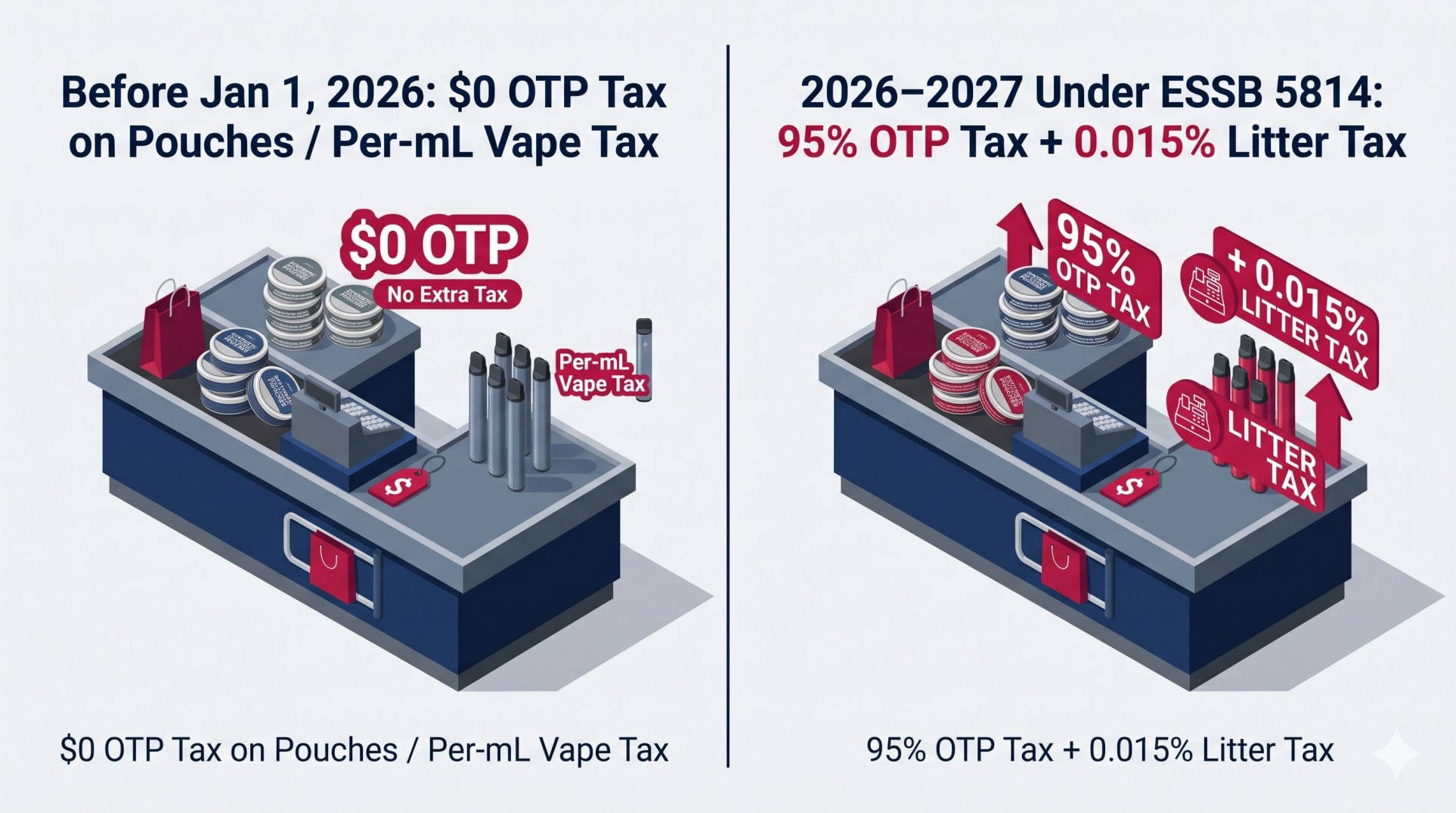
What Is Newly Taxed at 95% vs. What Is Excluded in 2026–2027?
To prevent costly misclassifications in your point-of-sale (POS) and ERP tax engines, every distributor and retailer must separate newly covered 95% OTP items from products that remain under separate tax schedules:
- Newly Subject to the 95% OTP Tax (RCW 82.26.020): All tobacco-derived and synthetic nicotine pouches (ZYN, On!, Velo, Rogue, Fre, Lucy), nicotine lozenges/gums/toothpicks (unless FDA-approved as cessation drugs), disposable vapor products containing nicotine, closed-system nicotine pods, open-system bottled e-liquids containing nicotine, and e-cigarettes bundled with nicotine liquid.
- Zero-Nicotine (0 mg) Vapor Products (Remain Under RCW 82.25.010): E-liquids and disposable vapes that contain zero nicotine (neither tobacco-derived nor synthetic) do not meet the definition of a tobacco/nicotine product under Chapter 82.26 RCW. Instead, 0 mg vapor liquids remain subject to the volume-based Vapor Products Tax of $0.09 per mL (accessible containers over 5 mL) or $0.27 per mL (all other containers 5 mL or less).
- Traditional OTP Items With Specific Rate Caps (Unchanged Under RCW 82.26.020): While pipe tobacco, chewing tobacco, and roll-your-own tobacco remain at 95% of the taxable sales price, large cigars remain taxed at 95% of the taxable sales price capped at $0.65 per cigar; little cigars remain taxed at $0.15125 per cigar ($3.025 per pack of 20); moist snuff in containers of 1.2 oz. or less is taxed at $2.526 per unit; and moist snuff over 1.2 oz. is taxed at $2.105 per ounce. (Note: Dry synthetic or tobacco-free nicotine pouches do not qualify for the per-can moist snuff rate—they are taxed at the uncapped 95% ad valorem rate!)
- Statutory Exclusions (Cigarettes & FDA Cessation Drugs): Combustible cigarettes remain taxed separately under Chapter 82.24 RCW at $3.025 per pack of 20 ($30.25 per carton). Additionally, RCW 82.26.010 excludes drugs, devices, or combination smoking-cessation products (such as Nicorette gum or NicoDerm CQ patches) approved for sale by the U.S. Food and Drug Administration (FDA) as of December 31, 2024 under the Federal Food, Drug, and Cosmetic Act (21 U.S.C. Sec. 301 et seq.). Note that FDA Premarket Tobacco Product Application (PMTA) marketing granted orders (such as those issued for ZYN or e-cigarettes) are tobacco marketing authorizations—not FDA drug/device approvals—meaning PMTA-authorized pouches and vapes are 100% taxable at 95%.
- Modified Risk Tobacco Products (MRTP) Rate Reductions (RCW 82.26.020(3)): Products granted a specific FDA Modified Risk Tobacco Product (MRTP) exposure-modification order qualify for a 25% reduction in the OTP tax rate (bringing the 95% rate down to 71.25%), while products granted an FDA risk-modification MRTP order qualify for a 50% reduction (bringing the 95% rate down to 47.5%). Always verify active FDA MRTP order status with DOR before applying a reduced rate.
Multi-state wholesalers and e-commerce vape sellers navigating similar state excise spikes can review our 2026–2027 multi-state vape, OTP, and synthetic nicotine excise tax compliance guide to benchmark Washington against California, Minnesota, and Utah.
Supply-Chain Incidence: Unaffiliated vs. Affiliated Pricing & The No-Credit Vape Trap
Under RCW 82.26.020 and RCW 82.26.010(19), the legal incidence of the Washington 95% tax on vapes and nicotine pouches falls on the first “distributor” who brings, manufactures, ships, or handles the products for sale in Washington, calculated on the “taxable sales price” including freight and delivery charges.
Understanding who is legally classified as the “distributor” and how the “taxable sales price” is defined under Washington law is the single most important defense against a six-figure DOR audit assessment.
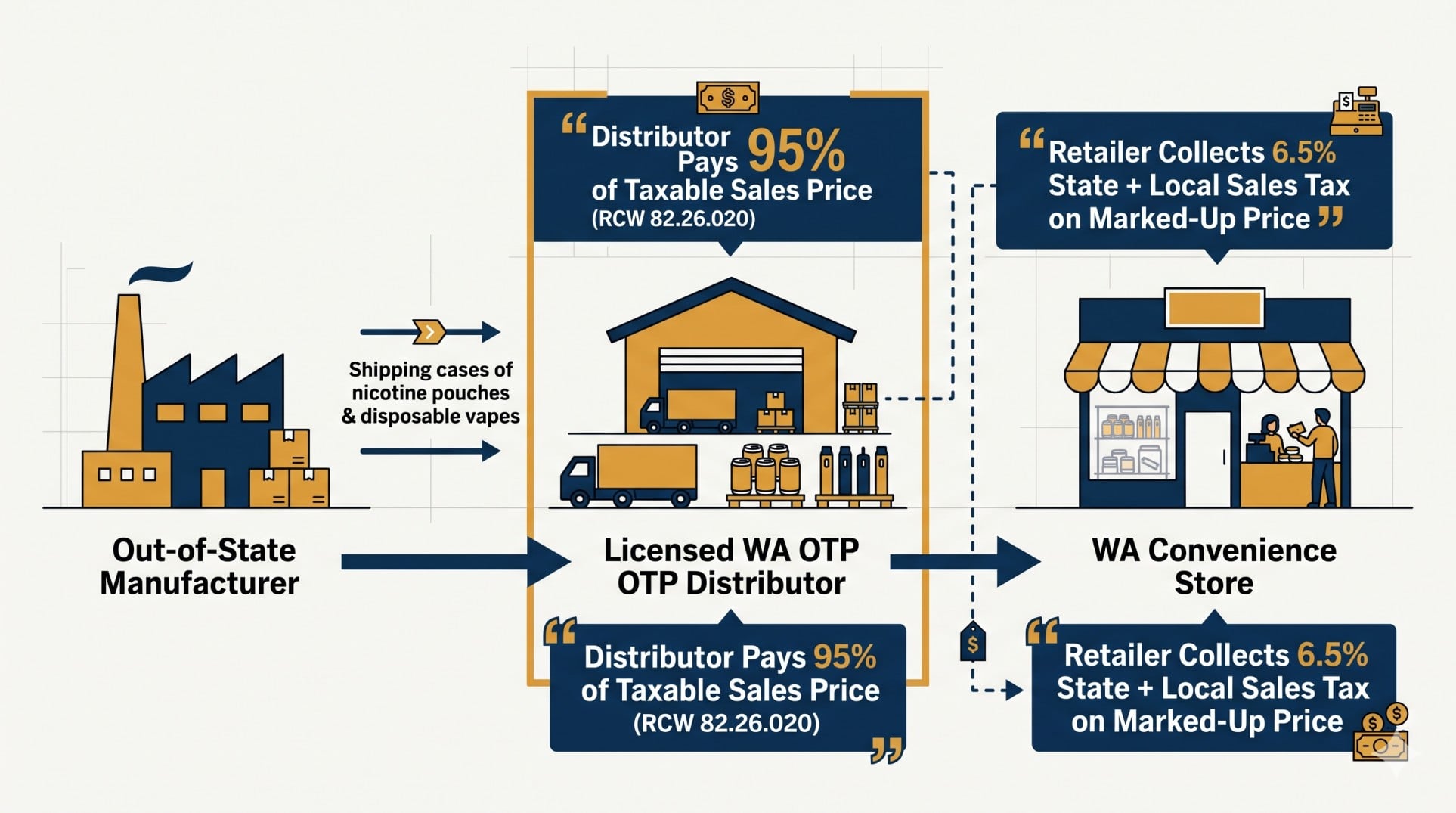
How “Taxable Sales Price” Is Calculated (RCW 82.26.010)
Unlike retail sales tax—which is calculated on the final checkout price paid by the consumer—Washington’s 95% OTP tax is a wholesale-tier tax based on the distributor’s taxable sales price. However, the exact dollar base depends on whether the distributor is affiliated with the supplier and whether a Washington retailer buys from a licensed or unlicensed source:
- Purchases From an Unaffiliated Manufacturer or Wholesaler (RCW 82.26.010(19)(a)(i)): When a Washington distributor (or a Washington retailer importing untaxed goods) buys nicotine pouches or vapes from an unaffiliated seller, the taxable sales price is the actual purchase price paid by the taxpayer, including all charges for delivery, freight, transportation, or handling necessary to complete the sale. If a manufacturer invoices a distributor $10,000 for nicotine pouches plus $400 for shipping, the 95% tax applies to the full $10,400 ($9,880.00 in OTP tax!).
- Purchases From an Affiliated Manufacturer or Distributor (RCW 82.26.010(19)(a)(ii)): Vertically integrated vape and pouch brands cannot artificially lower their Washington OTP tax by transferring inventory between related corporate entities at nominal cost. If the taxpayer purchases products from an affiliated manufacturer or distributor, the 95% tax is calculated on the actual selling price for which the taxpayer sells those products to unaffiliated distributors, unaffiliated retailers, or ultimate consumers.
- When a Washington Retailer Becomes a Statutory Distributor: If a Washington smoke shop or convenience store orders nicotine pouches or disposable vapes from an out-of-state wholesaler that has not paid the Washington 95% OTP tax, the Washington retailer becomes the statutory distributor upon first possession in the state under RCW 82.26.010(8) and RCW 82.26.200. The retailer must hold both an OTP Retailer License and an OTP Distributor License and remit the 95% tax directly to DOR on its Combined Excise Tax Return.
The Double-Taxation Trap & Ongoing 2026 Constitutional Litigation
When Washington SB 5814 tobacco products tax amendments were drafted in 2025, the Legislature expanded “tobacco products” in RCW 82.26.010 to include all nicotine products without simultaneously repealing the existing Vapor Products Tax language in Chapter 82.25 RCW ( prompting cleanup bills like SB 6129 and HB 2382 during the 2026 legislative session and triggering a major constitutional lawsuit against DOR).
Critical DOR Audit Warning: Constitutional Lawsuits Do Not Pause Your Filing Duty
In its official 2026 Notice Regarding Legal Proceedings on ESSB 5814, the Washington Department of Revenue acknowledged that industry plaintiffs have sued the state arguing that DOR’s interpretation violates the Washington Constitution. However, DOR explicitly warned that under Washington law, statutes are presumed constitutional and an administrative agency cannot refuse to enforce them. Retailers and distributors must continue reporting and paying the 95% tax on all nicotine vapes and pouches in 2026–2027, and DOR has confirmed that zero credit is allowed for any per-milliliter vapor tax previously paid on nicotine e-liquids shifted into the 95% OTP regime.
| Product Category | Pre-2026 Washington Excise Tax (Through Dec 31, 2025) | 2026–2027 Washington Excise Tax (Eff. Jan 1, 2026 Under SB 5814) | Litter Tax (0.015%) Applicability in 2026–2027 | Primary Governing WA Statute |
|---|---|---|---|---|
| Synthetic & Tobacco-Derived Nicotine Pouches (ZYN, On!, Velo, Rogue) | $0.00 (Exempt from OTP & Vapor Tax) | 95% of Taxable Sales Price (Uncapped) | Yes (0.015% Litter Tax Applies) | RCW 82.26.010 & RCW 82.26.020 |
| Disposable Vapes & Closed Pods Containing Nicotine (≤ 5 mL) | $0.27 per mL of liquid solution | 95% of Taxable Sales Price (Whole Device + Liquid Value) | Yes (0.015% Litter Tax Applies) | RCW 82.26.010 & RCW 82.26.020 |
| Open-System Bottled E-Liquids Containing Nicotine (> 5 mL) | $0.09 per mL of liquid solution | 95% of Taxable Sales Price (Uncapped) | Yes (0.015% Litter Tax Applies) | RCW 82.26.010 & RCW 82.26.020 |
| Zero-Nicotine (0 mg) E-Liquids & Vapor Products | $0.09/mL (> 5 mL) or $0.27/mL (≤ 5 mL) | $0.09/mL (> 5 mL) or $0.27/mL (≤ 5 mL) (Unchanged) | No (Non-nicotine vapor products excluded from Litter Tax) | RCW 82.25.010 |
| Moist Snuff (Traditional tobacco dip/snuff) | $2.526/unit (≤ 1.2 oz.) or $2.105/oz. (> 1.2 oz.) | $2.526/unit (≤ 1.2 oz.) or $2.105/oz. (> 1.2 oz.) | Yes (0.015% Litter Tax Applies) | RCW 82.26.020(1)(c) |
| Large Cigars (Excluding little cigars) | 95% of Taxable Sales Price (Capped at $0.65/cigar) | 95% of Taxable Sales Price (Capped at $0.65/cigar) | Yes (0.015% Litter Tax Applies) | RCW 82.26.020(1)(b) |
| Combustible Cigarettes & Little Cigars (Pack of 20) | $3.025 per pack ($0.15125 per stick) | $3.025 per pack ($0.15125 per stick) | Yes (0.015% Litter Tax Applies) | RCW 82.24.020 & RCW 82.26.020(1)(d) |
| FDA-Approved Cessation Drugs/Devices (Approved as of Dec 31, 2024) | $0.00 (Exempt from OTP & Vapor Tax) | $0.00 (Excluded from RCW 82.26.010) | Applies only under Drug/Toiletries category if applicable | RCW 82.26.010(21) |
Mandatory Pre-Existing Inventory Reporting & Litter Tax Rules for 2026–2027
Under the Washington Department of Revenue’s ESSB 5814 mandate, every retailer and distributor holding untaxed or previously vapor-taxed nicotine products on January 1, 2026 was required to self-report that stock on the dedicated return line “Pre-existing inventories of nicotine products as of January 1, 2026” and remit the full 95% tax.
Why is Washington pre-existing nicotine inventory reporting still the #1 audit trigger in late 2026 and throughout 2027? Because thousands of independent smoke shops, gas stations, and convenience stores either didn’t know the floor stock tax existed in January 2026, or assumed that because their wholesaler had already paid the old per-milliliter vapor tax on their disposable vapes in late 2025, their shelf inventory was “tax-paid.”
It wasn’t. And Washington DOR auditors are now cross-referencing late-2025 wholesale purchase manifests against Q1 2026 Combined Excise Tax Returns to catch retailers who skipped the floor stock line item.
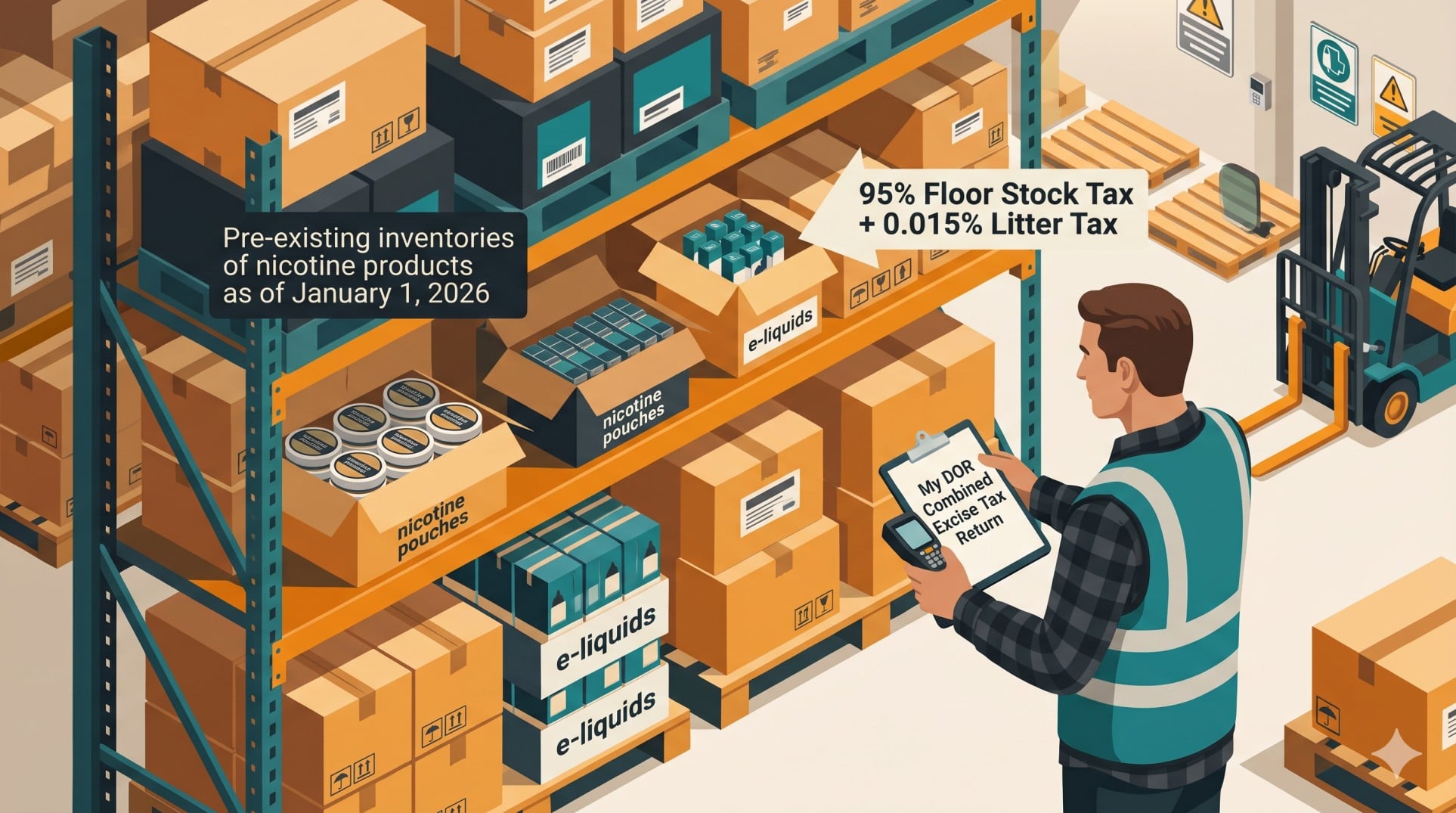
How DOR Audits Pre-Existing Nicotine Inventory & Valuation
When auditing a convenience store or vape shop for 2026–2027 compliance, DOR and LCB enforcement officers demand your physical inventory count as of 12:01 a.m. on January 1, 2026, alongside all distributor purchase invoices from Q3 and Q4 2025. Here are the exact valuation rules DOR applies to that inventory:
- Purchased From an Unaffiliated Wholesaler/Manufacturer: You must calculate the 95% floor stock tax on the actual purchase price you paid for the nicotine pouches, disposable vapes, and nicotine e-liquids on hand as of January 1, 2026 (including inbound shipping/freight charges on the invoice).
- Purchased From an Affiliated Entity: If your retail store is affiliated with the distributor or manufacturer, you must calculate the 95% floor stock tax on the actual retail selling price of the inventory held on January 1, 2026.
- No Offset for 2025 Vapor Tax Paid: Even if your distributor charged you $2.70 per 10 mL disposable vape in Vapor Products Tax in December 2025, DOR provides zero credit or offset against the 95% OTP tax owed on that same device sitting on your shelf on January 1, 2026.
Don’t Forget the Newly Triggered 0.015% Washington Litter Tax!
There is a second hidden trap buried in the reclassification of nicotine vapes and synthetic pouches. Under RCW 82.19.010 and RCW 82.19.020, Washington levies a 0.015% (0.00015) Litter Tax on the gross proceeds of wholesale and retail sales of 13 statutory categories of products—including “cigarettes and tobacco products.”
Prior to 2026, vapor products were exempt from the Litter Tax because they were regulated under Chapter 82.25 RCW rather than Chapter 82.26 RCW. Beginning January 1, 2026, because nicotine vapes, e-liquids, and synthetic nicotine pouches are statutorily defined as “tobacco products,” every manufacturer, distributor, and retailer selling them in Washington must report those gross sales on the Litter Tax line of their Combined Excise Tax Return and remit the 0.015% tax. If you haven’t enabled Litter Tax tracking on your vape and pouch SKUs in 2026, you are underreporting every single month. Retailers facing floor stock discrepancies should consult our excise and sales tax audit defense and voluntary disclosure specialists before an LCB or DOR audit notice arrives.
2026–2027 Business Scenarios: Wholesale & Retail Tax-on-Tax Math
Because the Washington 95% tax on vapes and nicotine pouches is embedded into the wholesale cost before retail markups, Business and Occupation (B&O) taxes, and local retail sales taxes are applied, a 95% wholesale tax translates into a 95% to 110%+ surge in the final out-the-door price at the register.
Under RCW 82.08.010(1), Washington’s Retail Sales Tax (6.5% state base rate plus local city/county rates up to 3.85% in Seattle, totaling 10.35% in Seattle in 2026, or 9.1% in Spokane and 10.3% in Tacoma) applies to the full gross retail selling price—which includes the passed-through 95% OTP excise tax. This is classic “Tax-on-Tax” pyramiding.
Let’s walk through four real-world mathematical scenarios for 2026–2027.
Scenario 1: The $30 Roll of Synthetic Nicotine Pouches in Seattle (2025 vs. 2026–2027)
The Setup: Rainier Express Mart, an independent convenience store in Seattle, Washington (Location Code 1726, where the 2026 combined state and local retail sales tax rate is 10.35%—comprising 6.5% state + 3.85% local), buys rolls of synthetic nicotine pouches (5 cans per roll) from an unaffiliated licensed distributor.
The Wholesale & Retail Math Comparison:
- Distributor’s Landed Acquisition Cost (Purchase Price + Freight from Manufacturer): $4.00 per can ($20.00 per 5-can roll).
- In 2025 (0% OTP Tax): The distributor added a $0.80/can margin and sold the can to Rainier Express Mart for $4.80 ($24.00/roll). Rainier Express Mart applied a 45.8% retail markup to price the can at $7.00 ($35.00/roll). At the Seattle register, the customer paid $7.00 + 10.35% sales tax ($0.72) = $7.72 per can (or $38.62 per 5-can roll).
- In 2026–2027 (Under the 95% Washington Synthetic Nicotine Pouch Tax):
- Distributor’s 95% OTP Tax Liability: The distributor owes 95% on its $4.00 landed purchase price = $3.80 per can ($19.00 per roll) in OTP excise tax.
- New Wholesale Invoice to Retailer: Base cost ($4.00) + OTP Tax ($3.80) + Distributor Margin ($0.80) = $8.60 per can ($43.00 per roll).
- New Retail Shelf Price (Maintaining Margin): Applying the same percentage markup (or even a compressed 59% markup to cover working capital, 0.471% Retailing B&O tax, and 0.015% Litter tax), the shelf price jumps to $13.65 per can ($68.25 per roll).
- Tax-on-Tax at the Seattle Register (10.35% Sales Tax): $13.65 × 10.35% = $1.41 in retail sales tax (meaning the customer is paying 10.35% sales tax on the $3.80 of embedded OTP tax!).
- Final Out-the-Door Consumer Price in Seattle: $15.06 per can (or $75.31 per 5-can roll)—nearly double the 2025 price!
Scenario 2: The Disposable Vape Shift From $0.09/mL to 95% Ad Valorem
The Setup: Cascade Smoke & Vape in Tacoma, Washington (Location Code 2717, combined 2026 retail sales tax rate of 10.30%) imports 1,000 high-puff disposable nicotine vapes (each containing 16 mL of 5% synthetic nicotine e-liquid in an accessible/non-closed reservoir format) directly from an unaffiliated out-of-state wholesaler in California that is not licensed in Washington.
The Invoice: 1,000 disposable vapes @ $8.50 each = $8,500.00 + $300.00 UPS Freight = $8,800.00 total landed purchase price ($8.80 per device).
Step-by-Step 2026 Tax Calculation:
- Pre-2026 Vapor Tax (For Comparison): At $0.09 per mL (16 mL × $0.09 = $1.44/device) or even $0.27/mL ($4.32/device), the volume tax was fixed regardless of hardware sophistication.
- 2026–2027 95% OTP Tax Liability: Because Cascade Smoke & Vape imported untaxed nicotine products from an unlicensed out-of-state seller, Cascade is the statutory distributor under RCW 82.26.010(8). The 95% tax applies to the entire $8,800.00 landed price (including the battery, screen, chassis, e-liquid, and $300 freight): $8,800.00 × 95% = $8,360.00 in OTP tax ($8.36 per vape).
- Total Landed Cost After OTP Tax: $8,800.00 + $8,360.00 = $17,160.00 ($17.16 per vape before the shop adds a single dollar of retail markup!).
- Retail Sale Taxes: When Cascade sells the 1,000 vapes at $29.99 each ($29,990 gross retail sales), it must also collect $3,088.97 in Tacoma retail sales tax (10.30%), pay $141.25 in Retailing B&O Tax ($29,990 × 0.471%), and pay $4.50 in Washington Litter Tax ($29,990 × 0.015%).
Scenario 3: The January 1, 2026 Pre-Existing Inventory Floor Stock Audit
The Setup: Spokane Valley C-Store held the following retail inventory on its shelves at the opening of business on January 1, 2026, all purchased from unaffiliated distributors in November and December 2025:
- 2,500 cans of synthetic nicotine pouches purchased at a wholesale invoice cost of $4.20 per can = $10,500.00.
- 800 disposable nicotine vapes purchased at a wholesale cost of $9.50 per unit (which already included $1.35 per unit in 2025 Washington Vapor Products Tax charged by the distributor) = $7,600.00.
- 200 bottles of 0 mg (zero-nicotine) e-liquid purchased at $6.00 per bottle = $1,200.00.
Step-by-Step Floor Stock Tax Calculation:
- Exclude 0 mg Zero-Nicotine E-Liquid ($1,200.00): Because the 200 bottles contain zero nicotine, they remain under Chapter 82.25 RCW and are exempt from the 95% OTP floor stock tax.
- Combine Qualifying Nicotine Inventory: $10,500.00 (pouches) + $7,600.00 (nicotine vapes) = $18,100.00 taxable sales price base.
- Apply the 95% Rate (Zero Credit for Prior Vapor Tax): Per Washington DOR’s November 25, 2025 Special Notice, Spokane Valley C-Store receives $0.00 credit for the $1,080.00 in 2025 vapor tax embedded in the disposable vapes. It owes 95% on the full $18,100.00 purchase price = $17,195.00 on the line item “Pre-existing inventories of nicotine products as of January 1, 2026.”
- Audit Penalty Exposure If Unreported: If Spokane Valley C-Store failed to report this on its January 2026 return (due February 25, 2026) and gets audited by DOR in late 2026, RCW 82.32.090 imposes a 29% late-payment penalty ($4,986.55) plus a 5% assessment penalty ($859.75)—or a 50% evasion penalty ($8,597.50) if willful—plus statutory interest!
Scenario 4: Out-of-State Affiliated Distributor Transfer Pricing
The Setup: Apex Nicotine Labs manufactures synthetic nicotine pouches in Nevada at a production cost of $1.10 per can. It transfers 50,000 cans to its wholly owned subsidiary, Apex Pacific Distribution LLC (a licensed Washington OTP distributor), at an intercompany transfer price of $1.50 per can ($75,000). Apex Pacific Distribution then sells the 50,000 cans to unaffiliated Washington convenience stores at $4.50 per can ($225,000).
Step-by-Step Affiliated Tax Math:
Under RCW 82.26.010(19)(a)(ii), because Apex Pacific Distribution purchased the pouches from an affiliated manufacturer, it is strictly prohibited from calculating the 95% tax on the $1.50 intercompany price. Instead, it must calculate the 95% OTP tax on the $4.50 actual selling price charged to the unaffiliated Washington retailers: $225,000 × 95% = $213,750.00 in OTP tax (plus 0.484% Wholesaling B&O tax and 0.015% Litter tax).
For distributors and retailers managing complex inventory valuations or multi-state excise filings, our outsourced tobacco, OTP, and vapor excise tax return preparation team handles monthly reconciliations across all 50 states.
Out-of-State Distributors, LCB Licensing & PACT Act Schedule C4 (ENDS) Rules
To legally sell, ship, or handle nicotine pouches, e-cigarettes, or vapes in Washington during 2026–2027, businesses must hold active Tobacco Products (OTP) endorsements issued through the Washington Business Licensing Service (BLS) and approved by the Washington State Liquor and Cannabis Board (LCB), while filing monthly PACT Act Schedule C4 (ENDS) reports by the 15th of each month.
Before 2026, a vape shop that only sold e-cigarettes and synthetic nicotine pouches only needed a Vapor Products Retailer License (or no tobacco license at all if it exclusively sold synthetic pouches). Starting January 1, 2026, selling synthetic nicotine pouches or nicotine vapes without a Tobacco Products (OTP) License is a criminal and administrative violation under Chapter 82.26 RCW exposing your inventory to immediate physical seizure and forfeiture by LCB officers under RCW 82.26.230.
2026–2027 Washington LCB & BLS License Fee Matrix
Make sure every warehouse and storefront holds the exact combination of endorsements on its Master Business License:
- Tobacco Products (OTP) Distributor License (RCW 82.26.150): Required for any business that brings untaxed nicotine pouches, nicotine vapes, or OTP into Washington, manufactures them in-state, or sells them at wholesale to Washington retailers. The annual fee is $650.00 for the primary location, plus $115.00 for each additional distribution place of business.
- Tobacco Products (OTP) Retailer License (RCW 82.26.170): Required for every convenience store, gas station, smoke shop, or vape store selling nicotine pouches, nicotine vapes, cigars, or chew to consumers. The annual fee is $175.00 per retail location.
- Vapor Products Licenses (RCW 70.345.020): Still required under LCB regulations for businesses handling vapor devices and e-liquids: $150.00 for a Vapor Product Distributor License ($100 for each additional location), $175.00 for a Vapor Product Retailer License, and $250.00 for a Vapor Product Delivery Sale License. (Note: Under RCW 82.26.170, a retailer applying for or renewing both an OTP Retailer License and a Vapor Product Retailer License simultaneously qualifies for a combined application fee of $250.00 for both endorsements!)
Federal PACT Act & Washington Schedule C4 (ENDS) Reporting on the 15th
Under the federal Preventing Online Sales of E-Cigarettes to Children Act (which amended the Jenkins/PACT Act, 15 U.S.C. Sec. 375 et seq.) and Washington DOR regulations, any out-of-state or in-state business shipping, selling, or advertising Electronic Nicotine Delivery Systems (ENDS)—which broadly covers all e-cigarettes, vape pens, e-liquids, components, and accessories regardless of nicotine content—into Washington interstate commerce must:
- Register with both the federal Bureau of Alcohol, Tobacco, Firearms and Explosives (ATF) and the Washington Department of Revenue (by submitting the federal PACT Act registration form to DOR’s Cigarette & Tobacco Tax Unit).
- File Washington Form Schedule C4 (ENDS) (Report of Interstate Shipments & In-State Exempt Sales) electronically via My DOR (using your assigned Letter ID) or via secure message/email to DOR no later than the 15th day of each month covering all shipments made during the previous calendar month. Even if you had zero sales into Washington during the month, you must still file a zero-activity Schedule C4 (ENDS) report!
- Remember that under RCW 70.345.090, Washington strictly prohibits mailing or shipping vapor products directly to consumers in Washington unless the seller holds a valid LCB Delivery Sale License and verifies age 21+ and adult signature upon delivery. Furthermore, USPS rules ban mailing ENDS products to consumers nationwide.
Step-by-Step My DOR Filing & Audit Survival Guide for WA Retailers & Distributors
To stay 100% compliant with Washington OTP distributor and retailer compliance rules in 2026–2027, businesses must file their monthly Combined Excise Tax Return via the My DOR portal by the 25th day of the following month and retain itemized 5-year invoice trails.
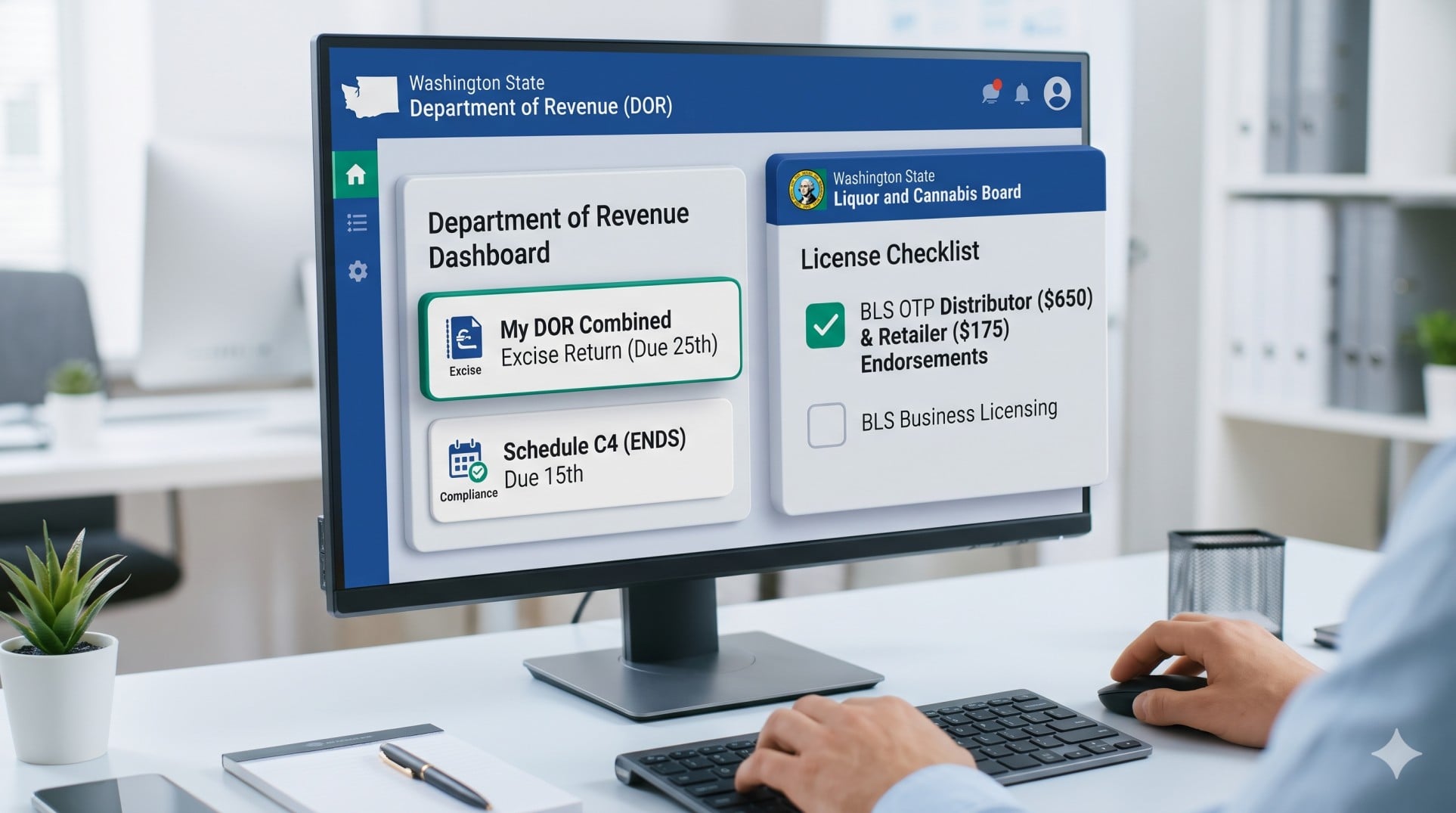
Step 1: Add the OTP Endorsement via My DOR Business Licensing
Log into your My DOR account, navigate to your Business License Account, and click “Add Endorsements to Existing Location.” Select the Tobacco Products Retailer endorsement ($175, or $250 combined with Vapor Retailer) and—if you ever purchase nicotine pouches or vapes from out-of-state suppliers that do not pay Washington’s 95% tax—add the Tobacco Products Distributor endorsement ($650). Wait for Washington State Liquor and Cannabis Board (LCB) Enforcement Division background check approval before receiving untaxed shipments.
Step 2: Verify Wholesale Invoices for the 95% Tax Statement (RCW 82.26.070)
If you are a Washington convenience store or smoke shop that only holds a Retailer license, you may only buy nicotine pouches and vapes from a Washington-licensed OTP distributor (you can verify active distributor licenses on the LCB public license lookup database). Ensure every wholesale invoice you receive explicitly states that the Washington 95% Tobacco Products Tax has been paid by the distributor. If an invoice from an out-of-state seller shows $0.00 Washington OTP tax, you owe the 95% tax on your next return!
Step 3: Complete Your Monthly Combined Excise Tax Return on My DOR (Due the 25th)
By the 25th day of the following month (for monthly filers; quarterly filers remit by April 30, July 31, October 31, and January 31; annual filers by April 15), log into My DOR and complete every applicable section of your Combined Excise Tax Return:
- Section 1 — Business & Occupation (B&O) Tax: Report wholesale sales under Wholesaling (0.484%) and retail sales under Retailing (0.471%). Note that the gross proceeds reported here include the passed-through 95% OTP excise tax!
- Section 2 — State & Local Retail Sales Tax: Report retail sales under the 6.5% state line and the specific 4-digit local location code (e.g., 1726 for Seattle, 3210 for Spokane, 2717 for Tacoma).
- Section 3 — Other Taxes (Tobacco Products Tax / OTP): Under the Tobacco Products/Cigars (95% of taxable sales price) line, enter the total taxable sales price of all nicotine pouches, nicotine vapes, e-liquids, and non-capped OTP you brought into Washington or acquired untaxed during the period, multiplied by 95%. (If you are filing a late or amended Q1 2026 return to clean up unreported January 1, 2026 inventory, report your opening stock value on the dedicated line: “Pre-existing inventories of nicotine products as of January 1, 2026”).
- Section 4 — Credits (Tobacco Products Tax Credit ID 930 / Form 40-2437): If your licensed Washington distribution warehouse previously paid the 95% OTP tax on nicotine pouches or vapes and subsequently shipped those products outside Washington to an out-of-state wholesaler or retailer for resale, returned them to the manufacturer, or destroyed unsellable stock under RCW 82.26.110, claim Tobacco Products Tax Credit [ID 930] and attach the Claim for Credit Tobacco Products Tax (Form 40-2437) and interstate shipping manifests. (Warning: Under RCW 82.26.110, no credit is allowed for direct-to-consumer sales shipped from Washington inventory to an out-of-state consumer).
- Section 5 — Litter Tax (0.015%): Enter your total gross wholesale and retail sales of cigarettes, cigars, nicotine pouches, and nicotine vapor products, multiplied by 0.00015.
Step 4: Maintain 5-Year Statutory Invoice & Manifest Records (RCW 82.26.060)
Under RCW 82.26.060, RCW 82.26.070, and RCW 82.26.080, both distributors and retailers must preserve complete physical or electronic purchase and sales invoices, bills of lading, and shipping manifests at their licensed premises for five years (note that OTP recordkeeping is 5 years, which is one year longer than Washington’s standard 4-year excise tax lookback!). If an LCB officer inspects your shop and finds uninvoiced nicotine pouches or disposable vapes, you are immediately liable for the 95% tax plus seizure of the contraband goods.
Need to register a new distribution warehouse or resolve a back-tax assessment? Visit our Washington B&O, retail sales, and OTP excise tax compliance hub to get immediate CPA/EA representation.
Frequently Asked Questions About Washington’s 95% Nicotine & Vape Tax
1. When did the Washington 95% tax on vapes and nicotine pouches take effect?
The Washington 95% tax on vapes and nicotine pouches took effect on January 1, 2026. Enacted under Engrossed Substitute Senate Bill 5814 (Chapter 422, Laws of 2025), the law amended RCW 82.26.010 to tax all tobacco-derived and synthetic nicotine products at 95% of the taxable sales price.
2. Are tobacco-free synthetic nicotine pouches like ZYN and On! taxed at 95% in Washington?
Yes, all oral nicotine pouches—including synthetic and tobacco-leaf-free brands like ZYN, On!, Velo, Rogue, and Fre—are subject to the 95% Other Tobacco Products (OTP) tax starting January 1, 2026. They do not qualify for the lower per-ounce moist snuff tax rate because they do not contain moist leaf snuff.
3. Can retailers or distributors claim a credit for Vapor Products Tax paid in 2025 on nicotine vapes?
No, the Washington Department of Revenue explicitly confirmed in its November 25, 2025 Special Notice that no credit or offset is provided for per-milliliter Vapor Products Tax previously paid on nicotine vapes or e-liquids. Sellers owed the full 95% OTP tax on their existing January 1, 2026 nicotine vapor inventory.
4. How did Washington require businesses to report pre-existing nicotine inventory on January 1, 2026?
Retailers and distributors were required to value all nicotine pouches, disposable vapes, and nicotine e-liquids in their possession on January 1, 2026 and report that amount on the first Combined Excise Tax Return due after January 1, 2026 using the one-time line item: “Pre-existing inventories of nicotine products as of January 1, 2026.”
5. Does the 95% OTP tax apply to zero-nicotine (0 mg) vapes and e-liquids?
No, vapor products and e-liquids that contain zero nicotine (neither tobacco-derived nor synthetic) are not subject to the 95% OTP tax under Chapter 82.26 RCW. Zero-nicotine vapor liquids remain taxed by volume under Chapter 82.25 RCW at $0.09 per mL (containers over 5 mL) or $0.27 per mL (containers 5 mL or less).
6. Are nicotine vapes and synthetic pouches subject to the Washington Litter Tax in 2026–2027?
Yes, effective January 1, 2026, because nicotine vapor products and synthetic nicotine pouches are statutorily classified as “tobacco products,” all wholesale and retail sales in Washington are subject to the 0.015% (0.00015) Litter Tax under RCW 82.19.010. Zero-nicotine vapor products remain exempt from the Litter Tax.
7. Is the 95% Washington OTP tax included in the retail price before calculating Retail Sales Tax?
Yes, under RCW 82.08.010, the 95% OTP tax is imposed at the wholesale/distributor tier and folds into the retailer’s cost of goods sold. When the retailer sells the vape or pouch to a consumer, Washington’s 6.5% state and local Retail Sales Tax (up to 10.35% combined) applies to the full retail selling price, creating a tax-on-tax effect.
8. Are FDA PMTA-authorized products like ZYN exempt from the 95% Washington nicotine tax?
No, an FDA Premarket Tobacco Product Application (PMTA) marketing order is not an FDA drug or medical device approval. The statutory exclusion in RCW 82.26.010 only exempts smoking-cessation drugs, devices, or combination products (like prescription inhalers or OTC nicotine patches/gum) approved under the Federal Food, Drug, and Cosmetic Act as of December 31, 2024.
9. What happens if a Washington smoke shop buys nicotine pouches from an unlicensed out-of-state distributor?
Under RCW 82.26.200, a Washington retailer that purchases untaxed nicotine pouches or vapes from an unlicensed out-of-state supplier must hold both an OTP Retailer License ($175) and an OTP Distributor License ($650) and remit the 95% tax directly to DOR. Unlicensed possession exposes the shop to product seizure and severe penalties.
10. Do lawsuits challenging ESSB 5814 pause the requirement to pay the 95% tax in 2026?
No, the Washington Department of Revenue has issued formal notices stating that while constitutional litigation over ESSB 5814 is pending in the courts, statutes are presumed constitutional and DOR must strictly enforce the law. Taxpayers must continue reporting and paying the 95% tax on time to avoid penalties up to 39%.
Protecting Your Convenience Store or Distribution Business From WA DOR Audits
The enactment of the Washington 95% tax on vapes and nicotine pouches under Engrossed Substitute Senate Bill 5814 has permanently transformed the unit economics and compliance risk profile for every tobacco wholesaler, convenience store, and smoke shop operating in or shipping into Washington. With DOR and LCB enforcement teams actively auditing January 1, 2026 floor stock declarations, cross-checking PACT Act Schedule C4 (ENDS) manifests against Combined Excise Tax Returns, and enforcing the newly expanded 0.015% Litter Tax, an innocent reporting oversight can quickly spiral into a business-ending assessment.
If your retail store or distribution company needs to reconcile unreported 2026 pre-existing nicotine inventory, apply for Washington OTP Distributor and Retailer licenses, file interstate credit claims under Credit ID 930 (Form 40-2437), or defend against a Washington Department of Revenue excise audit, contact the SALT & Excise Tax specialists at Ourtaxpartner.com today for battle-tested compliance support.
Disclaimer: This content provides general information for educational purposes only and reflects state, local, and federal sales, use, and excise tax laws applicable to the 2026–2027 compliance periods. State and local tax rates, nexus thresholds, and excise regulations change frequently across jurisdictions. This article does not constitute professional tax, legal, or accounting advice. Always consult a certified public accountant (CPA), enrolled agent (EA), or qualified SALT advisor at Ourtaxpartner.com regarding your specific business compliance obligations. Ourtaxpartner.com is not responsible for any actions taken based on the information provided herein.
