
Navigating casualty loss deductions in 2026 requires understanding a newly expanded set of Internal Revenue Code provisions alongside strict anti-double-dipping rules for government aid. When a hurricane, wildfire, tornado, or severe flood destroys personal or business property, knowing how to claim FEMA disaster relief on your taxes without triggering an IRS examination can save your household tens of thousands of dollars.
Two landmark pieces of federal legislation have reshaped the disaster tax code for Tax Year 2026 (for returns filed in 2027). First, the One Big Beautiful Bill Act (OBBBA, P.L. 119-21) permanently locked in the disaster-declaration requirement for personal losses while expanding IRC Section 165(h)(5) beginning in 2026 to cover certain governor-declared state disasters. Second, the Doug LaMalfa Federal Disaster Tax Relief Certainty Act (P.L. 119-108) codified IRC Section 165(h)(6), extending the generous qualified disaster loss rules through December 31, 2026. Below is the complete technical guide to calculating your deduction, coordinating FEMA grants, and filing Form 4684 accurately.
⚡ Executive Summary: Key 2026 Tax Rules at a Glance
- Two Personal Casualty Tracks in 2026: Under IRC Section 165(h)(6) (as codified by P.L. 119-108), losses from a Presidentially declared major disaster with an incident period beginning before January 1, 2027, qualify as a qualified disaster loss—waiving the 10%-of-AGI limit, applying a flat $500 per-casualty floor, and allowing non-itemizers to claim the loss on top of their 2026 Standard Deduction ($16,100 Single; $32,200 Married Filing Jointly; $24,150 Head of Household). Individual 2026 returns are due April 15, 2027.
- New 2026 State-Declared Disaster Rule (OBBBA): Starting January 1, 2026, IRC Section 165(h)(5) allows deductions for natural catastrophes, fires, floods, or explosions declared by a state governor (with Treasury concurrence) even without a Presidential declaration. However, state-only declarations remain subject to the $100 floor, the 10%-of-AGI reduction, and require itemizing on Schedule A.
- FEMA Grant Tax Treatment (IRC § 139): FEMA Individuals and Households Program (IHP) grants—capped at $44,800 for Housing Assistance and $44,800 for Other Needs Assistance for disasters declared through September 30, 2026, and rising to $46,400 each for declarations on or after October 1, 2026—are 100% exempt from federal income tax. However, any grant funds earmarked for structural property repair must be subtracted from your casualty loss on Form 4684.
- Prior-Year Refund Election (IRC § 165(i)): Taxpayers who suffer a federally declared disaster loss in 2026 can elect to deduct that loss on an amended 2025 tax return (Form 1040-X) for a rapid refund. The deadline to make this election for a 2026 loss is October 15, 2027.
Table of Contents
- ⚡ Executive Summary: Key 2026 Tax Rules at a Glance
- Understanding Casualty Loss Deductions in 2026 After Recent Tax Reforms
- How FEMA Disaster Relief Grants Are Taxed and Coordinated With Losses
- Measuring Property Damage and Using IRS Safe Harbor Valuation Methods
- Step-by-Step Guide to Claiming Disaster Losses on Form 4684 in 2027
- The Section 165(i) Prior-Year Election: Getting a Faster Tax Refund
- Business and Rental Property Losses vs. Personal-Use Property
- Penalty-Free $22,000 Disaster Retirement Withdrawals and 120-Day Extensions
- Frequently Asked Questions About Casualty Losses and FEMA Aid
- Final Disaster Recovery Tax Planning Steps for 2026 and 2027
Understanding Casualty Loss Deductions in 2026 After Recent Tax Reforms
Claiming personal casualty loss deductions in 2026 requires that your property damage result directly from a sudden, unexpected, or unusual event tied to either a federally declared disaster or, starting in 2026 under the OBBBA, a qualifying state-declared disaster.
Before the One Big Beautiful Bill Act (P.L. 119-21) was signed into law, the Tax Cuts and Jobs Act (TCJA) restriction on personal casualty losses was scheduled to expire at the end of 2025. The OBBBA permanently prevented that reversion. In 2026, you still cannot deduct ordinary personal losses—such as an isolated house fire, a single-car collision, a burst pipe from normal wear, or petty theft—unless you have personal casualty gains in the same tax year. Instead, your loss must fall into one of two distinct statutory tiers under IRC Section 165(h).
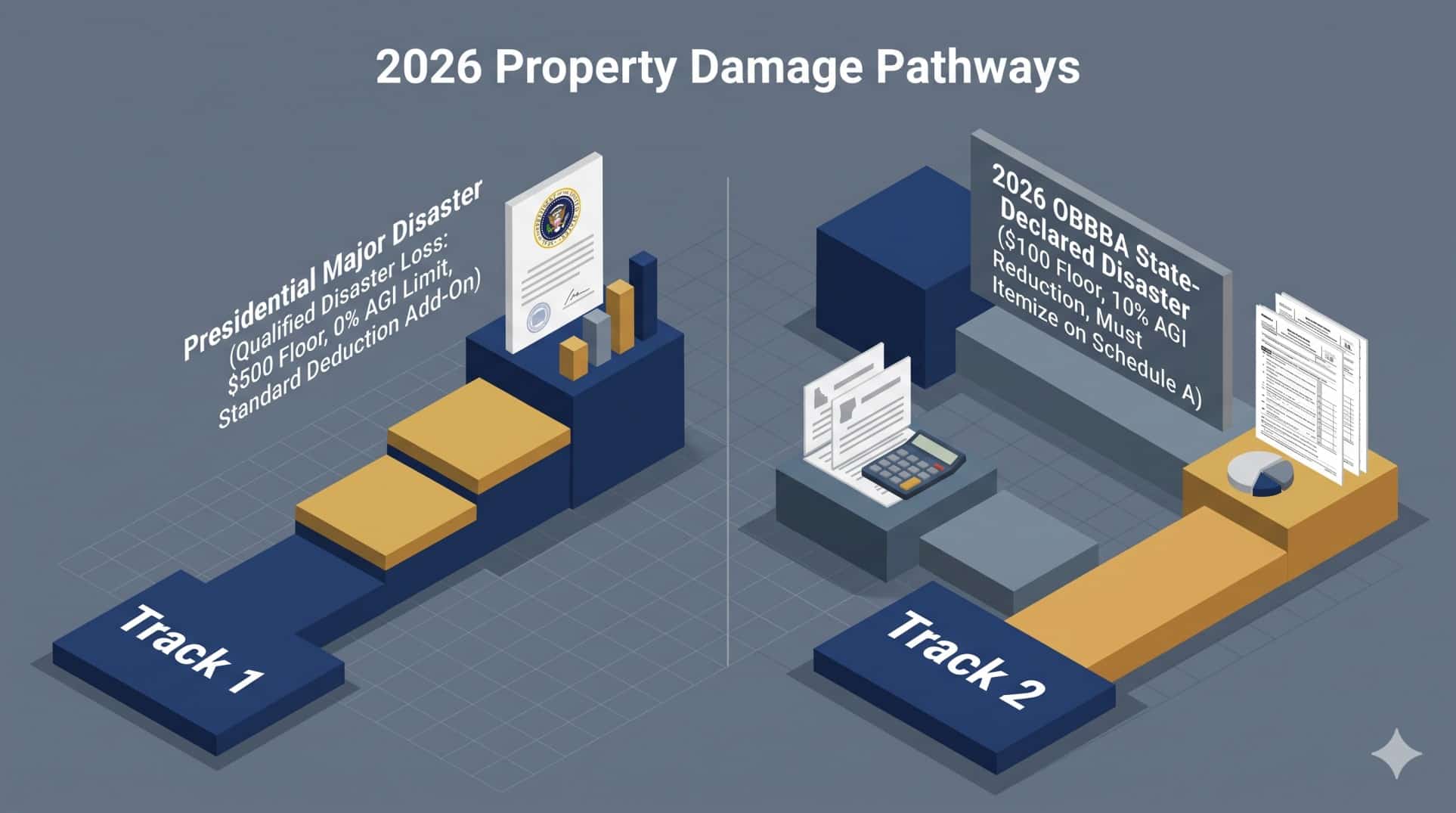
Tier 1: Qualified Disaster Losses Under IRC Section 165(h)(6) (The Generous Track)
For years, Congress extended special disaster relief rules in piecemeal legislation, leaving awkward date gaps between the Federal Disaster Tax Relief Act of 2023 (P.L. 118-148) and the OBBBA (which initially covered declarations only through September 2, 2025). In 2026, Congress enacted the Doug LaMalfa Federal Disaster Tax Relief Certainty Act (P.L. 119-108), codifying IRC Section 165(h)(6) to cover any Presidentially declared Major Disaster (designated with a FEMA “DR-” number under Section 401 of the Stafford Act) whose incident period begins on or after December 28, 2019, and before January 1, 2027.
If your 2026 home, vehicle, or household property damage stems from a Presidential Major Disaster declaration, your loss is a qualified disaster loss, granting three massive mathematical advantages:
- Complete Waiver of the 10%-of-AGI Reduction: You do not have to reduce your unreimbursed loss by 10% of your Adjusted Gross Income (AGI).
- Flat $500 Per-Casualty Floor: Instead of the regular $100 floor plus 10% AGI haircut, you simply subtract $500 from each separate casualty event.
- Deduction Available to Non-Itemizers: You do not need to give up the 2026 Standard Deduction ($16,100 for Single/MFS, $32,200 for Married Filing Jointly, or $24,150 for Head of Household) to claim the loss. Instead, non-itemizers report the net qualified disaster loss on Schedule A, Line 16, and combine it directly with their standard deduction on Form 1040, Line 12.
Tax Software Alert for 2026 Filers: Because Public Law 119-108 was enacted after the IRS published early baseline revisions of Publication 547, make sure your tax preparation software is updated for the codified IRC Section 165(h)(6) window through December 31, 2026. Any Presidential Major Disaster (DR- declaration) whose incident period begins in calendar year 2026 qualifies for the $500 floor and 0% AGI reduction.
Tier 2: Federal Emergency Declarations (EM-) and New 2026 State-Declared Disasters
What if your county suffers severe storm, tornado, or wildfire damage in 2026 that never receives a Presidential Major Disaster (DR-) declaration? Under the OBBBA amendments to IRC Section 165(h)(5)(A), effective for tax years beginning after December 31, 2025, personal casualty losses are now deductible if they result from a State-Declared Disaster—defined as any natural catastrophe (hurricane, tornado, storm, high water, earthquake, landslide, snowstorm, or drought) or any fire, flood, or explosion that a state governor (or the D.C. Mayor) and the U.S. Treasury Secretary determine caused damage severe enough to warrant IRC Section 165 relief.
This Tier 2 category also includes federal Stafford Act Section 501 Emergency Declarations (FEMA “EM-” numbers) that are not upgraded to Major Disasters. While Tier 2 losses are deductible in 2026, they follow the stricter classic formula:
- You must reduce each casualty event by $100.
- You must reduce the remaining total casualty loss by 10% of your Adjusted Gross Income (AGI).
- You must itemize deductions on Schedule A, Line 15 to receive a tax benefit (though the expanded 2026 State and Local Tax [SALT] cap of $40,400 under the OBBBA makes itemizing much easier for homeowners).
| Disaster Provision / Tax Rule | Presidential Major Disaster (“DR-” Qualified Disaster Loss) | Federal Emergency (“EM-“) or 2026 State-Declared Disaster | Ordinary Personal Accident / Non-Disaster Casualty |
|---|---|---|---|
| Controlling 2026 Statute | IRC § 165(h)(6) (P.L. 119-108) | IRC § 165(h)(5)(A) (OBBBA P.L. 119-21) | IRC § 165(h)(5)(B) |
| Per-Casualty Dollar Floor | $500 per event | $100 per event | Not deductible (unless offsetting personal casualty gains) |
| 10%-of-AGI Haircut Applies? | No — 100% Waived | Yes — Reduces loss by 10% of AGI | N/A |
| Can Non-Itemizers Claim It? | Yes — Stacks on top of 2026 Standard Deduction ($16,100 Single / $32,200 MFJ) | No — Must itemize on Schedule A, Line 15 | N/A |
| Prior-Year Election (IRC § 165(i)) Available? | Yes — Can claim on 2025 return by Oct 15, 2027 | EM- Federal: Yes / State-Only: No (Unless federal declaration is also issued) | No |
| Form 4684 & Schedule A Line | Form 4684 Line 11 ($500) & Line 15; Schedule A Line 16 | Form 4684 Line 11 ($100) & Line 18; Schedule A Line 15 | Form 4684 (Only up to personal casualty gains) |
How FEMA Disaster Relief Grants Are Taxed and Coordinated With Losses
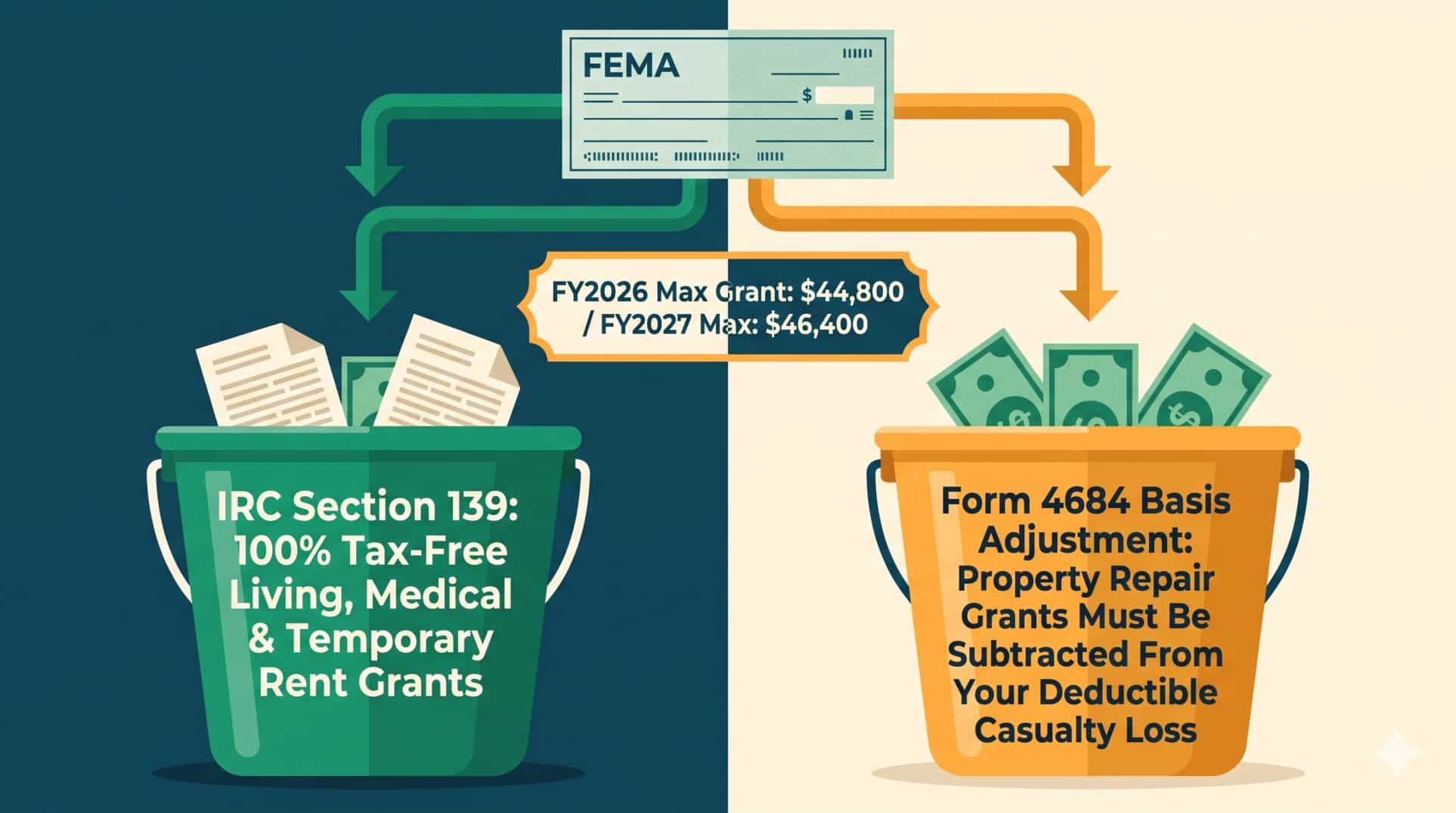
Emergency cash grants provided through FEMA disaster relief programs are 100% excluded from federal gross income under IRC Section 139, meaning you never pay income or self-employment tax on the grant money, though grants paid specifically to repair or replace damaged property must be subtracted from your deductible casualty loss.
When the President issues a major disaster declaration authorizing Individual Assistance (IA), survivors can apply for grants under FEMA’s Individuals and Households Program (IHP). For disasters declared during Federal Fiscal Year 2026 (October 1, 2025 through September 30, 2026), the maximum FEMA IHP grant is $44,800 for Housing Assistance (HA) and an additional $44,800 for Other Needs Assistance (ONA). For disasters declared on or after October 1, 2026 (the start of FY 2027), the CPI-adjusted FEMA cap increases to $46,400 for Housing Assistance and $46,400 for Other Needs Assistance.
IRC Section 139: Why FEMA Grants Are Tax-Free
Under IRC Section 139(b), any “qualified disaster relief payment” received by an individual is excluded from gross income. You will not receive a taxable Form 1099 for standard FEMA IHP grants, Red Cross emergency stipends, or state emergency living assistance, and you do not report them as income on Form 1040. Qualified payments under Section 139 cover reasonable and necessary personal, family, living, or funeral expenses incurred as a result of a qualified disaster, as well as payments to repair or rehabilitate a personal residence or repair/replace its contents.
Furthermore, under the Federal Disaster Tax Relief Act and the Doug LaMalfa Act (P.L. 119-108), qualified wildfire relief payments received for losses, extra living expenses, lost wages, personal injury, or emotional distress resulting from a federally declared wildfire disaster (declared before January 1, 2027) are also 100% excluded from gross income.
The Anti-Double-Dip Rule: Which FEMA Grants Reduce Your Form 4684 Deduction?
While FEMA grants are never taxed as income, IRC Section 165(a) and Section 139(g) prohibit taxpayers from claiming a casualty loss deduction for expenses that were reimbursed by insurance or government grants. According to IRS Publication 547 (Casualties, Disasters, and Thefts), you must examine your official FEMA award letter and divide your grant into two categories:
- Category 1 — Grants That DO Reduce Your Casualty Loss (Report on Form 4684, Line 3): Any FEMA Housing Assistance or Other Needs Assistance grant specifically designated for home repair, home replacement, or personal property/vehicle repair and replacement is treated exactly like an insurance reimbursement. You must subtract these dollar amounts directly from your property loss on Form 4684, Line 3.
- Category 2 — Grants That Do NOT Reduce Your Casualty Loss: Any FEMA grant earmarked for temporary rental assistance, hotel/lodging reimbursement, emergency food, water, medical/dental bills, child care, moving and storage, or funeral expenses does not reimburse you for physical property damage. These living-expense grants are 100% tax-free and do not reduce your deductible property casualty loss on Form 4684!
Crucial Insurance Claim Rule (IRC Section 165(h)(4)(E)): If your home or car is covered by an insurance policy, you cannot skip filing an insurance claim just to avoid a rate hike and deduct the loss on your taxes instead. Under IRC Section 165(h)(4)(E), any portion of a personal casualty loss covered by insurance is strictly nondeductible unless the taxpayer files a timely insurance claim. You can, however, always deduct your out-of-pocket insurance deductible (such as a 2% or 5% hurricane windstorm deductible) and any damages that exceed your policy limits or arise from excluded perils like uninsurable earth movement.
How SBA Disaster Loans and Insurance Living Expenses Work
Two other common financial inflows arrive after a major catastrophe:
- SBA Physical and Economic Injury Disaster Loans: Low-interest disaster loans from the U.S. Small Business Administration (SBA) are borrowed funds that must be repaid. Because a loan is not a grant or reimbursement, SBA loan proceeds do not count as taxable income and do not reduce your deductible casualty loss on Form 4684. Only if a portion of an SBA loan is later officially cancelled or forgiven would it reduce your loss or trigger cancellation-of-debt rules.
- Insurance Additional Living Expenses (ALE) / Loss of Use (IRC Section 123): When your homeowner’s insurance policy pays you for hotel bills, temporary apartment rent, and extra restaurant meals while your primary residence is uninhabitable, IRC Section 123 excludes those reimbursements from gross income up to the amount by which your actual disaster living expenses exceed your normal pre-disaster living expenses.
Measuring Property Damage and Using IRS Safe Harbor Valuation Methods
Under Treasury Regulation Section 1.165-7(b), the gross amount of a personal casualty loss before subtracting insurance is always the lesser of the property’s adjusted basis immediately before the disaster or the actual decrease in the property’s fair market value (FMV) caused by the disaster.
For personal-use real estate (your primary home or vacation cottage), the building, land, trees, and shrubbery are treated as a single integrated asset on Form 4684. You do not calculate separate losses for the roof, the driveway, and the oak trees. Personal household contents (furniture, clothing, electronics) and personal vehicles, however, must be valued separately from the real estate structure.
IRS Revenue Procedure 2018-08 Safe Harbor Valuation Methods
Hiring a certified real estate appraiser immediately after a widespread hurricane or wildfire is often expensive and logistically impossible. To help homeowners substantiate their decline in fair market value without a formal appraisal, the IRS issued Revenue Procedure 2018-08, establishing distinct safe harbor valuation methods that remain fully valid for casualty loss deductions in 2026:
| IRS Safe Harbor Method (Rev. Proc. 2018-08) | Eligible Property Type & Disaster Scope | Dollar / Value Cap | How Decrease in Fair Market Value (FMV) Is Measured |
|---|---|---|---|
| 1. Estimated Repair Cost Safe Harbor | Personal-use residential real property in any declared disaster | Losses of $20,000 or less (prior to § 165(h) floors) | Use the lesser of two independent, itemized repair estimates prepared by licensed contractors describing the costs to restore the home to its pre-disaster condition. |
| 2. De Minimis Safe Harbor | Personal-use residential real property OR personal belongings | Losses of $5,000 or less | Taxpayer’s own good-faith written estimate of the cost required to restore the home or replace destroyed personal belongings (keep photos and price logs). |
| 3. Insurance Safe Harbor | Personal-use residential real property in any declared disaster | No Dollar Cap | Use the estimated damage loss determined in the official report prepared by your homeowner’s or flood insurance company adjuster. |
| 4. Contractor Safe Harbor | Personal-use residential real property in a Federally Declared Disaster Area | No Dollar Cap | Use the contract price for repairs specified in a binding, itemized contract signed by both the homeowner and an independent licensed contractor. |
| 5. Disaster Loan Appraisal Safe Harbor | Personal-use residential real property in a Federally Declared Disaster Area | No Dollar Cap | Use an appraisal prepared for the purpose of obtaining a federal loan (such as an SBA disaster loan) or federal loan guarantee following the disaster. |
| 6. Replacement Cost Safe Harbor (Belongings) | Personal household belongings located in a Federally Declared Disaster Area (excludes vehicles, boats, antiques, art, jewelry) | No Dollar Cap | Determine current replacement cost of the item and reduce it by 10% for each year you owned the item (for items owned 9+ years, pre-disaster FMV is set at 10% of replacement cost). |
Note that if you use any of the Revenue Procedure 2018-08 safe harbors, you must attach a statement to your return specifying which safe harbor method you elected. Also keep in mind that repair estimates or contractor invoices can only include costs to restore the property to its exact pre-casualty condition—any capital upgrades (such as upgrading laminate countertops to quartz or adding square footage) must be excluded from the loss calculation. Review our tax audit recordkeeping and receipt requirements for tips on preserving digital photos and contractor bids.
Step-by-Step Guide to Claiming Disaster Losses on Form 4684 in 2027
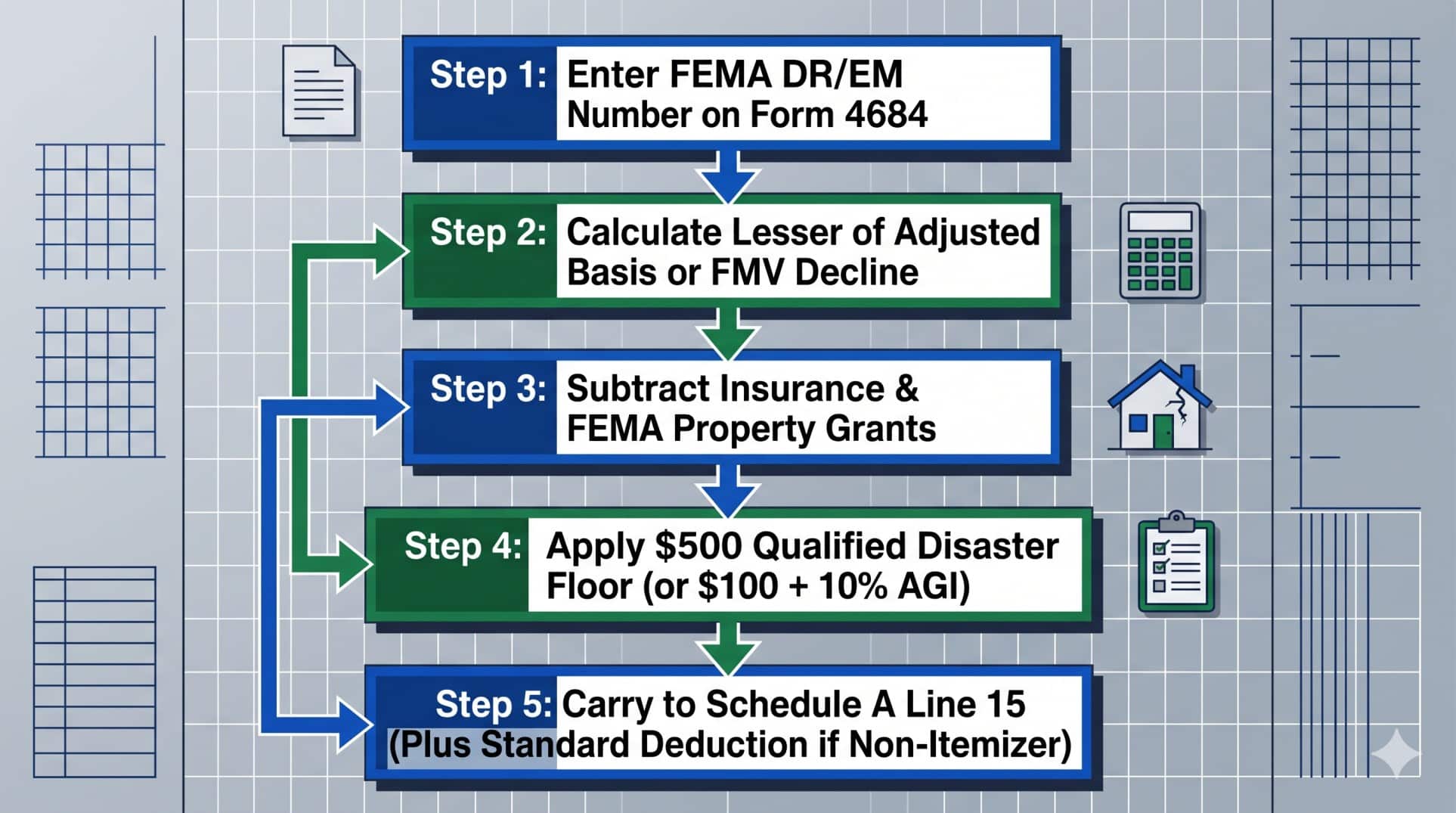
To claim a disaster deduction on your 2026 tax return, you must enter the official FEMA declaration number at the top of Form 4684, compute the unreimbursed loss in Section A, apply the $500 or $100 floor, and carry the final deduction to Schedule A.
Missing the FEMA alphanumeric code or mixing up Line 15 and Line 18 on Form 4684 is the fastest way to have your return flagged by IRS processing centers. Follow these five steps to complete your 2026 filing accurately.
Step 1: Enter the FEMA Disaster Declaration Number
At the very top of Form 4684 (Casualties and Thefts), check the box confirming whether the loss is attributable to a federally declared disaster and write the exact FEMA declaration number in the designated space (for example, “DR-4850-FL” for a Major Disaster or “EM-3615-GA” for an Emergency Declaration). If you are claiming a 2026 OBBBA governor-declared state disaster that passed Treasury concurrence, follow the updated 2026 Form 4684 instructions for state declaration codes.
Step 2: Complete Section A, Part I (Lines 1 through 9) for Each Property
Form 4684 provides columns for up to four separate properties (Properties A, B, C, and D) arising from the same casualty event (e.g., Property A is your home and land; Property B is your household furniture; Property C is your personal car):
- Line 1: Describe the property, its street address, and the date of the disaster.
- Line 2 (Cost or Other Basis): Enter your adjusted basis in the property (purchase price plus capital improvements, minus any prior depreciation or casualty deductions).
- Line 3 (Insurance or Other Reimbursement): Enter the sum of all insurance payouts received (or reasonably expected to be received) plus any FEMA Housing/ONA grants earmarked specifically for property repair or replacement. Do not include FEMA temporary rent/hotel grants or SBA loans here.
- Line 4 (Gain from Casualty): If your insurance payout on Line 3 exceeds your adjusted basis on Line 2, you have a casualty gain (see Involuntary Conversions under IRC Section 1033 below). Otherwise, enter $0.
- Lines 5, 6, and 7 (Fair Market Value Decline): Enter the FMV of the property immediately before the disaster on Line 5, the FMV immediately after the disaster on Line 6 (using an appraisal or a Rev. Proc. 2018-08 safe harbor), and the difference on Line 7.
- Line 8 & Line 9: Enter the smaller of Line 2 (Basis) or Line 7 (FMV decline) on Line 8, and subtract Line 3 (Reimbursements) to arrive at your net unreimbursed loss for that item on Line 9.
Step 3: Apply the $500 Qualified Disaster Floor (or $100 + 10% AGI) in Part II
Combine the losses from Properties A–D on Line 10. Next, apply the statutory floor on Line 11:
- If Your Loss Is a Qualified Disaster Loss (Presidential “DR-” Major Disaster in 2026): Enter $500 on Line 11, subtract it to get Line 12, and carry your total net qualified disaster loss to Line 15. You skip the 10%-of-AGI reduction on Line 17 completely!
- If Your Loss Is a State-Declared Disaster or Federal “EM-” Emergency: Enter $100 on Line 11, subtract it on Line 12, enter 10% of your Form 1040, Line 11 Adjusted Gross Income on Line 17, and arrive at your net deductible loss on Line 18.
Step 4: Transfer to Schedule A and Form 1040 (Standard vs. Itemized)
How the deduction flows to your 2026 Form 1040 depends on whether you itemize deductions (see our 2026 standard deduction vs itemized deduction guide for full Schedule A thresholds):
- Non-Itemizers With a Qualified Disaster Loss (Line 15): Enter the amount from Form 4684, Line 15 onto Schedule A (Form 1040), Line 16 (Other Itemized Deductions). Next, enter your regular 2026 Standard Deduction (e.g., $32,200 MFJ or $16,100 Single) on Schedule A, Line 18, check the box on Schedule A, and carry the combined sum of your Standard Deduction plus your Qualified Disaster Loss to Form 1040, Line 12!
- Itemizers With Any Eligible Disaster Loss: If your regular itemized deductions (mortgage interest, up to $40,400 in SALT taxes, and charitable contributions) already exceed your 2026 standard deduction, report a Qualified Disaster Loss (Line 15) on Schedule A, Line 16, or report a State-Declared / EM- Disaster Loss (Line 18) on Schedule A, Line 15.
Scenario 1: Florida Hurricane Victim (Presidential “DR-” Major Disaster + FEMA Grant + Non-Itemizer)
Let’s trace the exact 2026 numbers for Carlos and Priya, a married couple in Florida filing Married Filing Jointly with a 2026 Adjusted Gross Income (AGI) of $125,000. In September 2026, a Category 4 hurricane hits their county, and the President issues a Major Disaster Declaration (FEMA DR-XXXX-FL) with an incident period in September 2026.
Carlos and Priya purchased their home years ago and have an adjusted basis of $310,000. Using the Revenue Procedure 2018-08 Contractor Safe Harbor, a signed repair contract with a licensed general contractor shows $68,000 in storm damage. Their homeowner’s insurance policy carries a high hurricane windstorm deductible and pays out $36,000. Because they had underinsured roof damage and were displaced for three weeks, they also apply for FEMA disaster relief and receive an IHP award of $8,500—broken down on their FEMA letter as $5,000 for Home Repair and $3,500 for Temporary Rental/Hotel Assistance.
- Step 1 (Treatment of the $8,500 FEMA Grant): Under IRC Section 139, the entire $8,500 FEMA grant is 100% tax-free income. However, on Form 4684, Line 3, Carlos and Priya must include the $5,000 Home Repair portion alongside their $36,000 insurance payout, bringing total property reimbursements on Line 3 to $41,000. The $3,500 FEMA temporary rental grant is ignored on Form 4684 because it reimbursed living expenses, not property basis.
- Step 2 (Form 4684 Loss Calculation): Comparing their $310,000 adjusted basis (Line 2) to the $68,000 decrease in FMV (Line 7), the smaller amount is $68,000 (Line 8). Subtracting the $41,000 total reimbursements (Line 3) yields an unreimbursed property loss of $27,000 on Line 9 and Line 10.
- Step 3 (Applying the Qualified Disaster Loss Rules): Because the hurricane was a Presidential Major Disaster in 2026, it qualifies under IRC Section 165(h)(6). On Line 11, they subtract only the $500 flat floor, leaving a net qualified disaster loss of $26,500 on Line 15. They do not lose $12,500 (10% of their $125,000 AGI)!
- Step 4 (Stacking With the 2026 Standard Deduction): Carlos and Priya only have $14,000 in regular itemized deductions (well below the 2026 MFJ standard deduction of $32,200). Using Schedule A, Line 16, they add their $26,500 qualified disaster loss directly on top of their $32,200 standard deduction, claiming a total deduction of $58,700 on Form 1040, Line 12. In the 22% federal bracket, this single deduction saves them $5,830 in federal income tax.
Scenario 2: California Localized Flood Victim (2026 State-Declared Disaster Under OBBBA)
Now contrast Scenario 1 with Evelyn, a single homeowner in California with a 2026 AGI of $150,000. In February 2026, a localized mudslide and flash flood damages 40 homes in her canyon. The incident is too small to receive a Presidential FEMA Stafford Act declaration, so there is no FEMA DR- number. However, the Governor of California declares a State of Emergency, and the U.S. Treasury Secretary concurs that the event qualifies as a State-Declared Disaster under the new 2026 OBBBA rules (IRC Section 165(h)(5)(A)).
Evelyn suffers $45,000 in unreimbursed retaining wall and foundation damage (measured via the Contractor Safe Harbor, well below her $600,000 adjusted basis). She also paid $18,000 in mortgage interest and $22,000 in state income and property taxes in 2026 (all $22,000 of which is deductible under the expanded 2026 $40,400 SALT cap, giving her $40,000 in baseline Schedule A itemized deductions before the flood).
- Step 1 (Apply State-Declared Disaster Rules on Form 4684): Because this was a state-only declaration rather than a Presidential Major Disaster, it does not qualify for the $500 / 0%-AGI rule. Evelyn enters $45,000 on Line 10, subtracts the $100 floor on Line 11 (leaving $44,900 on Line 12), and must subtract 10% of her $150,000 AGI ($15,000) on Line 17.
- Step 2 (Net Schedule A Deduction): Evelyn’s net deductible casualty loss on Form 4684, Line 18 is $29,900 ($44,900 minus $15,000).
- Step 3 (Tax Savings): Because Evelyn already itemizes ($40,000 in mortgage interest + SALT exceeds the $16,100 Single standard deduction), she adds the $29,900 loss on Schedule A, Line 15, bringing her total 2026 itemized deductions to $69,900. In the 24% federal tax bracket, the new 2026 OBBBA state-disaster rule saves her $7,176—a deduction that would have been $0 under 2025 law!
The Section 165(i) Prior-Year Election: Getting a Faster Tax Refund
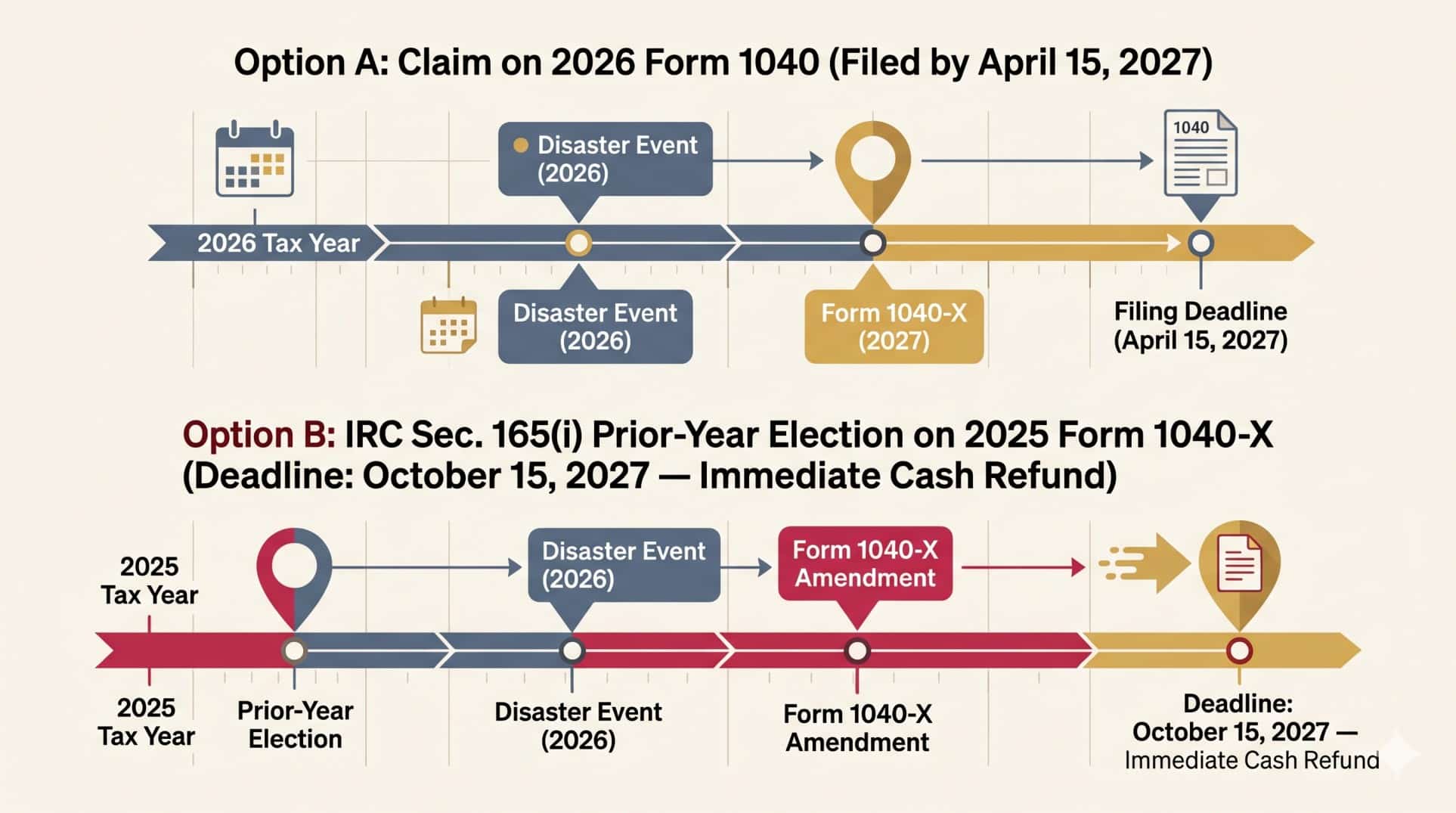
Under IRC Section 165(i), if you suffer a casualty loss attributable to a federally declared disaster during 2026, you can elect to deduct that loss on your 2025 federal tax return instead of waiting until 2027 to claim it on your 2026 return.
When a family loses a home in May or August 2026, waiting until spring 2027 to file a 2026 tax return means going months without cash flow. By making a Section 165(i) election on an amended 2025 return (Form 1040-X), you apply the 2026 disaster deduction against the income taxes you already paid for 2025, prompting the IRS to issue a direct refund check. Note that per IRC Section 165(i)(1), this election is strictly limited to federally declared disasters (Presidential DR- and EM- declarations); it does not apply to state-only disasters declared solely by a governor under the OBBBA.
How to Make the Section 165(i) Election and the October 15, 2027 Deadline
Under Revenue Procedure 2016-53 and the Instructions for Form 4684, you have until six months after the regular due date (without extensions) for filing your original return for the disaster year to make the Section 165(i) election. For a disaster occurring in calendar year 2026, the regular due date of the 2026 individual return is April 15, 2027—meaning your absolute deadline to file the election is October 15, 2027.
To execute the election for a 2026 disaster on your 2025 tax return, complete Section D (Part I) of Form 4684, attach it to a 2025 Form 1040-X, and include the FEMA declaration number, the exact date(s) of the disaster, and the city, town, or county where the damaged property was located. Check our step-by-step guide to filing an amended tax return on Form 1040-X for electronic filing rules. Should you need to revoke an election after filing it, you have 90 days after the due date for making the election to complete Section D, Part II of Form 4684 and return any refund received.
How do you choose between claiming the loss in 2025 versus 2026? Compare your marginal tax brackets across both years. If your household earned $220,000 in 2025 (24% marginal bracket) but your income dropped to $80,000 in 2026 (12% marginal bracket) because the disaster disrupted your work, electing to claim the loss on your 2025 return via Section 165(i) doubles the tax value of every dollar deducted!
Business and Rental Property Losses vs. Personal-Use Property
Unlike personal-use property, casualty and theft losses involving trade, business, or income-producing rental property under IRC Section 165(c)(1) and (c)(2) are 100% deductible in 2026 without any disaster declaration requirement, without a $100 or $500 floor, and without any 10%-of-AGI reduction.
Whether a tornado levels a commercial warehouse in a Presidential disaster zone or an isolated electrical fire destroys a single rental duplex or delivery van, business and rental losses are reported in Section B of Form 4684. However, the valuation formula inside Section B depends on whether the business asset was partially damaged or completely destroyed:
- Partially Damaged Business or Rental Property: Just like personal property, your deductible loss before insurance is the lesser of the property’s adjusted basis (cost minus accumulated depreciation) or the decrease in fair market value, minus any insurance or grant reimbursements.
- Completely Destroyed Business or Rental Property (Total Loss): Under Treasury Regulation Section 1.165-7(b)(1)(ii), if business or income-producing property is completely destroyed (or stolen), the fair market value before the disaster is completely ignored! Your deductible loss is simply your adjusted basis in the property minus any salvage value and insurance reimbursements, even if the property’s fair market value was lower than its basis.
Furthermore, unlike personal residences (where the building, land, and landscaping are combined into one single basis calculation), business and rental real estate requires you to separate the adjusted basis of the building from the basis of the land and landscaping in Section B of Form 4684. If a business casualty loss exceeds your total 2026 income from all sources, it generates a Net Operating Loss (NOL) under IRC Section 172 that can be carried forward indefinitely to offset up to 80% of future taxable income.
When you replace destroyed business equipment, vehicles, or qualified improvement property in 2026 using out-of-pocket cash or SBA loan funds (beyond any tax-deferred insurance proceeds), the OBBBA permanently restored 100% Bonus Depreciation under IRC Section 168(k) for qualifying property acquired and placed in service after January 19, 2025, alongside an expanded 2026 Section 179 expensing limit of $2,560,000. Review our 2026 business bonus depreciation and Section 179 guide for entity-specific rules across Schedule C, Partnerships (Form 1065), and S-Corporations (Form 1120-S).
What If Insurance Pays More Than Your Basis? (IRC Section 1033 Involuntary Conversions)
Because real estate values have appreciated sharply over the past decade while rental buildings are depreciated each year, an insurance company payout for a destroyed home or rental building frequently exceeds the taxpayer’s adjusted tax basis—creating a casualty gain on Form 4684, Line 4.
Under IRC Section 1033 (Involuntary Conversions), you can postpone paying capital gains tax on a casualty gain if you reinvest the insurance proceeds into replacement property of similar or related service/use within a statutory replacement window:
- Standard Replacement Period: 2 years after the close of the first tax year in which you realize any part of the gain.
- Principal Residence in a Federally Declared Disaster Area (IRC § 1033(h)): Extended to 4 years after the close of the first tax year in which any gain is realized. In addition, under Section 1033(h)(1)(A)(i), no gain is ever recognized on insurance proceeds received for unscheduled personal property (household contents) inside a disaster-damaged primary residence, regardless of how you spend those proceeds! Homeowners who decide not to rebuild a destroyed primary residence can also apply their IRC Section 121 home-sale exclusion (up to $250,000 Single / $500,000 Married Filing Jointly) against the insurance payout.
Scenario 3: Small Business Owner Losing a Commercial Building and Delivery Van in a 2026 Tornado
Consider Marcus, who owns an HVAC sole proprietorship (Schedule C) in Oklahoma. In May 2026, a tornado strikes his shop. It completely destroys his commercial service van and causes partial structural damage to his commercial storage building:
- Asset 1 — Commercial Service Van (Total Destruction): Marcus bought the van for $55,000 and claimed $35,000 in prior depreciation, leaving an adjusted basis of $20,000. Its fair market value right before the tornado was $18,000. His commercial auto insurance pays him $14,500 (after deductibles and policy caps), with $0 salvage value. Because the business van was completely destroyed, FMV ($18,000) is ignored! His Form 4684 Section B business loss on the van is his $20,000 adjusted basis minus the $14,500 insurance payout = $5,500.
- Asset 2 — Commercial Storage Building (Partial Damage): The building alone (excluding the land basis) has an adjusted basis of $140,000. An independent appraisal shows the tornado reduced the building’s FMV by $60,000, and commercial property insurance pays $42,000. Because the building was only partially damaged, Marcus takes the lesser of basis ($140,000) or FMV decline ($60,000), which is $60,000, and subtracts the $42,000 insurance reimbursement, yielding a deductible business loss of $18,000.
- Total 2026 Business Tax Benefit: Marcus reports both losses in Section B of Form 4684, carrying a combined $23,500 ordinary loss ($5,500 + $18,000) to Form 4797 (Sales of Business Property) and then to Schedule 1 (Form 1040), Line 4. Because business casualty losses are above-the-line ordinary deductions, the $23,500 directly reduces Marcus’s Adjusted Gross Income without any $100/$500 floor or 10% AGI haircut, and he still claims his full standard deduction!
Penalty-Free $22,000 Disaster Retirement Withdrawals and 120-Day Extensions
Beyond property write-offs, federal disaster declarations unlock two immediate liquidity and compliance benefits for 2026: penalty-free Qualified Disaster Recovery Distributions of up to $22,000 from retirement accounts under SECURE 2.0, and mandatory 120-day tax deadline postponements under IRC Section 7508A.
Qualified Disaster Recovery Distributions (Form 8915-F)
Under IRC Section 72(t)(2)(M) (enacted by the SECURE 2.0 Act), individuals whose principal residence is located in a federally declared disaster area and who sustain an economic loss from that disaster can withdraw up to $22,000 per disaster from an IRA, 401(k), 403(b), or governmental 457(b) plan within 180 days of the disaster with three major tax protections (reported on IRS Form 8915-F):
- 100% Exemption From the 10% Early Withdrawal Penalty: Even if you are under age 59½, the 10% early distribution tax under Section 72(t) is completely waived.
- Three-Year Income Spread: Unless you elect otherwise, the taxable distribution is automatically spread evenly over three tax years (e.g., a $21,000 distribution taken in 2026 adds only $7,000 to your taxable income in 2026, 2027, and 2028).
- Three-Year Tax-Free Rollover Repayment Option: You have up to three years from the day after you received the distribution to repay all or part of the funds back into an eligible retirement account. Any amount repaid within the three-year window is treated as a tax-free rollover, allowing you to file Form 1040-X to recover any income tax paid on earlier installments! Check our 2026 retirement distribution and RMD tax guide for more Form 8915-F details.
Mandatory 120-Day Deadline Postponements (Filing Relief for Natural Disasters Act)
Under the Filing Relief for Natural Disasters Act (P.L. 119-29, which amended IRC Section 7508A for disasters declared after July 24, 2025), Congress expanded automatic administrative deadline relief in two critical ways for 2026 and 2027:
- Mandatory Postponement Doubled to 120 Days: The mandatory minimum postponement period for federal tax filing, tax payment, and IRA contribution deadlines increased from 60 days to 120 days following a qualifying disaster declaration.
- Expanded to Governor-Declared State Disasters: State governors (or the D.C. Mayor) can now submit a written request to the Treasury Secretary to trigger IRC Section 7508A federal tax deadline extensions for qualified state-declared disasters, even before or without a Presidential FEMA declaration. Always verify that the IRS has published an official state-specific News Release (such as AL-2026-01 or FL-2026-07) confirming the exact counties and postponed dates before relying on an extension.
Note that state conformity varies significantly: while a state-declared disaster may qualify for a federal deduction under the OBBBA or a federal deadline extension under Section 7508A, states like California, New York, Pennsylvania, and New Jersey enforce their own state tax return rules. Check your state Department of Revenue disaster announcements separately from IRS.gov.
Frequently Asked Questions About Casualty Losses and FEMA Aid
1. Is FEMA disaster relief taxable on my 2026 federal tax return?
No, FEMA Individual Assistance grants (both Housing Assistance and Other Needs Assistance) are 100% exempt from federal income tax under IRC Section 139. You do not report FEMA grant payments as taxable income on Form 1040, and they do not affect your eligibility for Social Security or income-tested tax credits.
2. Do I have to subtract my FEMA grant from my casualty loss deduction on Form 4684?
You only subtract the portion of a FEMA grant that was awarded specifically to repair or replace damaged real estate or personal property (entered on Form 4684, Line 3 alongside insurance proceeds). Any FEMA grant funds designated for temporary rent, hotel lodging, food, medical bills, or personal living needs do not reduce your deductible property casualty loss.
3. Can I claim a casualty loss in 2026 if I take the standard deduction?
Yes, if your loss is a “qualified disaster loss” resulting from a Presidentially declared Major Disaster (FEMA “DR-” declaration) with an incident period beginning before January 1, 2027. Under IRC Section 165(h)(6), non-itemizers deduct their net loss (after a $500 floor) on Schedule A, Line 16 and add it directly to their 2026 standard deduction ($16,100 Single / $32,200 Married Filing Jointly).
4. What is the difference between a federally declared disaster and a 2026 state-declared disaster?
A Presidential Major Disaster qualifies for the $500 per-casualty floor, 0% AGI reduction, standard deduction add-on, and Section 165(i) prior-year refund election. A 2026 OBBBA governor-declared state disaster (with Treasury concurrence) is deductible on federal returns starting in 2026, but requires itemizing on Schedule A, applies a $100 floor, reduces the loss by 10% of your AGI, and is ineligible for the prior-year election.
5. Can I deduct my hurricane or homeowner’s insurance deductible on my taxes?
Yes, your out-of-pocket homeowner’s, flood, or windstorm insurance deductible represents unreimbursed property damage and is fully eligible to be included in your Form 4684 casualty loss calculation. As long as your unreimbursed loss (including the deductible) exceeds the $500 floor for a Presidential major disaster (or $100 plus 10% of AGI for a state-declared disaster), it is deductible.
6. What if I choose not to file an insurance claim so my premiums don’t go up?
Under IRC Section 165(h)(4)(E), you are legally prohibited from deducting any portion of a personal casualty loss that is covered by an insurance policy unless you file a timely insurance claim. If you have $30,000 of insured damage with a $5,000 deductible and refuse to file a claim, the IRS disallows the $25,000 covered portion and only permits you to count the $5,000 deductible toward Form 4684.
7. Does an SBA disaster loan reduce my casualty loss deduction?
No, a disaster loan from the U.S. Small Business Administration (SBA) is a debt obligation that you must repay with interest, not a grant or insurance reimbursement. You can use SBA loan proceeds to pay contractors to rebuild your home or business while still claiming 100% of your unreimbursed casualty loss on Form 4684.
8. What is the deadline to claim a 2026 disaster loss on my 2025 tax return?
Under IRC Section 165(i) and Revenue Procedure 2016-53, the deadline to elect to claim a 2026 federally declared disaster loss on an amended 2025 return (Form 1040-X) is six months after the regular due date of your 2026 return (without extensions). For calendar year 2026 individual filers, that exact deadline is October 15, 2027.
9. Are fallen trees and landscaping removal deductible after a 2026 storm?
For a personal residence hit by a declared disaster, trees, landscaping, and the house are treated as one single property unit on Form 4684. You cannot deduct a tree removal invoice directly as a standalone expense; however, tree removal and clean-up costs can be used as part of an IRS safe harbor to measure the overall decline in your property’s fair market value, provided they do not exceed your adjusted basis.
10. How do I get free copies of lost prior-year tax returns after a disaster?
If your tax records were destroyed in a federally declared disaster, the IRS waives the usual fee and expedites requests for exact copies of prior tax returns. File IRS Form 4506 (Request for Copy of Tax Return) and write the official FEMA disaster designation (e.g., “Hurricane [Name] — DR-XXXX”) in red ink across the top of the form, or download free tax transcripts immediately via your IRS.gov online account.
Final Disaster Recovery Tax Planning Steps for 2026 and 2027
Maximizing casualty loss deductions in 2026 comes down to meticulous documentation during the first 60 days after the storm or fire clears. Before demolition or clean-up crews haul away debris, take timestamped photographs of every room and exterior structure, save your itemized insurance adjuster reports, and keep your official FEMA Individual Assistance determination letter separating repair grants from temporary living grants.
If your loss stems from a 2026 Presidential Major Disaster, run the numbers with your CPA or EA right away to see whether filing an IRC Section 165(i) prior-year election on a 2025 Form 1040-X delivers a faster, larger refund than waiting until April 15, 2027. By leveraging the Revenue Procedure 2018-08 safe harbors, the codified $500 qualified disaster floor, and the OBBBA’s new state-declared disaster rules, you can turn the tax code into a powerful source of rebuilding capital.
Disclaimer: This content provides general information for educational purposes only and reflects federal tax laws applicable to Tax Year 2026 (returns filed in 2027). Tax laws are complex and subject to change. This article does not constitute professional tax, legal, or accounting advice. Always consult a certified public accountant (CPA), enrolled agent (EA), or qualified tax attorney regarding your specific financial situation. Ourtaxpartner.com is not responsible for any actions taken based on the information provided herein.
