
⚡ Executive Summary: 1031 Exchange Rules for 2026
- The 1031 exchange rules for 2026 allow real estate investors to defer 100% of federal capital gains and depreciation recapture taxes by reinvesting proceeds into like-kind real property.
- The Tax Cuts and Jobs Act (TCJA) permanently limited Section 1031 to real property; the 2025 sunset of other TCJA provisions does not bring back exchanges for personal property or equipment.
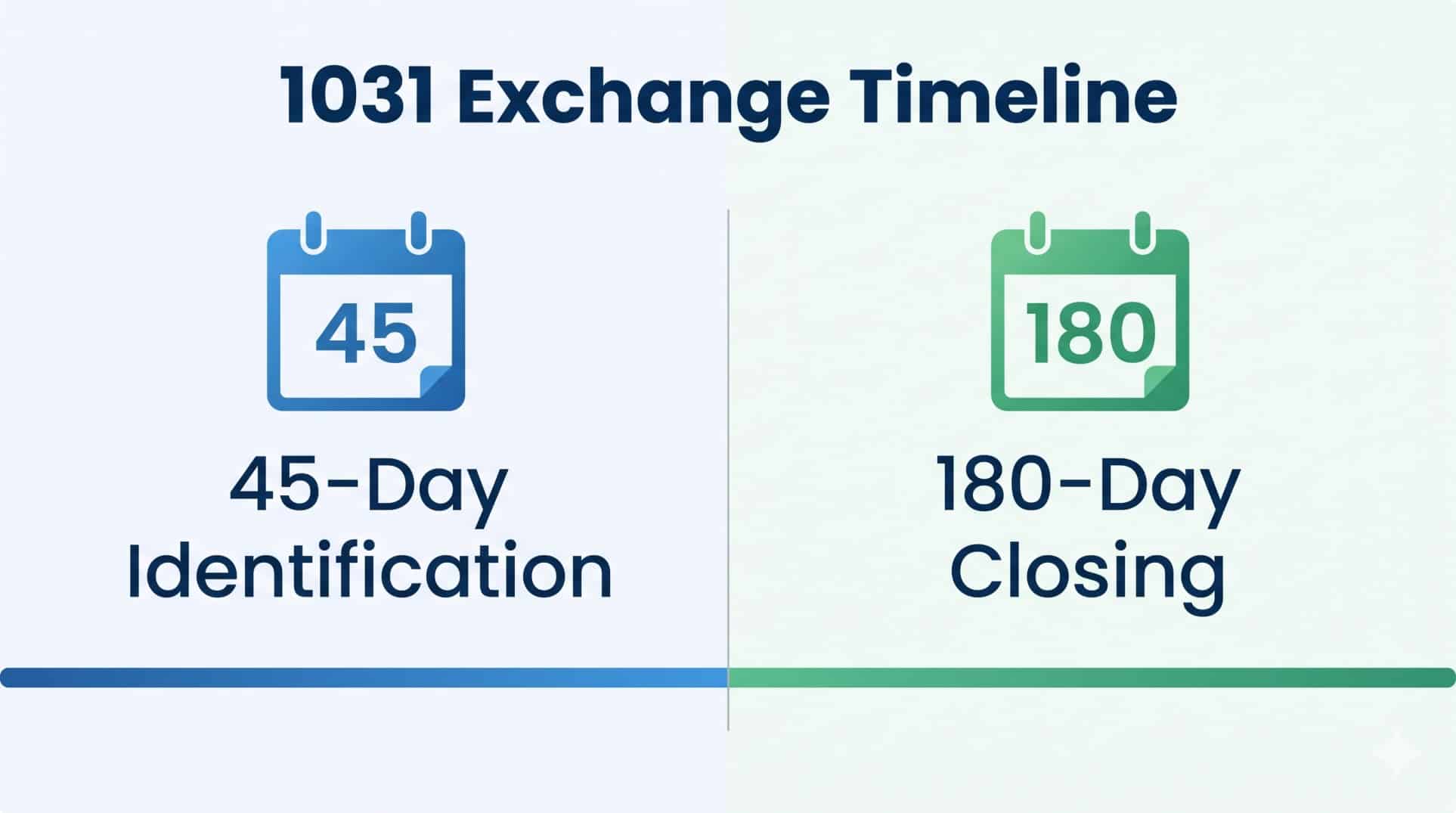
- Taxpayers must strictly adhere to a 45-day identification window and a 180-day closing window. The IRS grants zero extensions for weekends or holidays.
- To avoid taxable “boot,” you must purchase a replacement property of equal or greater value and reinvest all cash equity.
Selling real estate at a massive profit triggers a steep tax bill. Between federal capital gains taxes, depreciation recapture, and the Net Investment Income Tax (NIIT), you can easily lose up to a third of your profits to the IRS. But Section 1031 of the Internal Revenue Code offers a legal, permanent way to keep your capital compounding. By understanding the exact 1031 exchange rules for 2026, you can roll your equity from one property to the next without recognizing a single dollar of taxable gain at closing.
The mechanics are rigid. The IRS does not care if your bank delayed a wire or if a title company missed a deadline. If you violate the sequence of events, touch the cash proceeds, or miss a midnight deadline, your transaction instantly converts into a fully taxable event. This guide breaks down the exact statutes, timelines, and safe harbors you must follow to successfully execute a like-kind exchange this tax year.
Table of Contents
- What is a 1031 Exchange?
- The Unforgiving 1031 Exchange Timeline
- Defining a Like-Kind Exchange in 2026
- How to Avoid Boot in a 1031 Exchange
- Can You Move Into a 1031 Exchange Property?
- Top 1031 Misconceptions for 2026
- Step-by-Step Guide to Your Investment Property Sale
- Frequently Asked Questions About 1031 Exchanges
What is a 1031 Exchange?
A 1031 exchange is a tax-deferral strategy that allows a real estate investor to sell an investment property and acquire a new one while deferring all capital gains taxes. The underlying philosophy of IRC Section 1031 is that if an investor simply moves their capital from one qualifying property to another, their economic position hasn’t actually changed. They haven’t cashed out, so the IRS allows the tax liability to roll over into the new asset.
This is the primary vehicle for deferring capital gains on investment property in the United States. It allows investors to consolidate multiple smaller properties into one large commercial asset, relocate their investments to better markets, or transition from high-maintenance residential rentals to passive triple-net (NNN) leases.
The tax is deferred, not forgiven. The original cost basis of the relinquished property transfers to the replacement property. However, if an investor continues to execute 1031 exchanges throughout their lifetime and holds the final property until death, their heirs receive a “step-up in basis” under IRC Section 1014. This effectively wipes out the accumulated deferred capital gains entirely.
The Unforgiving 1031 Exchange Timeline
The IRS enforces two parallel, non-negotiable clocks that start ticking the exact day your relinquished property closes. A core pillar of the 1031 exchange rules for 2026 is that these deadlines run concurrently. You do not get 45 days plus 180 days; you get 180 days total.
The 45-Day Identification Period
You have exactly 45 calendar days from the closing date of your sale to formally identify potential replacement properties. This identification must be in writing, signed by you, and delivered to your Qualified Intermediary (QI). You cannot simply tell your broker what you want to buy. If day 45 falls on a Sunday or a federal holiday, the deadline does not roll over to Monday. You must identify the property by that Sunday.
When identifying properties, you must use one of three IRS rules:
- The 3-Property Rule: You can identify up to three potential replacement properties of any fair market value. You can purchase one, two, or all three of them.
- The 200% Rule: You can identify four or more properties, provided their combined fair market value does not exceed 200% of the value of the property you sold.
- The 95% Exception: You can identify any number of properties of any value, but you must actually acquire and close on 95% of the total value of all identified properties. (This is rarely used due to the high risk of failure).
Marcus sells a commercial warehouse for $2,000,000. He wants to diversify into smaller residential units. Under the 3-property rule, he could only identify three duplexes. Instead, he uses the 200% rule. He identifies six different duplexes, each valued at $500,000. The total value of the identified properties is $3,000,000. Because $3,000,000 is less than 200% of his $2,000,000 sale price (which would be $4,000,000), his identification is perfectly valid under IRS rules. He ultimately closes on four of the duplexes.
The 180-Day Closing Period
You must close on your replacement property (or properties) by the earlier of two dates: 180 calendar days after the sale of your relinquished property, or the due date of your income tax return for the year the property was sold (including extensions).
If you sell a property late in the year—for example, on December 1, 2026—your 180th day falls in late May 2027. However, your tax return is due April 15, 2027. To get the full 180 days, you must file an extension (Form 4868) for your tax return. If you file your return on April 15 without an extension and haven’t closed on the replacement property, your 1031 exchange timeline is cut short, and the exchange fails.
If you need to brush up on how tax deadlines impact your broader financial strategy, reviewing a guide to real estate tax extensions can keep you compliant.
Defining a Like-Kind Exchange in 2026
The term “like-kind” confuses many first-time investors. It does not mean you have to swap a duplex for a duplex, or raw land for raw land. In the context of real estate, the IRS defines like-kind very broadly. Any real property held for productive use in a trade or business, or for investment, is considered like-kind to any other real property held for investment.
You can exchange:
- A single-family rental for a commercial strip mall.
- Raw land for an apartment complex.
- An industrial warehouse for a fractional interest in a Delaware Statutory Trust (DST).
What does not qualify as a like-kind exchange? You cannot exchange real estate for personal property, stocks, bonds, or partnership interests. The Tax Cuts and Jobs Act (TCJA) of 2017 permanently eliminated 1031 exchanges for personal property (like heavy machinery, aircraft, or franchise licenses). While many individual tax provisions of the TCJA are scheduled to sunset at the end of 2025, the restriction of Section 1031 to real property is permanent. It will not revert in 2026.
Additionally, property held primarily for sale—such as a house you just flipped or inventory built by a developer—does not qualify. The property must be held for investment.
How to Avoid Boot in a 1031 Exchange
To achieve total tax deferral, you must reinvest 100% of your equity and acquire a property of equal or greater value than the one you sold. If you fail to do either, you generate “boot.” Boot is any non-like-kind property received in an exchange, usually in the form of cash or debt reduction. Boot in a 1031 exchange is taxable to the extent of your realized gain.
There are two primary types of boot you must watch out for:
| Type of Boot | How It Occurs | Tax Consequence |
|---|---|---|
| Cash Boot | You pull cash out of the transaction at closing, or you buy a replacement property that costs less than your total cash proceeds. | The cash received is taxed as capital gains up to the amount of your total realized gain. |
| Mortgage Boot | You acquire a replacement property with a smaller mortgage than the one you paid off, and you do not replace that debt reduction with fresh cash. | The reduction in your debt liability is treated as taxable income by the IRS. |
When calculating your potential liability under the 1031 exchange rules for 2026, you must account for both cash and mortgage boot. Many investors accidentally trigger mortgage boot because they focus solely on reinvesting their cash equity and forget about their debt requirements.
Elena sells an apartment building for $1,500,000. She pays off a $500,000 mortgage at closing, leaving her with $1,000,000 in cash proceeds (held by her QI). To fully defer her taxes, she must buy a replacement property worth at least $1,500,000.
She finds a replacement property for $1,300,000. She uses her entire $1,000,000 in cash equity and takes out a new mortgage for $300,000.
Because she traded down in total value (from $1.5M to $1.3M) and reduced her debt liability (from $500k to $300k), she has generated $200,000 in mortgage boot. Even though she didn’t pocket a single dollar of cash, she will owe capital gains taxes on that $200,000 difference.
Can You Move Into a 1031 Exchange Property?
Taxpayers often ask if they can move into a property acquired under the 1031 exchange rules for 2026. The short answer is yes, but you must navigate strict IRS safe harbor rules to avoid disqualifying the original exchange.
If you buy a replacement property with the immediate intent to use it as your primary residence, it does not qualify as investment property, and your exchange will fail. However, the IRS issued Revenue Procedure 2008-16, which provides a safe harbor for converting an investment property into a primary residence or vacation home.
To satisfy the safe harbor, you must hold the replacement property for at least 24 months immediately following the exchange. During each of those two 12-month periods, you must meet two strict usage tests:
- You must rent the property to another person at fair market value for at least 14 days.
- Your personal use of the property cannot exceed the greater of 14 days or 10% of the number of days the property was rented at fair market value.
Once you successfully complete this 24-month holding period, you can safely move into a 1031 exchange property and convert it to your primary residence without invalidating the prior tax deferral.
David sells a rental condo in Chicago and uses a 1031 exchange to buy a beachfront home in Florida. He intends to retire there eventually. Under Rev. Proc. 2008-16, he rents the Florida home to vacationers for 100 days in Year 1. Because 10% of 100 days is 10 days, and 14 days is greater, David can use the home personally for up to 14 days in Year 1. He repeats this exact pattern in Year 2. On day one of Year 3, having satisfied the 24-month safe harbor, David stops renting the property, packs his bags, and moves in full-time. His original 1031 exchange remains perfectly valid.
If you later decide to sell this converted primary residence, you cannot simply claim the full Section 121 primary residence exclusion ($250,000 for singles, $500,000 for married couples). The Housing and Economic Recovery Act of 2008 requires you to hold the property for a total of five years before selling, and the IRS will prorate your capital gains exclusion based on the ratio of “non-qualified use” (the time it was a rental) to the total time you owned the property.
Top 1031 Misconceptions for 2026
Because the tax code is dense, bad advice circulates rapidly among real estate investors. Falling for 1031 misconceptions can result in a failed exchange and massive penalties.
Misconception 1: You can touch the money as long as you reinvest it within 45 days.
This is the fastest way to destroy an exchange. You cannot have actual or constructive receipt of the sale proceeds. The funds must go directly from the closing table to a Qualified Intermediary (QI). If the title company wires the funds to your personal checking account, even for a minute, the exchange is dead. You cannot fix it.
Misconception 2: LLC members can do their own separate exchanges.
If an investment property is owned by a multi-member LLC (taxed as a partnership), the LLC is the taxpayer, not the individual members. If one partner wants to cash out and the other wants to exchange, the partners cannot simply split the proceeds. They must execute a “drop and swap” strategy. This involves dissolving the partnership and distributing the property deed to the members as Tenants in Common (TIC) well before the investment property sale occurs. This establishes each individual as a separate taxpayer eligible for their own exchange.
Misconception 3: You have to replace your exact mortgage amount.
You do not need a mortgage of the exact same size, but you do need to replace the value of the debt you paid off. If you pay off a $500,000 mortgage, you can replace that debt liability by taking out a new $500,000 mortgage on the replacement property, OR you can bring $500,000 of fresh, out-of-pocket cash to the closing table. You just cannot let your total reinvestment value drop.
If you are restructuring your entity ownership prior to a sale, consulting a guide on LLC taxation for real estate is highly recommended to avoid triggering unintended taxable events.
Step-by-Step Guide to Your Investment Property Sale
Executing a flawless transaction under the 1031 exchange rules for 2026 requires a coordinated team. You cannot do this alone, and you cannot set it up after you close. Here is the exact sequence of events for deferring capital gains on investment property.
Step 1: Hire a Qualified Intermediary (QI)
Before you even list your property, interview and hire a QI. The QI drafts the exchange agreement, holds your funds in a secure escrow account, and ensures the transaction complies with IRS Section 1031. Your attorney, CPA, or real estate agent cannot act as your QI if they have provided services to you in the past two years. They are disqualified persons.
Step 2: Include 1031 Cooperation Clauses in Your Contracts
Your purchase and sale agreements for both the relinquished and replacement properties should include a standard 1031 cooperation clause. This legally requires the buyer or seller to sign the necessary assignment documents acknowledging the exchange, at no cost or delay to them.
Step 3: Close on the Relinquished Property
You go to closing. The buyer funds the transaction. The title company pays off your existing mortgage, covers closing costs, and wires the remaining net cash proceeds directly to your QI’s escrow account. The 45-day and 180-day clocks start immediately.
Step 4: Identify Replacement Properties
Within 45 days, you evaluate the market, run your numbers, and formally submit your identification letter to your QI. You must clearly identify the properties using a legal description or an unambiguous street address.
Step 5: Close on the Replacement Property
You negotiate the purchase of one or more of your identified properties. When it is time to close, your QI wires your tax-deferred funds directly to the title company handling the purchase. You sign the closing documents, take title to the new property, and the exchange is complete.
Step 6: Report the Exchange to the IRS
When tax season arrives, your CPA will file IRS Form 8824 (Like-Kind Exchanges) with your federal tax return. This form details the properties exchanged, the dates of the transfers, the identities of the parties involved, and calculates any recognized boot.
Frequently Asked Questions About 1031 Exchanges
What qualifies as like-kind property?
Any real estate held for productive use in a trade or business or for investment qualifies as like-kind to any other investment real estate. You can swap vacant land for an apartment building, or a commercial warehouse for a residential rental. Personal property, primary residences, and inventory (flips) do not qualify.
Can I use a 1031 exchange for a primary residence?
No. Section 1031 is strictly for investment and business-use properties. However, you can sell a primary residence tax-free using the Section 121 exclusion, which allows individuals to exclude up to $250,000 (or $500,000 for married couples) of capital gains, provided they lived in the home for two of the past five years.
What happens if I miss the 45-day identification deadline?
If you fail to identify replacement property in writing by midnight of the 45th day, your exchange fails entirely. The Qualified Intermediary will return your funds to you (usually on day 46), and you will owe full capital gains taxes on the sale. The IRS does not grant extensions for weekends, holidays, or market conditions.
How does a reverse 1031 exchange work?
A reverse exchange occurs when you acquire the replacement property before you sell your relinquished property. Because you cannot own both properties simultaneously under 1031 rules, an Exchange Accommodation Titleholder (EAT) must temporarily hold title to one of the properties until the sale of the relinquished property closes. The same 45-day and 180-day timelines apply.
What is a Delaware Statutory Trust (DST) in a 1031 exchange?
A DST is a legally recognized trust that allows multiple investors to hold fractional interests in large, institutional-grade commercial real estate. The IRS recognizes DST interests as like-kind real property. Investors often use DSTs as a backup identification option or to passively invest their proceeds without the headaches of active property management.
Do I have to replace the exact amount of debt I paid off?
You must replace the value of the debt to avoid mortgage boot, but you do not have to use a new loan to do it. If you paid off a $400,000 mortgage, you can take out a new $400,000 mortgage on the replacement property, or you can inject $400,000 of your own personal cash into the purchase to offset the debt reduction.
Can I do a 1031 exchange into a Real Estate Investment Trust (REIT)?
No. Shares in a traditional REIT are considered securities (stocks), not real property, so they do not qualify for a like-kind exchange. However, you can execute a 1031 exchange into a DST, or utilize an advanced strategy called a Section 721 exchange (an “UPREIT”) to eventually convert real property into operating partnership units of a REIT.
What happens to a 1031 exchange when you die?
If you hold a 1031 exchange property until your death, the deferred capital gains are essentially erased. Under IRC Section 1014, your heirs receive the property with a “stepped-up basis” equal to its fair market value on the date of your death. If they sell the property the next day, they owe zero capital gains tax.
Can I sell multiple properties and exchange them into one large property?
Yes. This is called a consolidation exchange. You can sell several smaller relinquished properties and pool the proceeds to buy one large replacement property. However, the 45-day and 180-day clocks start ticking the moment the very first relinquished property closes, making the timing highly complex.
Mastering the 1031 exchange rules for 2026 allows you to keep your capital working for you, rather than handing a massive percentage of your wealth to the government. By respecting the timelines, avoiding boot, and working with a competent Qualified Intermediary, you can scale your real estate portfolio tax-free.
Disclaimer: This content provides general information for educational purposes only. Tax laws are complex and change often. It is not professional tax, legal, or financial advice. Always consult a qualified tax professional for personalized guidance regarding your specific situation. Ourtaxpartner.com is not responsible for any actions taken based on the information provided herein.
