
For decades, parents faced a frustrating dilemma when saving for their children’s education. If you diligently funded a 529 plan, but your child decided not to attend college, secured a full scholarship, or simply finished school with money left in the account, that capital was trapped. Pulling those leftover college funds out for non-education purposes triggered ordinary income taxes plus a steep 10% federal penalty on the earnings.
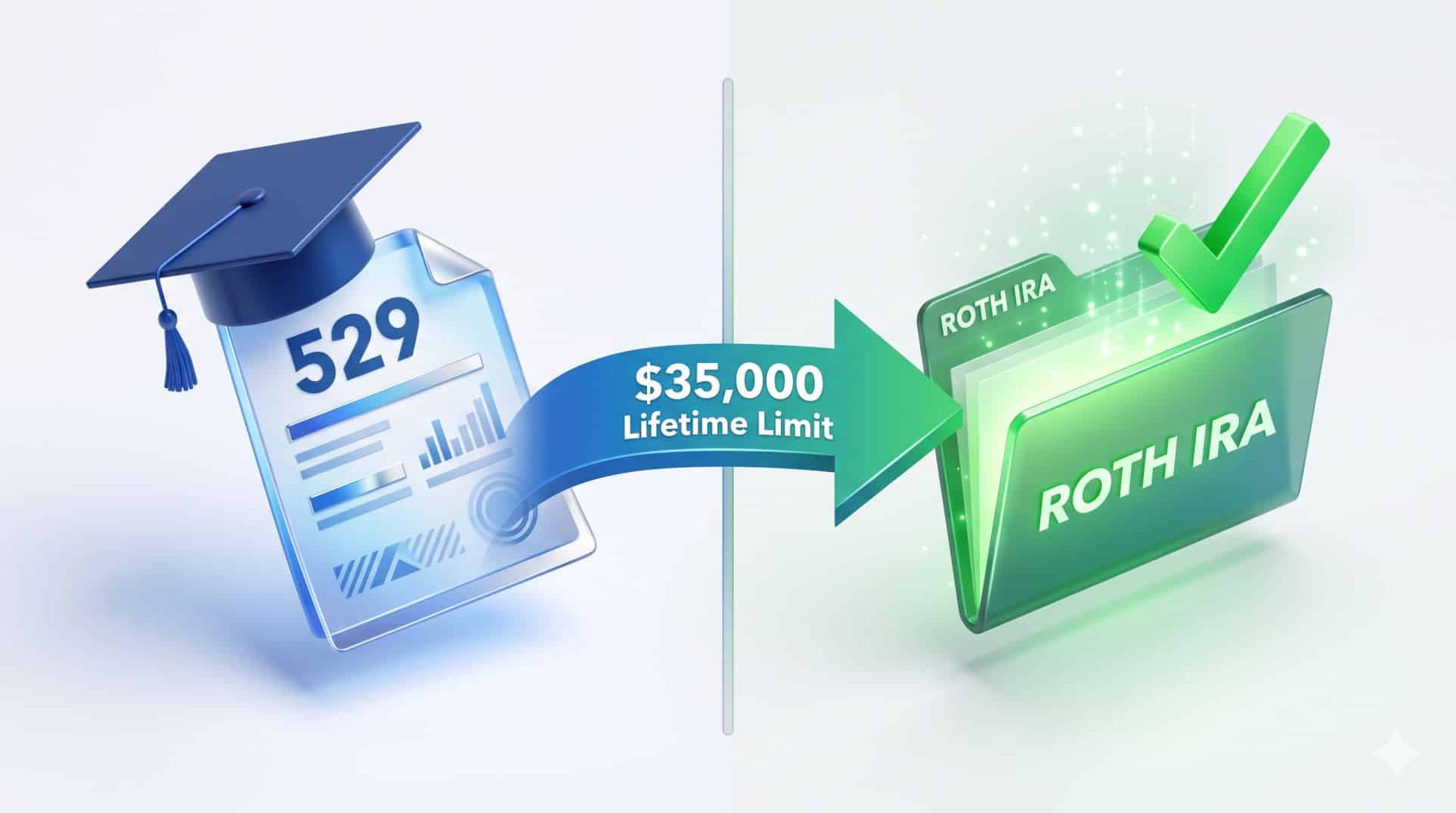
That penalty trap ended with the passage of the SECURE 2.0 Act. Section 126 of the legislation introduced a specific rollover rule that fundamentally changed education planning. You can now move unused 529 assets directly into a Roth IRA for the account beneficiary, completely tax-free and penalty-free.
However, the IRS did not make this a free-for-all. Executing 529 to Roth IRA Rollovers in 2026 requires navigating a strict maze of aging requirements, lifetime caps, and annual contribution limits. One misstep in the transfer process will immediately trigger the exact taxes and penalties you are trying to avoid. This guide breaks down the exact mechanics of the law, the math behind the limits, and the step-by-step process to secure your child’s retirement.
⚡ Executive Summary: 2026 Rollover Mechanics
- Lifetime Cap: You are limited to a strict $35,000 lifetime maximum rollover per beneficiary.
- Annual Limits Apply: You cannot move the $35,000 all at once. Rollovers are subject to the annual Roth IRA contribution limit, which is $7,500 for the 2026 tax year.
- The 15-Year Rule: The 529 plan must have been open and active for at least 15 consecutive years before the rollover occurs.
- Earned Income Mandate: The beneficiary receiving the Roth IRA funds must have earned W-2 or self-employment income at least equal to the amount being rolled over that year.
Table of Contents
- Understanding 529 to Roth IRA Rollovers in 2026
- The Math: $35,000 Lifetime Cap vs. 2026 Annual Limits
- The 15-Year Rule and the 5-Year Holding Period
- The Earned Income Requirement for Beneficiaries
- The MAGI Loophole: Bypassing High-Income Restrictions
- State Tax Traps: When a Federal Benefit Costs You Locally
- Step-by-Step Guide: Rules, Limits, and How to Execute
- Frequently Asked Questions About 529 Rollovers
Understanding 529 to Roth IRA Rollovers in 2026
Before the SECURE 2.0 Act took effect, families with leftover college funds had very few good options. You could change the beneficiary to another qualifying family member, leave the money invested in case the child decided to go to graduate school years later, or take a non-qualified withdrawal and suffer the tax consequences.
Congress recognized that the fear of the 10% penalty was actively discouraging middle-class families from funding 529 plans in the first place. To fix this, they created a specific rollover rule allowing those funds to be repurposed for retirement. Because 529 plans are funded with after-tax dollars (just like Roth IRAs), the transition makes structural sense within the tax code.
When you execute 529 to Roth IRA Rollovers in 2026, the money moves from the 529 account directly into a Roth IRA held in the name of the 529 beneficiary. The parent (who is usually the 529 account owner) cannot roll the money into their own personal Roth IRA. The tax code explicitly mandates that the retirement account must belong to the student.
The Math: $35,000 Lifetime Cap vs. 2026 Annual Limits
The most common misconception about 529 to Roth Rollovers is that you can simply write a check for the entire balance. The IRS strictly prohibits this. The law imposes a $35,000 lifetime maximum per beneficiary. More importantly, you are forced to move that money slowly over several years.
Any funds moved from a 529 to a Roth IRA count directly against the beneficiary’s annual IRA contribution limit. For the 2026 tax year, the IRS set the standard IRA contribution limit at $7,500 (or $8,600 if the beneficiary happens to be age 50 or older). This means you can only roll over a maximum of $7,500 in 2026.
If the beneficiary makes a separate, out-of-pocket contribution to their Roth IRA during the year, that amount subtracts from what you can roll over. If they manually contribute $2,000 to their Roth IRA in 2026, you can only roll over $5,500 from the 529 plan that same year.
Marcus graduated from college in 2025 with $40,000 of leftover college funds in his 529 plan. His parents want to move the maximum allowable amount to his Roth IRA. Because the 2026 annual limit is $7,500, they must execute this specific rollover rule over five separate tax years.
Year 1 (2026): They roll over $7,500. Lifetime remaining: $27,500.
Year 2 (2027): Assuming the limit remains $7,500, they roll over another $7,500. Lifetime remaining: $20,000.
Year 3 (2028): They roll over $7,500. Lifetime remaining: $12,500.
Year 4 (2029): They roll over $7,500. Lifetime remaining: $5,000.
Year 5 (2030): They roll over the final $5,000, hitting the $35,000 lifetime cap. The remaining $5,000 in the 529 plan cannot be rolled over and must be used for education or withdrawn subject to penalties.
The 15-Year Rule and the 5-Year Holding Period
To prevent wealthy taxpayers from using 529 plans as short-term tax shelters, Congress implemented strict aging requirements. You cannot open a 529 plan today, fund it, and roll it into a Roth IRA next year.
First, the 529 account must have been open for a minimum of 15 years before the date of the rollover. The IRS tracks this based on the original establishment date of the account. A major grey area currently exists regarding beneficiary changes. If you open an account for your oldest child, and 10 years later change the beneficiary to your youngest child, does the 15-year clock reset? While the IRS has not issued final Treasury Regulations on this exact edge case, conservative tax professionals advise assuming the clock resets upon a beneficiary change until official guidance dictates otherwise.
Second, the IRS enforces a 5-year holding period on the actual funds. You cannot roll over any contributions (or the earnings associated with those contributions) made to the 529 plan within the last five years. This prevents parents from dumping $35,000 into a 15-year-old account right before graduation just to funnel it into a Roth IRA.
Sarah’s parents opened her 529 plan in 2010, easily satisfying the 15-year rule by 2026. In 2022, they made a final $5,000 contribution to the account. In 2026, Sarah graduates and wants to execute a rollover. While the account itself is old enough, that specific $5,000 contribution from 2022 (and any interest it earned) is ineligible for rollover in 2026 because it has not sat in the account for five full years. She can only roll over funds that were deposited in 2021 or earlier.
The Earned Income Requirement for Beneficiaries
Because 529 to Roth Rollovers are treated as standard IRA contributions under the tax code, the beneficiary must meet standard IRA income rules. The most critical of these is the earned income requirement.
The beneficiary receiving the funds must have earned income (W-2 wages, 1099-NEC self-employment income, or tips) during the tax year of the rollover. Furthermore, their earned income must be equal to or greater than the amount being rolled over. Passive income, such as dividends, capital gains, or gifts from parents, does not count.
This rule frequently catches families off guard. If your child graduates in May 2026, takes the summer off to travel, and does not start their first job until November, they might not earn enough to maximize the rollover.
David is a college junior in 2026. His parents want to start rolling over his leftover college funds now. David works a part-time campus job and earns exactly $4,000 for the entire 2026 tax year. Even though the IRS annual limit is $7,500, David’s rollover is strictly capped at $4,000. If his parents attempt to roll over the full $7,500, the IRS will classify the excess $3,500 as an ineligible contribution, triggering a 6% annual excise tax penalty until it is removed.
The MAGI Loophole: Bypassing High-Income Restrictions
While the earned income rule restricts low earners, high earners actually get a massive break under this specific rollover rule. Standard Roth IRA contributions are subject to strict Modified Adjusted Gross Income (MAGI) phase-outs. In 2026, if a single filer earns over a certain threshold (projected around $153,000), they are legally barred from contributing directly to a Roth IRA.
However, Congress explicitly exempted 529 to Roth IRA Rollovers in 2026 from these MAGI limits. If your child graduates and immediately lands a high-paying job in tech or finance earning $200,000 a year, they cannot make a standard Roth contribution. But they can still receive a $7,500 rollover from their 529 plan. This creates a powerful backdoor mechanism for high-earning young professionals to continue building tax-free retirement wealth.
State Tax Traps: When a Federal Benefit Costs You Locally
Federal tax law and state tax law do not always align. While the IRS considers 529 to Roth Rollovers to be a non-taxable event, your state department of revenue might disagree.
Many states offer an upfront state income tax deduction when you contribute to a 529 plan. If your state has not passed legislation to conform to the federal SECURE 2.0 Act, they will treat the rollover as a non-qualified withdrawal. In these non-conforming states, executing the rollover will trigger a state income tax bill on the earnings, and the state will likely claw back any tax deductions you claimed when you originally funded the account.
Before initiating a transfer, you must verify your specific state’s conformity rules. States like California and New York frequently have complex conformity timelines, so consulting a local CPA is highly recommended to avoid surprise state tax bills.
Step-by-Step Guide: Rules, Limits, and How to Execute
If you have verified that your account meets the 15-year rule, the 5-year holding period, and the beneficiary has sufficient earned income, you are ready to move the money. Follow these exact steps to ensure the IRS does not flag the transaction.
Step 1: Open the Destination Roth IRA
The Roth IRA must be opened in the exact name and Social Security Number of the 529 plan beneficiary. The 529 account owner (the parent) cannot use their own Roth IRA.
Step 2: Calculate the Eligible Amount
Determine the beneficiary’s expected earned income for 2026. Compare that to the $7,500 annual limit. Subtract any standard IRA contributions the beneficiary has already made this year. The lowest of these numbers is your maximum rollover amount.
Step 3: Initiate a Trustee-to-Trustee Transfer
You must never take personal possession of the funds. Do not request a check made out to yourself or the beneficiary. You must contact the 529 plan administrator and request a direct trustee-to-trustee transfer to the Roth IRA custodian. The money must move directly between the financial institutions.
Step 4: Document the Transfer for Tax Season
At the end of the year, the 529 plan will issue a Form 1099-Q reporting the distribution. The Roth IRA custodian will issue a Form 5498 reporting the contribution. You will use these documents to report the tax-free rollover on your Form 1040, proving to the IRS that the distribution was a qualified SECURE 2.0 rollover.
Frequently Asked Questions About 529 Rollovers
What is the maximum amount for 529 to Roth IRA Rollovers in 2026?
The maximum you can roll over in 2026 is $7,500, which aligns with the standard annual IRA contribution limit. You are also subject to a strict $35,000 lifetime cap per beneficiary.
Can I roll leftover college funds into my own Roth IRA as the parent?
No. The tax code requires the destination Roth IRA to be in the name of the 529 plan beneficiary. You cannot roll the funds into the account owner’s retirement account.
Does changing the beneficiary reset the 15-year rule?
The IRS has not issued final, definitive guidance on this specific scenario. However, most tax professionals advise that changing the beneficiary likely resets the 15-year clock. Proceed with extreme caution if your account has a recent beneficiary change.
What happens if the beneficiary has no earned income?
If the beneficiary does not have W-2 or self-employment income during the tax year, they cannot execute a rollover. The rollover amount cannot exceed their total earned income for that specific year.
Do the Roth IRA MAGI income limits apply to this specific rollover rule?
No. Congress exempted 529 to Roth rollovers from the standard Roth IRA Modified Adjusted Gross Income phase-outs. High-earning beneficiaries can still receive these rollovers.
Can I roll over money I contributed to the 529 plan last year?
No. The IRS enforces a 5-year holding period. You cannot roll over any contributions, or the earnings generated by those contributions, that were made within the last five years.
How do I physically move the money to avoid penalties?
You must use a direct trustee-to-trustee transfer. The 529 plan administrator must send the funds directly to the Roth IRA custodian. If you take a cash distribution and try to deposit it yourself, it will be treated as a taxable non-qualified withdrawal.
Will I owe state taxes on 529 to Roth Rollovers?
It depends on your state. While the rollover is tax-free at the federal level, states that do not conform to the SECURE 2.0 Act may treat it as a non-qualified withdrawal, triggering state income taxes and deduction clawbacks.
Can I roll over more than $7,500 if my child is over 50?
Yes. If the 529 beneficiary is age 50 or older in 2026, they qualify for the $1,100 catch-up contribution, raising their annual rollover limit to $8,600, provided they have the earned income to support it.
What tax forms will I receive to prove the rollover?
You will receive a Form 1099-Q from the 529 plan showing the distribution, and a Form 5498 from the Roth IRA custodian showing the contribution. You will reconcile these on your annual tax return.
Executing 529 to Roth IRA Rollovers in 2026 is one of the most powerful wealth-transfer strategies available to families today. By strictly adhering to the 15-year rule, respecting the annual limits, and ensuring the beneficiary has sufficient earned income, you can seamlessly transform unused education savings into a lifetime of tax-free retirement growth.
Disclaimer: This content provides general information for educational purposes only. Tax laws are complex and change often. It is not professional tax, legal, or financial advice. Always consult a qualified tax professional for personalized guidance regarding your specific situation. Ourtaxpartner.com is not responsible for any actions taken based on the information provided herein.
