
⚡ Executive Summary: The New Vehicle Tax Break
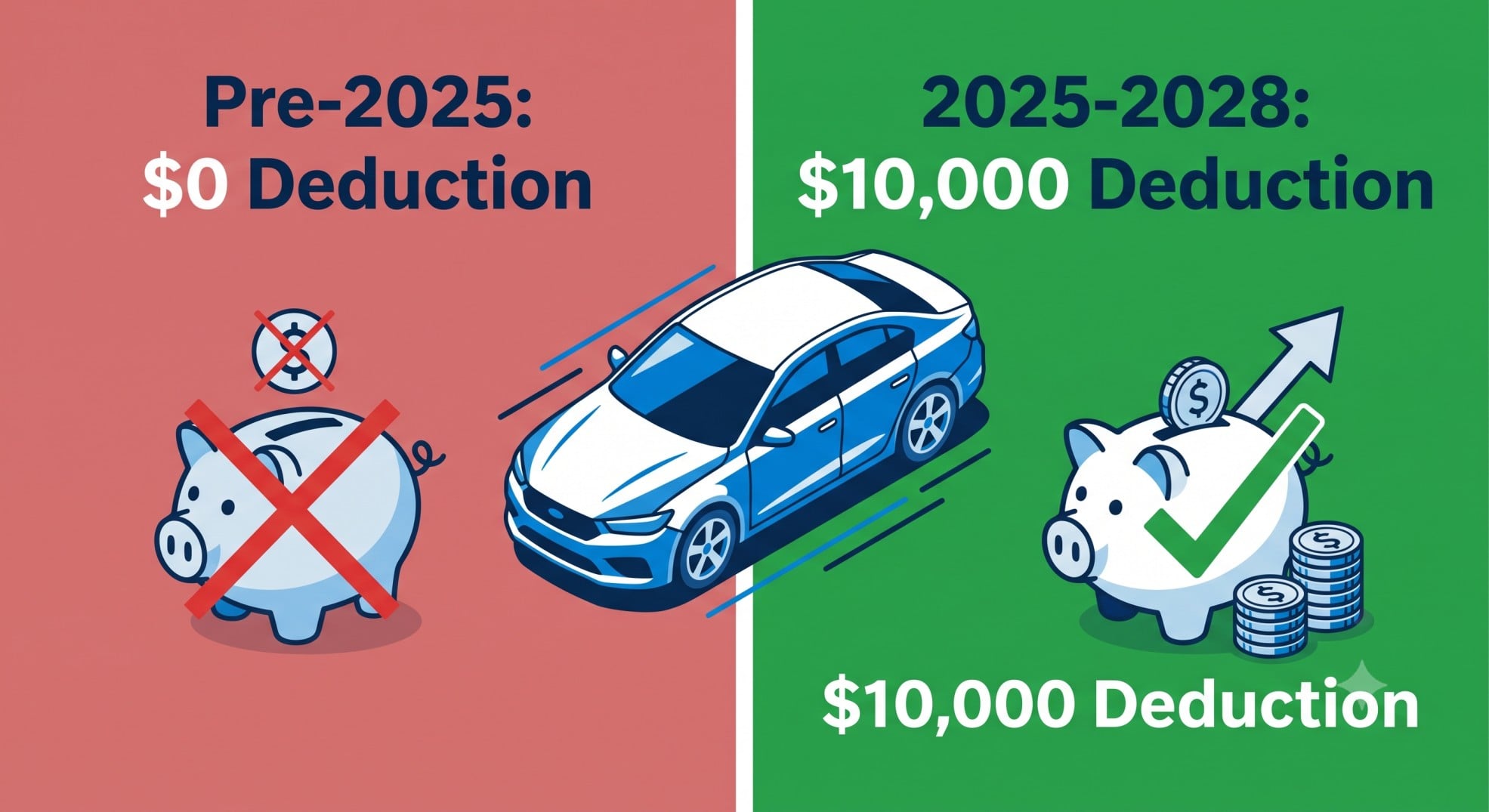
- The One Big Beautiful Bill Act (OBBBA) allows eligible taxpayers to deduct up to $10,000 in auto loan interest annually for tax years 2025 through 2028.
- This is an above-the-line deduction, meaning you do not need to itemize your taxes to claim the benefit.
- The deduction phases out based on your Modified Adjusted Gross Income, with strict cutoffs at $150,000 for single filers and $250,000 for joint filers.
- Only new vehicles that underwent final assembly in the United States and were financed after December 31, 2024, qualify for the write-off.
Table of Contents
Introduction: The Return of the Car Loan Write-Off
For nearly four decades, the IRS treated the interest you paid on a personal car loan as a completely non-deductible personal expense. That strict rule vanished with the passage of the One Big Beautiful Bill Act (OBBBA) on July 4, 2025. Congress designed this legislation to stimulate domestic auto manufacturing and provide immediate financial relief to middle-class car buyers. The result is a highly lucrative, temporary tax break that changes the math of buying a new car.
Under this temporary provision, eligible taxpayers can deduct up to $10,000 in auto loan interest on their federal tax returns. This specific benefit applies exclusively to the 2025, 2026, 2027, and 2028 tax years. If you finance a qualifying vehicle during this window, the government is effectively subsidizing a portion of your borrowing costs.
The most powerful aspect of this new law is its structure. You do not need to itemize your deductions on Schedule A to claim this benefit. The OBBBA established this as an above-the-line deduction. It directly reduces your Adjusted Gross Income (AGI) before the standard deduction is even applied. Whether you rent an apartment or own a home, whether you are single or married, you can deduct up to $10,000 in auto loan interest as long as you meet the specific income and vehicle requirements.
But the IRS does not hand out five-figure tax deductions without attaching strings. The rules governing exactly who qualifies, what type of car you must buy, and how the loan must be structured are rigid. Failing a single test disqualifies your entire claim.
Income Limits and the Phaseout Math
The government designed this tax break specifically for middle-income households. High earners are intentionally excluded. To determine if you can deduct up to $10,000 in auto loan interest, you must first calculate your Modified Adjusted Gross Income (MAGI). For most standard W-2 employees, your MAGI is identical to your Adjusted Gross Income. However, if you have foreign earned income, student loan deductions, or certain passive losses, your MAGI will differ slightly.
The IRS uses your Modified Adjusted Gross Income to establish strict phaseout thresholds. If your income falls below the starting threshold, you get the full deduction. If it falls within the phaseout range, your deduction is reduced. If it exceeds the upper limit, you get nothing.
Here are the exact thresholds for the 2026 tax year:
- Single Filers: The phaseout begins at $100,000. It is completely eliminated at $150,000.
- Married Filing Jointly: The phaseout begins at $200,000. It is completely eliminated at $250,000.
The phaseout math is linear and precise. The IRS reduces your maximum allowable deduction by $200 for every $1,000 your Modified Adjusted Gross Income exceeds the starting threshold. You do not lose the deduction all at once; it slowly bleeds away as your income rises.
For example, suppose you are a single filer with a MAGI of $120,000. You are exactly $20,000 over the $100,000 starting limit. You multiply that 20 (representing the number of thousands over the limit) by $200. The result is a $4,000 reduction. Instead of being able to deduct up to $10,000 in auto loan interest, your personal cap drops to $6,000 for the year.
Couples filing jointly face the exact same math, just starting at a higher baseline. If a married couple earns $225,000, they are $25,000 over their $200,000 threshold. Multiplying 25 by $200 results in a $5,000 reduction, cutting their maximum deduction in half.
Vehicle Eligibility: The “What” You Can Buy
You cannot simply buy any car off a lot and expect a tax break. The One Big Beautiful Bill Act imposes strict manufacturing and usage requirements on the vehicle itself. If the car fails any of these four tests, the interest on the loan is entirely non-deductible.
First, the vehicle must be strictly new. The tax code defines this as the “original use” beginning with the taxpayer. Used cars, certified pre-owned vehicles, and cars purchased at the end of someone else’s lease do not qualify. You must be the first registered owner of the vehicle.
Second, the vehicle must satisfy a strict domestic manufacturing requirement. The final assembly of the vehicle must occur within the United States. A car manufactured in Mexico, Canada, Germany, or Japan will not qualify, even if it is sold by an American brand like Ford or Chevrolet. Conversely, a foreign brand like Toyota or BMW might qualify if the specific model was assembled in an American plant (like Toyota’s facility in Texas or BMW’s plant in South Carolina). The IRS requires taxpayers to verify this by checking the National Highway Traffic Safety Administration’s VIN Decoder.

Third, the vehicle must fit into an approved category and weight class. The law covers passenger cars, minivans, SUVs, pickup trucks, and motorcycles. However, the vehicle must have a Gross Vehicle Weight Rating (GVWR) of less than 14,000 pounds. Heavy commercial trucks, RVs, and massive transport vehicles are excluded.
Finally, you must satisfy the personal use rule. To deduct up to $10,000 in auto loan interest under this specific provision, you must use the vehicle for personal purposes more than 50% of the time. This is a one-time test based on your intent at the time of purchase. If you buy a truck primarily for your landscaping business and use it 80% of the time for commercial work, you cannot claim this personal deduction. (Business owners would instead deduct the interest as a standard business expense on Schedule C).
Loan Requirements: The “How” You Finance It
The structure of your financing matters just as much as the car you buy. The IRS has closed several loopholes to prevent taxpayers from gaming the system. To deduct up to $10,000 in auto loan interest, your debt must meet three non-negotiable criteria.
First, the loan must originate after December 31, 2024. If you bought a qualifying new car in November 2024, you are out of luck. The law is not retroactive. Only loans signed and executed on or after January 1, 2025, generate deductible interest.
Second, the debt must be secured by a first lien directly on the qualifying vehicle. This means the lender must have the legal right to repossess the car if you stop making payments. You cannot buy a car using a personal unsecured loan, a credit card, or a home equity line of credit (HELOC) and claim this specific deduction. The loan must be a traditional auto loan tied directly to the VIN.
Third, the law explicitly excludes specific types of financing arrangements. You cannot deduct up to $10,000 in auto loan interest if you lease the vehicle. Lease payments are not loans, and the “interest” embedded in a lease (the money factor) does not qualify. Furthermore, cash-out refinancing is prohibited. If you refinance an existing qualified auto loan, the new loan only qualifies if the initial balance of the new loan does not exceed the ending balance of the original loan. You cannot pull equity out of your car and deduct the interest on that extra cash.
Finally, the IRS prohibits related-party loans. You cannot borrow money from your parents, your spouse, or a business you control, pay them interest, and then write it off. The loan must originate from a legitimate, arm’s-length financial institution like a bank, credit union, or dealership financing arm.
Steps to Claim the Deduction at Tax Time
Claiming the deduction requires specific paperwork. Because this is an above-the-line deduction, the IRS wants proof that you actually paid the interest to a legitimate financial institution.
Starting in the 2026 tax year, the IRS imposed new reporting requirements on lenders. Any bank, credit union, or financing company that collects more than $600 in auto loan interest from you during the year must issue a year-end tax statement. This document is called Form 1098-VLI (Vehicle Loan Interest). It functions exactly like the Form 1098 you receive for a mortgage or student loan. It will state the exact amount of interest you paid during the calendar year.

When you sit down to file your taxes, you must locate and save your Vehicle Identification Number (VIN). The IRS uses the VIN to verify the vehicle’s manufacturing origin and ensure it meets the domestic assembly requirement. You cannot claim the deduction without providing this 17-character code.
To execute the claim, you will report the interest on Form 1040, Schedule 1-A, Part IV. This is the designated section for “Additional Deductions.” You will enter the total interest paid (up to your calculated limit), input the VIN, and carry the total deduction over to the front page of your Form 1040. This immediately reduces your taxable income before your standard deduction is applied.
Real-World Tax Scenarios and Math Examples
To fully understand how to deduct up to $10,000 in auto loan interest, we must look at how the rules apply to everyday taxpayers. These hypothetical scenarios demonstrate the phaseout math, the vehicle rules, and the filing mechanics.
Scenario 1: The Single Filer with Full Eligibility
Marcus is a single software developer earning a Modified Adjusted Gross Income of $85,000 in 2026. In February 2026, he buys a brand-new, U.S.-assembled SUV for $45,000. He finances it through his local credit union. During the 2026 calendar year, he pays $3,200 in interest on the loan. Because Marcus’s MAGI is well below the $100,000 single-filer threshold, he faces no phaseouts. The vehicle is new, assembled in the U.S., and secured by a lien. Marcus will take his Form 1098-VLI and report the full $3,200 on Schedule 1-A. This above-the-line deduction reduces his taxable income to $81,800, saving him roughly $700 in federal taxes.
Scenario 2: The Married Couple in the Phaseout Zone
David and Elena are married and file jointly. Their combined Modified Adjusted Gross Income for 2026 is $230,000. They purchased a new, U.S.-assembled minivan in 2025 and paid $6,000 in auto loan interest during 2026. They want to deduct up to $10,000 in auto loan interest, but they are caught in the phaseout zone. Their $230,000 income is $30,000 over the $200,000 joint threshold. The Math: 30 (thousands over) × $200 = $6,000 reduction. Their maximum allowable deduction drops from $10,000 to $4,000. Even though they paid $6,000 in interest to the bank, they are legally capped at claiming a $4,000 deduction on Schedule 1-A.
Scenario 3: The High Earner Hard Cutoff
Sarah is a single surgeon with a Modified Adjusted Gross Income of $160,000. She buys a qualifying new pickup truck and pays $4,500 in interest during the year. Sarah gets zero tax benefit. The single-filer phaseout ends completely at $150,000. Because her income exceeds the hard cutoff, she cannot deduct a single penny of her auto loan interest, despite meeting all the vehicle and loan requirements.
Scenario 4: The Used Car Trap
James earns $75,000 a year. He buys a two-year-old, certified pre-owned sedan that was originally assembled in Michigan. He finances it and pays $2,100 in interest. James cannot deduct up to $10,000 in auto loan interest. Even though his income is low enough, and the car was built in the U.S., the vehicle fails the “original use” test. The One Big Beautiful Bill Act strictly limits the deduction to new vehicles. The interest James pays remains a non-deductible personal expense.
Frequently Asked Questions
What is the One Big Beautiful Bill Act (OBBBA)?
The One Big Beautiful Bill Act is a major piece of federal legislation signed into law on July 4, 2025. Among many other provisions, it created a temporary tax break allowing taxpayers to deduct personal auto loan interest for tax years 2025 through 2028.
Do I have to itemize my taxes to claim this deduction?
No. This is an above-the-line deduction. You claim it on Schedule 1-A, which reduces your Adjusted Gross Income directly. You can take this deduction and still claim the standard deduction on your tax return.
Can I deduct up to $10,000 in auto loan interest on a used car?
No. The law explicitly states that the “original use” of the vehicle must begin with the taxpayer. Used cars, certified pre-owned vehicles, and cars bought off a lease do not qualify for the deduction.
How do I know if my car was assembled in the United States?
You must check your vehicle’s 17-character Vehicle Identification Number (VIN). The IRS recommends using the National Highway Traffic Safety Administration’s (NHTSA) online VIN Decoder to verify the plant of final assembly. You must report this VIN on your tax return.
What happens if my Modified Adjusted Gross Income is too high?
If your MAGI exceeds the starting thresholds ($100,000 for singles, $200,000 for joint filers), your maximum deduction is reduced by $200 for every $1,000 you are over the limit. If you exceed the hard cutoffs ($150,000 single, $250,000 joint), you cannot claim the deduction at all.
Does this deduction apply to leased vehicles?
No. Leases are explicitly excluded from this tax provision. You must purchase the vehicle with a traditional auto loan secured by a first lien on the car to qualify for the interest deduction.
Can I deduct the interest if I bought the car for my business?
This specific OBBBA deduction is for personal-use vehicles (used more than 50% for personal reasons). If you bought the car primarily for business, you cannot use this provision. However, you can likely deduct the interest as a standard business expense on Schedule C.
What form will my lender send me at tax time?
Starting in the 2026 tax year, lenders who collect more than $600 in qualifying auto loan interest from you will issue a Form 1098-VLI (Vehicle Loan Interest). You will use the numbers on this form to fill out your tax return.
Can I refinance my car loan and still keep the deduction?
Yes, but with strict limits. If you refinance an original qualified loan, the new loan still qualifies as long as it is secured by the vehicle and the new loan balance does not exceed the ending balance of the original loan. Cash-out refinancing disqualifies the excess debt.
When does this tax deduction expire?
The ability to deduct up to $10,000 in auto loan interest is a temporary measure. It applies only to interest paid during the 2025, 2026, 2027, and 2028 tax years. Unless Congress extends the law, the deduction will disappear on January 1, 2029.
Disclaimer: This content provides general information for educational purposes only. Tax laws are complex and change often. It is not professional tax, legal, or financial advice. Always consult a qualified tax professional for personalized guidance regarding your specific situation. Ourtaxpartner.com is not responsible for any actions taken based on the information provided herein.
