
⚡ Executive Summary: 2026 Retirement Limits
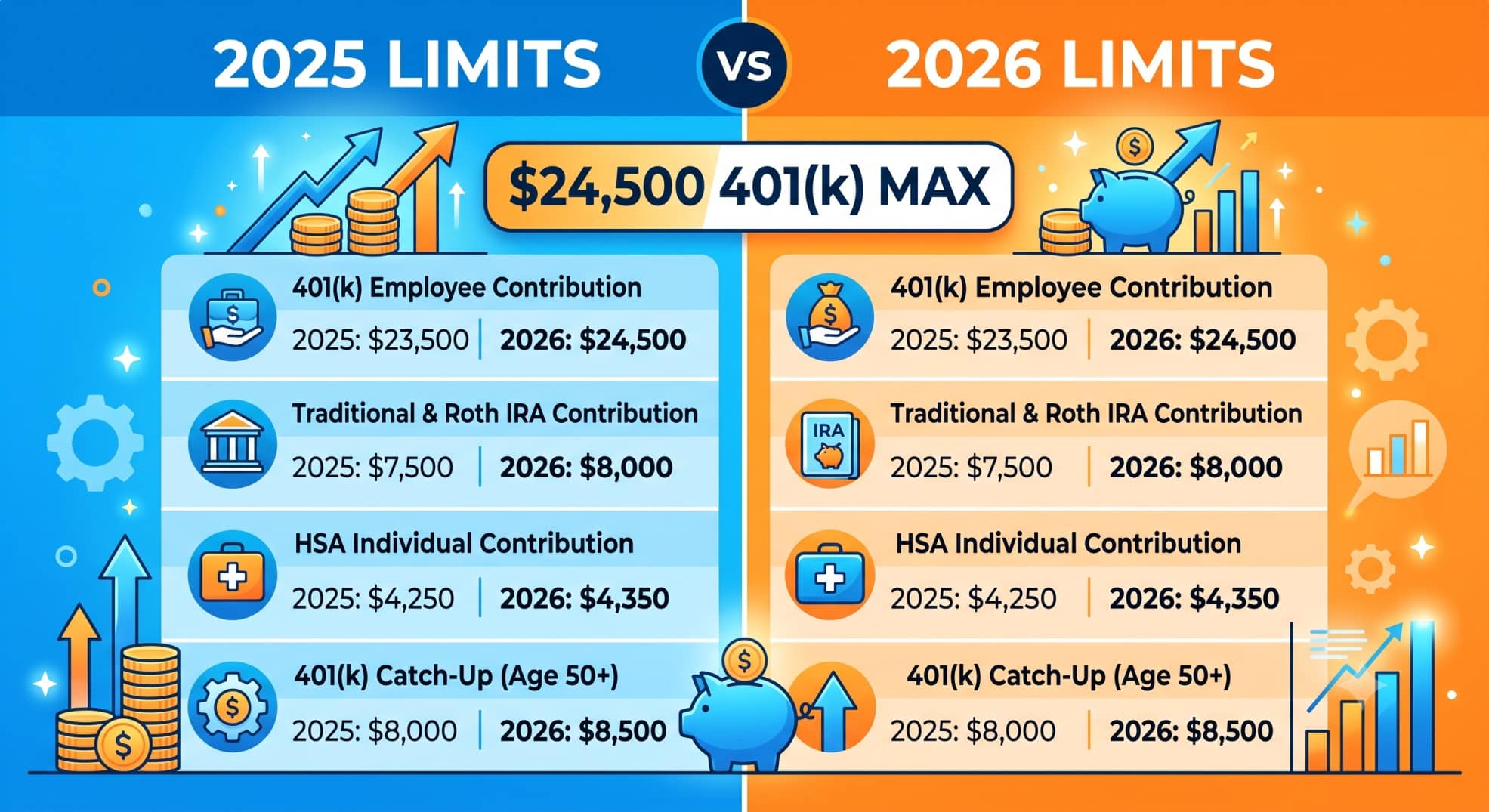
- The base 401k limit 2026 has increased to $24,500, with total employer and employee contributions capped at $72,000.
- The IRA contribution limit 2026 is now $7,500, and the catch-up contribution for those 50 and older has increased to $1,100.
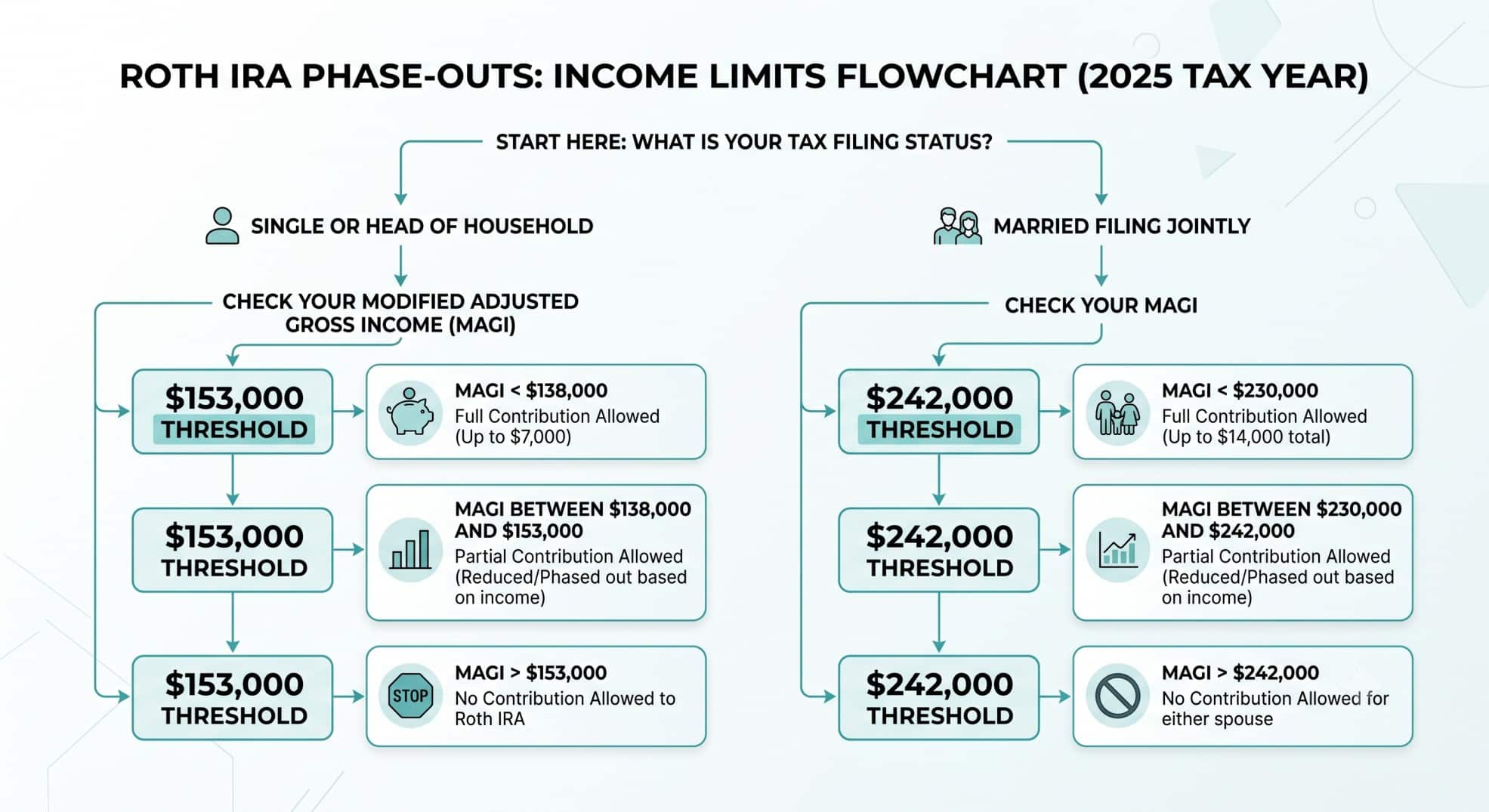
- The Roth IRA income limits 2026 phase out between $153,000 and $168,000 for single filers, and $242,000 to $252,000 for joint filers.
- The SEP IRA limit 2026 allows self-employed individuals to contribute up to $72,000 based on their net business earnings.
Table of Contents
- The 401k Limit 2026: Base and Catch-Up Rules
- The IRA Contribution Limit 2026
- Roth IRA Income Limits 2026
- Traditional IRA Deduction Phase-Outs
- SEP IRA Limit 2026 and SIMPLE IRA Rules
- The Savers Credit 2026 Income Thresholds
- Step-by-Step Guide: Adjusting Your 2026 Contributions
- Frequently Asked Questions About 2026 Retirement Limits
The IRS has finalized the inflation-adjusted retirement figures for the new tax year. The 401k limit 2026 and the corresponding IRA thresholds offer taxpayers expanded opportunities to shield their income from federal taxes. Because inflation remained a factor through the measurement period, nearly every major retirement account saw a bump in its maximum allowable contribution.
Maximizing these accounts is not just about building a nest egg. It is a direct, dollar-for-dollar strategy to lower your Adjusted Gross Income (AGI). Lowering your AGI can keep you below the threshold for the Net Investment Income Tax, protect your child tax credits, and even help you navigate the ACA Premium Tax Credit 2026 Changes by keeping your income below the strict subsidy cliff.
You need to update your payroll deferrals immediately. If you leave your automated contributions set to last year’s maximums, you will leave valuable tax deductions on the table.
The 401k Limit 2026: Base and Catch-Up Rules
The baseline 401k limit 2026 for employee elective deferrals is $24,500. This applies to traditional pre-tax 401(k)s, Roth 401(k)s, 403(b) plans, and most 457 plans. You can split this $24,500 between pre-tax and Roth accounts within your workplace plan, but your combined total cannot exceed the cap.
For workers aged 50 and older, the standard catch-up contribution is $8,000. This means participants 50+ can generally contribute up to $32,500 of their own salary into their 401(k) in 2026.
The SECURE 2.0 Act introduced a special “super catch-up” for a very specific age bracket. If you are aged 60, 61, 62, or 63 by December 31, 2026, your catch-up limit increases to $11,250. This pushes your total allowable employee contribution to a massive $35,750 for the year. Once you turn 64, your catch-up limit drops back down to the standard $8,000.
There is also a strict rule for high earners regarding these catch-up contributions. If your wages from your current employer exceeded $150,000 in the prior year (2025), the IRS mandates that all of your catch-up contributions in 2026 must be made on an after-tax Roth basis. You can no longer take a pre-tax deduction for those catch-up dollars.
Scenario 1: Maxing Out the 401(k) at Age 52
David is 52 years old and earns $130,000 a year. He wants to aggressively fund his retirement and lower his current tax bill.
He elects to contribute the maximum 401k limit 2026 of $24,500. Because he is over 50, he also elects to make the $8,000 catch-up contribution.
His total contribution is $32,500. Because his prior-year income was under $150,000, he can make the entire $32,500 as a pre-tax contribution. This drops his taxable W-2 income from $130,000 down to $97,500, saving him thousands in federal and state income taxes.

The absolute maximum that can be deposited into your 401(k) from all sources—your deferrals, employer match, and employer profit-sharing—is $72,000 for 2026 (or $80,000 if you include the standard age 50 catch-up). This total limit is defined under IRC Section 415(c).
The IRA Contribution Limit 2026
The IRA contribution limit 2026 is $7,500. This is a combined limit. You cannot put $7,500 into a Traditional IRA and another $7,500 into a Roth IRA. The aggregate total across all your personal IRAs cannot exceed $7,500 for the year.
For taxpayers aged 50 and older, the IRA catch-up contribution has increased to $1,100. This is a direct result of the SECURE 2.0 Act, which finally indexed the IRA catch-up amount to inflation. If you are 50 or older, your total IRA contribution limit 2026 is $8,600.
You must have earned income (W-2 wages or net self-employment income) to contribute to an IRA. If you only have passive income from rental properties or dividends, you are not eligible to contribute. However, a non-working spouse can use a “Spousal IRA” to contribute the full $7,500 based on the working spouse’s income, provided they file a joint tax return.
Roth IRA Income Limits 2026
Roth IRAs offer tax-free growth and tax-free withdrawals in retirement, making them highly desirable. But the IRS restricts who can contribute directly to a Roth IRA based on Modified Adjusted Gross Income (MAGI).
The Roth IRA income limits 2026 have shifted upward. If your MAGI falls within the phase-out range, your allowable contribution is reduced. If your MAGI exceeds the top of the range, you cannot make a direct Roth IRA contribution at all.
| Filing Status | Full Contribution Allowed | Phase-Out Range (Partial) | No Contribution Allowed |
|---|---|---|---|
| Single / Head of Household | Under $153,000 | $153,000 – $168,000 | $168,000 or more |
| Married Filing Jointly | Under $242,000 | $242,000 – $252,000 | $252,000 or more |
| Married Filing Separately | N/A | $0 – $10,000 | $10,000 or more |
If your income exceeds these limits, you can still fund a Roth IRA using the Backdoor Roth strategy. This involves making a non-deductible contribution to a Traditional IRA and immediately converting it to a Roth IRA. Because there are no income limits for Traditional IRA contributions or Roth conversions, high earners use this method to bypass the Roth IRA income limits 2026 entirely.
Scenario 2: Navigating the Roth Phase-Out
Sarah and Mark are married and file jointly. Their projected 2026 MAGI is $260,000. They want to contribute to their Roth IRAs.
Because their $260,000 income is above the $252,000 absolute cutoff for joint filers, they are completely locked out of making direct Roth contributions.
Instead, Sarah opens a Traditional IRA and contributes $7,500. She does not take a tax deduction for this. The next day, she converts that $7,500 into her Roth IRA. Assuming she has no other pre-tax IRA balances (which would trigger the pro-rata rule), the conversion is tax-free. She successfully bypassed the income limits.
Traditional IRA Deduction Phase-Outs
Anyone with earned income can contribute to a Traditional IRA, but not everyone gets to deduct that contribution on their tax return. If you (or your spouse) are covered by a retirement plan at work, the IRS phases out your ability to take the deduction based on your MAGI.
If you are single and covered by a workplace plan, your deduction phases out between $81,000 and $91,000 in 2026. If your MAGI is $91,000 or higher, you get zero tax deduction for your Traditional IRA contribution.
If you are married filing jointly and you are covered by a workplace plan, your deduction phases out between $129,000 and $149,000.
If you are not covered by a workplace plan, but your spouse is, the phase-out range for your specific deduction is much higher: $242,000 to $252,000. If neither you nor your spouse has a workplace plan, there are no income limits; you can deduct the full contribution regardless of how much you earn.
SEP IRA Limit 2026 and SIMPLE IRA Rules
Small business owners and freelancers have access to specialized retirement accounts with much higher limits than standard IRAs.
The SEP IRA limit 2026 is $72,000. A SEP (Simplified Employee Pension) is funded entirely by employer contributions. As a self-employed individual, you act as both the employer and the employee. You can generally contribute up to 25% of your net self-employment earnings (which mathematically works out to 20% of your net adjusted profit) up to the $72,000 cap. There are no catch-up contributions for a SEP IRA because the contributions are made by the employer, not the employee.
The SIMPLE IRA is designed for small businesses with 100 or fewer employees. For 2026, the employee contribution limit for a SIMPLE IRA is $17,000. The catch-up contribution for employees aged 50 and older is $4,000, bringing the total potential employee deferral to $21,000. Employers must also make mandatory matching or non-elective contributions to a SIMPLE IRA.
Scenario 3: The Self-Employed SEP Calculation
Elena is a freelance graphic designer operating as a sole proprietor. Her net Schedule C profit for 2026 is $150,000.
She wants to maximize her SEP IRA limit 2026. After calculating the deduction for half of her self-employment tax, her adjusted net earnings are roughly $139,000.
She can contribute 20% of that adjusted figure to her SEP IRA. She writes a check for $27,800 to her SEP IRA before tax day. This $27,800 is an above-the-line deduction that directly reduces her taxable income.
The Savers Credit 2026 Income Thresholds
The Retirement Savings Contributions Credit, commonly known as the Saver’s Credit, is a direct tax credit designed to incentivize low- and moderate-income workers to save for retirement. Unlike a deduction, which lowers your taxable income, a credit reduces your actual tax bill dollar-for-dollar.
You can claim a credit for 10%, 20%, or 50% of your first $2,000 in retirement contributions ($4,000 if married filing jointly). The percentage you get depends on your AGI.
To qualify for the savers credit 2026 at all, your AGI must fall below these absolute maximum thresholds:
- Married Filing Jointly: $80,500
- Head of Household: $60,375
- Single / Married Filing Separately: $40,250
Scenario 4: Claiming the Saver’s Credit
James is a single filer earning $35,000 in 2026. He manages to contribute $2,000 to his Roth IRA during the year.
Because his income is below the $40,250 limit for single filers, he qualifies for the savers credit 2026. Based on the IRS sliding scale for his specific income bracket, he qualifies for the 10% credit tier.
He receives a $200 tax credit (10% of his $2,000 contribution) on his tax return, directly reducing the taxes he owes the federal government.
Step-by-Step Guide: Adjusting Your 2026 Contributions
Do not wait until the middle of the year to adjust your retirement strategy. Follow these steps in January to ensure you hit the 401k limit 2026 without disrupting your cash flow.
- Calculate Your Per-Paycheck Deferral: If you are paid bi-weekly (26 pay periods) and want to hit the $24,500 maximum, divide $24,500 by 26. You need to defer $942.30 per paycheck.
- Factor in the Catch-Up: If you are 50 or older, your target is $32,500. Divide that by 26 pay periods to get a deferral of $1,250 per paycheck.
- Check Your Prior-Year Wages: If you are 50+ and earned over $150,000 in 2025, contact your HR department immediately. Ensure your $8,000 catch-up contribution is coded as Roth, or your contributions may be rejected by the plan administrator.
- Automate Your IRA: To hit the $7,500 IRA contribution limit 2026, set up an automatic transfer of $625 from your checking account to your IRA on the 1st of every month.
- Audit Your MAGI: If you expect your income to approach the Roth IRA income limits 2026 ($153,000 Single / $242,000 MFJ), halt your automated Roth contributions. Wait until the end of the year when your exact MAGI is known, or execute a Backdoor Roth strategy proactively to avoid excess contribution penalties.
Frequently Asked Questions About 2026 Retirement Limits
What is the exact 401k limit 2026?
The base employee contribution limit for a 401(k) in 2026 is $24,500. If you are 50 or older, you can add an $8,000 catch-up contribution for a total of $32,500. If you are aged 60 to 63, a special super catch-up allows a total contribution of $35,750.
What is the IRA contribution limit 2026?
The maximum you can contribute across all your Traditional and Roth IRAs combined is $7,500. If you are 50 or older, you can contribute an additional $1,100, bringing your total limit to $8,600.
What are the Roth IRA income limits 2026 for married couples?
For married couples filing jointly, the ability to make a direct Roth IRA contribution begins to phase out at a MAGI of $242,000. If your joint MAGI is $252,000 or higher, you are completely ineligible to make a direct contribution.
Can I contribute to both a 401(k) and an IRA in the same year?
Yes. You can max out your 401(k) at $24,500 and also max out your IRA at $7,500. However, participating in a 401(k) may restrict your ability to deduct your Traditional IRA contribution depending on your income.
How does the SEP IRA limit 2026 work?
The SEP IRA limit is capped at $72,000 for 2026. Contributions are made by the employer. If you are self-employed, you can generally contribute up to 20% of your adjusted net self-employment earnings, up to that $72,000 maximum.
Who qualifies for the savers credit 2026?
Low- and moderate-income taxpayers who contribute to a retirement account qualify. Your AGI must be under $80,500 if married filing jointly, $60,375 if head of household, or $40,250 if single.
What is the new Roth catch-up rule for high earners?
Under the SECURE 2.0 Act, if you are 50 or older and your wages from your current employer exceeded $150,000 in the prior year, all of your 401(k) catch-up contributions must be made on an after-tax Roth basis. You cannot make pre-tax catch-up contributions.
What happens if I contribute more than the IRA limit?
If you exceed the $7,500 limit, the IRS will assess a 6% excise tax penalty on the excess amount for every year it remains in the account. You must withdraw the excess contribution and any earnings it generated before the tax filing deadline to avoid the penalty.
Can I use the Backdoor Roth strategy in 2026?
Yes. The Backdoor Roth strategy remains completely legal. If your income exceeds the Roth IRA income limits 2026, you can make a non-deductible contribution to a Traditional IRA and then convert it to a Roth IRA to bypass the income restrictions.
Disclaimer: This content provides general information for educational purposes only. Tax laws are complex and change often. It is not professional tax, legal, or financial advice. Always consult a qualified tax professional for personalized guidance regarding your specific situation. Ourtaxpartner.com is not responsible for any actions taken based on the information provided herein.
