
The Internal Revenue Service officially released the 2027 tax brackets and inflation-adjusted standard deduction figures in IRS Revenue Procedure 2026-35 . These updated thresholds govern the money you earn between January 1, 2027, and December 31, 2027, for federal tax returns filed in early 2028 . By widening the income thresholds across all seven federal tax tiers, the tax code shields a larger share of your paycheck from inflation .
Following the enactment of Public Law 119-21 (commonly known as the One, Big, Beautiful Bill Act or OBBBA), Congress permanently locked in the seven-tier marginal rate structure under Internal Revenue Code (IRC) Section 1(j) . Every autumn, the Treasury Department recalculates these income cutoffs using the Chained Consumer Price Index for All Urban Consumers (C-CPI-U) under IRC Section 1(f) . For everyday families and wage earners, that math translates directly into higher take-home pay starting on your very first January 2027 pay stub.
⚡ Executive Summary: Key 2027 Tax Rules at a Glance
- 2027 Standard Deduction Jump: Increases to $33,200 for Married Filing Jointly, $24,925 for Heads of Household, and $16,600 for Single and Married Filing Separately under IRC Section 63(c)(2) (for Tax Year 2027 returns due in April 2028) .
- Senior & Blind Bonus Shield: Qualifying taxpayers age 65 or older (or blind) can claim an additional standard deduction of $1,700 per person for married filers or $2,100 for unmarried filers under IRC Section 63(f) .
- Expanded 10% Starter Bracket: The lowest 10% federal tax rate covers the first $25,600 of taxable income for joint filers, $18,250 for Heads of Household, and $12,800 for single filers per IRS Revenue Procedure 2026-35 .
- Higher Top 37% Threshold: The top 37% tax bracket only kicks in once taxable income exceeds $793,650 for Married Filing Jointly, $661,375 for Single filers, and $661,350 for Heads of Household .
Table of Contents
- ⚡ Executive Summary: Key 2027 Tax Rules at a Glance
- How Inflation Adjustments Stop “Bracket Creep” in 2027
- The 2027 Standard Deduction by Filing Status
- Official 2027 Tax Brackets and Marginal Rates (All Filing Statuses)
- 2027 Capital Gains Brackets, Child Tax Credit, and EITC Adjustments
- Real-World Scenarios: How the 2027 Numbers Protect Your Paycheck
- Step-by-Step Guide: Calculating Your 2027 Tax Liability on Form 1040
- Adjusting Your W-4 Withholding and State Tax Conformity
How Inflation Adjustments Stop “Bracket Creep” in 2027
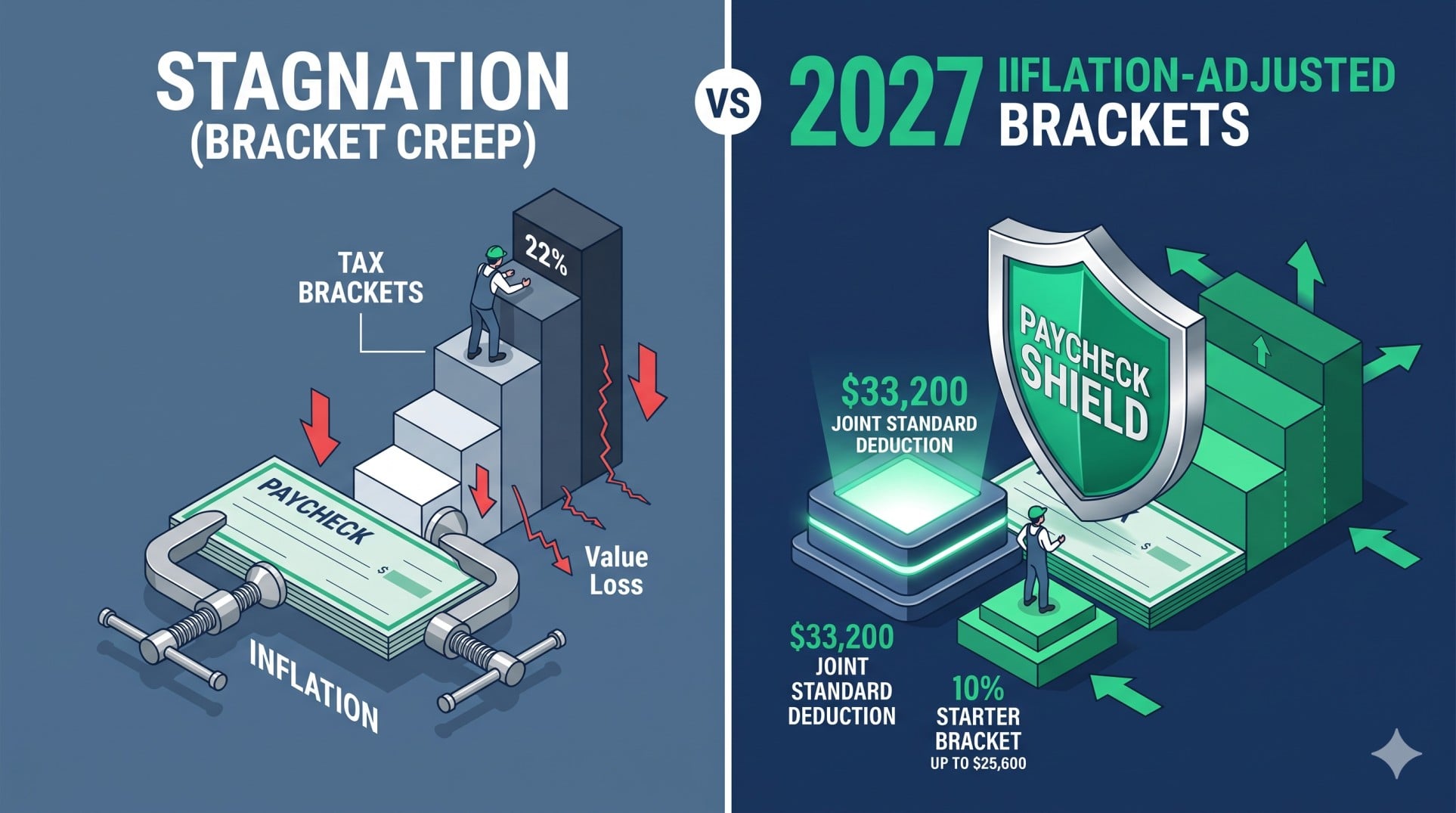
Inflation adjustments prevent bracket creep by expanding the dollar thresholds of the federal standard deduction and marginal tax tiers to match rising living costs. When the IRS widens these brackets, a cost-of-living wage increase won’t accidentally push your income into a higher tax percentage.
Economists coined the term bracket creep to describe what happens when wages rise strictly to keep pace with grocery, housing, and utility prices, but tax thresholds remain frozen. Suppose your employer gives you a 3% raise solely to match a 3% inflation rate. Your actual purchasing power hasn’t grown by a single penny.
Yet under an unindexed tax system, those extra nominal dollars spill over into higher tax tiers. You end up paying a larger percentage of your income to the Treasury while feeling poorer at the checkout register.
Under IRC Section 1(f), the IRS combats this silent tax hike by adjusting more than 60 tax provisions each year . By raising the 2027 standard deduction and stretching out the 2027 tax brackets in IRS Revenue Procedure 2026-35, the government ensures that only real gains in purchasing power face steeper tax rates . If your salary remains flat in 2027, your total federal income tax bill will actually drop because more of your existing paycheck sits inside the tax-free deduction zone and lower 10% and 12% tiers .
The 2027 Standard Deduction by Filing Status
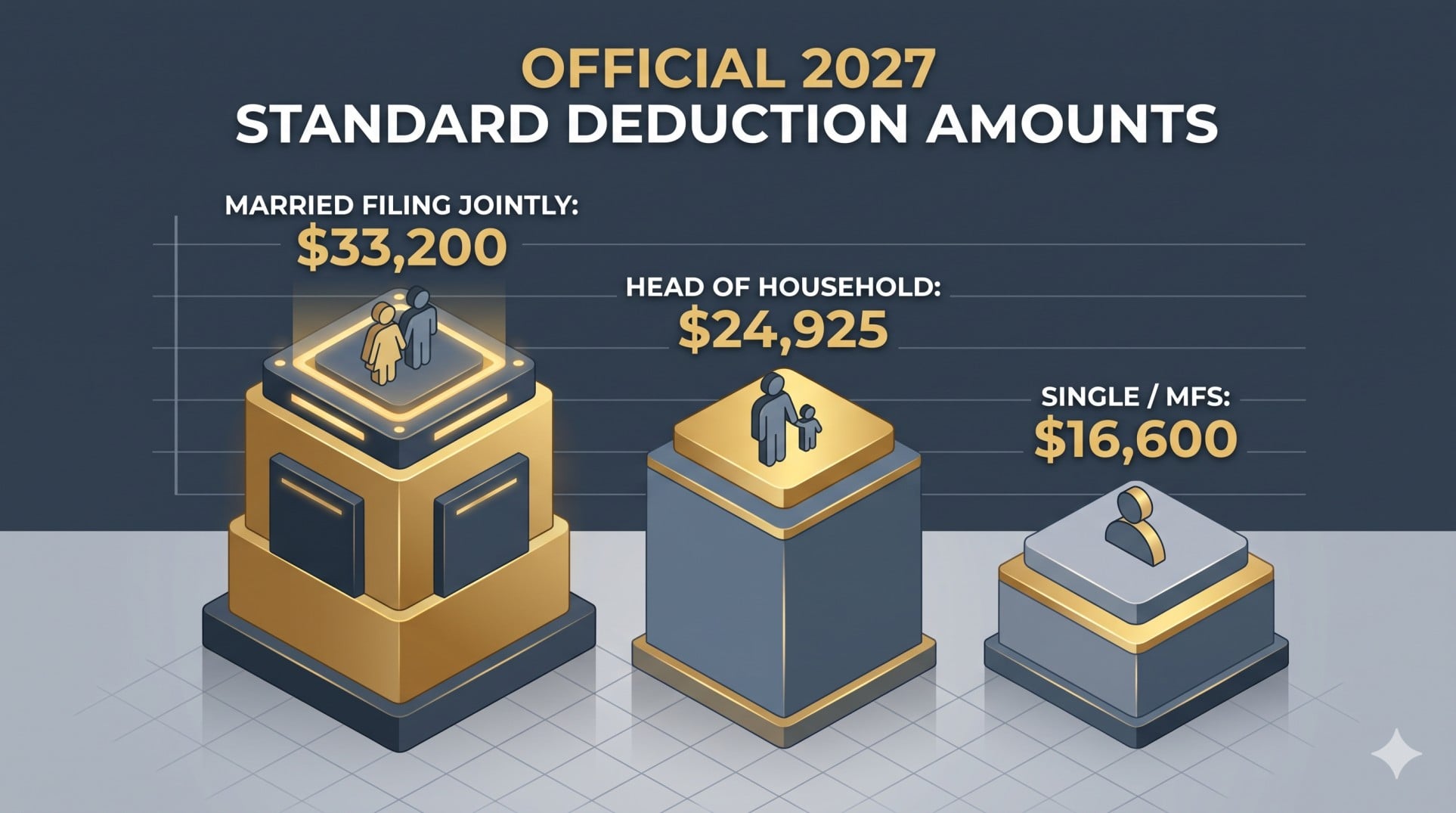
For Tax Year 2027, the official 2027 standard deduction rises to $33,200 for Married Filing Jointly, $24,925 for Heads of Household, and $16,600 for Single or Married Filing Separately . Taxpayers claim this flat dollar reduction on Form 1040 instead of itemizing deductions on Schedule A.
Think of the standard deduction as a zero-percent tax bracket sitting at the very bottom of your tax return. Before the IRS applies the 10% starter bracket to a single dollar of your wages, you subtract your standard deduction from your Adjusted Gross Income (AGI). Because Congress permanently elevated these baseline thresholds under Public Law 119-21, roughly 90% of American households claim the standard write-off rather than tracking mortgage interest, state and local taxes (SALT), and charitable receipts on Schedule A.
You can review how this baseline subtraction interacts with your broader tax strategy in our guide to choosing between standard and itemized deductions. Below is the complete breakdown of the baseline deduction figures from Section 3.15 of IRS Revenue Procedure 2026-35 .
| Filing Status | IRC Statutory Authority | 2027 Standard Deduction | Additional Aged/Blind Deduction (Per Qualifying Condition) |
|---|---|---|---|
| Married Filing Jointly & Surviving Spouses | IRC § 1(j)(2)(A) & § 63(c)(2) | $33,200 | +$1,700 per spouse per condition |
| Head of Household | IRC § 1(j)(2)(B) & § 63(c)(2) | $24,925 | +$2,100 per condition |
| Single (Unmarried Individuals) | IRC § 1(j)(2)(C) & § 63(c)(2) | $16,600 | +$2,100 per condition |
| Married Filing Separately | IRC § 1(j)(2)(D) & § 63(c)(2) | $16,600 | +$1,700 per condition |
The Additional Deduction for Aged or Blind Taxpayers in 2027
Taxpayers who turn 65 before the close of the tax year or meet the statutory definition of blindness qualify for an additional deduction for aged or blind taxpayers under IRC Section 63(f) . For 2027, this bonus adds $1,700 for married individuals (filing jointly or separately) and qualifying surviving spouses . Unmarried taxpayers—including Single and Head of Household filers—receive an extra $2,100 .
These amounts stack when a taxpayer meets both criteria. A single retiree who is 68 years old and legally blind adds $4,200 ($2,100 × 2) to the $16,600 base, creating a total 2027 standard deduction of $20,800 .
For a married couple filing jointly where both spouses are over age 65, each spouse claims the $1,700 bump . That lifts their combined tax-free standard deduction from $33,200 to $36,600 .
IRS Birthday Rule Pro-Tip: Under federal tax law, the IRS considers you to have reached age 65 on the day before your actual 65th birthday. If you were born on January 1, 1963, you are legally considered age 65 for Tax Year 2027 and can claim the full $1,700 or $2,100 additional standard deduction on your 2027 Form 1040 .
2027 Standard Deduction Rules for Dependents
Working teenagers and college students who can be claimed as a dependent on a parent’s return face a special ceiling under IRC Section 63(c)(5) . Per Section 3.15(2) of IRS Revenue Procedure 2026-35, a dependent’s 2027 standard deduction cannot exceed the greater of :
- $1,400, OR
- The sum of $500 plus the dependent’s earned income for the year (capped at the normal $16,600 single standard deduction) .
So if a 17-year-old dependent earns $6,000 at a summer lifeguard job in 2027, their standard deduction equals $6,500 ($6,000 earned income + $500) . Because their deduction exceeds their wages, they owe zero federal income tax.
Official 2027 Tax Brackets and Marginal Rates (All Filing Statuses)
The 2027 tax brackets maintain seven federal marginal rates: 10%, 12%, 22%, 24%, 32%, 35%, and 37% . For Married Filing Jointly, the 10% starter bracket applies to the first $25,600 of taxable income, while the top 37% tax bracket applies to taxable income over $793,650 .
A persistent myth in personal finance is that crossing into a higher tax bracket causes your entire salary to be taxed at that higher rate. That’s not how the U.S. Internal Revenue Code works. Federal income taxes operate like a series of progressive buckets.
Every taxpayer fills up the 10% starter bracket first, regardless of whether they earn $40,000 or $4,000,000 . Only the specific dollars that spill over the top edge of one bucket get taxed at the next bucket’s rate. Understanding the difference between your marginal tax rate vs. effective tax rate is the foundation of smart year-end tax planning.
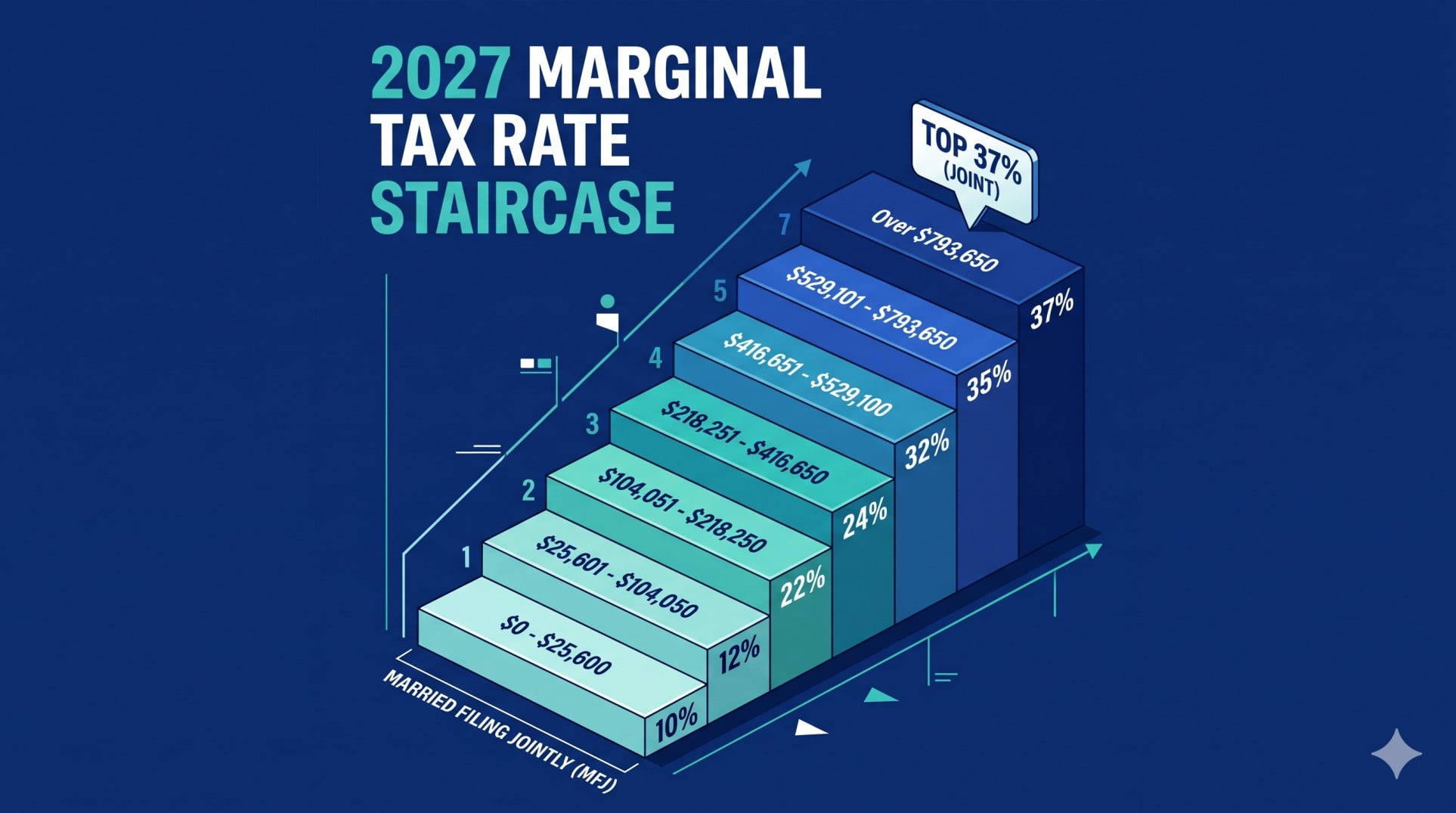
Table 1: Married Individuals Filing Jointly and Surviving Spouses — IRC § 1(j)(2)(A)
Married couples filing a joint return enjoy the widest bracket thresholds in the tax code . Up to $104,050 of a couple’s taxable income (which equals $137,250 of gross income when combined with their $33,200 standard deduction) stays inside the low 10% and 12% tiers .
| Marginal Tax Rate | 2027 Taxable Income Threshold (Married Filing Jointly) | Base Tax + Marginal Calculation Formula |
|---|---|---|
| 10% | Not over $25,600 | 10% of taxable income |
| 12% | Over $25,600 but not over $104,050 | $2,560.00 plus 12% of the excess over $25,600 |
| 22% | Over $104,050 but not over $218,250 | $11,974.00 plus 22% of the excess over $104,050 |
| 24% | Over $218,250 but not over $416,650 | $37,098.00 plus 24% of the excess over $218,250 |
| 32% | Over $416,650 but not over $529,100 | $84,714.00 plus 32% of the excess over $416,650 |
| 35% | Over $529,100 but not over $793,650 | $120,698.00 plus 35% of the excess over $529,100 |
| 37% | Over $793,650 | $213,290.50 plus 37% of the excess over $793,650 |
Table 2: Heads of Households — IRC § 1(j)(2)(B)
Unmarried taxpayers who pay more than half the cost of keeping up a home for a qualifying child or dependent use the Head of Household schedule . This status provides a significantly wider 10% and 12% runway than the Single filing status .
| Marginal Tax Rate | 2027 Taxable Income Threshold (Head of Household) | Base Tax + Marginal Calculation Formula |
|---|---|---|
| 10% | Not over $18,250 | 10% of taxable income |
| 12% | Over $18,250 but not over $69,650 | $1,825.00 plus 12% of the excess over $18,250 |
| 22% | Over $69,650 but not over $109,100 | $7,993.00 plus 22% of the excess over $69,650 |
| 24% | Over $109,100 but not over $208,300 | $16,672.00 plus 24% of the excess over $109,100 |
| 32% | Over $208,300 but not over $264,550 | $40,480.00 plus 32% of the excess over $208,300 |
| 35% | Over $264,550 but not over $661,350 | $58,480.00 plus 35% of the excess over $264,550 |
| 37% | Over $661,350 | $197,360.00 plus 37% of the excess over $661,350 |
Table 3: Single (Unmarried Individuals) & Table 4: Married Filing Separately
For Single filers (IRC Section 1(j)(2)(C)) and Married Individuals Filing Separate Returns (IRC Section 1(j)(2)(D)), the first five tax brackets are identical, exactly half the width of the joint return brackets . They diverge only at the top end of the 35% tier, where Married Filing Separately hits the top 37% tax bracket at $396,825 (half of the joint threshold) while Single filers don’t hit 37% until $661,375 .
| Marginal Tax Rate | 2027 Single Taxable Income Threshold | 2027 Married Filing Separately Threshold | Base Tax + Marginal Calculation Formula |
|---|---|---|---|
| 10% | Not over $12,800 | Not over $12,800 | 10% of taxable income |
| 12% | Over $12,800 to $52,025 | Over $12,800 to $52,025 | $1,280.00 + 12% of excess over $12,800 |
| 22% | Over $52,025 to $109,125 | Over $52,025 to $109,125 | $5,987.00 + 22% of excess over $52,025 |
| 24% | Over $109,125 to $208,325 | Over $109,125 to $208,325 | $18,549.00 + 24% of excess over $109,125 |
| 32% | Over $208,325 to $264,550 | Over $208,325 to $264,550 | $42,357.00 + 32% of excess over $208,325 |
| 35% | Over $264,550 to $661,375 | Over $264,550 to $396,825 | $60,349.00 + 35% of excess over $264,550 |
| 37% | Over $661,375 | Over $396,825 | Single: $199,237.75 + 37% over $661,375 MFS: $106,645.25 + 37% over $396,825 |
Note that Estates and Trusts also have a dedicated rate schedule under IRC Section 1(j)(2)(E) (Table 5 of Revenue Procedure 2026-35), hitting the 10% rate up to $3,400, 24% over $3,400 to $12,100, 35% over $12,100 to $16,500, and the 37% bracket on undistributed trust taxable income over $16,500 .
2027 Capital Gains Brackets, Child Tax Credit, and EITC Adjustments
Beyond ordinary wage brackets, IRS Revenue Procedure 2026-35 increases the 2027 long-term capital gains 0% rate threshold to $102,100 for joint filers and $51,050 for single filers . It also lifts key family and workplace benefits, including a $2,300 maximum Child Tax Credit and a $3,500 Health FSA contribution limit .
Protecting your paycheck from bracket creep isn’t limited to W-2 wages. When you sell stocks, mutual funds, or real estate held for more than one year, your profit is taxed under the preferential long-term capital gains brackets under IRC Section 1(h) and Section 1(j)(5) . In 2027, married couples can realize up to $102,100 in taxable income (which is $135,300 in total income after accounting for the $33,200 standard deduction) and pay a 0% federal tax rate on their long-term investment gains and qualified dividends .
| Filing Status | 0% Long-Term Capital Gains Threshold (2027 Taxable Income) | 15% Long-Term Capital Gains Threshold (2027 Taxable Income) | 20% Maximum Rate Threshold (2027 Taxable Income) |
|---|---|---|---|
| Married Filing Jointly & Surviving Spouses | Up to $102,100 | Over $102,100 to $633,600 | Over $633,600 |
| Head of Household | Up to $68,350 | Over $68,350 to $598,400 | Over $598,400 |
| Single (All Other Individuals) | Up to $51,050 | Over $51,050 to $563,200 | Over $563,200 |
| Married Filing Separately | Up to $51,050 | Over $51,050 to $316,800 | Over $316,800 |
Other Paycheck-Boosting 2027 Adjustments in Rev. Proc. 2026-35
Several related provisions in IRS Revenue Procedure 2026-35 directly impact family budgets and small business owners in 2027 :
- Child Tax Credit (IRC § 24): The maximum credit rises to $2,300 per qualifying child for 2027, with the refundable Additional Child Tax Credit portion increasing to $1,800 .
- Earned Income Tax Credit (IRC § 32): The maximum EITC for lower-to-moderate-income families with three or more qualifying children increases to $8,496 ($7,552 for two children, $4,573 for one child, and $685 for taxpayers with no qualifying children) . The investment income limit for EITC eligibility rises to $12,600 .
- Health Flexible Spending Arrangements (IRC § 125(i)): Employees can contribute up to $3,500 in pre-tax salary reductions to a workplace Health FSA in 2027, with a maximum unused carryover limit of $700 .
- Qualified Business Income Deduction (IRC § 199A): For self-employed individuals, freelancers, and S-Corp owners claiming the 20% QBI deduction, the taxable income phase-in thresholds expand to $416,600 for Married Filing Jointly (phasing out completely at $566,600) and $208,300 for Single and Head of Household filers . You can explore how this interacts with your self-employment taxes in our complete Section 199A QBI deduction guide.
- Alternative Minimum Tax Exemptions (IRC § 55): The 2027 AMT exemption rises to $144,700 for joint filers and $93,000 for unmarried individuals, with phase-out thresholds starting at $1,031,900 (joint) and $515,950 (unmarried) .
Real-World Scenarios: How the 2027 Numbers Protect Your Paycheck
Seeing the 2027 tax brackets on a chart is helpful, but running the step-by-step math on real household budgets shows how the 2027 standard deduction and progressive tiers interact. Let’s look at four distinct taxpayer profiles for Tax Year 2027.
Scenario 1: Married Couple With a Cost-of-Living Raise (Joint Filers)
Consider Elena and Marcus, a married couple in Ohio filing a joint return. In 2027, their combined gross W-2 income after pre-tax 401(k) contributions (their AGI) is $135,000. They have no itemized deductions and claim the 2027 standard deduction .
- Step 1 (Subtract Standard Deduction): Start with their $135,000 AGI and subtract the $33,200 joint standard deduction . Their 2027 taxable income is $101,800.
- Step 2 (Apply the 10% Starter Bracket): The first $25,600 of their taxable income is taxed at 10%, which equals $2,560.00 .
- Step 3 (Apply the 12% Bracket): The remaining taxable income from $25,600 up to $101,800 (which is $76,200) falls entirely inside the 12% bracket, because the 2027 12% ceiling for joint filers stretches all the way to $104,050 . Multiply $76,200 by 12% to get $9,144.00 .
- Step 4 (Total Tax & Effective Rate): Add $2,560.00 and $9,144.00 for a total federal income tax liability before credits of $11,704.00.
Notice the protection against bracket creep here. Even though Elena and Marcus earn $135,000 in gross pay, not a single dollar of their income touches the 22% tax bracket . Their highest marginal rate is 12%, and their true effective tax rate on their $135,000 AGI is just 8.67% .
Scenario 2: Single Parent Claiming Head of Household
Take Danielle, an unmarried nurse in Texas raising her 8-year-old son. She files as Head of Household with an Adjusted Gross Income of $92,000 in 2027.
- Step 1 (Subtract Standard Deduction): Subtract the $24,925 Head of Household standard deduction from her $92,000 AGI, leaving $67,075 in taxable income .
- Step 2 (Apply the 10% Starter Bracket): The first $18,250 of taxable income is taxed at 10%, generating $1,825.00 in tax .
- Step 3 (Apply the 12% Bracket): Because the 12% Head of Household bracket goes up to $69,650 in 2027, her remaining $48,825 of taxable income ($67,075 minus $18,250) stays completely inside the 12% tier . Multiply $48,825 by 12% to get $5,859.00 .
- Step 4 (Subtract the 2027 Child Tax Credit): Her gross tax is $7,684.00 ($1,825.00 + $5,859.00). After subtracting the inflation-adjusted $2,300 Child Tax Credit for her son under IRC Section 24, her net federal income tax drops to $5,384.00 (an effective rate of 5.85%) .
Scenario 3: Single Retiree Over Age 65 (Stacking Deductions)
Look at Robert, a 69-year-old unmarried retiree in Arizona. In 2027, his AGI from taxable pension payments and traditional IRA withdrawals is $65,000.
- Step 1 (Stack the Aged Bonus): Robert starts with the $16,600 Single standard deduction and adds the $2,100 additional deduction for aged or blind taxpayers under IRC Section 63(f), giving him a total write-off of $18,700 .
- Step 2 (Compute Taxable Income): Subtracting $18,700 from $65,000 leaves $46,300 in taxable income.
- Step 3 (Apply the Single Brackets): The first $12,800 is taxed at 10% ($1,280.00) . The remaining $33,500 ($46,300 minus $12,800) is taxed at 12% ($4,020.00), since the single 12% tier extends to $52,025 . Robert’s total federal tax is $5,300.00—and if he qualifies for any statutory senior bonus deductions enacted under Public Law 119-21, his taxable income drops even further.
Scenario 4: Dual-Physician Household Hitting the Top 37% Tax Bracket
Consider Priya and David, two surgeons filing jointly in Florida with a combined 2027 AGI of $900,000. They do not have enough mortgage interest or state taxes (capped by SALT rules) to beat the standard deduction, or they choose to use the standard deduction for simplicity.
- Step 1 (Calculate Taxable Income): Subtracting the $33,200 joint standard deduction from $900,000 leaves $866,800 in taxable income .
- Step 2 (Apply Progressive Tiers Up to $793,650): Using Table 1 of IRS Revenue Procedure 2026-35, the cumulative tax on the first $793,650 of taxable income across the 10%, 12%, 22%, 24%, 32%, and 35% buckets is exactly $213,290.50 .
- Step 3 (Apply the Top 37% Tax Bracket): Only the excess above $793,650—which is $73,150 ($866,800 minus $793,650)—faces the top 37% tax bracket . Multiply $73,150 by 37% to get $27,065.50 .
- Step 4 (Total Income Tax): Their combined income tax is $240,356.00 ($213,290.50 + $27,065.50), resulting in an effective income tax rate of 26.71% on their $900,000 income—more than 10 percentage points lower than their 37% top marginal rate .
Step-by-Step Guide: Calculating Your 2027 Tax Liability on Form 1040
To calculate your 2027 federal tax on IRS Form 1040, subtract above-the-line adjustments on Schedule 1 from gross income to find AGI, deduct your 2027 standard deduction on Line 12, and apply the 2027 tax brackets to the resulting taxable income on Line 15.
Understanding how numbers flow down the front page of Form 1040 helps you spot opportunities to lower your tax bill before December 31, 2027. Every deduction falls into one of two categories: “above-the-line” adjustments or “below-the-line” deductions.
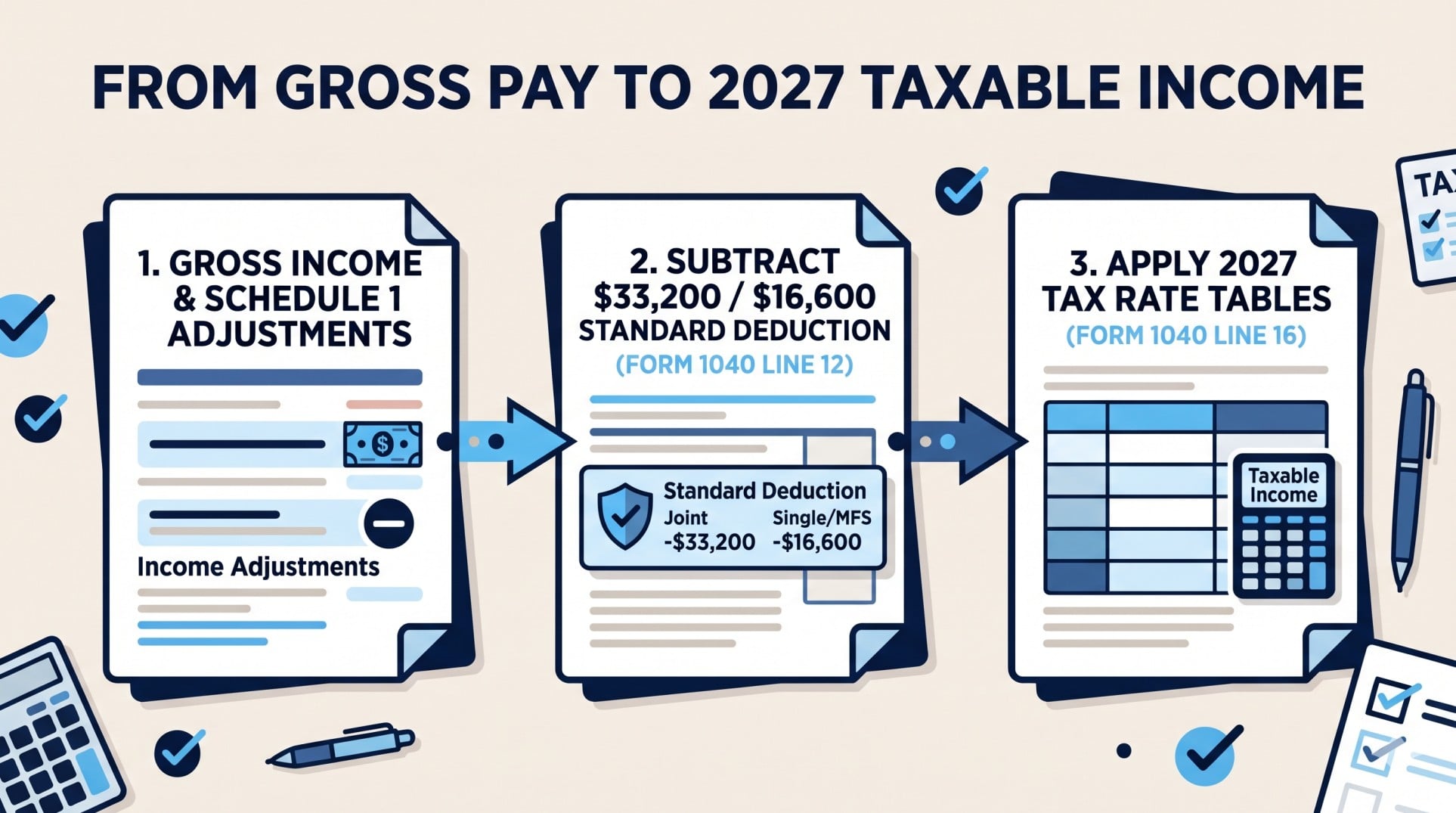
- Step 1: Aggregate Your Gross Income (Form 1040, Lines 1–9). Combine all taxable income streams earned during calendar year 2027. Include W-2 wages (Line 1a), taxable interest and ordinary dividends from Form 1099-INT and 1099-DIV (Lines 2b and 3b), IRA or pension distributions (Lines 4b and 5b), capital gains from Schedule D (Line 7), and net business or freelance profit from Schedule C (Line 8). Note that pre-tax payroll deferrals into a traditional 401(k), 403(b), or $3,500 Health FSA are already excluded from Box 1 of your Form W-2 .
- Step 2: Subtract “Above-the-Line” Adjustments (Schedule 1, Part II to Form 1040, Line 10). Above-the-line deductions are the most valuable write-offs in the tax code because you can claim them even if you take the 2027 standard deduction. Common Schedule 1 adjustments include Health Savings Account (HSA) contributions reported on Form 8889, traditional IRA deductions, student loan interest up to $2,500, the $350 educator expense deduction under IRC Section 62(a)(2)(D) (per Section 3.13 of Rev. Proc. 2026-35), and half of your self-employment tax . Subtracting Line 10 from Line 9 produces your Adjusted Gross Income (AGI) on Line 11. Check our guide to above-the-line tax deductions to make sure you don’t miss any Schedule 1 adjustments.
- Step 3: Claim Your 2027 Standard Deduction (Form 1040, Line 12). Enter your baseline deduction—$33,200 for Married Filing Jointly, $24,925 for Head of Household, or $16,600 for Single/Married Filing Separately—unless your itemized deductions on Schedule A exceed those figures . If you or your spouse are 65 or older or blind, check the boxes in the Standard Deduction section of Form 1040 to add the $1,700 or $2,100 additional deduction for aged or blind taxpayers .
- Step 4: Deduct Qualified Business Income (Form 1040, Line 13). If you have pass-through income from a sole proprietorship, LLC, partnership, or S-Corporation, attach Form 8995 (or Form 8995-A) to subtract your 20% QBI deduction.
- Step 5: Determine Taxable Income and Compute Tax (Form 1040, Lines 15–16). Subtract your total deductions (Line 14) from your AGI (Line 11) to arrive at Taxable Income on Line 15. Apply the official 2027 Tax Rate Tables from Revenue Procedure 2026-35 to that Line 15 figure (or use the Qualified Dividends and Capital Gain Tax Worksheet if you have long-term investment gains) and enter your calculated tax on Line 16 .
Adjusting Your W-4 Withholding and State Tax Conformity
Employers automatically program the 2027 tax brackets and standard deduction into payroll software every January, slightly boosting your net take-home pay. However, households with multiple jobs, side-hustle income, or state tax returns must verify their Form W-4 settings and state conformity rules.
When IRS Revenue Procedure 2026-35 takes effect on January 1, 2027, payroll providers (like ADP, Gusto, and Paychex) update their federal withholding tables under IRS Publication 15-T . Because the 2027 standard deduction and lower brackets are wider, payroll systems withhold slightly less federal income tax from each biweekly check . You don’t need to submit a new Form W-4 just to get the standard inflation adjustment.
You should submit an updated IRS Form W-4 to optimize your paycheck withholding in 2027 if:
- Both spouses work and earn similar salaries, which can cause each employer’s payroll software to apply the full $33,200 joint standard deduction and 10% starter bracket twice unless Step 2(c) is checked on Form W-4 .
- You earn significant 1099-NEC freelance income, rental income, or taxable investment dividends that aren’t subject to automatic payroll withholding.
- You had a major life change in 2026 or 2027, such as marriage, divorce, or the birth of a child qualifying you for the $2,300 Child Tax Credit .
Key 2027–2028 Filing & Estimated Tax Deadlines: If you pay quarterly estimated taxes on Form 1040-ES for Tax Year 2027, your four installment deadlines fall on April 15, 2027 (Q1), June 15, 2027 (Q2), September 15, 2027 (Q3), and January 18, 2028 (Q4, shifted from January 15 due to the weekend and Martin Luther King Jr. Day). Your annual 2027 Form 1040 tax return is due on April 17, 2028 (since April 15, 2028, falls on a Saturday).
Federal vs. State Tax Conformity Warning
Never assume your state Department of Revenue uses the federal 2027 standard deduction or bracket thresholds. While nine states levy no broad individual wage income tax (Alaska, Florida, Nevada, New Hampshire, South Dakota, Tennessee, Texas, Washington, and Wyoming), the remaining states follow a patchwork of rules:
- Flat-Tax States: States like Illinois, Indiana, Michigan, North Carolina, and Pennsylvania tax income at a single flat percentage rather than progressive tiers, and several offer much smaller personal exemptions instead of a $33,200 standard deduction.
- Decoupled Progressive States: High-tax states like California (Franchise Tax Board), New York, and New Jersey maintain their own independent tax brackets and significantly lower state standard deductions. A married couple in California might owe zero federal tax on their first $33,200 of income in 2027 while still owing California state income tax on a large portion of that exact same money .
Putting the 2027 Tax Numbers to Work
The inflation adjustments inside IRS Revenue Procedure 2026-35 hand everyday taxpayers a wider shield against bracket creep . With the 2027 standard deduction climbing to $33,200 for married couples and $16,600 for single filers, and the 2027 tax brackets expanding all the way from the 10% starter bracket up to the top 37% tax bracket at $793,650 (joint), you have more room to earn, invest, and execute smart tax moves . Use these official thresholds to plan your 2027 401(k) deferrals, HSA contributions, and Roth conversions so you keep every legal dollar in your pocket when you file in 2028.
Disclaimer: This content provides general information for educational purposes only and reflects federal tax laws applicable to Tax Year 2027 (returns filed in 2028) . Tax laws are complex and subject to change. This article does not constitute professional tax, legal, or accounting advice. Always consult a certified public accountant (CPA), enrolled agent (EA), or qualified tax attorney regarding your specific financial situation. Ourtaxpartner.com is not responsible for any actions taken based on the information provided herein.
