
For 2025 federal tax returns filed in 2026, many older taxpayers may qualify for a new extra deduction of up to $6,000 per person. This guide explains who qualifies, how the income phaseout works, how to claim it, and how it differs from the regular age-65 standard deduction.
Quick takeaways
- What many readers call the “senior bonus deduction” is referred to by the IRS as the enhanced deduction for seniors. It applies for tax years 2025 through 2028.
- For tax year 2025, the maximum deduction is $6,000 per eligible person, or $12,000 on a joint return if both spouses qualify.
- The deduction is in addition to the regular federal age-65 standard deduction rules already in place.
- You can claim it whether you take the standard deduction or itemize deductions.
- If you are married, you generally must file jointly to claim it. A married filing separately return does not qualify.
Who this applies to
This article is for individual taxpayers, especially seniors, retirees, and married couples filing a 2025 federal Form 1040 or Form 1040-SR return in 2026. It also matters for self-employed individuals and sole proprietors because they claim this deduction, if eligible, on their individual return, not as a separate business-entity deduction. This article is federal-focused. State income tax treatment may differ.
Introduction
If you are age 65 or older, 2025 is the first tax year this new deduction may matter for you. The key question is simple: Can you claim the full $6,000, a reduced amount, or nothing at all? The answer depends mainly on your age, filing status, Social Security number eligibility, and modified adjusted gross income, often called MAGI.
This guide covers the 2025 federal rules only. It does not give personal tax advice, and it does not try to cover every edge case for nonresident returns, estates, trusts, or complex state conformity rules. If your facts are unusual, it is worth checking with a CPA, EA, or tax attorney.
What the deduction is
The IRS calls this new break the enhanced deduction for seniors. It is a temporary federal deduction created for tax years 2025 through 2028. For 2025, an eligible person can claim up to $6,000, and a married couple filing jointly can claim up to $12,000 if both spouses qualify.
This is a deduction, not a credit. In plain English, that means it reduces taxable income, not tax dollar-for-dollar. So the tax savings depend on your overall tax situation.
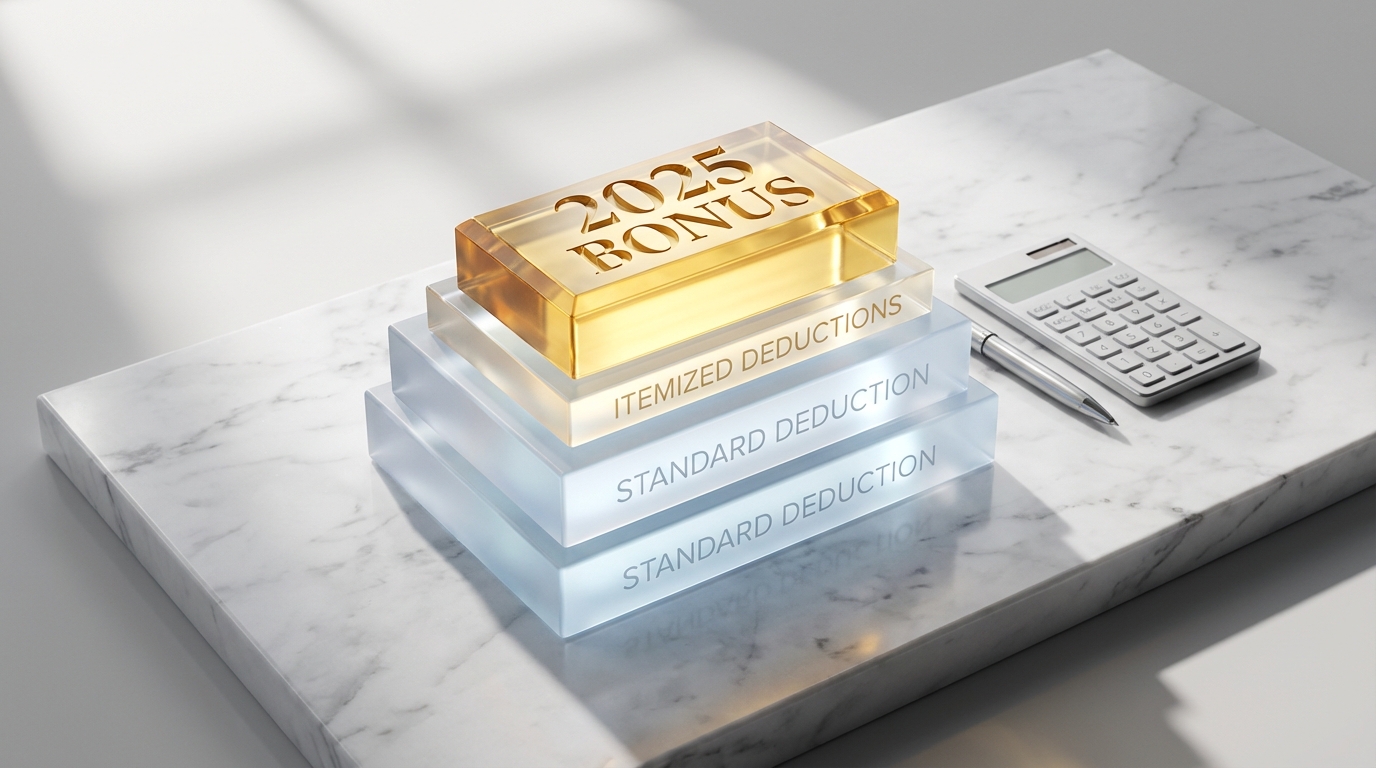
It is also not the same thing as the long-standing extra standard deduction for being age 65 or older. The IRS specifically says this new deduction is in addition to the existing senior standard deduction rules.
Who qualifies for the 2025 senior deduction
For tax year 2025, you generally qualify only if all of the following are true:
- You were born before January 2, 1961
- You have a valid Social Security number
- If you are married, you file a joint return
- Your income is not too high for the deduction after applying the phaseout rules.
The IRS also says a person is considered to reach age 65 on the day before their 65th birthday. That matters for taxpayers who turn 65 late in the year.
Valid SSN rule
The SSN rule is important. For this deduction, a valid SSN means one that is valid for employment and was issued by the Social Security Administration before the due date of the 2025 return, including extensions.
Married filing separately does not qualify
This is one of the easiest mistakes to miss. If you are married and file married filing separately, you generally cannot claim the enhanced senior deduction. The Form 1040 instructions say married filing separately taxpayers cannot take the enhanced senior deduction, and the senior deduction rules require married taxpayers to file jointly.
Itemizers can still claim it
This deduction is not limited to taxpayers who take the standard deduction. The IRS says eligible taxpayers can claim it whether they itemize or take the standard deduction. That makes it different from the regular additional standard deduction for age 65, which only helps if you are using the standard deduction.
How much is the 2025 deduction?
The starting amount is straightforward:
- $6,000 for one eligible taxpayer
- $12,000 on a joint return if both spouses are eligible.
But that is only the maximum. Your actual deduction can be reduced by income.
How the income phaseout works
For 2025, the deduction begins to phase out when your modified adjusted gross income (MAGI) goes over:
- $75,000 for single, head of household, or qualifying surviving spouse
- $150,000 for married filing jointly.
On Schedule 1-A, the IRS worksheet reduces the $6,000 amount by 6% of the excess MAGI above the threshold. Then, on a joint return, each qualifying spouse can claim that reduced per-person amount.
Based on that IRS worksheet formula, the deduction phases down to zero at:
- $175,000 MAGI for single, head of household, and qualifying surviving spouse filers
- $250,000 MAGI for married filing jointly.
That last point is an inference from the IRS worksheet formula on Schedule 1-A: once the 6% reduction equals the full $6,000 amount, nothing is left to deduct.
What MAGI means here
For this deduction, the IRS tells taxpayers to figure MAGI in Part I of Schedule 1-A. If you do not have excluded Puerto Rico income and are not filing Form 2555 or Form 4563, your MAGI for this purpose is generally the amount from Form 1040, 1040-SR, or 1040-NR, line 11b, carried to Schedule 1-A, line 3.
That matters because many taxpayers assume the phaseout is based on gross income, Social Security benefits alone, or taxable income after deductions. It is not. For this deduction, the IRS worksheet uses MAGI.
How this differs from the regular age-65 standard deduction
This is the biggest reader misunderstanding.
The regular federal tax rules already give many older taxpayers a larger standard deduction if they are age 65 or older. For 2025, the basic standard deduction amounts are:
- $15,750 for single or married filing separately
- $31,500 for married filing jointly or qualifying surviving spouse
- $23,625 for head of household.
If you are age 65 or older, you may also qualify for the regular additional standard deduction. For 2025, that extra amount is generally $1,600, but it increases to $2,000 if you are unmarried and not a surviving spouse.
So the new 2025 senior deduction is a separate layer. It sits on top of the standard deduction rules and can also help taxpayers who itemize.
Myth vs. fact
Myth: The new $6,000 senior deduction replaced the old age-65 deduction. Fact: It did not replace it. The IRS says the enhanced deduction for seniors is in addition to the existing rules for seniors.
How to claim it on your 2025 federal return
For 2025, you claim this deduction on Schedule 1-A (Form 1040), Additional Deductions. The senior deduction is figured in Part V of that schedule. The total from Schedule 1-A, line 38 then flows to Form 1040 or Form 1040-SR, line 13b.
In practical terms, the filing steps are:
- Complete Part I of Schedule 1-A to determine MAGI.
- Complete Part V for the enhanced deduction for seniors.
- Transfer the total additional deductions from line 38 to Form 1040/1040-SR, line 13b.
If you file electronically, tax software should walk you through this. But you still need correct records for your date of birth, filing status, SSN, and income amounts that affect MAGI.
How this works for business owners and self-employed taxpayers
This is an individual deduction, not a special deduction claimed on a separate business entity return. The IRS places it on Schedule 1-A attached to Form 1040, 1040-SR, or 1040-NR.
That means:
- A retired employee may claim it if personally eligible.
- A self-employed taxpayer or sole proprietor may also claim it if personally eligible.
- A single-member LLC taxed as a disregarded entity would generally look to the owner’s individual return.
- Partnerships, S corporations, and C corporations do not get a separate entity-level “senior bonus deduction” on the business return itself, because the IRS created this deduction as part of the individual return filing process. This is an inference from the IRS forms and filing instructions.
If you own a business and your income runs through to your personal return, your entity choice can still affect your overall tax picture. But this particular deduction is tied to the individual taxpayer’s eligibility, not simply to owning a business.
Important limitations and edge cases
A few rules deserve extra attention.
Death during 2025
If a taxpayer was born before January 2, 1961, but died in 2025 before actually reaching age 65, the IRS says they do not qualify. The IRS added a clarification to the 2025 Form 1040 instructions to address this point.
Alternative minimum tax
If you are subject to alternative minimum tax (AMT), this deduction may not work the same way you expect. The 2025 Form 6251 instructions say the enhanced senior deduction is treated as a personal exemption that is added back to alternative minimum taxable income as an adjustment under section 56(b)(5)(D).
For many taxpayers this will not matter. But if you are already dealing with AMT, stock options, or other complex adjustments, this is a good reason to ask a tax professional before assuming the deduction gives you the full expected benefit.
Deadlines and timing
For most calendar-year individual filers, the federal due date for a 2025 Form 1040 or 1040-SR is April 15, 2026. If you need more time, you can generally request an automatic extension to October 15, 2026 by filing Form 4868 or using an approved electronic method. But an extension gives you more time to file, not more time to pay.
State filing deadlines and extension rules may differ, especially if your state does not fully follow new federal deductions. For state returns, check your state tax agency’s 2025 instructions.
Common mistakes to avoid
Here are the most common problems to watch for:
- Calling this the same thing as the old age-65 standard deduction. It is separate.
- Forgetting that married filing separately does not qualify.
- Using the wrong income measure. The phaseout uses MAGI, not taxable income.
- Missing the valid SSN rule.
- Assuming you must take the standard deduction to claim it. You do not. Itemizers may also qualify.
What changed for tax year 2025
For 2025, this deduction is entirely new. The IRS added a new Schedule 1-A so taxpayers can claim the new deductions enacted under the law, including the enhanced deduction for seniors. The deduction is temporary and, under current IRS guidance, applies for 2025 through 2028.
That means older taxpayers filing in 2026 may see a tax benefit that did not exist on their 2024 federal return. It also means prior-year planning habits may not fully fit 2025 returns.
Bottom line
For tax year 2025, many older taxpayers can claim a new federal deduction of up to $6,000 per eligible person. The IRS calls it the enhanced deduction for seniors. To claim it, you generally must be born before January 2, 1961, have a valid SSN, and, if married, file jointly. The deduction phases out above $75,000 MAGI for single, head of household, and qualifying surviving spouse filers, and above $150,000 MAGI for joint filers. It is claimed on Schedule 1-A and then carried to Form 1040 or 1040-SR, line 13b.
What to do next
- Check whether you or your spouse were born before January 2, 1961 and have a valid SSN for 2025 filing purposes.
- Review whether your filing status will be married filing jointly if you are married, because separate returns do not qualify.
- Use Schedule 1-A, Part I and Part V to estimate whether you qualify for the full deduction or a reduced amount.
- If you expect AMT, a complex return, or state conformity issues, talk with a CPA, EA, or tax attorney before filing.
- If you need more time to file your 2025 federal return, request an extension by April 15, 2026.
Source note: Sources consulted: IRS forms, instructions, publications, official IRS updates, and related federal guidance.

4 thoughts on “2025 Senior Bonus Deduction: Essential Rules to Claim the $6,000 Tax Break”