
On January 1, 2026, the longstanding Ohio sales tax exemption on advertising materials, retail product catalogs, and direct marketing order-acceptance equipment officially expired. Enacted under Amended Substitute House Bill 96 (the FY 2026–2027 Ohio Biennial Budget Bill), this statutory repeal subjects printed catalogs, flyers, coupons, newspaper inserts, and preliminary print artwork to Ohio’s 5.75% state base rate plus county and transit levies ranging from 0.75% to 2.25%.
Most Ohio retailers and direct-mail marketers still have outdated blanket exemption certificates sitting on file with their commercial printers. Because print vendors rely on those old certificates to skip tax collection on 2026 and 2027 invoices, thousands of businesses are walking directly into a high-stakes Ohio use tax audit trap.
And the confusion surrounding Governor Mike DeWine’s line-item vetoes has only made compliance worse. While the Governor preserved the narrow statutory exemption for standalone newspapers and commercial printing press machinery, the exemption for retail catalogs and promotional direct mail was permanently eliminated.
⚡ Executive Summary: Key 2026–2027 Tax Compliance Rules at a Glance
- Statutory Exemption Repealed (Effective January 1, 2026): Under Ohio House Bill 96, Ohio repealed R.C. 5739.02(B)(35)(a)–(c), ending the tax-free treatment of catalogs, retail flyers, newspaper inserts, coupons, preliminary artwork, and direct-marketing order-taking computers and phones. Combined state and county tax rates in 2026–2027 range from 6.50% to 8.00%.
- The Newspaper & Press Veto Distinction: On June 30, 2025, Governor DeWine issued a line-item veto preserving the exemption for actual newspapers (R.C. 5739.02(B)(4)) and production machinery used by commercial printers (R.C. 5739.02(B)(42)(f)). However, finished advertising materials, newspaper inserts, and catalogs purchased by retailers lost their exemption on January 1, 2026.
- Forms, Portals & Monthly Deadlines: Businesses must self-assess and remit untaxed print and catalog purchases on Ohio Form UUT-1 (Universal Use Tax Return) or via a Direct Payment Permit through the OH|TAX eServices portal by the 23rd day of the following month. HB 96 also capped the 0.75% vendor prompt-payment discount on Form UST-1 at $750 per month per license.
- Audit Exposure & Penalties: Using a pre-2026 Form STEC-B (Blanket Exemption Certificate) to buy catalogs or promotional mailers tax-free triggers a 15% statutory audit penalty under R.C. 5739.133, plus 8% annual statutory interest for 2026 across a 4-year audit lookback period.
Table of Contents
- ⚡ Executive Summary: Key 2026–2027 Tax Compliance Rules at a Glance
- How Ohio HB 96 Repealed the Advertising & Catalog Exemption
- The Newspaper Veto Confusion: What Survived vs. What Is Taxable
- Why Out-of-State Printers Trigger an Ohio Use Tax Audit Trap
- Direct Mail Sourcing Rules Under Ohio Revised Code 5739.033(F)
- 2026–2027 Business Scenarios: Calculating Your Use Tax Liability
- Step-by-Step Guide to Revoking Exemption Certificates & Filing Form UUT-1
- Frequently Asked Questions About the Ohio Advertising & Catalog Tax Repeal
- Protecting Your Business From an Ohio Department of Taxation Audit
How Ohio HB 96 Repealed the Advertising & Catalog Exemption
Effective January 1, 2026, Ohio Amended Substitute House Bill 96 repealed Ohio Revised Code (R.C.) 5739.02(B)(35), eliminating the sales and use tax exemption for retail advertising materials, product catalogs, direct-marketing print artwork, and order-acceptance telecommunications and computer equipment.
Why did the Ohio General Assembly target marketing budgets? Lawmakers needed to offset a massive personal income tax restructuring that phased Ohio’s individual income tax down to a flat 2.75% rate starting in 2026. According to the Ohio Legislative Service Commission fiscal analysis of HB 96, repealing select business-to-business sales tax exemptions generates an estimated $85 million in state General Revenue Fund (GRF) receipts in FY 2026 and $176 million in FY 2027, plus an additional $65 million for county and transit authorities over the biennium.
Prior to 2026, the Ohio sales tax exemption on advertising materials shielded three distinct categories of commercial purchases under R.C. 5739.02(B)(35) and its companion use tax statute, R.C. 5741.02(C). Starting January 1, 2026, every single one of these categories became fully subject to state and county tax:
- Retail Price & Description Materials (Former R.C. 5739.02(B)(35)(a)): Catalogs, newspaper inserts, flyers, mailers, coupons, gift certificates, and promotional brochures distributed to consumers that price and describe tangible personal property offered for retail sale.
- Direct Marketing Preliminary Print Materials & Sweepstakes (Former R.C. 5739.02(B)(35)(b)): Preliminary items purchased by direct marketing vendors—including commercial photographs, graphic artwork, color separations, and typesetting used to print advertising material—as well as printed sweepstakes mailers offering free merchandise or prize chances.
- Direct Marketing Order-Acceptance Equipment (Former R.C. 5739.02(B)(35)(c)): Telephones, computers, servers, headsets, facsimile machines, and related hardware purchased by direct marketing vendors and used primarily to accept customer orders via mail, phone, or internet for warehouse fulfillment.
- Qualified Call Center Telecommunications & Electronic Publishing (HB 96 Companion Repeals): Alongside the Ohio catalog sales tax repeal, HB 96 eliminated the exemption for telecommunications services used by qualified call centers (employing 50 or more full-time equivalent agents) and repealed the 25% sales tax refund for electronic information service providers under R.C. 5739.071.
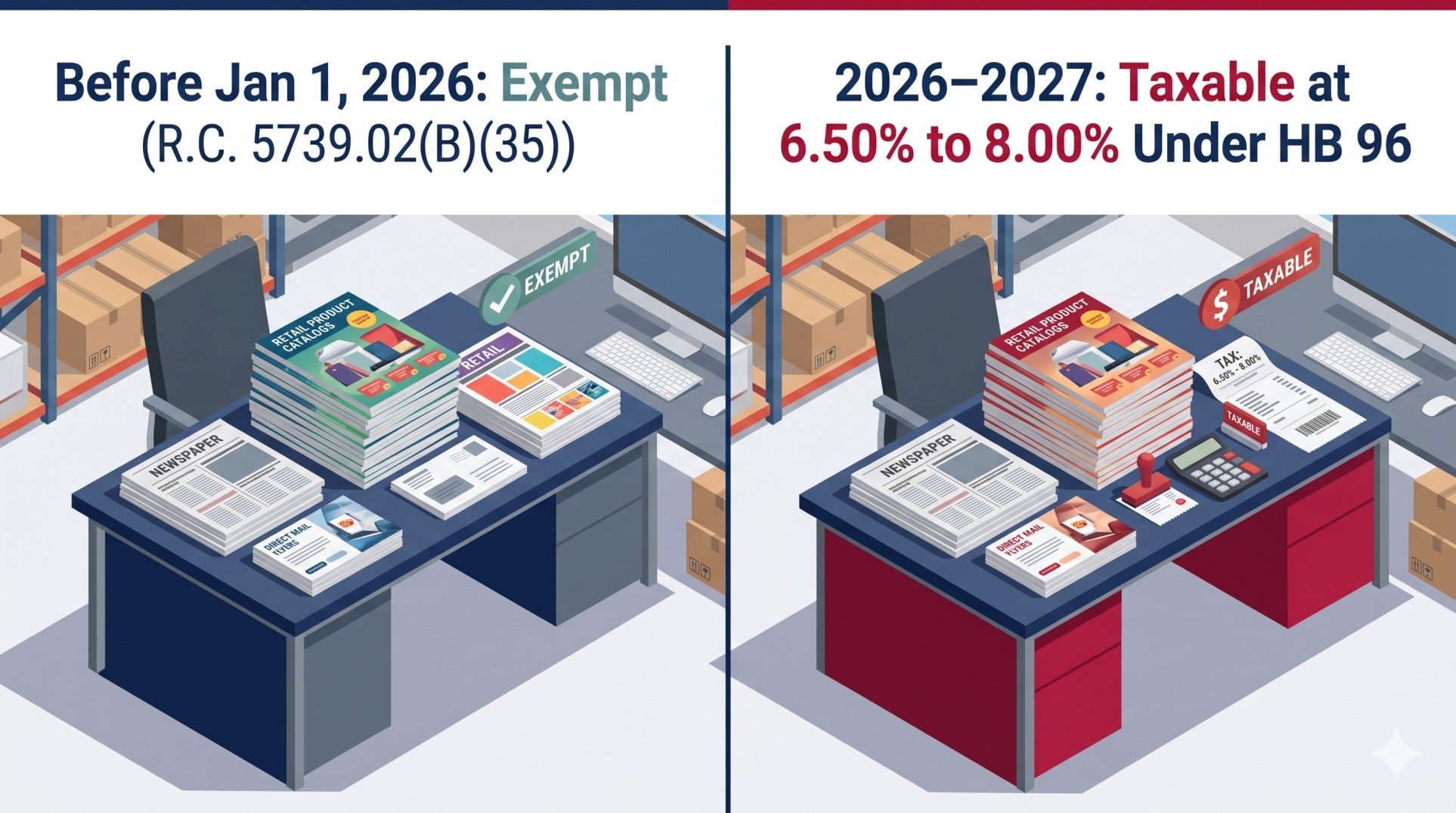
If your retail chain, e-commerce brand, or wholesale distribution company prints product catalogs or mails promotional postcards to Ohio households, those print runs are no longer exempt. You must pay Ohio sales tax to your printer at checkout or self-assess consumer use tax on the full production and printing invoice. Businesses evaluating their broader multi-state exposure should review our 2026–2027 multi-state sales and use tax nexus compliance guide to see how state base expansions impact remote marketers.
The Newspaper Veto Confusion: What Survived vs. What Is Taxable
While Governor Mike DeWine issued a line-item veto on June 30, 2025 that preserved the tax exemption for newspapers and commercial printing press machinery, he did not veto the repeal of the exemption for retail catalogs, flyers, and advertising inserts.
This partial veto created a dangerous blind spot for corporate controllers and AP departments across Ohio. In late June 2025, trade associations representing printers and local journalists launched an urgent campaign urging Governor DeWine to strike the printing and media provisions from HB 96. When the Governor signed the budget on June 30, 2025, he issued 67 line-item vetoes, including Item Number 43, which saved newspapers and commercial printing production equipment.
Many retail executives read the July 2025 headlines proclaiming that “Ohio Governor Protects Newspapers and Printed Materials” and assumed their marketing catalogs and direct mailers were safe. They weren’t.
Audit Warning: The Newspaper vs. Newspaper Insert Trap
Under preserved R.C. 5739.02(B)(4), purchasing a community or national newspaper remains exempt from Ohio sales tax in 2026 and 2027. However, under repealed R.C. 5739.02(B)(35)(a), freestanding advertising inserts, Sunday coupon circulars, and retail flyers printed for insertion into those newspapers are 100% taxable beginning January 1, 2026.
How the Supply-Chain Tier Distinction Works in 2026–2027
To avoid overpaying tax—or underpaying and getting hit with an audit assessment—you must distinguish between the Commercial Printer (Manufacturer Tier) and the Retailer or Advertiser (End-User Tier):
- What Survived for Commercial Printers (Exempt): Governor DeWine’s veto preserved R.C. 5739.011 and R.C. 5739.02(B)(42)(f). Commercial printing houses located in Ohio can still purchase printing presses, bindery lines, finishing machinery, and raw materials (ink, paper stock, plates, coatings, and film) tax-free when those inputs are used to produce printed material for sale to customers.
- What Survived for Publishers & Media (Exempt): Sales of qualifying newspapers (under R.C. 5739.02(B)(4)) and transfers of copyrighted motion picture films (under R.C. 5739.01(B)(5), including commercial video films) remain exempt from tax because the Governor vetoed their repeal.
- What Died for Retailers & Direct Marketers (Taxable Jan 1, 2026): When the commercial printer sells the finished catalogs, brochures, price lists, coupons, or promotional flyers to a retailer or direct marketer, that transaction is now a taxable retail sale. Furthermore, if an Ohio retailer buys its own in-house digital presses, toner, and paper to print its own flyers (not for sale to others), neither the manufacturing exemption nor the repealed advertising exemption applies.
| Item / Transaction Category | Ohio Statutory Citation | Pre-2026 Tax Status (Through Dec 31, 2025) | 2026–2027 Tax Status (Eff. Jan 1, 2026) | Legal Incidence & Compliance Impact |
|---|---|---|---|---|
| Retail Catalogs, Flyers & Price Lists (pricing & describing retail goods) | R.C. 5739.02(B)(35)(a) (Repealed by HB 96) | Exempt | Taxable (6.50%–8.00%) | Retailer/Marketer pays sales tax to printer or remits consumer use tax on Form UUT-1. |
| Newspaper Advertising Inserts & Coupons (purchased by retailers) | R.C. 5739.02(B)(35)(a) (Repealed by HB 96) | Exempt | Taxable (6.50%–8.00%) | Taxable to the advertiser/retailer purchasing the printed inserts for distribution. |
| Direct Mail Preliminary Artwork, Photos & Sweepstakes Mailers | R.C. 5739.02(B)(35)(b) (Repealed by HB 96) | Exempt | Taxable (6.50%–8.00%) | Direct marketing vendor owes tax on graphic design tangibles, typesetting, and prize mailers. |
| Direct Marketing Order-Acceptance Computers & Phone Systems | R.C. 5739.02(B)(35)(c) (Repealed by HB 96) | Exempt | Taxable (6.50%–8.00%) | Hardware and telecom equipment used to take mail/phone/web orders is fully taxable. |
| Qualified Call Center Telecommunications Services | R.C. 5739.02(B)(53) (Repealed by HB 96) | Exempt | Taxable (6.50%–8.00%) | Inbound/outbound telecom services for call centers (50+ FTEs) are taxable starting Jan 1, 2026. |
| Standalone Newspapers (community & national unbound publications) | R.C. 5739.02(B)(4) (Vetoed—Preserved) | Exempt | Exempt | Governor DeWine’s June 30, 2025 veto preserved the exemption for newspaper sales. |
| Commercial Printing Presses, Ink & Paper (used to print items for sale) | R.C. 5739.02(B)(42)(f) & 5739.011 (Vetoed—Preserved) | Exempt | Exempt (for Commercial Printers) | Commercial printers buy ink, paper, and presses tax-free, but must charge tax on finished catalogs. |
| Copyrighted Motion Picture Films (including commercial ad films) | R.C. 5739.01(B)(5) (Vetoed—Preserved) | Exempt | Exempt | Governor’s veto preserved the exclusion for transfers of copyrighted motion picture films. |
| Prompt-Payment Vendor Discount (Form UST-1 / UUT-1) | R.C. 5739.12 (Amended by HB 96) | 0.75% Unlimited | 0.75% Capped at $750/mo | Capped at $750 per vendor license per month starting Jan 1, 2026 (motor vehicle dealers excluded). |
Why Out-of-State Printers Trigger an Ohio Use Tax Audit Trap
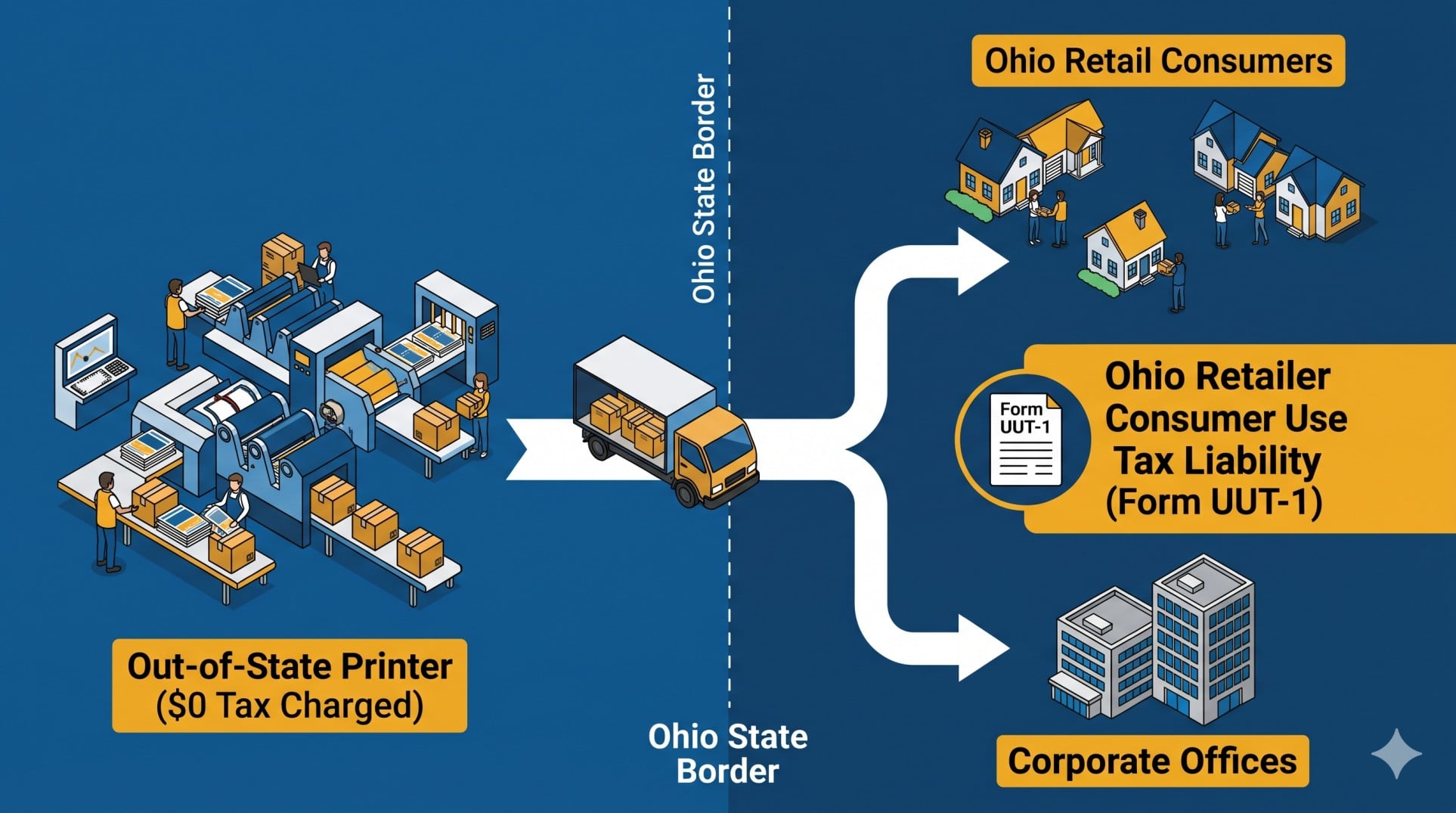
An Ohio use tax audit trap occurs when an Ohio business purchases newly taxable catalogs or advertising materials from a commercial printer that fails to charge Ohio sales tax—either because the printer lacks Ohio nexus or relies on an expired Form STEC-B blanket exemption certificate.
Under Ohio Revised Code 5741.02, Ohio imposes a companion Consumer Use Tax on the storage, use, or other consumption of tangible personal property and taxable services within the state whenever Seller’s Sales Tax was not paid at the time of purchase. If your vendor doesn’t collect the tax, the legal liability does not disappear. It shifts 100% onto your books as the buyer.
Three Ways Ohio Businesses Fall Into the Audit Trap in 2026–2027
State tax auditors from the Ohio Department of Taxation (ODT) know exactly where to look when an exemption is repealed. During a standard sales and use tax field audit, auditors request your chart of accounts and filter specifically for General Ledger (GL) expense accounts labeled “Advertising,” “Direct Mail,” “Catalog Production,” “Print Marketing,” and “Promotional Materials.”
Here is why nearly every mid-market retailer and direct marketer fails this audit check in 2026:
- Trap 1: “Zombie” Blanket Exemption Certificates (Form STEC-B): Years ago, your procurement team handed your commercial printer an Ohio Form STEC-B (Sales and Use Tax Blanket Exemption Certificate) checking the box for R.C. 5739.02(B)(35)(a). Under R.C. 5739.03(B), when a vendor accepts a properly completed exemption certificate in good faith, the vendor is relieved of the duty to collect tax. When the law changed on January 1, 2026, your printer’s ERP system kept that blanket certificate active and continued issuing $0-tax invoices. In an audit, ODT will not assess the printer—they will assess you as the consumer under R.C. 5741.02 for using an invalid exemption claim.
- Trap 2: Out-of-State Commercial Printers Without Ohio Nexus: High-volume catalogs are frequently printed at specialized web-offset facilities in Wisconsin, Illinois, Indiana, or Kentucky. If a small or specialized out-of-state printer has under $100,000 in gross receipts sourced to Ohio and fewer than 200 transactions into Ohio (Ohio retains both the $100,000 and 200-transaction economic nexus thresholds under R.C. 5741.01(I)(2) in 2026), that printer has no legal obligation to collect Ohio tax. Or, if the printer ships the catalogs via common carrier directly to a United States Postal Service (USPS) Sectional Center Facility, their billing system may default to $0 tax. You owe Ohio Consumer Use Tax on every catalog delivered to an Ohio address.
- Trap 3: Call Center & Order-Intake IT Upgrades: Direct marketing companies upgrading their order-intake servers, VoIP phone systems, and agent workstations in 2026 often have blanket exemptions on file with B2B hardware vendors under repealed R.C. 5739.02(B)(35)(c). Any capital asset invoice dated on or after January 1, 2026 without Ohio sales tax is an immediate audit assessment item.
If your accounts payable team hasn’t audited its vendor master file since the Ohio HB 96 sales tax changes took effect, you are accruing unrecorded tax liabilities every month. Our team regularly assists companies with sales and use tax audit defense and voluntary disclosure agreements to clean up historical exposure before ODT issues an audit notice.
Direct Mail Sourcing Rules Under Ohio Revised Code 5739.033(F)
Under Ohio Revised Code 5739.033(F), sales and use tax on advertising and promotional direct mail—including retail catalogs and flyers—is sourced to the specific local taxing jurisdictions where the printed materials are delivered to recipients, rather than the printer’s origin location.
Sourcing is where the math gets tricky for multi-state and multi-county marketers. For ordinary intrastate retail sales of tangible personal property, Ohio is an origin-sourced state under R.C. 5739.033(B)(1)—meaning an Ohio vendor normally charges the tax rate of the county where the order is received. However, Ohio law carves out a mandatory destination-sourcing rule for “advertising and promotional direct mail” under R.C. 5739.033(F).
How to Source Multi-State and Multi-County Catalog Runs
When you contract with a commercial printer or mail house to print and mail 500,000 catalogs across the country, you do not owe Ohio tax on catalogs mailed to customers in Pennsylvania, Michigan, or Florida—even if the printer is located in Columbus, Ohio. Conversely, if your printer is in Chicago, Illinois, you do owe Ohio direct mail use tax on the exact portion of the print run delivered to Ohio residents.
Under R.C. 5739.033(F)(1), the tax calculation follows three strict statutory pathways:
- Pathway A: Providing Delivery Jurisdiction Information to the Printer (R.C. 5739.033(F)(1)(c)): If you provide your printer with a mailing distribution breakdown (such as a USPS ZIP-to-County summary report) showing the exact Ohio counties and out-of-state jurisdictions where the catalogs are delivered, the printer must collect Ohio sales tax only on the Ohio portion, calculated at the exact combined state and county rate of each Ohio recipient’s delivery address.
- Pathway B: Direct Payment Permit or Direct Mail Exemption Certificate (R.C. 5739.033(F)(1)(a) & (e)): If you present the printer with an Ohio Direct Payment Permit (issued under R.C. 5739.031) or a Streamlined Sales Tax (SST) Certificate of Exemption checking the “Direct Mail” sourcing box (Note: this is a sourcing election certificate, not a taxability exemption!), the printer charges $0 tax. You then assume full legal responsibility to self-assess and remit Ohio direct mail use tax on Form UUT-1 allocated across the exact Ohio counties where the catalogs landed.
- Pathway C: The Default Origin Penalty Rule (R.C. 5739.033(F)(1)(d)): What happens if you don’t give your Ohio printer a mailing distribution list, a Direct Payment Permit, or a Direct Mail sourcing certificate? Under division (F)(1)(d) and (C)(5), the Ohio printer is legally required to charge Ohio sales tax on 100% of the entire print run (including catalogs shipped out of state!) at the rate of the location from which the direct mail was shipped.
Separately Stated Postage & Delivery Charges on Print Invoices
What about the postage and freight charges on your catalog invoice? Under R.C. 5739.01(H)(1), “price” includes delivery charges made by the vendor. However, charges for delivery via the United States Postal Service (USPS postage) that are separately stated on the invoice and represent a direct pass-through of federal postage without markup are excluded from the taxable base. By contrast, if a printer ships bulk pallets of catalogs to your Ohio retail stores via private common carrier (such as UPS Freight or FedEx Freight) and bills you for shipping on the same invoice as the taxable catalogs, that common-carrier delivery charge is 100% taxable in Ohio.
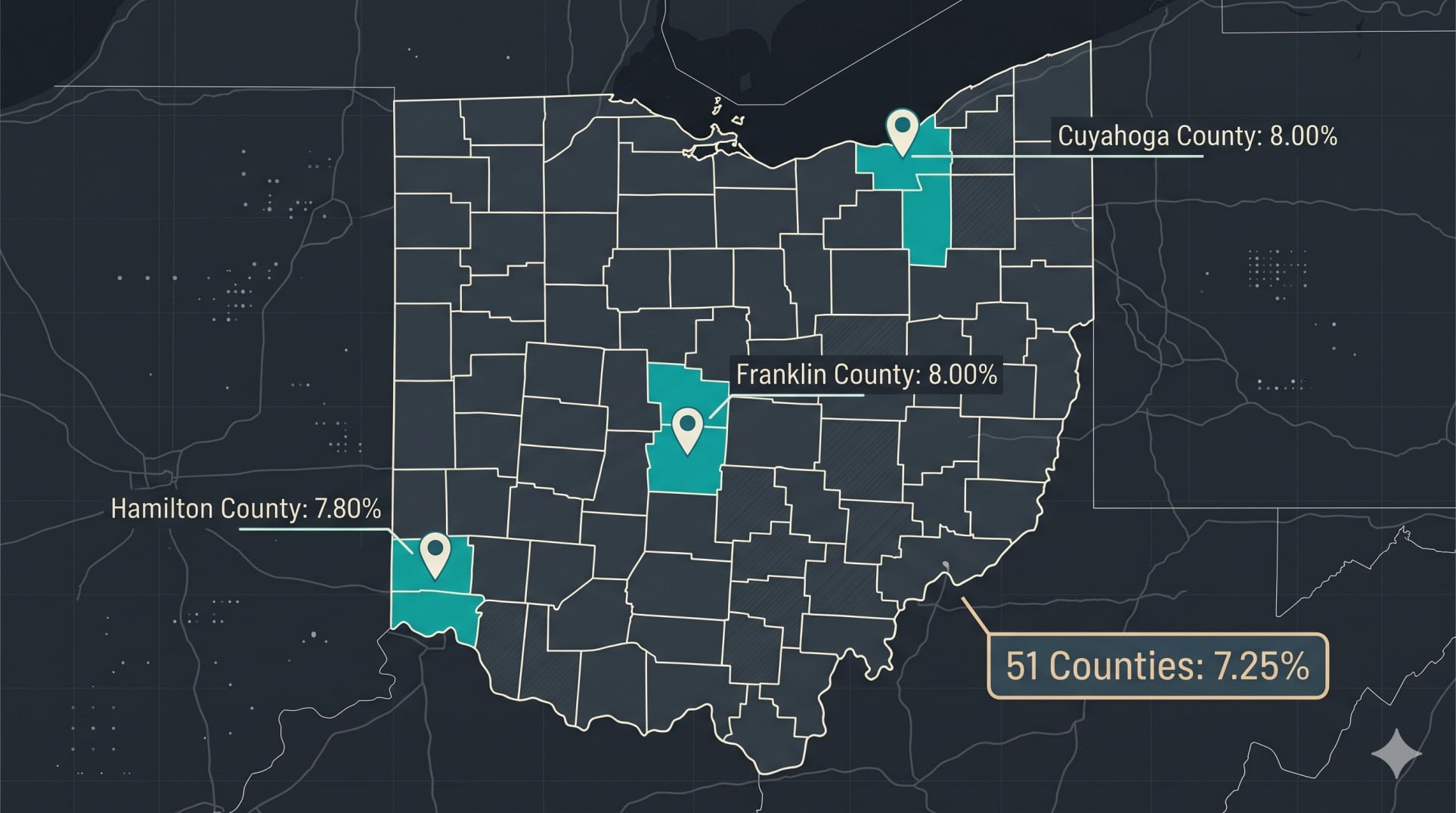
| Ohio County & Major Metro Area | 2026–2027 County Code | State Base Rate | County & Transit Levy | Total 2026–2027 Combined Rate | UUT-1 County Rate Code (0.05% Increments) |
|---|---|---|---|---|---|
| Franklin County (Columbus / COTA District) | 25 | 5.75% | 2.25% (1.75% Co. + 0.50% COTA) | 8.00% | 2545 (plus 8923 State) |
| Cuyahoga County (Cleveland / RTA) | 18 | 5.75% | 2.25% | 8.00% | 1845 (plus 8923 State) |
| Hamilton County (Cincinnati / SORTA) | 31 | 5.75% | 2.05% (1.25% Co. + 0.80% SORTA) | 7.80% | 3141 (plus 8923 State) |
| Lucas County (Toledo / TARTA) | 48 | 5.75% | 2.00% | 7.75% | 4840 (plus 8923 State) |
| Montgomery County (Dayton) | 57 | 5.75% | 1.75% | 7.50% | 5735 (plus 8923 State) |
| 51 Default Ohio Counties (incl. Licking, Lake, Scioto, Warren eff. Oct 1, 2026) | Varies (e.g., 83 Warren) | 5.75% | 1.50% | 7.25% | XX30 (plus 8923 State) |
| Summit County (Akron) & Greene County | 77 (Summit) / 29 (Greene) | 5.75% | 1.00% | 6.75% | 7720 / 2920 (plus 8923 State) |
| Stark County (Canton), Butler, Lorain & Wayne Counties | 76 (Stark) / 09 (Butler) | 5.75% | 0.75% | 6.50% | 7615 / 0915 (plus 8923 State) |
Note on 2026 County Rate Changes: According to the Ohio Department of Taxation, no county rates changed on January 1, April 1, or July 1, 2026. The sole county rate change in 2026 occurred on October 1, 2026, when Warren County (Code 83) increased its combined sales and use tax rate from 6.75% to 7.25%. Also note that portions of Delaware, Fairfield, Licking, and Union counties located inside the Central Ohio Transit Authority (COTA) district carry an additional transit levy.
2026–2027 Business Scenarios: Calculating Your Use Tax Liability
To calculate your exact 2026–2027 tax exposure under the Ohio catalog sales tax repeal, you must separate taxable printing, paper, artwork, and common-carrier freight from non-taxable USPS postage and out-of-state recipient deliveries, then apply the specific county rate where the materials are received.
Let’s examine four realistic business scenarios demonstrating how the Ohio HB 96 sales tax changes operate on actual invoices and audit schedules.
Scenario 1: Multi-County Holiday Catalog Mailing From an Out-of-State Printer
The Setup: Buckeye Home Furnishings, a retail chain headquartered in Columbus, Ohio, contracts with Midwest Web Press in Illinois to print and mail 400,000 Spring/Summer 2026 retail product catalogs in May 2026. Because Buckeye Home Furnishings gave Midwest Web Press a blanket exemption certificate back in 2023, the Illinois printer charges $0 sales tax on the May 2026 invoice.
The Invoice Breakdown:
- Catalog printing, paper, and bindery (400,000 copies @ $0.80 each): $320,000
- Preliminary photography and graphic typesetting charges billed by the printer: $20,000
- Separately stated USPS Marketing Mail postage (pass-through at cost): $110,000
- Total Invoice Amount: $450,000
The Mailing Distribution List:
- 150,000 catalogs (37.5%) mailed to recipients outside Ohio (Indiana, Kentucky, Michigan, Pennsylvania).
- 100,000 catalogs (25.0%) mailed to recipients in Franklin County, Ohio (8.00% combined rate).
- 80,000 catalogs (20.0%) mailed to recipients in Cuyahoga County, Ohio (8.00% combined rate).
- 70,000 catalogs (17.5%) mailed to recipients in Butler County, Ohio (6.50% combined rate).
Step-by-Step 2026 Use Tax Calculation:
- Determine the Taxable Print Base: Both the catalog printing ($320,000) and preliminary artwork/typesetting ($20,000) lost their exemptions on January 1, 2026 under repealed R.C. 5739.02(B)(35)(a) and (b). Total taxable production base = $340,000. The separately stated USPS postage ($110,000) is excluded.
- Exclude Out-of-State Deliveries: Under R.C. 5739.033(F), the 37.5% shipped outside Ohio ($127,500 of the print base) is exempt from Ohio use tax.
- Calculate Franklin County Use Tax (25.0% of base): $340,000 × 25.0% = $85,000 taxable base × 8.00% = $6,800.00.
- Calculate Cuyahoga County Use Tax (20.0% of base): $340,000 × 20.0% = $68,000 taxable base × 8.00% = $5,440.00.
- Calculate Butler County Use Tax (17.5% of base): $340,000 × 17.5% = $59,500 taxable base × 6.50% = $3,867.50.
- Total Ohio Consumer Use Tax Due on May 2026 Form UUT-1 (Due June 23, 2026): $6,800.00 + $5,440.00 + $3,867.50 = $16,107.50.
Scenario 2: The Newspaper Insert vs. Newspaper Veto Distinction
The Setup: Queen City Grocery operates supermarkets across Hamilton County (Cincinnati), Ohio. In August 2026, Queen City Grocery pays an Ohio commercial printer $45,000 to print 1.5 million full-color weekly coupon and price circulars. Those circulars are delivered to local newspapers in Hamilton County to be stuffed inside the Sunday paper. Queen City Grocery also pays the newspaper publisher $15,000 for the media distribution/insertion service fee and purchases $1,200 worth of daily newspapers for its corporate office lobby.
Step-by-Step 2026 Taxability & Math:
- Corporate Newspaper Subscriptions ($1,200): $0 tax. Because Governor DeWine vetoed the repeal of R.C. 5739.02(B)(4), standalone newspaper purchases remain 100% exempt.
- Newspaper Insertion / Media Space Fee ($15,000): $0 tax. Advertising space and media distribution fees charged by a publisher remain a non-taxable service when separately stated from the sale of tangible printed inserts.
- Printed Weekly Coupon Circulars ($45,000): Taxable! Newspaper inserts and coupons that price and describe retail items lost their exemption under R.C. 5739.02(B)(35)(a) on January 1, 2026. At Hamilton County’s 7.80% combined rate (5.75% state + 2.05% county/SORTA), Queen City Grocery owes $3,510.00 in sales or use tax ($45,000 × 7.80%).
Scenario 3: Direct Marketing Call Center & Order-Intake Equipment
The Setup: Summit Industrial Supply, a direct-marketing B2B catalog distributor in Akron (Summit County, 6.75% combined rate), takes orders by phone and web and fulfills them by common carrier from its Akron warehouse. In March 2026, Summit purchases $120,000 in new order-entry desktop computers, servers, and headsets for its inbound sales reps, and spends $80,000 across 2026 on dedicated inbound telecommunications lines for its 65-person call center.
Step-by-Step 2026 Audit Assessment Math:
Summit’s controller uses an old Form STEC-B citing R.C. 5739.02(B)(35)(c) (direct marketing order-acceptance equipment) and R.C. 5739.02(B)(53) (qualified call center telecom) to buy both tax-free. Both exemptions were repealed on January 1, 2026 by HB 96. When ODT audits Summit Industrial Supply twelve months later:
- Unpaid Use Tax on Order-Acceptance Hardware: $120,000 × 6.75% = $8,100.00.
- Unpaid Use Tax on Call Center Telecom Services: $80,000 × 6.75% = $5,400.00.
- Total Unpaid Tax Principal: $13,500.00.
- Statutory Audit Penalty (15% under R.C. 5739.133): $13,500.00 × 15% = $2,025.00.
- Statutory Interest (8.00% annual rate for 2026 per ODT Administrative Journal Entry): Approximately $1,080.00 for one year of delinquency.
- Total Audit Assessment Bill: $16,605.00.
Scenario 4: The $750 Monthly Vendor Discount Cap Trap
The Setup: Suppose Midwest Web Press (from Scenario 1) registers to collect Ohio Seller’s Use Tax and collects $180,000 in total Ohio tax during November 2026 from its various Ohio retail clients. Prior to 2026, filing Form UST-1 on time by the 23rd of the following month allowed the vendor to keep a 0.75% prompt-payment discount equal to $1,350.00 ($180,000 × 0.0075). Beginning January 1, 2026 under HB 96 (amending R.C. 5739.12), Ohio caps the vendor discount at $750.00 per vendor’s license per month (except for motor vehicle dealers). Midwest Web Press can only deduct $750.00, forfeiting the remaining $600.00 to the state.
For businesses managing complex multi-county allocations or high-volume monthly returns, our outsourced sales and use tax return preparation services automate county rate lookups and prevent costly filing errors.
Step-by-Step Guide to Revoking Exemption Certificates & Filing Form UUT-1
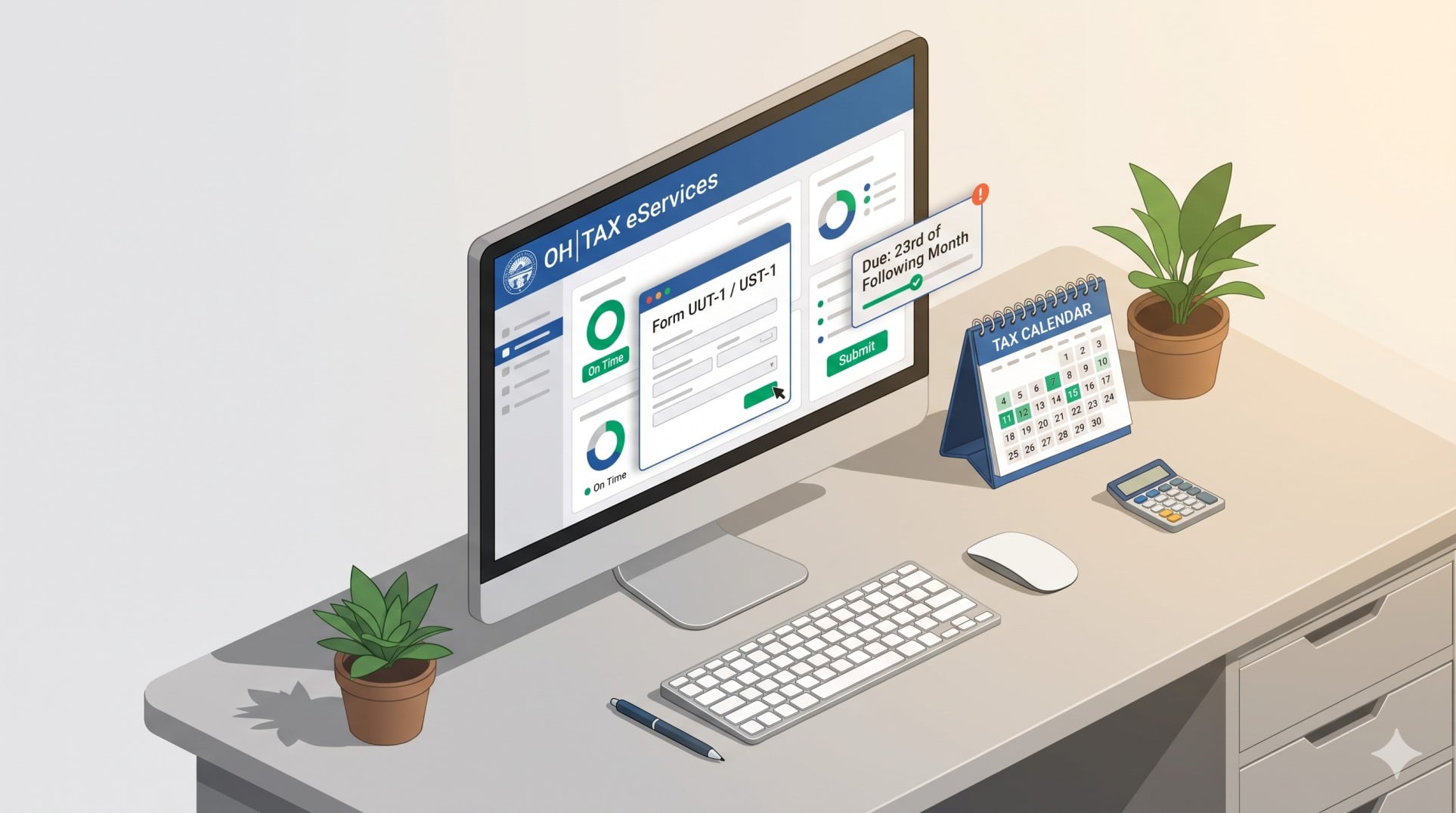
To eliminate your 2026–2027 audit exposure, you must formally revoke pre-2026 blanket exemption certificates with your print vendors in writing, register for an Ohio Consumer’s Use Tax account (Form UT 1008), and remit self-assessed tax monthly or quarterly on Form UUT-1 via OH|TAX eServices by the 23rd of the following month.
Step 1: Audit Your AP Vendor Master File & Revoke Form STEC-B
Pull a 2026–2027 disbursement report for all commercial printers, direct mail houses, graphic production studios, and IT hardware suppliers. Identify every vendor where you previously submitted an Ohio Form STEC-B (Sales and Use Tax Blanket Exemption Certificate), Form STEC-U (Unit Exemption Certificate), or Streamlined Sales Tax (SST) Certificate of Exemption claiming exemption under R.C. 5739.02(B)(35).
Send a formal written revocation notice to each printer instructing them that the Ohio sales tax exemption on advertising materials expired on January 1, 2026. If you want the printer to calculate and collect Ohio tax on your behalf, provide them with a ZIP-to-County delivery distribution report for each mailing under R.C. 5739.033(F)(1)(c). Alternatively, if you prefer to self-assess the tax internally, issue the printer a Direct Mail sourcing certificate or Direct Payment Permit number so you control the county allocation math yourself.
Step 2: Register for an Ohio Consumer’s Use Tax Account (Form UT 1008)
Holding a standard Ohio Vendor’s License (Form ST-1) allows you to collect sales tax from your retail customers on Form UST-1, but you cannot report significant recurring business consumer use tax liabilities on a standard vendor’s return without proper registration. If your business does not already have an active Consumer’s Use Tax account (prefix 97-XXXXXX) or Direct Payment Permit (prefix 98-XXXXXX), register immediately through the OH|TAX eServices portal (or by submitting paper Application Form UT 1008). There is $0 registration fee for a Consumer’s Use Tax account.
Step 3: Map Deliveries to Ohio’s 88 Four-Digit County Rate Codes
When preparing your monthly or quarterly Form UUT-1 (Universal Use Tax Return), Ohio requires you to separate the 5.75% state base tax from the local county/transit permissive tax using specific four-digit rate codes:
- State Base Rate Code (8923): All taxable purchases across the entire state are reported under code 8923 for the state portion (where “89” represents the state and “23” represents 23 increments of 0.25%, equaling 5.75%).
- County Permissive Rate Codes (XXYY): The first two digits represent the Ohio county number (01 through 88), and the last two digits represent the county/transit rate divided by 0.05%. For example, Franklin County is County 25, and its local rate (including COTA) is 2.25%. Divide 2.25% by 0.05% to get 45—making Franklin County’s local code 2545. Hamilton County (County 31, local rate 2.05%) uses code 3141.
Step 4: File and Pay Electronically via OH|TAX eServices by the 23rd
Log into OH|TAX eServices or the Ohio Business Gateway to file Form UUT-1 electronically. Returns and electronic funds transfer (EFT) payments are strictly due on the 23rd day of the month following the close of the reporting period (for example, the January 2026 return is due February 23, 2026; quarterly filers remit by April 23, July 23, October 23, and January 23). Retain all print invoices, USPS mailing statements (PS Form 3602), and county allocation spreadsheets for at least four years to satisfy Ohio’s statutory audit lookback window under R.C. 5739.16.
Pro-Tip: Consider a Voluntary Disclosure Agreement (VDA) for Unpaid 2026 Tax
If your company purchased hundreds of thousands of dollars in untaxed catalogs and direct mail during 2026 without remitting use tax, filing an Ohio Voluntary Disclosure Agreement (VDA) through OH|TAX eServices before the Department contacts you waives the 15% statutory penalty. Under ODT’s August 2026 updated VDA spreadsheet rules, you have 60 days after receiving the agreement to submit your county-by-county use tax schedule (up to 5,000 line entries per tab) and remit the tax plus statutory interest.
Need help setting up your county allocation tables or reviewing your Commercial Activity Tax (CAT) interplay? Check out our Ohio Commercial Activity Tax (CAT) and sales tax compliance guide for a complete breakdown of Ohio business taxes.
Frequently Asked Questions About the Ohio Advertising & Catalog Tax Repeal
1. When did Ohio repeal the sales tax exemption on catalogs and advertising materials?
Ohio repealed the sales and use tax exemption on advertising materials and catalogs effective January 1, 2026. The repeal was enacted on June 30, 2025, under Amended Substitute House Bill 96 (the FY 2026–2027 Biennial Budget), which eliminated Ohio Revised Code 5739.02(B)(35)(a)–(c).
2. Did Governor Mike DeWine veto the Ohio catalog sales tax repeal?
No, Governor DeWine did not veto the Ohio catalog sales tax repeal. While his June 30, 2025 line-item veto (Item 43) preserved the exemption for standalone newspapers (R.C. 5739.02(B)(4)) and commercial printing press machinery (R.C. 5739.02(B)(42)(f)), the exemption for retail catalogs, flyers, coupons, and newspaper inserts was permanently eliminated starting January 1, 2026.
3. Are newspaper inserts and Sunday circulars taxable in Ohio in 2026 and 2027?
Yes, printed newspaper inserts, freestanding circulars, and retail flyers purchased by a retailer or advertiser for distribution inside a newspaper are fully taxable at 6.50% to 8.00% starting January 1, 2026. Only the sale of the underlying newspaper itself remains exempt under R.C. 5739.02(B)(4).
4. Do Ohio businesses owe use tax on catalogs mailed to customers outside Ohio?
No, you do not owe Ohio direct mail use tax on catalogs delivered to recipients outside Ohio, provided you comply with R.C. 5739.033(F). You must give your printer a delivery jurisdiction breakdown (or issue a Direct Payment Permit / Direct Mail sourcing certificate) so only the portion delivered to Ohio addresses is taxed.
5. What happens if my commercial printer still has my old Form STEC-B on file?
If your printer relies on a pre-2026 Form STEC-B blanket exemption certificate to skip charging tax on 2026 or 2027 catalog invoices, your business becomes directly liable for unpaid Ohio Consumer Use Tax. You must self-assess and remit the tax on Form UUT-1, or face a 15% audit penalty plus 8% annual interest.
6. Are USPS postage charges on direct mail invoices subject to Ohio sales or use tax?
Separately stated United States Postal Service (USPS) postage charges that are passed through at cost without markup are exempt from Ohio sales and use tax. However, third-party common carrier freight charges (such as UPS or FedEx Freight) billed by a printer to ship bulk flyers to your Ohio stores are fully taxable under R.C. 5739.01(H)(1).
7. Are graphic design fees and preliminary print artwork taxable in Ohio in 2026?
Yes, preliminary tangible materials purchased by direct marketing vendors—including commercial photographs, artwork, color separations, and typesetting used to print advertising materials—lost their exemption on January 1, 2026 under the repeal of R.C. 5739.02(B)(35)(b). Furthermore, when graphic design charges are bundled into a commercial printing invoice, the entire gross charge for the finished printed catalogs is taxable.
8. Did Ohio HB 96 also tax computers and phones used to take catalog orders?
Yes, effective January 1, 2026, HB 96 repealed R.C. 5739.02(B)(35)(c), which previously exempted computers, telephones, servers, and equipment used primarily by direct marketing vendors to accept retail orders. It also repealed the telecommunications exemption for qualified call centers employing 50 or more full-time agents.
9. What form and deadline apply to reporting Ohio Consumer Use Tax on advertising materials?
Businesses report self-assessed consumer use tax on Ohio Form UUT-1 (Universal Use Tax Return) through the OH|TAX eServices portal. Returns and electronic payments are due on the 23rd day of the month following the end of your monthly or quarterly reporting period.
10. Can commercial printers still buy ink, paper, and printing presses tax-free in Ohio?
Yes, commercial printers manufacturing printed materials for sale to third-party customers can still claim the production exemption under R.C. 5739.02(B)(42)(f) and R.C. 5739.011 for presses, bindery equipment, ink, and paper stock. The tax applies when the printer sells the finished catalogs or flyers to the retail business or advertiser.
Protecting Your Business From an Ohio Department of Taxation Audit
The repeal of the Ohio sales tax exemption on advertising materials and product catalogs under House Bill 96 is one of the most aggressive base-broadening measures in recent Ohio tax history. Because the repeal took effect on January 1, 2026 right after Governor DeWine’s widely publicized newspaper veto, thousands of retail chains, e-commerce brands, and direct-mail marketers have continued buying print runs tax-free without realizing their blanket exemption certificates are invalid.
Don’t wait for an Ohio Department of Taxation auditor to pull your marketing general ledger and hit your business with a four-year assessment, a 15% statutory penalty, and 8% compounding interest. Whether you need to revoke outdated Form STEC-B certificates, build automated ZIP-to-County direct mail sourcing schedules under R.C. 5739.033(F), file monthly Form UUT-1 returns, or negotiate a penalty-free Ohio Voluntary Disclosure Agreement, contact the SALT compliance specialists at Ourtaxpartner.com today to lock down your 2026–2027 compliance.
Disclaimer: This content provides general information for educational purposes only and reflects state, local, and federal sales, use, and excise tax laws applicable to the 2026–2027 compliance periods. State and local tax rates, nexus thresholds, and excise regulations change frequently across jurisdictions. This article does not constitute professional tax, legal, or accounting advice. Always consult a certified public accountant (CPA), enrolled agent (EA), or qualified SALT advisor at Ourtaxpartner.com regarding your specific business compliance obligations. Ourtaxpartner.com is not responsible for any actions taken based on the information provided herein.
