
Eighteen months ago, oral nicotine pouches operated in a coast-to-coast tax vacuum because legacy state statutes only taxed products containing tobacco leaf. That era is dead. Following a legislative wave in which over 20 states introduced targeted bills and 20 states plus Washington, D.C. actively enforce a dedicated nicotine pouch excise tax in 2026–2027, manufacturers, distributors, convenience store chains, and online retailers face a fractured compliance matrix.
Depending on which state line a delivery truck crosses, the exact same can of ZYN, VELO, On!, or Rogue is taxed by net weight in ounces (with or without an artificial 1.0 oz or 1.2 oz minimum floor), by discrete pouch/container count, or by wholesale percentage price ranging from 20% in Nebraska to 95% in Washington and Minnesota.
And the compliance traps have accelerated throughout 2026: Oregon launched a per-can tax on January 1, 2026, the Texas Supreme Court issued a landmark ruling on May 8, 2026 classifying tobacco-free pouches as taxable “tobacco substitutes,” Utah switched from weight-based to unit-based taxation on July 1, 2026, and New York imposed a 75% wholesale tax and mandatory floor tax effective September 1, 2026. Here is your complete 2026–2027 multi-state survival and filing guide.
⚡ Executive Summary: Key 2026–2027 Tax Compliance Rules at a Glance
- Three Competing Tax Methodologies Across 20+ States: As of late 2026, 20 states and D.C. tax oral nicotine pouches using three incompatible bases: Ad Valorem Wholesale Percentage (e.g., WA & MN at 95%, RI at 80%, NY at 75%, IL at 45%, IN closed-system vapes vs. OTP at 30%), Unit/Container Count (e.g., OR at $0.65/can, UT at $1.00/can, NC at $0.10/can), and Weight-Based Per Ounce (e.g., IN at $0.50/oz exact weight, TX at $1.22/oz with a $1.46/can 1.2 oz minimum, ME at $3.54/oz with a 1.0 oz minimum).
- Oregon & Indiana Mechanics (2025–2026 Enactments): Under Oregon House Bill 3940 (effective January 1, 2026), packages of 20 or fewer oral nicotine pouches are taxed at $0.65 per package (plus $0.0325 per pouch over 20) on quarterly Form OR-530 (with a 1.5% timely discount). Under Indiana House Enrolled Act 1001 (effective July 1, 2025), alternative nicotine products are taxed by proportional net weight at $0.50 per ounce on monthly Form OTP-M due the 15th of the month.
- New York’s 75% Tax (Eff. Sept 1, 2026) & Texas Supreme Court Ruling (May 8, 2026): Per NYS Department of Taxation and Finance Important Notice N-26-2, New York extended its 75% wholesale OTP tax to alternative nicotine products on September 1, 2026 (reported on Form MT-203) and mandated a one-time 75% floor tax on August 31, 2026 inventory via Form MT-200.5 (due September 21, 2026). In Texas, the Texas Supreme Court ruled on May 8, 2026 (Comptroller v. RJR Vapor Co.) that cellulose-and-nicotine pouches are taxable Class W “tobacco substitutes” subject to $1.22/oz (minimum $1.46 per can ≤ 1.2 oz) on Form 69-100.
- The Q4 2026 “15-to-20 Pouch” SKU Shift Trap: In Q4 2026, Philip Morris International (PMI) began transitioning flagship ZYN cans from 15 pouches to 20 pouches per can. This packaging shift alters per-can weight in proportional weight states like Indiana, keeps per-can tax flat in 20-unit cap states like Oregon, Utah, and North Carolina, and requires immediate ERP SKU weight/unit table updates.
Table of Contents
- ⚡ Executive Summary: Key 2026–2027 Tax Compliance Rules at a Glance
- Weight-Based vs. Unit-Based vs. Wholesale-Percentage Excise Taxes Explained
- Deep Dive: Oregon’s Per-Can Tax (HB 3940) & Indiana’s $0.50/oz Weight Rule
- New York’s 75% Wholesale Tax, Texas’s Supreme Court Ruling & Connecticut Rules
- 2026–2027 Multi-State Nicotine Pouch Excise Tax Rate & Method Matrix (20+ States)
- 2026–2027 Business Scenarios: Calculating the Same Can Across 5 States
- Step-by-Step Multi-State ERP Configuration, Licensing & Return Filing Guide
- Frequently Asked Questions About Multi-State Nicotine Pouch Excise Taxes
- Automating Your Multi-State OTP & Alternative Nicotine Tax Compliance
Weight-Based vs. Unit-Based vs. Wholesale-Percentage Excise Taxes Explained
States calculate a nicotine pouch excise tax using one of three statutory models: weight-based per-ounce taxation (either proportional to actual net weight or subject to a 1.0 to 1.2 oz container floor), unit-based taxation per discrete pouch or canister, or ad valorem wholesale-percentage taxation.
Why does the structural design of the tax matter just as much as the headline rate? Because oral nicotine pouches are physically ultra-lightweight compared to traditional moist snuff. A standard 15-pouch or 20-pouch canister of ZYN, On!, or VELO typically contains between 6 grams and 10 grams of total net product weight—which equals roughly 0.21 ounces to 0.35 ounces per can.
When state legislatures and Departments of Revenue draft or amend their tobacco tax statutes to capture tobacco-leaf-free pouches, the interaction between product weight, pouch count, and wholesale invoice price produces wildly different tax bills on the exact same SKU.
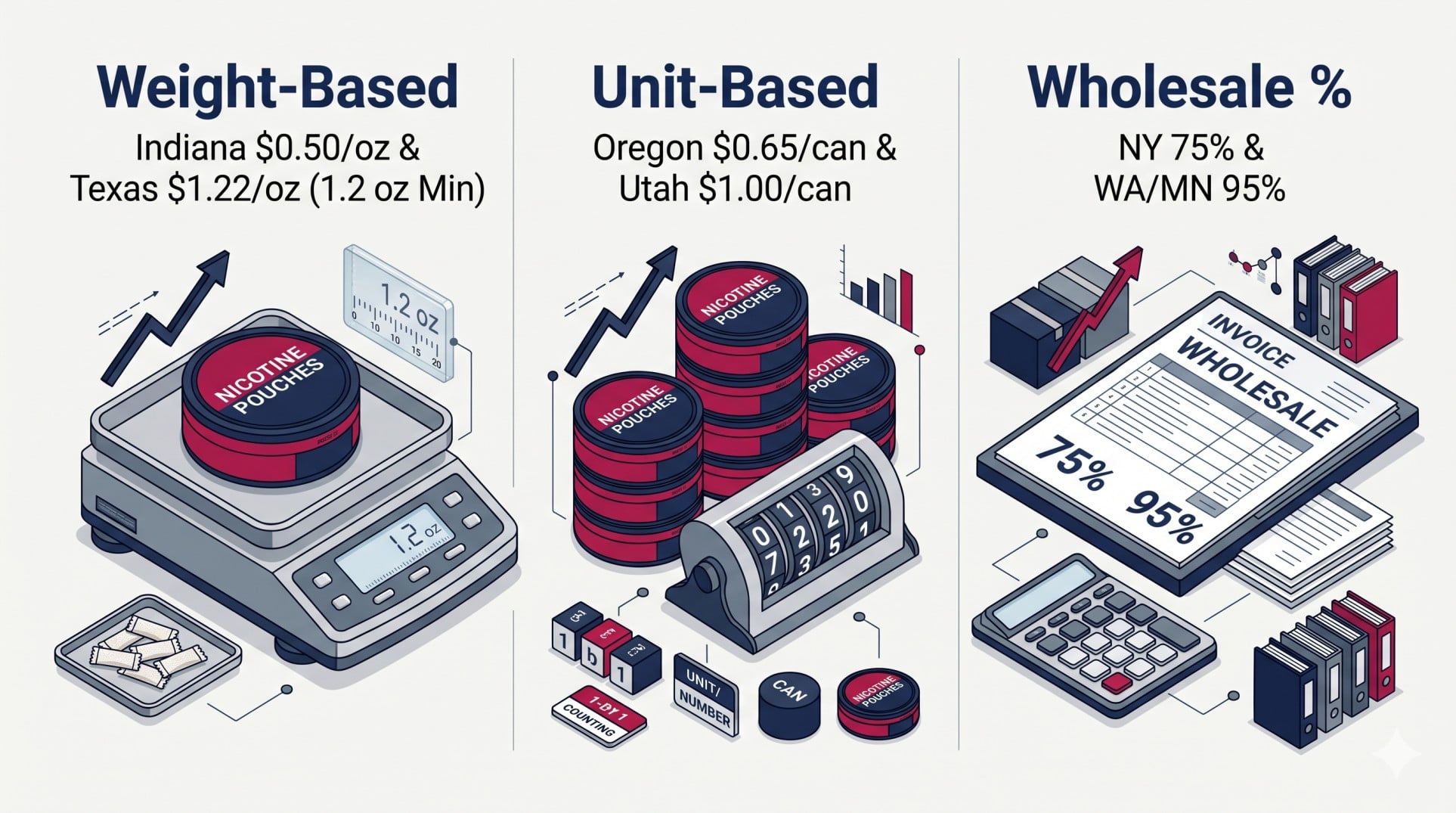
Model 1: Weight-Based Excise Taxes (Proportional vs. Minimum Container Floor)
Weight-based excise taxes levy a fixed dollar amount per ounce of product weight as listed by the manufacturer. However, understanding weight-based vs unit-based vs wholesale tobacco tax mechanics requires splitting weight-based states into two distinct sub-categories:
- Proportional Fractional-Ounce States (e.g., Indiana): Under Indiana Code 6-7-2-7(c) and Indiana Department of Revenue General Tax Information Bulletin #206, the $0.50 per ounce tax applies strictly in proportion to all fractional parts of an ounce based on manufacturer-listed net weight, with no minimum container weight floor. If a can of pouches weighs 0.26 ounces (approx. 7.4 grams), the Indiana excise tax is just $0.13 per can ($0.50 × 0.26 oz).
- Minimum Container Weight Floor States (e.g., Texas, Maine, Vermont): Historically designed for 1.2-ounce cans of Copenhagen or Skoal moist snuff, these statutes treat every single retail tin weighing under 1.0 oz or 1.2 oz as if it weighed a full 1.0 oz or 1.2 oz! In Texas ($1.22/oz with a 1.2 oz minimum floor), a 0.26-ounce can of pouches is taxed as if it weighed 1.2 ounces—resulting in a flat $1.46 tax per can ($1.22 × 1.2). In Maine (which hiked its smokeless/pouch rate from $2.02/oz to $3.54/oz effective January 5, 2026, with a 1.0 oz minimum), every can is taxed at $3.54. In Vermont ($2.57/oz with a 1.2 oz minimum), every can is taxed at $3.08.
Model 2: Unit-Based / Per-Canister Excise Taxes (The 20-Pouch Threshold)
Recognizing that oral nicotine pouches are sold in discrete pre-portioned sachets rather than loose pinchable tobacco, several states enacted dedicated unit-based taxes between mid-2025 and mid-2026. These statutes establish a flat tax for standard canisters containing up to 20 discrete consumable units (pouches), plus a per-pouch surcharge for mega-cans exceeding 20 units:
- Oregon (Effective January 1, 2026): $0.65 per package containing 20 or fewer consumable units; for packages over 20 units, $0.0325 per unit rounded to the nearest cent.
- Utah (Effective July 1, 2026): Switched from a weight-based tax ($1.83/oz) to a unit-based tax of $1.00 per can containing up to 20 units, plus $0.05 per additional unit over 20.
- North Carolina (Effective July 1, 2025): $0.10 per container of up to 20 units, plus $0.005 per unit beyond 20 (for example, a 24-pouch container carries $0.12 in North Carolina excise tax).
Model 3: Ad Valorem Wholesale-Percentage Excise Taxes
The majority of states taxing pouches simply expanded their statutory definition of “Other Tobacco Products” (OTP) to include synthetic or tobacco-free nicotine, applying an ad valorem percentage rate (ranging from 20% to 95%) to the wholesale price (or manufacturer’s invoice price). On a sample can with a $4.00 wholesale price, a 20% wholesale tax in Nebraska (effective January 1, 2026 under LB 9) adds $0.80, a 45% wholesale tax in Illinois (tripled from 15% on July 1, 2025) adds $1.80, a 75% wholesale tax in New York (effective September 1, 2026) adds $3.00, an 80% wholesale tax in Rhode Island (effective October 1, 2025) adds $3.20, and a 95% tax in Washington or Minnesota adds $3.80 per can. (Note that Minnesota also enforces a moist-snuff container minimum of $3.04 per can ≤ 1.2 oz if 95% of the wholesale price ever falls below $3.04!)
2026 Industry Alert: How PMI’s Q4 2026 Shift From 15-Pouch to 20-Pouch ZYN Cans Impacts Your Tax Engine
In its Q3 2026 Form 10-Q filing (October 23, 2026), Philip Morris International announced it is transitioning the majority of its flagship U.S. ZYN product line from 15 pouches per can to 20 pouches per can in the fourth quarter of 2026. Look at how the three tax models react to adding 5 extra pouches to every can: In unit-based states like Oregon ($0.65), Utah ($1.00), and North Carolina ($0.10), the tax per can changes by $0.00 because the 20-pouch threshold isn’t breached! In wholesale-percentage states (like NY, WA, and IL), if the wholesale invoice price per can stays flat, the tax per can stays flat (cutting the effective tax per pouch by 25%). However, in proportional weight states like Indiana ($0.50/oz), adding 5 pouches increases the net weight of the can by 33.3%, which immediately increases the excise tax due per can on Form OTP-M!
Distributors dealing with Washington’s extreme ad valorem rules should also read our dedicated breakdown of Washington State’s 95% tax on vapes and nicotine pouches under SB 5814 for deep-dive Pacific Northwest compliance.
Deep Dive: Oregon’s Per-Can Tax (HB 3940) & Indiana’s $0.50/oz Weight Rule
Effective January 1, 2026, the Oregon oral nicotine products tax imposes $0.65 per package of 20 or fewer units (reported quarterly on Form OR-530), whereas the Indiana alternative nicotine products tax imposes $0.50 per ounce of manufacturer-listed net weight (reported monthly on Form OTP-M).
Because Oregon and Indiana represent the nation’s flagship models for unit-based versus proportional weight-based taxation, multi-state compliance teams must configure separate calculation logic for each state.
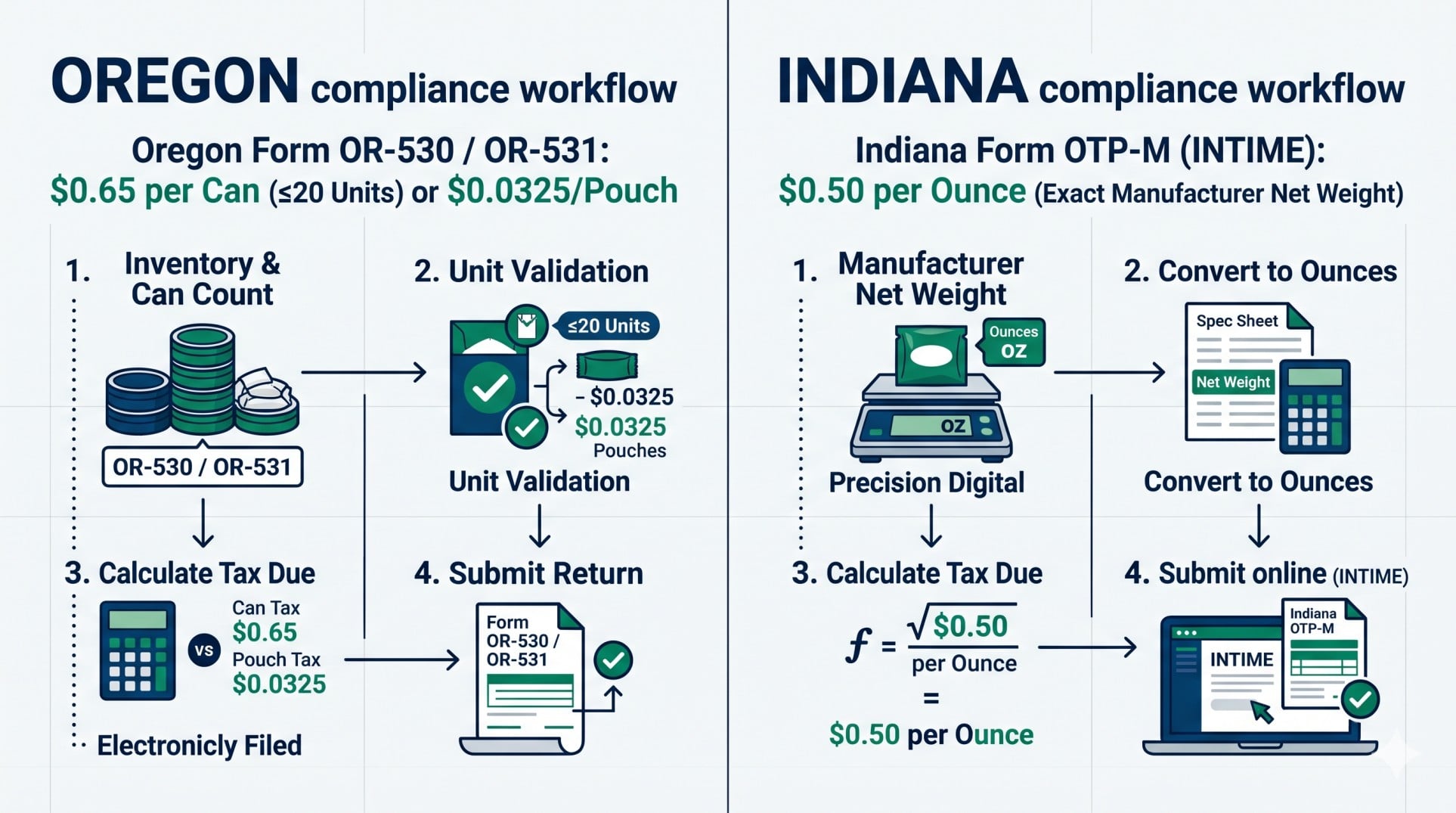
1. Oregon’s Unit-Based Oral Nicotine Products Tax (HB 3940 & OAR 150-323-0307)
Enacted during the 2025 legislative session under Oregon House Bill 3940 and implemented by Oregon Department of Revenue Administrative Rule OAR 150-323-0307 effective January 1, 2026, Oregon created a dedicated tax category for “oral nicotine products.” The statute defines an oral nicotine product as any noncombustible item—excluding traditional moist snuff—that contains tobacco-derived nicotine, synthetic nicotine, or a nicotine analog intended for human consumption via the oral cavity by means other than inhalation, vaporization, or aerosolization.
- 2026–2027 Tax Rate & Unit Math: Packages containing 20 or fewer discrete consumable units (pouches, lozenges, tablets, or strips) are taxed at $0.65 per package. Packages containing more than 20 units are taxed at $0.0325 (3.25 cents) per consumable unit for every unit in the package, rounded to the nearest whole cent. (For example, a 25-pouch canister is taxed at 25 × $0.0325 = $0.8125, rounded to $0.81 per package.)
- Contrast With Oregon Moist Snuff (July 1, 2026 Rate Hike): Do not confuse oral nicotine pouches with traditional tobacco moist snuff on your Oregon return! Under ORS 323.505, traditional moist snuff was taxed at $1.86/oz ($2.24 minimum per tin) in Q1–Q2 2026, and increased on July 1, 2026 to $1.89 per ounce with a $2.27 minimum tax per retail container. Oral nicotine pouches are reported separately on Lines 58–62 of the revised 2026 Form OR-530.
- Quarterly Filing, 1.5% Vendor Discount & Floor Stock Enforcement: Licensed Oregon tobacco distributors report and pay the tax quarterly on Form OR-530 (Oregon Quarterly Tax Return for Tobacco Distributors) via Revenue Online by the last day of January, April, July, and October. Timely filers receive a 1.5% (0.015) quarterly tax discount on Line 61 of Form OR-530! Under OAR 150-323-0307(2), Oregon retail dealers holding untaxed oral nicotine inventory on January 1, 2026 were required to file Form OR-531 (Unlicensed Tobacco Quarterly Tax Return) and pay the floor tax by April 30, 2026; any untaxed inventory found in a retail store on or after May 1, 2026 is declared contraband subject to immediate DOR seizure and civil penalties under ORS 323.538(4). (Also note: Multnomah County and Washington County, Oregon enforce local bans on flavored nicotine products!)
2. Indiana’s $0.50/oz Weight-Based Alternative Nicotine Tax (Information Bulletin #206)
Under Indiana House Enrolled Act 1001 (2025 Budget Bill) and Indiana Department of Revenue General Tax Information Bulletin #206, Indiana overhauled its Other Tobacco Products (OTP), Closed System Cartridge (CSC), Electronic Cigarette, and Alternative Nicotine Products (ANP) tax rates effective July 1, 2025 (governing all 2026 and 2027 compliance periods):
- The $0.50 per Ounce ANP Rate: Indiana defines “alternative nicotine products” as noncombustible products containing nicotine (but not tobacco leaf) intended to be chewed, absorbed, dissolved, or ingested—expressly capturing synthetic and tobacco-extracted nicotine pouches and dissolvables. Effective July 1, 2025, Indiana increased the ANP tax rate by 25%, from $0.40 per ounce to $0.50 per ounce, and a proportionate tax at the same rate on all fractional parts of an ounce calculated on the product net weight listed by the manufacturer.
- Don’t Confuse Indiana’s $0.50/oz Pouch Rate With Its 30% OTP/Vape Rates: While the same Indiana budget bill raised traditional non-snuff OTP to 30% of wholesale price (with a $3.00 per cigar cap), doubled Closed System Cartridges (pods) from 15% to 30% of wholesale price, and doubled open-system e-liquids from 15% to 30% of gross retail income, alternative nicotine pouches are taxed strictly at $0.50 per ounce (matching Indiana’s moist snuff rate of $0.50/oz, without a minimum container weight floor).
- Monthly Filing, 0.7% Collection Allowance & Unlicensed Retailer Felony Trap: Licensed Indiana OTP distributors and remote sellers must file Form OTP-M (Other Tobacco Products Monthly Return) and Supporting Schedules OTP-M-S electronically via the INTIME portal by the 15th day of each month, deducting a 0.7% (0.007) timely collection allowance. Under Information Bulletin #206, an unlicensed Indiana retailer that purchases nicotine pouches via the internet or catalog from an out-of-state supplier not licensed as an Indiana distributor must register as a distributor and pay the tax—failing to do so is a Class B misdemeanor (or a Level 6 felony if done with intent to evade tax), plus a civil penalty equal to the greater of 100% of the retail value or $5,000 per purchase!
New York’s 75% Wholesale Tax, Texas’s Supreme Court Ruling & Connecticut Rules
During 2026, two of the largest consumer markets in the United States—New York and Texas—began enforcing heavy excise taxes on tobacco-free nicotine pouches through completely different legal mechanisms, while Connecticut remained a high-alert legislative battleground.
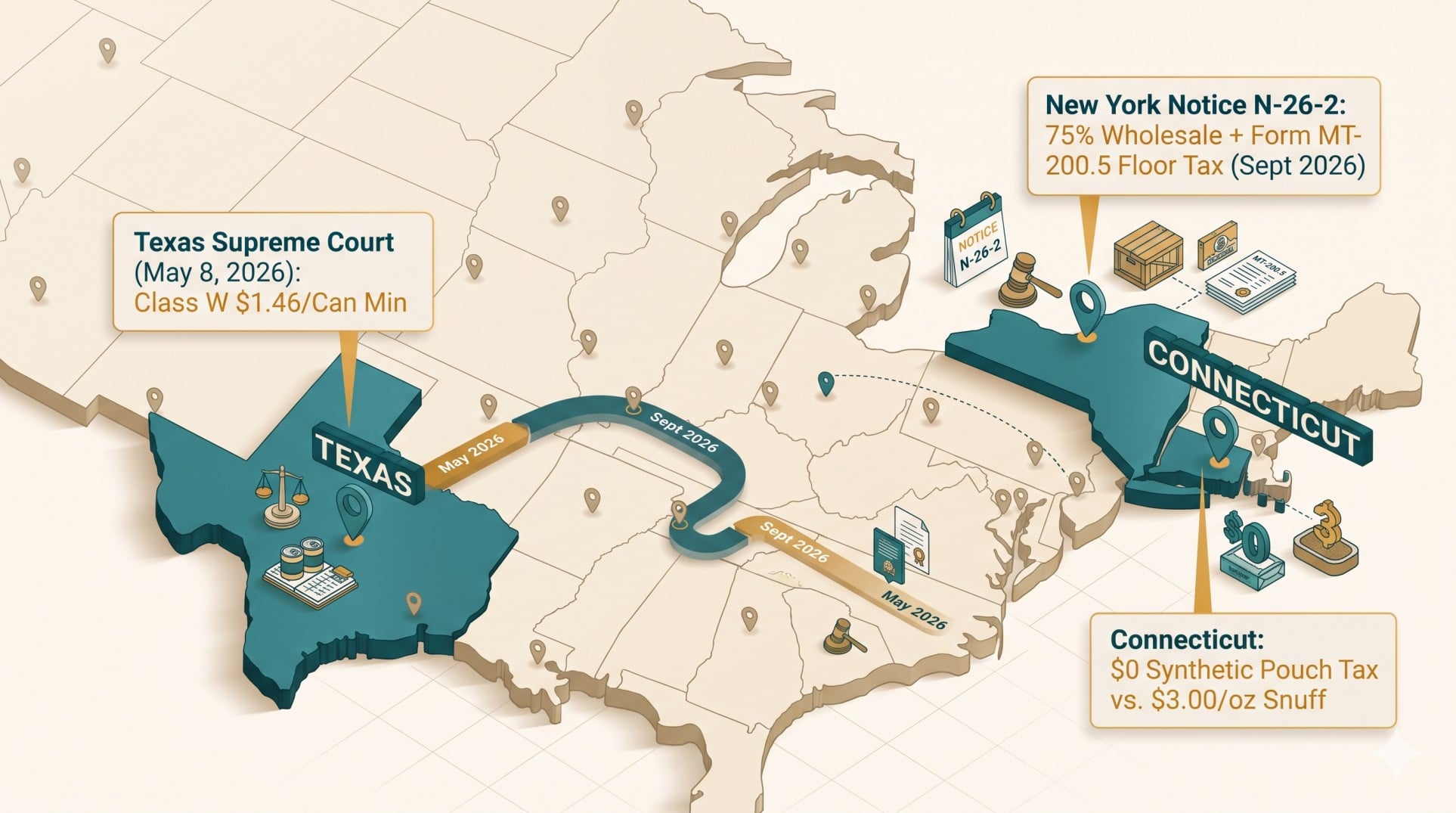
1. New York’s 75% Wholesale Tax & Floor Tax Mandate (Effective September 1, 2026)
Enacted on May 28, 2026 under Chapter 59 of the Laws of 2026 (the FY 2026–2027 New York State Budget Bill, A10009/S09009) and detailed in New York State Department of Taxation and Finance Important Notice N-26-2 (issued July 9, 2026), the New York 75% nicotine pouch tax took effect on September 1, 2026.
- Statutory Scope & Wholesale Rate: New York amended Tax Law Article 20 (§ 471-b) to classify “alternative nicotine products”—defined as noncombustible products containing nicotine without tobacco leaf, other than vapor products or FDA-approved cessation drugs/devices—as taxable tobacco products subject to a 75% tax on the wholesale price. In New York, “wholesale price” is the price for which the product is sold to a distributor (before promotional discounts). Notice that New York did not group pouches under its per-ounce moist snuff rate ($2.00/oz); instead, it placed them into the 75% ad valorem bucket!
- Mandatory August 31, 2026 Floor Tax & The 50% Retail Shortcut (Form MT-200.5): Because pouches sitting in New York warehouses, convenience stores, bodegas, and vending machines prior to September 1 had never been taxed, Important Notice N-26-2 required every distributor, wholesale dealer, and retail dealer to conduct a physical inventory count as of 11:59 p.m. EST on August 31, 2026 and file Form MT-200.5 (Alternative Nicotine Products Floor Tax Return) with full payment of the 75% floor tax by September 21, 2026. For the floor tax return only, New York allowed retail dealers to calculate their wholesale base as 50% of their retail selling price (excluding sales tax).
- Ongoing Monthly Filing & Licensing: Any business importing or selling nicotine pouches in New York on or after September 1, 2026 must hold an active NYS Tobacco Products Distributor License (Form MT-202) or Retail Dealer Registration (Form DTF-716). Distributors report ongoing monthly imports/sales on Form MT-203 (Distributor of Tobacco Products Tax Return) by the 20th day of the following month.
2. Texas Supreme Court Ruling: Class W “Tobacco Substitutes” ($1.46/Can Minimum)
Unlike New York, Texas did not pass a new tax rate in 2026—instead, the Supreme Court of Texas handed the Texas Comptroller a massive courtroom victory. On May 8, 2026, in a 20-page opinion authored by Justice Brett Busby (reversing the Third Court of Appeals in RJR Vapor Co.’s tax-protest suit over VELO nicotine pouches), the Texas Supreme Court ruled that oral nicotine pouches are taxable “tobacco substitutes” under Texas Tax Code Section 155.001(15)(D) & (E).
- Why the Court Ruled Pouches Are Taxable: Justice Busby held that because the primary ingredient in oral pouches—a blend of powdered microcrystalline cellulose (non-tobacco plant matter) and nicotine isolate—takes the place and function of pulverized tobacco in traditional snus/snuff, the pouches are “made of a tobacco substitute.” (While the Supreme Court remanded a narrow Texas Constitutional “equal and uniform taxation” challenge back to the Third Court of Appeals for further review, the Comptroller’s authority to collect the tax is fully active.)
- How the Texas Class W Rate ($1.22/oz with 1.2 oz Minimum) Works: Under Texas Tax Code Section 155.0211, the Texas Comptroller classifies oral nicotine pouches as Class W products (non-cigarette tobacco/substitute products taxed by weight). The statutory rate is $1.22 per ounce. However, under Texas’s small-container minimum floor rule, every single can weighing 1.2 ounces or less is taxed at a flat minimum of $1.46 per can ($1.22 × 1.2 oz = $1.464, published as $1.46). Cans exceeding 1.2 ounces are taxed proportionally at $1.22/oz. Distributors report Class W cans monthly on Texas Form 69-100 (Texas Distributor Monthly Report of Cigar and Tobacco Products) via Webfile by the last day of the following month.
3. Connecticut: The New England Border Haven & 2026 Legislative Watch
What about Connecticut? Throughout 2025 and 2026, Connecticut lawmakers introduced multiple high-profile proposals targeting nicotine pouches and retail shops—including Senate Bill 427 (seeking to align noncombustible nicotine tax rates with traditional tobacco) and 2026 House Bill 5228 (seeking to cap tobacco/nicotine retail floor space at 25% and revenue at 50% while expanding Department of Consumer Protection oversight over synthetic nicotine). However, Connecticut has not enacted an excise tax on tobacco-free synthetic nicotine pouches as of late 2026.
Under Connecticut General Statutes Chapter 214a (reported monthly on Form OP-300 via myconneCT by the 25th of the following month), Connecticut taxes traditional tobacco snuff at $3.00 per ounce and other tobacco-leaf products at 50% of wholesale price (cigars capped at $0.50). Because tobacco-free synthetic nicotine pouches do not contain tobacco leaf, they currently carry $0.00 in Connecticut OTP excise tax (subject only to Connecticut’s 6.35% retail sales tax)—turning Connecticut stores along the I-95 and I-84 corridors into a major cross-border magnet for shoppers fleeing Rhode Island’s 80% tax and New York’s 75% tax!
Businesses operating across the Northeast or managing audit exposure should explore our multi-state tobacco, OTP, and excise tax registration and audit defense services to stay ahead of rapid legislative shifts.
2026–2027 Multi-State Nicotine Pouch Excise Tax Rate & Method Matrix (20+ States)
As of November 2026, 20 states and the District of Columbia enforce an excise tax on oral nicotine pouches, spanning wholesale percentage taxes (20% to 95%), per-can unit taxes ($0.10 to $1.00), and per-ounce weight taxes ($0.50/oz to $3.54/oz).
Use the comprehensive 2026–2027 compliance table below to verify the exact tax methodology, statutory rate, effective date, required tax return form, and estimated excise tax impact on a standard sample canister (assuming a $4.00 wholesale price, 15 to 20 pouches, and 0.26 oz net weight):
| State / Jurisdiction | Tax Methodology | 2026–2027 Enacted Excise Tax Rate on Nicotine Pouches | Key Effective Date / Recent Rule Change | Estimated Tax on $4.00 Wholesale / 0.26 oz Can | Primary State Tax Return / Form |
|---|---|---|---|---|---|
| Washington | Wholesale % | 95% of taxable sales price (incl. freight) | Jan 1, 2026 (ESSB 5814; plus 0.015% Litter Tax) | $3.80 / can | WA Combined Excise Return (My DOR – Due 25th) |
| Minnesota | Wholesale % (w/ Floor) | 95% of wholesale price (or $3.04 min per can ≤ 1.2 oz) | Ongoing (Greater of 95% wholesale or $3.04 moist snuff min) | $3.80 / can ($3.04 minimum floor) | MN Form TP-1 (e-Services – Due 18th) |
| Maine | Weight-Based (w/ Floor) | $3.54 per ounce (1.0 oz minimum per container) | Jan 5, 2026 (Hiked from $2.02/oz to $3.54/oz) | $3.54 / can | ME Form TOB-RET (Maine Tax Portal – Due last day) |
| Rhode Island | Wholesale % | 80% of wholesale cost | Oct 1, 2025 (Expanded OTP definition to pouches) | $3.20 / can | RI Form OTP-1 (Due 10th of following month) |
| Vermont | Weight-Based (w/ Floor) | $2.57 per ounce (1.2 oz minimum / $3.08 per tin) | Ongoing (Taxed as snuff/tobacco substitute with 1.2 oz floor) | $3.08 / can | VT Form CTT-646 (myVTax – Due 15th) |
| New York | Wholesale % | 75% of wholesale price | Sept 1, 2026 (Ch. 59 Laws of 2026; Notice N-26-2) | $3.00 / can (+ Aug 31 Floor Tax) | NY Form MT-203 (Monthly – Due 20th) & Form MT-200.5 |
| New Hampshire | Wholesale % | 65.03% of wholesale sales price | Ongoing (Applies to tobacco-derived oral nicotine OTP) | $2.60 / can | NH Form DP-151 (Granite Tax Connect – Due 15th) |
| District of Columbia | Wholesale % | 64% of wholesale sales price | Ongoing (Adjusted annually; flavor ban enforced) | $2.56 / can | DC Form FR-800OTP (MyTax.DC.gov – Quarterly) |
| Maryland | Wholesale % | 60% of wholesale price | July 1, 2024 (Increased from 53% to 60% under Budget Act) | $2.40 / can | MD Form 603 / OTP Return (Due 21st of month) |
| Colorado | Wholesale % | 56% of Manufacturer’s List Price (MLP) | Ongoing (Proposition EE schedule; rises to 62% July 1, 2027) | $2.24 / can | CO Form DR 0220 (Revenue Online – Quarterly) |
| California | Wholesale % | 51.08% of wholesale cost (FY 2026–2027 rate) | July 1, 2026 – June 30, 2027 (Down from 54.27%; CDTFA set) | $2.04 / can (Flavor ban enforced) | CA CDTFA Tobacco Products Distributor Return (Due 25th) |
| Illinois | Wholesale % | 45% of wholesale price (+ local Cook/Chicago taxes) | July 1, 2025 (Tripled from 15% to 45% & added pouches) | $1.80 / can | IL Form TP-1 (MyTax Illinois – Due 15th) |
| Texas | Weight-Based (w/ Floor) | $1.22 per ounce ($1.46 minimum per can ≤ 1.2 oz) | May 8, 2026 (TX Supreme Court RJR Vapor Class W ruling) | $1.46 / can | TX Form 69-100 (Webfile – Due last day of month) |
| Nevada | Wholesale % | 30% of wholesale price | Ongoing (Revised monthly PACT reporting eff. July 2025) | $1.20 / can | NV Form TPT-01 (Due 20th of following month) |
| New Jersey | Wholesale % | 30% of wholesale sales price | Ongoing (Applies to tobacco-derived oral nicotine OTP) | $1.20 / can | NJ Form TPT-10 (Due 20th of following month) |
| Utah | Unit-Based (Per Can) | $1.00 per can (≤ 20 units) + $0.05/unit over 20 | July 1, 2026 (Switched from $1.83/oz weight tax to per-can) | $1.00 / can | UT Form TC-553 (TAP Portal – Quarterly) |
| Nebraska | Wholesale % | 20% of purchase price paid by first owner | Jan 1, 2026 (LB 9 expanded OTP to alternative nicotine/analogs) | $0.80 / can | NE Form 56 (NebFile – Due 10th of following month) |
| Louisiana | Wholesale % | 20% of manufacturer’s net invoice price | Ongoing (Smokeless/oral tobacco & alternative nicotine tier) | $0.80 / can | LA Form R-5604 (LaTAP – Due 20th of month) |
| Oregon | Unit-Based (Per Can) | $0.65 per package (≤ 20 units) or $0.0325/unit (> 20) | Jan 1, 2026 (HB 3940 & OAR 150-323-0307; 1.5% discount) | $0.65 / can (No state sales tax) | OR Form OR-530 (Quarterly – Due Jan/Apr/Jul/Oct 31) |
| Indiana | Weight-Based (Exact) | $0.50 per ounce (proportional fractional weight; no min) | July 1, 2025 (Hiked from $0.40/oz; Bulletin #206) | $0.13 / can (for 0.26 oz can) | IN Form OTP-M (INTIME – Due 15th; 0.7% discount) |
| North Carolina | Unit-Based (Per Can) | $0.10 per container (≤ 20 units) + $0.005/unit over 20 | July 1, 2025 (New ANP container tax; ALE enforcement) | $0.10 / can ($0.12 for 24-pouch can) | NC Form B-A-101 (Due 20th of following month) |
| Connecticut | Exempt (Synthetic) | $0.00 on tobacco-free pouches (Traditional snuff: $3.00/oz) | 2025–2026 bills (SB 427 / HB 5228) introduced; not enacted | $0.00 / can (6.35% sales tax only) | CT Form OP-300 (myconneCT – Due 25th for leaf OTP) |
2026–2027 Business Scenarios: Calculating the Same Can Across 5 States
To see why a single national pricing or ERP tax rule fails in 2026–2027, let’s trace the exact mathematical tax calculation for a multi-state distributor shipping the same oral nicotine pouch product into Oregon, Indiana, Texas, and New York.
Scenario 1: Multi-State Distributor Shipping 10,000 Cans (15-Pouch vs. 20-Pouch Shift)
The Setup: Heartland Nicotine Distribution LLC is a licensed multi-state tobacco and alternative nicotine distributor. In November 2026, Heartland ships 10,000 cans of oral nicotine pouches to convenience stores in each of four states: Oregon, Indiana, Texas, and New York.
The Product Specifications:
- Manufacturer’s Wholesale Invoice Price to Heartland: $3.60 per can ($36,000.00 per 10,000-can shipment).
- Batch A (Legacy 15-Pouch Can): Contains 15 pouches with a manufacturer-listed net weight of 0.24 ounces (6.8 grams) per can.
- Batch B (New Q4 2026 20-Pouch Can): Contains 20 pouches with a manufacturer-listed net weight of 0.32 ounces (9.07 grams) per can, sold at the exact same $3.60 wholesale price.
Step-by-Step 2026 Excise Tax Math Across All Four States (Per 10,000 Cans):
- Oregon (Unit-Based on Form OR-530):
- Under HB 3940, both the 15-pouch can (Batch A) and the 20-pouch can (Batch B) contain “20 or fewer consumable units.” Both are taxed at $0.65 per package.
- Gross Oregon Oral Nicotine Tax: 10,000 cans × $0.65 = $6,500.00.
- Less Oregon 1.5% Quarterly Distributor Discount (Line 61 of Form OR-530): $6,500.00 × 0.015 = -$97.50.
- Net Oregon Tax Remitted (Batch A or Batch B): $6,402.50. (However, if Heartland ships a 25-pouch can into Oregon, the rate switches to $0.0325 × 25 = $0.8125, rounded to $0.81 per can = $8,100.00 gross tax!)
- Indiana (Proportional Weight-Based on Form OTP-M):
- Under Information Bulletin #206, Indiana taxes exact fractional ounces at $0.50 per ounce.
- Batch A (15-pouch / 0.24 oz can): 10,000 cans × 0.24 oz = 2,400 total ounces × $0.50/oz = $1,200.00 gross tax ($0.12/can). Less Indiana’s 0.7% timely collection allowance (-$8.40) = $1,191.60 net tax due.
- Batch B (20-pouch / 0.32 oz can): Because the 20-pouch can weighs 33.3% more, total weight jumps to 10,000 cans × 0.32 oz = 3,200 total ounces × $0.50/oz = $1,600.00 gross tax ($0.16/can). Less 0.7% discount (-$11.20) = $1,588.80 net tax due! Failing to update your SKU weight table in Indiana when switching from 15-pouch to 20-pouch cans causes an immediate 25% tax underpayment on Form OTP-M.
- Texas (Weight-Based With 1.2 oz Minimum Floor on Form 69-100):
- Following the May 8, 2026 Texas Supreme Court ruling, both the 0.24 oz can (Batch A) and the 0.32 oz can (Batch B) weigh less than 1.2 ounces. Under Class W rules, both are taxed at the flat 1.2 oz minimum floor of $1.46 per can.
- Total Texas Class W Tax Due (Batch A or Batch B): 10,000 cans × $1.46 = $14,600.00 (over 12 times higher than Indiana’s weight-based tax on Batch A!).
- New York (75% Wholesale Percentage on Form MT-203):
- Under Tax Law § 471-b and Notice N-26-2 (effective September 1, 2026), New York ignores both pouch count and ounce weight, taxing 75% of the $36,000.00 wholesale price.
- Total New York OTP Tax Due (Batch A or Batch B): $36,000.00 × 75% = $27,000.00 ($2.70 per can).
Scenario 2: New York Convenience Store Chain Floor Tax Audit (Form MT-200.5)
The Setup: Hudson Valley Convenience Corp operates 12 gas stations across Westchester and Dutchess Counties, New York. At 11:59 p.m. EST on August 31, 2026, the chain held 15,000 cans of ZYN, On!, and VELO pouches across its store shelves and backrooms. The chain sells the cans at a retail shelf price of $6.40 per can (before New York state and local sales tax), and lost several early-2026 paper wholesale invoices from cash-and-carry jobbers.
Step-by-Step New York Floor Tax Calculation (Due September 21, 2026):
- Under NYS Department of Taxation and Finance Important Notice N-26-2 and the instructions for Form MT-200.5 (Alternative Nicotine Products Floor Tax Return), a retail dealer may elect to use 50% of its retail selling price (excluding sales tax) as the deemed wholesale price for floor tax purposes only.
- Deemed Wholesale Price per Can: $6.40 retail price × 50% = $3.20 per can.
- Total Deemed Wholesale Inventory Base: 15,000 cans × $3.20 = $48,000.00.
- 75% Floor Tax Due on Form MT-200.5: $48,000.00 × 75% = $36,000.00 ($2.40 per can).
- What If Hudson Valley Missed the September 21, 2026 Deadline? Under New York Tax Law § 481, failing to file Form MT-200.5 and pay by September 21, 2026 triggers civil late-filing/late-payment penalties (up to 30% of the tax due, plus $100 minimum penalty for returns over 60 days late), statutory interest compounded daily, and potential revocation of the chain’s Certificate of Registration to sell tobacco products!
Scenario 3: Tax-on-Tax Retail Checkout Cascade in NY vs. IN vs. OR
Remember that in almost every state with a retail sales tax, the distributor’s wholesale nicotine pouch excise tax is folded into the wholesale invoice charged to the retailer, which then becomes part of the gross retail selling price subject to state and local retail sales tax at the cash register:
- In New York City (8.875% Combined Sales Tax): If a $3.60 wholesale can absorbs $2.70 in NYS 75% excise tax, and the distributor/retailer markups push the pre-tax shelf price to $8.50, the NYC customer pays an additional $0.75 in retail sales tax ($8.50 × 8.875%) = $9.25 out the door (meaning $0.24 of the sales tax is literally a tax on the $2.70 excise tax!).
- In Indiana (7.0% State Sales Tax): On the same can with only $0.12 to $0.16 in weight-based excise tax, a $5.75 shelf price plus 7.0% Indiana sales tax ($0.40) lands at just $6.15 out the door.
- In Oregon (0.0% State Sales Tax): With $0.65 in unit-based excise tax and zero state or local retail sales tax, a $5.64 baseline can lands near $6.29 out the door.
Retailers and distributors looking to automate these calculations across their e-commerce checkouts and wholesale invoicing systems can leverage our outsourced excise and sales tax compliance and return filing services to eliminate manual spreadsheet errors.
Step-by-Step Multi-State ERP Configuration, Licensing & Return Filing Guide
To prevent audit assessments when selling oral nicotine pouches across state lines in 2026–2027, your accounting and IT teams must maintain a three-attribute SKU master file and execute state-specific OTP licenses and electronic tax returns.
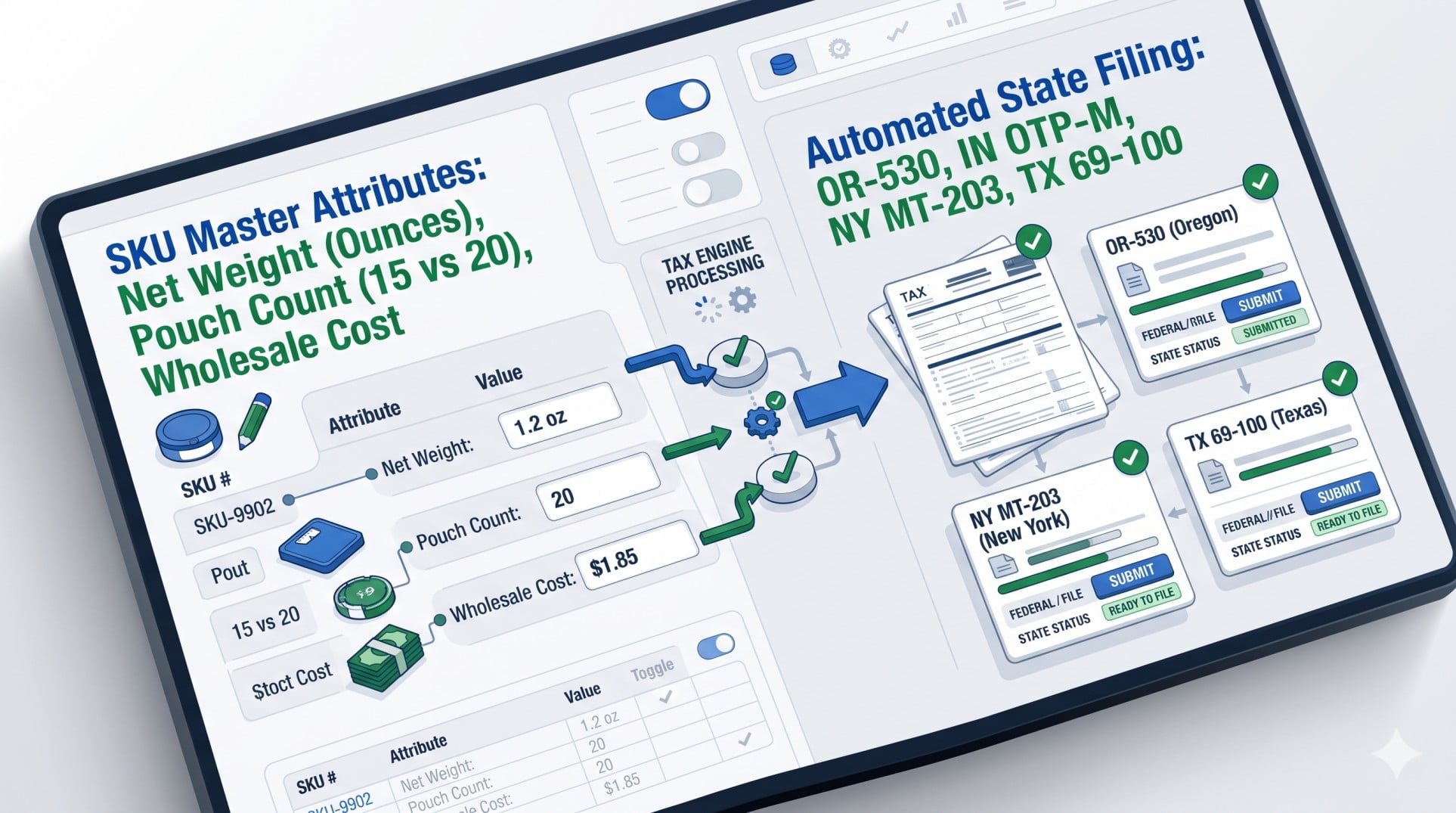
Step 1: Build a Three-Attribute SKU Master Table in Your ERP
Never assign a single “OTP” tax code to oral nicotine pouches in NetSuite, SAP, Microsoft Dynamics, or your warehouse management system. Because of the weight-based vs unit-based vs wholesale tobacco tax split across the 20+ taxing states, every single oral nicotine SKU in your item master must store four verified fields:
- Nicotine Origin Flag: Specify whether the nicotine is Tobacco-Derived, Synthetic / Leaf-Free, or a Nicotine Analog (critical for states like New Hampshire or Connecticut where statutory definitions distinguish leaf-derived OTP from synthetic ANP).
- Manufacturer’s Net Weight in Ounces (to 4 Decimal Places): Required for proportional weight states like Indiana ($0.50/oz) and for checking whether a mega-can exceeds the 1.0 oz floor in Maine or the 1.2 oz floor in Texas, Vermont, and Minnesota. Create a separate SKU or effective-date weight table whenever a manufacturer shifts a product from 15 pouches to 20 pouches!
- Discrete Consumable Unit Count per Container: Required for unit-based states (Oregon, Utah, North Carolina) to determine whether the package falls under the ≤ 20 unit flat rate or triggers the per-pouch over-20 calculation.
- Statutory Wholesale / Taxable Sales Price Base: Map whether the state taxes the manufacturer’s list/invoice price before discounts (e.g., Colorado, Indiana samples, New York), purchase price paid by first owner (Nebraska), or actual landed purchase price including inbound freight (Washington).
Step 2: Secure State OTP / Alternative Nicotine Licenses Before First Shipment
Every state that brought nicotine pouches into its tobacco tax code in 2025–2026 requires out-of-state and in-state distributors, wholesalers, and retailers to hold active tobacco/OTP licenses prior to importing or selling a single can:
- Oregon: Apply for an Oregon Tobacco Distributor License through Oregon Revenue Online before distributing oral nicotine products to Oregon retailers.
- Indiana: Apply for an Indiana Other Tobacco Products (OTP) Distributor License via the INTIME portal (requires a $1,000 surety bond and a $25 annual license fee under IC 6-7-2-8).
- New York: Per Important Notice N-26-2, importers and wholesalers not already licensed as NYS Tobacco Products Distributors had to file Form MT-202 (Application for a License as a Wholesale Dealer of Tobacco Products or an Appointment as a Distributor of Tobacco Products) before September 1, 2026, while retailers must hold a current Tobacco Products Retail Dealer Registration (Form DTF-716) via NY Business Express.
- Texas: Obtain a Texas Cigar and Tobacco Products Distributor Permit (Form AP-193, $300 permit fee for a two-year period) or Retailer Permit ($180) from the Texas Comptroller of Public Accounts.
Step 3: Execute Monthly & Quarterly Electronic Filings on Schedule
Lock these statutory portals and due dates into your 2026–2027 compliance calendar:
- 10th of the Month: File Nebraska Form 56 (via NebFile) and Rhode Island Form OTP-1.
- 15th of the Month: File Indiana Form OTP-M and Schedule OTP-M-S (via INTIME, claiming the 0.7% discount), Illinois Form TP-1 (via MyTax Illinois), Vermont Form CTT-646 (via myVTax), and New Hampshire Form DP-151.
- 18th of the Month: File Minnesota Form TP-1 (via MN e-Services).
- 20th of the Month: File New York Form MT-203 (via NYS Online Services; and file late Form MT-200.5 immediately if you missed the September 21, 2026 floor tax deadline!), North Carolina Form B-A-101, Nevada Form TPT-01, New Jersey Form TPT-10, and Louisiana Form R-5604.
- 25th of the Month: File the Washington Combined Excise Tax Return (via My DOR), the California CDTFA Tobacco Products Distributor Return, and Connecticut Form OP-300 (via myconneCT for leaf-based OTP/snuff).
- Last Day of the Month / Quarter: File Texas Form 69-100 and Maine Form TOB-RET monthly by the last day of the following month. File Oregon Form OR-530 (via Revenue Online, claiming the 1.5% discount on Line 61), Utah Form TC-553 (via TAP), and Colorado Form DR 0220 quarterly by January 31, April 30, July 31, and October 31.
Need help cleaning up missed 2025–2026 filings or missed floor stock returns in New York, Oregon, or Washington? Visit our Voluntary Disclosure Agreement (VDA) and state excise tax amnesty page to resolve past-due liabilities without crippling fraud or evasion penalties.
Frequently Asked Questions About Multi-State Nicotine Pouch Excise Taxes
1. How many states charge a nicotine pouch excise tax in 2026–2027?
As of late 2026, 20 states plus the District of Columbia enforce a dedicated state excise tax on oral nicotine pouches. Additionally, lawmakers in over 20 states introduced bills between 2025 and 2026 to tax or hike rates on tobacco-free and synthetic nicotine pouches.
2. How does the Oregon oral nicotine products tax work in 2026?
Effective January 1, 2026 under Oregon House Bill 3940, the Oregon oral nicotine products tax is a unit-based tax of $0.65 per package for containers with 20 or fewer consumable units, and $0.0325 per unit for packages with more than 20 units. Distributors report it quarterly on Form OR-530.
3. What is the Indiana alternative nicotine products tax rate for nicotine pouches?
Effective July 1, 2025 (and governing 2026–2027), the Indiana alternative nicotine products tax rate is $0.50 per ounce of manufacturer-listed product weight, calculated proportionally on all fractional parts of an ounce with no minimum container weight floor. Distributors file monthly on Form OTP-M by the 15th.
4. When did the New York 75% nicotine pouch tax and floor tax take effect?
The New York 75% nicotine pouch tax took effect on September 1, 2026 under Chapter 59 of the Laws of 2026 and NYS Notice N-26-2, taxing alternative nicotine products at 75% of the wholesale price. Sellers also owed a one-time 75% floor tax on August 31, 2026 inventory via Form MT-200.5 by September 21, 2026.
5. Are tobacco-free nicotine pouches taxable in Texas in 2026–2027?
Yes, on May 8, 2026, the Texas Supreme Court ruled in Comptroller v. RJR Vapor Co. that oral nicotine pouches made of plant cellulose and nicotine isolate are taxable “tobacco substitutes.” Texas taxes them as Class W products at $1.22 per ounce, with a $1.46 minimum tax per can weighing 1.2 ounces or less.
6. What is the difference between Indiana’s and Texas’s weight-based nicotine pouch taxes?
Indiana applies its $0.50 per ounce rate strictly to the exact fractional weight of the can (so a 0.26 oz can owes just $0.13). Texas applies a 1.2-ounce minimum container floor to its $1.22 per ounce rate, forcing every 0.26 oz can to pay a flat $1.46 in excise tax.
7. How does Utah tax nicotine pouches starting July 1, 2026?
Effective July 1, 2026, Utah repealed its prior weight-based calculation ($1.83 per ounce) on nicotine pouches and switched to a unit-based tax of $1.00 per standard can containing up to 20 units, plus $0.05 for each additional unit over 20, reported quarterly on Form TC-553.
8. Does shifting from a 15-pouch can to a 20-pouch can change the excise tax due?
It depends on the state’s tax model. In unit-based states with a 20-unit threshold (Oregon, Utah, North Carolina), moving from 15 to 20 pouches causes zero change in per-can tax. In proportional weight states like Indiana ($0.50/oz), the heavier 20-pouch can increases the excise tax proportionally.
9. Are synthetic nicotine pouches taxed in Connecticut in 2026?
No, while Connecticut taxes traditional tobacco-leaf snuff at $3.00 per ounce and other leaf tobacco products at 50% of wholesale price on Form OP-300, bills introduced in 2025–2026 to tax tobacco-free synthetic nicotine pouches were not enacted, leaving synthetic pouches subject only to 6.35% retail sales tax.
10. Which states have the highest and lowest nicotine pouch excise taxes in 2026?
Washington and Minnesota impose the highest rates at 95% of wholesale/taxable sales price (approx. $3.80 per can on a $4.00 wholesale base), followed by Maine ($3.54/can), Rhode Island (80% wholesale), Vermont ($3.08/can), and New York (75% wholesale). Among taxing states, North Carolina ($0.10/can) and Indiana (~$0.12–$0.16/can) impose the lowest effective taxes.
Automating Your Multi-State OTP & Alternative Nicotine Tax Compliance
Navigating the 2026–2027 nicotine pouch excise tax boom requires far more than plugging a flat percentage into your billing software. With 20 states and Washington, D.C. enforcing a complex mix of ad valorem wholesale percentages (like New York’s 75% rate and Washington’s 95% rate), per-can unit tiers (like Oregon’s $0.65 rate and Utah’s $1.00 rate), and fractional vs. minimum-floor weight rules (like Indiana’s $0.50/oz exact weight rule versus Texas’s $1.46/can Class W minimum), a single SKU misconfiguration can trigger severe multi-state audit penalties or inventory seizures.
Don’t let rapid state budget changes, floor stock tax deadlines, or Q4 2026 pouch-count shifts derail your distribution or retail margins. Contact the SALT & Excise Tax specialists at Ourtaxpartner.com today to configure your multi-state SKU tax tables, secure your state OTP distributor and retailer licenses, and put your monthly and quarterly excise filings on autopilot.
Disclaimer: This content provides general information for educational purposes only and reflects state, local, and federal sales, use, and excise tax laws applicable to the 2026–2027 compliance periods. State and local tax rates, nexus thresholds, and excise regulations change frequently across jurisdictions. This article does not constitute professional tax, legal, or accounting advice. Always consult a certified public accountant (CPA), enrolled agent (EA), or qualified SALT advisor at Ourtaxpartner.com regarding your specific business compliance obligations. Ourtaxpartner.com is not responsible for any actions taken based on the information provided herein.
