
⚡ Executive Summary: 2025 Vehicle Tax Deductions
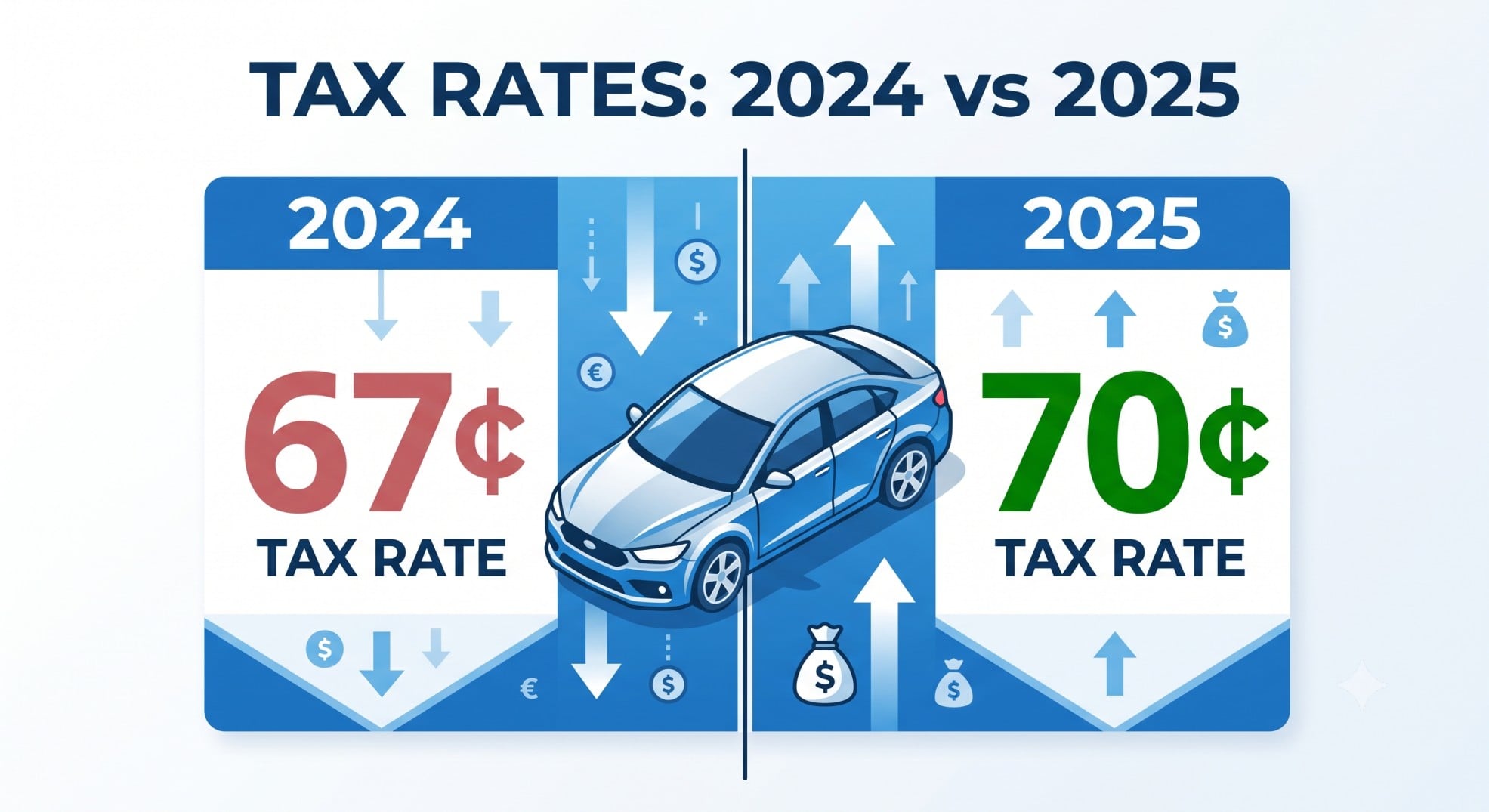
- The official IRS mileage rate for 2025 is 70 cents per mile for business use, a 3-cent increase from the previous year.
- The rate for medical and eligible moving purposes remains flat at 21 cents per mile.
- The charitable rate is set by federal statute and remains unchanged at 14 cents per mile.
- W-2 employees generally cannot claim unreimbursed business mileage on their federal returns due to the Tax Cuts and Jobs Act (TCJA) restrictions, which remain in effect through 2025.
Table of Contents
- What is the IRS Mileage Rate for 2025?
- How the 2025 Standard Mileage Rate is Calculated
- Who Can Claim the Business Mileage Rate?
- Medical Mileage Rate and Moving Expenses
- Maximizing Your Charitable Mileage Deduction
- Standard Mileage Rate vs. Actual Expenses Method
- Step-by-Step: How to Calculate and Claim Your Deduction
- Real-World Tax Scenarios and Examples
- Recordkeeping Rules: Surviving an IRS Audit
- Frequently Asked Questions About the IRS Mileage Rate for 2025
What is the IRS Mileage Rate for 2025?
The IRS mileage rate for 2025 dictates exactly how much taxpayers can deduct for operating a vehicle for business, medical, moving, or charitable purposes. For the 2025 tax year, the business rate sits at 70 cents per mile. This figure applies to miles driven between January 1, 2025, and December 31, 2025.
The agency adjusts these figures annually based on an extensive study of the fixed and variable costs of operating an automobile in the United States. Fuel prices, insurance premiums, maintenance costs, and vehicle depreciation all factor into the final number.
| Purpose of Travel | 2024 Rate (per mile) | 2025 Rate (per mile) | Change |
|---|---|---|---|
| Business | 67 cents | 70 cents | + 3 cents |
| Medical / Moving* | 21 cents | 21 cents | No change |
| Charitable | 14 cents | 14 cents | No change |
*The moving expense deduction is currently restricted to active-duty members of the Armed Forces relocating under military orders.
Taxpayers use these rates to bypass the tedious process of tracking every single gas receipt, oil change, and tire replacement. Instead of calculating exact out-of-pocket costs, you simply multiply your qualifying miles by the applicable rate.
How the 2025 Standard Mileage Rate is Calculated
The IRS does not pull these numbers out of thin air. The 2025 standard mileage rate is the result of an independent annual study commissioned by the IRS. The study analyzes the national average costs of vehicle ownership.
The business rate accounts for both fixed and variable costs. Fixed costs include auto insurance, license and registration fees, taxes, and depreciation. Variable costs cover gas, oil, tire wear, and routine maintenance. Because the business rate includes depreciation, the IRS specifies a portion of the rate that acts as a depreciation allowance. For 2025, the depreciation component of the business rate is 33 cents per mile.
This depreciation factor is critical. If you eventually sell a vehicle you used for business, you must reduce the vehicle’s basis by the amount of depreciation you claimed. When you use the standard rate, you are still claiming depreciation—it is simply baked into the 70-cent figure.
The medical and moving rates, on the other hand, are based solely on variable costs. The IRS assumes you already own the car and are paying the fixed costs regardless of your medical trips. Therefore, the 21-cent rate only compensates you for the gas and wear-and-tear directly associated with that specific trip.
Who Can Claim the Business Mileage Rate?
Not everyone who drives for work can write off their miles. The rules heavily favor self-employed individuals and business owners.
If you are an independent contractor, freelancer, gig worker (like an Uber or DoorDash driver), or a small business owner filing Schedule C, you are fully eligible to use the business mileage rate. You deduct this expense directly against your business income, lowering your net profit and, consequently, your self-employment and income taxes.
W-2 employees face a much stricter reality. Prior to 2018, employees could deduct unreimbursed business expenses—including mileage—if they exceeded 2% of their Adjusted Gross Income (AGI). The Tax Cuts and Jobs Act (TCJA) suspended this deduction entirely. Through the end of 2025, standard W-2 employees cannot deduct unreimbursed mileage on their federal tax returns.
There are a few narrow exceptions for W-2 workers. You can still claim the deduction on Form 2106 if you fall into one of these categories:
- Armed Forces reservists traveling more than 100 miles from home.
- Qualified performing artists.
- Fee-basis state or local government officials.
- Employees with impairment-related work expenses.
If you do not fit into those four categories and you receive a W-2, your only recourse is to request a reimbursement directly from your employer. Employers often use the IRS mileage rate for 2025 to reimburse their staff tax-free through an accountable plan.
Medical Mileage Rate and Moving Expenses
The medical mileage rate for 2025 is 21 cents per mile. You can claim this rate when driving to and from medical treatments, doctor appointments, pharmacies, and hospitals. It also covers transportation for a parent who must accompany a child to receive medical care.
However, claiming this deduction requires clearing a high hurdle. Medical mileage is lumped in with your other qualified medical expenses on Schedule A (Itemized Deductions). You can only deduct total medical expenses that exceed 7.5% of your Adjusted Gross Income. If you take the standard deduction rather than itemizing, your medical miles will not provide any tax benefit.
The moving mileage rate is also 21 cents per mile. But just like the employee business expense deduction, the TCJA severely restricted moving expenses. Currently, only active-duty members of the Armed Forces who move due to a permanent change of station can claim this deduction. Civilian taxpayers cannot deduct moving mileage at the federal level for 2025.
Maximizing Your Charitable Mileage Deduction
If you volunteer for a qualified 501(c)(3) organization, you can deduct the miles you drive in service of that charity. The charitable mileage deduction is 14 cents per mile.
Unlike the business and medical rates, the IRS does not adjust the charitable rate annually based on inflation or gas prices. It is fixed by federal statute under IRC Section 170(i). It has remained at 14 cents for over two decades. Only an act of Congress can change it.
To claim this deduction, the driving must be directly related to the volunteer work. Commuting to a charity’s headquarters to perform administrative work qualifies. Delivering meals to the homebound for a registered nonprofit qualifies. Just remember that you must itemize your deductions on Schedule A to claim charitable miles, and the organization must be a recognized tax-exempt entity.
Standard Mileage Rate vs. Actual Expenses Method
Taxpayers always have a choice: use the 2025 standard mileage rate or track their actual vehicle expenses. You cannot use both in the same year for the same vehicle.
The actual expenses method requires you to calculate the total cost of operating your car for the year. This includes gas, oil, repairs, tires, insurance, registration fees, lease payments, and depreciation. You then multiply the total cost by your business-use percentage.
For example, if you drove 20,000 miles total in 2025, and 10,000 of those were for business, your business-use percentage is 50%. You would deduct 50% of your total actual vehicle expenses.
The standard rate is vastly simpler. You just multiply your business miles by 70 cents. But simplicity is not the only factor. You must navigate the “First-Year Rule.”
If you want to use the standard mileage rate, you must choose it in the very first year you place the vehicle in service for your business. If you use the standard rate in year one, you can switch back and forth between the standard rate and actual expenses in subsequent years. Read more about vehicle depreciation strategies here.
If you choose the actual expenses method in the first year—especially if you claim Section 179 expensing or bonus depreciation—you are permanently locked out of using the standard mileage rate for that specific vehicle for the rest of its lifespan.

Step-by-Step: How to Calculate and Claim Your Deduction
Claiming your mileage deduction requires precision. Follow these steps to ensure your tax return is accurate and audit-proof.
Step 1: Record Your Odometer Readings
On January 1, 2025, write down your vehicle’s exact odometer reading. Do it again on December 31, 2025. The IRS requires you to report the total miles the vehicle was driven during the year, not just the business miles.
Step 2: Maintain a Contemporaneous Log
Track your business miles as they happen. Use a physical logbook or a GPS-enabled mileage tracking app. Record the date, the destination, the business purpose, and the exact number of miles driven for every single trip.
Step 3: Separate Commuting from Business
The IRS strictly forbids deducting commuting miles. Driving from your home to your regular office is a personal commute. However, driving from your office to a client site, or from one job site to another, qualifies as business mileage. If your home is your principal place of business (qualifying for the home office deduction), trips from your home to client meetings are fully deductible.
Step 4: Calculate the Math
At tax time, tally your total business miles. Multiply that number by the IRS mileage rate for 2025 (70 cents). Add any business-related parking fees and tolls, which are deductible on top of the standard rate.
Step 5: Report on the Correct Form
Sole proprietors and single-member LLCs will report this deduction on Schedule C (Form 1040), Part II, Line 9. You will also need to answer the vehicle-related questions in Part IV of Schedule C, which ask for your total miles, commuting miles, and whether you have written evidence to support your deduction.
Real-World Tax Scenarios and Examples
To understand how the business mileage rate impacts actual tax returns, let’s look at a few hypothetical scenarios based on 2025 tax rules.
Scenario 1: The Freelance Consultant
David is a freelance IT consultant in Ohio. He works out of a home office. In 2025, he drives to various client offices to install hardware. His total mileage for the year is 18,000 miles, of which 12,000 are documented business miles. David chooses the standard rate. He multiplies 12,000 miles by $0.70, resulting in an $8,400 deduction. He reports this on his Schedule C. This $8,400 directly reduces his net business income, saving him money on both his 15.3% self-employment tax and his federal income tax.
Scenario 2: Standard vs. Actual Expenses
Sarah is a real estate agent who buys a new SUV in 2025. She drives 25,000 miles total, with 15,000 business miles (60% business use). If she uses the standard rate: 15,000 miles × $0.70 = $10,500 deduction. If she uses actual expenses: Her gas, insurance, repairs, and standard MACRS depreciation total $14,000 for the year. She multiplies $14,000 by her 60% business use, resulting in an $8,400 deduction. In this case, Sarah is better off claiming the $10,500 deduction using the 2025 standard mileage rate. Because she chose the standard rate in year one, she retains the flexibility to switch to actual expenses in 2026 if she has a year with massive repair bills.
Scenario 3: The Medical Mileage Threshold
Marcus is retired and makes frequent trips to a specialized clinic. In 2025, he drives 1,500 miles for medical purposes. Using the medical mileage rate of 21 cents, his mileage deduction is $315. Marcus’s AGI is $50,000. The IRS requires medical expenses to exceed 7.5% of AGI ($3,750) before they become deductible. Marcus has $4,000 in other out-of-pocket medical bills. He adds the $315 in mileage, bringing his total to $4,315. He can deduct the amount over the threshold ($4,315 – $3,750 = $565) on his Schedule A, provided his total itemized deductions exceed the 2025 standard deduction.
Scenario 4: The W-2 Reimbursement Trap
Elena is an outside sales rep receiving a W-2. She drives 10,000 miles for her employer in 2025. Her employer reimburses her at a flat rate of 40 cents per mile, paying her $4,000. Because the IRS mileage rate for 2025 is 70 cents, Elena is technically “under-reimbursed” by $3,000. Prior to 2018, she could have deducted that $3,000 difference on her tax return. However, due to the TCJA, Elena cannot deduct this shortfall. The $4,000 she received is tax-free, but she absorbs the remaining cost of operating her vehicle.
Recordkeeping Rules: Surviving an IRS Audit
The IRS is notoriously strict when auditing vehicle expenses. Under IRC Section 274(d), taxpayers must provide strict substantiation for travel expenses. The “Cohan rule,” which sometimes allows taxpayers to estimate expenses when records are lost, explicitly does not apply to vehicle mileage.
If you claim the business mileage rate, you must have a contemporaneous log. “Contemporaneous” means the records were created at or near the time the driving occurred. Trying to reconstruct a mileage log from memory in April of the following year is a guaranteed way to lose an audit.
Your logbook—whether physical or digital—must contain four specific pieces of information for every trip:
- The date of the trip.
- The exact mileage driven.
- The destination (city, town, or specific address).
- The specific business purpose (e.g., “Client meeting with John Doe regarding Q3 contract”).
Digital tracking apps have become the gold standard for compliance. These apps run in the background of your smartphone, tracking your GPS coordinates and automatically calculating the distance. You simply swipe left for personal and right for business. At tax time, you generate a clean, IRS-compliant spreadsheet.

Frequently Asked Questions About the IRS Mileage Rate for 2025
Can W-2 employees claim the IRS mileage rate for 2025?
Generally, no. The Tax Cuts and Jobs Act suspended miscellaneous itemized deductions, meaning standard W-2 employees cannot deduct unreimbursed business mileage on their federal returns through 2025. Only specific professions, like Armed Forces reservists and fee-basis government officials, are exempt from this restriction.
Does the standard mileage rate apply to electric vehicles (EVs)?
Yes. The IRS standard mileage rate applies equally to gasoline, diesel, hybrid, and fully electric vehicles. You do not get a different per-mile rate for driving an EV, even though your variable fuel costs (electricity) might be lower than a gas-powered car.
Can I switch between the standard rate and actual expenses?
You can switch between the two methods year to year, but only if you used the standard mileage rate in the very first year you placed the vehicle in service for your business. If you used actual expenses in year one, you are locked into that method for the life of the vehicle.
What happens if my employer reimburses me at a lower rate?
If your employer reimburses you at a rate lower than the official 70 cents per mile, the reimbursement you receive is tax-free. However, as a W-2 employee, you cannot deduct the difference on your federal tax return due to current tax laws.
Are commuting miles deductible?
No. The IRS considers the drive from your home to your regular place of business a personal commuting expense. Commuting miles are never deductible, regardless of how far you drive or whether you take work calls in the car.
What portion of the 2025 business rate is considered depreciation?
For 2025, the IRS has designated 33 cents of the 70-cent business rate as the depreciation allowance. You must use this figure to reduce the basis of your vehicle if you eventually sell it or trade it in.
Can I claim parking fees and tolls on top of the standard rate?
Yes. The standard mileage rate covers the cost of operating the vehicle, but it does not cover parking fees or tolls incurred while traveling for business. You can deduct these expenses separately in addition to your mileage deduction.
Do I need to keep gas receipts if I use the standard mileage rate?
No. The primary benefit of the standard rate is that you do not need to keep receipts for gas, oil changes, or repairs. However, you absolutely must keep a detailed mileage log proving the date, distance, and business purpose of your trips.
How does Section 179 affect the mileage deduction?
If you claim a Section 179 deduction or bonus depreciation on a vehicle, you are using the actual expenses method. By doing so in the first year, you forfeit the right to ever use the standard mileage rate for that specific vehicle in future tax years.
Does the charitable mileage deduction ever change?
The charitable mileage deduction rarely changes because it is set by federal statute (IRC Section 170(i)), not by the IRS. It has been locked at 14 cents per mile for over two decades and requires an act of Congress to increase.
Disclaimer: This content provides general information for educational purposes only. Tax laws are complex and change often. It is not professional tax, legal, or financial advice. Always consult a qualified tax professional for personalized guidance regarding your specific situation. Ourtaxpartner.com is not responsible for any actions taken based on the information provided herein.
