
Illinois and Arkansas officially eliminated their state grocery tax on January 1, 2026. Headlines promised immediate checkout relief for consumers and simpler accounting for food sellers. Instead, multi-location grocers, convenience stores, and remote food shippers walked straight into a jurisdictional trap.
Zero percent at the state level does not mean zero percent at the register. In Arkansas, hundreds of cities and counties still enforce local food taxes. In Illinois, state lawmakers simultaneously authorized municipalities and counties to enact their own 1% replacement levy without voter referendums.
Over 700 Illinois jurisdictions adopted that ordinance across the January and July 2026 rollout waves. If your point-of-sale (POS) systems simply zeroed out food tax codes on New Year’s Day, you are either under-collecting local tax and accruing audit liabilities or illegally over-charging shoppers in exempt towns.
⚡ Executive Summary: Key 2026–2027 Tax Compliance Rules at a Glance
- Illinois Repeal & Local Shift: Under Public Act 103-0781 (HB 3144), Illinois repealed its 1% statewide grocery tax effective January 1, 2026, but over 650 municipalities and counties imposed a local 1% grocery tax on Jan 1, followed by 59 more jurisdictions on July 1, 2026 ( plus existing 1.25% or 1% RTA/MED transit taxes).
- Arkansas Repeal & Local Retention: Under the Arkansas Grocery Tax Relief Act (Act 709 / HB 1685), Arkansas eliminated its 0.125% state tax on food and food ingredients on January 1, 2026, leaving city and county grocery taxes (often 1% to 5.5%) untouched.
- New Form Mechanics: Illinois retailers must segregate grocery receipts onto the new Line 5c of Illinois Form ST-1 and Form ST-2 (or deduct exempt grocery receipts on Schedule A, Line 16), while Arkansas sellers report local food tax by jurisdiction code on Form ET-1 via ATAP.
- Severe Audit Exposure: Illinois assesses a punitive 15% statutory tax rate on destination-based sales lacking verifiable delivery address records, making rooftop-level POS geolocation mandatory in 2026 and 2027.
Table of Contents
- ⚡ Executive Summary: Key 2026–2027 Tax Compliance Rules at a Glance
- How the 2026 State Grocery Tax Repeal Shifted the Burden to Local Jurisdictions
- Illinois Public Act 103-0781: The 1% Local Grocery Tax Patchwork
- The Arkansas Grocery Tax Relief Act: 0% State Rate Meets Full Local Taxes
- Regional Context: How Kansas and Alabama Compare in 2026–2027
- Reconfiguring Point-of-Sale (POS) Systems by Store and Delivery Address
- Product Taxability Traps: Groceries vs. Prepared Food, Candy, and Drugs
- Step-by-Step Filing Mechanics: Illinois Form ST-1 and Arkansas Form ET-1
- Audit Triggers, Consumer Use Tax, and Penalty Defense for 2026–2027
- Frequently Asked Questions About State and Local Grocery Taxes
How the 2026 State Grocery Tax Repeal Shifted the Burden to Local Jurisdictions
When Illinois and Arkansas eliminated their state grocery tax on January 1, 2026, neither legislature banned local governments from taxing food. Both states decentralized food taxation, transforming a single statewide baseline into hundreds of fragmented municipal and county taxing districts.
For decades, retail tax managers relied on uniform state-level food rules. If you sold a loaf of bread or a carton of eggs in Illinois through December 31, 2025, the state collected a flat 1% Retailers’ Occupation Tax (ROT) across every zip code, with local additions limited strictly to the Chicago-area Regional Transportation Authority (RTA) and the Metro-East Mass Transit District (MED). In Arkansas, every grocery transaction carried a uniform 0.125% state food tax alongside existing local rates.
That uniformity vanished at midnight on January 1, 2026. Lawmakers wanted credit for cutting the state grocery tax, yet local mayors and county commissioners refused to surrender the underlying municipal revenue. The resulting compromise kept state treasuries whole while handing local governments the authority to tax groceries independently.
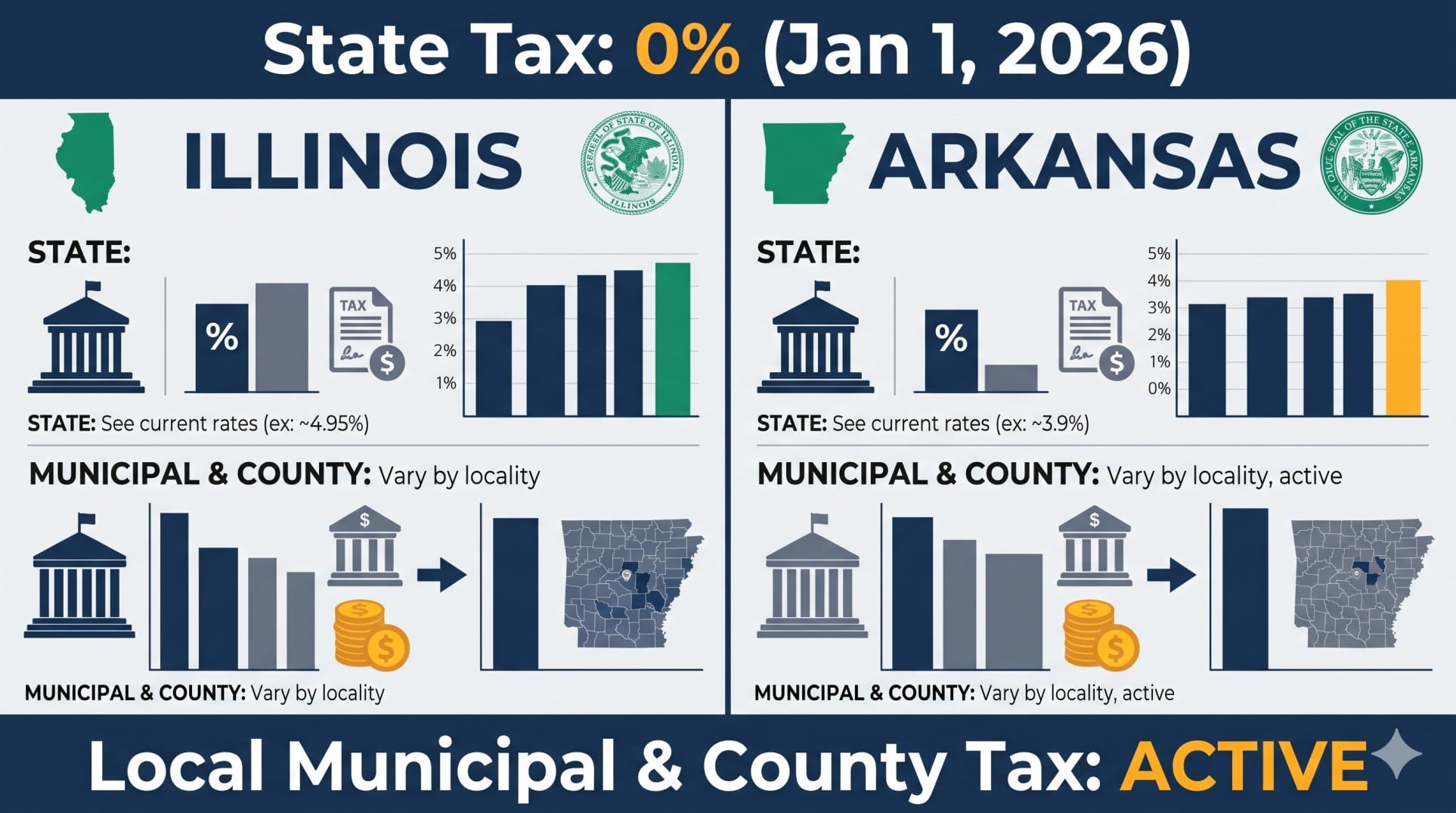
For brick-and-mortar supermarkets, convenience chains, and e-commerce meal-kit shippers, this decentralization means tax compliance is now a boundary-line game. Two stores operating three miles apart on the same highway—or one delivery van crossing an unincorporated county line—must now calculate, collect, and report completely different food tax rates. Retailers expanding across state lines should review our multi-state economic nexus compliance guide to see how local tax shifts interact with remote seller thresholds.
Illinois Public Act 103-0781: The 1% Local Grocery Tax Patchwork
Under Illinois Public Act 103-0781 (House Bill 3144), Illinois repealed its 1% statewide tax on groceries on January 1, 2026, while authorizing municipalities and counties to enact an identical 1% local grocery tax by ordinance without voter approval.
Prior to 2026, revenue from the 1% Illinois state tax on qualifying food didn’t actually stay in Springfield. The Illinois Department of Revenue (IDOR) distributed those funds directly back to local municipalities and counties. When Governor JB Pritzker signed Public Act 103-0781, the state cut off that automatic distribution and told local officials they had to pass their own local ordinances if they wanted to keep the money.
The Rolling 6-Month Ordinance Window (January 1 and July 1 Waves)
Local governments wasted no time. Per IDOR Informational Bulletin FY 2026-03 and FY 2026-11, municipalities and counties that filed a certified ordinance with IDOR by October 1, 2025, activated their 1% Municipal or County Grocery Occupation Tax on January 1, 2026. According to Illinois Municipal League and IDOR data, 656 municipalities and 3 counties (Washington, Wabash, and Moultrie) met that initial deadline, covering roughly 56.5% of the state’s population.
But the Illinois statute created a permanent, rolling compliance trap. Under Public Act 103-0781, local jurisdictions can adopt, repeal, or modify a local grocery tax twice a year:
- April 1 Filing Deadline: Ordinances submitted to IDOR by April 1 take effect on July 1 of the same calendar year.
- October 1 Filing Deadline: Ordinances submitted to IDOR by October 1 take effect on January 1 of the following calendar year.
We already saw the impact of this rolling schedule during the second wave. Per IDOR Informational Bulletin FY 2026-25, an additional 56 municipalities and 3 counties enacted the 1% local grocery tax effective July 1, 2026. Retailers who treated the January 1, 2026 rate update as a one-time IT project immediately fell out of compliance on July 1, and another wave of rate changes will hit on January 1, 2027, and July 1, 2027.
How RTA, MED, and Unincorporated County Boundaries Interact
Two critical statutory guardrails govern how these Illinois local rates stack:
- No City/County Double Stacking: Counties are strictly authorized to impose the 1% County Grocery Occupation Tax in unincorporated areas of the county. If both a county and an incorporated city within that county pass a 1% ordinance, a store inside city limits only charges 1%, never 2%.
- RTA and MED Transit Taxes Remain Active: Public Act 103-0781 did not repeal regional transit taxes on food. Sales of groceries within the Regional Transportation Authority (RTA) remain subject to the 1.25% RTA food rate in Cook County and 0.75% food rate in DuPage, Kane, Lake, McHenry, and Will counties (where the additional 0.25% county portion applies to general merchandise, bringing the total RTA low-rate food addition to 1.25% in Cook County and 1.00% in the collar counties). Sales in the Metro-East Mass Transit District (MED) in Madison and St. Clair counties retain their 0.25% (or applicable district) food tax.
Consequently, if a Chicago (Cook County) grocer sells qualifying food in 2026 or 2027, the customer still pays 2.25% total tax (1% Chicago municipal grocery tax + 1.25% RTA tax). If a grocer in a collar-county suburb that opted out of the municipal grocery tax sells the same item, the rate drops from 2.00% in 2025 to 1.00% (RTA only) in 2026.
The Arkansas Grocery Tax Relief Act: 0% State Rate Meets Full Local Taxes
The Arkansas Grocery Tax Relief Act (enacted as Act 709 of 2025 / House Bill 1685) reduced the Arkansas state sales and use tax on food and food ingredients from 0.125% to 0% effective January 1, 2026, while leaving all municipal and county grocery taxes in full force.
Unlike Illinois, where the state rate was 1% and most cities previously had no independent food tax, Arkansas cities and counties have taxed groceries at their full general local sales tax rates for years. Prior to 2026, Arkansas taxed general merchandise at a 6.5% state rate, while “food and food ingredients” enjoyed a reduced 0.125% (one-eighth of one percent) state rate.
When the Arkansas Grocery Tax Relief Act eliminated that remaining 0.125% sliver on January 1, 2026, it saved Arkansas shoppers roughly $4.4 million annually in state tax. However, under Arkansas Code Annotated § 26-52-317, qualifying food remains fully subject to city and county gross receipts and compensating use taxes unless a specific municipality votes to exempt food—which almost none have done due to municipal bond pledges.
SALT Compliance Alert for Arkansas Retailers: Do not mark grocery SKUs as “Tax Exempt” in your master item catalog for Arkansas. Marking an item globally exempt removes both state and local taxes at checkout, leaving your business directly liable for uncollected city and county taxes ranging from 1.5% to over 5.5%.
In Little Rock (Pulaski County), for example, the state food tax dropped to 0% on January 1, 2026, but the combined city and county local tax of 2.5% (1.5% Little Rock city + 1.0% Pulaski County) still applies to every bag of flour and gallon of milk. In Fayetteville (Washington County), shoppers pay 0% state tax on groceries but still pay 3.25% in combined city and county taxes.
Regional Context: How Kansas and Alabama Compare in 2026–2027
Midwestern and Southern retailers managing regional footprints must coordinate the 2026 Illinois and Arkansas changes alongside recent grocery tax overhauls in Kansas and Alabama, both of which also decoupled state rate cuts from local municipal taxes.
If your accounting team oversees regional supermarket chains or ships pantry staples across the central United States, four states now share a similar structural split between state and local food taxation:
- Kansas (0% State / Full Local): Following a multi-year statutory phasedown (6.5% to 4% in 2023, to 2% in 2024), Kansas completely eliminated its state grocery tax on January 1, 2025. Just like Arkansas, Kansas city and county sales taxes (often 1% to 4.25%) still apply to food and food ingredients in 2026 and 2027.
- Alabama (2% State / Home-Rule Local): Under legislation enacted in 2023, Alabama cut its state sales tax on groceries from 4% to 3% in September 2023, and after meeting Education Trust Fund revenue targets, dropped the state grocery rate from 3% to 2% on September 1, 2025. Through 2026 and 2027, Alabama’s state food rate sits at 2%, while local county and municipal grocery taxes remain locked in unless reduced by local ordinance. Because Alabama is a home-rule state, retailers must often remit those local grocery taxes on separate municipal portals.
| State | 2025 State Grocery Rate | 2026–2027 State Grocery Rate | Effective Date of Change | Local City/County Grocery Tax Rules (2026–2027) | Primary Reporting Form & Portal |
|---|---|---|---|---|---|
| Illinois | 1.00% | 0.00% | January 1, 2026 (Local wave 2: July 1, 2026) | Over 700 cities/counties charge a 1.00% local grocery tax; RTA (1.00%–1.25%) and MED (0.25%) remain active. | Form ST-1 & Form ST-2 (Line 5c / Sch. A Line 16) via MyTax Illinois |
| Arkansas | 0.125% | 0.00% | January 1, 2026 | Full city and county local sales/use taxes still apply to groceries (typically 1.00% to 5.50% combined). | Form ET-1 (Local Tax Schedule) via Arkansas ATAP |
| Kansas | 0.00% (Cut from 2.00% on Jan 1, 2025) | 0.00% | January 1, 2025 | Full city, county, and special district local sales taxes still apply to qualifying food ingredients. | Form ST-36 via KS Dept. of Revenue Customer Service Center |
| Alabama | 3.00% (Cut to 2.00% on Sep 1, 2025) | 2.00% | September 1, 2025 | Local municipal and county rates remain in effect (up to 6.00%+ locally); cities/counties may opt to cut locally by resolution. | Form SLS-450 & Local Home-Rule Returns via My Alabama Taxes (MAT) |
Comparing these four states reveals a clear pattern for CFOs and tax directors. State legislatures love repealing the state grocery tax for political optics, but they leave the local tax base intact. Businesses managing multi-state filings can explore our outsourced sales and use tax return preparation services to keep these shifting local schedules reconciled every month.
Reconfiguring Point-of-Sale (POS) Systems by Store and Delivery Address
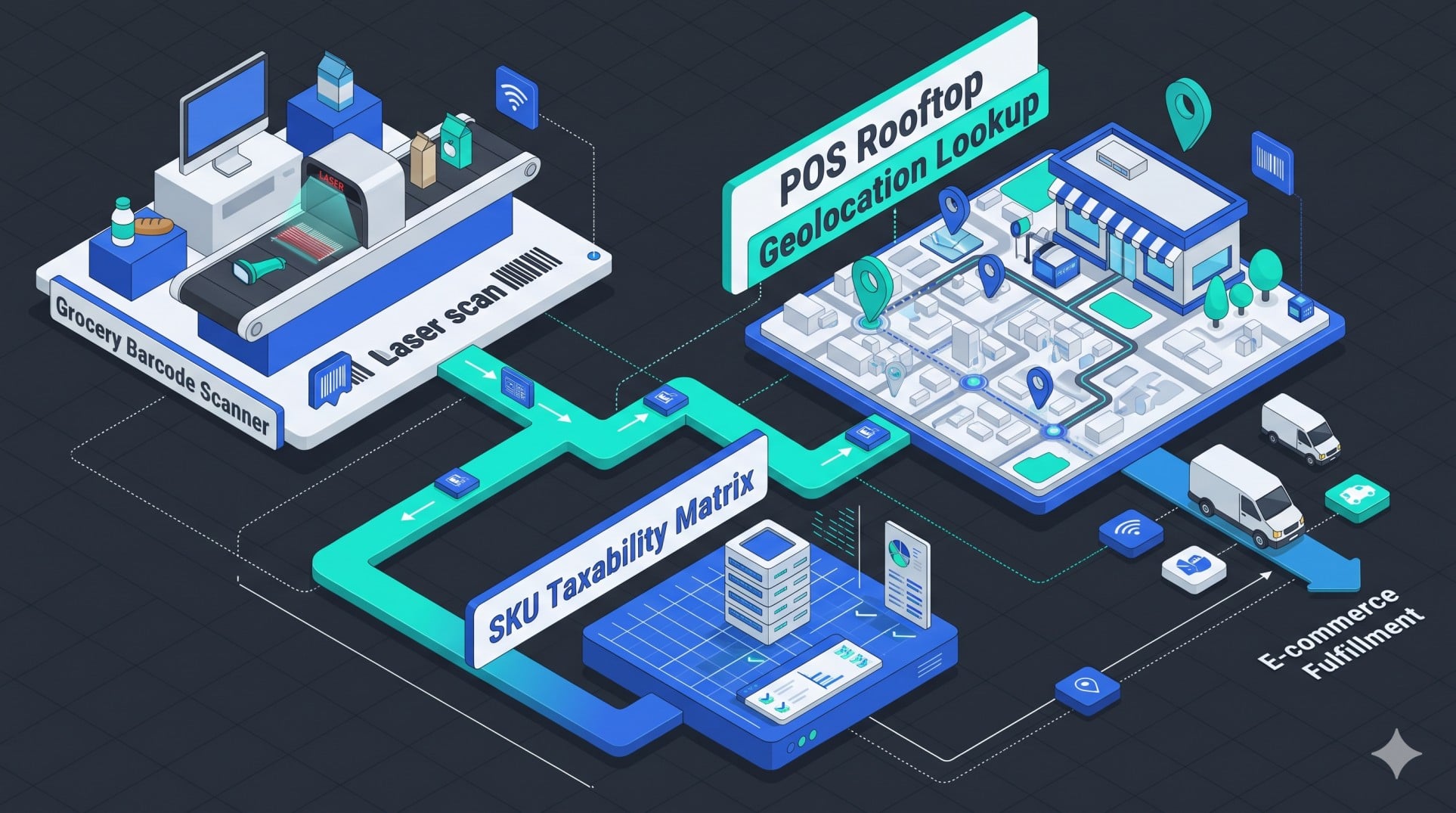
To prevent audit assessments in 2026 and 2027, retailers must configure their point-of-sale (POS) systems and e-commerce checkout engines to separate state tax rules from local tax rules and assign rates using rooftop-level geolocation rather than 5-digit ZIP codes.
Legacy cash registers and poorly configured cloud POS platforms (such as unmapped Square, Clover, Toast, or custom ERP setups) often treat “Reduced Food / Grocery” as a single flat percentage override. That architecture breaks down under the 2026 Illinois and Arkansas laws.
Origin vs. Destination Sourcing Rules in Illinois and Arkansas
How your point-of-sale (POS) systems determine the right local rate depends entirely on how the customer receives the groceries:
- In-Store Brick-and-Mortar Sales (Origin Sourcing): When a shopper buys groceries over the counter at a physical store in Illinois or Arkansas, the transaction is sourced to the physical store address. You must verify whether your store sits inside an incorporated municipality or an unincorporated county area, and lock that exact jurisdiction’s 2026–2027 food rate into the store’s register profile.
- Remote Sellers, E-Commerce & Local Delivery (Destination Sourcing): If you are an out-of-state remote seller shipping specialty foods, coffee, or meal kits into Illinois or Arkansas—or an in-state grocer using your own vans to deliver orders to customers’ homes under destination rules—the tax rate is governed by the customer’s delivery address.
In Illinois, remote retailers who exceed the economic nexus threshold must collect destination-based state and local Retailers’ Occupation Tax for the exact municipality or unincorporated county where the groceries are delivered. Keep in mind that effective January 1, 2026, Illinois also eliminated its 200-transaction economic nexus rule, leaving a strict $100,000 cumulative gross receipts threshold over the preceding 12 months. Arkansas similarly enforces a $100,000 or 200-transaction economic nexus threshold with strict destination sourcing.
Why 5-Digit ZIP Codes Fail in Illinois and Arkansas
Never rely on 5-digit ZIP codes to calculate local grocery tax on delivered orders. Postal ZIP codes are designed for mail carrier routes, not municipal tax boundaries. A single 5-digit ZIP code in suburban Illinois or Northwest Arkansas routinely spans three different incorporated towns and a large swath of unincorporated county land.
Consider what happens in Illinois when a municipality imposes the 1% Municipal Grocery Occupation Tax, while the surrounding county does not impose a County Grocery Occupation Tax in unincorporated areas. Two neighbors sharing the exact same 5-digit ZIP code—living on opposite sides of a street that marks the city limit—have different legal tax rates (1% vs. 0%). Only a 9-digit ZIP+4 or rooftop latitude/longitude tax API lookup can distinguish between them.
Scenario 1: Multi-Location Illinois Grocer & Delivery Fleet
Let’s examine Prairie Fresh Markets, a fictional regional grocer operating physical stores in Chicago (Cook County) and an unincorporated area of Sangamon County outside Springfield, while also shipping online gift baskets statewide. In August 2026 (after the July 1 second wave of local ordinances), Prairie Fresh processes three separate transactions for $200.00 of qualifying raw groceries (fresh produce, uncooked pasta, and coffee beans):
- Register Sale at Chicago Store (Cook County): The state grocery rate is 0%. However, Chicago enacted the 1.00% Municipal Grocery Occupation Tax, and Cook County sits inside the RTA district (1.25% food rate). The POS system calculates 2.25% tax on $200.00 = $4.50 tax collected (Total receipt: $204.50).
- Register Sale at Unincorporated Sangamon County Store: The store sits outside city limits in unincorporated Sangamon County, which did not adopt a countywide grocery ordinance and sits outside the RTA/MED transit zones. The POS calculates 0.00% state tax and 0.00% local tax = $0.00 tax collected (Total receipt: $200.00).
- Online Delivery to Hinckley, IL (DeKalb County): Hinckley did not charge a local grocery tax in January 2026, so Prairie Fresh initially coded Hinckley deliveries at 0%. However, Hinckley was one of the 56 municipalities that adopted the 1.00% local grocery tax effective July 1, 2026 (per IDOR Bulletin FY 2026-25). Because Prairie Fresh updated its POS tax engine for the July 1 wave, the checkout system properly charges 1.00% on $200.00 = $2.00 tax collected (Total receipt: $202.00).
Product Taxability Traps: Groceries vs. Prepared Food, Candy, and Drugs
Eliminating the state grocery tax widens the tax rate gap between qualifying groceries and non-qualifying items like prepared food, soft drinks, and candy—making SKU-level barcode classification the #1 target for state sales tax auditors in 2026 and 2027.
When the state rate on groceries drops to 0% while general merchandise remains taxed at 6.25% (plus local tax) in Illinois and 6.50% (plus local tax) in Arkansas, a misclassified UPC barcode costs the state over 6 cents on every dollar. Auditors from IDOR and the Arkansas Department of Finance and Administration (DFA) run automated SKU sample tests on POS item master files to catch grocers applying the grocery exemption to high-rate items.
| Product Category | Illinois 2026–2027 Tax Treatment (86 Ill. Adm. Code 130.310) | Arkansas 2026–2027 Tax Treatment (Ark. Code Ann. § 26-52-317) | POS SKU Configuration Rule |
|---|---|---|---|
| Qualifying Unprepared Groceries (Milk, eggs, raw meat, bread, produce, baking flour) | 0% State Tax + 1% Local Grocery Tax (if enacted by city/county) + RTA/MED (if applicable). | 0% State Tax + Full Local City & County Sales Tax. | Map to “Qualifying Food / Grocery” tax code; link strictly to local food tax tables. |
| Soft Drinks & Bottled Sodas (Carbonated/non-carbonated sweetened drinks <50% juice) | Full General Merchandise Rate (6.25% State + Local General Rate + Local Soft Drink Taxes in Chicago). | Full General Merchandise Rate (6.50% State + Local General Rate; plus AR wholesale soft drink excise tax). | Never group with grocery beverages; tax at full combined state/local general rate. |
| Candy & Confectionery | Full General Merchandise Rate (6.25% State + Local). Exception: Sweetened items containing flour (e.g., Kit Kat, Twix) and items requiring refrigeration qualify as groceries! | Full General Merchandise Rate (6.50% State + Local). Arkansas follows Streamlined Sales Tax (SST) rules: preparations of sugar/chocolate without flour are taxable candy. | Audit ingredient labels for “flour”; separate flour-based snacks (grocery rate) from pure candy (general rate). |
| Prepared Hot Food & Deli Items (Rotisserie chicken, hot soup bar, sandwiches made to order, items sold with utensils) | Full General Merchandise Rate (6.25% State + Local + Municipal Places for Eating Taxes). | Full General Merchandise Rate (6.50% State + Local + Local HMR/Restaurant Taxes). Cold food merely cut or repackaged by seller remains exempt from state tax. | Trigger full general rate if sold heated, mixed by seller for immediate consumption, or handed out with utensils. |
| Qualifying Drugs & Medical Appliances (OTC meds with Rx label/Drug Facts, insulin, crutches) | 1.00% State Tax STILL APPLIES! Public Act 103-0781 did not repeal the 1% Illinois state tax on drugs/medical appliances (reported on Form ST-1 Line 5a). | Prescription drugs for human use are exempt; OTC non-prescription drugs are taxed at the 6.50% State + Local General Rate. | Critical Illinois Trap: Decouple OTC drugs/medical appliances from Grocery SKUs in Illinois POS systems! |
| Cannabis-Infused Edibles & Alcoholic Beverages | Full General Merchandise Rate (6.25% State + Local + IL Cannabis/Liquor Excise Taxes). | Full General Merchandise Rate (6.50% State + Local + AR Alcoholic Beverage Supplemental Taxes). | Map to high-rate general merchandise plus applicable category excise surcharges. |
The Illinois Drug & Medical Appliance Decoupling Trap
Look closely at the fifth row in the matrix above. Through December 31, 2025, Illinois taxed qualifying food, qualifying drugs, and medical appliances together under the exact same 1% low-rate bucket on Illinois Form ST-1 (Line 5a). Because the rate and reporting line were identical, thousands of Illinois pharmacies, convenience stores, and supermarkets programmed a single “1% Low Rate” button into their point-of-sale (POS) systems covering both groceries and over-the-counter medications (such as ibuprofen, allergy pills, and bandages with a federal Drug Facts panel).
Under 86 Ill. Adm. Code Section 130.311 and Public Act 103-0781, the 1% Illinois state tax on qualifying drugs and medical appliances was not repealed. Only groceries changed. If a store in an Illinois municipality that did not pass a local grocery ordinance zeroed out its “1% Low Rate” POS category on January 1, 2026, that store stopped collecting the mandatory 1% state tax on drugs and medical appliances. Conversely, even if the city passed a 1% local grocery tax (keeping both rates at 1%), reporting drug receipts on the grocery line (Line 5c) instead of the drug line (Line 5a) triggers an immediate Form ST-1 return mismatch.
Scenario 2: Arkansas Mixed-Basket Supermarket Checkout
Consider Ozark Family Grocer located in Fayetteville, Arkansas (Washington County). In Fayetteville, the 2026 general merchandise sales tax rate is 9.75% (6.50% Arkansas state rate + 2.00% Fayetteville city rate + 1.25% Washington County rate). Under the Arkansas Grocery Tax Relief Act, the 2026 grocery tax rate in Fayetteville is 3.25% (0.00% state rate + 2.00% city rate + 1.25% county rate).
A customer approaches the register with a mixed basket totaling $100.00 before tax:
- $60.00 of raw steaks, fresh apples, and sliced deli turkey (merely sliced and repackaged cold by the grocer, which Act 709 explicitly classifies as qualifying food, not prepared food).
- $15.00 for a hot rotisserie chicken and a cup of hot macaroni and cheese from the deli warmer (Prepared Food).
- $15.00 for a 12-pack of carbonated cola and a bag of gummy bears made without flour (Soft Drinks and Candy).
- $10.00 for a bottle of over-the-counter pain relievers (Non-prescription Drug).
Here is how a properly reconfigured Arkansas POS system calculates the receipt in 2026:
- Qualifying Groceries ($60.00): Taxed at 0.00% state + 3.25% local = $1.95 local tax.
- Prepared Food, Soda, Candy & OTC Meds ($40.00 combined): Taxed at 6.50% state + 3.25% local (9.75% combined) = $2.60 state tax + $1.30 local tax = $3.90 tax (Note: Fayetteville’s local Hotel, Motel, and Restaurant [HMR] tax may also apply to the $15.00 hot deli meal depending on store dining facilities).
- Total Sales Tax Collected at Checkout: $1.95 + $3.90 = $5.85 (Total customer payment: $105.85).
Had Ozark Family Grocer mistakenly coded the sliced cold deli meat as prepared food, they would have overcharged the customer 6.5%. Had they left the gummy bears and cola inside the “Food” department code, they would have under-collected 6.50% state tax ($0.98 per basket) across thousands of daily transactions. Businesses selling regulated items alongside groceries should also review our beverage and OTP excise tax compliance guide to ensure wholesale soft drink and tobacco taxes are properly separated from retail sales tax.
Step-by-Step Filing Mechanics: Illinois Form ST-1 and Arkansas Form ET-1
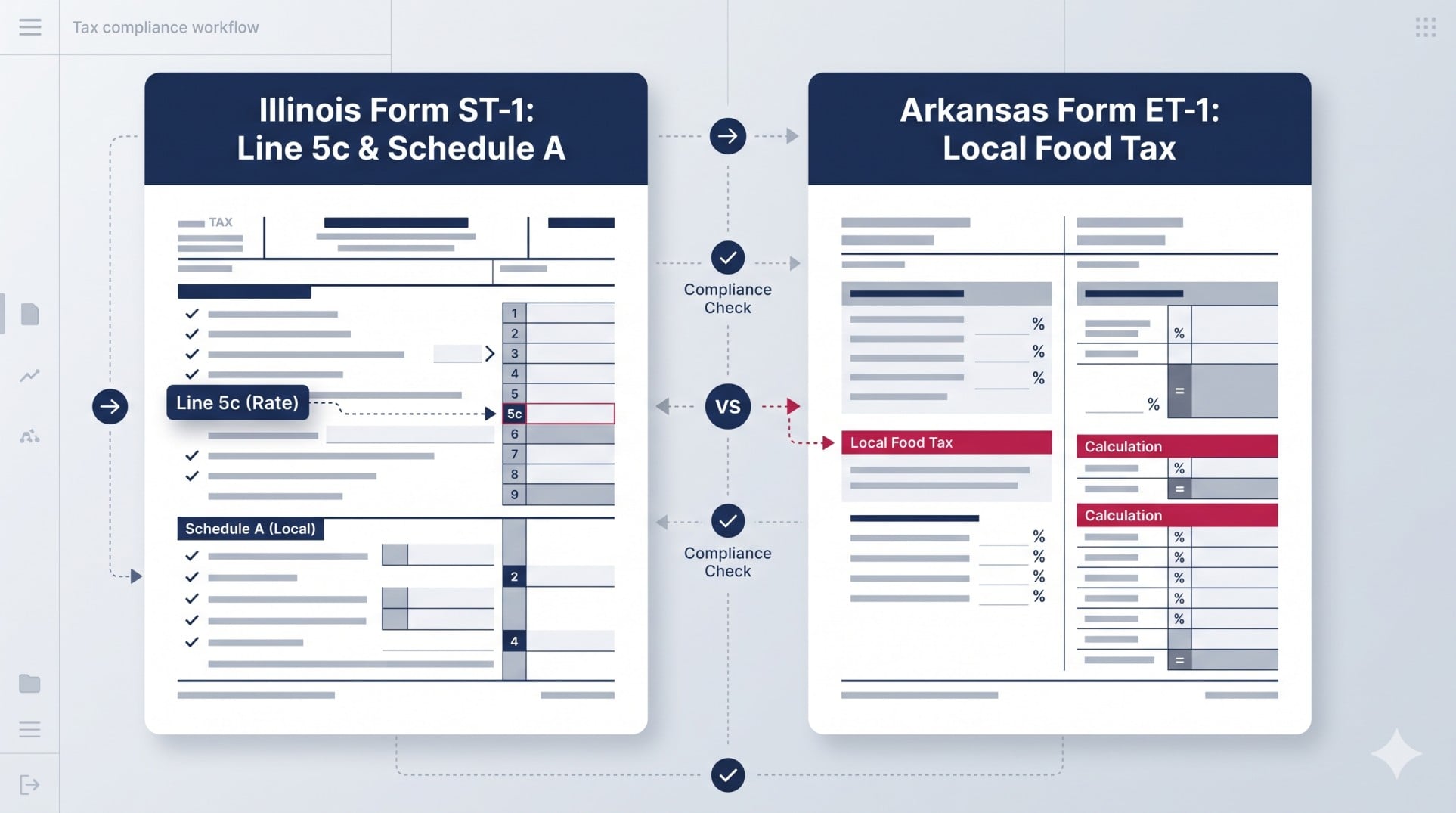
Even when the state grocery tax is 0%, retailers cannot simply omit grocery sales from their monthly tax returns; both Illinois and Arkansas require gross grocery receipts to be reported, segregated, and reconciled on specific return schedules.
Filing errors on 2026 and 2027 sales tax returns are triggering automated math error notices because bookkeepers don’t realize that gross receipts on Line 1 must still match federal income tax and 1099-K merchant processing totals.
How to File Illinois Form ST-1 and Form ST-2 in MyTax Illinois
In Illinois, retailers file Illinois Form ST-1 (Sales and Use Tax and E911 Surcharge Return) and—if operating multiple locations or making destination-based sales across multiple jurisdictions—Form ST-2 (Multiple Site Form) via the MyTax Illinois portal. Returns and payments are due on or before the 20th day of the month following the reporting period. Retailers who file and pay on time may claim the Illinois retailer’s timely filing discount of 1.75% of the tax due, capped at $1,000 per month across all tax types reported on the return.
Per IDOR publication PIO-119 (Grocery Receipts Reporting on Form ST-1 and Form ST-2 Chart), your line-by-line reporting depends on whether the sale occurred in a jurisdiction imposing a local grocery tax (including RTA/MED):
Path A: Sales in a Municipality/County WITH a 1% Local Grocery Tax (or inside RTA/MED)
- Step 2, Line 1 (Total Receipts): Include all gross receipts from qualifying grocery sales, including the local grocery tax collected.
- Schedule A, Line 2b (Taxes Collected on Groceries): Deduct the exact dollar amount of grocery tax collected during the period so you only pay tax on the net sales base.
- Step 2, Line 3 (Net Taxable Receipts): Your net taxable grocery receipts remain in this total.
- Step 3, Line 5a & 5b (Drugs and Medical Appliances): Report ONLY qualifying drugs and medical appliances here at the 1% state rate (plus RTA/MED if applicable). Do not put groceries on Line 5a.
- Step 3, Line 5c & 5d (NEW — Grocery Base & Tax): Enter the net taxable grocery receipts on Line 5c (and on the corresponding location breakdown on Form ST-2), and multiply by the site’s exact local grocery tax rate (e.g., 1.00%, 1.25%, or 2.25%) on Line 5d.
Path B: Sales Outside RTA/MED Where NO Local Grocery Tax Is Imposed (0% Total Grocery Tax)
- Step 2, Line 1 (Total Receipts): You must still include all gross receipts from non-taxable grocery sales on Line 1.
- Schedule A, Line 16 (Other Deductions — Exempt Groceries): Deduct the total non-taxable grocery receipts on Schedule A, Line 16, and enter the required statutory description showing they are exempt grocery sales outside a taxing jurisdiction.
- Step 3, Line 5c: Leave Line 5c blank ($0) for that site location.
How to File Arkansas Form ET-1 in ATAP
In Arkansas, registered vendors report sales and use taxes monthly on Form ET-1 (Arkansas Excise Tax Return) through the Arkansas Taxpayer Access Point (ATAP) portal. While the statutory final due date for Form ET-1 is the last day of the month following the reporting period, Arkansas offers a lucrative 2% timely payment discount on state taxes (capped at $1,000 per month per taxpayer/combined group) only if the return and payment are submitted on or before the 20th day of the month.
- State Gross Receipts vs. State Food Tax Section: Because the state rate on food and food ingredients dropped from 0.125% to 0.00% on January 1, 2026, qualifying grocery sales generate $0 in state food tax liability on the state section of Form ET-1. General merchandise (prepared food, candy, soft drinks, soap, paper goods) continues to be reported on the 6.50% State Gross Receipts Tax line.
- Local Sales and Use Tax Schedule: You must still report the combined taxable base—including both general merchandise and qualifying food and food ingredients—under each applicable city and county local jurisdiction code (e.g., Little Rock / Pulaski County code) on the Local Tax section of Form ET-1.
- Whole Dollar Rounding Rule: Remember that ATAP and Form ET-1 require all taxable sales bases and tax figures to be entered in whole dollars.
Audit Triggers, Consumer Use Tax, and Penalty Defense for 2026–2027
State revenue auditors in Illinois and Arkansas are actively targeting three compliance failures in 2026 and 2027: unverified delivery addresses on destination sales, unremitted tax over-collections (unjust enrichment), and missing consumer use tax on store supplies.
The Illinois 15% Penalty Rate for Missing Destination Records
If your business ships groceries or meal kits to Illinois customers, pay strict attention to IDOR’s recordkeeping mandate for remote and destination-based sellers. Under Illinois law, destination-based retailers must maintain verifiable shipping and delivery address records to substantiate which municipality or unincorporated county received each order.
If an auditor examines your books and you cannot produce sufficient delivery address data to prove the exact local jurisdiction for your Illinois sales, IDOR is statutorily authorized to assess those undetermined gross receipts at a punitive flat 15% tax rate. Losing address logs on $500,000 of online grocery sales—where the actual local tax was 0% or 1%—can trigger a catastrophic $75,000 tax assessment plus interest and late payment penalties.
Scenario 3: The Unjust Enrichment & Audit Extrapolation Trap
Let’s look at Heartland Pantry Delivery, an e-commerce specialty grocer based in Missouri that exceeds the $100,000 economic nexus threshold in both Illinois and Arkansas. During the first six months of 2026, Heartland made two configuration errors in its checkout software:
- Error 1 (Illinois Over-Collection): Heartland left a flat 1.00% tax rule turned on for all Illinois ZIP codes. For customers living in the 600+ Illinois towns that passed a 1% local grocery tax, the rate happened to be right, though Heartland mistakenly reported it on Line 5a (Drugs) instead of Line 5c (Groceries). However, for $300,000 of sales shipped to rural unincorporated Illinois counties with 0% grocery tax, Heartland illegally collected $3,000 in non-existent tax from customers and pocketed it instead of remitting it. Under Illinois unjust enrichment statutes, a retailer who erroneously collects tax from a customer must either refund the exact amount to the customer or remit 100% of the over-collected tax to IDOR. Keeping erroneous tax collections triggers fraud and negligence penalties.
- Error 2 (Arkansas Under-Collection): Hearing that the Arkansas Grocery Tax Relief Act repealed the grocery tax, Heartland’s IT team set all Arkansas food SKUs to “0% Tax Exempt” on January 1, 2026. Over two quarters, Heartland shipped $400,000 of qualifying groceries to homes in Little Rock, Fayetteville, and Bentonville without collecting local city and county taxes (averaging 3.25% combined). During a DFA audit, the auditor assesses Heartland directly for the uncollected local tax: $400,000 × 3.25% = $13,000 in back tax, plus a 5% per month failure-to-pay penalty (up to 35%) and 10% per annum statutory interest.
Don’t Forget Consumer Use Tax on Store Operations
While reconfiguring checkout registers for Seller’s Sales Tax, supermarket controllers must also monitor Consumer Use Tax. Grocery stores constantly pull items from resale inventory for internal store use—such as cleaning supplies, paper towels, trash bags, employee breakroom soda, or deli display trays—or purchase point-of-sale hardware and refrigeration equipment from out-of-state vendors who don’t charge sales tax.
Those internal withdrawals and untaxed equipment purchases are not qualifying groceries sold for home consumption. You must self-assess and remit full state and local Consumer Use Tax (6.25% state base in Illinois on Form ST-1; 6.50% state plus local use tax in Arkansas on Form ET-1). If you discover historical under-collections or unfiled returns in either state, we strongly recommend pursuing a Voluntary Disclosure Agreement (VDA) and sales tax audit defense strategy before the state issues an audit notice.
Frequently Asked Questions About State and Local Grocery Taxes
1. Did Illinois completely eliminate sales tax on groceries in 2026?
No, Illinois only eliminated its 1% statewide grocery tax on January 1, 2026, under Public Act 103-0781. Over 700 Illinois municipalities and counties immediately enacted their own 1% local grocery tax in January and July 2026, and Regional Transportation Authority (RTA) and Metro-East (MED) transit taxes on food remain active.
2. Are groceries completely tax-free in Arkansas starting in 2026?
No, groceries are only exempt from state-level sales and use tax in Arkansas starting January 1, 2026. Under the Arkansas Grocery Tax Relief Act (Act 709), the 0.125% state food tax dropped to 0%, but all local municipal and county sales taxes (often 1% to 5.5%) still apply to grocery purchases.
3. How do I report grocery sales on Illinois Form ST-1 in 2026 and 2027?
You must report taxable local grocery receipts on the new Line 5c (Grocery base) and calculate the tax on Line 5d of Illinois Form ST-1 and Form ST-2. If you sell groceries in a location outside the RTA/MED with no local grocery tax, you include the sales on Step 2, Line 1, and deduct them on Schedule A, Line 16.
4. Did Illinois eliminate the 1% tax on prescription and over-the-counter drugs in 2026?
No, the 1% Illinois state tax on qualifying drugs and medical appliances was not eliminated and remains in full effect for 2026 and 2027. Retailers must separate drug and medical appliance SKUs from grocery SKUs in their point-of-sale (POS) systems and continue reporting drugs on Line 5a of Form ST-1.
5. Can an Illinois city and county both charge a 1% grocery tax on the same store?
No, a county and a municipality cannot double-stack the 1% local grocery tax on the same transaction. Under Public Act 103-0781, an Illinois county is only authorized to impose its 1% County Grocery Occupation Tax in unincorporated areas outside municipal boundaries, capping the local ordinance rate at 1% (plus RTA/MED transit taxes where applicable).
6. How often can Illinois cities and counties add a new 1% local grocery tax?
Illinois municipalities and counties can implement or repeal a 1% local grocery tax twice a year: on January 1 (for ordinances filed with IDOR by October 1) and on July 1 (for ordinances filed with IDOR by April 1). Retailers must check the MyTax Illinois Tax Rate Finder every May and November for upcoming rate waves.
7. Are candy, soda, and hot deli foods exempt under the Illinois and Arkansas grocery tax repeals?
No, soft drinks, candy (prepared without flour), alcoholic beverages, cannabis edibles, and hot prepared foods are excluded from the grocery definition in both states. These items remain taxed at the full general merchandise state rate (6.25% in Illinois; 6.50% in Arkansas) plus all applicable local and restaurant taxes.
8. How do SNAP and WIC purchases interact with the 2026 local grocery taxes?
Eligible food items purchased with federal Supplemental Nutrition Assistance Program (SNAP / EBT) or WIC benefits are 100% exempt from both state and local grocery tax in Illinois, Arkansas, Kansas, and Alabama. Your POS system must automatically strip off all city, county, and transit food taxes whenever a customer tenders payment via EBT or WIC.
9. What is the penalty if a remote grocery seller lacks delivery address records in Illinois?
If a destination-based or remote seller cannot provide verifiable delivery address documentation to prove which local jurisdiction received the goods, the Illinois Department of Revenue can assess the undetermined sales at a flat 15% statutory penalty rate under Illinois retailers’ occupation tax audit rules.
10. Do retailers still get a timely filing vendor discount in Illinois and Arkansas in 2026?
Yes, both states still offer timely filing discounts, subject to monthly caps. Illinois provides a 1.75% retailer discount (capped at $1,000 per month) when Form ST-1 is filed and paid by the 20th of the month, while Arkansas offers a 2.00% discount on state tax (capped at $1,000 per month) when Form ET-1 is paid on or before the 20th of the month.
Protect Your Retail Margins from 2026–2027 Local Grocery Tax Audits
Eliminating the state grocery tax in Illinois and Arkansas didn’t simplify retail tax compliance—it decentralized it across hundreds of municipal boundaries, semi-annual ordinance update windows, and strict return schedules. A single misconfigured tax code in your point-of-sale (POS) systems can silently bleed thousands of dollars in uncollected local taxes or trigger an IDOR or Arkansas DFA audit mismatch.
You don’t have to audit 700+ local ordinances or rebuild your POS tax matrices alone. At Ourtaxpartner.com, our SALT CPAs and indirect tax specialists handle end-to-end multi-state sales and use tax registrations, rooftop-level POS tax mapping, monthly Illinois Form ST-1 / Form ST-2 and Arkansas Form ET-1 filings, and full audit defense. Contact Ourtaxpartner.com today for a comprehensive POS tax rate review and keep your retail operations 100% compliant through 2026, 2027, and beyond.
Disclaimer: This content provides general information for educational purposes only and reflects state, local, and federal sales, use, and excise tax laws applicable to the 2026–2027 compliance periods. State and local tax rates, nexus thresholds, and excise regulations change frequently across jurisdictions. This article does not constitute professional tax, legal, or accounting advice. Always consult a certified public accountant (CPA), enrolled agent (EA), or qualified SALT advisor at Ourtaxpartner.com regarding your specific business compliance obligations. Ourtaxpartner.com is not responsible for any actions taken based on the information provided herein.
