
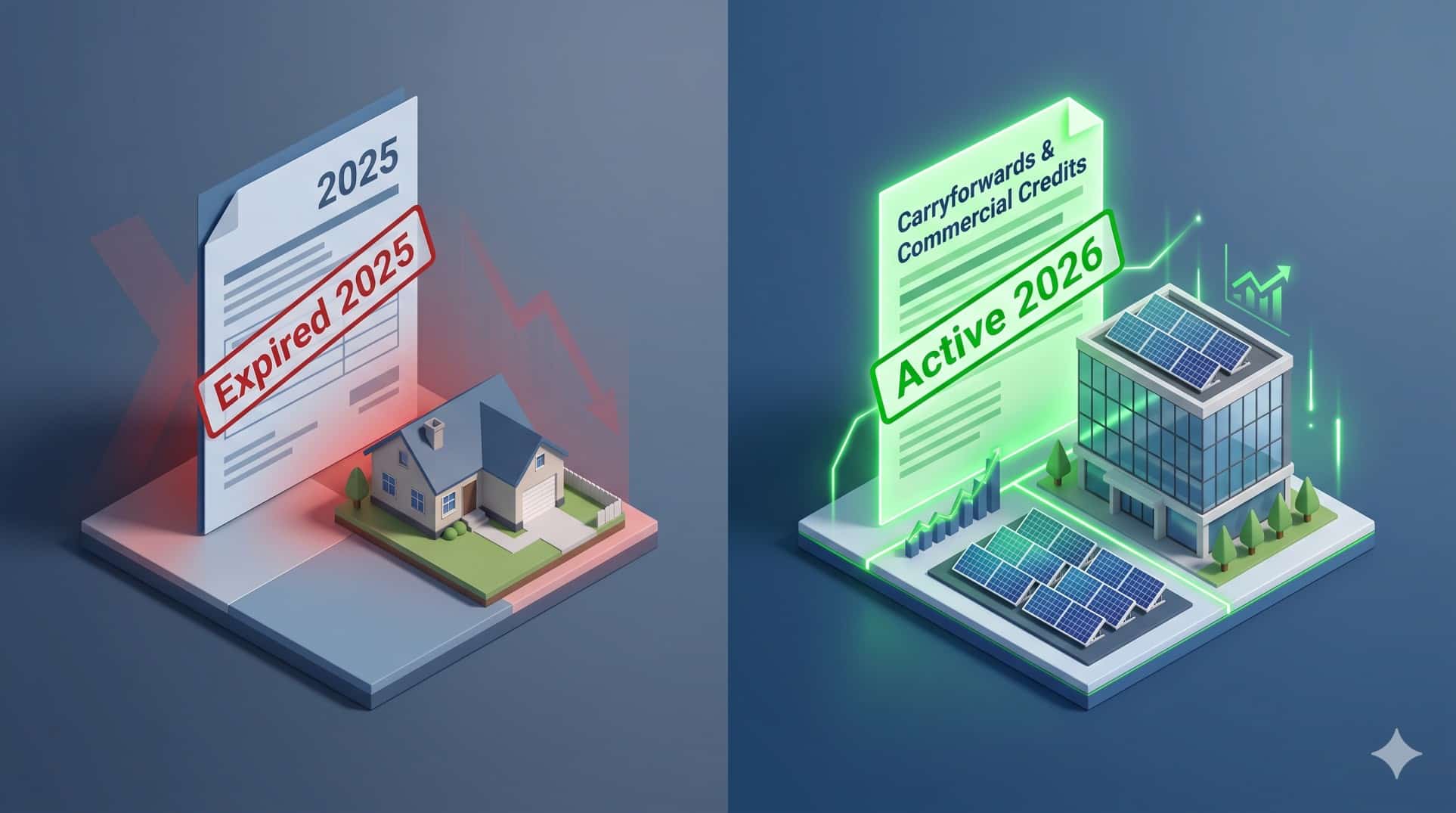
If you are planning a major home energy upgrade this year, the tax landscape has completely changed. The Federal Solar and Energy Efficiency Tax Credits that defined the market for the last decade underwent a massive, permanent overhaul in late 2025. The days of buying a solar array or a heat pump and simply writing off 30% on your personal tax return are officially over.
In July 2025, Congress passed the One Big Beautiful Bill (OBBB) Act. This legislation abruptly terminated the Section 25D Residential Clean Energy Credit and the Section 25C Energy Efficient Home Improvement Credit for any property placed in service after December 31, 2025. If you buy solar panels, battery storage, or a high-efficiency HVAC system for your personal residence in 2026, the federal government will not give you a direct tax credit.
But that does not mean federal incentives are entirely dead. The tax code just shifted the benefits. The commercial solar credits (Section 48E) survived the legislative cuts, making third-party ownership models like Power Purchase Agreements (PPAs) the new standard. Furthermore, the IRS still honors carryforwards for systems installed before the deadline. If you have leftover credits from last year, you can absolutely use them now.
This guide breaks down exactly how to navigate this new reality. We will cover the mechanics of claiming your carryforwards, the specific tax implications of how you finance a new system today, and the unique loopholes available to business owners working from home.
⚡ Executive Summary: 2026 Energy Credits
- Residential Repeal: The Section 25C (heat pumps, weatherization) and Section 25D (solar panels) credits expired on December 31, 2025. New 2026 residential purchases receive a 0% federal credit.
- Carryforwards Allowed: You can still claim unused Section 25D solar credits from 2025 or earlier on your 2026 tax return.
- Commercial Shift: Because the Section 48E commercial credit remains active, solar leases and PPAs are now the primary way homeowners indirectly benefit from federal subsidies.
- Home Office Loophole: Homeowners with a dedicated home office can claim the commercial Section 48E credit and MACRS depreciation on the business portion of a new 2026 solar installation.
Table of Contents
- The End of an Era: Federal Solar and Energy Efficiency Tax Credits in 2026
- Rolling Over Savings: how to carry forward solar tax credit on 2026 tax return
- Filing Mechanics: IRS Form 5695 instructions for 2026 tax year
- Financing: prepaid solar PPA vs purchase tax implications 2026
- Business Use: tax write offs for home office solar panels 2026
- Step-by-Step Guide: Managing Your 2026 Energy Taxes
- Frequently Asked Questions About Energy Credits
The End of an Era: Federal Solar and Energy Efficiency Tax Credits in 2026
To understand what you can claim this year, you have to understand what Congress took away. For years, the tax code heavily subsidized residential green energy. The Energy Efficient Home Improvement Credit (Section 25C) covered up to $2,000 for heat pumps and $1,200 for weatherization. The Residential Clean Energy Credit (Section 25D) offered an uncapped 30% credit for solar panels and battery storage.
The OBBB Act signed in July 2025 ended both programs prematurely. The cutoff date was strict: the equipment had to be installed and placed in service by December 31, 2025. If your solar installer finished the job on January 2, 2026, you missed the window. There are no Federal Solar and Energy Efficiency Tax Credits available for personal residential property purchased and installed in 2026.
However, the OBBB Act did not touch the commercial side of the tax code. Section 48E, which provides tax credits to businesses that install clean energy property, remains fully funded and active. This legislative split created a massive shift in the residential solar market. Because homeowners can no longer claim the credit themselves, third-party developers who can claim the commercial credit have taken over the industry.
Rolling Over Savings: how to carry forward solar tax credit on 2026 tax return
While new purchases are locked out, the IRS did not steal the credits you already earned. If you installed a solar system in 2025 (or earlier) and the 30% credit was larger than your total federal tax liability for that year, you are legally allowed to roll the remainder forward.
Understanding how to carry forward solar tax credit on 2026 tax return filings is critical for getting your full return on investment. The tax code allows Section 25D credits to be carried forward indefinitely. So, if you are wondering, can you roll over unused section 25D credit to 2026? The answer is a definitive yes. You can claim your unclaimed 2025 energy credits on 2026 tax return documents to wipe out your current tax bill.
Keep in mind that this carryforward rule applies only to Section 25D (solar panels, geothermal, and battery storage). The Section 25C credit for heat pumps and windows was a “use it or lose it” annual limit. You cannot carry forward unused Section 25C efficiency credits into 2026 under any circumstances.
Sarah installed a $30,000 solar panel system in October 2025. Her Section 25D credit was $9,000. When she filed her 2025 taxes, her total federal tax liability was only $5,000. She used $5,000 of her credit to reduce her 2025 tax bill to $0. Now, she needs to know how to carry forward solar tax credit on 2026 tax return forms. She simply takes the remaining $4,000 balance and applies it against her 2026 tax liability. If her 2026 tax bill is $6,000, the carryforward reduces it to $2,000.
Filing Mechanics: IRS Form 5695 instructions for 2026 tax year
To claim your carryforward, you must file IRS Form 5695 (Residential Energy Credits) alongside your Form 1040. Because the residential credits expired for new installs, the 2026 version of this form functions almost exclusively as a carryforward tracker for most taxpayers.
When you read the IRS Form 5695 instructions for 2026 tax year filings, you will notice that you cannot enter new installation costs on the primary lines for Section 25C or 25D. Instead, you will skip directly to the carryforward section in Part I.
You will need a copy of your 2025 Form 5695 to complete your 2026 taxes. The IRS Form 5695 instructions for 2026 tax year explicitly require you to pull the exact unused credit amount from last year’s worksheet. You enter this figure, calculate your current 2026 tax liability, and apply the credit until your liability hits zero. Any remaining balance is then documented on the 2026 form to be carried forward again into 2027.
Reducing 2026 individual tax liability with past solar credits is a straightforward math exercise, but failing to attach Form 5695 will result in the IRS rejecting your carryforward claim.
Financing: prepaid solar PPA vs purchase tax implications 2026
If you are installing a new solar system in 2026, how you pay for it completely dictates the financial outcome. Because the residential credit is dead, buying a system in cash or with a solar loan means you pay 100% of the retail price with zero federal help.
This reality makes the prepaid solar PPA vs purchase tax implications 2026 a vital topic. A Power Purchase Agreement (PPA) or a solar lease is a third-party ownership model. The solar developer installs and owns the equipment on your roof. You agree to buy the electricity it produces at a locked-in rate for 20 to 25 years.
So, are there any direct solar lease tax advantages for individual taxpayers 2026? No. You cannot file Form 5695 for a leased system. However, the developer can claim the Section 48E commercial tax credit because they own the asset. This answers the common question: how does the 2026 commercial solar credit benefit homeowners?
When the developer receives a 30% (or higher, with bonus adders) tax credit from the federal government, their cost basis drops significantly. They pass a portion of those savings down to you by offering a PPA electricity rate that is substantially lower than your local utility company’s rate. When weighing prepaid solar PPA vs purchase tax implications 2026, the PPA is now the only route left to access federal solar incentives, albeit indirectly.
| Financing Method (2026) | Who Owns the System? | Federal Tax Credit Status | Homeowner Financial Benefit |
|---|---|---|---|
| Cash Purchase / Loan | Homeowner | 0% (Repealed by OBBB Act) | Free electricity, but full upfront cost |
| Standard Solar PPA | Developer | Developer claims Section 48E | Lower monthly electricity bills |
| Prepaid Solar PPA | Developer | Developer claims Section 48E | Maximum indirect discount on power |
Business Use: tax write offs for home office solar panels 2026
There is one massive loophole for homeowners who want to purchase a system in 2026: the home office deduction. If you run a business out of your home, the IRS allows you to mix residential and commercial tax codes based on the square footage of your exclusive business space.
Because the Section 48E commercial credit is still active, calculating tax write offs for home office solar panels 2026 is highly lucrative. You must first determine your business use percentage. If you use 20% of your home’s square footage exclusively and regularly for your business, the IRS considers 20% of your solar installation a commercial business asset.
The 80% personal portion gets nothing, as the residential credit is dead. But for the 20% business portion, you can claim the 30% Section 48E commercial tax credit. Furthermore, the business portion unlocks depreciation. You can use the Modified Accelerated Cost Recovery System (MACRS) to depreciate the business portion of the solar array over five years. This provides a substantial deduction against your self-employment income on Schedule C.
Navigating tax write offs for home office solar panels 2026 requires precise bookkeeping. You must have a legitimate, qualifying home office under IRS rules to claim this commercial benefit on a residential property.
Marcus runs a consulting business from his home. His dedicated home office takes up 25% of his home’s square footage. He buys a $40,000 solar system in cash in 2026. He allocates 75% ($30,000) to personal use, which receives a $0 tax credit due to the OBBB Act. He allocates 25% ($10,000) to business use. He claims the 30% Section 48E commercial credit on that $10,000, yielding a $3,000 tax credit. He also sets up a 5-year MACRS depreciation schedule on the remaining basis to lower his Schedule C business income.
Step-by-Step Guide: Managing Your 2026 Energy Taxes
Whether you are claiming a carryforward or leveraging a home office, filing your energy taxes this year requires strict attention to detail. Follow these steps to ensure your return is accurate.
Step 1: Locate Your 2025 Tax Return
If you installed solar before the cutoff, pull your 2025 Form 1040 and Form 5695. You must find the exact dollar amount listed as your carryforward to the 2026 tax year. You cannot guess this number.
Step 2: Calculate Your 2026 Tax Liability
Before applying any carryforwards, determine your total federal tax liability for 2026. Non-refundable credits can only bring your liability down to zero; they cannot trigger a refund check for the excess.
Step 3: Apply the Carryforward via Form 5695
Follow the IRS Form 5695 instructions for 2026 tax year carefully. Enter your carryforward amount in Part I, apply it against your calculated tax liability, and document any remaining balance that will roll into 2027.
Step 4: Evaluate PPA Contracts Carefully
If you are installing a new system in 2026, demand transparency from your developer. Since they are claiming the Section 48E credit, negotiate a lower PPA rate. Compare the long-term cost of the PPA against a cash purchase to ensure you are actually benefiting from their commercial tax break.
Step 5: Consult a CPA for Home Office Claims
If you plan to claim the commercial credit on a residential system via the home office deduction, hire a tax professional. Calculating the depreciable basis after claiming the Section 48E credit requires complex MACRS math that should not be done by hand.
Frequently Asked Questions About Energy Credits
Are the Federal Solar and Energy Efficiency Tax Credits still available for new purchases in 2026?
No. The One Big Beautiful Bill (OBBB) Act of 2025 repealed the residential Section 25C and Section 25D credits for property placed in service after December 31, 2025. You cannot claim a federal credit for a new personal residential installation in 2026.
How do I know how to carry forward solar tax credit on 2026 tax return filings?
You must use your 2025 Form 5695 to find your exact carryforward amount. You then apply that amount against your 2026 tax liability. Any remaining credit automatically rolls over to your 2027 tax return.
Can I claim unclaimed 2025 energy credits on 2026 tax return forms?
Yes, but only for Section 25D (solar, geothermal, battery). If you had leftover solar credits from a 2025 installation, you enter that carryforward amount on your 2026 Form 5695. You cannot carry forward Section 25C (heat pump/efficiency) credits.
Can you roll over unused section 25D credit to 2026 if the system was installed in 2024?
Yes. Section 25D credits can be carried forward indefinitely. As long as you properly tracked the carryforward on your 2024 and 2025 returns, you can apply the remaining balance to reduce your 2026 taxes.
What are the prepaid solar PPA vs purchase tax implications 2026?
Purchasing a system in 2026 yields a 0% federal tax credit. A prepaid PPA means the developer owns the panels and claims the active Section 48E commercial tax credit. The developer then passes those savings to you via a cheaper electricity rate.
Are there any solar lease tax advantages for individual taxpayers 2026?
There are no direct tax advantages for the homeowner. Because you do not own the leased system, you cannot file for a tax credit. The advantage is strictly indirect, resulting in lower monthly utility costs.
How does the 2026 commercial solar credit benefit homeowners?
Homeowners benefit indirectly through third-party ownership. When developers claim the Section 48E commercial credit on leased systems or PPAs, their costs drop, allowing them to offer homeowners cheaper, locked-in energy rates.
Can I get tax write offs for home office solar panels 2026?
Yes. If you use a portion of your home exclusively for business, you can allocate that exact percentage of a new 2026 solar installation as a business expense. You can claim the commercial Section 48E credit and utilize MACRS depreciation on that specific portion.
Do I need to include the IRS Form 5695 instructions for 2026 tax year when I file?
No, you only submit the completed Form 5695 itself. The instructions are merely a tool to help you calculate your carryforwards and limits. Keep your previous years’ tax returns in your personal files for reference.
Does the Section 25C heat pump credit roll over to 2026?
No. The $2,000 annual limit for heat pumps under Section 25C was a “use it or lose it” credit. It cannot be carried forward. Furthermore, the credit itself was repealed for new installations made in 2026.
While the repeal of the residential Federal Solar and Energy Efficiency Tax Credits changed the market, smart taxpayers can still find value. By properly managing your carryforwards, understanding PPA mechanics, and utilizing home office deductions, you can continue to reduce your tax burden in 2026.
Disclaimer: This content provides general information for educational purposes only. Tax laws are complex and change often. It is not professional tax, legal, or financial advice. Always consult a qualified tax professional for personalized guidance regarding your specific situation. Ourtaxpartner.com is not responsible for any actions taken based on the information provided herein.
