
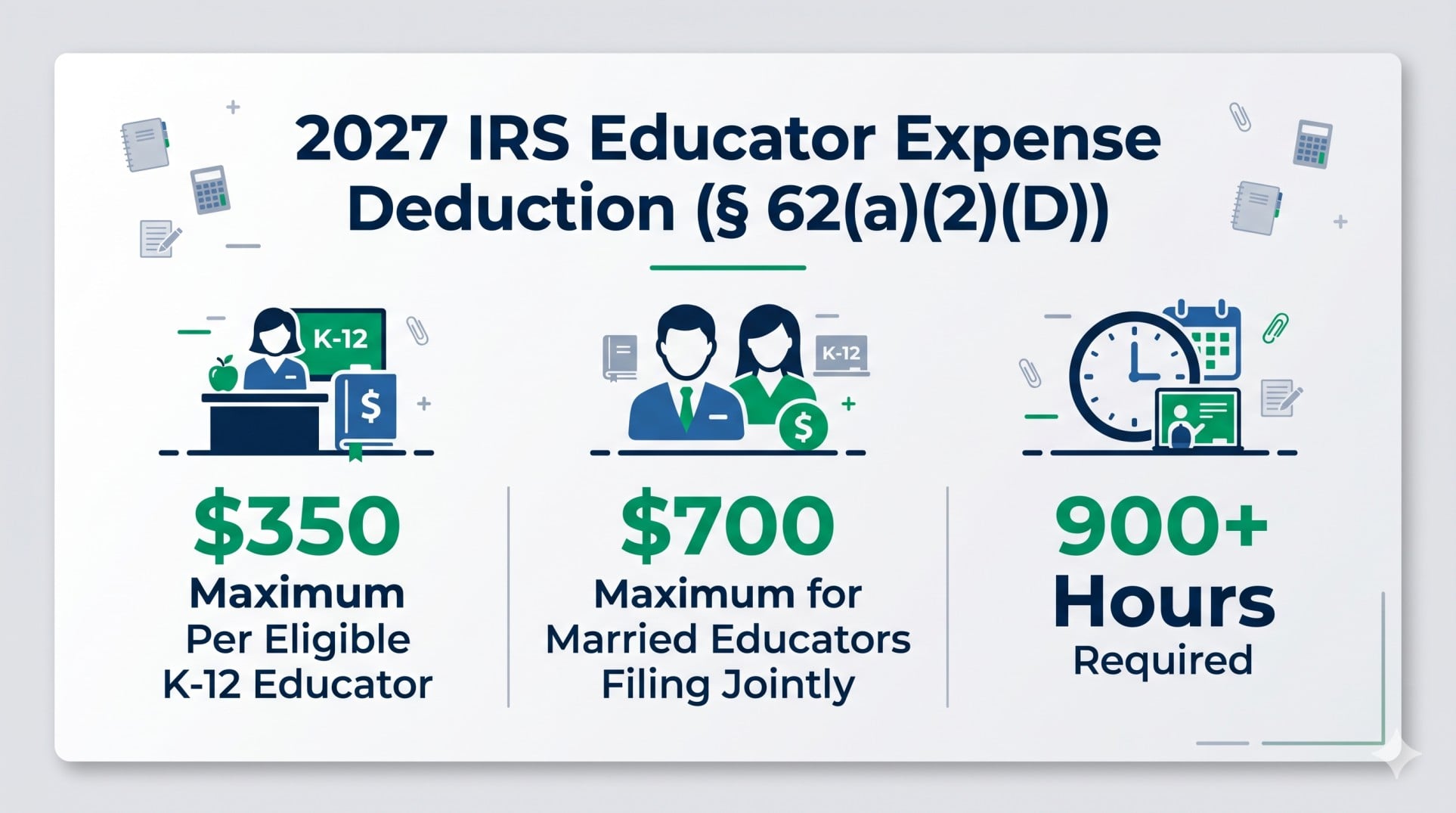
According to Section 3.13 of IRS Revenue Procedure 2026-35, the official educator expense deduction 2027 limit is $350 per eligible K-12 teacher, instructor, counselor, principal, or aide under Internal Revenue Code Section 62(a)(2)(D). If you and your spouse file a joint tax return and both qualify as eligible educators, your combined teacher tax deduction 2027 limit doubles to $700 (capped at $350 per spouse).
Because this tax break is an “above-the-line” adjustment to income reported on Schedule 1 (Form 1040), you can claim the full $350 or $700 write-off right on top of the 2027 standard deduction without itemizing. These official rules apply to unreimbursed out-of-pocket classroom expenses paid during calendar year 2027, which you’ll report on the federal tax return you file in early 2028.
⚡ Quick Numbers: 2027 Educator Expense Deduction at a Glance
- 2027 Maximum Individual Educator Deduction (IRC Sec. 62(a)(2)(D)): Up to $350 in unreimbursed out-of-pocket classroom and professional development expenses.
- 2027 Married Filing Jointly Limit (Two Eligible Educators): Up to $700 total on a joint return, provided neither spouse claims more than $350 of their own qualified expenses.
- Who Qualifies & Income Phaseout Rules: Must work at least 900 hours during the school year in a state-recognized K-12 school; there is no income cap or MAGI phaseout to claim this deduction.
- Key IRS Forms & Filing Deadline: Claim on Schedule 1 (Form 1040), Part II, Line 11 and transfer to Form 1040, Line 10 by Monday, April 17, 2028.
Table of Contents
Exact Educator Expense Deduction 2027 Numbers and IRS Limits
Under Section 3.13 of IRS Revenue Procedure 2026-35 and IRC Section 62(a)(2)(D), the educator expense deduction 2027 allows an eligible K-12 educator to deduct up to $350 of unreimbursed classroom expenses from gross income, or up to $700 if Married Filing Jointly and both spouses are eligible educators.
| Filing Status & Educator Household Type | 2027 Maximum Deduction Cap | Per-Spouse Statutory Cap | 2027 Income Phaseout Limit |
|---|---|---|---|
| Single (1 Eligible Educator) | $350 | N/A ($350 max) | None (No AGI or MAGI limit) |
| Head of Household (1 Eligible Educator) | $350 | N/A ($350 max) | None (No AGI or MAGI limit) |
| Married Filing Jointly (Only 1 Spouse is an Educator) | $350 | $350 for the educator spouse | None (No AGI or MAGI limit) |
| Married Filing Jointly (Both Spouses are Eligible Educators) | $700 | Up to $350 per spouse ($350 + $350) | None (No AGI or MAGI limit) |
| Married Filing Separately (1 Eligible Educator) | $350 | $350 on your separate return | None (Allowed on MFS returns) |
| Qualifying Surviving Spouse (1 Eligible Educator) | $350 | N/A ($350 max) | None (No AGI or MAGI limit) |
Pay close attention to the per-spouse rule for Married Filing Jointly couples where both spouses work in K-12 schools: you cannot pool one spouse’s unused limit to cover the other spouse’s overspending. If Teacher A spends $550 on classroom supplies in 2027 and Teacher B spends $100, Teacher A is capped at $350 and Teacher B can deduct $100, giving the couple a combined 2027 educator expense deduction of $450—not $650.
Unlike the 2027 student loan interest deduction—which phases out above $90,000 for Single filers and disallows Married Filing Separately returns—the K-12 classroom expense deduction 2027 has zero income limits and is fully available to Married Filing Separately taxpayers. Every qualifying K-12 educator can claim the $350 adjustment regardless of how much their household earns.
2026 vs. 2027 Educator Expense Deduction Comparison: What Changed?
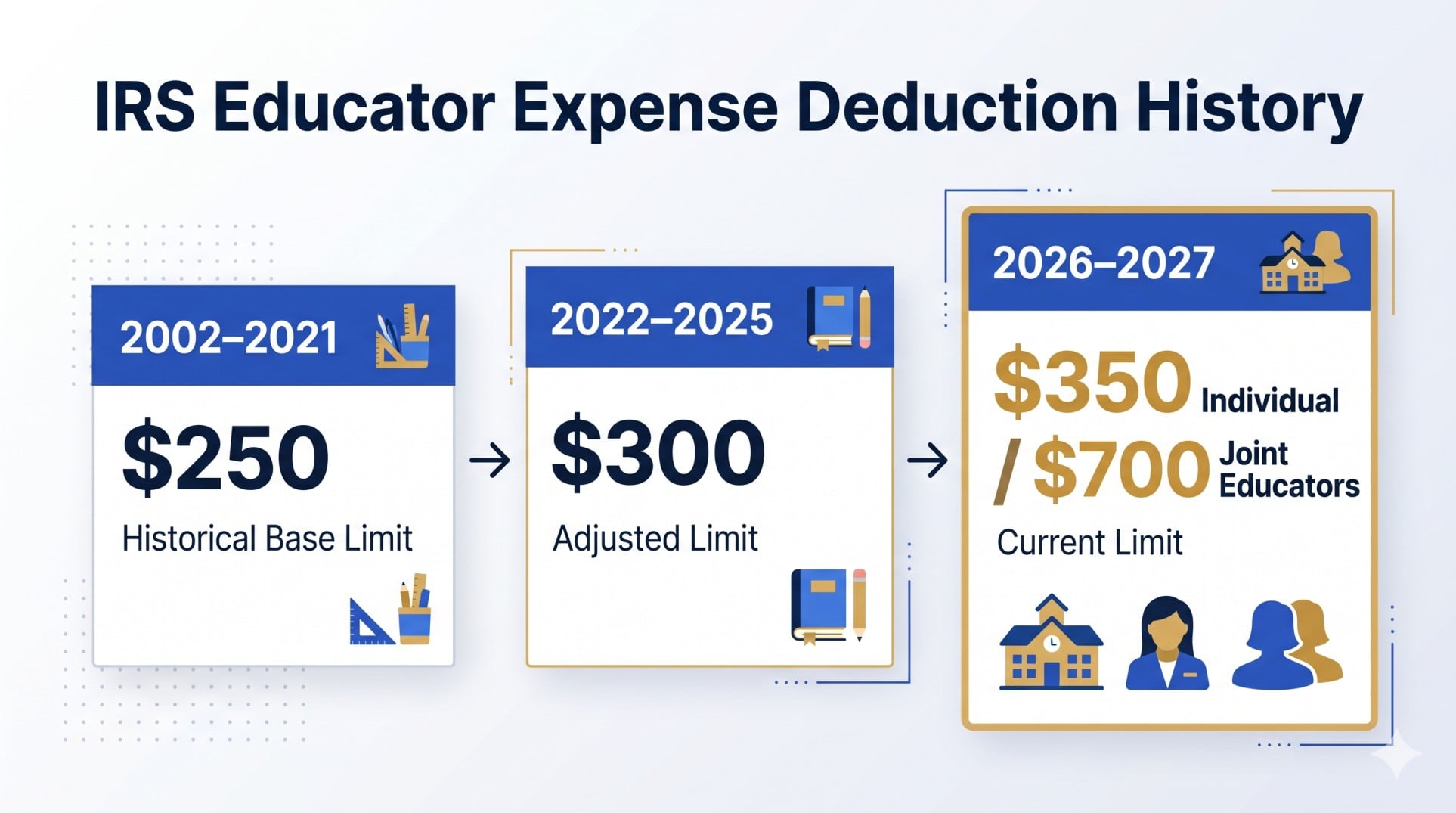
For Tax Year 2027, the IRS kept the educator expense deduction 2027 at $350 per educator (and $700 for two married educators filing jointly), matching the 2026 limit because cumulative inflation did not yet cross the next statutory $50 rounding threshold under IRC Section 62(d)(3).
| Educator & Related Tax Provision | 2022–2025 IRS Limit | 2026 IRS Limit (Rev. Proc. 2025-32) | 2027 IRS Limit (Rev. Proc. 2026-35) | 2026 vs. 2027 Change |
|---|---|---|---|---|
| Single K-12 Educator Expense Cap (§ 62(a)(2)(D)) | $300 | $350 | $350 | $0 (Unchanged at $350) |
| Joint Return — 2 Eligible K-12 Educators Cap | $600 ($300 each) | $700 ($350 each) | $700 ($350 each) | $0 (Unchanged at $700) |
| Minimum School-Year Hours Required (§ 62(d)(1)) | 900 hours | 900 hours | 900 hours | Unchanged |
| Lifetime Learning Credit MAGI Phaseout — Single (§ 25A) | $80,000–$90,000 | $80,000–$90,000 | $80,000–$90,000 | Unchanged (Up to $2,000 credit) |
| Lifetime Learning Credit MAGI Phaseout — MFJ (§ 25A) | $160,000–$180,000 | $160,000–$180,000 | $160,000–$180,000 | Unchanged (Up to $2,000 credit) |
| Employer Educational Assistance Exclusion (§ 127) | $5,250 | $5,250 | $5,420 | +$170 increase for 2027 |
Why didn’t the teacher tax deduction 2027 rise from $350 to $400? Under IRC Section 62(d)(3), the IRS indexes the original $250 statutory base amount for inflation, but the law mandates that any inflation increase must be rounded down to the nearest multiple of $50. Because the deduction just jumped by $50 in 2026 (rising from $300 to $350), it takes roughly four to five years of typical inflation to accumulate the next $50 step to $400.
What if you are a K-12 W-2 teacher who spends $1,500 out of pocket on your classroom in 2027—can you deduct the remaining $1,150 above the $350 cap as an itemized deduction on Schedule A? On your federal return, the answer is no: under the One, Big, Beautiful Bill Act (Public Law 119-21), Congress permanently repealed miscellaneous 2%-of-AGI itemized deductions for unreimbursed W-2 employee business expenses under IRC Section 67(g). For federal IRS purposes, $350 per educator is the hard ceiling for W-2 employees (though self-employed tutors or contract instructors filing Schedule C can still deduct 100% of ordinary and necessary business supplies).
Better Option for Graduate Classes & Continuing Education Courses: While you can include unreimbursed professional development course fees inside your $350 educator expense deduction 2027, teachers taking graduate classes or continuing education at an accredited college should check the Lifetime Learning Credit on Form 8863 first. The Lifetime Learning Credit pays back 20% of tuition and fees up to $2,000 as a direct tax credit—worth far more than a $350 deduction if your MAGI is below $90,000 (Single) or $180,000 (Married Filing Jointly)!
How the 2027 Teacher Tax Deduction Works & Who Qualifies
To qualify for the 2027 educator expense deduction under IRC Section 62(d)(1)(A), you must meet three strict tests regarding your role, your grade level, and your total hours worked during the school year, and only count qualified unreimbursed items.
| Category | Qualifies for the $350 Deduction (Eligible) | Does NOT Qualify (Disallowed by the IRS) |
|---|---|---|
| Eligible Roles & Grade Levels | Kindergarten through 12th grade (K-12) teachers, instructors, counselors, principals, or classroom aides | Preschool / Pre-K teachers, daycare workers, college/university professors, and non-instructional school staff |
| School Type & Hour Requirement | At least 900 hours during a school year in a public, private, or religious school providing K-12 education under state law | Homeschooling parents, summer-only instructors under 900 hours, or part-time substitutes under 900 hours |
| Classroom Books, Supplies & Tech | Books, pencils, paper, art supplies, lab materials, decorations, computer equipment, educational software & cloud apps | Items reimbursed by your school, PTA/PTO, or Crowdfunding grants (such as DonorsChoose) |
| Health & Physical Education (PE) | Athletic supplies (balls, rackets, cones, whistles, fitness gear) used in health or PE courses | Non-athletic supplies (such as textbooks, paper, or posters) used specifically for health or PE courses |
| Professional Development & Safety | Professional development courses related to the curriculum or students you teach; classroom PPE, disinfectant, soap & air purifiers | Commuting mileage to and from school, everyday teacher clothing, or union/professional association dues |
Watch out for the quirky statutory rule in IRC Section 62(a)(2)(D) for Health and Physical Education (PE) teachers: supplies purchased for health or PE classes only qualify if they are directly related to athletics! A PE teacher can deduct basketballs, jump ropes, stopwatches, and athletic cones, but cannot deduct non-athletic health class supplies under this specific code section.
You must also reduce your qualified classroom expenses by three specific offsets under IRC Section 62(d)(1)(B) before claiming the deduction on Schedule 1 Line 11 educator expenses 2027:
- School, District, or PTA Reimbursements: Any stipend or reimbursement from your employer or parent-teacher organization that is not reported as taxable wages in Box 1 of your Form W-2.
- Tax-Free Savings Bond Interest (Form 8815): Any interest from Series EE or Series I U.S. savings bonds that you excluded from income under IRC Section 135 because you used the proceeds to pay for your own professional development tuition.
- Tax-Free 529 Plan or Coverdell ESA Distributions: Any nontaxable qualified education distributions from a 529 plan or Coverdell Education Savings Account used to pay for those same expenses.
Let’s look at two clear real-world math examples for Tax Year 2027:
Example 1: Single Elementary Teacher Claiming the $350 Adjustment + Standard Deduction
Rachel is a Single 4th-grade teacher who works 1,400 hours during the school year and earns $64,000 in W-2 wages in 2027. During 2027, she spends $620 of her own money on classroom books, bulletin board supplies, educational iPad apps, and a summer reading instructional workshop, and receives a $100 tax-free reimbursement from her school’s PTA. Her net unreimbursed out-of-pocket expenses total $520 ($620 minus $100). On her 2027 tax return, Rachel claims the maximum $350 educator expense deduction 2027 on Schedule 1, Line 11, dropping her Adjusted Gross Income to $63,650 before subtracting her $16,600 Single standard deduction. Because Rachel is in the 12% 2027 federal income tax bracket, that $350 write-off saves her $42 in federal taxes (or $77 if her income places her in the 22% bracket).
Example 2: Married Couple (High School Teacher + Elementary Principal) With Uneven Spending
Marcus (a high school biology teacher) and Elena (an elementary school principal) both work over 900 hours in state-accredited K-12 schools and file Married Filing Jointly in 2027. During 2027, Marcus spends $480 out of pocket on lab supplies and software, while Elena spends $260 on professional development conferences and school materials. Even though their combined out-of-pocket spending is $740, the K-12 classroom expense deduction 2027 caps each spouse individually at $350. Marcus can deduct $350 (his maximum limit) and Elena can deduct her full $260, giving them a combined deduction of $610 on Schedule 1, Line 11.
Also separate federal IRS rules from state income tax laws. Because the teacher tax deduction 2027 reduces your federal Adjusted Gross Income (AGI), it automatically lowers your state taxable income in most states that start with federal AGI. Furthermore, states such as California, New York, Pennsylvania, Minnesota, and Alabama still allow W-2 employees to deduct unreimbursed job and classroom expenses above the federal $350 cap on their state tax returns, or offer dedicated state-level teacher tax credits.
How to Claim the Educator Expense Deduction on Your 2027 Tax Return
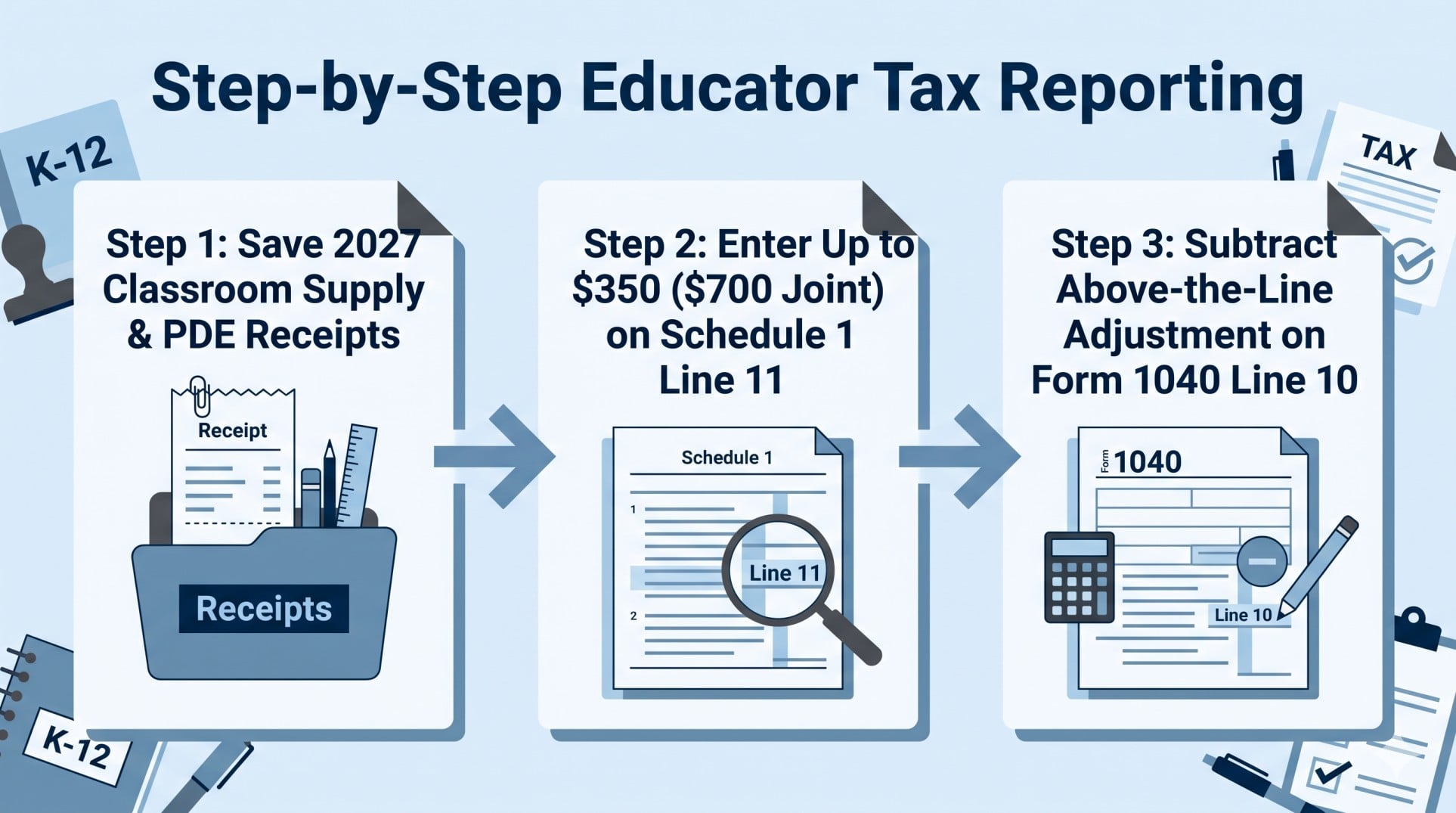
To claim the educator expense deduction 2027, you do not need to file Schedule A; simply total your receipts and enter your allowable amount (up to $350 or $700) on Schedule 1 (Form 1040), Part II, Line 11.
- Organize Your 2027 Classroom & Professional Development Receipts: Keep a dedicated folder or digital log of all receipts, credit card statements, and canceled checks for qualified K-12 classroom supplies, books, software, equipment, and professional development fees paid between January 1, 2027, and December 31, 2027. Note the date, vendor, item description, and exact dollar amount.
- Subtract Any Reimbursements or Tax-Free Education Benefits: Deduct any non-taxable school stipends, PTA/PTO reimbursements, crowdfunding grants, or tax-free 529/Coverdell/Savings Bond funds from your gross receipts to verify that your net unreimbursed out-of-pocket expenses reach at least $350 per eligible educator.
- Enter Your Deduction on Schedule 1 (Form 1040), Line 11: On Schedule 1 Line 11 educator expenses 2027 (“Educator expenses”), enter your qualified expenses up to $350. If you file Married Filing Jointly and both spouses are eligible educators, add each spouse’s qualified expenses (limiting each spouse to no more than $350) and enter the combined total up to $700 on Line 11.
- Total Your Part II Adjustments on Schedule 1, Line 26: Combine your Line 11 educator deduction with any other “above-the-line” adjustments you qualify for—such as the 2027 Health Savings Account (HSA) deduction on Line 13, traditional IRA deduction on Line 20, or student loan interest deduction on Line 21—and enter the sum on Schedule 1, Line 26.
- Transfer to Form 1040, Line 10, and File by April 17, 2028: Carry your total adjustments from Schedule 1, Line 26, to 2027 IRS Form 1040, Line 10, subtracting it from your total income on Line 9 to lower your Adjusted Gross Income on Line 11. Submit your 2027 return by Monday, April 17, 2028, and keep your classroom receipts in your tax records for at least three years.
Frequently Asked Questions
1. How much is the educator expense deduction 2027 for teachers?
According to Section 3.13 of IRS Revenue Procedure 2026-35, the official educator expense deduction 2027 is up to $350 per eligible K-12 educator under IRC Section 62(a)(2)(D). If you are Married Filing Jointly and both you and your spouse are eligible K-12 educators, you can deduct up to $700 total (up to $350 per spouse).
2. Can I claim the teacher tax deduction 2027 if I take the standard deduction?
Yes, you can claim the full teacher tax deduction 2027 even if you take the $16,600 (Single) or $33,200 (Married Filing Jointly) standard deduction. Because it is an “above-the-line” adjustment reported on Schedule 1 Line 11 educator expenses 2027, it reduces your Adjusted Gross Income before the standard deduction is applied.
3. Do preschool teachers, college professors, or homeschooling parents qualify in 2027?
No, IRC Section 62(d)(1)(A) restricts the 2027 educator expense deduction strictly to educators working in kindergarten through grade 12 (K-12) at a school that provides elementary or secondary education as determined under state law. Preschool teachers, college or university professors, and parents who homeschool their children do not qualify for the $350 deduction.
4. What is the 900-hour rule for the K-12 classroom expense deduction 2027?
To claim the K-12 classroom expense deduction 2027, you must work at least 900 hours during a school year as a K-12 teacher, instructor, counselor, principal, or classroom aide. Note that the 900-hour test is measured across the academic school year, not the January-to-December calendar year, though the expenses you deduct on your 2027 return must be paid during calendar year 2027.
5. Can teachers deduct classroom expenses over $350 as itemized deductions in 2027?
For federal tax purposes, W-2 teachers cannot deduct unreimbursed classroom expenses exceeding the $350 limit as miscellaneous itemized deductions on Schedule A because Congress permanently repealed employee business expense deductions under IRC Section 67(g). However, several states still allow teachers to deduct classroom expenses above $350 on their state income tax returns.
Disclaimer: This content provides general information for educational purposes only and reflects federal tax laws applicable to Tax Year 2027 (returns filed in 2028). Tax laws are complex and subject to change. This article does not constitute professional tax, legal, or accounting advice. Always consult a certified public accountant (CPA), enrolled agent (EA), or qualified tax attorney regarding your specific financial situation. Ourtaxpartner.com is not responsible for any actions taken based on the information provided herein.
