
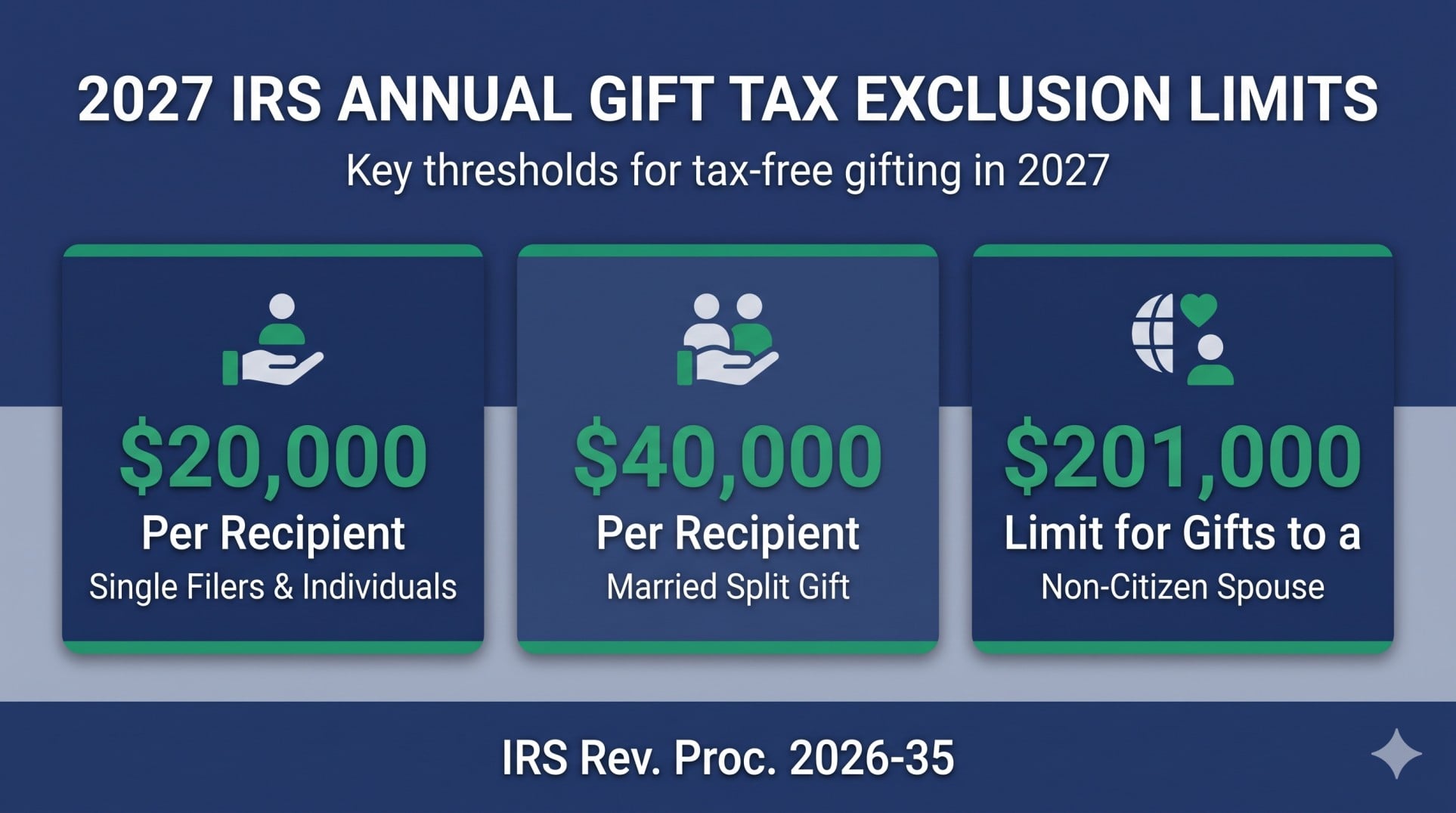
According to IRS Revenue Procedure 2026-35, the official annual gift tax exclusion 2027 allows you to give up to $20,000 per recipient tax-free without filing a gift tax return (or $40,000 per recipient for married couples who split gifts). Under IRC Sections 2503 and 2523(i)(2), the special annual exclusion for gifts to a non-U.S. citizen spouse rises to $199,000 for calendar year 2027.
You can give up to $20,000 each to as many separate individuals as you want—children, grandchildren, friends, or neighbors—during 2027 without touching your $15,480,000 lifetime gift and estate exemption. Even if you give someone more than $20,000 in 2027, you won’t owe a dime of out-of-pocket tax unless your total cumulative lifetime gifts above the annual limits surpass $15,480,000.
⚡ Quick Numbers: 2027 Annual Gift Tax Exclusion at a Glance
- 2027 Annual Gift Tax Exclusion (IRC Sec. 2503(b)): $20,000 per recipient for individual donors and $40,000 per recipient for married couples electing gift-splitting (up from $19,000 / $38,000 in 2026).
- 2027 Non-U.S. Citizen Spouse Gift Limit (IRC Sec. 2523(i)(2)): $199,000 in tax-free annual gifts to a spouse who is not a U.S. citizen (up from $194,000 in 2026).
- 529 Plan 5-Year Front-Loading & Lifetime Cushion: Front-load up to $100,000 (single) or $200,000 (married couple) into a 529 college plan in 2027; excess gifts draw against the $15,480,000 lifetime exemption.
- Key IRS Form & Filing Deadline: Report gifts exceeding the annual limits or married split gifts on IRS Form 709 by Monday, April 17, 2028.
Table of Contents
Exact Annual Gift Tax Exclusion 2027 and Non-Citizen Spouse Limits
Under Section 3.46 of IRS Revenue Procedure 2026-35 and IRC Section 2503(b), the annual gift tax exclusion 2027 is $20,000 per recipient for single donors, $40,000 per recipient for married couples splitting gifts, and $199,000 for gifts to a non-U.S. citizen spouse.
| Gift Category or Special Transfer Rule | Internal Revenue Code Section | 2027 Tax-Free Limit (Single Donor) | 2027 Tax-Free Limit (Married Couple) |
|---|---|---|---|
| Standard Annual Gift Tax Exclusion (Per Recipient) | IRC § 2503(b) | $20,000 | $40,000 (Split Gift on Form 709) |
| Gifts to a U.S. Citizen Spouse | IRC § 2523(a) | Unlimited | Unlimited |
| Gifts to a Non-U.S. Citizen Spouse (Annual Limit) | IRC §§ 2503 & 2523(i)(2) | $199,000 | N/A |
| 5-Year 529 College Plan Front-Loading Election | IRC § 529(c)(2)(B) | $100,000 | $200,000 |
| ABLE Disability Account Annual Gift Contribution | IRC § 529A(b)(2)(B)(i) | $20,000 | N/A (Capped at $20,000 per account) |
| Direct Tuition or Medical Expense Payments | IRC § 2503(e) | Unlimited (Paid directly to provider) | Unlimited (Paid directly to provider) |
| Covered Gifts/Bequests From a Covered Expatriate | IRC § 2801(c) | $20,000 | N/A |
| Foreign Gifts From Foreign Corporations/Partnerships | IRC § 6039F | $21,240.31 (Reporting Trigger) | N/A |
| Lifetime Gift & Estate Basic Exclusion Cushion | IRC §§ 2505(a) & 2010(c)(3) | $15,480,000 | $30,960,000 |
Because the 2027 gift tax limit per person applies on a per-recipient basis, there is no cap on the total dollar amount you can give away across multiple people in a single calendar year. If you have four children and six grandchildren (10 recipients total), you can give each of them $20,000 in 2027—transferring $200,000 as a single person or $400,000 with your spouse—completely free of federal gift tax.
Why is there a separate non-citizen spouse gift tax exclusion 2027 of $199,000? When both spouses are U.S. citizens, IRC Section 2523(a) provides an unlimited marital deduction, letting you transfer any amount of money or property between spouses tax-free. However, if your spouse is a green card holder (lawful permanent resident) or non-resident alien rather than a U.S. citizen, the unlimited marital deduction does not apply.
Instead, IRC Section 2523(i)(2) replaces the unlimited deduction with a “super-charged” annual exclusion of $199,000 for 2027. Any present-interest gifts to your non-citizen spouse up to $199,000 during 2027 are completely tax-free and require no IRS reporting, while gifts exceeding $199,000 reduce your 2027 lifetime gift and estate tax exemption of $15,480,000.
2026 vs. 2027 Annual Gift Tax Exclusion Comparison: What Changed?
Compared to 2026, the IRS raised the annual gift tax exclusion 2027 by $1,000 per recipient (a 5.26% jump due to statutory rounding in $1,000 increments) and increased the non-citizen spouse exclusion by $5,000.
| Gift Tax Provision | 2026 Limit (Rev. Proc. 2025-32) | 2027 Limit (Rev. Proc. 2026-35) | Year-Over-Year Increase ($ Change) |
|---|---|---|---|
| Annual Gift Tax Exclusion (Single Donor) | $19,000 | $20,000 | +$1,000 |
| Annual Gift Tax Exclusion (Married Split Gift) | $38,000 | $40,000 | +$2,000 |
| Non-U.S. Citizen Spouse Annual Gift Limit | $194,000 | $199,000 | +$5,000 |
| 5-Year 529 Plan Superfund Limit (Single Donor) | $95,000 | $100,000 | +$5,000 |
| 5-Year 529 Plan Superfund Limit (Married Couple) | $190,000 | $200,000 | +$10,000 |
| ABLE Account Annual Contribution Cap (Sec. 529A) | $19,000 | $20,000 | +$1,000 |
| Sec. 2801(c) Covered Expatriate Gift Exception | $19,000 | $20,000 | +$1,000 |
| Sec. 6039F Foreign Corporation/Partnership Gift Limit | $20,573 | $21,240.31 | +$667.31 |
| Lifetime Gift & Estate Exemption (Per Person) | $15,000,000 | $15,480,000 | +$480,000 |
Under IRC Section 2503(b)(2), the IRS only adjusts the per-recipient gift exclusion when cumulative inflation pushes the calculation across the next full $1,000 multiple. After staying at $19,000 for two years (2025 and 2026), inflation finally pushed the 2027 annual gift tax exclusion to the clean $20,000 mark.
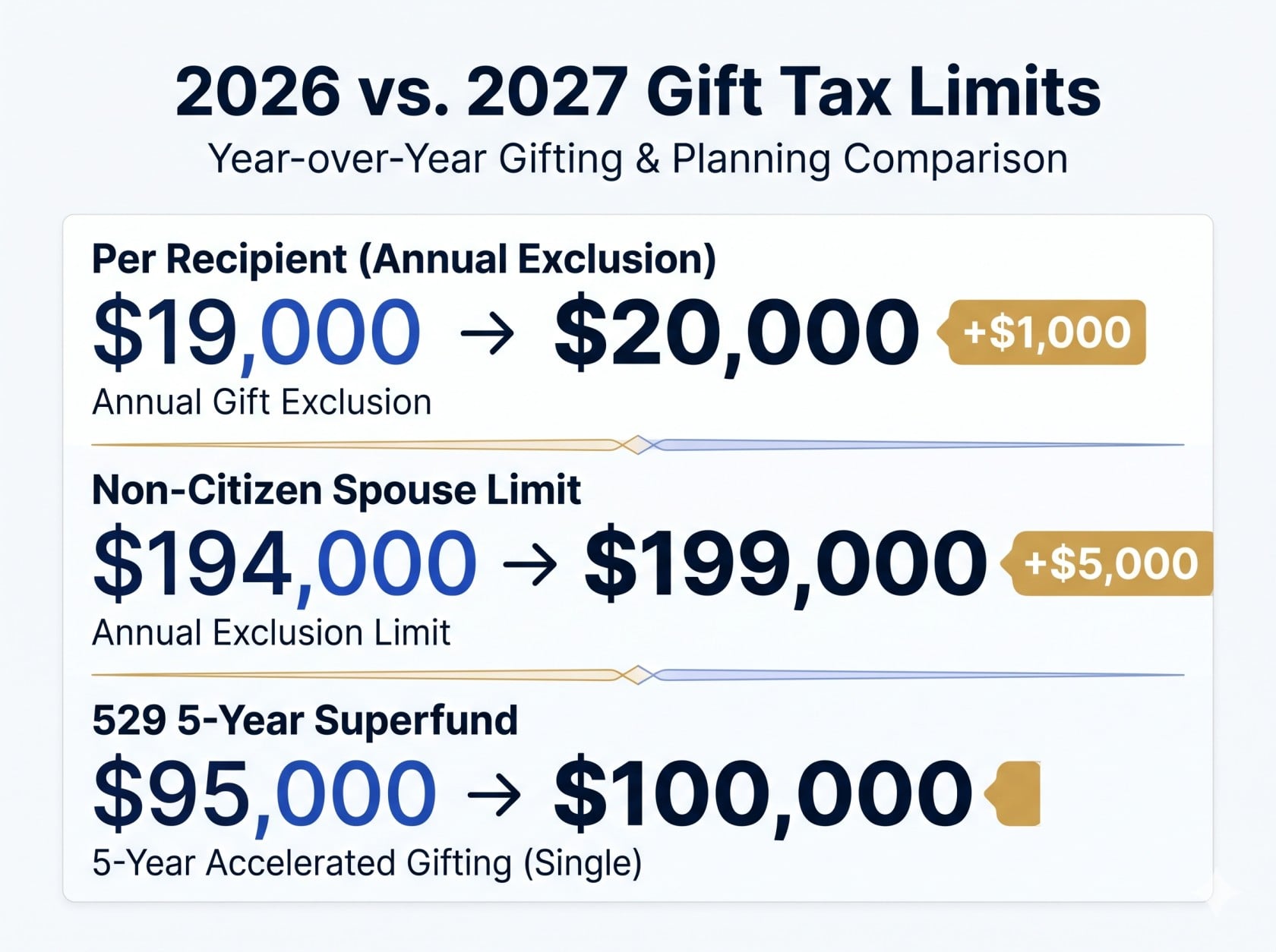
That $1,000 bump also unlocks higher limits for two popular savings vehicles in 2027:
- 529 College Savings Plan 5-Year “Superfunding”: Under IRC Section 529(c)(2)(B), you can contribute five years’ worth of annual exclusions in a single lump sum to a beneficiary’s 529 account. With the exclusion hitting $20,000 in 2027, an individual can front-load $100,000 per beneficiary (or $200,000 for a married couple), up from $95,000 and $190,000 in 2026.
- ABLE Accounts for Individuals With Disabilities: Because IRC Section 529A ties annual ABLE contributions directly to the Section 2503(b) gift exclusion, family members and account owners can contribute up to $20,000 into an ABLE account in 2027 (Section 3.36 of Revenue Procedure 2026-35).
Unlimited Tuition & Medical Gift Loophole (IRC Section 2503(e)): You can pay an unlimited amount for someone else’s school tuition or medical bills in 2027 without using a single dollar of your $20,000 annual gift exclusion or your $15,480,000 lifetime exemption. The catch? You must write the check or wire the funds directly to the university or healthcare provider—if you reimburse the student or patient directly, the payment counts toward your $20,000 limit.
How the 2027 Annual Gift Tax Exclusion Works & Who Qualifies
To qualify for the 2027 annual gift tax exclusion of $20,000 (or the $199,000 non-citizen spouse exclusion), your gift must be a transfer of a “present interest”—meaning the recipient has an immediate, unrestricted right to use, possess, or enjoy the money or property.
| Gift Scenario in 2027 | Qualifies for Annual Exclusion? | Reduces $15.48M Lifetime Exemption? | IRS Form 709 Required? |
|---|---|---|---|
| Single donor gives $20,000 or less to one recipient | Yes (Up to $20,000) | No ($0 reduction) | No |
| Married couple gives $40,000 from a joint account to one child | Yes ($20,000 per spouse) | No ($0 reduction) | No (Recommended if written from one spouse’s sole account) |
| One spouse gives $40,000 from sole assets (Electing Gift-Splitting) | Yes ($40,000 combined) | No ($0 reduction) | Yes — File Form 709 to consent to gift-splitting |
| Single donor gives $50,000 to one recipient | First $20,000 qualifies | Yes — Reduces lifetime limit by $30,000 | Yes — File Form 709 (Owe $0 tax unless over $15.48M lifetime) |
| U.S. citizen gives $199,000 or less to a non-U.S. citizen spouse | Yes (Up to $199,000) | No ($0 reduction) | No |
| U.S. citizen gives $250,000 to a non-U.S. citizen spouse | First $199,000 qualifies | Yes — Reduces lifetime limit by $51,000 | Yes — File Form 709 to report the $51,000 excess |
| Gift of a “Future Interest” (Irrevocable Trust without Crummey powers) | No ($0 annual exclusion) | Yes — Entire gift reduces lifetime limit | Yes — File Form 709 regardless of dollar amount |
Who pays the gift tax, and is a gift ever deductible on your income tax return? Under federal law, the donor (the person making the gift) is solely responsible for reporting gifts and paying any gift tax. Personal gifts to family or friends are never an “above-the-line” adjustment or “below-the-line” deduction on Form 1040—only donations to qualified 501(c)(3) charities qualify as 2027 itemized deductions on Schedule A. Meanwhile, the person receiving your gift pays $0 in federal income tax under IRC Section 102 and does not report the gift on their Form 1040.
Be careful when gifting appreciated stocks, cryptocurrency, or real estate instead of cash. Under IRC Section 1015, the recipient takes over your original “carryover cost basis” and holding period. When your recipient eventually sells that asset, they will owe 2027 long-term capital gains tax (0%, 15%, or 20%) on the gain measured from the price you originally paid.
Let’s walk through two clear real-world math examples for 2027:
Example 1: Married Couple Gifting to Children + Paying Direct University Tuition
In 2027, David and Maria (both U.S. citizens) have two married children and two grandchildren—a total of six family members (two children, two children-in-law, and two grandchildren). David and Maria elect gift-splitting to give $40,000 to each of the six family members, totaling $240,000. In addition, they pay $65,000 directly to their granddaughter’s university for tuition. Because the $65,000 direct tuition payment is exempt under IRC Section 2503(e) and each $40,000 gift falls within the split 2027 gift tax limit per person, David and Maria transfer $305,000 in 2027 while using $0 of their combined $30,960,000 lifetime exemption.
Example 2: Exceeding the $199,000 Non-Citizen Spouse Gift Tax Exclusion 2027
Claire, a U.S. citizen, is married to Mateo, an Italian citizen and U.S. green card holder. In 2027, Claire transfers $300,000 of her separate investment funds into Mateo’s individual brokerage account. Under the non-citizen spouse gift tax exclusion 2027, the first $199,000 is completely excluded under IRC Section 2523(i)(2). The remaining $101,000 ($300,000 minus $199,000) is a taxable gift that Claire must report on Form 709. Because Claire has never made prior taxable gifts, she owes $0 in gift tax; the $101,000 excess simply reduces her remaining $15,480,000 lifetime exemption to $15,379,000.
Also separate federal IRS rules from state tax laws. Currently, 49 states and the District of Columbia impose no state-level gift tax—Connecticut is the only state in the country with its own state gift tax. However, several states (such as New York and Maine) have “clawback” rules that add taxable gifts made within three years of death back into your state estate tax calculation.
How to Report Gifts Above the 2027 Exclusion on IRS Form 709
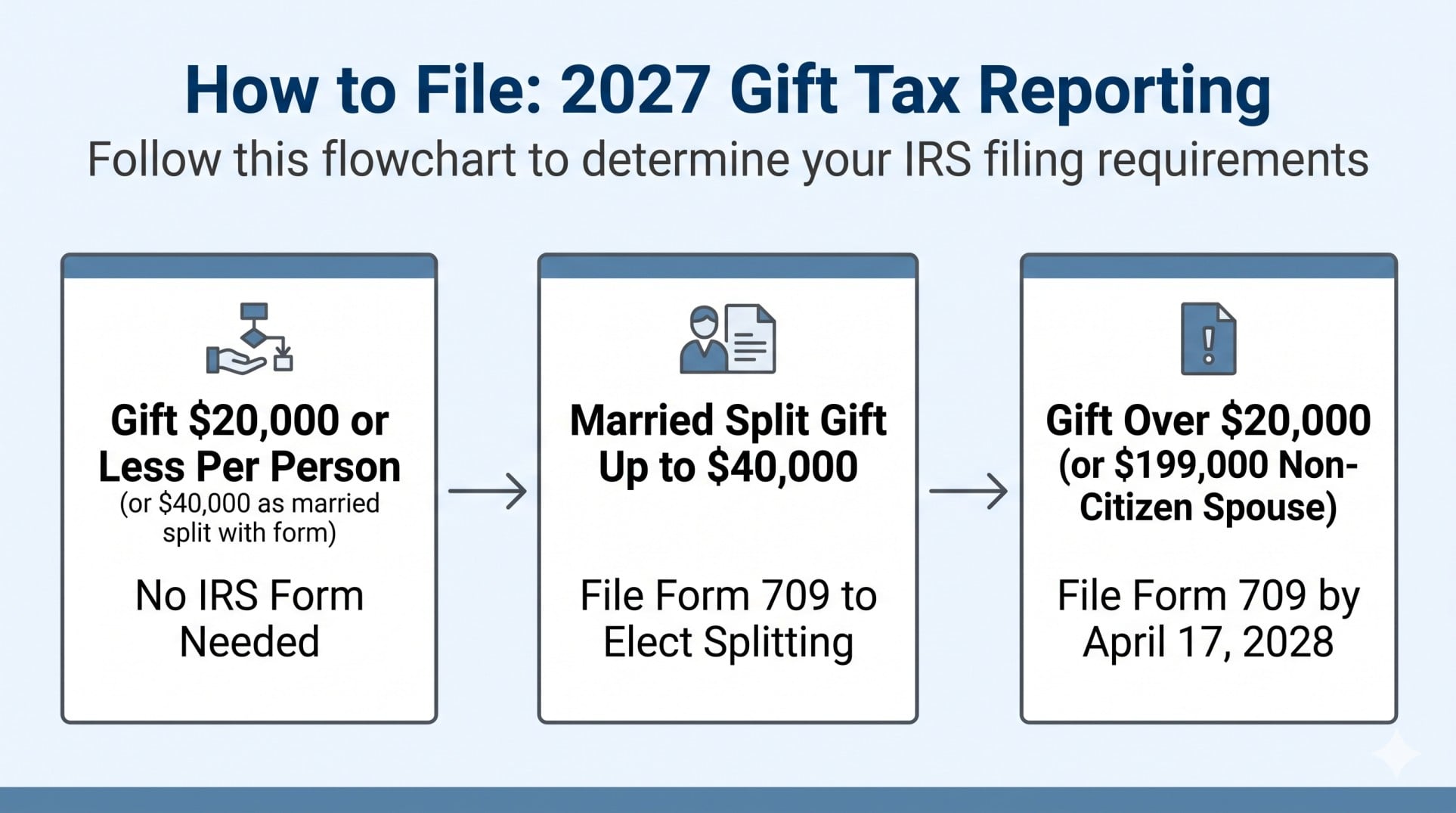
If your 2027 gifts stay at or below $20,000 per recipient (or $199,000 to a non-U.S. citizen spouse), you do not need to file anything; if you exceed the 2027 IRS gift tax return threshold or split gifts with your spouse, you must file IRS Form 709 by April 17, 2028.
- Value Your 2027 Gifts as of the Date of Transfer: Gather bank records for cash gifts, brokerage statements showing the average high/low share price on the date of transfer for stock gifts, or qualified appraisals for real estate and closely held business interests gifted during calendar year 2027.
- Complete Schedule A on IRS Form 709 (United States Gift and Generation-Skipping Transfer Tax Return): List all reportable gifts made during 2027 in Schedule A, Part 1 (or Part 2/Part 3 if the gift also skips a generation to a grandchild). Include the donee’s name, relationship, description of the asset, donor’s adjusted cost basis, date of the gift, and fair market value.
- Elect Married Gift-Splitting in Part 1 / Schedule A (If Applicable): If you and your spouse are splitting gifts up to $40,000 per recipient, check the “Yes” box for gift-splitting on Form 709, have the consenting spouse sign the Notice of Consent, and divide the gifts equally in Schedule A, Part 4. (If you are front-loading up to $100,000 or $200,000 into a 529 plan over five years, check the box in Schedule A, Question B, to spread the gift across 2027 through 2031 at $20,000 per year.)
- Subtract the $20,000 (or $199,000) Annual Exclusion and Apply Your Unified Credit: In Schedule A, Part 4, subtract up to $20,000 per donee (or up to $199,000 for a non-citizen spouse) to arrive at your total taxable gifts for 2027. Carry that number to Part 2 — Tax Computation on Page 1 of Form 709, where your available unified credit (up to $6,137,800, representing the $15,480,000 lifetime exclusion) automatically zeroes out any tax due.
- File Form 709 (and Form 3520 for Foreign Gifts) by April 17, 2028: Submit Form 709 to the IRS by Monday, April 17, 2028—note that extending your personal 2027 Form 1040 income tax return using Form 4868 automatically extends your Form 709 deadline to October 16, 2028 (or file Form 8892 if you are only extending Form 709). Additionally, if you received gifts exceeding $21,240.31 from a foreign corporation or partnership in 2027 (Section 3.51 of Rev. Proc. 2026-35) or over $100,000 from a foreign individual/estate, report the receipt on IRS Form 3520 by April 17, 2028.
Make sure any check mailed or delivered near year-end is deposited and clears the donor’s bank by December 31, 2027, so the IRS counts the transfer toward your 2027 exclusion rather than 2028.
Frequently Asked Questions
1. How much is the annual gift tax exclusion 2027 per recipient?
According to Section 3.46(1) of IRS Revenue Procedure 2026-35, the annual gift tax exclusion 2027 is $20,000 per recipient for single donors under IRC Section 2503(b). Married couples who elect gift-splitting on IRS Form 709 can give up to $40,000 per recipient in 2027 without reducing their lifetime exemption.
2. What is the non-citizen spouse gift tax exclusion 2027?
Under IRC Sections 2503 and 2523(i)(2), the non-citizen spouse gift tax exclusion 2027 is $199,000, up from $194,000 in 2026. You can transfer up to $199,000 in present-interest gifts to a spouse who is not a U.S. citizen during 2027 without filing Form 709 or using your lifetime exemption.
3. Do I owe gift tax if I give someone more than $20,000 in 2027?
No, exceeding the 2027 gift tax limit per person of $20,000 only triggers a paperwork requirement on IRS Form 709, not an immediate tax bill. The amount above $20,000 is simply subtracted from your $15,480,000 lifetime gift and estate tax exemption, and you pay $0 tax until that entire $15,480,000 pool is exhausted.
4. Does the person receiving a gift in 2027 have to report it on Form 1040?
No, gifts are completely tax-free to the recipient under IRC Section 102 and are never reported as income on the recipient’s Form 1040. The only exception is if a U.S. resident receives gifts over $100,000 from a foreign individual/estate or over $21,240.31 from a foreign corporation/partnership in 2027, which requires an informational report on Form 3520.
5. What is the 2027 IRS gift tax return threshold for married couples splitting gifts?
The 2027 IRS gift tax return threshold is $20,000 per recipient, but married couples must also file Form 709 whenever they elect to split a gift made from one spouse’s separate funds—even if the combined gift is $40,000 or less. To avoid filing Form 709 on gifts up to $40,000, each spouse can write a separate $20,000 check to the recipient.
Disclaimer: This content provides general information for educational purposes only and reflects federal tax laws applicable to Tax Year 2027 (returns filed in 2028). Tax laws are complex and subject to change. This article does not constitute professional tax, legal, or accounting advice. Always consult a certified public accountant (CPA), enrolled agent (EA), or qualified tax attorney regarding your specific financial situation. Ourtaxpartner.com is not responsible for any actions taken based on the information provided herein.
