
According to IRS Revenue Procedure 2026-35, the official estate tax exemption 2027 rises to $15,480,000 per individual and $30,960,000 for married couples under Internal Revenue Code Section 2010(c)(3). For calendar year 2027, the IRS also raised the annual gift tax exclusion to $20,000 per recipient ($40,000 per married couple splitting gifts).
Because the federal estate tax and gift tax share a unified credit, this $15,480,000 basic exclusion amount also serves as your lifetime gift tax exemption 2027 and your generation-skipping transfer (GST) tax exemption. Any taxable estate or lifetime gift transfers above these thresholds face a top federal transfer tax rate of 40%.
⚡ Quick Numbers: 2027 Federal Estate and Gift Tax Exemption at a Glance
- 2027 Basic Exclusion Amount (Estate, Lifetime Gift & GST): $15,480,000 per individual ($30,960,000 for married couples using portability), up from $15,000,000 in 2026.
- 2027 Annual Gift Tax Exclusion (IRC Sec. 2503(b)): $20,000 per recipient for individual donors ($40,000 for married couples electing gift-splitting), up from $19,000 in 2026.
- Non-Citizen Spouse & Special Estate Limits (2027): Tax-free annual gifts to a non-U.S. citizen spouse rise to $201,000; special use valuation reductions under Section 2032A cap at $1,500,000.
- Key IRS Forms & Deadlines: Report 2027 taxable gifts on Form 709 by April 17, 2028; file Form 706 for estates or portability within 9 months of the decedent’s date of death.
Table of Contents
Exact Estate Tax Exemption 2027 and Lifetime Gift Limits
Under Sections 3.44 through 3.56 of IRS Revenue Procedure 2026-35, the estate tax exemption 2027 is $15,480,000 per decedent, while the 2027 annual gift tax exclusion allows you to give up to $20,000 to as many separate individuals as you want without filing a gift tax return.
| Federal Transfer Tax Provision | Internal Revenue Code Section | Official 2027 IRS Limit (Individual) | Official 2027 IRS Limit (Married Couple) |
|---|---|---|---|
| Basic Exclusion Amount (Estate Tax Exemption) | IRC § 2010(c)(3) | $15,480,000 | $30,960,000 |
| Lifetime Gift Tax Exemption (Unified Credit) | IRC § 2505(a)(1) | $15,480,000 | $30,960,000 |
| Generation-Skipping Transfer (GST) Tax Exemption | IRC § 2631(c) | $15,480,000 | $30,960,000 (No Portability) |
| Annual Gift Tax Exclusion (Per Donee/Recipient) | IRC § 2503(b) | $20,000 | $40,000 (With Gift-Splitting) |
| 5-Year 529 Plan Front-Loading Gift Limit | IRC § 529(c)(2)(B) | $100,000 | $200,000 |
| Annual Gift Exclusion to a Non-U.S. Citizen Spouse | IRC §§ 2503 & 2523(i)(2) | $201,000 | N/A |
| Covered Gifts/Bequests From a Covered Expatriate | IRC § 2801(c) | $20,000 | N/A |
| Special Use Valuation Reduction Cap (Farms & Closely Held Real Estate) | IRC § 2032A | $1,500,000 | N/A |
| Estate Tax 2% Installment Interest Portion | IRC §§ 6166 & 6601(j) | $2,010,000 | N/A |
| Foreign Gift Reporting Threshold (From Foreign Individuals/Estates) | IRC § 6039F | $21,240.31 | N/A |
Why is the 2027 federal estate and gift tax exemption over $15 million instead of dropping back down to ~$7 million as originally scheduled under the 2017 tax law? The One, Big, Beautiful Bill Act (Public Law 119-21) permanently prevented the post-2025 sunset, raised the statutory base exclusion to $15,000,000 for 2026, and indexed that higher baseline for inflation starting in 2027.
That $15,480,000 basic exclusion translates into an applicable unified credit of $6,137,800 against federal estate and gift taxes in 2027. Unless your cumulative lifetime taxable gifts plus your net taxable estate at death surpass $15,480,000, you owe $0 in federal estate or gift tax.
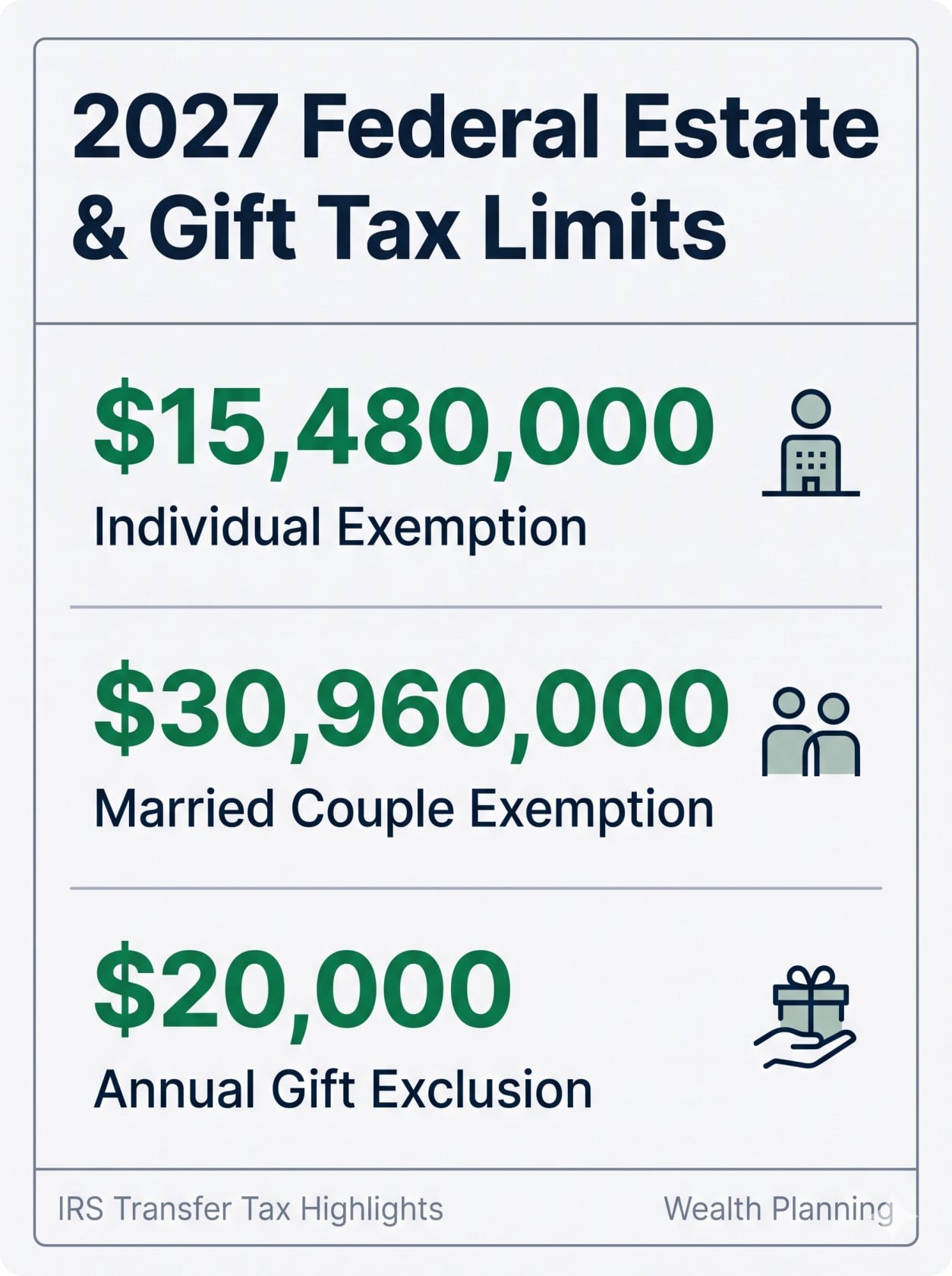
In addition to the lifetime limit, the increase in the 2027 annual gift tax exclusion to $20,000 per recipient triggers a major boost for education and disability savings. Under Section 3.36 of Revenue Procedure 2026-35, the annual contribution limit for ABLE accounts under IRC Section 529A also rises to $20,000 for 2027, and parents or grandparents funding a 529 college savings plan can now “superfund” up to $100,000 per beneficiary ($200,000 per married couple) in a single year using five-year gift averaging.
2026 vs. 2027 Estate Tax Exemption Comparison: What Changed?
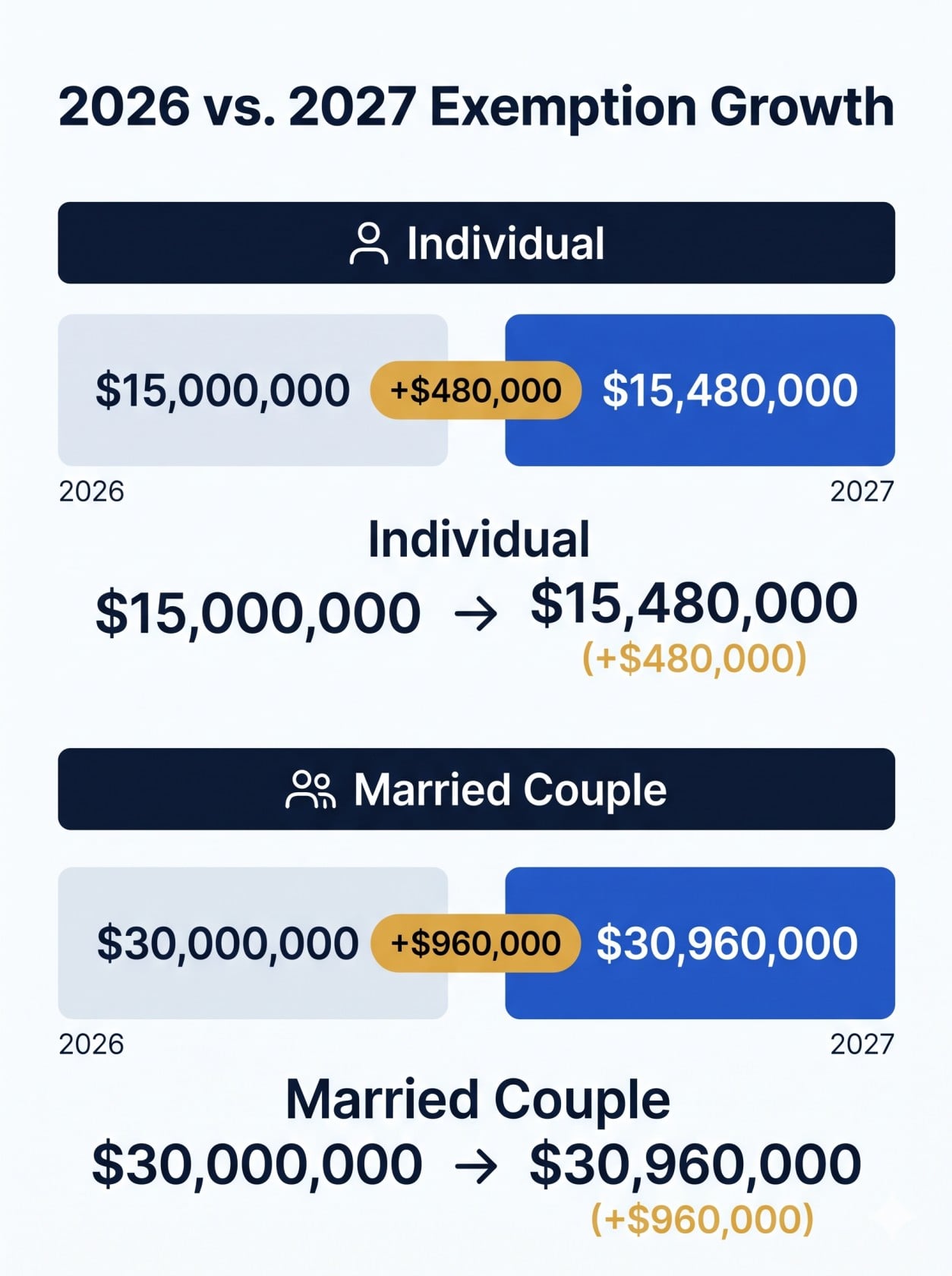
For calendar year 2027, the IRS raised the estate tax exemption 2027 by $480,000 per person (a 3.2% increase over 2026) and bumped the annual gift exclusion up by $1,000 per recipient.
| Estate & Gift Tax Item | 2026 Official IRS Limit | 2027 Official Limit (Rev. Proc. 2026-35) | Year-Over-Year Increase ($ Change) |
|---|---|---|---|
| Individual Estate, Gift & GST Exemption | $15,000,000 | $15,480,000 | +$480,000 |
| Married Couple Combined Exemption (Portability) | $30,000,000 | $30,960,000 | +$960,000 |
| Annual Gift Tax Exclusion (Single Donor) | $19,000 | $20,000 | +$1,000 |
| Annual Gift Tax Exclusion (Married Split Gift) | $38,000 | $40,000 | +$2,000 |
| 5-Year 529 Plan Superfund Limit (Single / Couple) | $95,000 / $190,000 | $100,000 / $200,000 | +$5,000 / +$10,000 |
| Annual Gift Limit to Non-Citizen Spouse | $194,000 | $201,000 | +$7,000 |
| Sec. 2032A Special Use Valuation Decrease Cap | $1,460,000 | $1,500,000 | +$40,000 |
| Sec. 6601(j) 2-Percent Estate Installment Portion | $1,940,000 | $2,010,000 | +$70,000 |
What does this $480,000 inflation adjustment mean if you already maxed out your $15,000,000 lifetime exemption in 2026? You gain an extra $480,000 of tax-free gifting capacity on January 1, 2027 (or an extra $960,000 for a married couple) that you can transfer to an irrevocable trust, family limited partnership, or heirs without triggering the 40% gift tax.
Closely held family businesses and farms also benefit from two targeted inflation increases in Revenue Procedure 2026-35. First, Section 3.45 raises the maximum estate valuation reduction for qualified farm or business real estate under IRC Section 2032A from $1,460,000 to $1,500,000. Second, Section 3.56 increases the “2-percent portion” for deferred estate tax installment payments on closely held businesses under IRC Sections 6166 and 6601(j) from $1,940,000 to $2,010,000.
Estate & Income Tax Strategy Tip: Assets held until death generally receive a full “step-up in basis” to fair market value under IRC Section 1014, wiping out unrealized 2027 long-term capital gains taxes for your heirs. By contrast, assets gifted during your lifetime under the lifetime gift tax exemption 2027 retain your original “carryover cost basis” under IRC Section 1015. Weigh the 40% estate tax against the 15% to 23.8% capital gains rate before gifting highly appreciated property.
How the 2027 Federal Estate and Gift Tax Exemption Works & Who Qualifies
The 2027 federal estate and gift tax exemption works as a two-tier shield: annual gifts up to $20,000 per recipient never count against you, and only gifts exceeding $20,000 in a single year reduce your $15,480,000 lifetime pool.
| Type of Wealth Transfer | 2027 Dollar Limit | Reduces $15.48M Lifetime Exemption? | IRS Form Required? |
|---|---|---|---|
| Gifts at or Below Annual Exclusion (Present Interest) | Up to $20,000 per recipient ($40,000 split) | No | No (Unless splitting gifts on Form 709) |
| Direct Tuition or Medical Payments (IRC § 2503(e)) | Unlimited (Must be paid directly to school/provider) | No | No |
| Gifts or Bequests to a U.S. Citizen Spouse (IRC § 2523/2056) | Unlimited (Marital Deduction) | No | No |
| Gifts to a Non-U.S. Citizen Spouse (IRC § 2523(i)(2)) | Up to $201,000 per year | No (Only excess over $201,000 reduces lifetime limit) | Form 709 if over $201,000 |
| Qualified Charitable Gifts & Bequests (IRC § 2522/2055) | Unlimited | No | Form 709 / Form 706 if over filing thresholds |
| Lifetime Gifts Exceeding the $20,000 Annual Exclusion | Up to $15,480,000 cumulative lifetime total | Yes (Dollar-for-dollar above $20,000) | Yes — File Form 709 (No tax owed until $15.48M is exhausted) |
Note that gifts are never an “above-the-line” or “below-the-line” deduction on your personal Form 1040 income tax return, and the recipient of a gift does not report the gift as taxable income under IRC Section 102. Only transfers to qualified 501(c)(3) charities can be claimed as itemized deductions on Schedule A.
How does marital “portability” work compared to the 2027 generation-skipping transfer tax exemption? Under IRC Section 2010(c)(4), if the first spouse dies in 2027 without using their full $15,480,000 exemption, the surviving spouse can elect to carry over the Deceased Spousal Unused Exclusion (DSUE), creating up to a $30,960,000 combined shield. However, the 2027 generation-skipping transfer tax exemption of $15,480,000 (which protects transfers to grandchildren or dynasty trusts from an extra 40% GST tax) is not portable between spouses unless you use specialized trust planning such as a Reverse QTIP election.
Let’s look at two practical math examples for 2027:
Example 1: Using the $20,000 Annual Exclusion vs. the $15,480,000 Lifetime Gift Exemption
In 2027, Robert (an unmarried widower with no prior taxable gifts) gives $20,000 each to his three nieces and gives $520,000 to his son to buy a house. The three $20,000 gifts to his nieces ($60,000 total) fall completely within the 2027 annual gift tax exclusion, so they require no reporting and do not touch his lifetime limit. For the $520,000 gift to his son, the first $20,000 is sheltered by the annual exclusion, leaving a $500,000 taxable gift that Robert must report on Form 709. Robert owes $0 out of pocket; instead, the $500,000 excess simply reduces his remaining lifetime gift tax exemption 2027 from $15,480,000 down to $14,980,000.
Example 2: High-Net-Worth Married Couple Using DSUE Portability and the 40% Estate Tax Rate
Arthur dies in March 2027 with a gross estate of $12,000,000, leaving everything outright to his surviving U.S. citizen wife, Evelyn. Because transfers to a U.S. citizen spouse qualify for the unlimited marital deduction, Arthur’s estate uses $0 of his $15,480,000 estate tax exemption 2027, and his executor timely files Form 706 to transfer his full $15,480,000 DSUE to Evelyn. If Evelyn passes away later in November 2027 with a total combined taxable estate of $33,960,000, her estate subtracts her combined $30,960,000 exemption (her own $15,480,000 plus Arthur’s $15,480,000 DSUE), leaving $3,000,000 subject to the 40% federal estate tax, resulting in an estate tax bill of $1,200,000.
Keep in mind that federal IRS exemptions do not protect you from state-level death taxes. Twelve states and the District of Columbia impose their own state estate tax—with state exemptions starting as low as $1,000,000 in Oregon and $2,000,000 in Massachusetts—while six states (Iowa, Kentucky, Maryland, Nebraska, New Jersey, and Pennsylvania) levy a state inheritance tax based on the heir’s relationship to the decedent, and Connecticut imposes its own state gift tax.
How to Report Gifts and Estate Transfers on IRS Forms 709 and 706
To report 2027 lifetime gifts above $20,000 or claim the estate tax exemption 2027, donors and executors must file dedicated transfer tax returns with the IRS rather than reporting these figures on Form 1040.
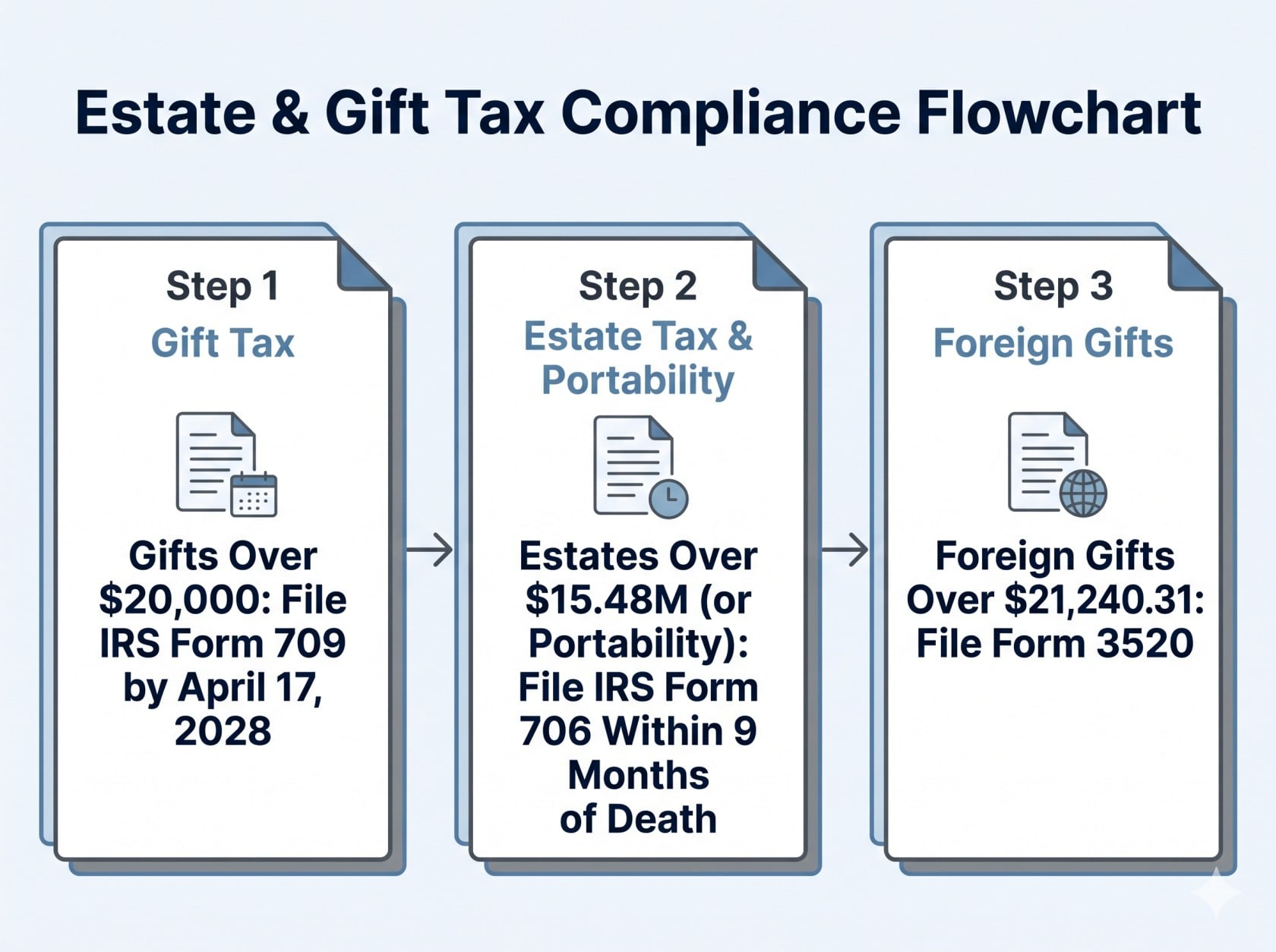
- File IRS Form 709 for 2027 Gifts Over $20,000 (Due April 17, 2028): If you give more than $20,000 to any single person in 2027, gift a future interest (such as certain trust contributions), or elect to split gifts up to $40,000 with your spouse, file Form 709 (United States Gift and Generation-Skipping Transfer Tax Return). Enter your gross gifts in Part 1 of Schedule A, subtract the $20,000 annual exclusion per recipient, and apply your unified credit in Part 2 (Tax Computation) against the $15,480,000 lifetime limit by Monday, April 17, 2028 (or October 16, 2028, if you file Form 4868 or Form 8892 for an extension).
- File IRS Form 706 for Estates Over $15,480,000 or Portability (Within 9 Months of Death): If an individual dies in 2027 with a gross estate plus adjusted taxable lifetime gifts exceeding $15,480,000, the executor must file Form 706 (United States Estate and Generation-Skipping Transfer Tax Return) within 9 months of the date of death (an automatic 6-month filing extension is available via Form 4768).
- Elect Marital Portability on Form 706 Part 6 (Even for Smaller Estates): If a married person dies in 2027 with an estate below $15,480,000, the executor must still file a complete Form 706 to lock in the unused DSUE for the surviving spouse. Under Rev. Proc. 2022-32, estates below the filing threshold that miss the 9-month deadline have up to 5 years from the date of death to file a late portability-only Form 706.
- Provide Basis Statements to Heirs on Form 8971 (Within 30 Days of Form 706): For taxable estates required to file Form 706 under IRC Section 6018, the executor must also file Form 8971 (Information Regarding Beneficiaries Acquiring Property From a Decedent) and distribute Schedule A to each beneficiary within 30 days of filing Form 706 to establish their stepped-up income tax basis.
- Report Large Gifts From Foreign Persons on Form 3520 (If Over $21,240.31): Under Section 3.51 of IRS Revenue Procedure 2026-35 and IRC Section 6039F, if a U.S. person receives gifts from a foreign corporation or foreign partnership exceeding $21,240.31 in 2027 (or over $100,000 from a nonresident alien individual or foreign estate under IRS Notice 97-34), the recipient must report the transfer on Form 3520 by April 17, 2028. Also remember that undistributed income earned inside a decedent’s estate or non-grantor trust in 2027 must be reported on Form 1041, where the top 37% 2027 federal income tax rate for estates and trusts begins at just $16,750 of taxable income.
Frequently Asked Questions
1. What is the official estate tax exemption 2027 per person and for married couples?
According to Section 3.44 of IRS Revenue Procedure 2026-35, the official estate tax exemption 2027 is $15,480,000 per individual under IRC Section 2010(c)(3). Married couples who elect portability on IRS Form 706 can shield up to $30,960,000 from the 40% federal estate tax.
2. How much is the 2027 annual gift tax exclusion?
The 2027 annual gift tax exclusion rises to $20,000 per recipient (up from $19,000 in 2026) under IRC Section 2503(b). Married couples who elect gift-splitting on IRS Form 709 can give up to $40,000 per recipient in 2027 without touching their $15,480,000 lifetime exemption.
3. Does using the lifetime gift tax exemption 2027 reduce my estate tax exemption at death?
Yes, because the federal gift and estate tax systems are unified under IRC Sections 2010 and 2505, every dollar of your lifetime gift tax exemption 2027 that you use for gifts above the $20,000 annual limit reduces the remaining exemption available for your estate at death. If you gift $5,480,000 above the annual exclusions during your life, you will have $10,000,000 left for your estate in 2027.
4. Do I pay tax if I give someone more than $20,000 in 2027?
No, you do not owe any out-of-pocket gift tax unless your total cumulative lifetime taxable gifts exceed $15,480,000. Giving someone more than $20,000 in 2027 simply means you must file IRS Form 709 by April 17, 2028, to subtract the excess amount from your $15,480,000 lifetime pool.
5. What is the 2027 gift tax limit for a non-U.S. citizen spouse?
While gifts between U.S. citizen spouses are unlimited, gifts to a spouse who is not a U.S. citizen do not qualify for the unlimited marital deduction. Under Section 3.46(2) of IRS Revenue Procedure 2026-35 and IRC Section 2523(i)(2), you can give up to $201,000 tax-free to a non-citizen spouse in 2027, up from $194,000 in 2026.
Disclaimer: This content provides general information for educational purposes only and reflects federal tax laws applicable to Tax Year 2027 (returns filed in 2028). Tax laws are complex and subject to change. This article does not constitute professional tax, legal, or accounting advice. Always consult a certified public accountant (CPA), enrolled agent (EA), or qualified tax attorney regarding your specific financial situation. Ourtaxpartner.com is not responsible for any actions taken based on the information provided herein.
