
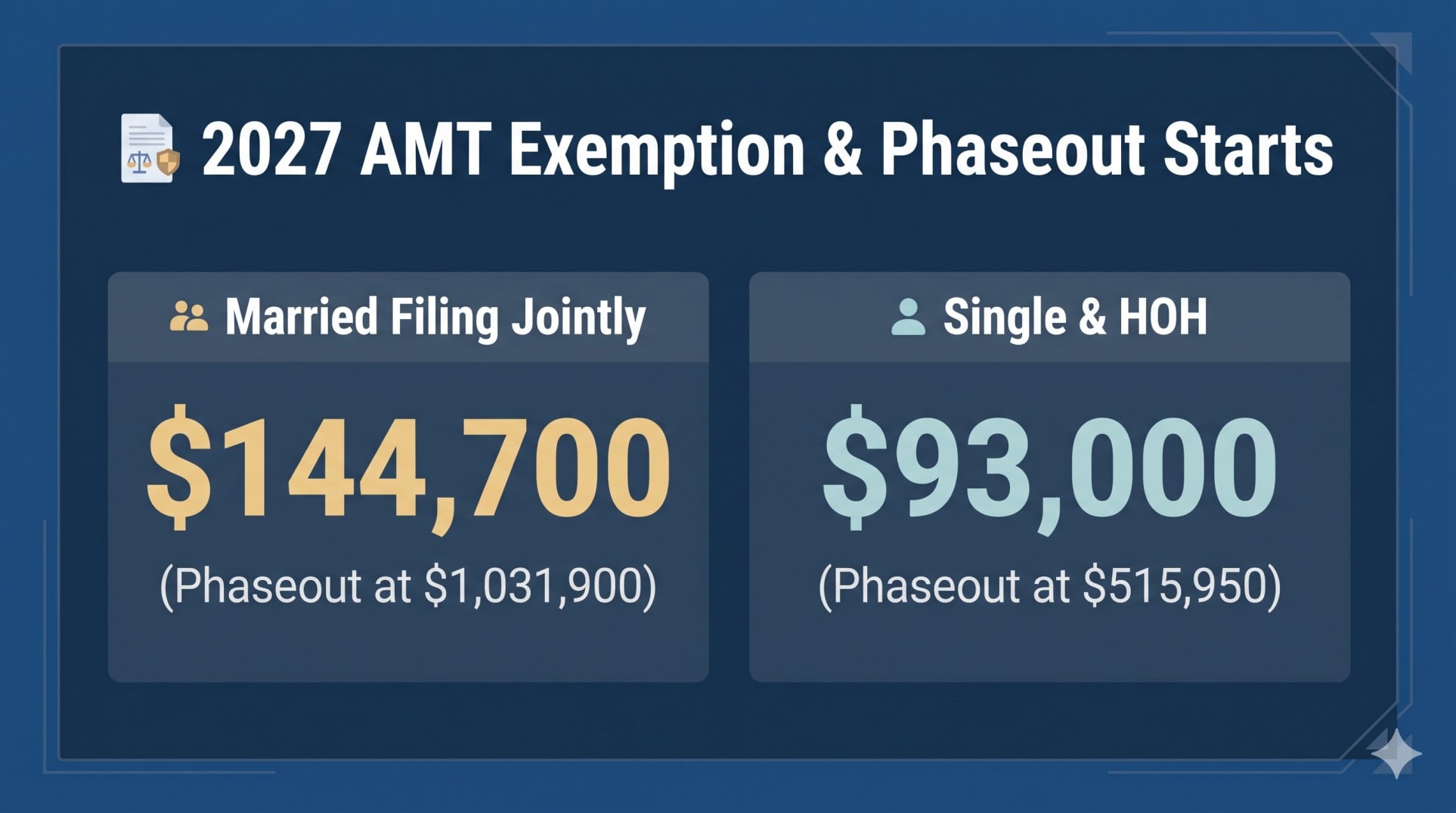
According to IRS Revenue Procedure 2026-35, the official AMT exemption 2027 rises to $144,700 for Married Filing Jointly couples and $93,000 for Single and Head of Household filers (slightly higher than early third-party estimates of $144,200 and $92,700). Under IRC Section 55(d)(2), exemption phaseouts for Tax Year 2027 begin at $1,031,900 for joint filers and $515,950 for unmarried individuals.
These inflation-adjusted figures apply to income earned during Tax Year 2027, which you’ll report on the federal return you file in early 2028. While the 2027 AMT exemption shields most middle-income households, changes enacted under the One, Big, Beautiful Bill Act (Public Law 119-21) mean high earners and employees exercising Incentive Stock Options (ISOs) face a faster 50% exemption phaseout once their income crosses the IRS threshold.
⚡ Quick Numbers: 2027 Alternative Minimum Tax (AMT) at a Glance
- Official 2027 AMT Exemption Amounts: $144,700 for Married Filing Jointly & Surviving Spouses, $93,000 for Single & Head of Household, $72,350 for Married Filing Separately, and $32,500 for Estates and Trusts.
- 2027 Phaseout Start & Complete Phaseout Limits: Phaseout begins at $1,031,900 (completely phased out at $1,321,300) for joint filers, and begins at $515,950 (completely phased out at $701,950) for Single and Head of Household filers.
- 26% vs. 28% AMT Bracket Threshold (2027): The 26% AMT rate applies to Alternative Minimum Taxable Income (AMTI) above the exemption up to $252,500 ($126,250 if Married Filing Separately); the 28% rate applies above that ceiling.
- Key IRS Forms & Filing Deadline: Calculate AMT on Form 6251 (or Form 8801 for prior-year minimum tax credits) and file with Form 1040 by April 17, 2028.
Table of Contents
Exact AMT Exemption 2027 Numbers and Phaseout Limits
Under Section 3.11 of IRS Revenue Procedure 2026-35 and IRC Section 55(d), the AMT exemption 2027 lets Single filers deduct $93,000 and Married Filing Jointly filers deduct $144,700 from their Alternative Minimum Taxable Income (AMTI) before calculating tentative minimum tax.
| Filing Status | 2027 AMT Exemption Amount | 2027 Phaseout Threshold (Starts) | 2027 Complete Phaseout (Exemption = $0) |
|---|---|---|---|
| Unmarried Individuals (Single & Head of Household) | $93,000 | $515,950 | $701,950 |
| Married Filing Jointly & Surviving Spouses | $144,700 | $1,031,900 | $1,321,300 |
| Married Filing Separately | $72,350 | $515,950 | $660,650 |
| Estates and Trusts | $32,500 | $108,200 | $173,200 |
| Child Subject to “Kiddie Tax” (IRC Sec. 59(j)) | Earned Income + $10,050 (Max $93,000) | $515,950 | $701,950 |
Why do some early tax blogs list $144,200 (joint) and $92,700 (single) with phaseouts of $1,310,700 and $655,350? Those were preliminary third-party estimates published before the IRS released Revenue Procedure 2026-35, and they also failed to account for the statutory reset of the phaseout thresholds under the One, Big, Beautiful Bill Act (Public Law 119-21).
Under the enacted law and official IRS tables in Revenue Procedure 2026-35, the 2027 AMT phaseout limits start at $515,950 for Single filers and $1,031,900 for joint filers. Once your AMTI surpasses your filing status threshold, your exemption shrinks by 50 cents for every dollar of excess AMTI until it disappears completely at $701,950 (Single) or $1,321,300 (Married Filing Jointly).
After subtracting your allowable Alternative Minimum Tax exemption 2027 from your AMTI, the remaining balance (called your ” taxable excess”) is taxed across two statutory 2027 Alternative Minimum Tax brackets under IRC Section 55(b)(1):
| Filing Status | 26% AMT Tax Bracket (Taxable Excess) | 28% AMT Tax Bracket (Taxable Excess) |
|---|---|---|
| Single, Head of Household, Married Filing Jointly & Estates/Trusts | $0 to $252,500 | Over $252,500 |
| Married Filing Separately | $0 to $126,250 | Over $126,250 |
Note that preferential rates for 2027 long-term capital gains and qualified dividends (0%, 15%, and 20%) still apply inside the AMT calculation. However, large capital gains increase your overall AMTI, which can push you past the $515,950 or $1,031,900 threshold and wipe out your AMT exemption.
2026 vs. 2027 AMT Exemption Comparison: What Changed?
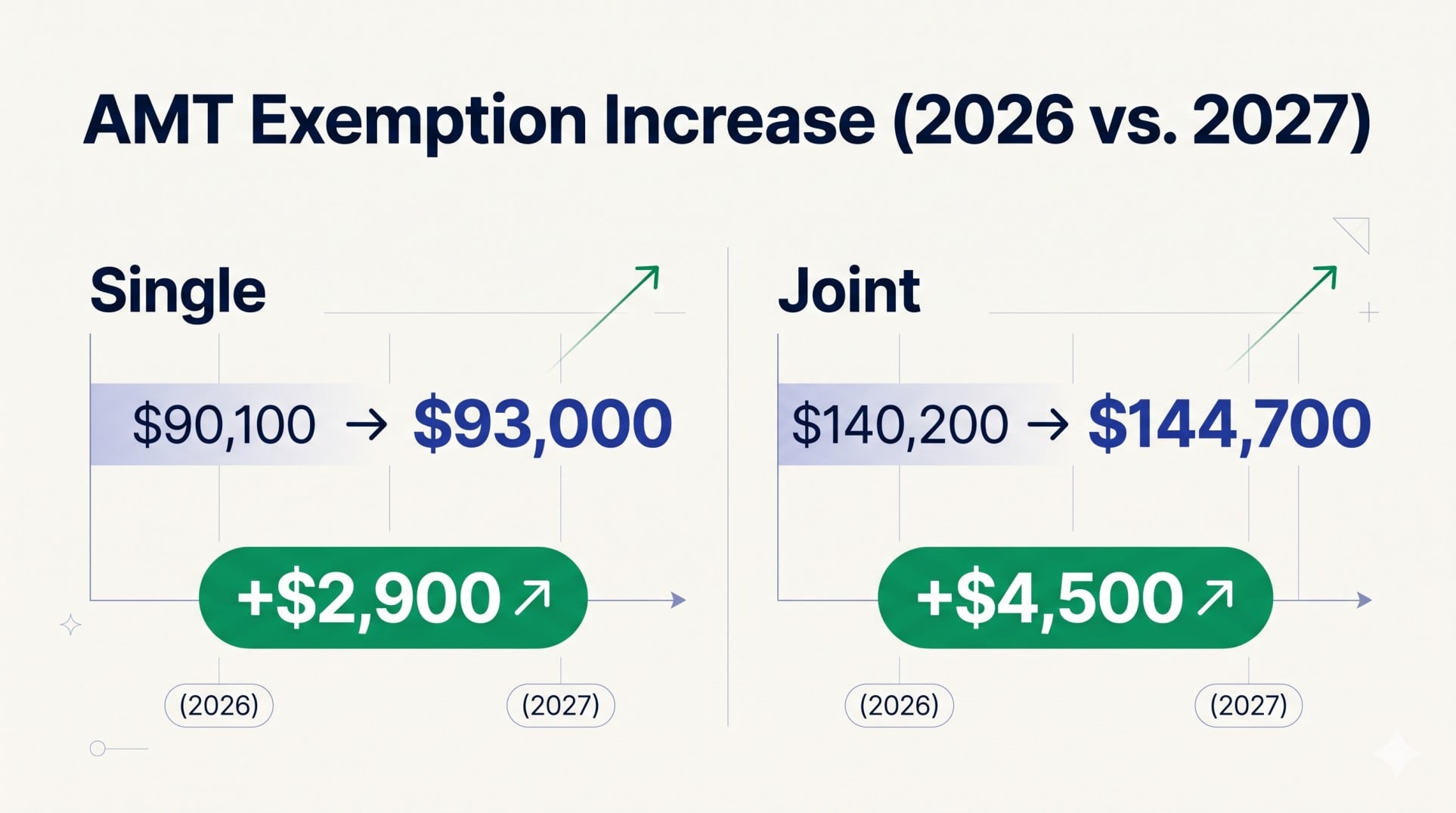
Compared to 2026, the IRS increased the AMT exemption 2027 and phaseout thresholds by roughly 3.2% across all filing statuses, giving joint filers an extra $4,500 in exemption protection and single filers an extra $2,900.
| AMT Provision & Filing Status | 2026 Official IRS Limit | 2027 Official Limit (Rev. Proc. 2026-35) | Dollar Increase ($ Change) |
|---|---|---|---|
| Single & HOH — AMT Exemption | $90,100 | $93,000 | +$2,900 |
| Married Filing Jointly — AMT Exemption | $140,200 | $144,700 | +$4,500 |
| Married Filing Separately — AMT Exemption | $70,100 | $72,350 | +$2,250 |
| Estates & Trusts — AMT Exemption | $31,400 | $32,500 | +$1,100 |
| Single, HOH & MFS — Phaseout Start | $500,000 | $515,950 | +$15,950 |
| Married Filing Jointly — Phaseout Start | $1,000,000 | $1,031,900 | +$31,900 |
| 28% AMT Bracket Threshold (All Except MFS) | $244,500 | $252,500 | +$8,000 |
| 28% AMT Bracket Threshold (MFS) | $122,250 | $126,250 | +$4,000 |
| Kiddie Tax AMT Base Exemption (Sec. 59(j)) | Earned Income + $9,750 | Earned Income + $10,050 | +$300 |
Why did the phaseout rules shift so noticeably between 2025, 2026, and 2027? Under theOne, Big, Beautiful Bill Act (P.L. 119-21), Congress made the higher TCJA base exemption amounts permanent, but reset the statutory phaseout starting points to $500,000 (Single) and $1,000,000 (Married Filing Jointly) for 2026, with annual inflation indexing resuming in 2027.
At the same time, the phaseout rate doubled from the old 25% reduction to a steeper 50% reduction (50 cents lost per dollar over the threshold). For a Single filer in 2027, that 50% phaseout rate means the entire $93,000 exemption is completely eliminated across a $186,000 income band (from $515,950 to $701,950).
Beware the 35% to 42% “AMT Bump Zone”: While your exemption is phasing out at a 50% rate between $515,950 and $701,950 (Single) or between $1,031,900 and $1,321,300 (MFJ), every extra $1.00 of income adds $1.50 to your taxable excess. At the 28% AMT bracket rate, that creates an effective marginal AMT rate of 42% (28% times 1.5)—higher than the top 37% 2027 ordinary federal income tax bracket.
How the Alternative Minimum Tax Works & Who Triggers It
The Alternative Minimum Tax operates as a parallel federal tax system under IRC Section 55 that strips away popular below-the-line deductions and adds back tax-preference income to ensure high earners pay at least a minimum baseline tax.
Think of the Alternative Minimum Tax exemption 2027 as the AMT version of the standard deduction. Instead of subtracting the regular 2027 standard deduction ($16,600 Single or $33,200 Married Filing Jointly) or certain itemized deductions, you start with your regular taxable income, add back specific AMT adjustments to arrive at your AMTI, and then deduct your 2027 AMT exemption.
Which deductions and income items trigger the AMT on Form 6251? Here are the primary adjustments:
- Standard Deduction & State and Local Tax (SALT) Deductions: Neither the regular standard deduction nor itemized state income, property, or sales tax deductions on Schedule A are allowed under the AMT.
- Incentive Stock Options (ISOs): When you exercise an ISO and hold the shares past year-end, the “bargain element” (the fair market value on the exercise date minus your strike price) is ignored for regular tax, but added directly to your AMTI on Form 6251.
- Private Activity Municipal Bond Interest: Tax-exempt interest from private activity bonds issued after August 7, 1986, must be added back to your AMTI.
- Accelerated Depreciation & Net Operating Losses: Businesses and real estate investors using accelerated MACRS depreciation or claiming regular Net Operating Loss (NOL) deductions must recalculate those figures under stricter AMT rules.
Let’s walk through two clear math examples showing how the 2027 AMT phaseout limits and brackets work in practice:
Example 1: Tech Employee Exercising Incentive Stock Options Below the Phaseout (Single Filer)
David is a Single software engineer who earns $216,600 in W-2 wages in 2027 and takes the $16,600 regular standard deduction, leaving $200,000 in regular taxable income and a regular federal tax liability of $40,391.50. During 2027, David also exercises 10,000 ISOs with a $10 strike price when the stock trades at $25, creating a $150,000 ISO bargain element. Adding his $16,600 standard deduction and $150,000 ISO spread back to his $200,000 regular taxable income gives him an AMTI of $366,600. Because $366,600 is below the $515,950 Single phaseout limit, he subtracts his full $93,000 AMT exemption 2027, leaving a taxable excess of $273,600. The first $252,500 is taxed at 26% ($65,650) and the remaining $21,100 is taxed at 28% ($5,908), creating a tentative minimum tax of $71,558. Since his tentative minimum tax exceeds his regular tax by $31,166.50, David owes $31,166.50 in extra AMT.
Example 2: Married Couple in the 50% Phaseout Zone (Married Filing Jointly)
Priya and Marcus file a joint return in 2027 with an AMTI of $1,151,900 after adding back their SALT deductions and private activity bond interest. Because their AMTI exceeds the $1,031,900 Married Filing Jointly phaseout threshold by $120,000, their $144,700 2027 AMT exemption is reduced by 50% of that excess, or $60,000 ($120,000 times 0.50). That leaves them with an allowable AMT exemption of $84,700 ($144,700 minus $60,000), which reduces their AMTI to a taxable excess of $1,067,200 before applying the 26% and 28% 2027 Alternative Minimum Tax brackets.
Remember that federal AMT rules are separate from state tax laws. Five states—California, Colorado, Connecticut, Iowa, and Minnesota—administer their own state-level Alternative Minimum Tax with separate exemption limits and rates.
How to Calculate and Report the AMT on Your 2027 Tax Return
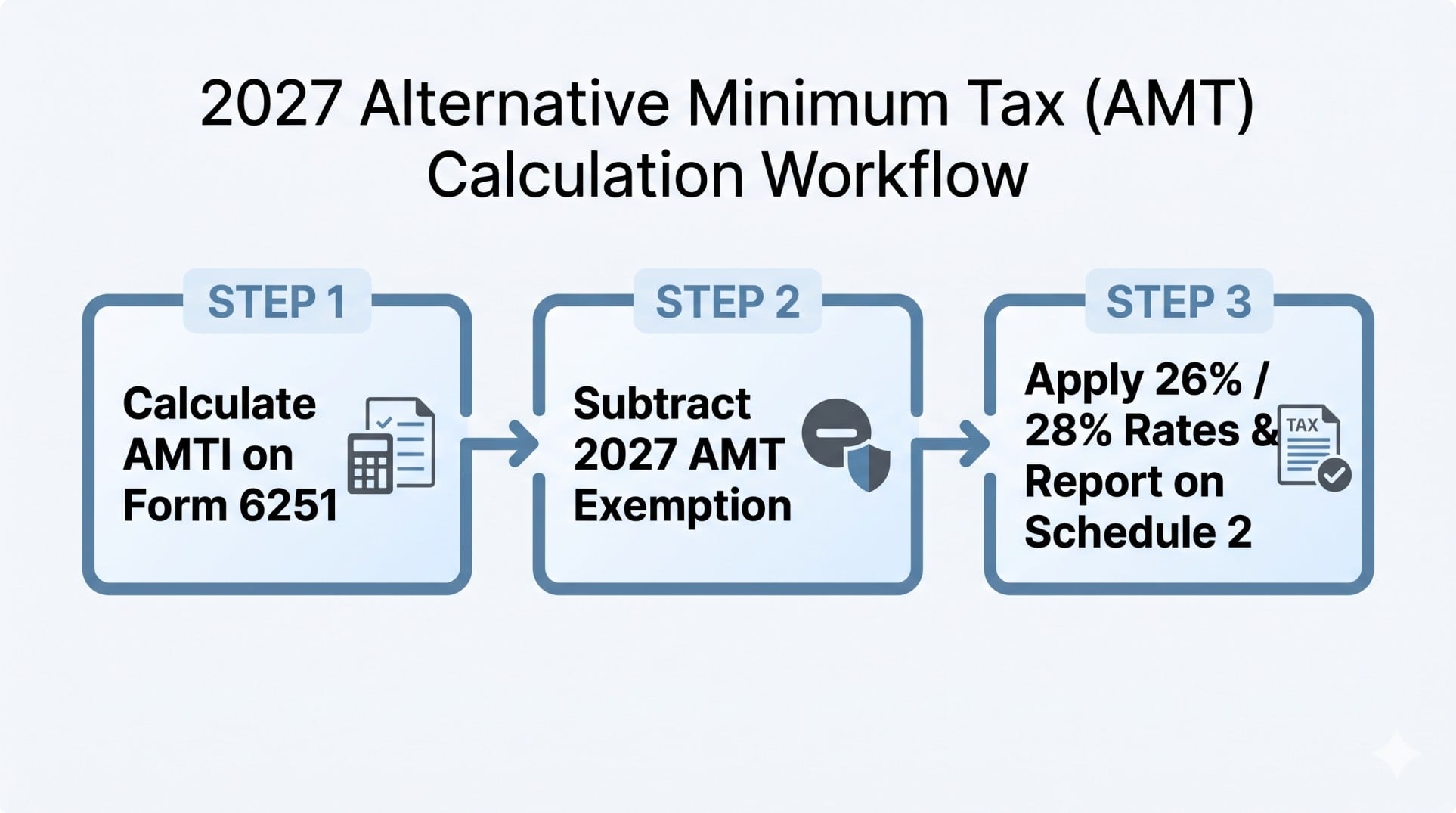
To determine if you owe the Alternative Minimum Tax for 2027, you must calculate your AMTI and subtract your AMT exemption 2027 on IRS Form 6251, then report any excess tentative minimum tax on Schedule 2 (Form 1040), Line 1.
- Calculate Your Alternative Minimum Taxable Income (Form 6251, Part I): Start with your regular taxable income from Form 1040, Line 15, and enter it on Form 6251, Line 1. Add back your standard deduction (or Schedule A taxes paid from Line 7) on Line 2a, your ISO bargain element on Line 2i, and any other preference items on Lines 2b through 3 to arrive at your total AMTI on Form 6251, Line 4.
- Apply Your 2027 AMT Exemption and Phaseout (Form 6251, Part II, Line 5): If your AMTI on Line 4 is at or below $515,950 (Single/HOH/MFS) or $1,031,900 (Married Filing Jointly), enter your full $93,000, $72,350, or $144,700 exemption on Line 5. If your AMTI exceeds the phaseout threshold, complete the Exemption Worksheet in the Form 6251 instructions to reduce your exemption by 50% of the excess, and subtract Line 5 from Line 4 to find your taxable excess on Line 6.
- Calculate Tentative Minimum Tax Across the 26% and 28% Brackets (Line 7 & Part III): If your Line 6 taxable excess is $252,500 or less ($126,250 if MFS) and you have no long-term capital gains or qualified dividends, multiply Line 6 by 26%. If Line 6 exceeds $252,500, multiply it by 28% and subtract $5,050 ($2,525 if MFS); if you have capital gains or qualified dividends, complete Part III (Lines 12 through 40) so those gains aren’t taxed above their 0%, 15%, or 20% caps.
- Compare Against Regular Tax and Transfer to Schedule 2 (Lines 9 through 11): Subtract any AMT foreign tax credit (Line 8) to get your tentative minimum tax on Line 9, and compare it to your regular tax liability on Line 10. If Line 9 is higher than Line 10, enter the difference on Form 6251, Line 11, and carry that exact AMT liability to Schedule 2 (Form 1040), Line 1.
- Claim Prior-Year Minimum Tax Credits on Form 8801 (If Applicable): If you paid AMT in a prior year due to deferral items like exercising ISOs, file IRS Form 8801 (Credit for Prior Year Minimum Tax) in years when your regular tax exceeds your tentative minimum tax to recoup your prior AMT payment via Schedule 3 (Form 1040), Line 6b.
Your 2027 federal tax return, along with Form 6251 and Form 8801, is due on Monday, April 17, 2028.
Frequently Asked Questions
1. What is the exact AMT exemption 2027 for Single and Married Filing Jointly taxpayers?
According to IRS Revenue Procedure 2026-35, the official AMT exemption 2027 is $93,000 for Single and Head of Household filers and $144,700 for Married Filing Jointly filers. Married individuals filing separately receive an exemption of $72,350, while estates and trusts can claim $32,500.
2. Why do some websites list $144,200 and $92,700 for the 2027 AMT exemption?
Figures of $144,200 (joint) and $92,700 (single) with phaseouts at $1,310,700 and $655,350 were unofficial CPI projections published before the IRS released Revenue Procedure 2026-35. Under Section 3.11 of Revenue Procedure 2026-35 and the One, Big, Beautiful Bill Act, the official IRS exemptions are $144,700 and $93,000, and phaseouts begin at $1,031,900 (joint) and $515,950 (single).
3. At what income level do the 2027 AMT phaseout limits completely eliminate the exemption?
Because the exemption phases out at 50 cents per dollar above the starting threshold, the 2027 AMT phaseout limits completely reduce the exemption to $0 when AMTI reaches $701,950 for Single and Head of Household filers or $1,321,300 for Married Filing Jointly couples. For Married Filing Separately taxpayers, the exemption hits zero at $660,650.
4. Does exercising Incentive Stock Options (ISOs) trigger the AMT in 2027?
Yes, exercising ISOs and holding the shares past December 31, 2027, is one of the most common AMT triggers for employees. You must report the spread between the stock’s fair market value on the exercise date and your option strike price on Form 6251, Line 2i, though you can leave a buffer up to your $93,000 or $144,700 exemption before owing AMT.
5. What is the Kiddie Tax Alternative Minimum Tax exemption 2027?
Under IRC Sections 55(d) and 59(j), a child subject to the Kiddie Tax on unearned investment income in 2027 can claim a special AMT exemption equal to the child’s earned income plus $10,050 (up from $9,750 in 2026). This total cannot exceed the regular unmarried 2027 AMT exemption limit of $93,000.
Disclaimer: This content provides general information for educational purposes only and reflects federal tax laws applicable to Tax Year 2027 (returns filed in 2028). Tax laws are complex and subject to change. This article does not constitute professional tax, legal, or accounting advice. Always consult a certified public accountant (CPA), enrolled agent (EA), or qualified tax attorney regarding your specific financial situation. Ourtaxpartner.com is not responsible for any actions taken based on the information provided herein.
