
Colorado enforces one of the most fragmented sales tax regimes in the United States, and the compliance rules tightened sharply on January 1, 2026. For years, small and mid-sized merchants offset their administrative accounting costs by retaining a timely filing discount known as the state retailer service fee (or vendor fee).
That financial cushion is gone. Under Colorado HB 25B-1005, enacted during the General Assembly’s special session, lawmakers permanently eliminated the state sales tax vendor allowance starting January 1, 2026. Simultaneously, the Colorado Department of Revenue (CDOR) rolled out strict mandatory electronic filing regulations that penalize businesses for mailing paper returns.
With the electronic filing threshold dropping from $500,000 in prior-year gross sales in 2026 down to just $50,000 on January 1, 2027, clinging to manual spreadsheets or paper checks now triggers automatic surcharges. Transitioning to an automated filing workflow is the only way to protect your bottom line across Colorado’s state and home-rule jurisdictions.
⚡ Executive Summary: Key 2026–2027 Tax Compliance Rules at a Glance
- State Vendor Fee Repealed (Jan 1, 2026): Under Colorado HB 25B-1005, retailers can no longer retain the 4.00% (capped at $1,000/period) state sales tax service fee on Form DR 0100 for filing periods beginning on or after January 1, 2026, though many local city, county, and home-rule service fees remain active per Publication DR 1002.
- Phased Mandatory E-Filing & 5% Penalty: Under CDOR Rules 39-21-119.5-2 and 39-21-119.5-10, electronic filing of Form DR 0100 became mandatory in January 2026 for retailers with $500,000+ in prior-year gross sales, drops to $50,000+ in January 2027, and covers 100% of retailers in January 2028. Mailing a paper return when required to e-file triggers a penalty of the greater of $50 or 5% of the tax due.
- Updated Filing Frequency & EFT Thresholds: Colorado raised the monthly filing threshold to $1,100 in state sales tax collected per month (allowing smaller merchants to file quarterly), while businesses remitting more than $75,000 per year in state sales tax must pay via Electronic Funds Transfer (EFT).
- 2026–2027 Rate & SaaS Alerts: The Colorado Retail Delivery Fee (Form DR 1786) rose from $0.28 to $0.31 per delivery for July 1, 2026, through June 30, 2027, and House Bill 26-1223 pulls remotely accessed computer software (SaaS) into the 2.90% state sales tax base effective January 1, 2027.
Table of Contents
- ⚡ Executive Summary: Key 2026–2027 Tax Compliance Rules at a Glance
- Colorado HB 25B-1005: The Permanent Repeal of the State Retailer Service Fee
- State vs. Local Service Fees: Where You Can Still Claim a Timely Filing Discount
- Phased Mandatory Electronic Filing Rules (2026–2028) and Paper Penalties
- 2025 vs. 2026–2027 Colorado Sales Tax Compliance & Penalty Matrix
- Compounding 2026–2027 Traps: The $0.31 Delivery Fee, Home-Rule Cities, and 2027 SaaS Tax
- Step-by-Step Automated Filing Mechanics: Revenue Online, SUTS, and Form DR 0100
- How Colorado Paper Filing, Late Payment, and EFT Penalties Stack in an Audit
- Frequently Asked Questions About Colorado’s E-Filing Rules and Service Fee Repeal
Colorado HB 25B-1005: The Permanent Repeal of the State Retailer Service Fee
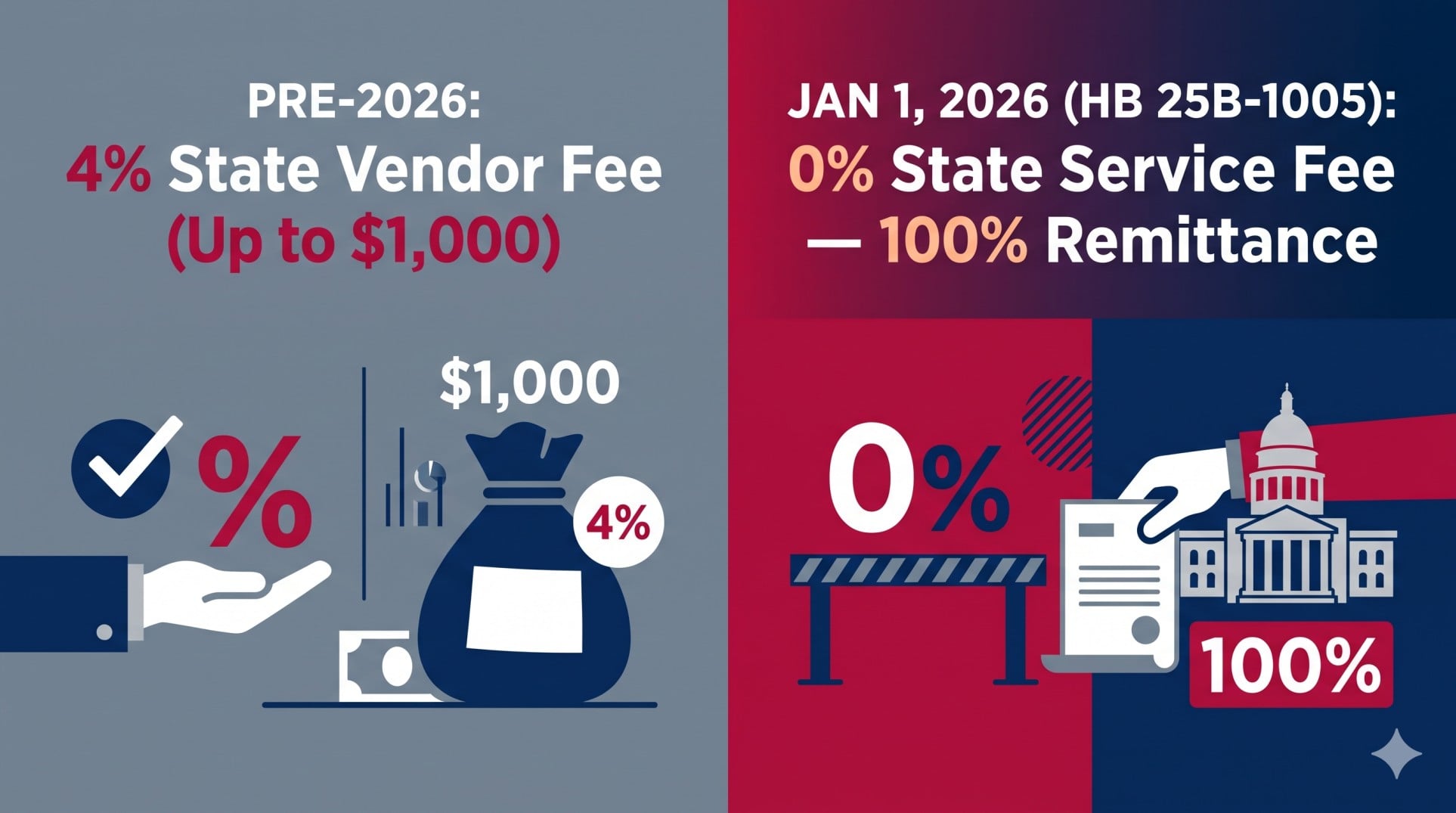
Effective January 1, 2026, Colorado HB 25B-1005 completely eliminated the state sales tax retailer service fee, requiring every merchant to remit 100% of the 2.90% state sales tax collected from customers without deducting a timely filing allowance.
Through December 31, 2025, qualifying retailers with $1,000,000 or less in total state net taxable retail sales per filing period were authorized to retain 4.00% of the state sales tax they collected—capped at $1,000 per filing period per retailer across all business locations—as compensation for the administrative cost of collecting and remitting tax on behalf of the state. Multi-location retailers used the State Service Fee Worksheet (Form DR 0103) to reconcile that $1,000 cap across their sites.
Faced with a state budget shortfall during the 2025 Extraordinary Session, the Colorado General Assembly passed Colorado HB 25B-1005 to recapture roughly $57 million annually for the state treasury and adjust allocations to the Housing Development Grant Fund (HDGF). Because removing a vendor allowance does not change the tax rate paid by consumers at the register, lawmakers enacted the repeal without a statewide voter referendum under Colorado’s Taxpayer’s Bill of Rights (TABOR).
What HB 25B-1005 Means for Your 2026–2027 Operating Budget
For a mid-sized Colorado retailer or out-of-state e-commerce seller that previously maxed out the $1,000 monthly vendor credit (which occurred whenever a business generated roughly $862,069 in monthly state-taxable sales, yielding $25,000 in state tax at 2.90%), the repeal represents a direct $12,000 annual cash-flow loss.
Even smaller Main Street shops generating $100,000 a month in taxable sales previously kept $116 per month ($1,392 per year) in state vendor discounts—enough to pay for their annual sales tax filing software or professional preparation fees. Starting with the January 2026 filing period (due February 20, 2026), the state column on Form DR 0100 sets the service fee rate to zero, and Form DR 0103 only applies if you are amending historical returns for periods prior to January 1, 2026. Multi-state merchants tracking vendor discounts across other states should review our 2026–2027 state-by-state timely filing discount comparison guide to see where collection credits still exist.
State vs. Local Service Fees: Where You Can Still Claim a Timely Filing Discount
While Colorado HB 25B-1005 repealed the state-level vendor discount, it did not repeal the retailer service fee offered by state-administered local cities, counties, special districts, or self-collecting home-rule municipalities.
Colorado’s sales tax structure splits into two distinct worlds: jurisdictions administered by the Colorado Department of Revenue (reported in separate columns on Form DR 0100) and over 70 self-collecting home-rule municipalities that administer their own tax codes. According to official CDOR guidance and Department Publication DR 1002 (Colorado Sales/Use Tax Rates), retailers who file and pay on or before the statutory due date (the 20th day of the following month) remain eligible to retain local service fees where authorized by local ordinance.
How Local Service Fees Work on Form DR 0100 and Home-Rule Returns
- State-Collected Cities and Counties (Form DR 0100 Columns): Dozens of state-collected statutory cities and counties allow timely filers to retain a local service fee—frequently ranging from 0.50% to 3.33% of the local tax collected—with no state-style $1,000 cap unless specified by the municipality in Publication DR 1002. When you file electronically through Revenue Online or the Sales & Use Tax System (SUTS), the portal automatically applies 0.00% to the State column while calculating the exact permitted service fee percentage in the County and City/LID columns.
- Special Districts (RTD, CD, RTA, MFD, PSI, MHD): Certain special districts reported on Form DR 0100 have eliminated or modified their vendor fees over time (for example, the Regional Transportation District [RTD] and Scientific and Cultural Facilities District [CD] eliminated their service fees earlier alongside state changes), whereas specific Regional Transportation Authorities (RTAs) or Local Improvement Districts (LIDs) follow the rates published in DR 1002.
- Self-Collecting Home-Rule Municipalities: Home-rule cities (such as Colorado Springs, Pueblo, Fort Collins, Aurora, or Grand Junction) set their own vendor fee percentages and monthly dollar caps by municipal charter. Some home-rule cities offer a 2.00% to 3.33% vendor fee (often capped at $100 to $500 per month), while others (like Denver and Boulder) have repealed their general vendor discounts.
Crucial Audit Warning for Manual Filers: Because the state column is now 0% while adjacent local columns on the exact same Form DR 0100 still calculate percentages like 2.00% or 3.33%, manually computing Form DR 0100 on paper or via outdated ERP formulas is a guaranteed recipe for math error notices. Claiming even $1 of state service fee on a 2026 or 2027 return triggers an immediate underpayment billing notice, disallowing your local timely filing discounts as well.
Phased Mandatory Electronic Filing Rules (2026–2028) and Paper Penalties
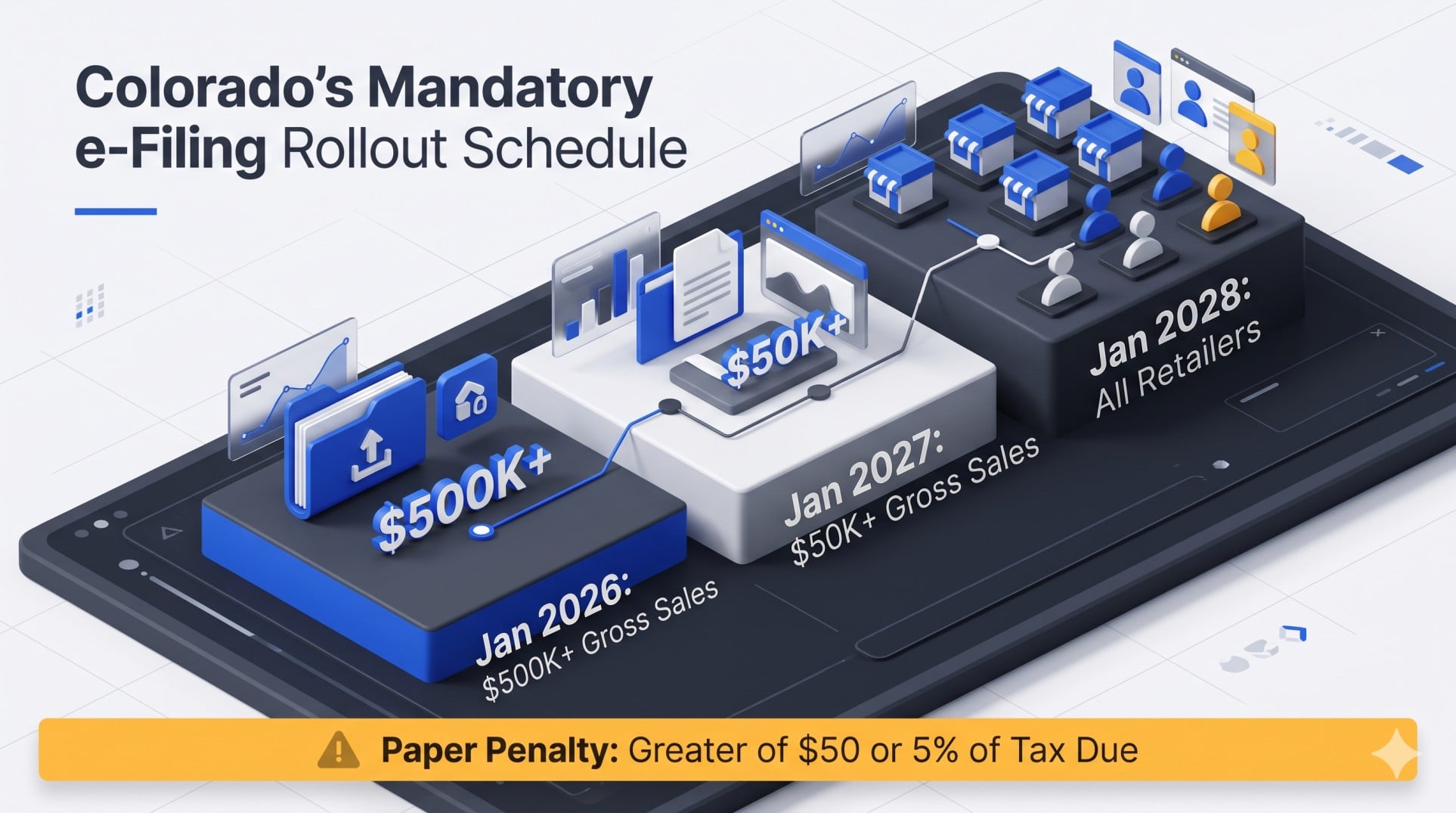
Under newly adopted Colorado Department of Revenue Rules 39-21-119.5-2, 39-21-119.5-10, and 39-21-119.5-11, Colorado launched a mandatory electronic filing rollout on January 1, 2026, assessing a penalty equal to the greater of $50 or 5% of the tax due against any business that submits a prohibited paper return.
For years, Colorado nudged businesses toward Revenue Online and SUTS while still processing thousands of paper Form DR 0100 packets mailed to Denver each month. That leniency ended in 2026. Pursuant to statutory authority under C.R.S. § 39-21-119.5, CDOR enacted a strict three-year phase-in schedule based on a retailer’s prior-calendar-year annual gross sales or qualified purchases.
The 2026–2028 Mandatory E-Filing Schedule Across Colorado Tax Types
The mandatory electronic filing rules cover four distinct indirect tax returns administered by the Colorado Department of Revenue:
- Retail Sales Tax Return (Form DR 0100):
- January 2026 Filing Period: Mandatory for retailers with $500,000 or more in annual gross sales or qualified purchases in the prior calendar year (2025).
- January 2027 Filing Period: Threshold drops tenfold! Mandatory for retailers with $50,000 or more in annual gross sales or qualified purchases in the prior calendar year (2026).
- January 2028 Filing Period: Mandatory for 100% of all Retail Sales Tax Returns, regardless of revenue size (including zero-dollar returns).
- County Lodging and Visitor Benefit Taxes (Form DR 1485): Mandatory starting January 2026 for operators with $75,000+ in prior-year gross room sales; drops to $7,000+ in January 2027; covers all returns in January 2028.
- Local Marketing District Tax (Form DR 1490): Mandatory starting January 2026 for operators with $500,000+ in prior-year gross room sales; drops to $15,000+ in January 2027; covers all returns in January 2028.
- Electronic Funds Transfer (EFT) Payment Mandate: In addition to e-filing the return, any business remitting more than $75,000 per year in Colorado state sales tax is legally required to remit payment electronically via EFT (ACH Debit or ACH Credit).
Why the January 2027 ($50,000) Cliff Will Catch Thousands of Small Businesses
Notice how the threshold for Form DR 0100 is measured: it looks at annual gross sales (total sales of goods and services reported on Line 1, whether taxable or exempt), not net taxable sales or tax liability. Almost every active brick-and-mortar shop, restaurant, contractor, or regional e-commerce seller generates at least $50,000 in annual gross sales ($4,167 per month).
If your business generated between $50,000 and $499,999 in gross sales during 2025, you were allowed to mail paper DR 0100 forms during 2026. The moment the calendar flips to the January 2027 filing period (due February 22, 2027, since February 20 is a Saturday), mailing that exact same paper return triggers an automatic $50 minimum penalty (or 5% of the tax due) on every single return you mail—per location! If you operate four small retail kiosks under one account and mail four paper site returns for a single month, CDOR assesses at least $200 in immediate paper-filing penalties even if you paid your tax in full and on time.
2025 vs. 2026–2027 Colorado Sales Tax Compliance & Penalty Matrix
To prepare your accounting systems for the 2026 and 2027 compliance cycles, compare Colorado’s legacy rules against the newly enforced statutory requirements below.
| Compliance Requirement | 2025 Legacy Rule (Through Dec 31, 2025) | 2026 Rule (Effective Jan 1, 2026) | 2027–2028 Rule (Effective Jan 1, 2027 & 2028) | Governing Statute / Form / Rule |
|---|---|---|---|---|
| State Retailer Service Fee (Vendor Discount) | 4.00% of state tax collected (capped at $1,000/period) if net taxable sales ≤ $1,000,000. | 0.00% (Repealed). Retailers must remit 100% of the 2.90% state sales tax collected. | 0.00% (Repealed). Local jurisdiction service fees remain active per DR 1002. | Colorado HB 25B-1005; Form DR 0100 (Form DR 0103 obsolete for 2026+ periods) |
| Mandatory Electronic Filing (Form DR 0100) | Paper filing generally permitted for standard retail sales tax filers. | Mandatory if prior-year (2025) gross sales or qualified purchases were $500,000 or more. | Jan 2027: Mandatory if prior-year gross sales ≥ $50,000. Jan 2028: Mandatory for 100% of filers. |
CDOR Rules 39-21-119.5-2, 39-21-119.5-10 & 39-21-119.5-11 |
| Paper Filing Penalty (Non-Electronic Return) | No general paper penalty for standard DR 0100 filers below EFT mandate. | Greater of $50 or 5% of the tax due per return filed on paper when e-file is required. | Greater of $50 or 5% of the tax due per non-compliant paper return. | C.R.S. § 39-21-119.5; Rule 39-21-119.5-2 |
| Monthly Filing Frequency Threshold | Required to file monthly if state sales tax collected exceeded $300/month ($600 in transitional updates). | Monthly filing threshold raised to $1,100/month in state tax collected (more businesses qualify for quarterly filing). | $1,100/month state tax threshold continues; zero returns still mandatory every period. | Amended CDOR Rule 39-26-109 |
| Colorado Retail Delivery Fee (RDF) | $0.29 (July 2024–June 2025) / $0.28 (July 1, 2025–June 30, 2026). | Increased to $0.31 per delivery effective July 1, 2026 (Exempt if prior-year CO retail sales ≤ $500,000). | $0.31 per delivery through June 30, 2027 (Next inflation adjustment July 1, 2027). | Form DR 1786 (Retail Delivery Fee Return) |
| Taxability of Computer Software & SaaS | Remotely accessed SaaS (no download) generally exempt at the state level (taxed by home-rule cities like Denver). | Remotely accessed SaaS remains exempt at the 2.90% state level through Dec 31, 2026. | Taxable at State Level (Jan 1, 2027): Computer software taxed regardless of delivery method. | Colorado House Bill 26-1223 (Signed June 4, 2026; effective Jan 1, 2027) |
Compounding 2026–2027 Traps: The $0.31 Delivery Fee, Home-Rule Cities, and 2027 SaaS Tax
Eliminating the retailer service fee and enforcing mandatory electronic filing are only two pieces of Colorado’s 2026–2027 compliance puzzle; businesses must simultaneously manage the $0.31 Retail Delivery Fee, over 70 self-collecting home-rule cities, and the January 1, 2027 state SaaS tax expansion.
When business owners attempt to manage Colorado compliance manually, they rarely fail on just one form. They get caught in the crossfire between multiple overlapping returns that share the exact same 20th of the month deadline.
1. The $0.31 Colorado Retail Delivery Fee (Form DR 1786)
Colorado imposes a separate Retail Delivery Fee (RDF) on every retail sale delivered by motor vehicle (including USPS, UPS, FedEx, DHL, or company delivery vans) to a Colorado destination that contains at least one item of tangible personal property subject to state sales or use tax. For the period running from July 1, 2026, through June 30, 2027, the Colorado Department of Revenue increased the Retail Delivery Fee from $0.28 to $0.31 per qualifying retail sale.
- Separate Return Requirement: You cannot report the $0.31 fee on Form DR 0100. It must be reported and remitted on a separate return—Form DR 1786 (Retail Delivery Fee Return)—on the exact same filing schedule and 20th of the month due date as your sales tax return.
- Small Business Exemption: Retailers whose total Colorado retail sales were $500,000 or less in the prior calendar year (and brand-new businesses in their first year) are exempt from collecting and remitting the $0.31 fee. Notice the symmetry: the exact moment your business crosses $500,000 in prior-year Colorado sales, you trigger both the 2026 mandatory electronic filing mandate and the $0.31 Retail Delivery Fee obligation!
2. Colorado House Bill 26-1223: State-Level SaaS & Software Tax Starting January 1, 2027
Historically, one of Colorado’s biggest headaches for tech companies was the disconnect between state law and home-rule municipal law. Through December 31, 2026, Colorado’s 2.90% state sales tax only applies to standardized software if delivered via tangible medium or under narrow download rules, leaving remotely accessed Software-as-a-Service (SaaS) exempt at the state level—even while home-rule cities like Denver (5.15% local rate) aggressively taxed SaaS.
On June 4, 2026, Governor Jared Polis signed House Bill 26-1223, which overhauls Colorado’s state definition of tangible personal property effective January 1, 2027. Beginning January 1, 2027, computer software is subject to the 2.90% Colorado state sales and use tax (and state-administered local taxes) regardless of how the software is delivered or accessed. Software and tech companies exceeding Colorado’s $100,000 economic nexus threshold (or the $50,000 2027 e-file threshold) must reconfigure their billing engines before New Year’s Day 2027. Tech leaders can explore our multi-state SaaS and digital goods sales tax compliance guide for a deeper breakdown of software sourcing rules.
Step-by-Step Automated Filing Mechanics: Revenue Online, SUTS, and Form DR 0100
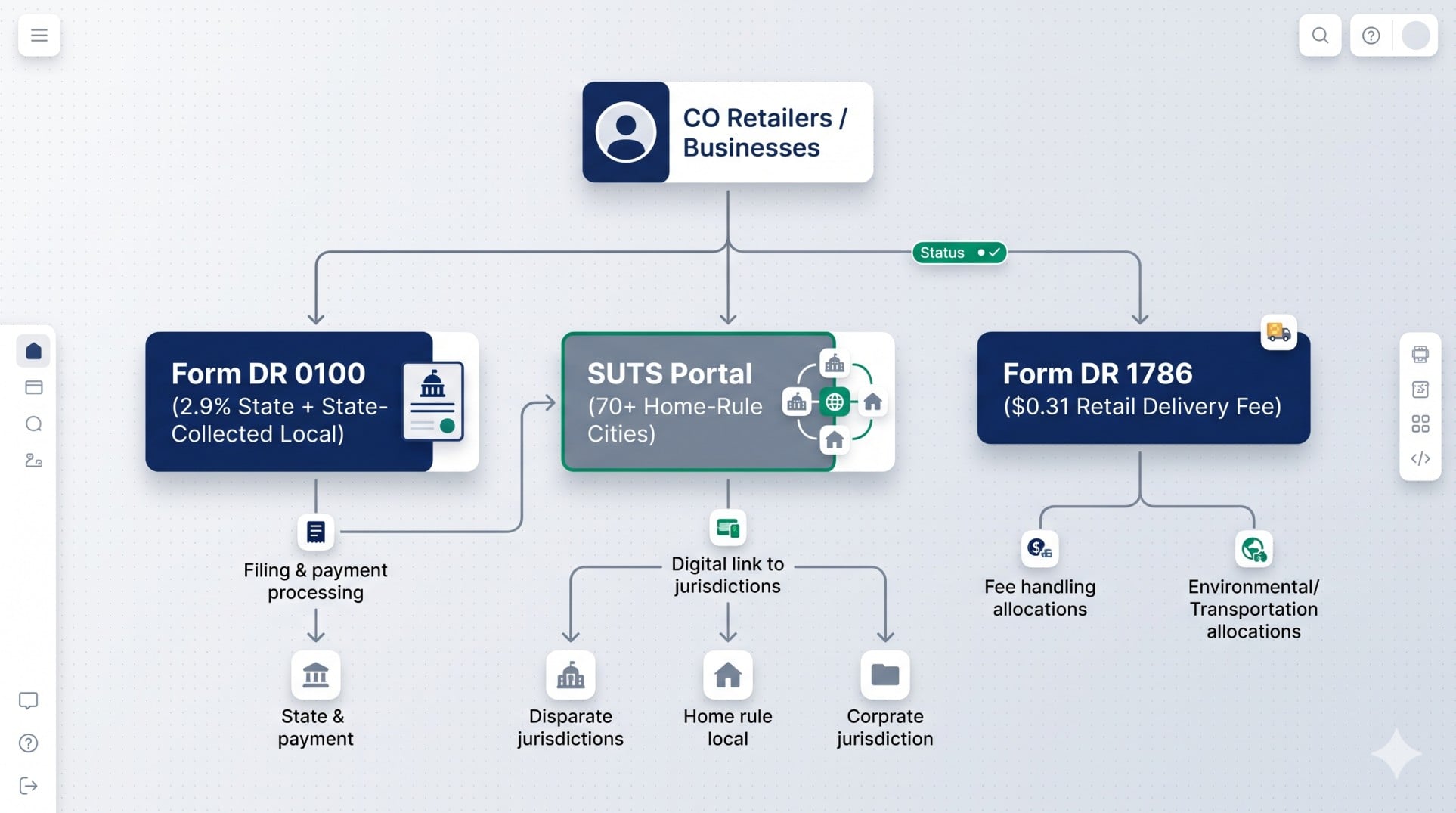
To comply with Colorado’s mandatory electronic filing mandate and accurately separate 0% state service fees from active local vendor discounts, retailers must transition away from paper forms and utilize Revenue Online, the Sales & Use Tax System (SUTS), or automated XML spreadsheet uploads.
Step 1: Verify Your Filing Frequency Under Amended Rule 39-26-109
Before configuring your automated filing calendar, check your assigned filing frequency on your Colorado Sales Tax License. Under recently amended Rule 39-26-109, CDOR raised the monthly filing threshold so that fewer small businesses are forced to file 12 times a year:
- Monthly Filers: Retailers who collect $1,100 or more per month in Colorado state sales tax (roughly $37,931+ in monthly state-taxable sales at 2.90%) must file monthly on or before the 20th day of the following month.
- Quarterly Filers: Retailers collecting less than $1,100 per month (but more than $15 per month) generally qualify to file quarterly, due on April 20, July 20, October 20, and January 20.
- Mandatory Zero Returns: Every open sales tax account and every registered site/location must file a return for every assigned period, even if gross sales were $0.00. Failing to e-file a $0 return triggers an automatic minimum late-filing penalty of $15 (plus the $50 non-electronic filing penalty if mailed on paper!).
Step 2: Choose the Right Electronic Filing Channel (Revenue Online vs. SUTS)
The Colorado Department of Revenue provides two primary electronic portals that satisfy the mandatory e-filing rules:
- Colorado Revenue Online (Best for Single-Location Brick-and-Mortar & DR 1786): Log into your Revenue Online dashboard to electronically file Form DR 0100 (covering the 2.90% state tax, state-administered counties, state-administered cities/LIDs, and special districts like RTD/CD/RTA) and your Form DR 1786 ($0.31 Retail Delivery Fee). Multi-location retailers can also upload a standardized CDOR Excel/XML template directly into Revenue Online.
- Colorado Sales & Use Tax System — SUTS (Best for Remote Sellers & Multi-Jurisdiction Filers): If you ship orders across Colorado or operate in multiple cities, SUTS is the state’s unified single point of remittance. Through a single SUTS upload, you can electronically file and pay your state Form DR 0100, all state-collected local jurisdictions, and over 60 participating self-collecting home-rule municipalities (such as Denver, Aurora, Colorado Springs, Fort Collins, and Boulder) in one automated batch.
Step 3: Reconcile Schedule A, Schedule B, and Multi-Column Deductions
One reason Colorado audits are so brutal is that exemptions are not uniform across the columns of Form DR 0100. While Line 1 (Gross Sales) and Schedule A (Deductions like wholesale sales for resale, out-of-state shipments, and service charges) apply across the board, Schedule B (Part 2 Exemptions) varies wildly by jurisdiction:
- Food for Home Consumption (Groceries): Exempt in the State (2.90%) and RTD/CD columns, yet fully taxable in dozens of state-collected statutory cities and counties unless exempted locally in Publication DR 1002.
- Residential Energy, Farm Equipment & Renewable Energy Components: Exempt at the state level, but selectively taxed by local cities and counties on the exact same Schedule B grid.
When you partner with Ourtaxpartner.com for automated multi-state sales and use tax return filing, our software maps every invoice line item by 11-digit Colorado location jurisdiction code, populates Schedule A and Schedule B across every column of Form DR 0100, claims every remaining local retailer service fee, and transmits your SUTS and home-rule returns electronically before the 20th of the month.
| Colorado Return / Portal | What Taxes Are Covered | 2026–2027 Service Fee Rule | Mandatory E-File Trigger | Statutory Due Date |
|---|---|---|---|---|
| Form DR 0100 (State Column) via Revenue Online / SUTS | 2.90% Colorado State Retail Sales Tax | 0.00% (Eliminated Jan 1, 2026 under Colorado HB 25B-1005) | $500k+ gross sales (Jan 2026); $50k+ (Jan 2027); All (Jan 2028) | 20th day of the month following the reporting period |
| Form DR 0100 (Local & Special District Columns) | State-administered Counties, Statutory Cities/LIDs, RTD (1.0%), CD (0.1%), RTA, PSI, MFD, MHD | 0.00% to 3.33% depending on local ordinance (per Publication DR 1002) on timely returns | Included on Form DR 0100 e-file mandate | 20th day of the month following the reporting period |
| Home-Rule City Returns via SUTS or City Portals | 70+ Self-Collecting Home-Rule Cities (Denver 5.15%, CO Springs 3.07%, Aurora 3.75%, etc.) | Varies by municipal charter (e.g., 0% in Denver; capped % in select cities) | Electronic filing required on SUTS or dedicated municipal portals | Typically the 20th day of the following month |
| Form DR 1786 via Revenue Online | $0.31 Colorado Retail Delivery Fee (July 1, 2026–June 30, 2027) | 0.00% (No vendor service fee permitted on Retail Delivery Fee) | Filed online alongside Form DR 0100 (Exempt if prior-year sales ≤ $500k) | 20th day of the month following the reporting period |
How Colorado Paper Filing, Late Payment, and EFT Penalties Stack in an Audit
Failing to adapt to Colorado’s 2026–2027 compliance rules exposes retailers to stacking penalties that combine the new 5% non-electronic filing penalty with up to 18% in late-filing and late-payment surcharges, statutory interest, and disallowed local vendor discounts.
Let’s examine how these rules play out across three realistic business scenarios in 2026 and 2027.
Scenario 1: Multi-Location Denver Metro Retailer Hit by HB 25B-1005 & Paper Penalties
Front Range Outfitters operates three outdoor gear shops in Colorado (one in Denver, one in Lakewood, and one in unincorporated Jefferson County), generating $900,000 per month in combined state-taxable retail sales across the three sites. In 2025, Front Range collected $26,100/month in 2.90% state sales tax ($900,000 × 2.90%). Because its net taxable sales were under $1,000,000 per period, Front Range completed Form DR 0103 and retained the maximum $1,000/month ($12,000/year) state retailer service fee.
In January 2026, Front Range’s longtime bookkeeper is unaware of both Colorado HB 25B-1005 and the new mandatory electronic filing rule for businesses over $500,000. For the January 2026 period, the bookkeeper prints three paper Form DR 0100 returns, manually deducts the old $1,000 state vendor discount, and mails a paper check for $25,100 state tax (plus local county/RTD taxes totaling $14,000, where Lakewood and Jefferson County had $0 local vendor fee) on February 19, 2026.
Here is what the Colorado Department of Revenue assesses on that single monthly filing:
- Disallowed State Service Fee Underpayment: Because HB 25B-1005 repealed the state vendor fee on January 1, 2026, Front Range underpaid its state tax by $1,000.00.
- 5% Mandatory Electronic Filing Penalty (Rule 39-21-119.5-2): Because Front Range had over $500,000 in 2025 gross sales, mailing paper Form DR 0100 returns was illegal. CDOR assesses a 5% non-electronic filing penalty on the total tax due across the returns: ($26,100 state + $14,000 local/RTD = $40,100 total tax due) × 5.00% = $2,005.00 paper penalty!
- 10% Late Payment Penalty on the $1,000 Shortfall: Because the $1,000 state tax balance was not paid by February 20, CDOR assesses a 10.00% late payment penalty on the unpaid $1,000 balance = $100.00 (plus 0.5% per month and statutory interest).
- Total First-Month Financial Hit: Front Range loses the $1,000 vendor fee and pays $2,105.00 in avoidable penalties for a single month—all because they didn’t switch to automated electronic filing!
Scenario 2: The January 2027 “$50,000 Cliff” for a Small Boutique
Aspen Valley Candles is a small, family-owned boutique in a state-collected Colorado town that generated $120,000 in annual gross sales during calendar year 2025 and $135,000 in annual gross sales during calendar year 2026. Because the store collects roughly $325/month in state sales tax (under the new $1,100/month threshold), it files Form DR 0100 quarterly.
Throughout 2026, Aspen Valley Candles legally mailed paper quarterly DR 0100 returns because its 2025 gross sales ($120,000) were below the 2026 $500,000 e-file threshold. However, effective January 1, 2027, the mandatory e-filing threshold drops to $50,000 in prior-year gross sales. Because Aspen Valley’s 2026 gross sales were $135,000, the boutique is now legally required to file electronically starting with the Q1 2027 return (due April 20, 2027).
If the owner mails a paper Q1 2027 return reporting $975.00 in state tax and $1,200.00 in local city/county tax ($2,175.00 total tax), 5% of the tax due is $108.75. Since the penalty is the greater of $50 or 5% of the tax due, CDOR bills the boutique $108.75 for mailing paper—wiping out the 3.33% local city service fee ($26.64) the boutique earned on its municipal column! Even if the boutique closed for the winter and mailed a $0.00 paper return for Q1 2027, it would still be hit with the $50.00 minimum paper filing penalty.
Scenario 3: Out-of-State E-Commerce Brand Missing SUTS & the $0.31 Delivery Fee
Peak Performance Supplements is a Texas-based e-commerce retailer selling nutritional products directly to Colorado consumers. In 2025, Peak Performance shipped 12,000 orders into Colorado totaling $720,000 in taxable retail sales. Because $720,000 exceeds both Colorado’s $100,000 economic nexus threshold and the $500,000 Retail Delivery Fee / 2026 E-File threshold, Peak Performance has three simultaneous monthly obligations in the second half of 2026:
- State & State-Collected Local Sales Tax (Form DR 0100 via SUTS): Electronic filing required; 0% state service fee retained; local city/county service fees retained automatically where applicable.
- Home-Rule City Sales Tax (via SUTS): Remitting local sales tax to participating home-rule destinations (Denver, Colorado Springs, Aurora, Fort Collins, etc.).
- Colorado Retail Delivery Fee (Form DR 1786): For the 6,000 orders shipped between July 1, 2026, and December 31, 2026, Peak Performance must collect and remit the updated $0.31 per order fee: 6,000 deliveries × $0.31 = $1,860.00 reported electronically on Form DR 1786.
By onboarding with Ourtaxpartner.com, Peak Performance connects its Shopify checkout directly to our automated filing engine, ensuring the $0.31 fee is itemized on every checkout receipt, all home-rule and DR 0100 returns are transmitted via SUTS by the 20th of each month, and zero paper or late penalties are ever incurred. If your business has unfiled Colorado home-rule returns or past Retail Delivery Fee exposure, explore our Colorado sales tax audit defense and Voluntary Disclosure Agreement (VDA) services to resolve historical liabilities cleanly.
Frequently Asked Questions About Colorado’s E-Filing Rules and Service Fee Repeal
1. Did Colorado eliminate the sales tax vendor discount in 2026?
Yes, effective January 1, 2026, Colorado HB 25B-1005 permanently eliminated the 4.00% state sales tax retailer service fee (vendor discount). Retailers must now remit 100% of the 2.90% state sales tax they collect on Form DR 0100, though many local city and county service fees remain active.
2. Can I still claim a local service fee on Colorado Form DR 0100 in 2026 and 2027?
Yes, the repeal in Colorado HB 25B-1005 only eliminated the state-level service fee. Retailers who file and pay on time (by the 20th of the following month) can still retain local vendor service fees for eligible state-administered cities, counties, and special districts at the exact percentages listed in CDOR Publication DR 1002.
3. Who is required to file Colorado sales tax electronically in 2026, 2027, and 2028?
Under CDOR Rule 39-21-119.5-10, mandatory electronic filing of Form DR 0100 applies starting January 2026 to retailers with $500,000 or more in prior-year gross sales, expands in January 2027 to retailers with $50,000 or more in prior-year gross sales, and covers 100% of all retailers starting January 2028.
4. What is the penalty for filing a paper Form DR 0100 in Colorado when required to e-file?
Under CDOR Rule 39-21-119.5-2 and C.R.S. § 39-21-119.5, the penalty for submitting a paper sales tax return when required to file electronically is the greater of $50 or 5% of the tax due per return. This penalty applies even if you submit your paper return and payment on time.
5. Do I still need to file Form DR 0103 (State Service Fee Worksheet) in 2026?
No, Form DR 0103 is no longer used for filing periods beginning on or after January 1, 2026, because the state service fee is now 0%. You only need Form DR 0103 if you are filing or amending a historical Colorado sales tax return for a period prior to January 1, 2026, where your combined state service fee exceeded the $1,000 cap.
6. What is the late filing and late payment penalty for Colorado sales tax in 2026–2027?
If you fail to file or pay Form DR 0100 by the 20th of the following month, Colorado assesses a penalty equal to the greater of $15 or 10% of the tax due plus 0.5% per month (up to a maximum of 18%), plus statutory interest, and you automatically forfeit any eligible local jurisdiction service fees.
7. What is the Colorado Retail Delivery Fee rate for July 2026 through June 2027?
From July 1, 2026, through June 30, 2027, the Colorado Retail Delivery Fee is $0.31 per qualifying retail sale delivered by motor vehicle to a Colorado address that includes at least one taxable item. Retailers with more than $500,000 in prior-year Colorado retail sales must report and remit the fee on Form DR 1786.
8. When does Colorado start taxing Software-as-a-Service (SaaS) at the state level?
Effective January 1, 2027, Colorado House Bill 26-1223 expands the state definition of tangible personal property to include computer software regardless of delivery method. This pulls remotely accessed SaaS and cloud software subscriptions into the 2.90% state sales tax base for the first time.
9. What is the monthly filing threshold for Colorado sales tax in 2026?
Under amended CDOR Rule 39-26-109, the monthly filing threshold is now $1,100 in state sales tax collected per month. Retailers who collect less than $1,100 per month in state sales tax generally qualify to file quarterly rather than monthly, though zero returns are still mandatory for every period.
10. When is Electronic Funds Transfer (EFT) mandatory for Colorado sales tax payments?
Any business with more than $75,000 per year in Colorado state sales tax liability is legally required to remit sales tax payments via Electronic Funds Transfer (EFT) through Revenue Online or SUTS. Paying by paper check when subject to the EFT mandate triggers separate non-compliance penalties.
Eliminate Colorado Filing Penalties with Ourtaxpartner.com’s Automated Compliance Team
Between the permanent repeal of the state retailer service fee under Colorado HB 25B-1005, the 5% penalty for violating mandatory electronic filing rules, the $0.31 Retail Delivery Fee on Form DR 1786, and 70+ self-collecting home-rule municipalities, manual Colorado sales tax preparation is a losing proposition in 2026 and 2027.
Now that the state no longer pays you a vendor allowance to cover your internal compliance hours, your team shouldn’t waste days every month wrestling with seven-page Form DR 0100 schedules or risking a $50-to-5% paper filing penalty as the threshold drops to $50,000 in January 2027. At Ourtaxpartner.com, our automated SALT filing platform and dedicated CPAs connect directly to your POS or e-commerce cart, calculate exact rooftop rates across every Colorado state and home-rule jurisdiction, capture every remaining local service fee discount you’re legally owed, and electronically transmit your Form DR 0100, Form DR 1786, and SUTS home-rule returns on time, every month. Contact Ourtaxpartner.com today to automate your Colorado sales tax filings and protect your business from costly 2026–2027 penalties.
Disclaimer: This content provides general information for educational purposes only and reflects state, local, and federal sales, use, and excise tax laws applicable to the 2026–2027 compliance periods. State and local tax rates, nexus thresholds, and excise regulations change frequently across jurisdictions. This article does not constitute professional tax, legal, or accounting advice. Always consult a certified public accountant (CPA), enrolled agent (EA), or qualified SALT advisor at Ourtaxpartner.com regarding your specific business compliance obligations. Ourtaxpartner.com is not responsible for any actions taken based on the information provided herein.
