
Tech founders, CFOs, and subscription billing managers can no longer assume that cloud-delivered software and media escape state sales tax. Historically, dozens of states only taxed software or digital media if a customer downloaded a file onto local hardware. That legal boundary has collapsed.
On July 1, 2026, Utah officially began taxing pure streaming access and codified the taxability of seller-hosted software (SaaS) under Utah Senate Bill 162. Utah’s expansion follows aggressive legislative overhauls in Louisiana (which raised its state rate to 5% and taxed SaaS and digital products), Maryland (which enacted a 3% tax on IT services, custom software, and enterprise SaaS), and Washington (which expanded retail sales tax to custom software, IT support, and human-effort digital services).
If your recurring billing engine in Stripe, Chargebee, Maxio, or NetSuite still treats cloud subscriptions, API access, or implementation fees as non-taxable services in these four states, your company is accumulating uncollected tax liability with every monthly renewal.
⚡ Executive Summary: Key 2026–2027 Tax Compliance Rules at a Glance
- Utah Streaming & SaaS Expansion (July 1, 2026): Under Utah Senate Bill 162, Utah imposes state (4.85% base) and local sales tax on streaming-only access to digital audiovisual, audio, book, and gaming content, while formally codifying tax on seller-hosted software (SaaS) regardless of whether a download occurs.
- Louisiana 5% Rate Hike & Digital Overhaul: Under House Bill 8 and House Bill 10 (effective Jan 1, 2025, through 2029), Louisiana raised its state sales tax rate from 4.45% to 5.00% and taxed prewritten computer software access services (SaaS), custom software, information services, and digital products at both the state and local parish levels (averaging 10.11% combined).
- Maryland’s 3% vs. 6% Tech Tax Split: Under House Bill 352 (BRFA of 2025) and Technical Bulletin No. 56 (effective July 1, 2025), Maryland imposes a 3.00% sales tax on enterprise SaaS, custom software, cloud hosting, and IT consulting under NAICS sectors 518, 519, 5415, and 5132, while taxing individual consumer SaaS and digital products at 6.00%.
- Washington’s ESSB 5814 Expansion & 2027 Prepayment Rule: Effective October 1, 2025, Washington ESSB 5814 added custom software, IT technical support, training, website development, and human-effort Digital Automated Services (DAS) to the 6.50% state + local retail sales tax base and Retailing B&O tax—plus a mandatory 80% sales tax prepayment due June 25, 2027, for monthly filers with $3M+ in 2026 retail sales.
Table of Contents
- ⚡ Executive Summary: Key 2026–2027 Tax Compliance Rules at a Glance
- Utah Senate Bill 162: Taxing Streaming Subscriptions and Seller-Hosted Software (SaaS)
- Louisiana HB 8 & HB 10: The 5% State Rate Hike and Parish-Level SaaS Tax
- Maryland’s 3% Tech Tax vs. 6% Digital Product Rate Split (HB 352)
- Washington ESSB 5814: Custom Software, IT Support, and Digital Automated Services
- 2026–2027 Multi-State Digital Goods, Streaming & SaaS Taxability Matrix
- Contract Timing, Invoice Unbundling, and Multiple Points of Use (MPU) Rules
- Step-by-Step Registration, Sourcing, and Return Filing for Tech Companies
- Frequently Asked Questions About SaaS, Streaming, and Digital Goods Taxes
Utah Senate Bill 162: Taxing Streaming Subscriptions and Seller-Hosted Software (SaaS)
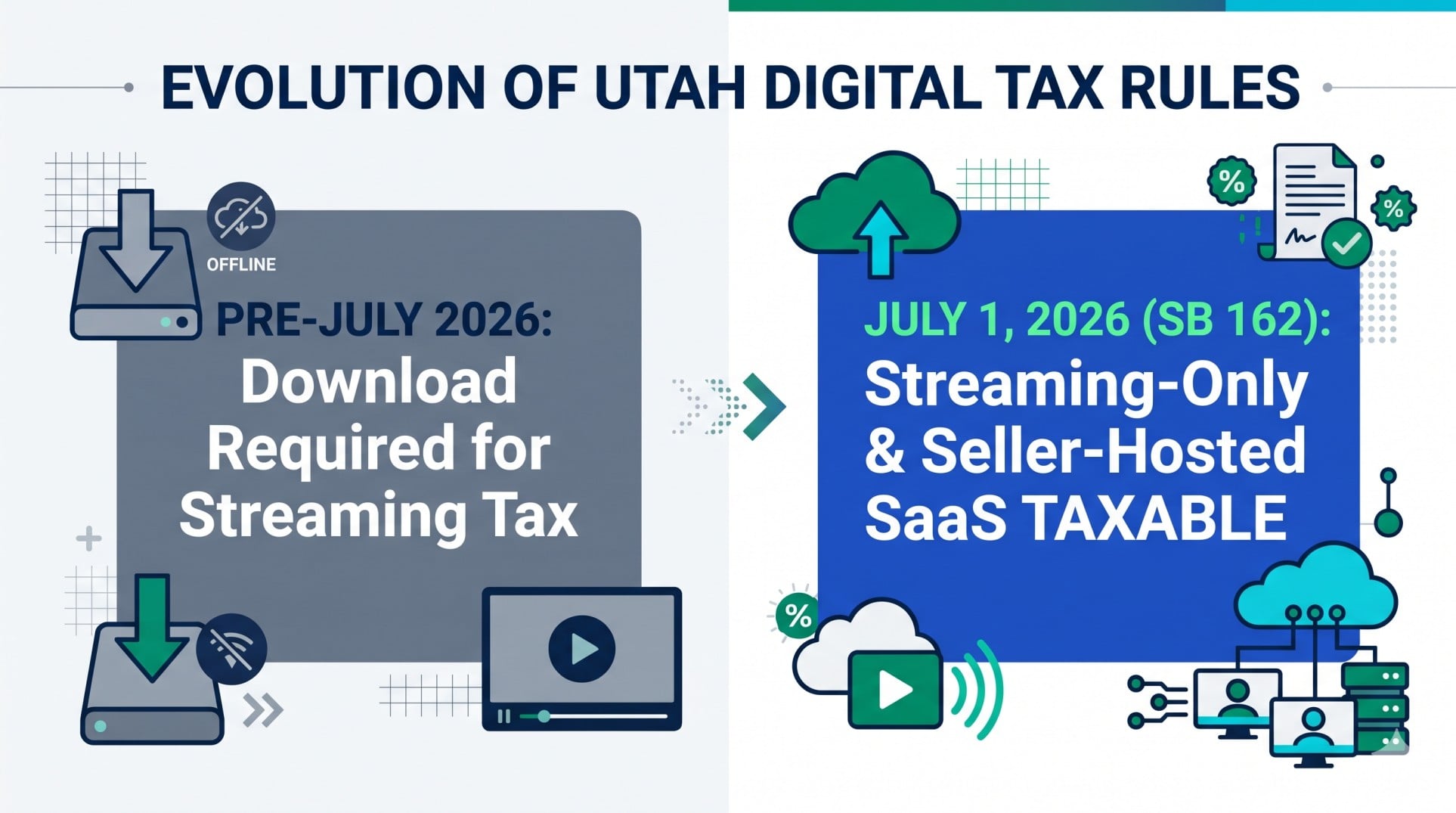
Effective July 1, 2026, Utah Senate Bill 162 expanded Utah’s state and local sales and use tax to cover pure streaming-only content and formally codified the taxability of seller-hosted software (SaaS), regardless of whether any file is downloaded by the user.
Signed into law by Governor Spencer Cox on March 23, 2026, S.B. 162 eliminated one of the last remaining statutory gray areas for digital media and cloud software providers selling into Utah. Previously, Utah taxed “products transferred electronically” and prewritten computer software, and the Utah State Tax Commission relied on Private Letter Rulings to assert tax on cloud software. However, pure streaming services—where a subscriber watched video, listened to audio, or played cloud games without an offline download option—often escaped taxation because no electronic file was transferred to the buyer’s device.
What Is Explicitly Taxable in Utah Starting July 1, 2026?
Under the statutory definitions enacted in Utah Senate Bill 162, Utah’s 4.85% base state rate plus applicable county, city, and transit local taxes (producing combined rates of 6.10% to 9.05%; 7.75% in Salt Lake City) now explicitly apply to amounts paid or charged for:
- Seller-Hosted Prewritten Computer Software: Defined by statute as “prewritten computer software that is accessed through the internet or a seller-hosted server, regardless of whether the access is permanent or any downloading occurs.” This locks B2B and B2C SaaS, cloud applications, and browser-based software into the Utah tax base.
- Streaming-Only Access & Subscriptions: Single-use or ongoing subscription payments for access to digital audiovisual works (video streaming), digital audio works (music and podcast streaming), digital books (e-books and audiobooks), and online gaming services, even when zero downloading or permanent transfer occurs.
- Exemption to Prevent Double Taxation: To avoid stacking taxes on cable and satellite providers, S.B. 162 clarifies that transactions already taxed under Utah’s separate Multi-Channel Video or Audio Service Tax Act (6.25% rate) are exempt from the retail sales and use tax.
Remember that Utah also simplified its remote seller nexus rule under Senate Bill 47 (effective July 1, 2025) by repealing its 200-transaction trigger. In 2026 and 2027, remote SaaS and streaming companies only establish Utah economic nexus when their gross revenue from Utah sales exceeds $100,000 in the current or previous calendar year. Out-of-state software companies should review our 2026–2027 economic nexus threshold guide to see how gross software revenue is measured across all 45 taxing states.
Louisiana HB 8 & HB 10: The 5% State Rate Hike and Parish-Level SaaS Tax
Under Louisiana House Bill 8 and House Bill 10 (enacted during the Third Extraordinary Session and effective January 1, 2025), Louisiana increased its state sales tax rate from 4.45% to 5.00% and expanded its state and local parish tax base to include seller-hosted software (SaaS), custom software, digital products, and information services.
Louisiana operates the highest average combined state and local sales tax rate in the United States (averaging 10.11% statewide, with combined parish and municipal rates reaching 10.00% in New Orleans/Orleans Parish, 9.75% in Jefferson Parish, 10.50% in Baton Rouge, and up to 13.50% in specific local districts). The 5.00% state rate remains locked in through December 31, 2029, before stepping down to 4.75% on January 1, 2030.
How Louisiana Taxes Software, Cloud Infrastructure, and Digital Goods
Codified under La. Rev. Stat. § 47:301, Louisiana defines taxable SaaS as “prewritten computer software access services.” Because Louisiana is a home-rule state with 64 parishes and roughly 415 local taxing jurisdictions, the expansion applies to both the 5% state tax and local parish taxes. Tech companies selling into Louisiana must carefully distinguish between taxable and exempt line items on their customer invoices:
- Taxable at Full State + Parish Rate: Prewritten computer software access services (SaaS), downloaded software, custom software, digital audiovisual and audio works, digital books, digital games, and information services (such as electronic data retrieval, financial market feeds, and database access).
- Narrow B2B Production Exemption: Unlike states that exempt all commercial software, Louisiana’s business exemption is remarkably narrow. Software and digital products are only exempt when used directly to produce taxable goods or services for sale (or used by FDIC-insured financial institutions and qualifying healthcare facilities). Everyday business SaaS—including CRM platforms, HR/payroll software, accounting suites, project management tools, and Slack/Zoom-style collaboration apps—is 100% taxable.
- Non-Taxable When Separately Stated: Cloud infrastructure and platform services (IaaS and PaaS for raw computing/storage), as well as software setup, implementation, configuration, and training fees, are not taxable in Louisiana only if they are separately stated on the customer invoice. Bundling onboarding or implementation into a single annual subscription line makes the entire invoice taxable.
Louisiana 2026 Mandatory Electronic Filing Warning: Effective January 1, 2026, the Louisiana Department of Revenue (LDR) enforced a strict electronic filing and electronic payment mandate for virtually all sales and use tax returns, including Form R-1029. Submitting a paper return or paying by paper check in 2026 or 2027 triggers an automatic penalty of $100 or 5% of the tax due (whichever is greater) and treats the payment as delinquent.
Maryland’s 3% Tech Tax vs. 6% Digital Product Rate Split (HB 352)
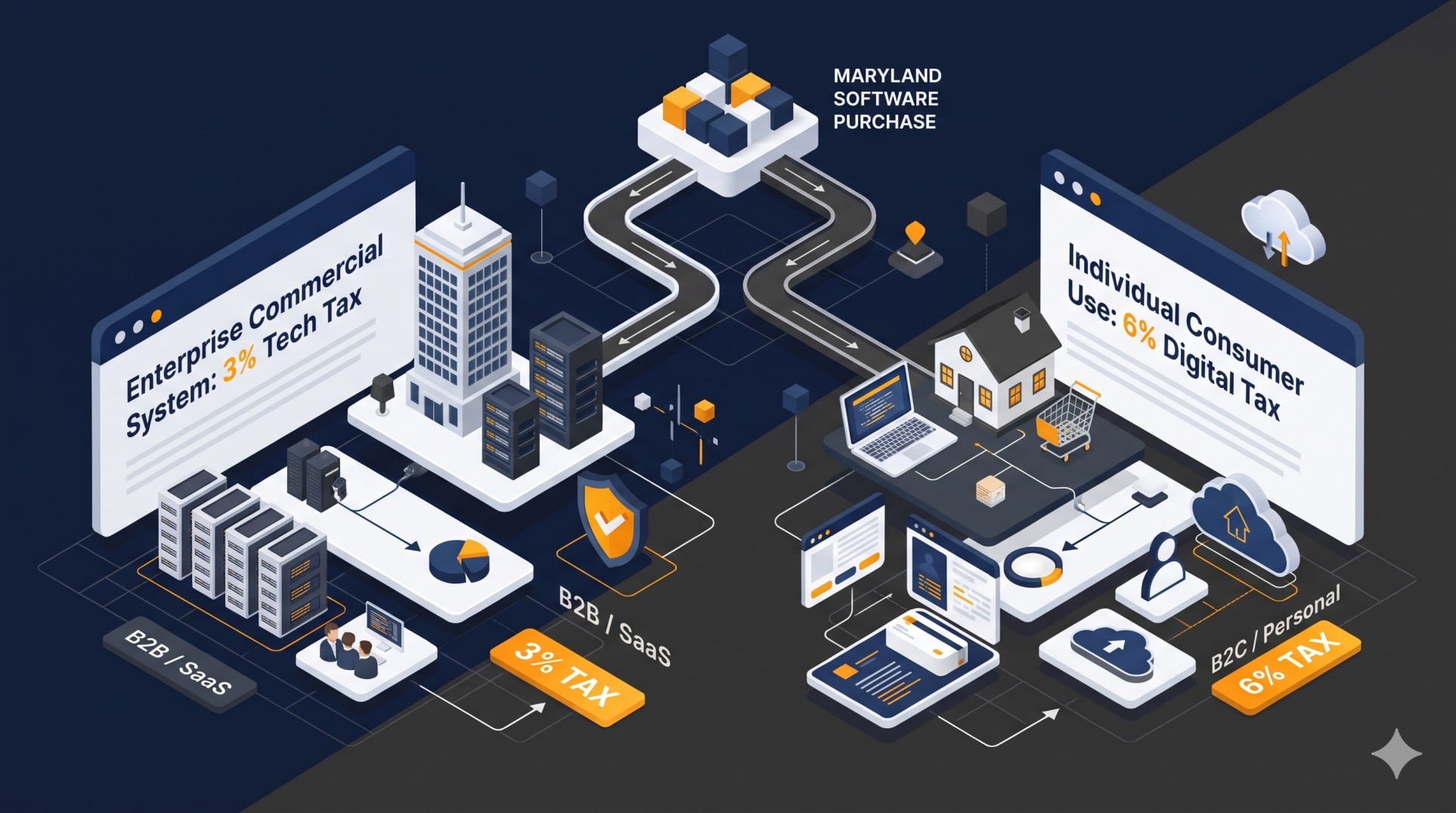
Under the Budget Reconciliation and Financing Act of 2025 (House Bill 352, Chapter 604), effective July 1, 2025, Maryland enacted a 3.00% sales and use tax on commercial IT services, cloud hosting, custom software, and enterprise SaaS, while maintaining a 6.00% tax rate on consumer digital goods and individual-use software.
Maryland’s “Tech Tax” caught thousands of B2B software vendors, MSPs (Managed Service Providers), and IT consulting firms off guard because it tied sales tax liability directly to North American Industry Classification System (NAICS) activity descriptions. Per Maryland Technical Bulletin No. 56, taxability is governed by the actual nature of the service sold on the invoice—not the primary NAICS code the vendor reports on its federal corporate income tax return.
The 4 NAICS Sectors Subject to Maryland’s 3% Tax
Any vendor meeting Maryland’s economic nexus threshold ($100,000 in gross revenue OR 200 separate transactions in the current or previous calendar year) must collect 3.00% Maryland sales tax on services matching these four NAICS sectors:
- NAICS Sector 518 (Computing Infrastructure, Data Processing & Web Hosting): Includes cloud computing (IaaS/PaaS), data storage, server hosting, application hosting, and streaming support services.
- NAICS Sector 519 (Other Information Services): Includes web search portals, news syndicates, libraries, archives, and electronic information databases.
- NAICS Subsector 5415 (Computer Systems Design & Related Services): Includes custom computer programming (541511), computer systems integration and design (541512), computer facilities management (541513), IT consulting, and cybersecurity services. Notably, HB 352 repealed Maryland’s legacy exemption for customized software.
- NAICS Subsector 5132 (Software Publishers): Includes system software and application software publishing services.
How the 3% vs. 6% Rate Split Works for SaaS and Affiliated Companies
Before July 1, 2025, Maryland excluded SaaS from its 6% digital products tax if the software was used solely in an enterprise computer system for commercial purposes. HB 352 eliminated that tax-free ride and created a two-tier rate structure:
- 3.00% Commercial Enterprise Rate: Applies when seller-hosted software (SaaS) is purchased for commercial use in an enterprise computer system, or when custom software and NAICS 518/519/5415/5132 IT services are sold.
- 6.00% Standard Rate (Tie-Breaker Rule): Applies when SaaS, downloaded software, or streaming subscriptions are sold for individual/personal use (classified as a digital product). Per the Comptroller of Maryland, if a software transaction could fall into both the 3% service category and the 6% digital product category, Maryland law mandates applying the higher 6% rate unless the buyer documents commercial enterprise use.
- No Intercompany Affiliate Exemption: Maryland Technical Bulletin No. 56 explicitly warns that the 3% IT and software tax applies to internal shared-service charges billed by one affiliated corporation to another related entity—even when provided strictly at cost! (Only specific research contracts inside the University of Maryland Discovery District or sales of cloud computing to “qualified cybersecurity businesses” enjoy targeted statutory exemptions).
Washington ESSB 5814: Custom Software, IT Support, and Digital Automated Services
While Washington has taxed prewritten remote access software (SaaS) for years, Engrossed Substitute Senate Bill 5814 (ESSB 5814)—effective October 1, 2025—dramatically expanded Washington’s 6.50% state plus local retail sales tax (and Retailing B&O tax) to include custom software, IT technical support, training, website development, digital advertising, and human-effort digital services.
In Washington, SaaS providers face a double-layered tax regime under RCW 82.04.050(6), RCW 82.04.192, and WAC 458-20-15503. First, the seller must collect destination-based Retail Sales Tax from the customer (6.50% state base plus local city/county rates, bringing Seattle’s combined rate to 10.35% in 2026). Second, the seller pays Washington’s gross receipts Retailing Business and Occupation (B&O) Tax (0.471%) on those same revenues.
How ESSB 5814 Destroyed the “Human Effort” and Professional Services Shield
Prior to ESSB 5814, SaaS and tech companies selling into Washington routinely separated their software subscription (taxable) from professional services like custom coding, onboarding training, help-desk support, custom web design, and human-driven data processing (which were exempt from retail sales tax and subject only to the Service & Other Activities B&O tax). ESSB 5814 erased those exemptions:
- Newly Taxable Tech & Digital Services: Effective October 1, 2025, Washington classifies IT technical consulting, IT training and technical support, data entry and data processing, custom website development, custom software, and the customization of prewritten software as taxable “retail sales.”
- Repeal of the 50% Human Effort DAS Exclusion: Previously, a Digital Automated Service (DAS) was exempt from Washington sales tax if more than 50% of the service involved human effort after the customer requested it, or if it involved live presentations or advertising. ESSB 5814 repealed those exclusions, making live online workshops/webinars, digital advertising services, and human-assisted digital platforms fully subject to retail sales tax (while carving out a specific exemption for telehealth/telemedicine and B2B intercompany sales between members of an affiliated group for IT, custom web, and advertising services).
- Higher B&O Surcharges in 2026–2027: Alongside ESSB 5814, Washington enacted tiered Service & Other B&O rates (rising above 1.5% for high-earners), a 0.5% surcharge on Washington taxable income exceeding $250 million effective January 1, 2026, and hiked the Advanced Computing B&O surcharge from 1.22% to 7.50% (capped at $75 million annually) effective January 1, 2026.
- Mandatory June 25, 2027 Sales Tax Prepayment Trap: Under ESSB 5814, any monthly filer with $3,000,000 or more in taxable Washington retail sales during calendar year 2026 must make a one-time prepayment equal to 80% of the state sales tax collected during the June 2026 period on or before June 25, 2027 (reconciled on the return due July 26, 2027), or face an immediate 10% penalty.
2026–2027 Multi-State Digital Goods, Streaming & SaaS Taxability Matrix
To configure tax engines accurately across Utah, Louisiana, Maryland, and Washington in 2026 and 2027, tax directors must map each product SKU against state-specific statutory rates, local sourcing rules, and economic nexus triggers.
| Compliance Factor | Utah (SB 162) | Louisiana (HB 8 & HB 10) | Maryland (HB 352 / TB 56) | Washington (ESSB 5814) |
|---|---|---|---|---|
| Key Effective Date | July 1, 2026 (Nexus transaction repeal: July 1, 2025) | January 1, 2025 (Mandatory E-File: Jan 1, 2026) | July 1, 2025 | October 1, 2025 (B&O hikes: Jan 1, 2026; Prepayment: Jun 25, 2027) |
| 2026–2027 Tax Rate on SaaS & Digital Goods | 4.85% State + Local (6.10%–9.05% combined) | 5.00% State + Local Parish (8.00%–13.50%; 10.11% avg.) | 3.00% (Enterprise B2B SaaS & IT Services) / 6.00% (Consumer Digital & Individual SaaS) | 6.50% State + Local (up to 10.35%+) + 0.471% Retailing B&O Tax |
| Seller-Hosted Software (SaaS) | Taxable (B2B and B2C; codified under SB 162) | Taxable (B2B and B2C; narrow direct-production exemption only) | Taxable (3% if commercial enterprise system; 6% if individual use) | Taxable as Remote Access Software (B2B and B2C) |
| Streaming Subscriptions (Video, Audio, Books, Gaming) | Taxable starting July 1, 2026, even with zero download | Taxable at full state + parish rate | Taxable at 6.00% as specified digital products | Taxable as Digital Goods / Digital Automated Services (DAS) |
| Custom Software & IT Consulting / Setup | Custom software & separately stated setup/training are Exempt | Custom software is Taxable; separately stated setup/training & IaaS are Exempt | Taxable at 3.00% (Custom software exemption repealed; NAICS 5415/518 taxed) | Taxable at full retail rate (Custom software, IT support, training & web dev taxed; affiliate exemption applies) |
| 2026–2027 Economic Nexus Threshold | $100,000 gross revenue (200-transaction rule repealed) | $100,000 gross sales (200-transaction rule repealed in 2023) | $100,000 gross revenue OR 200 transactions | $100,000 combined gross receipts (No transaction count) |
Contract Timing, Invoice Unbundling, and Multiple Points of Use (MPU) Rules
How you structure your software contracts, itemize your invoices, and document multi-state user seats determines whether your customers overpay tax—or whether your company gets hit with an audit assessment on bundled services.
1. Legacy Contract Grandfathering vs. Monthly Auto-Renewals
When a state expands its tax base to software or IT services, controllers often assume that multi-year Master Services Agreements (MSAs) signed prior to the effective date are grandfathered out of the tax. That assumption fails for recurring subscriptions:
- Maryland Subscription Rule: Under Maryland Comptroller guidance for HB 352, fixed-scope contracts signed before July 1, 2025, are not subject to the 3% tax even if paid later. However, each periodic subscription payment and each automatic renewal is treated as a brand-new, separate sale. A monthly or annual SaaS subscription originally signed in 2024 is fully taxable on every billing cycle billed after July 1, 2025, and any change order expanding contract scope triggers tax.
- Washington ESSB 5814 Transition Window: Per Washington DOR guidance, if a contract for newly taxable IT or custom software services was signed and paid in full before October 1, 2025, it remains exempt from retail sales tax. If a pre-existing contract remained unaltered and unpaid after October 1, 2025, Washington granted a transition window allowing businesses to report under the old classification only through March 31, 2026. Beginning April 1, 2026, 100% of ongoing billings on legacy contracts must collect Washington retail sales tax and report under Retailing B&O.
- Utah July 1, 2026 Cutover: Any billing period, renewal, or subscription charge for streaming or seller-hosted software (SaaS) invoiced on or after July 1, 2026, in Utah must include Utah state and local sales tax.
2. Multiple Points of Use (MPU) Certificates for Enterprise Seat Licenses
What happens when a corporate buyer headquartered in Baltimore, Maryland, or Seattle, Washington, buys 500 enterprise SaaS seats, knowing that only 100 employees work inside that state while the remaining 400 employees work in California, Texas, and New York (or abroad)?
If the SaaS vendor simply taxes 100% of the invoice based on the customer’s headquarters billing address, the buyer dramatically overpays tax on seats used in non-taxing states like California. Both Maryland (under HB 352 / Technical Bulletin 56 regulations), Washington (under RCW 82.08.0208(4) via the Digital Products & Remote Access Software Exemption Certificate), and Utah allow commercial buyers to claim Multiple Points of Use (MPU) apportionment:
- How MPU Works: When an enterprise buyer issues a valid MPU exemption certificate (or provides verified user-seat location apportionment data at the time of sale), the software vendor is relieved from collecting sales tax on the out-of-state seats (or relieved of collection entirely where the buyer assumes direct use-tax reporting responsibility, as required under Maryland’s Comptroller-authorized MPU certificate rules).
- Apportionment Documentation: The tax base is apportioned strictly by the ratio of concurrent users/employees located inside the taxing state divided by total authorized users company-wide. Never reduce the taxable base on a B2B software invoice without collecting and storing a signed MPU certificate or formal seat-allocation schedule in your audit file!
| Invoice / Contract Scenario | Tax Compliance Trap | Best-Practice Billing & ERP Fix (2026–2027) |
|---|---|---|
| Bundled SaaS + Implementation & Onboarding | In Louisiana and Utah, bundling non-taxable setup, configuration, or training fees into a single “Platform Subscription” line taints the entire invoice, making 100% of the charge taxable. | Unbundle your SKU catalog: list Prewritten SaaS License, Implementation/Setup Services, and Training on separate invoice lines with distinct tax codes. (Note: In WA and MD, IT setup and consulting are taxable even when separately stated!). |
| Multi-State Enterprise Seat Licenses (B2B) | Defaulting to the buyer’s headquarters “Bill-To” address in Seattle, Baltimore, or Salt Lake City taxes 100% of global employee seats at 3% to 10.35%. | Collect a signed Multiple Points of Use (MPU) certificate (or WA Digital Products Exemption Certificate) and apportion tax by verified state-by-state user headcount. |
| Maryland B2B vs. B2C Customer Classification | Charging 3% on all Maryland software sales—or failing to prove a buyer uses the SaaS in a commercial enterprise system—triggers a 3% audit assessment under Maryland’s 6% tie-breaker rule. | Require B2B customers in Maryland to provide a business FEIN / enterprise attestation at checkout to qualify for the 3% rate; default individual/consumer checkouts to 6%. |
| Intercompany Shared IT & Software Charges | Parent companies allocating cloud hosting, cybersecurity, or software costs to subsidiaries in Maryland often ignore sales tax. | In Maryland, intercompany affiliate IT/software charges are taxable at 3% even at cost! In Washington, ESSB 5814 provides an affiliated group exemption for intercompany IT, custom web, and advertising services. |
Tech companies managing complex B2B contracts and exemption certificates should utilize our automated sales tax exemption certificate management and audit defense services to prevent disallowed deductions during state examinations.
Step-by-Step Registration, Sourcing, and Return Filing for Tech Companies
Once your software, streaming, or digital media company crosses the $100,000 economic nexus threshold in Utah, Louisiana, Maryland, or Washington, you must register on each state’s designated online tax portal, configure destination address sourcing, and file recurring returns.
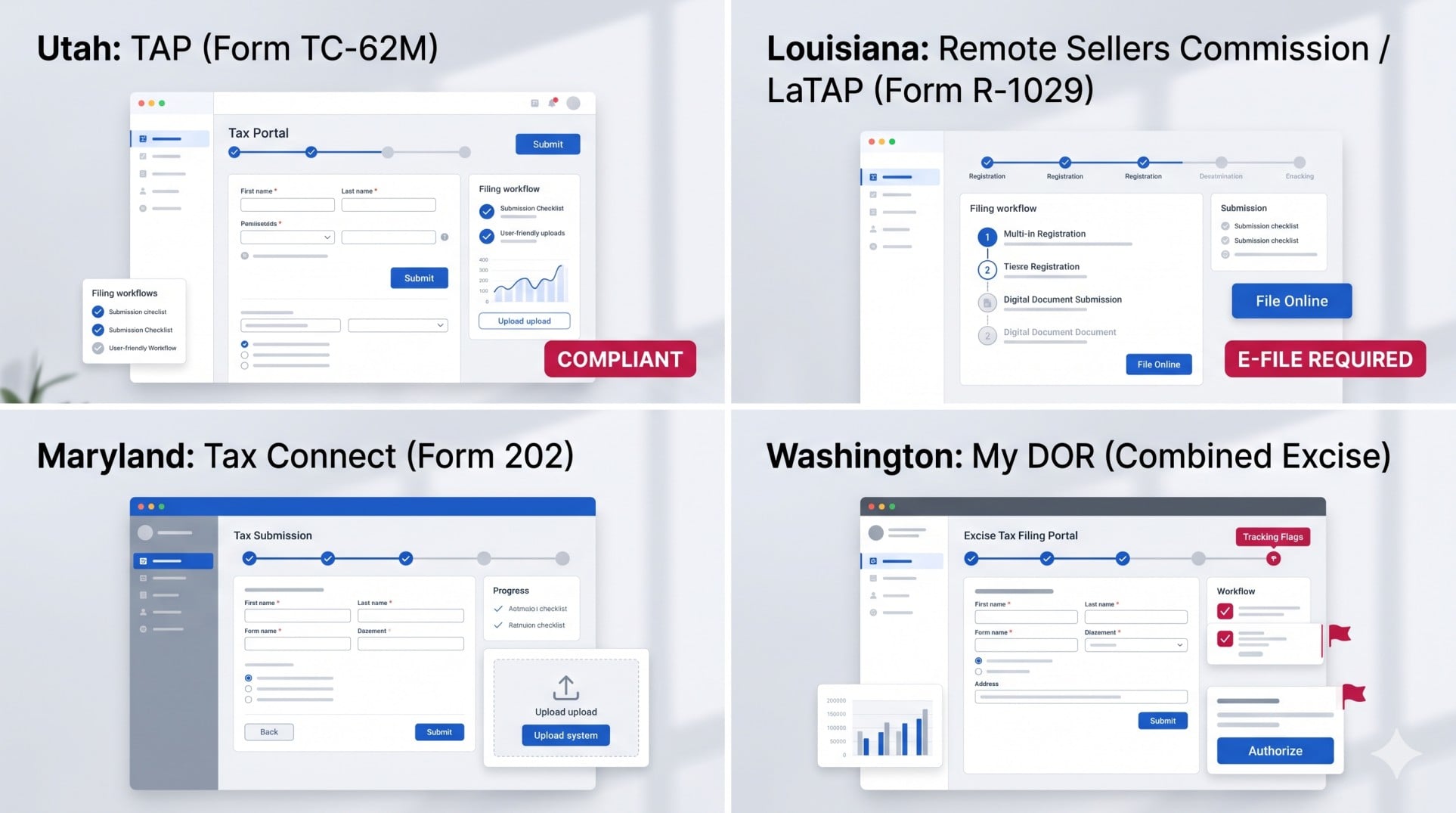
1. Utah Filing Mechanics (Utah TAP & Form TC-62M)
- Portal & Form: Register for a Utah Sales and Use Tax account via the Utah Taxpayer Access Point (TAP). Multi-jurisdiction remote sellers report state and local sales tax on Form TC-62M (Single-location sellers use Form TC-62S).
- Due Date & Discount: Returns and payments are due on the last day of the month following the monthly, quarterly, or annual reporting period. Monthly filers who file and pay on time receive a 1.31% seller discount.
- Sourcing Rule: Source streaming and seller-hosted software (SaaS) to the customer’s Utah street address (or primary place of use / billing address if street delivery is unavailable).
2. Louisiana Filing Mechanics (Remote Sellers Commission vs. LaTAP & Form R-1029)
- Dual Portal System: Out-of-state remote sellers with no physical presence in Louisiana register and file a single consolidated state-and-parish return through the Louisiana Sales and Use Tax Commission for Remote Sellers portal. Businesses with physical presence in Louisiana (such as a remote employee residing in New Orleans or Baton Rouge) register via LaTAP (Louisiana Taxpayer Access Point) to file state Form R-1029 electronically, and can use Parish E-File (expanded in February 2026) to submit local parish returns.
- Due Date & Mandatory E-File: All Louisiana returns are due on or before the 20th day of the month following the reporting period. Remember that paper filing of Form R-1029 is banned as of January 1, 2026 ($100 or 5% penalty).
3. Maryland Filing Mechanics (Maryland Tax Connect & Form 202)
- Portal & Form: Register for a Central Registration Number (CRN) and file Maryland Form 202 (Sales and Use Tax Return) electronically via the Maryland Tax Connect portal.
- Manual Rate Entry Warning: On Maryland Form 202, you must separately report your 6.00% taxable sales (consumer digital products and individual SaaS) and your 3.00% taxable sales (commercial enterprise SaaS and NAICS 518/519/5415/5132 IT services). Maryland Tax Connect requires you to manually calculate and type in the tax dollar amount for each rate line before clicking Calculate.
- Due Date & Vendor Discount: Form 202 is due on the 20th day of the month following the reporting period. Timely filers receive a vendor collection credit of 1.2% on the first $6,000 of gross tax collected and 0.9% on amounts above $6,000 (capped at $500 per return).
4. Washington Filing Mechanics (My DOR & Combined Excise Tax Return)
- Portal & Form: Register for a Unified Business Identifier (UBI) and file the Washington Combined Excise Tax Return electronically via the My DOR portal.
- Dual Reporting Requirement: You must report your Washington gross receipts twice on the same return: first under the Retailing B&O Tax classification (0.471% rate), and second under the State Sales Tax (6.50%) and Local City/County Sales Tax schedule mapped to 4-digit Washington location codes (e.g., Location Code 1726 for Seattle).
- Due Date: Monthly returns are due on the 25th day of the following month (Quarterly returns are due the last day of the month following the quarter). Don’t forget the June 25, 2027 80% prepayment if your 2026 retail sales top $3 million!
4 Real-World Tech & Media Scenarios: 2026–2027 Tax Math in Action
Scenario 1: “StreamPulse Media” — Video & Audio Streaming Platform in Utah
StreamPulse Media, based in Los Angeles, sells a $15.00/month streaming-only video and audiobook subscription (no offline downloads permitted). In 2026, StreamPulse has 10,000 active subscribers residing in Salt Lake City, Utah, generating $150,000/month ($1.8 million/year) in Utah gross revenue. Prior to July 1, 2026, StreamPulse did not collect Utah sales tax because its platform was streaming-only with zero file transfer.
Effective July 1, 2026, under Utah Senate Bill 162, streaming-only access to digital audiovisual, audio, and book works is explicitly taxable. For the July 2026 billing cycle, StreamPulse must charge Salt Lake City’s combined 7.75% sales tax rate (4.85% state + 2.90% local county/city/transit):
- Monthly Taxable Base: 10,000 subscribers × $15.00 = $150,000.00
- Utah Sales Tax Collected (7.75%): $150,000.00 × 7.75% = $11,625.00 per month ($1.16 per subscriber)
- Timely Filing Seller Discount (1.31%): Because StreamPulse files monthly on Form TC-62M via Utah TAP by August 31, it retains 1.31% ($152.29) and remits $11,472.71 to the Utah State Tax Commission.
Scenario 2: “CloudFlow CRM” — B2B SaaS + Implementation in Louisiana
CloudFlow CRM, a Delaware SaaS company with over $250,000 in annual Louisiana revenue, signs a new enterprise customer located in Jefferson Parish, Louisiana (Metairie) in October 2026. The contract includes a $24,000 annual subscription for prewritten cloud CRM software and a $6,000 fee for initial setup, data migration, and employee training (Total deal: $30,000). In Jefferson Parish, the 2026 combined sales tax rate is 9.75% (5.00% Louisiana state rate under HB 10 + 4.75% Jefferson Parish local rate).
- If Bundled on One Invoice Line ($30,000): The entire $30,000 charge is taxed as a prewritten computer software access service under HB 8: $30,000 × 9.75% = $2,925.00 tax.
- If Properly Unbundled on Two Invoice Lines: CloudFlow lists “Annual Prewritten CRM SaaS Subscription: $24,000” on Line 1 and “Implementation, Setup & Training Services: $6,000” on Line 2. Because separately stated setup and training fees are non-taxable in Louisiana, only the $24,000 SaaS line is taxed: $24,000 × 9.75% = $2,340.00 tax ($1,200.00 state + $1,140.00 parish), saving the customer $585.00 while keeping CloudFlow 100% audit-compliant on its electronic return with the Louisiana Remote Sellers Commission.
Scenario 3: “Apex Cyber & Dev” — Maryland 3% vs. 6% Split & MPU Apportionment
Apex Cyber & Dev, based in Virginia, sells cloud security software (NAICS 5132) and custom systems integration consulting (NAICS 541512) into Maryland. In September 2026, Apex closes two Maryland transactions:
- Deal A (B2C Consumer App Sales): Apex sells $20,000 of personal identity-monitoring software subscriptions to individual Maryland consumers. Because the software is for individual (non-enterprise) use, it is taxed as a digital product at 6.00% = $1,200.00 tax.
- Deal B (B2B Enterprise Contract with MPU): Apex bills a logistics corporation headquartered in Baltimore, Maryland, $80,000 for enterprise SaaS licenses and $20,000 for custom IT systems integration work performed for the Baltimore office. For the $80,000 enterprise SaaS license, the buyer provides valid Multiple Points of Use (MPU) documentation confirming that only 40% of the software users (200 of 500 seats) are located in Maryland, while 60% are in Virginia (where electronically delivered SaaS is exempt).
- Maryland Taxable Enterprise SaaS Base (40%): $80,000 × 40% = $32,000.00
- Maryland Taxable Custom IT Consulting (100% MD): $20,000.00
- Total 3% Tech Tax Base on Form 202: $32,000 + $20,000 = $52,000.00 × 3.00% = $1,560.00 tax.
Scenario 4: “Cascade DevOps Inc.” — Washington ESSB 5814 Retail + B&O Double Hit
Cascade DevOps Inc. provides cloud monitoring SaaS and custom software development to a client located in Seattle, Washington (Location Code 1726, where the 2026 combined retail sales tax rate is 10.35%: 6.50% state + 3.85% local). In October 2026, Cascade bills the Seattle client $50,000 for remote access software (SaaS), $30,000 for custom software coding, and $10,000 for live remote IT training workshops (Total invoice: $90,000).
Under Washington ESSB 5814, all three lines—SaaS, custom software, and live IT training—are now defined as taxable retail sales:
- Retail Sales Tax Collected from Seattle Client (10.35%): $90,000.00 × 10.35% = $9,315.00 (Total invoice paid by client: $99,315.00).
- Seller’s Retailing B&O Tax Paid by Cascade (0.471%): $90,000.00 × 0.471% = $423.90 (paid out of Cascade’s gross margin).
- Total Remitted on WA Combined Excise Tax Return: $9,315.00 + $423.90 = $9,738.90.
If your tech company discovered uncollected past sales tax in any of these states, our outsourced sales tax compliance and VDA filing team can negotiate penalty waivers before state auditors contact you.
Frequently Asked Questions About SaaS, Streaming, and Digital Goods Taxes
1. Is Software-as-a-Service (SaaS) taxable in Utah starting July 1, 2026?
Yes, seller-hosted software (SaaS) is explicitly subject to Utah state (4.85%) and local sales and use tax effective July 1, 2026, under Utah Senate Bill 162. The law defines seller-hosted prewritten computer software as taxable regardless of whether the customer downloads any code or accesses it purely through a web browser.
2. Are streaming-only subscriptions without downloads taxable in Utah in 2026?
Yes, beginning July 1, 2026, Utah Senate Bill 162 imposes sales and use tax on streaming-only access and subscriptions to digital audiovisual works, digital audio works, digital books, and online gaming services, closing the prior loophole that required a file download or permanent electronic transfer.
3. What is the sales tax rate on SaaS and digital goods in Louisiana for 2026 and 2027?
In Louisiana, SaaS (“prewritten computer software access services”) and digital goods are taxed at the 5.00% state sales tax rate (enacted under HB 8 and HB 10 through 2029) plus applicable local parish and municipal taxes. Combined state and local rates typically range from 8.00% to 13.50%, averaging 10.11% statewide.
4. Are software setup, implementation, and training fees taxable in Louisiana?
No, software setup, implementation, configuration, and training fees—as well as raw cloud infrastructure (IaaS/PaaS)—are not taxable in Louisiana provided they are separately stated on the customer’s invoice. If you bundle onboarding or setup fees into a single SaaS subscription line item, the entire charge becomes taxable.
5. Why does Maryland have both a 3% and a 6% sales tax rate for software?
Under Maryland House Bill 352 (effective July 1, 2025) and Technical Bulletin No. 56, commercial SaaS used solely in an enterprise computer system—along with IT consulting, cloud hosting, and custom software under NAICS codes 518, 519, 5415, and 5132—is taxed at 3.00%. Individual consumer SaaS and digital goods are taxed at 6.00%, and Maryland applies the higher 6% rate whenever both categories could apply.
6. Are intercompany IT and software charges between affiliated companies taxable in Maryland and Washington?
Maryland and Washington treat intercompany charges differently. In Maryland, Technical Bulletin No. 56 specifies that the 3% IT and software tax does apply to services sold between affiliated companies, even at cost. In Washington, ESSB 5814 provides an explicit exemption from retail sales tax for IT services, custom website development, and advertising services sold between members of an affiliated group.
7. What did Washington Senate Bill 5814 (ESSB 5814) change for tech companies?
Effective October 1, 2025, Washington ESSB 5814 expanded the 6.50% state + local retail sales tax (and 0.471% Retailing B&O tax) to cover custom software, customization of prewritten software, IT technical support and consulting, IT training, custom website development, digital advertising, live online presentations, and Digital Automated Services (DAS) involving human effort.
8. How do Multiple Points of Use (MPU) exemptions work for multi-state B2B SaaS contracts?
When a business buys SaaS licenses for employees located across multiple states, Multiple Points of Use (MPU) rules in states like Maryland, Washington, and Utah allow the tax base to be apportioned so only the percentage of seats used inside that state is taxed by the vendor (or shifted to the buyer’s direct use-tax return via an authorized MPU certificate).
9. What is the economic nexus threshold for SaaS companies in Utah, Louisiana, Maryland, and Washington in 2026?
In 2026 and 2027, Utah, Louisiana, and Washington enforce a pure $100,000 annual gross revenue/sales threshold with no transaction count (after Utah repealed its 200-transaction rule on July 1, 2025). Maryland continues to enforce a dual threshold of $100,000 in gross revenue OR 200 separate transactions in the current or previous calendar year.
10. What is Washington’s June 25, 2027 sales tax prepayment rule under ESSB 5814?
Under ESSB 5814, any monthly sales tax filer in Washington with $3,000,000 or more in taxable retail sales during calendar year 2026 is required to remit a one-time prepayment equal to 80% of its June 2026 state sales tax liability on or before June 25, 2027 (reconciled on the July 26, 2027 return), or face a mandatory 10% penalty.
Automate Your SaaS & Digital Tax Compliance with Ourtaxpartner.com
The rapid expansion of sales tax to seller-hosted software (SaaS), streaming subscriptions, digital goods, and IT consulting across Utah, Louisiana, Maryland, and Washington has turned recurring software billing into a high-stakes audit target. Misclassifying a NAICS code in Maryland, bundling implementation fees in Louisiana, ignoring Washington’s Retailing B&O tax, or missing Utah’s July 1, 2026 streaming cutover can silently erode up to 10.5% of your top-line ARR.
You don’t have to decipher state tax bulletins or manually calculate parish and municipal rates across four different state portals. At Ourtaxpartner.com, our SALT CPAs and technology tax specialists conduct SKU-by-SKU taxability matrices for software and digital media companies, configure Stripe, Chargebee, and NetSuite tax engines, manage Multiple Points of Use (MPU) exemption certificates, handle monthly filings on Utah Form TC-62M, Louisiana Form R-1029, Maryland Form 202, and the Washington Combined Excise Tax Return, and negotiate Voluntary Disclosure Agreements (VDAs) to eliminate past penalty exposure. Book a SaaS and digital tax compliance consultation with Ourtaxpartner.com today and protect your recurring revenue through 2026, 2027, and beyond.
Disclaimer: This content provides general information for educational purposes only and reflects state, local, and federal sales, use, and excise tax laws applicable to the 2026–2027 compliance periods. State and local tax rates, nexus thresholds, and excise regulations change frequently across jurisdictions. This article does not constitute professional tax, legal, or accounting advice. Always consult a certified public accountant (CPA), enrolled agent (EA), or qualified SALT advisor at Ourtaxpartner.com regarding your specific business compliance obligations. Ourtaxpartner.com is not responsible for any actions taken based on the information provided herein.
