
High-volume, low-dollar e-commerce brands have spent years trapped by the 200-transaction threshold. Selling 200 packs of $8 vinyl stickers or $12 phone cases generated barely $2,000 in revenue, yet it triggered the exact same multi-state tax registration and filing burden faced by enterprise retailers.
That disproportionate burden is finally receding. Across the 2025 and 2026 legislative cycles, Alaska, Utah, and Illinois officially eliminated their transaction-count triggers, leaving a single $100,000 gross sales threshold to govern out-of-state tax collection.
Dropping below a state’s revised threshold does not automatically cancel your existing tax permit. If you registered in these states strictly because of order volume, you must execute a formal sales tax deregistration before turning off tax collection in your checkout cart—or face automated non-filer assessments and unjust enrichment penalties.
⚡ Executive Summary: Key 2026–2027 Tax Compliance Rules at a Glance
- Illinois Transaction Repeal (Jan 1, 2026): Under Public Act 104-0006 (HB 2755) and IDOR Bulletin FY 2026-12, Illinois eliminated its 200-transaction test effective January 1, 2026, leaving only the $100,000 cumulative gross receipts threshold measured over a rolling 12-month quarterly lookback.
- Utah Transaction Repeal (July 1, 2025): Under Utah Senate Bill 47 (2025 General Session), Utah repealed its 200-transaction trigger effective July 1, 2025, establishing a sole $100,000 gross revenue threshold measured over the current or previous calendar year.
- Alaska ARSSTC Repeal (Jan 1, 2025): Under amendments to Section 040(A) of the Alaska Remote Seller Uniform Code, the Alaska Remote Seller Sales Tax Commission eliminated its 200-transaction rule effective January 1, 2025, leaving a $100,000 statewide gross sales test (which includes marketplace sales).
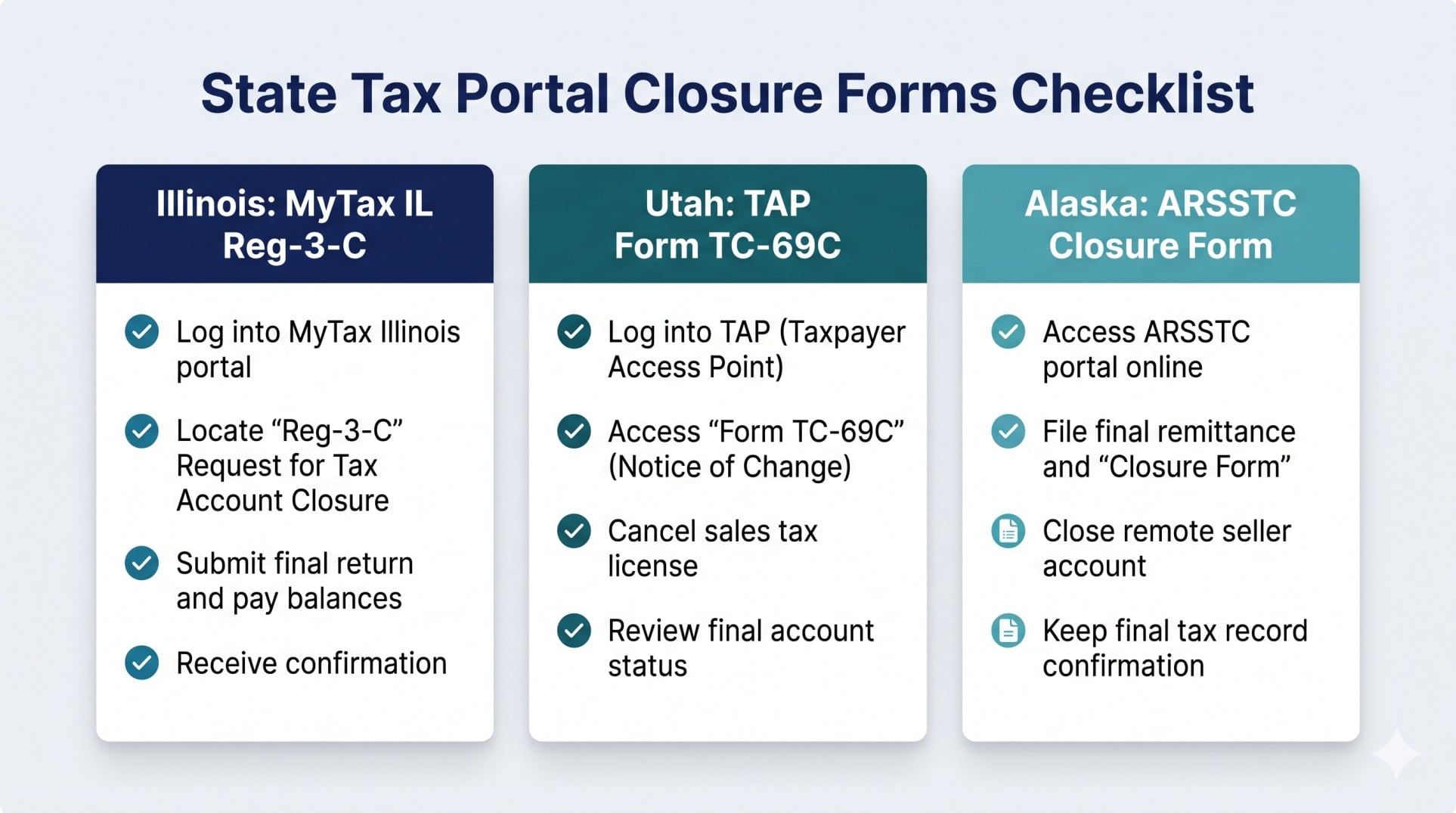
- Mandatory Deregistration Mechanics: Qualifying low-dollar sellers must file final returns and submit specific closure forms (MyTax Illinois / Form Reg-3-C, Utah Form TC-69C on TAP, and the ARSSTC Remote Seller Account Closure Form) to terminate ongoing zero-return filing obligations.
Table of Contents
- ⚡ Executive Summary: Key 2026–2027 Tax Compliance Rules at a Glance
- Why States Are Repealing the 200-Transaction Threshold for Remote Sellers
- Illinois Public Act 104-0006: Destination ROT Repeal and Voluntary Use Tax Shift
- Utah Senate Bill 47: Streamlined Sales Tax Alignment and Lookback Rules
- Alaska ARSSTC Uniform Code: Local Municipal Taxes Without Transaction Counts
- 2025 vs. 2026–2027 Economic Nexus & Deregistration Comparison Matrix
- Hidden Nexus Traps: Marketplace Facilitators, Inventory, and Trailing Rules
- Step-by-Step Sales Tax Deregistration Guide for High-Volume, Low-Dollar Sellers
- Frequently Asked Questions About Dropping the 200-Transaction Rule
Why States Are Repealing the 200-Transaction Threshold for Remote Sellers
States are repealing the 200-transaction threshold because processing thousands of low-dollar tax returns costs state revenue departments more in administrative overhead than the meager tax revenue collected from small e-commerce shops.
When the U.S. Supreme Court decided South Dakota v. Wayfair, Inc. in June 2018, the Court upheld South Dakota’s dual-trigger statute: $100,000 in annual in-state sales or 200 separate transactions. Over 40 states copied that exact phrasing to insulate their new laws from constitutional challenges.
The math quickly exposed a flaw for micro-brands and direct-to-consumer (DTC) merchants with a low Average Order Value (AOV). If your brand sells $15 coffee mugs, $10 craft supplies, or $8 beauty samples, 200 separate orders equal just $1,600 to $3,000 in gross annual revenue. At an average 7.5% combined tax rate, the state collects less than $225 a year in sales tax, while the business spends $1,500 to $3,000 annually on tax calculation software and monthly return filings.
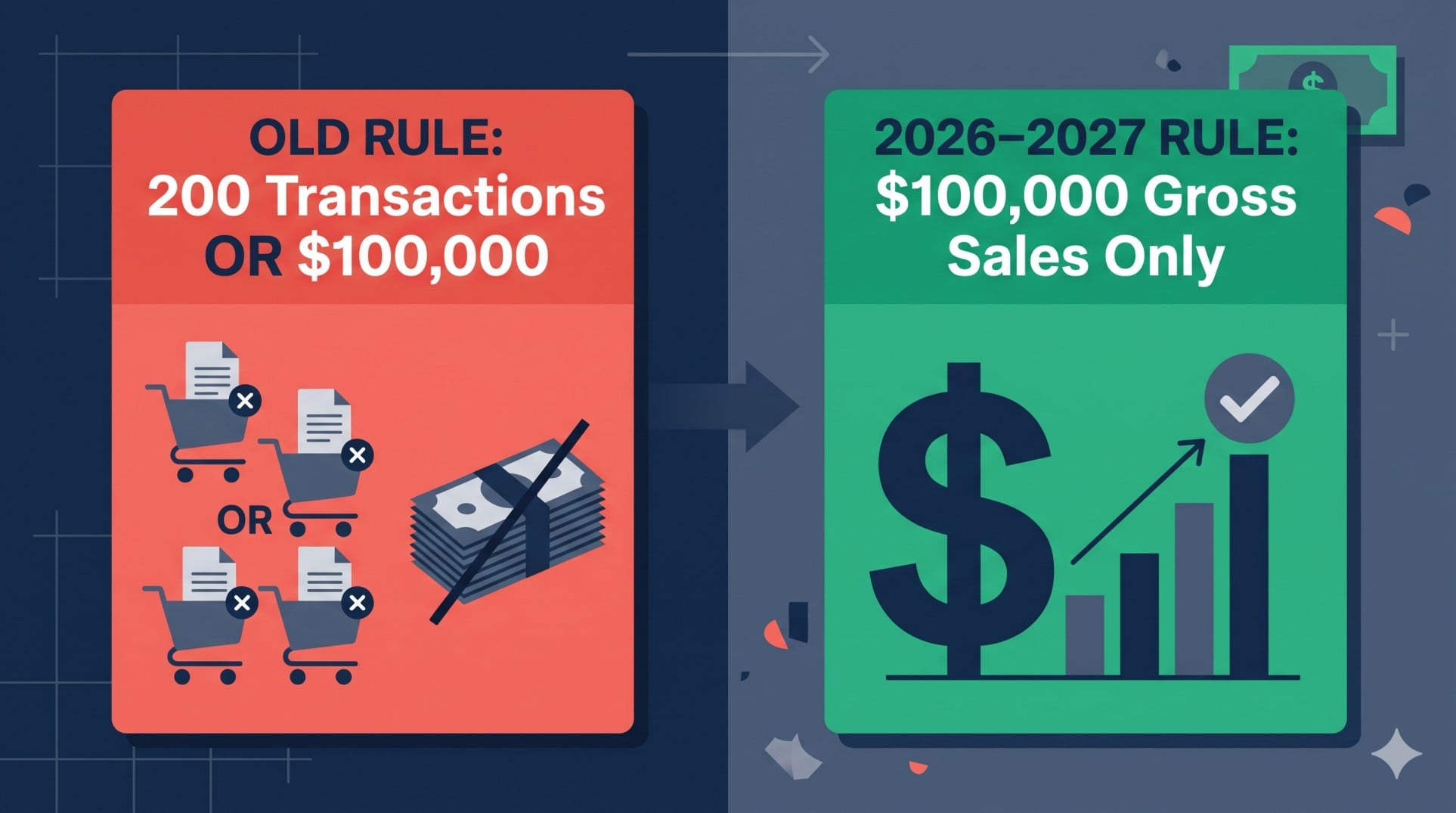
Led by the Streamlined Sales Tax (SST) Governing Board and state tax simplification task forces, states began stripping out the transaction count. California, Washington, Colorado, North Dakota, Wisconsin, Maine, Louisiana, Indiana, North Carolina, South Dakota, and Wyoming led the earlier waves. With Alaska (Jan 1, 2025), Utah (July 1, 2025), Illinois (Jan 1, 2026), and Kentucky (Aug 1, 2026 via HB 757) joining the movement, the $100,000 gross sales threshold is now the dominant national benchmark. Sellers evaluating their full national footprint should consult our comprehensive multi-state economic nexus review service to identify which jurisdictions still enforce order-count tests.
Illinois Public Act 104-0006: Destination ROT Repeal and Voluntary Use Tax Shift
Effective January 1, 2026, Illinois Public Act 104-0006 (House Bill 2755) eliminated the 200-transaction threshold for remote retailers and marketplace facilitators, making $100,000 in cumulative gross receipts the sole economic trigger for destination-based Illinois sales tax.
In Illinois, remote tax compliance is uniquely complex because of the “Leveling the Playing Field for Illinois Retail Act.” Since January 1, 2021, out-of-state sellers meeting the economic nexus threshold have been required to collect and remit state and local Retailers’ Occupation Tax (ROT) at the exact destination rate of the Illinois customer’s delivery address, rather than the flat 6.25% state Use Tax rate.
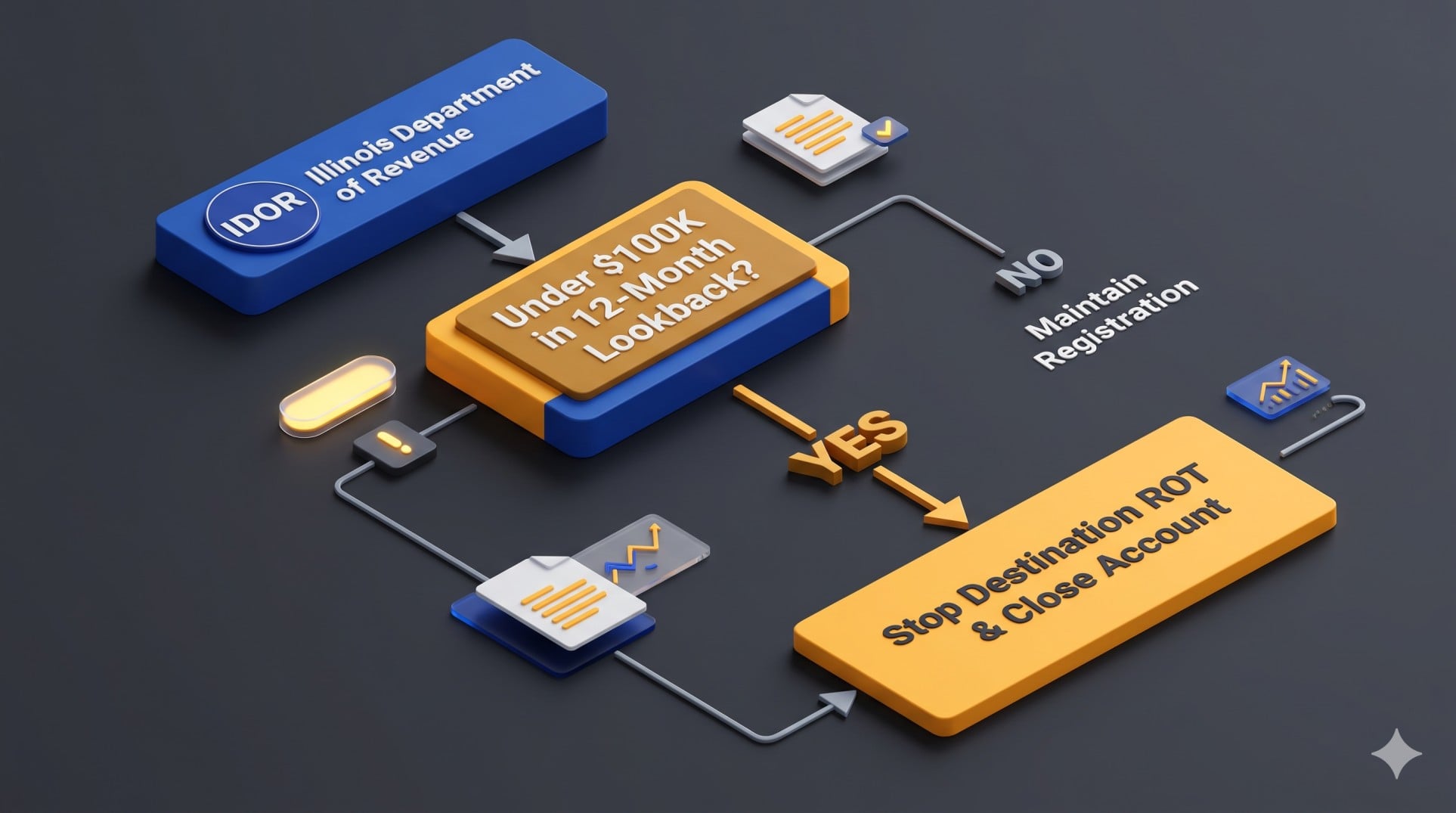
According to Illinois Department of Revenue (IDOR) Informational Bulletin FY 2026-12 (Destination-Based Retailers’ Occupation Tax Changes), beginning January 1, 2026, a remote retailer is only subject to state and local destination ROT if it makes $100,000 or more in cumulative gross receipts from sales of tangible personal property to Illinois purchasers during the preceding 12-month lookback period.
How the Illinois Quarterly Lookback and Automatic Reclassification Work
Unlike states that look strictly at the prior calendar year, Illinois enforces a rolling quarterly evaluation under 35 ILCS 120/2. Remote retailers must evaluate their preceding 12-month cumulative gross receipts at the end of every calendar quarter: March 31, June 30, September 30, and December 31.
What happens if you were already registered in Illinois because you crossed 200 transactions in 2024 or 2025, but your gross receipts never reached $100,000? Per IDOR Bulletin FY 2026-12, two critical rules apply on January 1, 2026:
- Mandatory Stop on Destination ROT: If your cumulative gross receipts for the 12-month lookback period ending December 31, 2025, were under $100,000, you must discontinue collecting and remitting state and local destination-based ROT on Form ST-1 and Form ST-2 starting January 1, 2026.
- The “Voluntary Use Tax” Reclassification Trap: IDOR did not automatically close the MyTax Illinois accounts of sellers who fell below the threshold. Instead, as of January 1, 2026, IDOR automatically converted those registrations to a “Voluntary Use Tax” collector status (collecting the flat 6.25% state use tax with no Form ST-2 local schedules). If you do not want to remain a voluntary use tax collector and file ongoing returns, you must proactively cancel your Illinois registration.
Illinois 2026 Remote Retailer Amnesty Note: Public Act 104-0006 also established a one-time Remote Retailer Amnesty Program running from August 1, 2026, through October 31, 2026. Unregistered remote sellers who had nexus between January 1, 2021, and June 30, 2026, could clear back liabilities at simplified flat rates (9.0% general merchandise; 1.75% food/drugs) with zero penalty or interest. For periods after October 31, 2026, standard Voluntary Disclosure Agreements (VDAs) and audit rules apply—including Illinois’s punitive 15% statutory tax rate on unverified destination sales.
What Counts Toward Illinois’s $100,000 Threshold?
When calculating whether your business remains under the $100,000 Illinois floor in 2026 and 2027, exclude the following from your cumulative gross receipts:
- Sales for Resale: Wholesale transactions backed by a valid, properly executed Illinois Certificate of Resale (Form CRT-61) are excluded from the threshold calculation.
- Marketplace Facilitator Sales: Sales made through a registered marketplace facilitator (such as Amazon, Etsy, Walmart, or eBay) where the facilitator certifies tax collection are excluded from a remote retailer’s own threshold calculation.
- Occasional Sales: Isolated or occasional sales of tangible personal property by a person who does not hold themselves out as a retailer are excluded.
Utah Senate Bill 47: Streamlined Sales Tax Alignment and Lookback Rules
Under Utah Senate Bill 47 (2025 General Session), signed into law on March 25, 2025, Utah repealed its 200-transaction threshold effective July 1, 2025, leaving only the $100,000 annual gross revenue test under Utah Code § 59-12-107(2)(c).
As a full member of the Streamlined Sales and Use Tax Agreement (SSUTA), the Utah State Tax Commission pushed for S.B. 47 to align Utah with the SST Governing Board’s simplification standards. Throughout 2026 and 2027, out-of-state remote sellers and marketplace facilitators only establish economic nexus in Utah if their gross revenue from sales into Utah exceeds $100,000 in either the previous calendar year or the current calendar year.
Utah Gross Revenue Inclusion Rules
While Utah’s threshold is simpler than Illinois’s rolling quarterly lookback, Utah casts a wide net on what counts toward that $100,000 gross revenue figure:
- Tangible Personal Property, Digital Products & Taxable Services: You must include gross revenue from sales of tangible personal property, products transferred electronically (digital downloads, streaming, prewritten software), and services for storage, use, or consumption in Utah.
- Exempt Sales Included in Gross Revenue: Because the statute measures “gross revenue” rather than “taxable retail sales,” wholesale and exempt transactions delivered into Utah count toward the $100,000 calculation. However, if 100% of your sales are wholesale resales backed by Utah Form TC-721 (Exemption Certificate), you have zero tax remittance liability.
- Filing Frequency & Vendor Discount Rules: Remote sellers who remain above $100,000 file Utah Form TC-62M (Multiple Location/Jurisdiction Return) or Form TC-62S (Single Location Return) via the Utah Taxpayer Access Point (TAP) due on the last day of the month following the reporting period. Note that mandatory monthly filers (annual liability of $50,000 or more) can claim Utah’s 1.31% seller discount on state and local taxes paid on time, whereas quarterly and annual filers receive no vendor discount.
If your business registered with the Utah State Tax Commission prior to July 1, 2025, solely because you exceeded 200 orders—and your total Utah gross revenue was under $100,000 in both 2025 and 2026—you are eligible to close your Utah sales tax account immediately after filing your final return. E-commerce merchants selling digital subscriptions or software alongside physical goods should also check our SaaS and digital goods sales tax taxability guide to verify how electronic transfers impact Utah gross revenue.
Alaska ARSSTC Uniform Code: Local Municipal Taxes Without Transaction Counts
Effective January 1, 2025, the Alaska Remote Seller Sales Tax Commission (ARSSTC) amended Section 040(A) of the Alaska Remote Seller Uniform Code to eliminate the 200-transaction threshold, requiring remote registration only when statewide gross sales reach or exceed $100,000 in the current or preceding calendar year.
Alaska is one of the five “NOMAD” states (alongside New Hampshire, Oregon, Montana, and Delaware) that imposes 0% state-level sales tax. However, over 100 local Alaskan cities and boroughs levy local municipal sales taxes ranging from 1.0% to 7.5% (such as Juneau at 5%, Ketchikan at 6.5%, and Wasilla at 2.5%, while Anchorage and Fairbanks charge 0% general sales tax). Following Wayfair, participating Alaskan municipalities formed the ARSSTC to administer a centralized registration and monthly filing portal for out-of-state sellers.
Critical Alaska ARSSTC Aggregated Marketplace Rule
Before you rush to cancel your ARSSTC permit, you must verify one critical rule in Section 040(A)(1) of the Alaska Uniform Code that catches mainland e-commerce brands off guard: Alaska includes marketplace facilitator sales in your individual $100,000 threshold calculation.
Under the amended Uniform Code, a remote seller meets the threshold if: “In the current or previous calendar year, the remote seller’s statewide gross sales, including the seller’s marketplace facilitator’s statewide gross sales, from the sale(s) of property, products or services delivered in the state meets or exceeds one hundred thousand dollars ($100,000).”
- Scenario A (100% Marketplace Seller): If you sell $120,000 into Alaska exclusively through Amazon FBA or Etsy (where the marketplace collects and remits the ARSSTC tax) and make $0 on your own Shopify website, Section 080(A) states you are not required to register with the ARSSTC, provided you submit a Marketplace Seller Affidavit if requested.
- Scenario B (Hybrid Direct + Marketplace Seller): Suppose you sell $92,000 on Amazon into Alaska and just $12,000 (across 300 small orders) on your own Shopify site. Even though your direct Shopify sales are only $12,000, your combined statewide gross sales into Alaska equal $104,000. Because you crossed the $100,000 statewide threshold, you must stay registered with the ARSSTC to collect and remit local municipal tax on your $12,000 of direct website sales!
Additionally, remember that “statewide gross sales” in Alaska includes deliveries into non-taxing Alaskan cities like Anchorage and Fairbanks. If you ship $85,000 of goods to customers in Anchorage (0% tax) and $20,000 to customers in Juneau (5% tax), your statewide Alaska sales total $105,000—meaning you still have nexus with the ARSSTC and must collect tax on the Juneau orders.
2025 vs. 2026–2027 Economic Nexus & Deregistration Comparison Matrix
To execute a compliant sales tax deregistration in 2026 or 2027, finance teams must verify the exact repeal date, lookback measurement period, marketplace aggregation rule, and official closure form for each jurisdiction.
| Jurisdiction | Old Rule (Pre-Repeal) | 2026–2027 Active Threshold | Effective Date & Statute | Lookback Measurement Period | Do Marketplace Sales Count Toward Threshold? | Official Portal & Deregistration Form |
|---|---|---|---|---|---|---|
| Illinois | $100,000 OR 200 transactions | $100,000 cumulative gross receipts only | January 1, 2026 (Public Act 104-0006 / HB 2755; Bulletin FY 2026-12) | Rolling 12-month period evaluated quarterly (Mar 31, Jun 30, Sep 30, Dec 31) | No (Excluded for remote retailers if marketplace certifies collection) | MyTax Illinois (“Close Account” request) or paper Form Reg-3-C |
| Utah | $100,000 OR 200 transactions | $100,000 gross revenue only | July 1, 2025 (Utah S.B. 47; Utah Code § 59-12-107) | Current or previous calendar year | Excluded where marketplace facilitator collects/remits on seller’s behalf | Utah TAP Portal (“Close Account”) or Form TC-69C |
| Alaska (ARSSTC) | $100,000 OR 200 transactions | $100,000 statewide gross sales only | January 1, 2025 (ARSSTC Uniform Code Section 040(A)) | Current or previous calendar year | Yes! Direct + Marketplace statewide sales are combined for the $100k test | ARSSTC Portal & ARSSTC Remote Seller Account Closure Form |
| Kentucky (Bonus 2026 Update) | $100,000 OR 200 transactions | $100,000 gross receipts only | August 1, 2026 (Kentucky HB 757, Acts Ch. 161) | Current or previous calendar year | No (Direct sales evaluated separately if marketplace collects) | Kentucky One Stop / MyTaxes Portal or Form 10A104 |
Hidden Nexus Traps: Marketplace Facilitators, Inventory, and Trailing Rules
Before submitting a permit cancellation request in Illinois, Utah, or Alaska, remote sellers must verify that they do not hold hidden physical presence nexus—such as third-party warehouse inventory—or unresolved trailing nexus obligations.
Repealing the 200-transaction threshold only modifies economic nexus for pure remote retailers. It provides zero relief if your business has a physical footprint in the state. If you deregister your sales tax permit while maintaining physical nexus, state auditors will revoke your cancellation retroactively and assess uncollected tax, late-filing penalties, and statutory interest.
3 Physical & Trailing Nexus Checks Required Before Deregistering
- Amazon FBA & 3PL Warehouse Inventory: Storing even a single pallet of inventory in a fulfillment center in Joliet, Illinois, or Salt Lake City, Utah, creates immediate physical presence nexus. In Illinois, per IDOR publication PIO-125 (Determining Physical Presence and Where a Sale is Sourced), a seller who fulfills orders from inventory stored in Illinois is not a remote retailer; those Illinois-fulfilled sales are taxed at the warehouse origin rate regardless of whether your revenue is $5,000 or $500,000.
- Remote Employees, Contractors & Trade Shows: Employing a remote software engineer, customer support rep, or traveling sales representative residing in Illinois, Utah, or an ARSSTC member municipality—or attending in-state trade shows to take orders—establishes physical nexus independent of the $100,000 gross sales threshold.
- Lookback & Trailing Nexus Clearance: You cannot deregister mid-year if you exceeded $100,000 during the state’s statutory lookback window. Under ARSSTC Interpretation 2023.02 and the Commission’s 2025 Repeal Notice, an Alaska remote seller could only cancel its registration on January 1, 2025, if its 2024 statewide gross sales did not exceed $100,000. Similarly, in Utah, you must confirm your gross revenue stayed under $100,000 for the entire preceding calendar year and the current year-to-date period before filing Form TC-69C.
| Pre-Deregistration Audit Check | Illinois Requirement | Utah Requirement | Alaska (ARSSTC) Requirement |
|---|---|---|---|
| 1. Verify Zero Physical Presence | Confirm no 3PL/FBA inventory in IL, no IL remote employees, and no in-state solicitors (per PIO-125). | Confirm no UT warehouse inventory, office, or in-state sales representatives (Utah Code § 59-12-107). | Confirm no physical store, inventory, or representative inside any ARSSTC member municipality. |
| 2. Confirm Lookback Revenue < $100,000 | Verify cumulative gross receipts of TPP < $100,000 for the preceding 4 quarters ending Dec 31, Mar 31, Jun 30, or Sep 30. | Verify total gross revenue (TPP, digital, services) < $100,000 in both prior calendar year and current YTD. | Verify combined direct + marketplace statewide gross sales < $100,000 in prior calendar year and current YTD. |
| 3. Reconcile & Remit All Collected Tax | Remit 100% of ROT/Use Tax collected on Form ST-1 / ST-2 prior to turning off shopping cart tax collection. | Remit 100% of state/local tax collected on Form TC-62M / TC-62S through the effective closure date. | Remit 100% of municipal tax collected across all member jurisdictions on the monthly ARSSTC portal return. |
If your e-commerce brand uses third-party logistics providers (3PLs) or multi-channel fulfillment, review our 3PL and marketplace facilitator nexus audit guide before closing any state tax accounts.
Step-by-Step Sales Tax Deregistration Guide for High-Volume, Low-Dollar Sellers
To complete a clean sales tax deregistration in Illinois, Utah, and Alaska, you must synchronize the exact date you turn off tax collection in your e-commerce checkout cart with your final state tax return and official account closure filing.
Never deactivate your state portal login or stop filing returns while your permit remains active. State tax computers automatically generate estimated failure-to-file assessments, delinquency notices, and corporate bank levies when an open account misses a monthly or quarterly due date—even when your actual sales tax liability is $0.
Step 1: How to Deregister in Illinois (MyTax Illinois & Form Reg-3-C)
- Run Your 12-Month Lookback Report: Pull your Illinois gross receipts for the most recent 4-quarter period (e.g., the 12 months ending September 30, 2026, or December 31, 2026). Confirm your direct taxable and exempt retail sales of tangible personal property are under $100,000.
- Turn Off Illinois Tax Collection at Period End: Disable Illinois tax calculation in Shopify, WooCommerce, Avalara, or TaxJar at 11:59 PM on the last day of your current reporting period (e.g., October 31). Never turn off tax collection mid-month if you can avoid it, and never keep collecting tax after your closure effective date.
- File Your Final Form ST-1 (and Form ST-2): Log into MyTax Illinois and file your final monthly or quarterly Form ST-1 (along with Form ST-2 if you collected destination-based ROT) by the 20th day of the following month. Remit every penny collected from Illinois customers.
- Close the Sales & Use Tax Account: Recall that IDOR automatically switched sub-$100k remote sellers to “Voluntary Use Tax” status on January 1, 2026. To completely terminate your filing obligation, log into MyTax Illinois, navigate to “More Account Options” under your Sales and Use Tax account, select “Close Account” (or submit paper Form Reg-3-C, Business Information Update), and specify that you are a remote retailer below the $100,000 economic nexus threshold under Public Act 104-0006. Save the portal confirmation number for your permanent audit file.
Step 2: How to Deregister in Utah (TAP Portal & Form TC-69C)
- Verify Prior and Current Year Gross Revenue: Confirm your Utah gross revenue (tangible goods, digital products, and taxable services) was under $100,000 in 2025 and remains under $100,000 year-to-date in 2026.
- File Your Final Form TC-62M or TC-62S: Log into the Utah Taxpayer Access Point (TAP) portal and file your final Sales and Use Tax Return (Form TC-62M for multi-jurisdiction remote sellers or Form TC-62S) on or before the last day of the month following the period in which you ceased collecting tax.
- Submit Utah Account Closure via TAP or Form TC-69C: Inside your Utah TAP dashboard, select your Sales and Use Tax account, click “More Account Options” → “Close Account,” and enter the exact last day you collected Utah sales tax. Alternatively, complete and sign paper Form TC-69C (Notice of Change for a Tax Account), checking the Sales and Use Tax box in Part A and indicating that your out-of-state business no longer meets Utah’s economic nexus threshold under S.B. 47.
Step 3: How to Deregister in Alaska (ARSSTC Account Closure Form)
- Audit Combined Statewide Sales: Add your direct website sales delivered into all of Alaska (both taxing and non-taxing municipalities) to your marketplace facilitator sales (Amazon, Etsy, Walmart) delivered into Alaska. Confirm the combined total is under $100,000 for the prior and current calendar year.
- Submit the ARSSTC Remote Seller Account Closure Form: Per official ARSSTC guidance on the Repeal of Transaction Thresholds, a qualifying seller must complete and submit the ARSSTC Remote Seller Account Closure Form (or submit a Marketplace Seller Affidavit under Section 080(A) if 100% of sales are through a registered marketplace).
- Continue Collecting Until Official Cancellation & File Final Return: Under ARSSTC rules, a remote seller must continue to collect and remit local municipal sales tax until the ARSSTC processes the cancellation. Once approved, file your final monthly return on the ARSSTC portal by the last day of the following month to zero out your account balance.
3 Real-World Business Scenarios: Calculating Your 2026–2027 Deregistration Savings
Scenario 1: “PixelStickers Co.” — High-Volume, Low-AOV Brand in Illinois
PixelStickers Co. is an Austin, Texas-based e-commerce shop selling custom laptop decals with an Average Order Value (AOV) of $15.00. In 2025, PixelStickers shipped 1,800 separate orders directly to Illinois customers, generating $27,000 in cumulative gross receipts. Because 1,800 orders exceeded the old 200-transaction threshold, PixelStickers had to register in Illinois, map rooftop destination rates across hundreds of Illinois cities, and file monthly Form ST-1 and Form ST-2 returns. Over 12 months, PixelStickers collected and remitted roughly $2,295 in Illinois tax (at an 8.5% average destination rate) while paying $1,800/year in software and filing fees.
Under Public Act 104-0006, the 200-transaction rule disappeared on January 1, 2026. Because PixelStickers’ 12-month lookback revenue of $27,000 sits $73,000 below the $100,000 gross sales threshold, the company no longer has Illinois economic nexus. By filing its final Form ST-1 and canceling its voluntary use tax status in MyTax Illinois, PixelStickers eliminates 12 complex returns a year and saves $1,800 annually in compliance costs.
Scenario 2: “Alpine Trail Teas” — Specialty Consumables Shipper in Utah
Alpine Trail Teas is an Oregon-based loose-leaf tea company shipping $25.00 tea samplers nationwide. In 2024, Alpine Trail shipped 420 orders into Utah totaling $10,500 in gross revenue, triggering registration under Utah’s old 200-transaction rule. In 2025, the company shipped 500 orders into Utah totaling $12,500. Following the enactment of Utah Senate Bill 47 (effective July 1, 2025), Utah eliminated the 200-transaction test.
In October 2026, Alpine Trail’s controller reviews their nexus footprint. With $12,500 in 2025 Utah revenue and $11,000 in 2026 year-to-date Utah revenue—and zero inventory or employees in Utah—Alpine Trail is well under the $100,000 threshold. The company turns off Utah tax collection at the end of the quarter, remits the $797.50 collected during the quarter on a final Form TC-62M, and submits Form TC-69C via Utah TAP to close the account permanently.
Scenario 3: “Northern Lights Outdoor Gear” — The Alaska Hybrid Marketplace Trap
Northern Lights Outdoor Gear, based in Washington State, sells camping accessories ($40.00 AOV) into Alaska. In 2025, the company shipped 350 orders via its own Shopify website to Alaskan customers, generating $14,000 in direct sales. Hearing that the ARSSTC repealed the 200-transaction threshold on January 1, 2025, the owner prepares to submit the ARSSTC Remote Seller Account Closure Form.
Before filing, Ourtaxpartner.com audits their multi-channel sales data and discovers that Northern Lights also sold $94,000 of camping gear to Alaskan buyers through Amazon FBA during 2025. Under Section 040(A) of the Alaska Remote Seller Uniform Code, Alaska aggregates direct sales ($14,000) and marketplace facilitator sales ($94,000) for a combined statewide total of $108,000. Because $108,000 exceeds the $100,000 gross sales threshold, Northern Lights still has economic nexus in Alaska and cannot deregister! Had the owner closed the ARSSTC account and stopped collecting local tax on the $14,000 of direct Shopify sales, the business would have faced an ARSSTC audit assessment plus late penalties. If you have unfiled historical periods in any state, explore our Voluntary Disclosure Agreement (VDA) and back-tax remediation services to clear past liabilities safely.
Frequently Asked Questions About Dropping the 200-Transaction Rule
1. When did Illinois eliminate the 200-transaction economic nexus threshold?
Illinois eliminated its 200-transaction threshold effective January 1, 2026, under Public Act 104-0006 (HB 2755) and IDOR Informational Bulletin FY 2026-12. Remote retailers and marketplace facilitators now only establish Illinois economic nexus if they reach $100,000 or more in cumulative gross receipts during the preceding 12-month quarterly lookback period.
2. When did Utah repeal the 200-transaction rule for remote sellers?
Utah repealed its 200-transaction economic nexus rule effective July 1, 2025, under Senate Bill 47 (2025 General Session). Out-of-state sellers now only trigger a Utah sales and use tax collection obligation if their gross revenue from sales into Utah exceeds $100,000 in the current or previous calendar year.
3. Does Alaska still have a 200-transaction threshold for local sales tax?
No, the Alaska Remote Seller Sales Tax Commission (ARSSTC) repealed its 200-transaction threshold effective January 1, 2025, under amended Section 040(A) of the Remote Seller Uniform Code. Remote sellers only have nexus with ARSSTC member municipalities if their statewide gross sales into Alaska reach or exceed $100,000 in the current or previous calendar year.
4. Why did MyTax Illinois change my account to “Voluntary Use Tax” in 2026?
Per IDOR Bulletin FY 2026-12, if you were registered as a remote retailer SOLELY because you met the old 200-transaction rule—and you did not reach $100,000 in gross receipts for the 12 months ending December 31, 2025—IDOR automatically converted your registration to “voluntary use tax” on January 1, 2026. You must formally close the account in MyTax Illinois if you wish to stop filing returns.
5. Do Amazon or Etsy marketplace sales count toward the $100,000 threshold in Illinois, Utah, and Alaska?
It depends on the state. In Illinois and Utah, sales made through a registered marketplace facilitator that collects tax on your behalf are excluded from your individual $100,000 threshold. In Alaska (ARSSTC), marketplace facilitator sales are included in your $100,000 statewide gross sales calculation under Section 040(A).
6. Can I deregister in Illinois or Utah if I store inventory in an Amazon FBA warehouse there?
No, you cannot deregister if you store inventory in a warehouse or fulfillment center located in Illinois or Utah. Inventory creates physical presence nexus regardless of your transaction count or dollar volume, requiring you to remain registered and file returns even if your sales are under $100,000.
7. What happens if I stop collecting sales tax in my online store without closing my state tax permit?
If you stop collecting tax in your checkout cart but leave your state sales tax permit open, the state Department of Revenue will treat you as a delinquent non-filer. You will receive automated estimated tax assessments, failure-to-file penalties, and potential bank levies until you file all missing zero returns and submit an official account closure form.
8. What happens if I keep collecting sales tax after I deregister my permit?
Collecting sales tax without an active permit—or failing to remit tax collected from customers—is a severe violation known as unjust enrichment or tax fraud. You must synchronize your shopping cart settings so that tax collection stops on the exact effective date of your permit cancellation, and every dollar collected beforehand must be remitted on your final return.
9. Which other states recently eliminated the 200-transaction threshold?
Alongside Alaska (2025), Utah (2025), and Illinois (2026), Kentucky eliminated its 200-transaction threshold effective August 1, 2026, under House Bill 757. Earlier states that dropped the transaction count include California, Washington, Colorado, North Dakota, Wisconsin, Maine, Louisiana, Indiana, North Carolina, South Dakota, and Wyoming.
10. How long should I keep my sales tax records after deregistering in a state?
You should retain all sales tax returns, gross receipt lookback calculations, exemption certificates, and your official portal deregistration confirmation letter for at least 4 to 7 years after closing your account. This documentation proves to future auditors why and when your collection obligation legally ended.
Let Ourtaxpartner.com Handle Your Multi-State Sales Tax Deregistration
The repeal of the 200-transaction threshold in Illinois, Utah, and Alaska is a major victory for high-volume, low-dollar e-commerce sellers. If your business ships hundreds of small orders without crossing the $100,000 gross sales threshold, you no longer need to bleed profits paying for unnecessary monthly tax filings in these jurisdictions.
However, executing a clean exit requires precision. Closing an account in the wrong order, overlooking Amazon FBA warehouse inventory, miscalculating Alaska’s aggregated marketplace rule, or ignoring Illinois’s automatic voluntary use tax conversion can trigger costly audit notices. At Ourtaxpartner.com, our SALT CPAs and indirect tax specialists audit your rolling 12-month and calendar-year lookback data, verify zero physical presence exposure, file your final Form ST-1, Form TC-62M, and ARSSTC returns, and process formal sales tax deregistration applications on your behalf. Schedule a nexus and deregistration review with Ourtaxpartner.com today and stop paying to file sales tax returns in states where you no longer have nexus.
Disclaimer: This content provides general information for educational purposes only and reflects state, local, and federal sales, use, and excise tax laws applicable to the 2026–2027 compliance periods. State and local tax rates, nexus thresholds, and excise regulations change frequently across jurisdictions. This article does not constitute professional tax, legal, or accounting advice. Always consult a certified public accountant (CPA), enrolled agent (EA), or qualified SALT advisor at Ourtaxpartner.com regarding your specific business compliance obligations. Ourtaxpartner.com is not responsible for any actions taken based on the information provided herein.
