
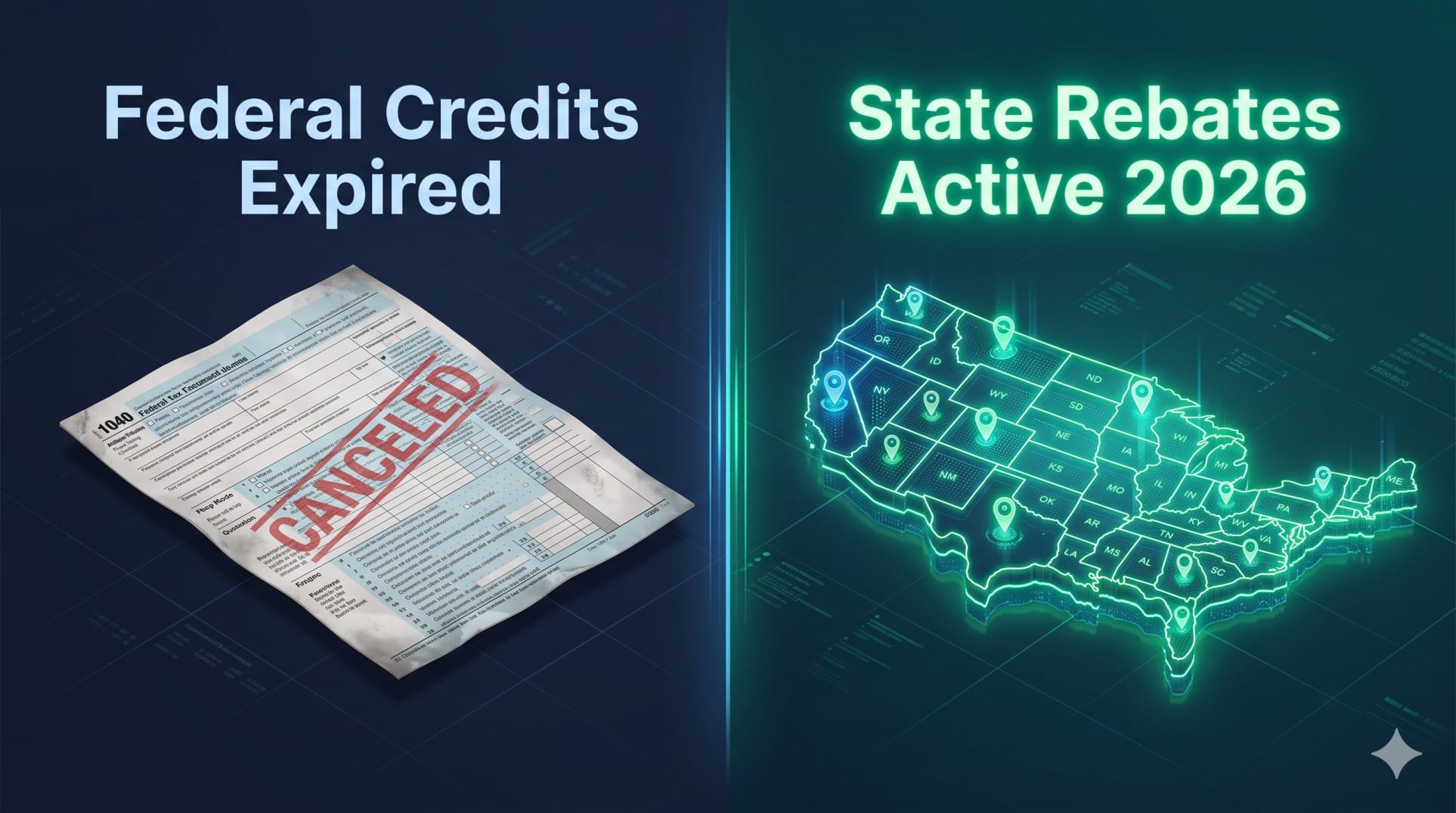
If you are researching 2026 EV Tax Credits, the landscape has completely shifted. The tax code surrounding electric vehicles underwent a massive rewrite in late 2025, fundamentally changing how and where buyers get their discounts. You can no longer rely on the IRS to subsidize your purchase.
The era of federal new and used clean vehicle credits is over. Congress officially allowed the Section 30D and Section 25E federal tax credits to expire on September 30, 2025. Anyone buying a Tesla, Ford, or Hyundai today will not see a $7,500 federal credit on their Form 1040 next April.
But the financial incentives have not disappeared—they simply moved to the state level. Governors and state legislatures have stepped in to fill the federal void, creating a highly localized, patchwork system of instant discounts and tax write-offs. Your zip code now dictates your savings.
This guide breaks down exactly how to navigate the current market. We will cover the strict income caps, the mechanics of instant dealership discounts, and the specific state programs you need to know about before signing a lease or purchase agreement.
⚡ Executive Summary: 2026 EV Incentives
- Federal Repeal: The IRS Section 30D and 25E EV tax credits expired on September 30, 2025. There are no federal vehicle purchase credits for tax year 2026.
- State Dominance: Savings are now entirely dependent on state-level point-of-sale rebates and state income tax credits.
- Top Programs: California, Colorado, and Massachusetts offer the most aggressive 2026 incentives, heavily targeting low-to-moderate-income buyers.
- Charger Credit: The federal Section 30C EV charger installation credit remains active but will expire on June 30, 2026.
Table of Contents
- The Big Shift: Federal vs. State 2026 EV Tax Credits
- How Income Limits and Point-of-Sale Rebates Work in 2026
- California MyFirstEV rebate 2026: Rules and Eligibility
- Colorado EV tax credits 2026: The Most Generous State Incentive
- East Coast Incentives: Massachusetts MOR-EV program 2026 and Beyond
- Navigating new and used clean vehicle credits in 2026
- Step-by-Step Guide: Claiming Your State EV Incentives
- Frequently Asked Questions About 2026 EV Tax Credits
The Big Shift: Federal vs. State 2026 EV Tax Credits
When discussing 2026 EV Tax Credits, we are strictly talking about state-level programs. The federal government has officially exited the electric vehicle subsidy business for individual consumers.
The IRS officially retired the federal new and used clean vehicle credits on September 30, 2025. This expiration was cemented by the Omnibus Budget and Business Act (OBBBA) signed in July 2025. If a dealership promises you a $7,500 federal tax credit today, they are either misinformed or using outdated marketing materials.
State governments anticipated this federal pullback. In response, many states revamped their own departments of energy and transportation to launch aggressive local incentives. These new programs are highly targeted. Instead of blanket credits for luxury vehicles, states are focusing their budgets on affordable commuter cars and middle-class taxpayers.
One small federal benefit does remain active for a few more months. The Section 30C Alternative Fuel Vehicle Refueling Property Tax Credit allows homeowners in eligible census tracts to claim up to $1,000 for installing a Level 2 charger. However, this infrastructure credit permanently expires on June 30, 2026. If you need a home charger, you must act before the summer deadline.
How Income Limits and Point-of-Sale Rebates Work in 2026
State programs operate differently than the old federal system. You no longer have to wait until tax season to see your savings.
The vast majority of states now utilize a dealer-direct model. When you purchase the vehicle, you transfer your eligibility to the dealership. The dealer subtracts the rebate amount from your final purchase price, effectively using state funds as your down payment. This lowers your total loan amount and reduces your monthly payments immediately.
However, states are fiercely protective of their budgets. They enforce strict Income Limits and Point-of-Sale Rebates to ensure funds go to those who need them most. Unlike the old federal system that allowed couples making up to $300,000 to claim credits, state limits are much lower.
Your eligibility is generally determined by your Modified Adjusted Gross Income (MAGI) from your most recently filed state tax return. If your income spiked this year, you might still qualify based on last year’s state tax filing requirements. Dealerships use state portals to verify your income bracket in real-time before applying the discount.
California MyFirstEV rebate 2026: Rules and Eligibility
California completely overhauled its incentive structure to focus on getting new drivers into electric cars.
The California MyFirstEV rebate 2026 is designed specifically for buyers who have never owned or leased a zero-emission vehicle. If you meet this requirement, the state provides a $3,500 point-of-sale rebate for a new EV, or a $1,750 instant rebate for a used EV. You do not claim this on your California Franchise Tax Board return; it happens entirely at the dealership.
Vehicle price caps are strictly enforced. To qualify for the new vehicle rebate, the EV must have a Manufacturer’s Suggested Retail Price (MSRP) of $50,000 or less. For used vehicles, the purchase price cannot exceed $25,000. California enforces these limits to prevent state funds from subsidizing luxury purchases.
Unlike older programs, MyFirstEV does not currently impose a hard income cap, provided you meet the strict first-time buyer criteria and the vehicle falls under the MSRP limit. You simply sign a self-attestation form at the dealership confirming your first-time status.
Maria lives in Los Angeles and wants to buy her first electric vehicle, a 2026 Ford Mustang Mach-E priced at $48,000. Because the MSRP is under the $50,000 cap, she qualifies for the California MyFirstEV rebate 2026. She does not need to wait until tax season. The dealer applies the $3,500 discount directly to her purchase agreement at the point of sale. If she were buying a used EV for $24,000, she would receive a $1,750 instant rebate instead.
Colorado EV tax credits 2026: The Most Generous State Incentive
Colorado currently offers the most lucrative combination of tax credits and rebates in the United States.
The Colorado EV tax credits 2026 structure heavily favors affordable vehicles. If you buy or lease a new EV with an MSRP under $35,000, you qualify for a $3,250 state tax credit ($750 base credit plus a $2,500 lower-price bonus). If the vehicle costs between $35,000 and $80,000, you only receive the $750 base credit. You claim this credit by filing Colorado Form DR 0617 with your state return, though many dealers will allow you to assign the credit to them at signing for an instant discount.
The real power of Colorado’s system is the Vehicle Exchange Colorado (VXC) program. Income-qualified Coloradans who trade in an older, high-emitting gas vehicle can receive a massive $9,000 point-of-sale rebate on a new EV, or $6,000 on a used EV.
Crucially, you can stack these programs. A buyer who qualifies for VXC and buys a sub-$35,000 EV can combine the $9,000 rebate with the $3,250 tax credit, yielding $12,250 in total state assistance.
David and John live in Denver and are replacing their 2010 gas-powered SUV with a new 2027 Chevy Bolt (MSRP $28,995). They meet the income requirements for the VXC program, earning them a $9,000 instant rebate. When they file their state taxes, they will also claim the Colorado EV tax credits 2026. Because the Bolt’s MSRP is under $35,000, they get the $750 base credit plus the $2,500 bonus. Their total state-level financial assistance equals $12,250.
East Coast Incentives: Massachusetts MOR-EV program 2026 and Beyond
East Coast states have built highly integrated rebate networks that rival the West Coast programs.
The Massachusetts MOR-EV program 2026 remains a flagship incentive. It offers a standard $3,500 post-purchase rebate for new battery-electric vehicles with an MSRP at or below $55,000 (though proposed regulations may lower this cap to $50,000). Low-to-moderate-income buyers can stack a $1,500 MOR-EV+ income adder, plus a $1,000 trade-in bonus, bringing total potential savings to $6,000.
Further north, the Maine ev credit 2026 program, administered by Efficiency Maine, provides instant rebates scaled directly to your income bracket. Low-income residents can receive up to $7,500 off a new EV, while moderate-income buyers receive lower tiered amounts.
The Connecticut ev credit 2026, known as the CHEAPR program, continues to offer point-of-sale rebates for both new and used vehicles. Rebates range from $2,250 to over $4,250 depending on whether you qualify for the standard or supplemental income-based tiers.
The New York EV credit 2026, officially the Drive Clean Rebate, provides up to $2,000 off the purchase price at participating dealers. The exact amount depends on the vehicle’s EPA-estimated all-electric range.
If you live in Rhode Island, the DRIVE EV program offers substantial post-purchase rebates for both new and used models. Pennsylvania drivers can tap into the Alternative Fuel Vehicle Rebate program. Meanwhile, buyers in Maryland can claim an excise tax credit of up to $3,000 against their vehicle registration taxes, significantly lowering the upfront cost of putting the car on the road.
Sarah is a moderate-income taxpayer in Boston buying a new EV for $42,000. She applies for the Massachusetts MOR-EV program 2026. She receives the standard $3,500 rebate. Because her income falls below the state’s threshold, she qualifies for the $1,500 MOR-EV+ income adder. She also trades in her old combustion engine car for an extra $1,000 bonus. Sarah walks away with $6,000 in state-funded rebates.
Navigating new and used clean vehicle credits in 2026
Buying a pre-owned electric vehicle requires a slightly different strategy than buying new.
While the federal new and used clean vehicle credits are gone, states have heavily prioritized the used market to make EVs accessible to working-class families. However, used EV programs come with much tighter restrictions to prevent abuse.
When buying secondhand, you will face tighter Income Limits and Point-of-Sale Rebates compared to new models. For example, California caps the purchase price of an eligible used EV at $25,000. Massachusetts requires buyers of used EVs to meet specific low-income thresholds to claim their $3,500 rebate. Colorado’s $6,000 VXC rebate applies to used EVs, but the vehicle must be purchased from an authorized dealer, not a private seller.
You must always buy from a state-approved, licensed dealership to claim these used vehicle rebates. Private party sales on Craigslist or Facebook Marketplace almost never qualify for state-funded EV incentives.
Step-by-Step Guide: Claiming Your State EV Incentives
Securing your state-level discounts requires preparation before you ever set foot on a dealership lot.
Step 1: Verify Your State’s MAGI Limits
Pull your state tax return from last year. Check your Modified Adjusted Gross Income against your state’s current EV program limits. If you are close to the threshold, consult a tax professional about calculating your Modified Adjusted Gross Income accurately.
Step 2: Check the Vehicle MSRP Caps
States will not subsidize luxury cars. Ensure the specific trim level you want falls under the state’s MSRP cap (e.g., $50,000 in California, $35,000 for the max credit in Colorado). Destination charges are usually excluded from the MSRP calculation, but dealer add-ons can sometimes push you over the limit.
Step 3: Confirm Dealer Participation
Not all dealerships are authorized to process state rebates. Before negotiating, explicitly ask the sales manager if they are registered with the state’s energy department (such as the VXC program in Colorado or the CSE in Massachusetts) to process point-of-sale discounts.
Step 4: Retain Your Documentation
Even if you receive an instant rebate at the dealership, keep the buyer’s order, the state attestation form, and the vehicle registration. If your state offers a tax credit rather than a rebate, you will need these documents to file your state tax return the following spring.
Frequently Asked Questions About 2026 EV Tax Credits
Are there any federal 2026 EV Tax Credits available?
No. The federal government repealed the Section 30D and 25E vehicle purchase credits on September 30, 2025. All vehicle purchase incentives in 2026 are funded and managed at the state level.
Did the IRS replace the new and used clean vehicle credits for 2026?
The IRS did not replace them. Congress allowed the new and used clean vehicle credits to expire entirely. Buyers must now look to their state’s Department of Energy or Department of Revenue for financial assistance.
Who qualifies for the California MyFirstEV rebate 2026?
Any California resident buying or leasing their first zero-emission vehicle qualifies. The vehicle must have an MSRP of $50,000 or less for new models, or a purchase price of $25,000 or less for used models.
Do the Colorado EV tax credits 2026 apply to used cars?
The specific Colorado state tax credit (up to $3,250) only applies to new EVs. However, used EVs qualify for the separate $6,000 Vehicle Exchange Colorado (VXC) rebate if the buyer meets income requirements and trades in an eligible gas vehicle.
How does a point-of-sale rebate actually work at the dealership?
The dealership verifies your eligibility through a state portal. Once approved, they subtract the rebate amount directly from the final purchase price of the car. The state then reimburses the dealership on the back end.
Can I combine state rebates with utility company incentives?
Yes. Many local utility companies offer separate rebates for buying an EV or installing a home charger. These are entirely separate from state tax credits and can usually be stacked for maximum savings.
What happens if my income increases the year I buy the EV?
Most state programs look at your Modified Adjusted Gross Income from the tax year prior to your purchase. If your income spikes in 2026, you may still qualify based on your 2025 state tax return.
Do leased vehicles qualify for state EV credits?
Usually, yes. Most states require a minimum lease term (typically 24 to 36 months) to qualify for the rebate. The leasing company applies the state rebate as a capitalized cost reduction, lowering your monthly payment.
Is the federal EV charger tax credit still active in 2026?
Yes, but only for the first half of the year. The Section 30C Alternative Fuel Vehicle Refueling Property Tax Credit allows eligible homeowners to claim up to $1,000 for charger installations, but it expires on June 30, 2026.
What documentation do I need to keep for my state tax return?
You should retain the final purchase agreement, the vehicle’s window sticker (showing the exact MSRP), your state registration, and any signed rebate attestation forms provided by the dealership.
Securing your 2026 EV Tax Credits requires a bit more local research than in previous years. By understanding your state’s specific rules, MSRP caps, and income limits, you can still drive away with thousands of dollars in savings.
Disclaimer: This content provides general information for educational purposes only. Tax laws are complex and change often. It is not professional tax, legal, or financial advice. Always consult a qualified tax professional for personalized guidance regarding your specific situation. Ourtaxpartner.com is not responsible for any actions taken based on the information provided herein.
