
⚡ Executive Summary: 2026 Capital Expensing Rules
- The Section 179 Deduction Limits for 2026 have increased to a maximum write-off of $2,560,000 for qualifying business property.
- The phase-out threshold for 2026 begins at $4,090,000, reducing the deduction dollar-for-dollar once total capital purchases exceed this amount.
- Heavy SUVs (6,000 to 14,000 lbs GVWR) are subject to a strict $32,000 Section 179 cap, while true commercial cargo vans and heavy-duty trucks are exempt from this limit.
- Recent legislation permanently restored 100% bonus depreciation for 2026, allowing businesses to fully expense assets even if they exceed Section 179 limits.

Table of Contents
- What Are the Section 179 Deduction Limits for 2026?
- How Section 179 Works for Equipment & Vehicles
- The Section 179 SUV Tax Loophole vs. Expensing Heavy Vehicles
- Bonus Depreciation in 2026: The 100% Rule Returns
- Real-World Examples: Calculating Your Tax Savings
- Qualifying Heavy Vehicles and Equipment
- Frequently Asked Questions About Section 179
Business owners looking to upgrade their fleets or purchase new machinery have a massive financial opportunity this year. The Section 179 Deduction Limits for 2026 have increased significantly, and recent legislative changes have completely rewritten the rules for first-year expensing. If you buy a truck, a tractor, or a server rack, the IRS allows you to write off the entire purchase price against your taxable income.
But the mechanics of expensing heavy vehicles are notoriously strict. Buy a vehicle that weighs 5,999 pounds, and your deduction is severely capped. Buy one that weighs 6,001 pounds, and you can write off tens of thousands of dollars immediately.
We are breaking down exactly how the tax code treats capital purchases this year. You will see the exact math for Equipment & Vehicles, learn how the heavy SUV cap works, and find out how the return of 100% bonus depreciation changes your tax strategy.
What Are the Section 179 Deduction Limits for 2026?
The IRS adjusts the maximum write-off amounts annually for inflation. For the 2026 tax year, the numbers are higher than ever, giving small and mid-sized businesses incredible leverage to reinvest in their operations.
The maximum deduction limit is exactly $2,560,000. This means you can deduct up to two and a half million dollars of qualifying property from your gross business income in a single year.
The phase-out threshold begins at $4,090,000. This rule targets massive corporations. If your business purchases more than $4.09 million in Heavy Vehicles and Equipment during the year, the IRS begins reducing your maximum deduction dollar-for-dollar. Once your total capital purchases hit $6,650,000, the deduction disappears completely.
These limits apply to both new and used property. The only requirement is that the property must be “new to you” and placed into service by December 31, 2026. You cannot buy a bulldozer on December 28, leave it sitting at the dealership until January, and claim it on your 2026 tax return. It must be actively ready and available for business use before the ball drops on New Year’s Eve.
How Section 179 Works for Equipment & Vehicles
Expensing heavy vehicles and equipment is not an automatic right. You have to actively elect to take the deduction on IRS Form 4562 when filing your business tax return.
When you buy a piece of machinery, standard accounting practice dictates depreciating it over its useful life—usually five to seven years. Section 179 lets you skip the waiting game. You deduct the full purchase price from your gross business income in year one, drastically lowering your immediate tax bill and keeping cash in your bank account.
To qualify, the asset must be used more than 50% for business purposes. If you use a laptop 60% for your LLC and 40% for personal browsing, you can only deduct 60% of the cost. The IRS strictly enforces this business-use percentage, especially for mixed-use assets like cars and computers.
Learn more about calculating your exact business use percentage here.
Financed purchases also qualify for the deduction. You can sign a loan document on December 30, put zero dollars down, place the equipment into service on December 31, and still claim the full deduction for the 2026 tax year. This makes financing an incredibly powerful tool, as your tax savings can often exceed your first year of loan payments.
The Section 179 SUV Tax Loophole vs. Expensing Heavy Vehicles
Not all vehicles are treated equally under the tax code. The IRS aggressively targets passenger vehicles to prevent taxpayers from writing off luxury sports cars as business expenses.
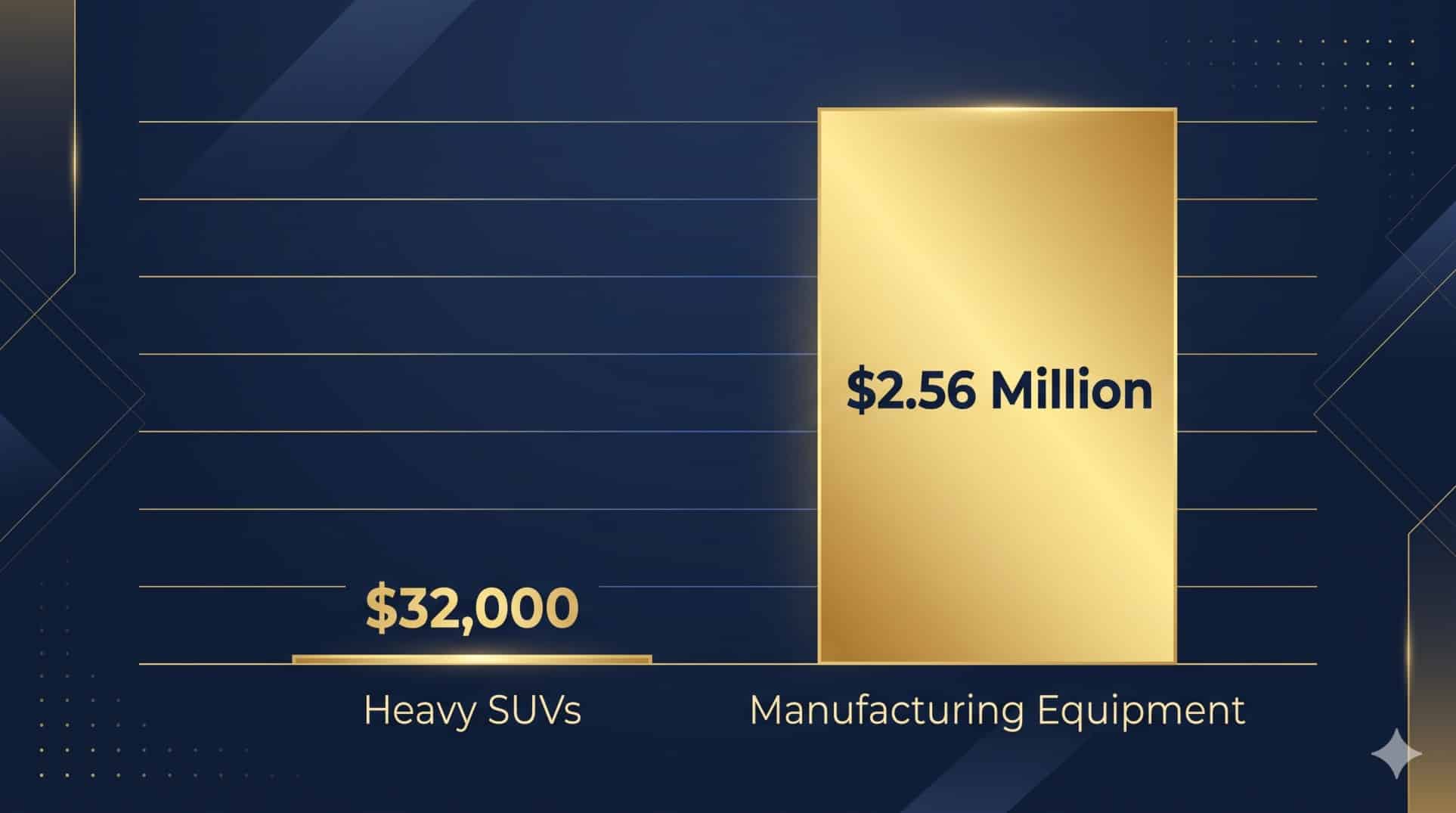
If a vehicle has a Gross Vehicle Weight Rating (GVWR) under 6,000 pounds, it is considered a light passenger vehicle. The maximum first-year depreciation deduction for these cars in 2026 is strictly capped at $12,200 (though bonus depreciation can slightly increase this number). You cannot use the massive $2.56 million limit on a standard sedan.
Vehicles with a GVWR between 6,000 and 14,000 pounds fall into a different category. This is the famous “SUV loophole.” For 2026, the IRS caps the deduction for these heavy SUVs at $32,000. If you buy an $80,000 luxury SUV that weighs 6,500 pounds, you can only take $32,000 under Section 179.
But true commercial vehicles face no such cap. If you are expensing heavy vehicles that have a cargo bed longer than six feet, or fully enclosed cargo vans with no seating behind the driver, they are exempt from the $32,000 limit. You can deduct the entire purchase price up to the $2.56 million limit. The IRS recognizes that a box truck or a chassis cab is a pure business asset, not a disguised personal vehicle.
| Vehicle Type | GVWR Requirement | 2026 Section 179 Limit |
|---|---|---|
| Light Passenger Cars | Under 6,000 lbs | $12,200 (Standard Depreciation Cap) |
| Heavy SUVs & Passenger Vans | 6,000 to 14,000 lbs | $32,000 Maximum |
| Cargo Vans (No rear seating) | Over 6,000 lbs | Full Purchase Price (Up to $2.56M) |
| Heavy-Duty Pickups (6ft+ bed) | Over 6,000 lbs | Full Purchase Price (Up to $2.56M) |
| Commercial Trucks & Tractors | Over 14,000 lbs | Full Purchase Price (Up to $2.56M) |
Read our complete guide on small business tax planning for fleet management.
Bonus Depreciation in 2026: The 100% Rule Returns
Section 179 is not the only way to write off Equipment & Vehicles. Bonus depreciation is the other half of the equation, and the rules have recently shifted in favor of business owners.
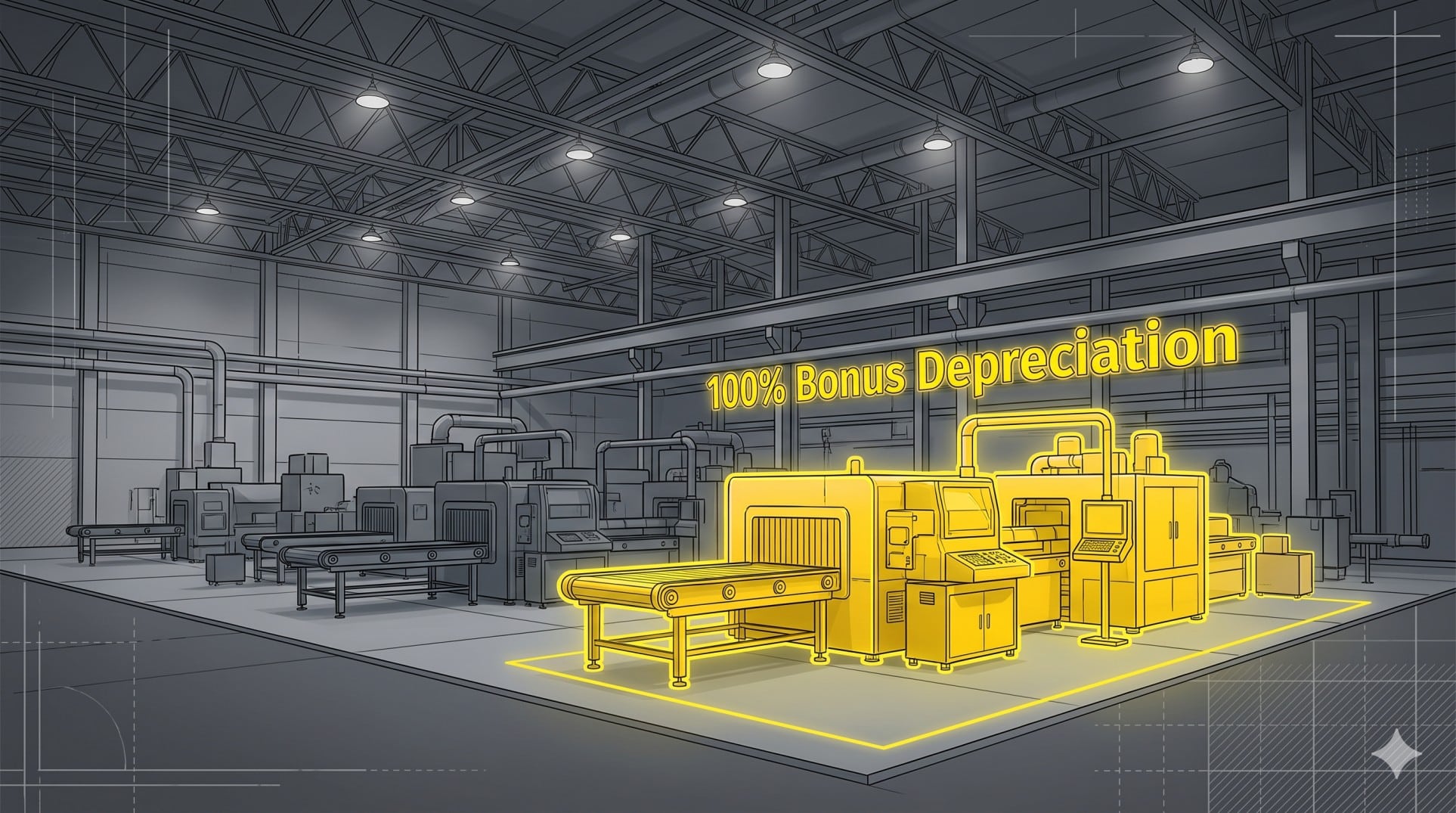
Under the old Tax Cuts and Jobs Act schedule, bonus depreciation was supposed to drop to just 20% in 2026. However, the passage of the One Big Beautiful Bill Act (OBBBA) in 2025 permanently restored bonus depreciation to 100% for property acquired after January 19, 2025. This is a massive win for capital-intensive industries.
This changes everything about how you file. You can now take a 100% first-year write-off without worrying about the taxable income limit. Section 179 cannot create a net operating loss (NOL). If your business makes $50,000 in profit, your deduction is capped at $50,000. Bonus depreciation has no such limit. It can drive your taxable income below zero, creating an NOL that you can carry forward to offset future taxes.
Many tax professionals advise using Section 179 first to hit specific state tax conformity goals, and then applying 100% bonus depreciation to any remaining basis. Because some states do not recognize federal bonus depreciation, balancing the two codes requires careful planning.
Real-World Examples: Calculating Your Tax Savings
Let’s look at how the Section 179 Deduction Limits for 2026 apply to actual business purchases. These hypothetical scenarios demonstrate the math behind the tax code.
Scenario 1: The Heavy SUV Purchase
Dr. Aris buys a 6,500 lb GVWR luxury SUV for $90,000 to travel between her three dental clinics. She uses it 100% for business.
Because it is an SUV between 6,000 and 14,000 lbs, her Section 179 deduction is capped at $32,000.
She has $58,000 in remaining basis. Thanks to the new 2026 rules, she applies 100% bonus depreciation to the remaining $58,000.
Her total first-year deduction is the full $90,000. She uses the primary deduction first, then bonus depreciation to clear the rest of the asset’s value.
See how depreciation recapture works when selling business assets later.
Scenario 2: The Fleet Upgrade
A local plumbing company buys three heavy-duty cargo vans for $65,000 each, totaling $195,000.
These vans have no rear passenger seating and are strictly for hauling tools and cargo. Therefore, they are entirely exempt from the $32,000 SUV cap.
The company uses the standard deduction rules to write off the entire $195,000 against their $400,000 net profit. They do not need to touch bonus depreciation because they are well under the $2.56 million limit and have sufficient taxable income.
Scenario 3: Exceeding the Phase-Out Limit
A manufacturing plant buys $4,500,000 in new assembly line machinery.
The 2026 phase-out threshold is $4,090,000.
They exceeded the limit by $410,000. The IRS reduces their maximum Section 179 limit ($2,560,000) by that $410,000 overage.
Their allowable deduction drops to $2,150,000.
They take the remaining $2,350,000 as 100% bonus depreciation. The entire $4.5 million is still written off in year one, but the mechanics require splitting it between the two different tax codes.
Qualifying Heavy Vehicles and Equipment
What exactly counts as eligible property? The IRS defines it as tangible personal property used actively in your trade or business.
Qualifying items include:
- Heavy Vehicles and Equipment (tractors, trailers, bulldozers, excavators)
- Office furniture, desks, and fixtures
- Computers, servers, and off-the-shelf software
- Manufacturing machinery and printing presses
- Certain improvements to non-residential commercial buildings (HVAC systems, roofing, fire protection alarms)
Land and permanent building structures do not qualify. Inventory that you plan to sell to customers does not qualify. The asset must be something your business uses to generate income, not the income-generating product itself.
Find out how to file Form 4562 correctly to claim these assets.
Frequently Asked Questions About Section 179
What are the Section 179 Deduction Limits for 2026?
The Section 179 Deduction Limits for 2026 allow businesses to deduct up to $2,560,000 in qualifying equipment and software. This limit begins to phase out dollar-for-dollar once total capital purchases exceed $4,090,000 for the tax year.
Can I use Section 179 on a used vehicle?
Yes, used vehicles qualify for the deduction. The IRS only requires that the vehicle or equipment is “new to you.” As long as you did not previously own the asset, you can claim the full allowable deduction based on its purchase price.
How does GVWR affect expensing heavy vehicles?
Gross Vehicle Weight Rating (GVWR) determines your deduction cap. Vehicles under 6,000 lbs are severely limited. Vehicles between 6,000 and 14,000 lbs (like heavy SUVs) are capped at $32,000 for Section 179. True commercial vehicles over 6,000 lbs with no passenger seating are exempt from the cap.
What is the difference between Section 179 and bonus depreciation?
Section 179 is limited by your business’s taxable income and cannot create a net operating loss. Bonus depreciation has no income limit and can be used to drive your taxable income below zero. Both allow for first-year expensing of assets.
Can Section 179 create a net operating loss?
No, it cannot. Your deduction is strictly limited to your net taxable business income for the year. If you want to create a net operating loss, you must utilize bonus depreciation instead.
Do financed Equipment & Vehicles qualify for the deduction?
Yes, financed assets fully qualify. You can finance a piece of machinery, put zero down, place it into service by December 31, and still deduct the entire purchase price on your 2026 tax return.
What happens if my business use drops below 50%?
If your business use of the asset drops below 50% in any year before its standard depreciation recovery period ends, you will face depreciation recapture. The IRS will force you to report the excess deduction you previously claimed as ordinary income.
Are light passenger cars eligible for Section 179?
Technically yes, but the deduction is so severely capped by luxury auto depreciation limits (around $12,200) that Section 179 provides almost no additional benefit over standard MACRS depreciation for light cars.
Does software count as Equipment & Vehicles under Section 179?
Yes, off-the-shelf computer software qualifies. It must be readily available for purchase by the general public, subject to a non-exclusive license, and not substantially modified for your specific business.
What is the phase-out threshold for 2026?
The phase-out threshold is $4,090,000. If you buy more than this amount in qualifying property, your $2.56 million maximum deduction is reduced dollar-for-dollar. It completely phases out once purchases hit $6,650,000.
Disclaimer: This content provides general information for educational purposes only. Tax laws are complex and change often. It is not professional tax, legal, or financial advice. Always consult a qualified tax professional for personalized guidance regarding your specific situation. Ourtaxpartner.com is not responsible for any actions taken based on the information provided herein.
