
⚡ Executive Summary: 2026 Offshore Reporting Rules
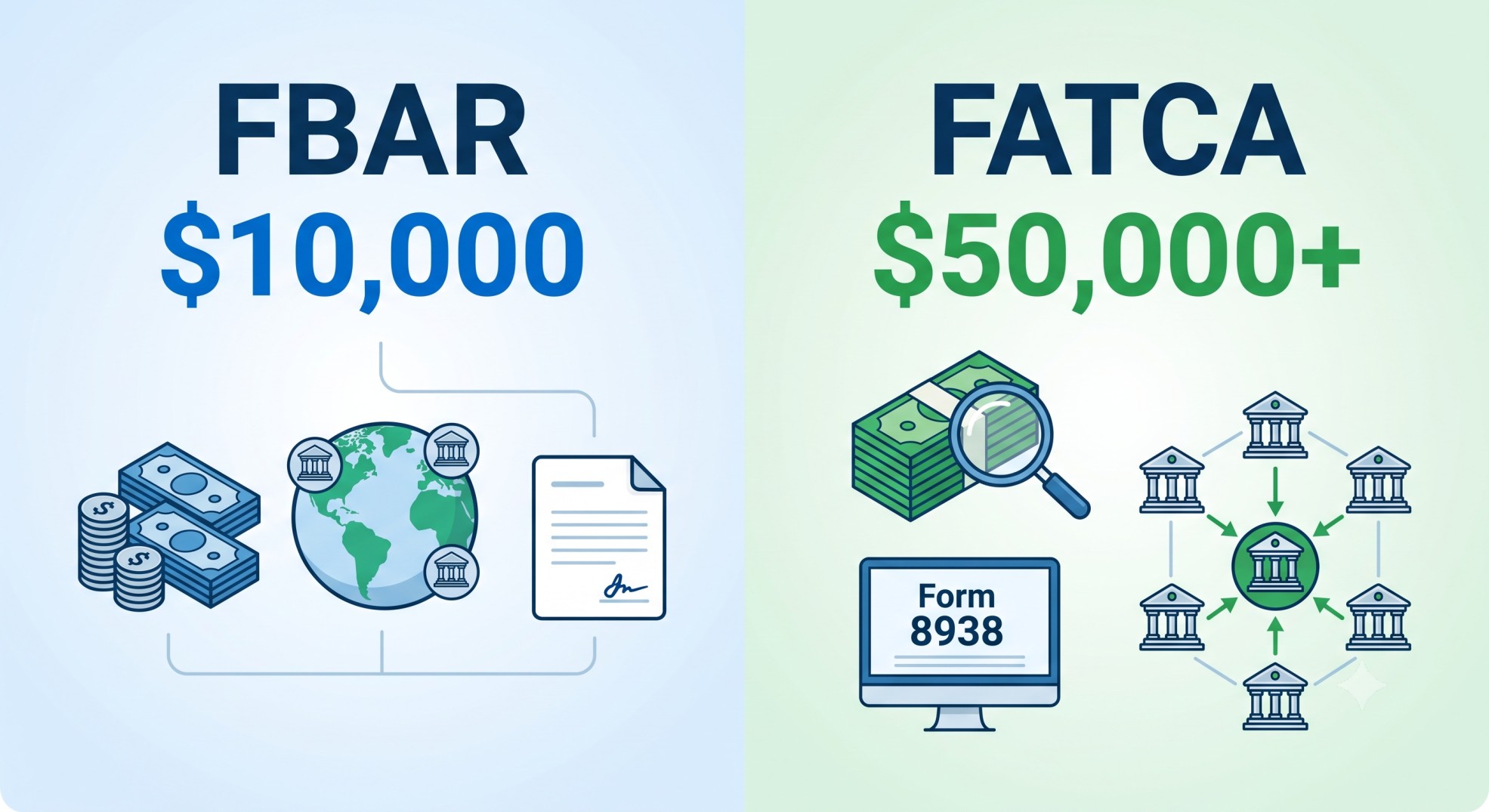
- The primary difference between FBAR and FATCA is the receiving agency: FBAR goes to the Treasury Department via FinCEN Form 114, while FATCA goes to the IRS via Form 8938.
- FinCEN Form 114 triggers when aggregate foreign accounts exceed $10,000 at any time during the calendar year.
- Form 8938 thresholds start at $50,000 for U.S. residents and scale up to $600,000 for married expats living abroad.
- FATCA covers a broader range of foreign financial assets, including directly held stocks and partnership interests, whereas FBAR strictly covers financial accounts.
- Proper FBAR and FATCA reporting is mandatory, and failing to file can result in penalties exceeding $16,500 for non-willful violations in 2026.
Table of Contents
- The Core Difference Between FBAR and FATCA
- What is FBAR (FinCEN Form 114)?
- What is FATCA (Form 8938)?
- The Difference Between FBAR and FATCA Thresholds
- Asset Types: Another Difference Between FBAR and FATCA
- Signature Authority: A Major Difference Between FBAR and FATCA
- Step-by-Step: How to Evaluate Your Filing Requirements
- Real-World Scenarios Highlighting the Difference Between FBAR and FATCA
- The Difference Between FBAR and FATCA Penalties
- Frequently Asked Questions About the Difference Between FBAR and FATCA
Taxpayers with offshore assets often misunderstand the difference between FBAR and FATCA. Holding money outside the United States triggers strict federal disclosure rules. The IRS and the Treasury Department use separate reporting regimes to track international wealth, and confusing the two can lead to disastrous financial consequences.
Knowing the difference between FBAR and FATCA prevents severe IRS penalties. You cannot assume that filing one form automatically satisfies the requirements of the other. They go to different agencies, have different deadlines, and measure entirely different types of wealth.
The Core Difference Between FBAR and FATCA
The most fundamental difference between FBAR and FATCA lies in their purpose. The U.S. government created these two frameworks decades apart to solve two distinct problems: financial crime and tax evasion.
Congress enacted the Bank Secrecy Act in 1970 to stop money laundering, terrorist financing, and the hiding of illicit funds in offshore tax havens. This law created the FBAR requirement. It is a law enforcement tool administered by the Financial Crimes Enforcement Network (FinCEN), a bureau of the Treasury Department.
Decades later, Congress passed the Foreign Account Tax Compliance Act in 2010. This law was designed specifically to catch U.S. taxpayers who were hiding global income to avoid paying federal income taxes. It is strictly a tax enforcement tool administered by the Internal Revenue Service. Because their goals differ, the rules governing FBAR and FATCA reporting operate on completely separate tracks.
What is FBAR (FinCEN Form 114)?
The Bank Secrecy Act requires U.S. persons to report their overseas financial accounts. You satisfy this requirement by filing FinCEN Form 114 electronically through the BSA E-Filing System. It does not go to the IRS, and it is never attached to your Form 1040.
The threshold for this form is notoriously low. If the aggregate maximum value of all your foreign accounts exceeds $10,000 at any point during the calendar year, you must file. This is an aggregate total. If you have three foreign bank accounts that each peak at $4,000 on different days, your aggregate total is $12,000. You must report all three accounts.
Filing deadlines align with tax season, but the mechanism is separate. The initial due date is April 15, but the Treasury grants an automatic extension to October 15. You do not pay taxes on this form; it is strictly an informational disclosure.
What is FATCA (Form 8938)?
To enforce global tax compliance, the IRS requires taxpayers to report specified offshore wealth. You report these details on Form 8938, which attaches directly to your annual federal income tax return.
Unlike the Treasury’s focus on financial crimes, the IRS uses this data to ensure you are paying taxes on global income. The Form 8938 thresholds are significantly higher than the $10,000 Treasury limit. They also vary based on your filing status and physical residence.
This law also forces foreign banks to report your account data directly to the IRS. When your tax return does not match the data provided by your foreign bank, automated IRS systems flag your account for an audit. The transparency created by these international data-sharing agreements makes hiding offshore assets virtually impossible in 2026.
The Difference Between FBAR and FATCA Thresholds
When evaluating the difference between FBAR and FATCA, thresholds dictate your obligations. The Treasury rule is a flat $10,000 aggregate maximum across all accounts. It does not matter if you are single, married, living in Texas, or living in Tokyo. The $10,000 rule applies universally to all U.S. persons.
Form 8938 thresholds, however, operate on a sliding scale. The IRS provides higher limits for taxpayers living abroad (expats) to accommodate their need for local banking. You must check your balances against two different metrics: the balance on the last day of the tax year, and the peak balance at any time during the year.
| Taxpayer Category | Filing Status | Year-End Threshold | Anytime Threshold |
|---|---|---|---|
| Living in the U.S. | Single / MFS | $50,000 | $75,000 |
| Living in the U.S. | Married Filing Jointly | $100,000 | $150,000 |
| Living Abroad (Expat) | Single / MFS | $200,000 | $300,000 |
| Living Abroad (Expat) | Married Filing Jointly | $400,000 | $600,000 |
Expats must meet the physical presence test or bona fide residence test to qualify for the higher limits. If you live in the United States, crossing $50,000 on December 31 triggers the requirement immediately.
Asset Types: Another Difference Between FBAR and FATCA
The difference between FBAR and FATCA reporting requirements extends to the types of assets covered. FinCEN Form 114 strictly targets financial accounts. This includes checking, savings, brokerage, and certain foreign mutual funds or life insurance policies with cash value.
Direct ownership of assets changes the equation. If you hold physical stock certificates of a foreign corporation in a safe, those are not held in an “account.” Therefore, they bypass the Treasury disclosure entirely.

Real estate provides another clear distinction. Foreign real estate is generally exempt from both forms unless it is held through a foreign entity like a corporation or trust. However, the IRS casts a much wider net over other investments. It requires you to report foreign financial assets like directly held stocks, foreign partnership interests, foreign hedge funds, and foreign-issued derivative contracts.
Signature Authority: A Major Difference Between FBAR and FATCA
Signature authority creates a distinct difference between FBAR and FATCA for corporate employees. Many professionals have the power to authorize transactions on their employer’s foreign bank accounts.
Corporate treasurers, CFOs, and overseas managers often hold this authority without owning the actual funds. Under Treasury rules, signature authority alone triggers a filing requirement if the account exceeds $10,000. The government wants to know who controls the money, regardless of who owns it.
This is where the rules diverge sharply. The IRS only requires reporting for assets in which you have a financial interest. If you can sign checks for your company but do not own the money, you do not report that account on Form 8938.
Step-by-Step: How to Evaluate Your Filing Requirements
Navigating these dual requirements requires a systematic approach. Follow these steps to ensure complete FBAR and FATCA reporting compliance for the 2026 tax year.
Step 1: Inventory all global assets. List every foreign bank account, brokerage account, pension, and directly held foreign investment. Include accounts where you only have signature authority. Read more about organizing offshore tax documents here.
Step 2: Calculate your peak aggregate account balance. Convert the highest balance of each account into U.S. dollars using the Treasury’s year-end exchange rate. Add them together. If the total exceeds $10,000, you must file FinCEN Form 114.
Step 3: Determine your IRS threshold. Identify your filing status and residency. Check if your total foreign financial assets exceed either the year-end limit or the anytime-during-the-year limit for your specific category.
Step 4: File the correct forms with the correct agencies. Submit your Treasury disclosure electronically by October 15. Attach Form 8938 to your Form 1040 and submit it to the IRS by your tax filing deadline.
Real-World Scenarios Highlighting the Difference Between FBAR and FATCA
Let’s examine how these rules apply to everyday taxpayers. These hypothetical scenarios demonstrate how the math works in practice.
Scenario 1: The U.S.-Based Tech Worker
David lives in Texas and files as Single. He holds $60,000 in a UK bank account.
His balance exceeds the $10,000 aggregate limit, triggering the Treasury requirement. Because he lives in the U.S., his Form 8938 thresholds are $50,000 at year-end. His $60,000 balance exceeds this limit. David must file both forms.
Scenario 2: The Expat Teacher
Sarah lives in Japan, qualifies as an expat, and files as Single. She has $150,000 in a Japanese bank account.
Her $150,000 balance easily clears the $10,000 Treasury limit. However, her expat Form 8938 thresholds are $200,000 at year-end. Because her balance is only $150,000, she falls below the IRS limit. This scenario perfectly illustrates the difference between FBAR and FATCA for expats. Sarah files the Treasury disclosure but skips Form 8938.
Scenario 3: The Corporate Executive
Marcus lives in New York. He has $5,000 in a personal foreign account. He also has signature authority over his employer’s $2,000,000 foreign corporate account.
He combines both accounts to check his Treasury requirement. The $2,005,000 total requires him to file FinCEN Form 114. For IRS purposes, he only counts assets he owns. His $5,000 personal account falls well below the $50,000 limit. Marcus files the Treasury disclosure only.
Scenario 4: The Direct Investor
Elena lives in Florida. She has $8,000 in a foreign bank account and holds $120,000 in foreign stock certificates directly in a home safe.
The Treasury only cares about accounts. Her $8,000 account is below the $10,000 limit, so she owes no Treasury disclosure. The IRS, however, counts both accounts and directly held foreign financial assets. Her total is $128,000, which exceeds her $50,000 limit. Elena files Form 8938 only.
The Difference Between FBAR and FATCA Penalties
The difference between FBAR and FATCA penalty structures is significant. The IRS and the Treasury enforce their rules independently, meaning you can face penalties from both agencies simultaneously for the exact same undisclosed account.
The IRS coordinates enforcement with FinCEN, and information sharing under bilateral tax treaties has made undisclosed accounts substantially more visible to federal auditors.
Treasury penalties are notoriously severe. For 2026, the inflation-adjusted penalty for a non-willful violation (a simple mistake) is up to $16,536 per violation. If the government proves you willfully hid the account, the penalty skyrockets to $165,353 or 50% of the account balance, whichever is greater.
IRS penalties start with a flat fee. Failing to file Form 8938 results in an automatic $10,000 penalty. If you ignore IRS notices to correct the issue, the penalty can increase up to a maximum of $50,000. The IRS can also impose a 40% accuracy-related penalty on any underpaid tax related to the undisclosed assets.

Frequently Asked Questions About the Difference Between FBAR and FATCA
What is the main difference between FBAR and FATCA?
The primary distinction is the agency that receives the form and the threshold for filing. You send FinCEN Form 114 to the Treasury Department for accounts over $10,000. You send Form 8938 to the IRS when assets exceed much higher limits, starting at $50,000.
Does the difference between FBAR and FATCA mean I have to file both?
Yes, many taxpayers must file both. Filing one does not satisfy the requirements of the other. If your assets exceed the thresholds for both regimes, you must submit separate forms to both the Treasury and the IRS.
Are foreign real estate properties considered foreign financial assets?
Directly owned foreign real estate is generally not considered a reportable asset for either regime. However, if you hold the real estate through a foreign corporation, partnership, or trust, the entity itself becomes a reportable asset.
How do the Form 8938 thresholds apply to married couples living abroad?
Married couples filing jointly who live abroad have the highest limits. They only need to file if their combined assets exceed $400,000 on the last day of the year, or $600,000 at any point during the year.
What happens if I miss the deadline for FinCEN Form 114?
Missing the October 15 extended deadline can trigger civil penalties. For 2026, a non-willful failure to file can result in a penalty of up to $16,536. Taxpayers who realize they missed the deadline should look into the IRS Streamlined Filing Compliance Procedures.
Do I need to report foreign cryptocurrency accounts?
The Treasury has indicated that foreign cryptocurrency exchanges will eventually be subject to reporting, but current rules are complex. However, the IRS strictly requires reporting foreign cryptocurrency holdings on Form 8938 if they exceed your specific threshold.
Can I file FBAR and FATCA reporting forms together?
No. You must file them through completely separate systems. Form 8938 is attached to your federal income tax return (Form 1040). The Treasury disclosure is filed electronically through the BSA E-Filing System.
What is the penalty for failing to file Form 8938?
The IRS imposes an automatic $10,000 penalty for failing to file. If the IRS notifies you of the failure and you continue to ignore it, the penalty can increase by $10,000 for every 30 days of non-compliance, up to a maximum of $50,000.
Does signature authority trigger both filing requirements?
No. Having signature authority over an account without a financial interest (like a corporate account) only triggers the Treasury requirement. The IRS only requires you to report assets in which you have a direct financial interest.
Are foreign pension plans subject to these rules?
Yes. Foreign pension plans and retirement accounts generally qualify as reportable accounts for both regimes. You must include their peak values when calculating your $10,000 aggregate limit and your specific IRS thresholds.
Disclaimer: This content provides general information for educational purposes only. Tax laws are complex and change often. It is not professional tax, legal, or financial advice. Always consult a qualified tax professional for personalized guidance regarding your specific situation. Ourtaxpartner.com is not responsible for any actions taken based on the information provided herein.
