
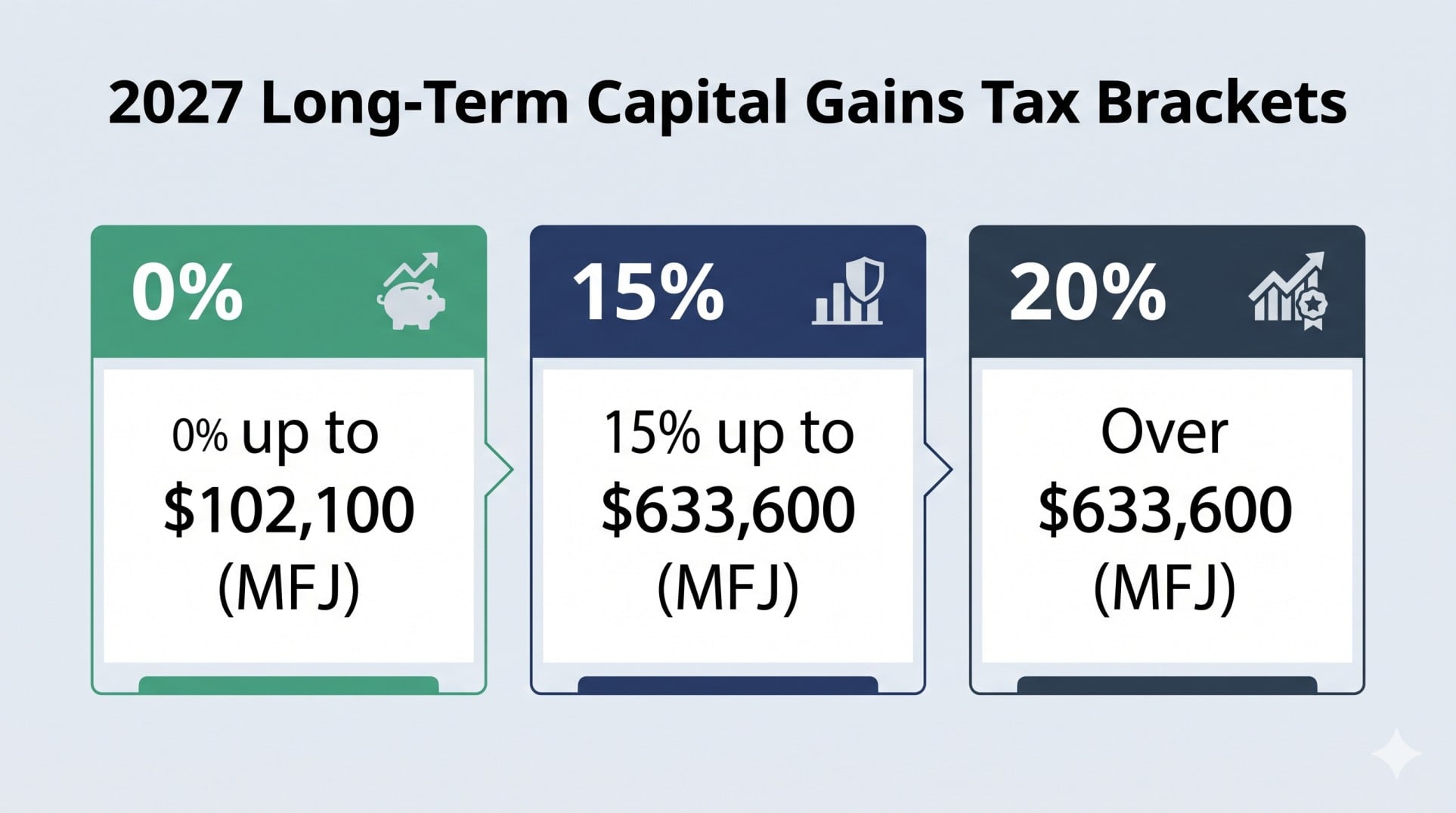
According to IRS Revenue Procedure 2026-35, the official 2027 capital gains tax brackets allow Single filers to pay a 0% tax rate on long-term gains up to $51,050 of taxable income, while Married Filing Jointly couples pay 0% up to $102,100. The top 20% rate begins when taxable income exceeds $563,200 for Single filers and $633,600 for joint filers.
These inflation-adjusted limits apply to assets held for more than one year and sold during Tax Year 2027, which you’ll report on the tax return you file in early 2028. Because capital gains thresholds apply to your taxable income—after subtracting the 2027 standard deduction of $16,600 for Single filers or $33,200 for joint filers—you can shield even more gross profit from the IRS.
⚡ Quick Numbers: 2027 Long-Term Capital Gains Tax Brackets at a Glance
- 0% Capital Gains Rate Limit (2027): Up to $51,050 for Single and Married Filing Separately, $68,350 for Head of Household, and $102,100 for Married Filing Jointly.
- 15% Capital Gains Rate Limit (2027): Taxable income up to $563,200 (Single), $598,400 (Head of Household), $633,600 (Married Filing Jointly), and $316,800 (Married Filing Separately).
- 20% Capital Gains Rate Threshold + NIIT: Applies to long-term gains above the 15% ceiling; high earners also face an unindexed 3.8% Net Investment Income Tax above $200,000 (Single) or $250,000 (MFJ) in MAGI.
- Key IRS Forms & Filing Deadline: Report sales on Form 8949, Schedule D, and Form 1040 (Line 7) by April 17, 2028.
Table of Contents
Exact 2027 Capital Gains Tax Brackets and Income Limits
Under IRC Section 1(h) and Section 1(j)(5), the 2027 capital gains tax brackets divide long-term investment profits into three federal tax rates—0%, 15%, and 20%—based on your filing status and total taxable income.
| Filing Status | 0% Tax Rate (Taxable Income) | 15% Tax Rate (Taxable Income) | 20% Tax Rate (Taxable Income) |
|---|---|---|---|
| Single | $0 to $51,050 | $51,051 to $563,200 | Over $563,200 |
| Married Filing Jointly & Surviving Spouses | $0 to $102,100 | $102,101 to $633,600 | Over $633,600 |
| Head of Household | $0 to $68,350 | $68,351 to $598,400 | Over $598,400 |
| Married Filing Separately | $0 to $51,050 | $51,051 to $316,800 | Over $316,800 |
| Estates and Trusts | $0 to $3,400 | $3,401 to $16,750 | Over $16,750 |
These thresholds come directly from Section 3.03 of IRS Revenue Procedure 2026-35. They govern qualified dividends and net long-term capital gains from selling stocks, bonds, mutual funds, real estate, or cryptocurrency held for more than 12 months.
Notice that the table measures taxable income, not gross income. Your taxable income equals your Adjusted Gross Income (AGI)—which includes wages, retirement distributions, interest, and capital gains—minus either your standard deduction or your 2027 itemized deductions on Schedule A.
Short-term capital gains from assets held for one year or less do not qualify for these preferential rates. Instead, the IRS taxes short-term profits at your ordinary federal income tax rates, which range from 10% to 37% in 2027.
Tax Planning Tip: Under the One, Big, Beautiful Bill Act (Public Law 119-21) and IRS Revenue Procedure 2026-35 Section 3.42, founders and early investors selling Qualified Small Business Stock (QSBS) under IRC Section 1202 see their per-issuer gain exclusion cap rise from $15,000,000 to $15,480,000 in 2027, while the aggregate gross asset limit increases from $75,000,000 to $77,390,000.
2026 vs. 2027 Capital Gains Tax Brackets Comparison: What Changed?
For Tax Year 2027, the IRS raised the 2027 long-term capital gains tax brackets by roughly 3.2% across all filing statuses compared to 2026, adding up to $3,200 to the 0% bracket and $19,900 to the 15% ceiling for joint filers.
| Filing Status & Rate Tier | 2026 Limit (Rev. Proc. 2025-32) | 2027 Limit (Rev. Proc. 2026-35) | Dollar Increase ($ Change) |
|---|---|---|---|
| Single — 0% Maximum Limit | $49,450 | $51,050 | +$1,600 |
| Single — 15% Maximum Limit | $545,500 | $563,200 | +$17,700 |
| Married Filing Jointly — 0% Maximum Limit | $98,900 | $102,100 | +$3,200 |
| Married Filing Jointly — 15% Maximum Limit | $613,700 | $633,600 | +$19,900 |
| Head of Household — 0% Maximum Limit | $66,200 | $68,350 | +$2,150 |
| Head of Household — 15% Maximum Limit | $579,600 | $598,400 | +$18,800 |
| Married Filing Separately — 0% Maximum Limit | $49,450 | $51,050 | +$1,600 |
| Married Filing Separately — 15% Maximum Limit | $306,850 | $316,800 | +$9,950 |
| Estates & Trusts — 0% Maximum Limit | $3,300 | $3,400 | +$100 |
| Estates & Trusts — 15% Maximum Limit | $16,250 | $16,750 | +$500 |
When you pair these higher capital gains thresholds with the increased 2027 standard deduction amounts from Section 3.15 of Revenue Procedure 2026-35, your total tax-free investment shield grows even larger.
For 2027, the standard deduction rises to $16,600 for Single and Married Filing Separately taxpayers, $24,925 for Head of Household filers, and $33,200 for Married Filing Jointly couples. Taxpayers age 65 or older (or blind) can claim an additional standard deduction of $1,700 per qualifying spouse on a joint return, or $2,100 if unmarried.
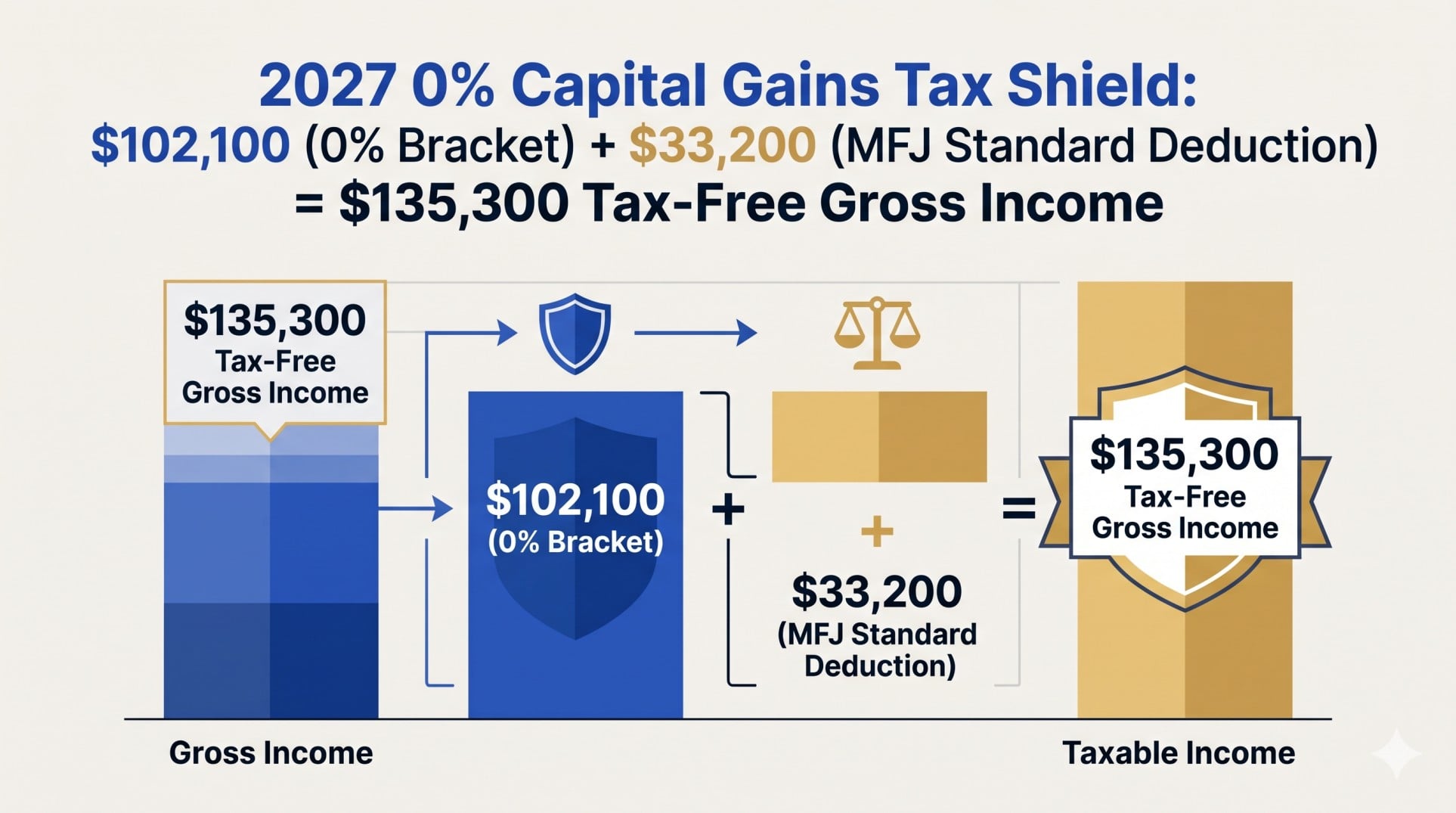
A Married Filing Jointly couple under age 65 who takes the $33,200 standard deduction can earn up to $135,300 in total gross income ($33,200 deduction plus $102,100 ceiling) before paying a single dime of federal long-term capital gains tax. If both spouses are 65 or older, two additional $1,700 senior deductions push that 0% capital gains 2027 gross income threshold to $138,700.
Single filers under 65 enjoy a combined gross income shield of $67,650 ($16,600 standard deduction plus the $51,050 maximum zero rate amount). An unmarried senior age 65 or older can add the $2,100 aged deduction to realize up to $69,750 in gross income at the 0% capital gains rate.
How the 2027 Long-Term Capital Gains Tax Works & Who Qualifies
To qualify for the 0% capital gains 2027 rate or the 15% capital gains bracket 2027, you must hold a capital asset for at least one year and one day before selling it, and your taxable income must fall within the IRS limits.
| Capital Gain Category or Surtax | Holding Period / Income Trigger | 2027 Maximum Federal Tax Rate |
|---|---|---|
| Short-Term Capital Gains | Held 1 year (365 days) or less | 10% to 37% (Ordinary 2027 federal income tax brackets) |
| Standard Long-Term Capital Gains & Qualified Dividends | Held more than 1 year (366+ days) | 0%, 15%, or 20% (Based on taxable income) |
| Unrecaptured Section 1250 Real Estate Gain | Depreciated real property held more than 1 year | Up to 25% |
| Collectibles & Precious Metals (Coins, Art, Gold ETFs) | Held more than 1 year | Up to 28% |
| Net Investment Income Tax (NIIT — IRC Sec. 1411) | MAGI over $200,000 (Single/HOH), $250,000 (MFJ), or $125,000 (MFS) | +3.8% surtax (Creates 18.8% or 23.8% effective top rate) |
| Net Capital Loss Deduction Limit (IRC Sec. 1211) | Capital losses exceeding total capital gains | Up to $3,000 above-the-line offset ($1,500 MFS); unlimited carryforward |
Your holding period clock starts on the day after you purchase the asset and ends on the day you sell it. If you buy shares of an index fund on May 10, 2026, your holding period begins May 11, 2026, meaning you must sell on or after May 11, 2027, to qualify for the 2027 long-term capital gains tax brackets.
How does the IRS stack your income? Ordinary income—such as W-2 wages, self-employment profit, traditional IRA withdrawals, and bank interest—Always fills up the bottom of your tax brackets first. Long-term capital gains and qualified dividends sit on top of your ordinary taxable income.
If your long-term capital gain crosses over a bracket boundary, the entire gain is not taxed at the higher rate. Only the dollars exceeding the threshold move into the 15% capital gains bracket 2027 or the 20% capital gains tax rate 2027.
Let’s look at two clear real-world math examples for Tax Year 2027:
Example 1: Tax-Gain Harvesting in the 0% and 15% Brackets (Married Filing Jointly)
Mark and Sarah are both 58 years old and file a joint return in 2027. They earn $105,000 in W-2 wages and sell long-term stock for a $50,000 profit, bringing their Adjusted Gross Income to $155,000. Subtracting their $33,200 standard deduction leaves $121,800 in total taxable income (consisting of $71,800 in ordinary taxable income and $50,000 in long-term capital gains). Because the 0% capital gains 2027 ceiling for joint filers is $102,100, Mark and Sarah have $30,300 of room left in the 0% bracket ($102,100 minus $71,800). The first $30,300 of their stock profit is taxed at 0% ($0 tax), and the remaining $19,700 is taxed at 15% ($2,955 tax), resulting in a total capital gains tax of just $2,955.
Example 2: High Earner Crossing the 20% Bracket + 3.8% NIIT (Single Filer)
Elena is a Single filer age 42 with $536,600 in W-2 salary and a $100,000 long-term capital gain from selling tech stock in 2027, giving her a Modified Adjusted Gross Income (MAGI) of $636,600. After subtracting her $16,600 standard deduction, her total taxable income is $620,000 ($520,000 in ordinary taxable income plus $100,000 in capital gains). Since her ordinary taxable income starts at $520,000 and the 15% capital gains bracket 2027 ceiling for Single filers is $563,200, the first $43,200 of her gain is taxed at 15% ($6,480), while the remaining $56,800 above the threshold hits the 20% capital gains tax rate 2027 ($11,360). Because her MAGI exceeds the $200,000 Single threshold for the Net Investment Income Tax, her entire $100,000 gain also incurs the 3.8% NIIT ($3,800), bringing her total federal tax on the stock sale to $21,640.
What if your investments lost money in 2027? Capital losses first offset capital gains of the same type—short-term losses cancel out short-term gains, and long-term losses cancel out long-term gains—before netting against each other. If you still have a net capital loss left over, you can claim an “above-the-line” adjustment on Form 1040 to deduct up to $3,000 ($1,500 if Married Filing Separately) directly against your ordinary W-2 or business income, and carry forward any remaining loss indefinitely to future tax years.
Keep in mind that these 2027 capital gains tax brackets apply strictly to federal IRS returns. While nine states—such as Florida, Texas, and Nevada—levy no state income tax on capital gains, high-tax states like California and New York tax long-term capital gains as ordinary income at state rates exceeding 10%, and Washington state imposes a separate excise tax on high-dollar capital gains.
How to Report Capital Gains on Your 2027 Tax Return
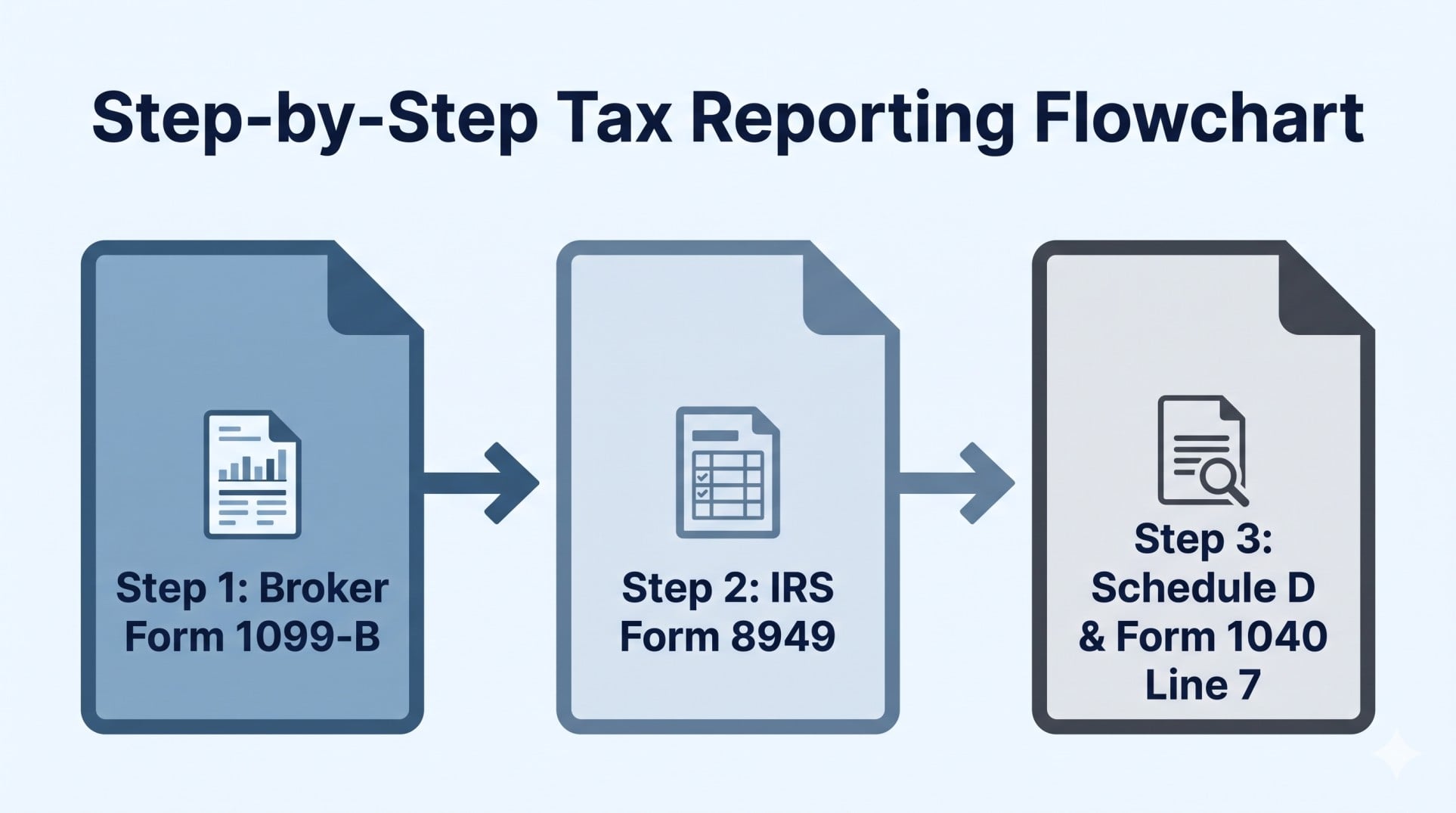
To report your 2027 investment sales to the IRS, you must reconcile your brokerage statements on Form 8949, summarize your net profit or loss on Schedule D, and transfer the final figure to Form 1040, Line 7.
- Gather Your Brokerage Tax Statements (By Mid-February 2028): Collect Form 1099-B (Proceeds From Broker and Barter Exchange Transactions) for stock, fund, or crypto sales, Form 1099-DIV (Box 1b for qualified dividends and Box 2a for capital gain distributions), and Form 1099-S if you sold real estate during 2027.
- Categorize Transactions on IRS Form 8949: List each individual asset sale, acquisition date, sale date, proceeds, and cost basis on IRS Form 8949 (Sales and Other Dispositions of Capital Assets). Report short-term trades held one year or less in Part I and long-term trades held more than one year in Part II, checking Box A, B, or C (or D, E, or F) depending on whether your broker reported your cost basis to the IRS.
- Summarize Net Gains or Losses on Schedule D: Transfer the subtotals from Form 8949 onto Schedule D (Form 1040), putting short-term totals in Part I (Lines 1a through 7) and long-term totals in Part II (Lines 8a through 15). Combine your short-term and long-term results in Part III (Line 16) to determine your overall net capital gain or loss.
- Calculate Your Preferential Rate Using the Qualified Dividends and Capital Gain Tax Worksheet: Do not look up your net long-term gain on the standard ordinary tax table. Complete the Qualified Dividends and Capital Gain Tax Worksheet in the Form 1040 instructions (or the Schedule D Tax Worksheet if you have 25% unrecaptured Section 1250 real estate depreciation or 28% collectibles gains) to apply the exact 0%, 15%, and 20% capital gains tax rate 2027 limits.
- File Form 8960 (If Subject to the 3.8% NIIT) and Transfer to Form 1040: Enter your net capital gain (or up to a $3,000 net capital loss deduction) on Form 1040, Line 7. If your MAGI exceeds $200,000 (Single) or $250,000 (Married Filing Jointly), attach Form 8960 to calculate the 3.8% Net Investment Income Tax and report it on Schedule 2 (Form 1040).
Your 2027 federal income tax return is due on Monday, April 17, 2028 (since April 15, 2028, falls on a Saturday). If you sell a large position during 2027 that is not covered by W-2 withholding, consider making quarterly estimated tax payments using Form 1040-ES to avoid underpayment penalties.
Frequently Asked Questions
1. What are the 0% capital gains 2027 income limits?
In 2027, you pay a 0% tax rate on long-term capital gains if your total taxable income is up to $51,050 for Single and Married Filing Separately filers, $68,350 for Head of Household, or $102,100 for Married Filing Jointly. According to IRS Revenue Procedure 2026-35, these limits apply after subtracting your standard or itemized deductions on Form 1040.
2. When does the 20% capital gains tax rate 2027 start?
The 20% capital gains tax rate 2027 applies once your total taxable income exceeds the top of the 15% bracket: $563,200 for Single filers, $598,400 for Head of Household, $633,600 for Married Filing Jointly, and $316,800 for Married Filing Separately. Only the capital gain dollars above those exact thresholds are taxed at 20%.
3. Do capital gains push me into a higher ordinary income tax bracket in 2027?
No, long-term capital gains never push your W-2 wages or retirement income into a higher ordinary tax bracket. Under IRS stacking rules on the Qualified Dividends and Capital Gain Tax Worksheet, ordinary income is always taxed first at the lowest brackets, and long-term capital gains sit on top of your ordinary income.
4. How much can I earn if I sell my primary home in 2027?
Under IRC Section 121, you can exclude up to $250,000 of capital gains from the sale of your main home if you file as Single, or up to $500,000 if you are Married Filing Jointly. To qualify, you must have owned and lived in the property as your primary residence for at least two of the five years before the sale; any profit above those limits is taxed using the 2027 long-term capital gains tax brackets on Schedule D.
5. Are qualified dividends taxed at the same rate as the 2027 capital gains tax brackets?
Yes, qualified dividends reported in Box 1b of Form 1099-DIV are taxed at the exact same 0%, 15%, and 20% thresholds as the 2027 capital gains tax brackets. Non-qualified (ordinary) dividends do not receive preferential treatment and are taxed at your standard 10% to 37% ordinary income tax rate.
Disclaimer: This content provides general information for educational purposes only and reflects federal tax laws applicable to Tax Year 2027 (returns filed in 2028). Tax laws are complex and subject to change. This article does not constitute professional tax, legal, or accounting advice. Always consult a certified public accountant (CPA), enrolled agent (EA), or qualified tax attorney regarding your specific financial situation. Ourtaxpartner.com is not responsible for any actions taken based on the information provided herein.
